Form 10-K for the year ended December 31, 2020
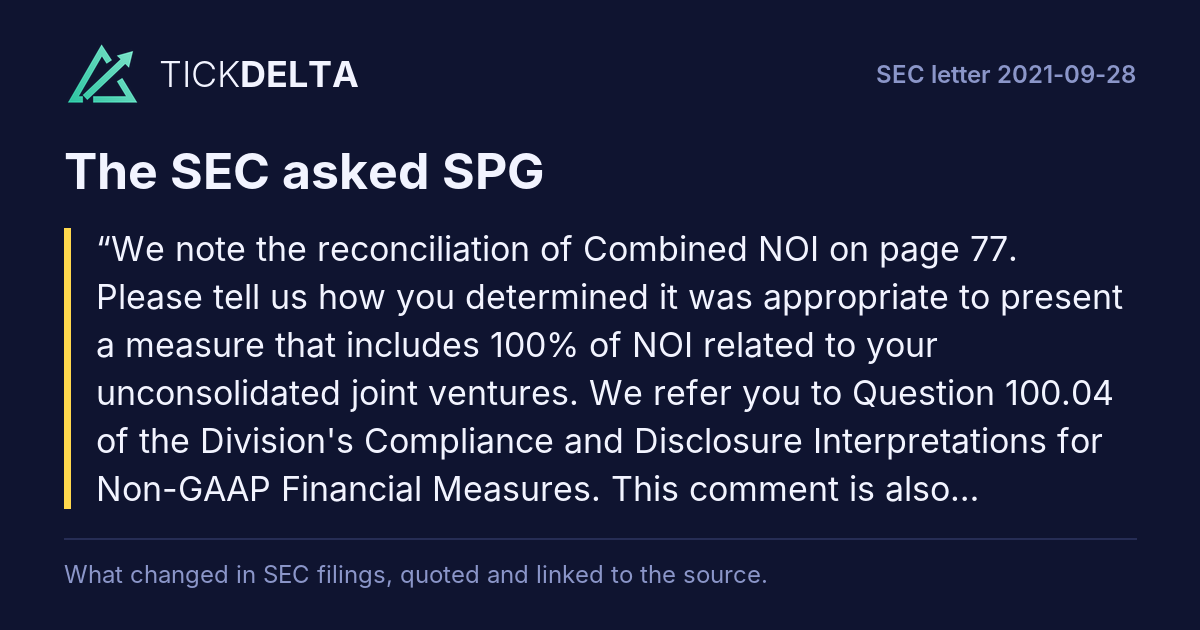
We note the reconciliation of Combined NOI on page 77. Please tell us how you determined it was appropriate to present a measure that includes 100% of NOI related to your unconsolidated joint ventures. We refer you to Question 100.04 of the Division's Compliance and Disclosure Interpretations for Non-GAAP Financial Measures.Rest of the question
This comment is also applicable to page 18 of the quarterly financial supplement filed February 8, 2021 on Form 8-K. 6. Investments in Unconsolidated Entities and International Investments
The Company acknowledges the Staff’s comment and has reviewed Question 100.04 of the Division’s Compliance and Disclosure
Interpretations for Non-GAAP Financial Measures. In future filings, the Company will revise its disclosure of NOI to exclude the combination of 100% of NOI related to its unconsolidated joint ventures with its consolidated properties. Read in the reply ↗
First report after the company's reply of 2021-10-12: 10-Q filed 2021-11-03 ↗, against the 10-Q filed 2021-08-04 ↗.
Tickdelta does not hold the text of both reports, so they are not compared here.
We note that on December 29, 2020 you completed the acquisition of an 80% noncontrolling ownership interest in TRG and that you are accounting for such acquisition using the equity method of accounting. In order to better understand the Company's accounting for this transaction please further tell us the following: • How the Company considered the variable interest guidance in ASC 810-10-15-14 and whether theRest of the question
acquisition resulted in an acquired VIE; and • If the acquisition did not result in the acquisition of a VIE, how the Company considered the guidance under ASC 810-10-15-8, ASC 810-10-15-8A and ASC 81010-15-10a such that it resulted in the Company owning 80% of the TRG group but not consolidating the TRG group
The Company respectfully advises the Staff that it evaluated the acquisition of an 80% noncontrolling ownership interest in Taubman Realty
Group, LLC (“TRG”), which it completed on December 29, 2020, under the referenced guidance in ASC 810, Consolidation
(“ASC 810”) (both the variable interest model (“VIE”) and the voting interest (“VOE”) model) and
ASC 323, Equity Method and Joint Ventures (“ASC 323”) and determined the equity method of accounting was appropriate for our investment.
The analysis below presents a summary of the relevant facts including the governance structure of TRG andRead in the reply ↗Rest of the answer
our evaluation of the VIE and VOE models.
1. Background and Summary of Conclusions
TRG is governed by a Board of Directors (the “Board”) comprised of six members: three nominated by SPG and three nominated by the Taubman Family Group (“Titanium”), which holds the remaining 20% interest in TRG. In accordance with the terms of the Joint Venture Operating Agreement of The Taubman Realty Group LLC (the “Operating Agreement”), each Board member is entitled to one vote and major decisions of the Board require unanimous approval.
The Company evaluated the criteria in ASC 810 to determine whether the investee, TRG, is a VIE and concluded that TRG is not a VIE; the Company then evaluated TRG under the VOE model and concluded that the Company does not consolidate TRG.
In connection with its analyses, the Company identified and evaluated the activities that most significantly impact the economic performance of TRG, each of which constitutes a major decision requiring unanimous approval of all Board members under the Operating Agreement. These activities that most significantly impact the economic performance of TRG are as follows:
· approval of the annual budget;
· approval of capital expenditures that exceed corresponding amounts set forth in the annual budget by $10 million or more;
· sale, acquisition and purchase of any assets, land or property that exceed $10 million in aggregate;
· entering into any financing activities that exceed $10 million in aggregate; and
· entering into any material lease contract (as defined in the Operating Agreement).
As the activities that most significantly impact the economic performance of TRG require unanimous approval of all Board members, the Company concluded that power is shared by SPG and Titanium and that SPG does not control, and therefore does not consolidate, TRG.
2. Variable Interest Entity Model Considerations
The Company determined that TRG is within the scope of the
VIE model set forth in ASC 810 and that the Company’s equity investment therein represents a variable interest. The Company then analyzed the accounting for its investment considering the variable interest guidance in ASC 810-10-15-14 and, specifically, whether TRG represents a VIE.
Under this guidance, an entity is a VIE if:
a) The total equity investment at risk is not sufficient to permit the legal entity to finance its activities without additional subordinated financial support provided by any parties, including equity holders. (Remaining criteria in 14a excluded for brevity.)
The
Company’s $3.1 billion contribution in exchange for 80% equity interest in TRG is considered equity at risk as the 80% equity interest participates in both profits and losses of TRG. TRG has approximately $4.0 billion of equity at risk in total (including that of Titanium).
As of the assessment date, TRG was generating positive cash flow and had been profitable for the past several years. In addition,
TRG is financed with third-party debt and Series A Preferred Units that are consistent with the capital structures of similar entities and which provide no additional governance rights. These instruments carry market terms and TRG does not require additional subordinated financial support from its equity holders or a third party. Accordingly, the Company concluded that TRG is well capitalized and its current equity at risk of $4.0 billion is sufficient to finance its activities; therefore, TRG is not a VIE under this criterion.
b) As a group the holders of the equity investment at risk lack any one of the following three characteristics of a controlling financial interest:
1. The power, through voting rights or similar rights, to direct the activities of a legal entity that most significantly impact the entity’s economic performance.
2. The obligation to absorb the expected losses of the legal entity.
First report after the company's reply of 2021-10-12: 10-Q filed 2021-11-03 ↗, against the 10-Q filed 2021-08-04 ↗.
Tickdelta does not hold the text of both reports, so they are not compared here.
Also in this review: closing letter, 2021-10-25