tickdelta
Sign in

Tickdelta is free for now. Sign up and get Pro free

← Screener

Utilities · Gas Utilities · NYSE

SRESempra

Compare with peers → Embed
The 10-K against last year's

480 changes: 117 added, 100 removed, 252 reworded, 11 quiet changes

10-K Feb 26, 2026 vs Feb 25, 2025
Risk FactorsRedline ↓
33.9%
of the text changed · 21,574 words now
38.9%
of the text changed · 20,591 words now
Legal ProceedingsRedline ↓
36.8%
of the text changed · 6,874 words now
Accounting PoliciesRedline ↓
15.1%
of the text changed · 11,648 words now

10-K 0001032208-26-000010 (2026-02-26) vs 10-K 0001032208-25-000012 (2025-02-25)

The redline

The paragraph that changed most in each section

Marked against last year's 10-K: cut words struck through, new words highlighted and underlined.

Risk Factors 335 words changed in this paragraph; it is 64% similar to last year's version.
The energy transition in California and elsewhere, including decarbonization goals, goals and increasingly divergent investor sentiment regarding climate change efforts, has introduced led to contradictory expectations from various investors and other stakeholders and uncertainty in long-term investor support, leading including some to reduce investment investors reducing participation in or divest divesting from our sector. Maintaining investor confidence and attracting capital at a competitive cost will depend, in part, on demonstrating our ability to address material business risks related to climate and our efforts to help achieve the goals of our consumers and the markets and jurisdictions where we operate. In an effort to maintain a sustainable and durable business risk profile and continue to focus on value creation, Sempra has evaluated and updated its climate aspirations to reflect the changing policy, regulatory, commercial and technological landscape, including stakeholders’ evolving focus on reliability, resiliency and affordability and the pace and impact of climate and other public policies. Following this evaluation, Sempra now aims to have net-zero scope 1 and 2 GHG emissions by 2050, with 2050 and has an interim target aim of 50% scope 1 and 2 GHG emissions reductions by 2035 (this interim target is relative to a 2019 baseline, applies to Sempra California California’s operations and Sempra Infrastructure’s Mexico (non-LNG) operations operations, and may be subject to further revision if Sempra’s planned sale of a portion of its equity interest in SI Partners is relative to a 2019 baseline). While the company no longer has a specific goal to achieve net-zero scope 3 GHG emissions by 2050, the capabilities we are developing through our energy transition action plan could also support the reduction of scope 3 GHG emissions and help meet regulatory, consumer and market demand for lower- and zero-carbon energy. completed). Sempra’s, SDG&E’s and SoCalGas’ abilities to advance their respective net-zero and other climate objectives and meet the demand for lower-carbon and reliable energy in California and elsewhere will depend on many factors, some of which we do not control, including supportive federal and state energy laws, policies, incentives, tax credits and regulatory decisions; cost and affordability considerations; development, commercialization and regulatory acceptance of affordable, alternative and lower-carbon energy sources, including cleaner fuels; successful research and development efforts focused on lower carbon technologies that are economically and technically feasible; cooperation from our partners, financing sources and commercial counterparties; customer participation in conservation and energy efficiency programs; our ability to execute our planned investments in our infrastructure; and consumers’ decisions and preferences. In addition, we will need to continue to expend capital and employee resources to develop and deploy new technologies and modernize grid systems, which may not be recoverable in rates or, with respect to our businesses that are not regulated utilities, may not be able to be passed through to customers. Even if such costs are recoverable, these costs, coupled with necessary safety and reliability investments, may negatively impact the affordability of SDG&E’s and SoCalGas’ services and, for our businesses that are not regulated utilities, may cause costs to increase to levels that reduce customer demand and growth. Moreover, forecasting to 2035, 2045 and 2050 specified targets over longer-term periods is inherently speculative without knowing uncertain and could be significantly impacted by the trajectory of the energy transition. As a result, although we are dedicated to making progress on our climate aims and are continuing to develop capabilities designed to reduce GHG emissions from our own operations as well as to support consumers’ and markets’ own climate goals, goals and applicable legislative and regulatory mandates, we may not be successful in achieving these objectives. We could suffer difficulties attracting investors and business partners, reputational harm and other negative effects if we do not meet or if we further modify our GHG emissions reduction aims or there are negative views about our environmental disclosures or practices generally.

Source: Item 1A, 10-K 0001032208-26-000010 vs Item 1A, 10-K 0001032208-25-000012

MD&A 218 words changed in this paragraph; it is 44% similar to last year's version.
SDG&E is exposed to the risk that the participating California electric IOUs may incur third-party wildfire costs for which they will seek recovery from the Wildfire Fund with respect to wildfires that have occurred since enactment of the 2019 Wildfire Legislation in July 2019. In such a situation, SDG&E may recognize a reduction of its Wildfire Fund asset and record accelerated amortization against earnings when available coverage is reduced due to recoverable claims from any of the participating IOUs. PG&E is seeking reimbursement from the Wildfire Fund for losses associated with the Dixie Fire, which burned from July 2021 through October 2021. In the case of the recent LA fires, the causes of these fires have not been determined and therefore these fires may not impact the Wildfire Fund. If any California electric IOUs’ assets are determined to be a cause of fires, including fires of the size and scope of the recent LA Fires, payments of claims associated with those events could have a material adverse effect on the Wildfire Fund and on SDG&E’s and Sempra’s financial condition and results of operations up to the The carrying value of our SDG&E’s Wildfire Fund asset, with additional potential material exposure if SDG&E’s equipment is determined to be a cause of a fire. In addition, the Wildfire Fund could be completely exhausted due to fires in the other California electric IOUs’ service territories, by fires in SDG&E’s service territory or by a combination thereof. In the event that the Wildfire Fund is materially diminished, exhausted or terminated, SDG&E will lose the protection afforded by the Wildfire Fund, and as a consequence, a fire in SDG&E’s service territory could have a material adverse effect on SDG&E’s and Sempra’s results of operations, financial condition, cash flows and/or prospects. asset totaled $260 million at December 31, 2025.

Source: Item 7, 10-K 0001032208-26-000010 vs Item 7, 10-K 0001032208-25-000012

Legal Proceedings 161 words changed in this paragraph; it is 39% similar to last year's version.
Amendments to Mexico’s Electricity Industry Law. Law - Resolved. In March 2021, the Mexican government published a decree with amendments to Mexico’s Electricity Industry Law the LIE that include some included public policy changes, including establishing priority of dispatch for CFE plants over privately owned plants. The decree further purports to permit ones and allowing the CRE CNE to revoke self-supply permits granted under the former electricity law, which were grandfathered when law under certain circumstances. In 2024, the new Electricity Industry Law was enacted, if it considers them to have been obtained improperly. According Mexican government adopted changes to the decree, Mexican Constitution to reinforce state control over strategic sectors by granting a central role to government entities like the CFE and PEMEX. Following these amendments were to become effective constitutional reforms, in March 2021, and SENER, 2025, the CRE and Centro Nacional de Control de Energía (Mexico’s National Center for Mexican government adopted the 2025 Energy Control) were to have 180 calendar days to modify, as necessary, all resolutions, policies, criteria, manuals and other regulations applicable to Laws, which repealed the power industry to conform with this decree. Numerous legal actions were taken against the decree, which resulted in Mexican courts issuing a suspension of the decree later in March 2021. LIE.

Source: Item 3, via Note 16 – COMMITMENTS, CONTINGENCIES AND GUARANTEES, 10-K 0001032208-26-000010 vs Item 3, via Note 15 – COMMITMENTS AND CONTINGENCIES, 10-K 0001032208-25-000012

Accounting Policies 155 words changed in this paragraph; it is 52% similar to last year's version.
ECA LNG Phase 1 is a VIE because its total equity at risk is not sufficient to finance its activities without additional subordinated financial support. We expect that ECA LNG Phase 1 will require future capital contributions or other financial support to finance the construction of the facility. Sempra is the primary beneficiary of this VIE because we have the power to direct the activities related to the construction and future operation and maintenance of the liquefaction facility. As a result, we consolidate ECA LNG Phase 1. Sempra consolidated $ 1,758 15,950 million and $ 1,580 8,177 million of assets at December 31, 2024 2025 and 2023, December 31, 2024, respectively, consisting primarily of PP&E, net, and restricted cash attributable to ECA LNG Phase 1 these VIEs that could be used only to settle obligations of this VIE these VIEs and that are not available to settle obligations of Sempra, and $ 1,080 6,335 million and $ 1,029 2,664 million of liabilities at December 31, 2024 2025 and 2023, 2024, respectively, consisting primarily of long-term debt and accounts payable attributable to ECA LNG Phase 1 these VIEs for which creditors do not have recourse to the general credit of Sempra. Additionally, At December 31, 2025, these assets and liabilities are classified as we discuss in held for sale (see Note 6, IEnova and TotalEnergies SE have provided guarantees for 83.4 % and 16.6 %, respectively, of the loan facility supporting construction of the liquefaction facility. 6).

Source: 10-K text, Note 1 – SIGNIFICANT ACCOUNTING POLICIES AND OTHER FINANCIAL DATA, 10-K 0001032208-26-000010 vs 10-K text, Note 1 – SIGNIFICANT ACCOUNTING POLICIES AND OTHER FINANCIAL DATA, 10-K 0001032208-25-000012
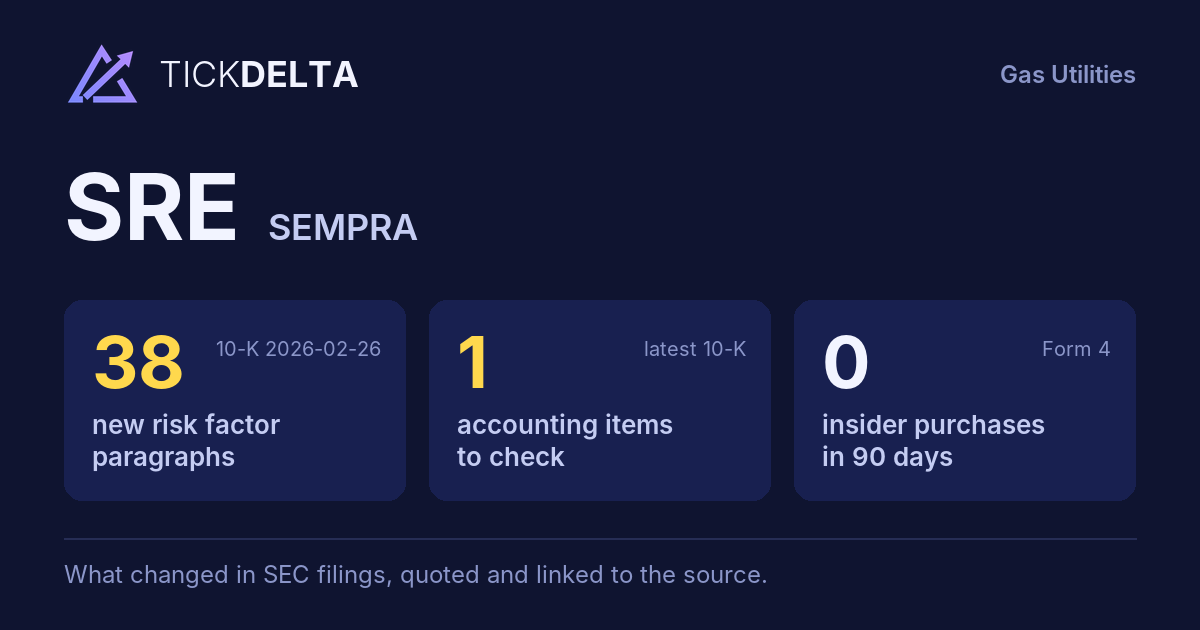
Every change, by type

Sentences and paragraphs added, removed or reworded

Sentences and paragraphs of SRE's Risk Factors and MD&A, 10-K 2026-02-26 against 10-K 2025-02-25. Each links to the text at sec.gov.

AddedRisk Factors
▪shortages of or delays in obtaining equipment, materials, supplies, commodities or labor, which have been and may continue to be exacerbated by supply chain and gas transportation capacity constraints, tight labor markets, and cost increases due to inflation, tariffs or otherwise, that may not be recoverable in a timely manner or at all

Read it in 10-K 2026-02-26 at sec.gov ↗

AddedRisk Factors
We face evolving cybersecurity, technology resiliency and data security and governance risks, including with respect to increasing use of artificial intelligence.

Read it in 10-K 2026-02-26 at sec.gov ↗

AddedRisk Factors
In addition to security and privacy risks related to data, we face challenges related to data governance, including the need to manage our data with the aim to meet regulatory requirements and create a foundation for the use of artificial intelligence tools. Our current and potential future uses of such tools (and use by our vendors and agents) may expose us to heightened security and privacy risks as well as operational, legal, and reputational risks. Data produced by or contained in artificial intelligence tools may contain inaccuracies, and our investments in such technologies and related organizational changes may not deliver the expected benefits, which could result in operational disruptions, inefficiencies, unexpected costs and regulatory disallowances. Beginning in January 2027, our businesses that are subject to the California Consumer Privacy Act will also be subject to new regulations related to, among other things, the use of artificial intelligence tools to automate certain decisions. These regulations may limit some potential applications of such technologies, particularly with respect to previously collected personal data. The regulations require companies to disclose any covered use of such technologies and how the relevant decisions will be made and to allow consumers to opt out of such use, subject to limited exceptions. The regulations also require companies to conduct risk assessments before initiating certain data processing activities, disclose information about these assessments to the California Privacy Protection Agency, conduct an annual cybersecurity audit and submit a written compliance certification to the agency.

Read it in 10-K 2026-02-26 at sec.gov ↗

AddedRisk Factors
Conditions in global markets, including the impact of enacted and proposed tariffs and other trade actions, may materially and adversely affect us.

Read it in 10-K 2026-02-26 at sec.gov ↗

AddedRisk Factors
Our businesses import various materials, including steel and aluminum, and purchase foreign-sourced goods, such as electrical transformers, from domestic distributors. SI Partners also generates a material portion of its earnings from LNG exports to customers located outside the U.S., including countries in Asia and Europe. Our ability to continue importing materials and purchasing foreign-sourced goods at competitive prices and reaching positive FIDs on LNG and other projects in development is subject to a number of risks, including adverse impacts on the affordability of projects in development and under construction due to the imposition of tariffs by the U.S. Administration, and adverse impacts caused by (i) legal and regulatory requirements or limitations imposed by foreign governments, including tariffs, quotas or other trade barriers, sanctions, adverse tax law changes, nationalization, currency restrictions, or import restrictions, and (ii) disruptions or delays in shipments caused by customs compliance or other actions of government agencies.

Read it in 10-K 2026-02-26 at sec.gov ↗

Show the other 16
AddedRisk Factors
In 2018, the U.S. imposed tariffs on certain imported steel and aluminum products, as well as tariffs in various ranges on imports from China. Those tariffs remain in effect. Beginning in January 2025, the U.S. Administration has announced a number of new and increased tariffs, both threatened and imposed, including a higher total tariff rate on goods from China and numerous other tariffs on imports from all countries with only limited exclusions. The U.S. Administration has delayed the effectiveness of certain tariffs and tariff rate increases and threatened to accelerate the effectiveness of others. In particular, the U.S. Administration has imposed new tariffs on Mexico and Canada, and additional tariffs have been threatened and these and other changes, including in connection with the planned joint review of the U.S.-Mexico-Canada Agreement in 2026, may become effective in the near term. Additionally, the U.S. Administration has expanded the application of the 2018 steel and aluminum tariffs to countries and products that had previously been excluded, including a broad range of derivative products, increased steel and aluminum tariff rates, and imposed tariffs on certain imported copper products. The U.S. Administration also is considering new tariffs on additional imported products, including power grid equipment, large-scale batteries and plastic piping. These threatened and imposed tariffs have created uncertainty in our business development efforts and for projects currently under construction, and we expect them to impact our businesses’ costs related to construction, pipeline transportation, electricity procurement and financing, among other areas, and increase costs across the LNG value chain. These impacts may result in delays, cost overruns or reduced profitability for construction and development projects, denials or delays of recovery in rates of higher costs at our regulated utilities, or other adverse effects, any of which could be material.

Read it in 10-K 2026-02-26 at sec.gov ↗

AddedRisk Factors
We also face uncertainty in the interpretation and application of these tariffs, including with respect to customs valuation, product classification and country-of-origin determinations. Any disagreement with regulators on these matters could result in the retroactive assessment of additional tariffs with interest, the imposition of penalties, or other enforcement actions, any of which could be material.

Read it in 10-K 2026-02-26 at sec.gov ↗

AddedRisk Factors
These recent tariffs, along with other U.S. trade actions, have triggered retaliatory actions by certain affected countries, including China’s announcement of a tariff on U.S. LNG. The Mexican government has announced it may implement retaliatory tariffs in response to the U.S. Administration’s tariffs, and other foreign governments may also impose trade measures, including retaliatory tariffs, on LNG or other U.S. goods in the future. These tariffs and other trade actions could negatively impact demand for our LNG exports, which would adversely impact our LNG projects and development pipeline.

Read it in 10-K 2026-02-26 at sec.gov ↗

AddedRisk Factors
While the U.S. Administration has announced various trade deals, many such agreements are preliminary and may be subject to change. Certain of the announced deals, including the agreement with the European Union, require further governmental approvals, and certain announced deal terms, including purported commitments by the European Union and Japan to purchase more U.S. energy, may be non-binding or subject to voluntary implementation by the private sector. Any disagreement between the U.S. and other countries over the implementation of such trade deals or any failure to obtain required governmental approvals or otherwise reach a final agreement could result in prolonged uncertainty regarding the scope and duration of these trade actions by the U.S. and other countries. Such actions and any resulting economic, financial or geopolitical instability could materially adversely affect our results of operations, financial condition, cash flows and/or prospects.

Read it in 10-K 2026-02-26 at sec.gov ↗

AddedMD&A
▪The 2025 Wildfire Legislation was signed into law and established, among other things, an $18 billion Continuation Account that would provide additional liquidity to reimburse catastrophic wildfire-related claims incurred by large California electric IOUs if the Wildfire Fund is depleted, and a multi-stakeholder task force, coordinated by the Wildfire Fund’s administrator, to prepare and submit to the California legislature and Governor of California on or before April 1, 2026, a report that evaluates and sets forth recommendations on new models to complement or replace the Wildfire Fund

Read it in 10-K 2026-02-26 at sec.gov ↗

AddedMD&A
▪In September 2025, we entered into an agreement to sell 45% of our equity interest in SI Partners to the KKR Partners for an aggregate base purchase price of approximately $9.99 billion, subject to adjustments, and expect the sale to close in the second or third quarter of 2026, subject to closing conditions

Read it in 10-K 2026-02-26 at sec.gov ↗

AddedMD&A
▪In December 2025, we entered into an agreement to sell Ecogas for 9.0 billion Mexican pesos (approximately $500 million U.S. dollar-equivalent at December 31, 2025), subject to adjustments, and expect the sale to close in the second or third quarter of 2026, subject to closing conditions

Read it in 10-K 2026-02-26 at sec.gov ↗

AddedMD&A
▪$703 million income tax expense in 2025 as a result of management’s decision to classify SI Partners and Ecogas as held for sale, comprised of the following:

Read it in 10-K 2026-02-26 at sec.gov ↗

Next Related parties →