Form 10-K for the Fiscal Year Ended December 31, 2020
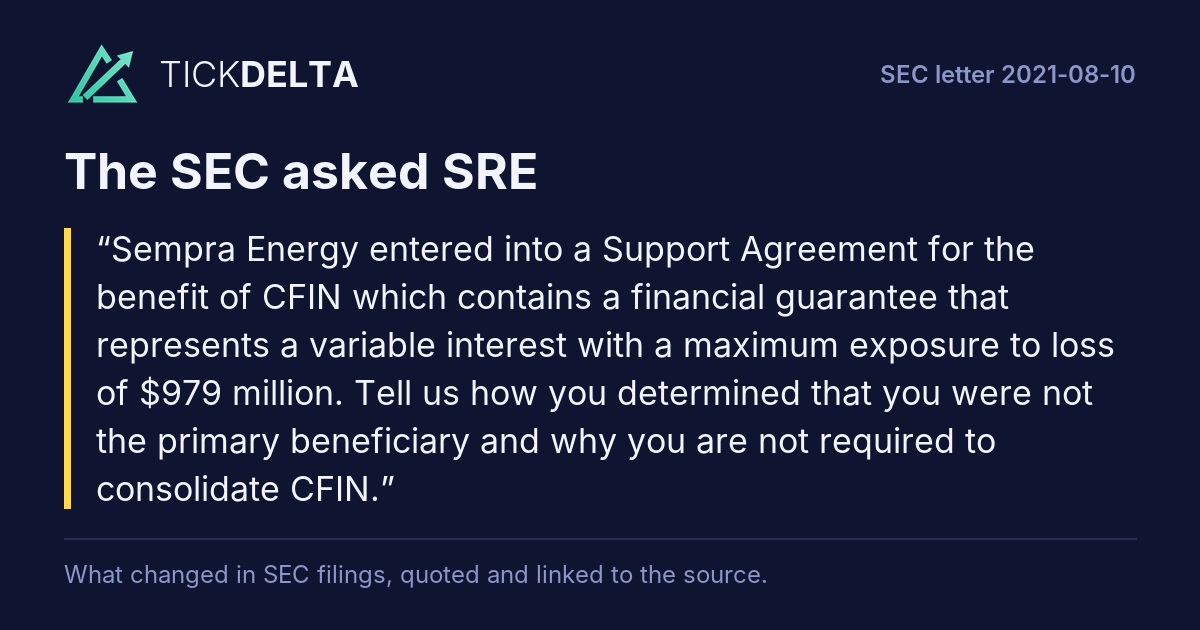
Sempra Energy entered into a Support Agreement for the benefit of CFIN which contains a financial guarantee that represents a variable interest with a maximum exposure to loss of $979 million. Tell us how you determined that you were not the primary beneficiary and why you are not required to consolidate CFIN.
When considering whether Sempra Energy is the primary beneficiary of CFIN, we evaluated the criteria under ASC 810-10-25-38A to determine whether we have a controlling financial interest in CFIN based on having both (a) the power to direct the activities that most significantly impact CFIN’s economic performance (the “power criterion”); and (b) the obligation to absorb losses of CFIN or the rights to receive benefits from CFIN that could potentially be significant to CFIN (the “economics criterion”).
We concluded that we do not meet the power criterion.Read in the reply ↗Rest of the answer
CFIN, which is wholly owned by Cameron LNG JV, entered into financing agreements (the “Agreements”) with external lenders and Cameron LNG JV and its four project owners, who are unrelated third parties, and received and used the aggregate proceeds of $1.5 billion to provide a loan to Cameron LNG JV. We examined the Agreements to identify the ongoing activities that most significantly affect the economic performance of CFIN, while considering the risks designed to be absorbed by the variable interest holders. We identified the most significant activities as (a) the ability to determine remedies in the event of default if CFIN is unable to satisfy its obligations under the Agreements; and (b) the ability to make modification, prepayment, or refinance decisions as it relates to the Agreements. Because these significant activities require unanimous consent of Cameron LNG JV’s four project owners, either directly or through an action by Cameron LNG JV’s board of directors, which Sempra Energy does not control, we concluded that we do not control the ability or have the power to direct the activities that most significantly affect the economic performance of CFIN. Based on this conclusion, we determined that we do not meet the power criterion as required by ASC 810-10-25-38A and thus are not the primary beneficiary, and therefore should not consolidate CFIN.
In response to the Staff’s comment, we respectfully advise the Staff that we will adjust our disclosure in future filings to clarify the most significant activities of CFIN and our lack of power to direct those activities. In future Form 10-K and Form 10-Q filings where this disclosure is applicable, we will add the following disclosure (edits to previous disclosure are indicated by underline):
“As we discuss in Note 6, in July 2020, Sempra entered into a Support Agreement for the benefit of CFIN, which is a VIE. Sempra is not the primary beneficiary of the VIE because we do not have the power to direct the most significant activities of CFIN, including modification, prepayment, and refinance decisions related to the financing arrangement with external lenders and Cameron LNG JV and its four project owners as well as the ability to determine and enforce remedies in the event of default. The conditional obligations of the Support
Agreement represent a variable interest that we measure at fair value on a recurring basis (see Note 12).
First report after the company's reply of 2021-08-20: 10-Q filed 2021-11-05 ↗, against the 10-Q filed 2021-08-05 ↗.
Tickdelta does not hold the text of both reports, so they are not compared here.
Revise your disclosure to clarify for investors how the carrying charge, or return, is calculated on your regulatory assets. Also, revise to disclose the remaining amount of regulatory assets not earning a return during the recovery period and the remaining recovery period applicable to them. Refer to 980-340-50-1.
Within Note 4 on page F-62 of our 2020 Form 10-K, we disclose regulatory assets earning a return in the table labeled “Regulatory Assets (Liabilities).” These balances are indicated by footnote “(2)” that reads, “Includes regulatory assets earning a return,” while the remaining regulatory assets disclosed in the table do not earn a return.
We believe we have given appropriate consideration to ASC 980-340-50-1 with regards to the regulatory assets that do not earn a return. The periods during which we recognize a regulatory asset while not earning a return vary by regulatory asset.Read in the reply ↗Rest of the answer
For additional clarification, we will adjust our future disclosure to specify that we generally do not earn a return on our regulatory assets until such time as a related cash expenditure has been made and, as applicable, provide the recovery periods for those regulatory assets that do not earn a return. In addition, we will clarify how the return is determined on regulatory assets that do earn a return during their recovery period. In future Form 10-K filings and our next Form 10-Q filing where this disclosure is applicable, we will add the following disclosure (edits to previous disclosure are indicated by underline and strike-through):
NOTE 4. REGULATORY MATTERS
REGULATORY ASSETS AND LIABILITIES
We show the details of regulatory assets and liabilities in the following table and discuss them below. With the exception of regulatory balancing accounts, we generally do not earn a return on our regulatory assets until such time as a related cash expenditure has been made. Upon the occurrence of a cash expenditure associated with a regulatory asset, the related amounts are recoverable through a regulatory account mechanism for which we earn a return authorized by applicable regulators, which currently approximates the three-month commercial paper rate. The periods during which we recognize a regulatory asset while we do not earn a return vary by regulatory asset.
REGULATORY ASSETS (LIABILITIES)
(Dollars in millions)
December 31,
2020 2019
SDG&E:
Fixed-price contracts and other derivatives $ (53) $ 8
Deferred income taxes recoverable (refundable) in rates 22 (108)
Pension and other postretirement benefit plan obligations 50 103
Removal obligations (2,121) (2,056)
Environmental costs 56 45
Sunrise Powerlink fire mitigation 121 121
Regulatory balancing accounts(1)(2)
Commodity – electric 72 102
Gas transportation 35 22
Safety and reliability 67 77
Public purpose programs (158) (124)
2019 GRC retroactive impacts 56 111
Other balancing accounts 233 106
Other regulatory assets (liabilities), net(2)
72 (153)
Total SDG&E (1,548) (1,746)
SoCalGas:
Deferred income taxes refundable in rates (82) (203)
Pension and other postretirement benefit plan obligations 417 400
Employee benefit costs 37 44
Removal obligations (685) (728)
Environmental costs 36 40
Commodity – gas, including transportation (56) (118)
Safety and reliability 335 295
Public purpose programs (253) (273)
2019 GRC retroactive impacts 202 400
Other balancing accounts (58) (7)
75 (101)
Total SoCalGas (32) (251)
Sempra Mexico:
Deferred income taxes recoverable in rates 80 83
Other regulatory assets — 6
Total Sempra Energy Consolidated $ (1,500) $ (1,908)
(1) At December 31, 2020 and 2019, the noncurrent portion of regulatory balancing accounts – net undercollected for SDG&E was $139 million and $108 million, respectively, and for SoCalGas was $218 million and $500 million, respectively.
(2) Includes regulatory assets earning a return authorized by applicable regulators, which currently approximates the three-month commercial paper rate.
In the table above:
Regulatory Assets Not Earning a Return
•Regulatory assets arising from fixed-price contracts and other derivatives are offset by corresponding liabilities arising from purchased power and natural gas commodity and transportation contracts. The regulatory asset is increased/decreased based on changes in the fair market value of the contracts. It is also reduced as payments are made for commodities and services under these contracts. The related amounts are recovered in rates once these contracts are settled, generally within X years.
•Deferred income taxes refundable/recoverable in rates are based on current regulatory ratemaking and income tax laws. SDG&E, SoCalGas and Sempra Mexico expect to refund/recover net regulatory liabilities/assets related to deferred income taxes over the lives of the assets, ranging from X to X years, that give rise to the related accumulated deferred income tax balances. Regulatory assets and liabilities include excess deferred income taxes resulting from statutory income tax rate changes and certain income tax benefits and expenses associated with flow-through items, which we discuss in Note 8.
•Regulatory assets/liabilities related to pension and other postretirement benefit plan obligations are offset by corresponding liabilities/assets and are being. The assets are recovered in rates as the plans are funded.
•The regulatory asset related to employee benefit costs represents our liability associated with long-term disability insurance that will be recovered from customers in future rates as expenditures are made.
•Regulatory liabilities from removal obligations represent cumulative amounts collected in rates for future asset removal costs in excess of cumulative amounts incurred (or paid).
•Regulatory assets related to environmental costs represent the portion of our environmental liability recognized at the end of the period in excess of the amount that has been recovered through rates charged to customers. We expect this amount to be recovered in future rates as expenditures are made.
•The regulatory asset related to Sunrise Powerlink fire mitigation is offset by a corresponding liability for the funding of a trust to cover the mitigation costs. SDG&E expects to recover the regulatory asset in rates as the trust is funded over a remaining 49-year period.
Regulatory Assets Earning a Return
•Overand undercollected regulatory balancing accounts reflect the difference between customer billings and recorded or CPUC-authorized costs, including commodity costs. Depreciation, taxes and return on rate base may also be included in certain accounts. Amounts in the balancing accounts are recoverable (receivable) or refundable (payable) in future rates, subject to CPUC approval. The adopted revenue requirements in the 2019 GRC FD associated with the period from January 1, 2019 through December 31, 2019 are being recovered in rates over a 24-month period that began in January 2020.
First report after the company's reply of 2021-08-20: 10-Q filed 2021-11-05 ↗, against the 10-Q filed 2021-08-05 ↗.
Tickdelta does not hold the text of both reports, so they are not compared here.
We note your disclosure that the cost estimate related to the Aliso Canyon Natural Gas Storage Facility Gas Leak does not include litigation, regulatory proceedings or regulatory costs to the extent it is not possible to predict at this time the outcome of these actions or reasonably estimate the costs to defend or resolve the actions or the amount of damages.Rest of the question
Please disclose an estimated range of reasonably possible losses in excess of the amounts accrued. Refer to ASC 450-20-50-4.
We respectfully refer the Staff to our disclosure in Note 16 on page F-134 of our 2020 Form 10-K, which notes “Unless otherwise indicated, we are unable to estimate reasonably possible losses in excess of any amounts accrued.” With respect to the Aliso Canyon Natural Gas Storage Facility Gas Leak, we were unable to reasonably estimate the possible loss or a range of loss beyond the amounts we have recorded because of uncertainties as to future events and actions such as the outcome of litigation and regulatory proceedings, the amount of regulatory costs and costs to defend or resolve theRead in the reply ↗Rest of the answer
events or actions, and the amount of damages, restitution, or civil, administrative or criminal fines, sanctions, penalties or other costs or remedies that may be imposed or incurred. Accordingly, consistent with ASC 450-20-50-4(b), the 2020 Form 10-K does not include disclosure of a reasonable estimate of the possible loss or a range of loss in excess of the amounts accrued. For additional clarification, in future Form 10-K and Form 10-Q filings where this disclosure is applicable, to the extent we are not able to reasonably estimate the possible loss or a range of loss in excess of any amounts accrued, we will include an additional statement that a possible range of loss cannot be reasonably estimated.
We are available to discuss our responses to your comments at any time. You may reach the undersigned at pwall@sempra.com.
First report after the company's reply of 2021-08-20: 10-Q filed 2021-11-05 ↗, against the 10-Q filed 2021-08-05 ↗.
Tickdelta does not hold the text of both reports, so they are not compared here.
Also in this review: closing letter, 2021-09-03