Screener / SEC EDGAR /CIK 0000873303 /10-K filed Mar 2, 2026, compared with Feb 28, 2025 /Numbers from the XBRL of the 10-Ks
Nasdaq Health care · Pharmaceuticals

Sarepta Therapeutics, Inc. SRPT

Compare with peers Embed
The 10-K against last year's

207 changes: 62 added, 31 removed, 113 reworded, 1 quiet changes

10-K Mar 2, 2026 vs Feb 28, 2025

10-K 0001193125-26-084144 (Mar 2, 2026) vs 10-K 0000950170-25-029973 (Feb 28, 2025)

Every paragraph, and how much of it changed

One bar per paragraph, in the order of the 10-K. Height and colour show the share of its words not in the closest paragraph a year earlier; the tallest bars are new paragraphs.

Risk Factors

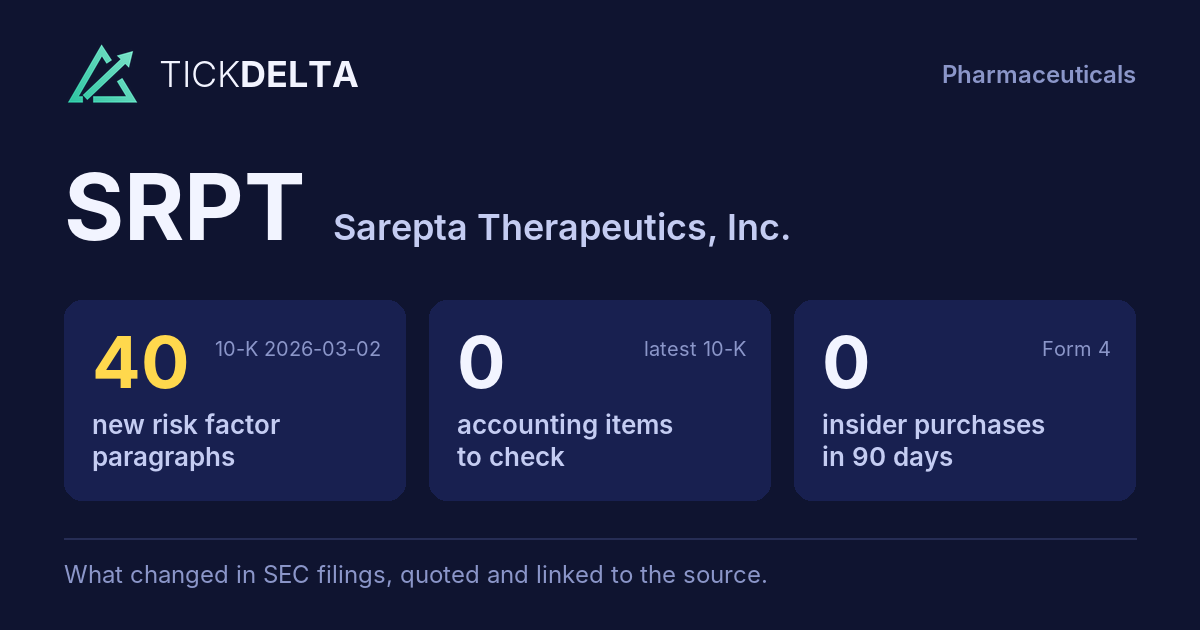
424 paragraphs · 40 new · 135 reworded · 16 gone · 10-K Mar 2, 2026 against Feb 28, 2025
New paragraph Reworded (5% of its words or more) Same or nearly
Paragraph 391 · 50% changed Every version of it
In September 2022, we issued $1,150.0 million aggregate principal amount of 2027 Notes, pursuant to that certain indenture dated as of September 16, 2022, between us, as issuer, and U.S. Bank National Association, as trustee, including $20.0 million of 2027 Notes issued to the Michael A. Chambers Living Trust in a private placement. Our ability to make scheduled payments Additionally, on August 28, 2025, the Company completed privately negotiated exchanges of $700.0 million in aggregate principal amount of 2027 Notes for consideration consisting of (i) $602.0 million in aggregate principal amount of 2030 Notes, (ii) an aggregate of 5,851,693 shares of the Company’s Common Stock, and (iii) an aggregate of approximately $127.3 million in cash. On December 18, 2025, the Company completed privately negotiated exchanges of approximately $291.4 million in aggregate principal of, to pay interest on, or to refinance our indebtedness, including the Notes, depends on our future performance, which is subject to many factors, including, economic, financial, competitive amount of 2027 Notes for consideration consisting of (i) approximately $291.4 million in aggregate principal amount of 2030 Notes and other, beyond our control. We do not expect our business to be able to generate cash flow from operations (ii) an aggregate of approximately $31.6 million in the foreseeable future, sufficient to service our debt and make necessary capital expenditures and we may therefore be required to adopt one or more alternatives, such as selling assets, restructuring debt or obtaining
Paragraph 70 · 47% changed Every version of it
More restrictive government regulations or negative public opinion would harm our business, financial condition, results of operations operations, financial guidance, ability to accurately forecast key financial metrics, and prospects and may delay or impair the development and commercialization of our gene therapy product candidates or demand for ELEVIDYS or any other products we may develop. For example, earlier gene therapy trials of other sponsor's products led to several well-publicized adverse events, including death, and other gene therapy trials have failed to demonstrate efficacy. Lack In addition, in March and June 2025 we announced two reported cases of efficacy and/or serious adverse events related to clinical trials we, ALF resulting in death of non-ambulatory patients following treatment with ELEVIDYS, as well as one case of ALF resulting in death of a non-ambulatory patient following dosing in our strategic partners or other companies conduct, even if such adverse events are not ultimately attributable to the relevant product candidates or products, and/or failed commercialization of Phase 1/2 LGMD trial for our gene therapy products product candidate, SRP-9004. In response to these announcements, the FDA revoked the platform technology designation for the Company’s AAVrh74 Platform Technology previously granted on June 2, 2025. The degree to which these events have impacted or will impact market acceptance of ELEVIDYS in ambulatory patients, or any of our other drug products, is uncertain and difficult to estimate, which may result in increased government regulation, unfavorable public perception, potential regulatory delays unpredictable variability in the testing or approval of our financial forecasts.
Paragraph 319 · 45% changed Every version of it
We have generated net operating loss and tax credit carryforwards in certain historical periods as we pursued our business strategy. To the extent that we continue to generate taxable losses, unused losses will carry forward to offset a portion of future taxable income, if any, subject to expiration of such carryforwards in the case of carryforwards generated prior to January 1, 2018. In general, under Section 382 of the Internal Revenue Code, a corporation that undergoes an “ownership change” is subject to limitations on its ability to utilize its pre-change net operating losses and certain other tax assets (including R&D tax credits) to offset future taxable income. In general, an ownership change occurs if the aggregate stock ownership of certain stockholders increases by more than 50 percentage points over such stockholders’ lowest percentage ownership during the testing period, which is generally three years. An ownership change could limit our ability to utilize our net operating loss and tax credit carryforwards for taxable years including or following such “ownership change.” Such limitations may result in expiration of a portion of the net operating loss carryforwards incurred prior to 2018 before utilization and may be substantial. If such change has occurred or does occur, the tax benefits related to the net operating loss carryforwards and certain other tax assets may be limited or lost. Moreover, proposed U.S. Treasury Regulations promulgated under Section 382 of the Code could, if finalized, significantly impact a corporation’s ability to use its pre-change net operating loss carryforwards or other attributes following an ownership change. Limitations imposed on the ability to use net operating losses and tax credits to offset future taxable income could require us to pay U.S. federal income taxes earlier than we estimated or than would have otherwise been required if such limitations were not in effect and could cause such net operating losses and tax credits to expire unused, in each case reducing or eliminating the benefit of such net operating losses and tax credits and potentially adversely affecting our financial position. Similar rules and limitations may apply for state income tax purposes. At the state level, there may also be periods during which the use of net operating loss carryforwards or other attributes is suspended or otherwise limited, which could accelerate or permanently increase state taxes owed. These net operating losses have been fully offset by a valuation allowance due to uncertainties surrounding our ability to realize these tax benefits.
Paragraph 46 · 41% changed Every version of it
The U.S. government, state legislatures and foreign governments have shown significant interest in implementing cost-containment programs to limit the growth of government-paid and private insurance healthcare costs, including proposed or implemented reforms involving price controls, waivers from Medicaid drug rebate law requirements, restrictions on reimbursement and requirements for substitution of generic products for branded prescription drugs and implementing new requirements for, or eliminating caps on, rebates paid on products under government healthcare programs. We anticipate that the Trump Administration and Congress, state legislatures and the private sector will continue to consider and may adopt healthcare policies intended to curb rising healthcare costs, and specifically prescription drug costs. These cost reforms. Cost containment measures may initiatives might include, among other possible actions, implementation or modification of:
Paragraph 296 · 41% changed Every version of it
The number and complexity of both federal and state laws continues to increase, and additional governmental resources are being used to enforce these laws and to prosecute companies and individuals who are believed to be violating them. We anticipate that government scrutiny of pharmaceutical sales and marketing practices and other activities will continue for the foreseeable future and subject us to the risk of government investigations and enforcement actions. Given the breadth of the laws and regulations, limited guidance for certain laws and regulations, and evolving government interpretations of the laws and regulations, governmental authorities may possibly conclude that our business practices are non-compliant. For example, in September 2025, the FDA stated that it intends to more aggressively enforce requirements for direct-to-consumer ("DTC") drug advertising and sent more than 100 warning or untitled letters to companies for allegedly deceptive prescription drug advertising, which represents a dramatic increase in FDA actions as compared to prior years. The FDA also announced plans to expand its oversight of digital and social media advertising and to initiate a rulemaking that would call for drug companies to disclose additional safety information in DTC broadcast advertisements. The nature and extent of changes to FDA regulations and enforcement approach is unclear but may impact pharmaceutical marketing efforts industry-wide, including for us, which could in turn impact our sales and operations. As another example, recent government communications indicate that the longstanding focus of federal enforcement agencies on pharmaceutical company activities will continue. In 2025, the U.S. Department of Justice (“DOJ”) issued a white collar enforcement plan identifying enforcement priorities
Paragraph 255 · 40% changed Every version of it
In addition, if our third-party manufacturers are unable to satisfy requirements related to the manufacturing ELEVIDYS, our ability to meet commercial demand may be adversely impacted, which could result in the loss of potential revenues, adversely affect our ability to gain market acceptance of ELEVIDYS, or otherwise adversely affect our business, financial condition and prospects. ELEVIDYS is our first gene therapy product. We may not be able to accurately estimate commercial demand for this new type of product. our products given their novelty and complexity. If commercial demand for ELEVIDYS our products or product candidates is greater than we estimate, we and our manufacturers may be unable to fulfill all orders for ELEVIDYS in a timely manner, which may adversely affect our business, financial condition and prospects. Conversely, if commercial demand is less than we estimate, we may be required to reduce, suspend, or cease production, which has, and could in the future, result in significant accounting charges relating to write-off of inventory if such inventory becomes in excess, obsolete or unusable.
Paragraph 217 · 40% changed Every version of it
For drugs and biologics that have been designated as fast track products or breakthrough therapies, or granted access to the PRIME scheme, interaction and communication between the regulatory agency and the sponsor of the trial can help to identify the most efficient path for clinical development. Sponsors of drugs with fast track products or breakthrough therapies may also be able to submit marketing applications on a rolling basis, meaning that the FDA may review portions of a marketing application before the sponsor submits the complete application to the FDA, if the sponsor pays the user fee upon submission of the first portion of the marketing application. For products that receive a priority review designation, the FDA's marketing application review goal is shortened to six months, as opposed to ten months under standard review. This review goal is based on the date the FDA accepts the marketing application for review. This application validation period typically adds approximately two months to the timeline for review and decision from the date of submission. RMAT designations will accelerate approval and will include all the benefits of fast track and breakthrough therapy designations, including early interactions with the FDA, but the exact mechanisms have not yet been announced by the FDA.
Paragraph 157 · 39% changed Every version of it
•denial by the regulatory agencies of permission to proceed with our planned clinical trials or any other clinical trials we may initiate, or placement of a clinical trial on hold; hold. For example, on July 21, 2025, we announced that the FDA placed our LGMD programs, including SRP-9003, on clinical hold following a case of ALF resulting in the death of a patient in our Phase 1/2 LGMD clinical trial for SRP-9004, which has impacted the timing of a BLA submission for SRP-9003;

MD&A

114 paragraphs · 22 new · 54 reworded · 15 gone · 10-K Mar 2, 2026 against Feb 28, 2025
New paragraph Reworded (5% of its words or more) Same or nearly
Paragraph 34 · 50% changed
•$8.5 •$883.8 million decrease increase in research up-front and other milestone expenses primarily due to timing the $583.6 million in acquired in-process research and development expense associated with our Arrowhead Collaboration Agreement. The remaining increase relates to $300.0 million of milestone payments to Arrowhead, triggered by Arrowhead's achievement of certain up-front and milestone payments, partially offset by an increase the DM1 Milestones, with no similar activity in sponsored research with academic institutions during 2024; and
Paragraph 47 · 50% changed
•$8.5 •$34.3 million decrease in stock-based compensation expense primarily due to an increase the fulfillment of remaining service conditions associated with certain PSUs in indirect manufacturing costs absorption offset as a result March 2025, reversal of ELEVIDYS approval in June 2023, previously recognized expense related to unvested awards and reduced headcount pursuant to our Restructuring and the ESPP Suspension. This was partially offset by the achievement of certain performance conditions related to being met in June and December 2025 for certain restricted stock units with performance conditions (“PSUs”) during 2024; PSUs;
Paragraph 92 · 50% changed
•$20.1 •$79.8 million increase in other expenses assets primarily due to the timing of charitable contribution activity. billings to Roche for orders of ELEVIDYS for use outside of the U.S., as well as increased royalty receivables from Roche related to increased ELEVIDYS sales outside of the U.S.;
Paragraph 60 · 50% changed
Other (expense) income, net for 2024 2025 increased by approximately $9.6 $62.0 million compared to 2023. 2024. The change is primarily due to the impairment of a strategic investment during 2023, with no similar activity during 2024. This change was partially offset by a $35.2 million decrease in interest income and accretion of investment discount, net as a result of lower interest rates and the investment mix of our investment portfolio portfolio, a $19.7 million increase in interest expense primarily due to the 2030 Notes carrying a higher interest rate than our 2027 Notes and an a $13.1 million increase in the loss on our strategic investments in publicly traded companies, including Arrowhead. These changes were partially offset by a $7.8 million loss associated with the change in fair value derivative liabilities in 2024, which primarily relates to our contingent consideration, with no similar activity in 2025 due to the adoption of derivatives, primarily Accounting Standards Update 2025-07 ("ASU 2025-07"). As a result, two existing contracts that include a settlement feature based on our operations or activities are now excluded from ASC 815, Derivatives and Hedging and any liabilities will be recognized as such obligations become probable and estimable under ASC 450, Contingencies. Refer to Note 2, Summary of Significant Accounting Policies and Recent Accounting Pronouncements for additional information related to contingent consideration. the adoption of ASU 2025-07.
Paragraph 65 · 49% changed
For 2024 and 2023, 2024, our principal sources of liquidity were primarily derived from the sales of our products, net the maturity and sale of available-for-sale securities, our collaboration arrangement with Roche, proceeds from sale exercise of the ELEVIDYS PRV, proceeds from stock options and the settlement of capped call options associated with the 2024 Notes (the “2017 Capped Calls”) and our collaboration arrangement with Roche. convertible senior notes due on November 15, 2024. Our principal uses of cash are for 2024 were inventory commitments, research and development expenses, manufacturing costs, selling, general and administrative expenses, investments, capital expenditures, business development transactions, settlement of long-term debt expenditures and other working capital requirements. Refer to Note 13, Indebtedness and Note 19, Leases for additional discussion of our outstanding indebtedness and material changes to our leasing obligations, respectively. The changes in our working capital primarily reflect the use of cash in operating activities, as well as an increase in inventory due to the capitalization of ELEVIDYS inventory after its approval in June 2023. While our contractual obligations, commitments and debt service requirements over the next several years are significant, we intend to continue to fund our short-term financing needs and working capital requirements from cash flows of operating activities as well as cash on hand and such sources are anticipated to be adequate to fund working capital requirements for at least twelve months from the date these consolidated financial statements were issued.
Paragraph 45 · 49% changed
•$25.2 •$16.3 million increase decrease in professional service expenses primarily due to reduced costs relating to certain litigation matters and reduced commercial spending related to ongoing litigation matters, our continuing expansion efforts and continuing efforts to commercialize ELEVIDYS; cost reduction initiative associated with our Restructuring;
Paragraph 39 · 48% changed
•$8.5 •$26.6 million decrease in stock-based compensation expense primarily due to an increase in indirect manufacturing costs absorption offset as a result the reversal of ELEVIDYS approval in June 2023, partially offset by the achievement of performance conditions previously recognized expense related to unvested awards and reduced headcount pursuant to our Restructuring, fulfillment of remaining service conditions associated with certain restricted stock units with performance conditions (“PSUs”) during 2024; ("PSUs") in March 2025 and our decision to suspend our employee stock purchase plan ("ESPP Suspension") in 2025. This was partially offset by certain performance conditions being met in June and December 2025 for certain PSUs;
Paragraph 84 · 47% changed
(3) The leases embedded in a certain supply agreement are included in manufacturing obligations. The increase decrease in short-term manufacturing commitments is primarily driven by ramp-up of a supplemental letter agreement (the "Letter Agreement") entered into with Catalent in August 2025 to address certain financial and operational matters related to the ELEVIDYS manufacturing activities as a result of anticipated increase in demand. Suspension. Refer to Note 23, Commitments and Contingencies for further discussion surrounding the Letter Agreement with Catalent.

A paragraph is matched with the one last year that shares the most of its words; under half in common makes it new. The paragraphs shown are the 8 reworded the most in each section.

The paragraph that changed most in each section

The redline

Marked against last year's 10-K: cut words struck through, new words highlighted.

Accounting Policies532 words changed in this paragraph; it is 69% similar to last year's version.
Leases At the inception of an arrangement, the Company determines whether the arrangement is or contains a lease based on the unique facts and circumstances present in the arrangement. Leases with a term greater than 12 twelve months are recognized on the consolidated balance sheets as ROU assets and short-term and long-term lease liabilities, as applicable. The Company has elected not to recognize leases with terms of 12 twelve months or less on the consolidated balance sheets. The Company typically only includes an initial lease term in its assessment of a lease arrangement. Options to renew a lease are not included in the Company’s assessment unless there is reasonable certainty that the Company will renew. The Company monitors its plans to renew its leases quarterly or on an as-needed basis. In addition, the Company’s lease agreements generally do not contain any residual value guarantees or restrictive covenants. Operating lease liabilities and their corresponding ROU assets are recorded based on the present value of future lease payments over the expected remaining lease term at lease commencement. The initial measurement of the lease liability is determined based on the future lease payments, which may include lease payments that depend on an index or a rate (such as the consumer price index or other market index). The Company initially measures payments based on an index or rate by using the applicable rate at lease commencement and subsequent changes in such rates are recognized as variable lease costs. Variable payments that do not depend on a rate or index are not included in the lease liability and are recognized as they are incurred. Lease costs for operating leases are recognized on a straight-line basis over the lease term as an operating expense with unrecognized variable lease payments recognized as incurred. Certain adjustments to the ROU asset may be required for items such as lease prepayments or incentives received. The interest rate implicit in lease contracts is typically not readily determinable. As a result, the Company utilizes its incremental borrowing rate, which reflects the fixed rate at which the Company could borrow on a collateralized basis the amount of the lease payments in the same currency, for a similar term, in a similar economic environment. Components of a lease are bifurcated between lease components and non-lease components. The fixed and in-substance fixed contract consideration identified is then allocated based on the relative standalone price to the lease and non-lease components. The Company adopted a practical expedient provided by ASC Topic 842, Leases, and elected to account for the lease and non-lease components together for existing classes of underlying assets and allocates the contract consideration to the lease component only. In contrast, the Company does elected not to apply the practical expedient provided by ASC Topic 842, Leases, for leases embedded in manufacturing and supply agreements with certain of its contract manufacturing organizations and has instead allocated contract consideration between the lease and non-lease components based on their relative standalone price. (Loss) Earnings (Loss) per Share Basic (loss) earnings (loss) per share is computed by dividing net (loss) income (loss) by the weighted-average number of shares of common stock outstanding. Diluted earnings per share is computed based on the treasury stock method for stock awards and if-converted method for convertible notes by dividing net income by the weighted-average number of shares of common stock and potentially dilutive common stock equivalents outstanding. Potential common equivalent shares are excluded if their effect is anti-dilutive. Embedded Derivatives The Effective January 1, 2025, the Company evaluates adopted Accounting Standard Update ("ASU") 2025-07, Derivatives and Hedging (Topic 815) and Revenue from Contracts with Customers (Topic 606): Scope Refinements ("ASU 2025-07"), which introduced a scope exception for non-exchange-traded contracts with underlyings based on operations or activities specific to one party. As a result, certain of its financial and business development transactions to determine if contingent consideration obligations previously accounted for as embedded components of these contracts derivatives no longer meet the definition of a derivative under ASC 815. In general, embedded derivatives are required to be bifurcated from the host instrument if (i) the embedded feature is not clearly 815, Derivatives and closely Hedging (“ASC 815”). See Recent Accounting Pronouncements below related to the host contract cumulative effect of adopting this new accounting guidance. Contingent Consideration Arising from Asset Acquisitions Following the adoption of ASU 2025‑07, cash contingent consideration obligations arising from asset acquisitions, which are not accounted for as derivatives, are accounted for under ASC 450, Contingencies ("ASC 450"). The Company will recognize a liability when it becomes probable that payment will be required and (ii) the embedded feature, if considered amount can be reasonably estimated. Acquired In-Process Research and Development Acquired in-process research and development (“IPR&D”) is recognized at fair value and initially characterized as an indefinite-lived intangible asset, irrespective of whether the acquired IPR&D has an alternative future use. If the acquired net assets do not constitute a freestanding instrument, meets business under the definition acquisition method of a derivative. The embedded derivative accounting, the transaction is reported on accounted for as an asset acquisition and no goodwill is recognized. In an asset acquisition, the consolidated balance sheets at its fair value. Any change in fair value, as determined at each period, amount allocated to acquired IPR&D with no alternative future use is recorded as a component of an expense at the consolidated statements of comprehensive income (loss). Contingent Consideration Certain of the Company’s license and collaboration agreements include future payments that are contingent upon the receipt, or receipt and subsequent sale, of a Priority Review Voucher (“PRV”). The Company has concluded that these contingent payments represent embedded derivatives. The Company records a liability for such contingent payments at fair value on the date the agreements are effective. The Company estimates the fair value of contingent consideration derivatives through a valuation model that includes an income approach based on the probability-weighted expected cash flows that incorporated industry-based probability-adjusted assumptions relating to the achievement of the milestone and thus the likelihood of making the payments. Changes in the fair value of the contingent consideration derivatives can result from changes to one or multiple assumptions, including adjustments to the discount rates, the assumed development timeline and the probability of achievement of certain regulatory milestones. At least quarterly, or upon a material change to one or more of the assumptions discussed above, the Company assesses its contingent consideration derivatives and revalues them as necessary. If a revaluation occurs, changes in the fair value of the Company’s contingent consideration derivatives are recognized in the Company’s consolidated statements of comprehensive income (loss). Such changes are classified as other income (loss), net, which corresponds to the classification of any gain recognized upon the actual sale of a PRV. acquisition date.

Source: 10-K text, Note 2 – SUMMARY OF SIGNIFICANT ACCOUNTING POLICIES AND RECENT ACCOUNTING PRONOUNCEMENTS, 10-K 0001193125-26-084144 vs 10-K text, Note 2 – SUMMARY OF SIGNIFICANT ACCOUNTING POLICIES AND RECENT ACCOUNTING PRONOUNCEMENTS, 10-K 0000950170-25-029973

Risk Factors301 words changed in this paragraph; it is 41% similar to last year's version.
We have generated net operating loss and tax credit carryforwards in certain historical periods as we pursued our business strategy. To the extent that we continue to generate taxable losses, unused losses will carry forward to offset a portion of future taxable income, if any, subject to expiration of such carryforwards in the case of carryforwards generated prior to January 1, 2018. In general, under Section 382 of the Internal Revenue Code, a corporation that undergoes an “ownership change” is subject to limitations on its ability to utilize its pre-change net operating losses and certain other tax assets (including R&D tax credits) to offset future taxable income. In general, an ownership change occurs if the aggregate stock ownership of certain stockholders increases by more than 50 percentage points over such stockholders’ lowest percentage ownership during the testing period, which is generally three years. An ownership change could limit our ability to utilize our net operating loss and tax credit carryforwards for taxable years including or following such “ownership change.” Such limitations may result in expiration of a portion of the net operating loss carryforwards incurred prior to 2018 before utilization and may be substantial. If such change has occurred or does occur, the tax benefits related to the net operating loss carryforwards and certain other tax assets may be limited or lost. Moreover, proposed U.S. Treasury Regulations promulgated under Section 382 of the Code could, if finalized, significantly impact a corporation’s ability to use its pre-change net operating loss carryforwards or other attributes following an ownership change. Limitations imposed on the ability to use net operating losses and tax credits to offset future taxable income could require us to pay U.S. federal income taxes earlier than we estimated or than would have otherwise been required if such limitations were not in effect and could cause such net operating losses and tax credits to expire unused, in each case reducing or eliminating the benefit of such net operating losses and tax credits and potentially adversely affecting our financial position. Similar rules and limitations may apply for state income tax purposes. At the state level, there may also be periods during which the use of net operating loss carryforwards or other attributes is suspended or otherwise limited, which could accelerate or permanently increase state taxes owed. These net operating losses have been fully offset by a valuation allowance due to uncertainties surrounding our ability to realize these tax benefits.

Source: Item 1A, 10-K 0001193125-26-084144 vs Item 1A, 10-K 0000950170-25-029973

Legal Proceedings191 words changed in this paragraph; it is 42% similar to last year's version.
On June 20, 2023, Regenx and U-Penn commenced a second patent infringement lawsuit against Sarepta and its contract manufacturer, Catalent Catalent, asserting alleged patent alleged infringement of U. S. Patent No. 11,680,274 (“the ’274 Patent”). In the second lawsuit, Regenx and U-Penn allege that Sarepta and Catalent’s manufacture, use and commercial launch of ELEVIDYS® (formerly/also known as SRP-9001) infringe the ’274 Patent. Sarepta answered the complaint on August 10, 2023, 2023. On February 21, 2024, Sarepta submitted a petition for inter partes review ("IPR") for filing with the Patent Trial and Appeal Board (“PTAB”) at the U.S. Patent and Trademark Office (“USPTO”). The petition sought to invalidate the ’274 Patent. On March 20, 2024, the court in the patent infringement litigation ordered that the case be stayed pending final resolution of the IPR proceedings. On August 22, 2024, the PTAB instituted review of all challenged claims of the ’274 Patent on all asserted grounds. U-Penn subsequently disclaimed five of the six challenged claims, and on August 20, 2025, the PTAB entered a case schedule final written decision in the IPR proceedings finding that the sole remaining claim was not unpatentable. On October 3, 2025, the parties submitted a joint status report to the court in the patent infringement litigation, in which they agreed that the stay of the patent litigation should remain in place until Sarepta has been set exhausted its right to review by the Federal Circuit. On October 20, 2025, Sarepta filed a notice of appeal of the PTAB's decision to the Federal Circuit, and the appeal is pending.

Source: Item 3, via Note 23 – COMMITMENTS AND CONTINGENCIES, 10-K 0001193125-26-084144 vs Item 3, via Note 22 – COMMITMENTS AND CONTINGENCIES, 10-K 0000950170-25-029973

MD&A189 words changed in this paragraph; it is 35% similar to last year's version.
For 2024 and 2023, 2024, our principal sources of liquidity were primarily derived from the sales of our products, net the maturity and sale of available-for-sale securities, our collaboration arrangement with Roche, proceeds from sale exercise of the ELEVIDYS PRV, proceeds from stock options and the settlement of capped call options associated with the 2024 Notes (the “2017 Capped Calls”) and our collaboration arrangement with Roche. convertible senior notes due on November 15, 2024. Our principal uses of cash are for 2024 were inventory commitments, research and development expenses, manufacturing costs, selling, general and administrative expenses, investments, capital expenditures, business development transactions, settlement of long-term debt expenditures and other working capital requirements. Refer to Note 13, Indebtedness and Note 19, Leases for additional discussion of our outstanding indebtedness and material changes to our leasing obligations, respectively. The changes in our working capital primarily reflect the use of cash in operating activities, as well as an increase in inventory due to the capitalization of ELEVIDYS inventory after its approval in June 2023. While our contractual obligations, commitments and debt service requirements over the next several years are significant, we intend to continue to fund our short-term financing needs and working capital requirements from cash flows of operating activities as well as cash on hand and such sources are anticipated to be adequate to fund working capital requirements for at least twelve months from the date these consolidated financial statements were issued.

Source: Item 7, 10-K 0001193125-26-084144 vs Item 7, 10-K 0000950170-25-029973

Sentences and paragraphs added, removed or reworded

Every change, by type

Sentences and paragraphs of SRPT's Risk Factors and MD&A, 10-K Mar 2, 2026 against 10-K Feb 28, 2025. Each links to the text at sec.gov.

Quiet changes are sentences kept from last year with one to four words changed, at least one of them a hedge, a modal or a qualifier (may, could, will, not, significant, material…). A year or date rolling forward is not counted.

The full word list

adverse, adversely, all, although, anticipate, anticipates, any, approximately, believe, believes, can, cannot, certain, could, expect, expects, generally, however, if, intend, intends, largely, likely, many, material, materially, may, might, most, must, never, no, not, possible, primarily, probable, should, significant, significantly, some, substantial, substantially, unlikely, will, would

AddedRisk Factors
Further, the current administration has also undertaken significant efforts to reduce the size and spending of the federal government, including at the FDA. A significant reduction in FDA’s workforce or FDA’s budget, or other disruptions at FDA, including any government shutdown, could materially impact FDA’s ability to engage in a variety of activities that may affect our business, including routine regulatory and oversight activities. For example, any reduction in FDA’s workforce could lead to disruptions and delays in FDA’s review and oversight of our post-approval confirmatory trials.
Read it in 10-K Mar 2, 2026 at sec.gov
AddedRisk Factors
the first 120 days following marketing approval. If we or the manufacturing facilities for our products fail to comply with applicable regulatory requirements, a regulatory agency may:
Read it in 10-K Mar 2, 2026 at sec.gov
AddedRisk Factors
If we or a regulatory agency discover previously unknown adverse events or events of unanticipated severity or frequency, a regulatory agency may establish additional regulatory requirements including, among other things, labeling changes, implementation of risk evaluation and mitigation strategy program, or additional post-marketing studies or clinical trials. For example, following two patient deaths due to ALF in non-ambulatory patients associated with the use of ELEVIDYS, the FDA proposed, and we agreed to, a safety label supplement for ELEVIDYS to include a boxed warning for ALI and ALF. Subsequently, on July 18, 2025, we announced a reported case of ALF resulting in death in a patient following dosing in the Company's Phase 1/2 LGMD trial for SRP-9004. The Company recently announced the conclusion of the label supplement for ELEVIDYS, including the addition of a boxed warning for risk of ALI and ALF and the removal of the non-ambulatory population from the Indication and Usage section. We are in the process of conducting various clinical trials for ELEVIDYS, including to evaluate the use of an enhanced immunosuppressive regimen as part of treatment with ELEVIDYS for non-ambulant individuals living with Duchenne. We intend to discuss with the FDA the results of this study and a potential pathway forward to resume commercial dosing in the non-ambulatory population. Regardless of the outcome of the study, however, it is unclear if or when we will be able to resume shipments to non-ambulatory patients.
Read it in 10-K Mar 2, 2026 at sec.gov
AddedRisk Factors
Workforce reductions in and restructuring of the U.S. Department of Health and Human Services, including at the FDA, may also create regulatory uncertainty, potentially impacting drug and biologic development programs and approvals.
Read it in 10-K Mar 2, 2026 at sec.gov
AddedRisk Factors
For example, in March and June 2025, we announced two reported cases of ALF resulting in death in non-ambulatory patients following treatment with ELEVIDYS. Following these announcements, the FDA proposed, and we agreed to, a safety label supplement for ELEVIDYS to include a boxed warning for ALI and ALF. Subsequently, on July 18, 2025 we announced a reported case of ALF resulting in death in a patient following dosing in our Phase 1/2 LGMD trial for SRP-9004. These announcements have impacted, and may continue to, impact the market adoption of our products and create uncertainty among patients, providers, and payers. Although we have resumed shipments to ambulatory patients in the U.S., we may continue to experience hesitation from patients, payers and healthcare providers, which could adversely impact our business. The degree to which such hesitation continues, and the degree to which it could adversely impact our business, is uncertain and difficult to predict.
Read it in 10-K Mar 2, 2026 at sec.gov
Show the other 65
AddedRisk Factors
Additionally, on November 3, 2025, we announced topline results from our ESSENCE trial, a confirmatory trial intended to verify the clinical benefits of VYONDYS 53 and AMONDYS 45, which primary endpoint did not meet statistical significance. Our analysis of the trial results is ongoing. However, these topline results could lead to regulatory actions from the FDA, including changes to our drug labels or revocation of accelerated approvals and directives to remove these products from the market altogether, negatively impact patient demand for these products or result in changes to reimbursement and coverage of these products by payors. Such outcomes could adversely impact our business, financial condition, results of operations, financial guidance, ability to accurately forecast key financial metrics, and prospects.
Read it in 10-K Mar 2, 2026 at sec.gov
AddedRisk Factors
•an inability to retain an adequate number of effective commercial personnel. For example, a number of commercial personnel have departed from the Company in connection with and following our Restructuring, which has resulted in the need for additional hiring and training efforts, which may continue in the future;
Read it in 10-K Mar 2, 2026 at sec.gov
AddedRisk Factors
In the siRNA field, we face competition by third parties who are also developing product candidates targeting the same disease states as our product candidates, including but not limited to Avidity (DM1, FSHD), Dyne (DM1, FSHD), Arthex Biotech (DM1), PepGen (DM1), Vertex Pharmaceuticals (DM1), Entrada (FSHD), Celularity (FSHD), Novartis (FSHD), Biohaven (SCA), Vico Therapeutics (SCA, Huntington’s), Skyhawk Therapeutics (SCA, Huntington’s), uniQure (Huntington’s), Roche Ionis (Huntington’s), Wave (Huntington’s), and PTC (Huntington’s). Some, but not all, of these entities’ product candidates use RNA technologies. Several of these companies’ product candidates are further along in development and may obtain regulatory approval in advance of our product candidates. These and other competitors may have greater financial, scientific, and commercial resources than us, which may impact our ability to secure the technologies we desire or to otherwise effectively compete in these disease states.
Read it in 10-K Mar 2, 2026 at sec.gov
AddedRisk Factors
Further, any reduction in the FDA’s workforce could delay or materially impact the FDA’s feedback on our development programs, including through meetings and other informal interactions, and affect the FDA’s review and oversight of our product candidates. Additionally, changes in the FDA personnel under the new presidential administration may lead to changes in the regulations, policies and operations of the FDA, which may impact our clinical development plans. Any of these actions could adversely affect the development and approval of our product candidates. In addition, as a result of any government shutdown, the FDA staff may be unable to process and review regulatory submissions in a timely manner or at all.
Read it in 10-K Mar 2, 2026 at sec.gov
RemovedRisk Factors
•the exercise by Roche of its option to obtain an exclusive license to commercialize one or more of our Duchenne products beyond ELEVIDYS outside of the U.S. and Roche’s subsequent commercialization efforts.
Read it in 10-K Feb 28, 2025 at sec.gov
RemovedRisk Factors
In addition, we have granted Roche an exclusive option to obtain an exclusive license to commercialize certain products, including eteplirsen, golodirsen and casimersen, outside of the U.S. If this option is exercised, Roche will have sole control over and decision-making authority with respect to the commercialization of such products outside the U.S.
Read it in 10-K Feb 28, 2025 at sec.gov
RemovedRisk Factors
on how the Catalyst decision is ultimately implemented. Legislation has been introduced to amend the Orphan Drug Act in a way that may prevent these effects of the Catalyst decision, but it is unclear if or when such legislation could be enacted.
Read it in 10-K Feb 28, 2025 at sec.gov
RemovedRisk Factors
We also rely on a third party to design, manufacture, obtain and maintain regulatory approval for necessary diagnostic tests for ELEVIDYS. Any delay or failure by us or our collaborators to develop or obtain regulatory approval of the necessary diagnostic tests could harm our business, possibly materially.
Read it in 10-K Feb 28, 2025 at sec.gov
RemovedRisk Factors
The operations at one of our partner sites could also be disturbed by man-made or natural disasters, public health pandemics or epidemics or other business interrupts such as potential supply chain disruptions caused by the ongoing conflict between Russia and Ukraine. In addition, the need to prioritize rated orders issued by the Federal Emergency Management Agency pursuant to the U.S. Defense Production Act could impact the manufacturing, supply chain and distribution of our products and product candidates.
Read it in 10-K Feb 28, 2025 at sec.gov
RemovedRisk Factors
We currently have development, manufacturing and testing agreements with third parties to manufacture supplies of ELEVIDYS and our gene therapy product candidates. Several factors could cause production interruptions, including talent acquisition/retention, equipment malfunctions, facility contamination, raw material shortages or contamination, natural disasters, disruption in utility services, human error or disruptions in the operations of suppliers.
Read it in 10-K Feb 28, 2025 at sec.gov
RemovedRisk Factors
In addition, the FDA, the EMA and other foreign regulatory authorities may require us to submit samples of any approved product together with the protocols showing the results of applicable tests at any time. Under some circumstances, the FDA, the EMA or other foreign regulatory authorities may require that we not distribute a lot until the competent authority authorizes its release.
Read it in 10-K Feb 28, 2025 at sec.gov
RemovedRisk Factors
We also may encounter problems hiring and retaining the experienced scientific, quality control and manufacturing personnel needed to operate our manufacturing process which could result in delays in our production or difficulties in maintaining compliance with applicable regulatory requirements.
Read it in 10-K Feb 28, 2025 at sec.gov
RemovedRisk Factors
obligated to expend time, money and effort in production, record keeping and quality control to seek to assure that the product meets applicable specifications and other requirements.
Read it in 10-K Feb 28, 2025 at sec.gov
RewordedRisk Factors
Furthermore, we cannot predict to what extent an economic recession, changes in fiscal policy policy, restrictions in eligibility for or reductions in funding government health care programs such as Medicaid or a general increase in unemployment rates may disrupt global healthcare systems and access to our products or result in a widespread loss of individual health insurance coverage due to unemployment or trends in employee attrition, a shift from commercial payor coverage to government payor coverage, coverage may disrupt access to our products or result in an increase in demand for patient assistance and/or free drug programs, any of which would adversely affect access to our products and our net sales.
Read it in 10-K Mar 2, 2026 at sec.gov
RewordedRisk Factors
The U.S. government, state legislatures and foreign governments have shown significant interest in implementing cost-containment programs to limit the growth of government-paid and private insurance healthcare costs, including proposed or implemented reforms involving price controls, waivers from Medicaid drug rebate law requirements, restrictions on reimbursement and requirements for substitution of generic products for branded prescription drugs and implementing new requirements for, or eliminating caps on, rebates paid on products under government healthcare programs. reforms.
Read it in 10-K Mar 2, 2026 at sec.gov
RewordedRisk Factors
While orphan status for any of our products, if granted or maintained, would provide market exclusivity in the U.S. for seven years from the time periods specified above upon approval, of approval of the applicable market authorization, we would not be able to exclude other companies from obtaining regulatory approval of products using the same or similar active ingredient for the same indication during or beyond the exclusivity period applicable to our product on the basis of orphan drug status (e.g., seven years in the U.S.).
Read it in 10-K Mar 2, 2026 at sec.gov
RewordedRisk Factors
In addition, we are aware of many pharmaceutical and biotechnology companies that are actively engaged in research and development using platform technologies that may be viewed as competing with ours beyond and including those companies mentioned immediately above, such as Alnylam Pharmaceuticals, Inc., Arbutus (formerly Tekmira Pharmaceuticals Corp.), Deciphera Pharmaceuticals, Ionis Pharmaceuticals, Inc., Roche Innovation Center Copenhagen (formerly Santaris Pharma A/S), Shire plc (now Takeda), Biogen, Moderna Therapeutics, Avidity, Dyne Therapeutics, Stoke Therapeutics, Ultragenyx, Sanofi and PepGen. Inc.
Read it in 10-K Mar 2, 2026 at sec.gov
RewordedRisk Factors
Lack of efficacy and/or serious adverse events related to clinical trials or our commercial products we, our strategic partners or other companies conduct, even if such adverse events are not ultimately attributable to the relevant product candidates or products, and/or failed commercialization of gene therapy products may result in increased government regulation, unfavorable public perception, potential regulatory delays in the testing or approval of our product candidates, stricter labeling requirements for those product candidates that are approved and a decrease in demand for any such product candidates, all of which could adversely impact our business.
Read it in 10-K Mar 2, 2026 at sec.gov
RewordedRisk Factors
The US Even though, the supply of healthcare related products have generally been exempted from global sanctions in the past, the U.S. and other nations have raised the possibility of sanctions on companies that do business with Russia or its allies, including Belarus. Belarus, including healthcare companies.
Read it in 10-K Mar 2, 2026 at sec.gov
RewordedRisk Factors
Additionally, as of December 31, 2024, 2025, there were approximately 3.4 1.8 million shares of common stock available for future issuance under our 2018 Equity Incentive Plan, approximately 0.2 million shares of common stock available for issuance under our Amended and Restated 2013 Employee Stock Purchase Plan, and approximately 1.0 2.3 million shares of common stock available for issuance under our 2024 Employment Commencement Incentive Plan.
Read it in 10-K Mar 2, 2026 at sec.gov
RewordedRisk Factors
For example, we will have limited influence and control over the development and commercialization activities of Roche in the territories in which it leads development and commercialization of ELEVIDYS, and if the exclusive option is exercised, in the territories in which it may lead commercialization of certain other products or product candidates. ELEVIDYS.
Read it in 10-K Mar 2, 2026 at sec.gov
RewordedRisk Factors
Over the last few years, we have had several executive management changes. changes, including the departure of Dallan Murray, Chief Customer Officer in July 2025 and Bilal Arif, Chief Technical Operations Officer in August 2025.
Read it in 10-K Mar 2, 2026 at sec.gov
RewordedRisk Factors
Our stock has had significant swings in trading prices, in particular in connection with our public communications regarding feedback received from regulatory authorities. authorities, the adverse events observed in non-ambulatory patients receiving ELEVIDYS and in our Phase 1/2 LGMD trial for SRP-9004, and our ESSENCE readout.
Read it in 10-K Mar 2, 2026 at sec.gov
RewordedRisk Factors
RMAT designations will accelerate approval and will include all the benefits of fast track and breakthrough therapy designations, including early interactions with the FDA, but the exact mechanisms have not yet been announced by the FDA.
Read it in 10-K Mar 2, 2026 at sec.gov
RewordedRisk Factors
(i) exon skipping product candidates, such as Wave (targeting various exons, including 53 and 51), Nippon Shinyaku (targeting various exons, including 51 and 45, and notably for exon 53 for which it has received accelerated FDA approval for its product Viltepso (viltolarsen)), Dyne Therapeutics pursuing antibody-oligonucleotide conjugates for exons 44, 45, 51, and 53, Avidity Biosciences pursuing antibody-oligonucleotide conjugates for exons 44, 45 and 51, PepGen (notably for exon 51), SQY Therapeutics and BioMarin (BMN-351 (for exon 51), Entrada (notably for exon 51), Entrada; 44, 45, 50, and 51);
Read it in 10-K Mar 2, 2026 at sec.gov
Quiet changesRisk Factors
Failure to comply with healthcare and other regulations is may subject us to substantial penalties and our business, operations and financial condition could be adversely affected.
Read it in 10-K Mar 2, 2026 at sec.gov
AddedMD&A
Revenues from product sales are recorded at the time of sale at the net sales price (transaction price), which includes estimates of variable consideration for which reserves are established and which result from rebates, governmental chargebacks including PHS chargebacks, prompt pay discounts, patient assistance programs and distribution fees. These reserves are based on the amounts earned or to be claimed on the related sales and are classified as reductions of accounts receivable (if no payments are required of us) or a current liability (if a payment is required of us). Our estimates take into consideration current contractual and statutory requirements. Actual amounts of consideration ultimately received or paid may differ from our estimates.
Read it in 10-K Mar 2, 2026 at sec.gov
AddedMD&A
For 2025, we recognized $175.5 million in collaboration revenue consisting of (1) $112.0 million related to the expiration of an option for a certain program previously recorded as deferred revenue and (2) $63.5 million related to milestone payments received under the Roche Collaboration Agreement from the regulatory approval of ELEVIDYS in Japan for individuals ages 3- to less than 8-years-old, who do not have any deletions in exon 8 and/or exon 9 in the Duchenne gene and who are negative for anti-AAVrh74 antibodies, as compared to $48.0 million in collaboration revenue in 2024 related to Roche’s declined option to acquire the ex-US rights to a certain external, early-stage Duchenne development program previously recorded as deferred revenue. Please refer to Note 3, License and Collaboration Agreements for further discussion of the Roche Collaboration Agreement.
Read it in 10-K Mar 2, 2026 at sec.gov
AddedMD&A
While the Roche Supply Agreement is in the process of being negotiated, we delivered batches of commercial ELEVIDYS supply to Roche that were agreed upon on a purchase order-by-purchase order basis. Contract manufacturing revenue increased by $75.0 million primarily due to increased deliveries of ELEVIDYS to Roche in 2025 and increases in our manufacturing costs driven by greater-than-expected write-offs of (1) batches of our products not meeting our quality specifications as well as (2) certain excess or obsolete inventory attributable to Roche during 2025. In addition, royalty revenue increased by $17.4 million from increased sales of ELEVIDYS by Roche outside of the U.S. in 2025.
Read it in 10-K Mar 2, 2026 at sec.gov
AddedMD&A
The Restructuring, announced in July 2025, was designed to reduce operating expenses and align our cost structure with strategic priorities, aiming to enhance financial flexibility and meet our 2027 financial obligations. This plan included a revised cost structure, program portfolio and a reduction in force. The workforce reduction represented approximately 36% of our workforce. We recorded a restructuring charge of $42.0 million for 2025, primarily related to employee termination benefits, including severance, along with accelerated depreciation for assets impacted by the restructuring plan, with no similar activity in 2024.
Read it in 10-K Mar 2, 2026 at sec.gov
AddedMD&A
On August 28, 2025 (the "First Effective Date"), we completed a partial refinancing of the 2027 Notes (the "August 2025 Exchange") and exchanged $700.0 million in aggregate principal amount of 2027 Notes for the following consideration:
Read it in 10-K Mar 2, 2026 at sec.gov
AddedMD&A
On December 18, 2025 (the "Second Effective Date"), we completed the second partial refinancing of the 2027 Notes (the “December 2025 Exchange”) and exchanged $291.4 million in aggregate principal amount of the 2027 Notes for the following consideration:
Read it in 10-K Mar 2, 2026 at sec.gov
AddedMD&A
The Company concluded that neither the August 2025 Exchange nor December 2025 Exchange (collectively, the “Exchange Transactions”) met the criteria for induced conversion. Further, we concluded that the refinanced debt in the August 2025 Exchange as well as approximately $182.8 million of that in the December 2025 Exchange were substantially different from the original debt and, thus, accounted for as debt extinguishments. The gain recognized on the extinguishments for the year ended December 31, 2025 was $16.9 million. The Company also determined that the remaining $108.6 million of the refinanced debt in the December 2025 Exchange was not substantially different from the original debt and, therefore, accounted for as debt modification. Please refer to Note 13, Indebtedness for additional information on the August 2025 Exchange and December 2025 Exchange.
Read it in 10-K Mar 2, 2026 at sec.gov
AddedMD&A
In the August 2025 Exchange, we exchanged 2027 Notes for a combination of 2030 Notes, common stock and cash. Concurrently with the issuance of the 2030 Notes during the August 2025 Exchange, we completed the private placement of approximately 1.1 million shares of Common Stock to J. Wood Capital Advisors LLC ("JWCA") at a purchase price per share of $18.07. In the December 2025 Exchange, we exchanged 2027 Notes for 2030 Notes and cash. While the 2030 Notes carry a higher interest rate than the 2027 Notes, the August 2025 Exchange and December 2025 Exchange reduced our total outstanding principal amount of long-term debt by $98.0 million and delayed $893.4 million of the principal payment to 2030. Additionally, our Revolving Credit Facility remains undrawn as of December 31, 2025. Refer to Note 13, Indebtedness for additional discussion of our outstanding indebtedness. We periodically engage in discussions with the lenders under our Revolving Credit Facility regarding business developments and our continued ability to borrow under our Revolving Credit Facility. See Risk Factors—Risks Related to our Financial Condition and Capital Requirements—Our existing and any future indebtedness could adversely affect our ability to operate our business.
Read it in 10-K Mar 2, 2026 at sec.gov
RemovedMD&A
oEXONDYS 51 (eteplirsen) Injection (“EXONDYS 51”), granted accelerated approval by the FDA on September 19, 2016, is indicated for the treatment of Duchenne in patients who have a confirmed mutation of the dystrophin gene that is amenable to exon 51 skipping. EXONDYS 51 uses our PMO chemistry and exon-skipping technology to skip exon 51 of the dystrophin gene.
Read it in 10-K Feb 28, 2025 at sec.gov
RemovedMD&A
oVYONDYS 53 (golodirsen) Injection (“VYONDYS 53”), granted accelerated approval by the FDA on December 12, 2019, is indicated for the treatment of Duchenne in patients who have a confirmed mutation of the dystrophin gene that is amenable to exon 53 skipping. VYONDYS 53 uses our PMO chemistry and exon-skipping technology to skip exon 53 of the dystrophin gene.
Read it in 10-K Feb 28, 2025 at sec.gov
RemovedMD&A
oAMONDYS 45 (casimersen) Injection (“AMONDYS 45”), granted accelerated approval by the FDA on February 25, 2021, is indicated for the treatment of Duchenne in patients who have a confirmed mutation of the dystrophin gene that is amenable to exon 45 skipping. AMONDYS 45 uses our PMO chemistry and exon-skipping technology to skip exon 45 of the dystrophin gene.
Read it in 10-K Feb 28, 2025 at sec.gov
RemovedMD&A
•ELEVIDYS (delandistrogene moxeparvovec-rokl), approved by the FDA on June 20, 2024, is an AAV-based gene therapy for the treatment of ambulatory patients at least four years old with Duchenne with a confirmed mutation in the Duchenne gene. ELEVIDYS is also approved for non-ambulatory patients under the accelerated approval pathway. ELEVIDYS was previously granted accelerated approval by the FDA on June 22, 2023 for the treatment of ambulatory patients aged four through five years with Duchenne with a confirmed mutation in the Duchenne gene. ELEVIDYS is contraindicated in patients with any deletion in exon 8 and/or exon 9 in the Duchenne gene.
Read it in 10-K Feb 28, 2025 at sec.gov
RemovedMD&A
•SRP-9003 (LGMD, gene therapy program). We are developing gene therapy programs for various forms of LGMD. The most advanced of our LGMD product candidates, SRP-9003, aims to treat LGMD2E, also known as beta-sarcoglycanopathy, a severe and debilitating form of LGMD characterized by progressive muscle fiber loss, inflammation and muscle fiber replacement with fat and fibrotic tissue. SRP-9003 is designed to transfect a gene that codes for and restores beta-sarcoglycan protein with the goal of restoring the dystrophin associated protein complex. SRP-9003 has generated positive pre-clinical safety and efficacy data utilizing the AAVrh.74 vector, the same vector used in our SRP-9001 gene therapy program. A Phase 1/2a trial of SRP-9003 commenced in the fourth quarter of 2018. In June 2020, we announced safety and expression results from three clinical trial participants in the high-dose cohort measured at 60 days, and one-year functional data from three clinical trial participants in the low-dose cohort. In March 2022, we announced 36-month functional data from three clinical trial participants in the low-dose cohort and 24-month functional data from two clinical trial participants in the high-dose cohort. In December 2024, we announced that we had completed enrollment and dosing in EMERGENE (Study SRP-9003-301), a Phase 3 clinical trial of SRP-9003 (bidridistrogene xeboparvovec).
Read it in 10-K Feb 28, 2025 at sec.gov
RemovedMD&A
inventory, obsolete inventory, or inventories that do not meet our quality specifications is recorded as a component of cost of sales in the consolidated statements of comprehensive income (loss).
Read it in 10-K Feb 28, 2025 at sec.gov
RemovedMD&A
For the Year Ended December 31, 2024 2023 Change Change (in thousands) $ % Contract manufacturing $ 49,038 $ 9,216 $ 39,822 NM* Amortization of performance obligations** 48,000 89,244 (41,244) (46 Royalty revenue 16,981 — 16,981 NM* Total collaboration and other $ 114,019 $ 98,460 $ 15,559 16
Read it in 10-K Feb 28, 2025 at sec.gov
RemovedMD&A
** Related to the recognition of previously deferred revenue under the Roche collaboration agreement as the Company satisfies its performance obligations under the contract. For more information, please read Note 3, License and Collaboration Agreements.
Read it in 10-K Feb 28, 2025 at sec.gov
RemovedMD&A
For the Year Ended December 31, 2024 2023 Change Change (in thousands) $ % Inventory costs related to products sold (excluding products sold to Roche**) $ 249,108 $ 108,988 $ 140,120 129% Royalty payments 47,744 39,537 8,207 21% Inventory costs related to products sold to Roche** 22,247 1,818 20,429 NM* Total cost of sales (excluding amortization of in-licensed rights) $ 319,099 $ 150,343 $ 168,756 112%
Read it in 10-K Feb 28, 2025 at sec.gov
RemovedMD&A
*Beginning in 2024, we implemented an updated manufacturing absorption methodology that allocates the absorption of indirect manufacturing costs to their respective originating categories. Research and development expenses by category, specifically, manufacturing expenses, compensation and other personnel expenses, facility- and technology-related expenses and professional services, have been reclassified for 2023 for comparability. This reallocation has no impact on the total research and development expenses recognized.
Read it in 10-K Feb 28, 2025 at sec.gov
RemovedMD&A
•$10.3 million increase in stock-based compensation expense primarily related to the achievement of performance conditions related to certain PSUs during the year ended December 31, 2024 and changes in headcount;
Read it in 10-K Feb 28, 2025 at sec.gov
RewordedMD&A
The increase change primarily reflects an increase in net product revenues of ELEVIDYS of $620.4 $77.9 million in 2024 2025 as a result of its initial FDA approval in June 2023 and subsequent expanded label approval in June 2024. 2024, partially offset by higher discounts associated with the PHS chargeback program in 2025 due to ELEVIDYS no longer qualifying for pediatric designation, which had previously reduced our rebate obligations to certain payers.
Read it in 10-K Mar 2, 2026 at sec.gov
RewordedMD&A
For 2024 and 2023, 2024, our principal sources of liquidity were primarily derived from the sales of our products, net the maturity and sale of available-for-sale securities, our collaboration arrangement with Roche, proceeds from sale exercise of the ELEVIDYS PRV, proceeds from stock options and the settlement of capped call options associated with the 2024 Notes (the “2017 Capped Calls”) and our collaboration arrangement with Roche. convertible senior notes due on November 15, 2024.
Read it in 10-K Mar 2, 2026 at sec.gov
RewordedMD&A
While our contractual obligations, commitments and debt service requirements over the next several years are significant, we intend to continue to fund our short-term financing needs and working capital requirements from cash flows of operating activities as well as cash on hand and such Such sources are anticipated to be adequate to fund working capital requirements for at least twelve months from the date these consolidated financial statements were issued.
Read it in 10-K Mar 2, 2026 at sec.gov
RewordedMD&A
While our contractual obligations, commitments and debt service requirements over the next several years are significant, we intend to continue to fund our short-term financing needs and working capital requirements from cash flows of from operating activities as well as cash on hand and such sources are anticipated to be adequate to fund working capital requirements for at least twelve months drawing from the date these consolidated financial statements were issued. our Revolving Credit Facility, as needed.
Read it in 10-K Mar 2, 2026 at sec.gov
RewordedMD&A
Applying our proprietary, highly differentiated and innovative technologies, and through collaborations with our strategic partners, we have developed multiple approved products for the treatment of Duchenne and are developing potential therapeutic candidates for a broad range of diseases and disorders, including Duchenne, LGMDs, Duchenne and LGMD, as well as those through our partnered programs with Arrowhead, including FSHD, DM1, SCA2, IPF, Huntington's disease and other neuromuscular and central nervous system related disorders. skeletal diseases.
Read it in 10-K Mar 2, 2026 at sec.gov
RewordedMD&A
The changes in our working capital for both periods primarily reflect the use of cash in operating activities, as well as an increase a reduction in inventory due our cash, cash equivalents and investments to fund the capitalization of ELEVIDYS inventory after its approval Arrowhead Payments in June 2023. 2025.
Read it in 10-K Mar 2, 2026 at sec.gov
RewordedMD&A
Additional information regarding our obligations under debt, lease, and manufacturing arrangements is provided in Note 13, Indebtedness, Note 19, Leases, Note 22, Commitments and Contingencies Leases and Note 23, Subsequent event, Commitments and Contingencies, respectively, to the consolidated financial statements. statements included elsewhere in this Annual Report on Form 10-K.
Read it in 10-K Mar 2, 2026 at sec.gov
RewordedMD&A
Our pipeline includes programs in various stages of pre-clinical and clinical development, reflecting reflects our aspiration to apply our multifaceted approach and expertise in precision genetic medicine to make a profound difference in the lives of patients suffering from rare diseases.
Read it in 10-K Mar 2, 2026 at sec.gov
RewordedMD&A
We periodically analyze our inventories for excess amounts or obsolescence and write down excess or obsolete or otherwise unmarketable inventory to its estimated net realizable value based on assumptions about expected future demand and market conditions. value.
Read it in 10-K Mar 2, 2026 at sec.gov
RewordedMD&A
Our principal uses of cash are for 2024 were inventory commitments, research and development expenses, manufacturing costs, selling, general and administrative expenses, investments, capital expenditures, business development transactions, settlement of long-term debt expenditures and other working capital requirements.
Read it in 10-K Mar 2, 2026 at sec.gov
RewordedMD&A
We believe that our existing cash, cash equivalents and cash equivalents, investments along with future cash generated from operations and availability under our Revolving Credit Facility will be sufficient to meet the capital requirements of our operations for the next 12 twelve months and foreseeable future.
Read it in 10-K Mar 2, 2026 at sec.gov

Sources

The two latest 10-Ks on EDGAR, section by section. Each change links to the text at sec.gov.

Also

New risk factors: paragraphs with nothing like them last year, quoted in full.

Work with it

Excel workbook · CSV. Google Sheet that stays up to date: paste =IMPORTDATA("https://tickdelta.com/company/SRPT/export.csv") into a cell.

Next:Related parties
Esc

Type a ticker such as AAPL, a name, an investor such as Buffett, or a topic such as tariffs. ↑ ↓ to move, Enter to open.