Paragraph 357 · 47% changed
Every version of it
Screener
/
SEC EDGAR
/CIK 0001727196
/10-K filed Mar 3, 2026, compared with Feb 27, 2025
/Numbers from the XBRL of the 10-Ks
Nasdaq
Health care · Biotechnology
Scholar Rock Holding Corp SRRK
The 10-K against last year's
234 changes: 49 added, 48 removed, 133 reworded, 4 quiet changes
10-K Mar 3, 2026 vs Feb 27, 2025
Risk Factors
17.3%
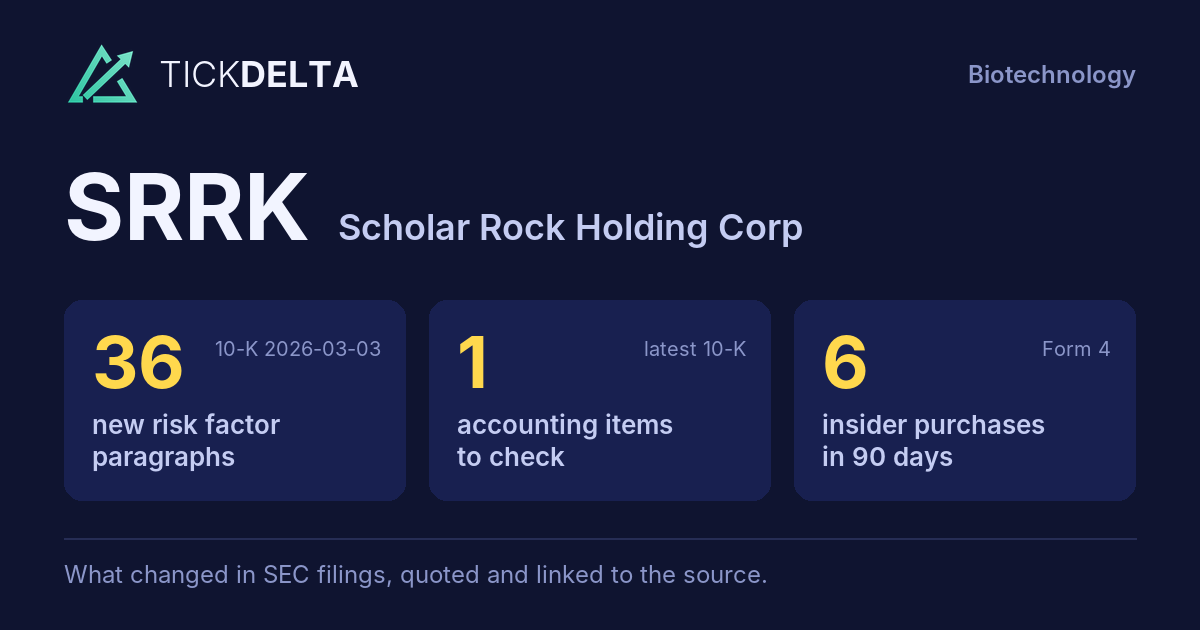
of the text changed · 37,375 words now · 36 new paragraphs, 29 gone
MD&A
34.3%
of the text changed · 5,666 words now · 13 new paragraphs, 19 gone
10-K 0001104659-26-022551 (Mar 3, 2026) vs 10-K 0001558370-25-001682 (Feb 27, 2025) Not compared: Legal Proceedings, Accounting Policies.
Every paragraph, and how much of it changed
One bar per paragraph, in the order of the 10-K. Height and colour show the share of its words not in the closest paragraph a year earlier; the tallest bars are new paragraphs.
Risk Factors
418 paragraphs · 36 new · 126 reworded · 29 gone · 10-K Mar 3, 2026 against Feb 27, 2025
New paragraph
Reworded (5% of its words or more)
Same or nearly
Paragraph 57 · 46% changed
Every version of it
Paragraph 369 · 46% changed
Every version of it
On February 10, 2025, 27, 2026, we entered into an terminated our previous Amended and Restated Loan and Security Agreement (the “Amended and Restated Loan and Security Agreement”) Agreement, dated as of February 10, 2025 with Oxford Finance LLC (“Oxford”). The Amended (“Oxford” and Restated such agreement, as amended, the “Existing Loan Agreement”) and entered into a Financing Agreement (the “Financing Agreement”) with certain funds managed by Blue Owl Capital Corporation (“Blue Owl”). Concurrently with the entry into the Financing Agreement, we also entered into a Pledge and Security Agreement amends and restates in its entirety that certain (the “Security Agreement”, together with the Financing Agreement, the “2026 Loan and Security Agreement dated as of October 16, 2020, as amended. Agreement”) with Blue Owl.
Paragraph 141 · 46% changed
Every version of it
Paragraph 224 · 45% changed
Every version of it
Paragraph 206 · 43% changed
Every version of it
The disaster recovery and business continuity plans we have in place may prove inadequate in the event of a serious disaster or similar event. We may incur substantial expenses as a result of the limited nature of our disaster recovery and business continuity plans, which could have a material adverse effect on our business. As part of our risk management policy, we maintain insurance coverage at levels that we believe are appropriate for our business. However, in the event of an accident or incident at our facilities, we cannot assure you that the amounts of insurance will be sufficient to satisfy any damages and losses. If our facilities, the manufacturing facilities of our third-party contract manufacturers, or the sites where we conduct clinical trials or preclinical studies, are unable to operate because of an accident or incident or for any other reason, even for a short period of time, our research and development programs may be harmed. Any business interruption may have a material and adverse effect on our business, financial condition, results of operations and prospects.
Paragraph 3 · 42% changed
Every version of it
The regulatory approval process for our product candidates apitegromab in the U.S., EU and other jurisdictions will be lengthy, time-consuming and inherently unpredictable and we may fail to receive or be delayed in receiving regulatory approval of apitegromab, SRK-181, SRK-439 or we may receive regulatory approval for only a subset of SMA patients. The CRL received from the FDA in September 2025 will require us to resubmit the apitegromab BLA and future product candidates. our progress toward potential commercialization of apitegromab has been delayed. The CRL could impact the current review process of our MAA with the EMA, which could result in a delay or a resubmission of the MAA to the EMA.
Paragraph 22 · 42% changed
Every version of it
The regulatory approval process for our product candidates apitegromab in the U.S., EU and other jurisdictions will be lengthy, time-consuming and inherently unpredictable and we may fail to receive or be delayed in receiving regulatory approval of apitegromab, SRK-181, SRK-439 or we may receive regulatory approval for only a subset of SMA patients. The CRL received from the FDA in September 2025 will require us to resubmit the apitegromab BLA and future product candidates. our progress toward potential commercialization of apitegromab has been delayed. The CRL could impact the current review process of our MAA with the EMA, which could result in a delay or a resubmission of the MAA to the EMA.
Paragraph 357 · 47% changed
Every version of it
10-K Feb 27, 2025Inflation and rapid increases in interest rates have led to a decline in the trading value of previously issued government securities with interest rates below current market interest rates. Although the U.S. Department of Treasury, FDIC and Federal Reserve Board have announced a program to provide up to $25 billion of loans to financial institutions secured by certain of such government securities held by financial institutions to mitigate the risk of potential losses on the sale of such instruments, widespread demands for customer withdrawals or other liquidity needs of financial institutions for immediate liquidity may exceed the capacity of such program. Additionally, there is no guarantee that the U.S. Department of Treasury, FDIC and Federal Reserve Board will provide access to uninsured funds in the future in the event of the closure of other banks or financial institutions, or that they would do so in a timely fashion.
10-K Mar 3, 2026
Department of Treasury, FDIC and Federal Reserve Board will provide access to uninsured funds in the future in the event of the closure of other banks or financial institutions, or that they would do so in a timely fashion.
Paragraph 57 · 46% changed
Every version of it
10-K Feb 27, 2025Apitegromab and SRK-181 are our two clinical-stage product candidates. Patients in ONYX, our long-term extension study for patients from both the TOPAZ and SAPPHIRE studies, are receiving apitegromab in conjunction with an approved SMN therapy. These patients are reliant on the continued use and availability of such therapies. If access to an approved SMN therapy such as nusinersen or risdiplam becomes limited or is unavailable, we may be forced to pause or stop our ONYX long-term extension trials, or the medical condition of patients may be affected which could negatively affect the efficacy and safety results for apitegromab in the trials or reduce the amount of data or confound the data from this trial. In May 2024, we initiated the Phase 2 EMBRAZE proof-of-concept trial of apitegromab in combination with approved GLP-1 RAs in obesity. This study relies upon the continued availability of such GLP-1 RA. Access to approved GLP-1 RAs are limited for use in clinical trials and may continue to be limited for such use. If GLP-1 RAs become more limited or unavailable, we may be unable to enroll, or may be delayed in enrolling patients, or may be forced to stop our Phase 2 study. While we have obtained substantial supply of an approved GLP-1 RA for use in this Phase 2 study, we cannot assure you that we will be able to obtain adequate supply for future studies of our product candidate in obesity. Patients in Part B of our ongoing Phase 1 DRAGON clinical trial of SRK-181 in patients with locally advanced or metastatic solid tumors that exhibit resistance to anti-PD-(L)1 antibody therapies are receiving SRK-181 in conjunction with an approved anti-PD-(L)1 therapy such as pembrolizumab. If access to the approved anti-PD-(L)1 therapy becomes limited or is unavailable, we may be forced to pause or stop our Phase 1 DRAGON clinical trial, or the medical condition of patients may be affected which could negatively affect the efficacy and safety results for SRK-181 in the trial. Any delay or suspension of our clinical trials would significantly and delay our clinical development programs and harm our business, financial condition and results of operations.
10-K Mar 3, 2026
becomes limited or is unavailable, we may be forced to pause or stop our ONYX or OPAL clinical trials, or the medical condition of patients may be affected which could negatively affect the efficacy and safety results for apitegromab in the trial or reduce the amount of data or confound the data from this trial. Any delay or suspension of our clinical trials would significantly delay our clinical development programs and harm our business, financial condition and results of operations.
Paragraph 369 · 46% changed
Every version of it
10-K Feb 27, 2025
On February 10, 2025, we entered into an Amended and Restated Loan and Security Agreement (the “Amended and Restated Loan and Security Agreement”) with Oxford Finance LLC (“Oxford”). The Amended and Restated Loan and Security Agreement amends and restates in its entirety that certain Loan and Security Agreement dated as of October 16, 2020, as amended.
10-K Mar 3, 2026
On February 27, 2026, we terminated our previous Amended and Restated Loan and Security Agreement, dated as of February 10, 2025 with Oxford Finance LLC (“Oxford” and such agreement, as amended, the “Existing Loan Agreement”) and entered into a Financing Agreement (the “Financing Agreement”) with certain funds managed by Blue Owl Capital Corporation (“Blue Owl”). Concurrently with the entry into the Financing Agreement, we also entered into a Pledge and Security Agreement (the “Security Agreement”, together with the Financing Agreement, the “2026 Loan Agreement”) with Blue Owl.
Paragraph 141 · 46% changed
Every version of it
10-K Feb 27, 2025In order to conduct later-stage clinical trials, or, if approved, produce commercial product, we will need to manufacture such product candidate in large quantities. In particular, we expect to rely on our contract manufacturers to scale our manufacturing processes for future clinical trials of apitegromab, and if our development efforts are successful and if apitegromab is approved, for commercial supply of apitegromab. We, or any manufacturing partners, may be unable to successfully increase the manufacturing capacity for apitegromab in a timely or cost-effective manner to meet our supply requirements. If we successfully commercialize any of our product candidates, we may be required to establish large-scale commercial manufacturing capabilities. As our drug development pipeline increases and matures, we will have a greater need for clinical study and commercial manufacturing capacity. In addition, quality-control issues may arise during scale-up activities. If we, or any manufacturing partners, are unable to successfully scale-up the manufacture of our product candidates in sufficient quality and quantity, the development, testing, clinical trials, and if approved, commercial supply, of that product candidate may be delayed or infeasible, and regulatory approval, commercial launch or commercial supply of any resulting product may be delayed or not received, which could significantly harm our business.
10-K Mar 3, 2026
To conduct later-stage clinical trials and, if approved, produce commercial product, we will need to manufacture our product candidates in larger quantities and at appropriate quality standards. We rely on third-party contract manufacturers to scale our manufacturing processes for our clinical programs, and if approved, for commercial supply. We and our manufacturing partners may be unable to increase manufacturing capacity in a timely or cost-effective manner, and quality control issues may arise during process scale-up, technology transfer, or commercial production. If we, or any manufacturing partners, are unable to scale manufacturing of our product candidates in sufficient quantity or quality, development activities, clinical trials, regulatory submissions, or approvals, or commercial launch and supply could be delayed, disrupted, or become infeasible, which could materially affect our business. In September 2025, we received a CRL from the FDA for the apitegromab BLA citing observations identified during an FDA inspection of a third-party fill-finish facility. The facility received a Form 483 in July 2025, the facility was classified as OAI and in November 2025 received a warning letter from the FDA. The observations were related to the facility and were not specific to apitegromab.
Paragraph 224 · 45% changed
Every version of it
10-K Feb 27, 2025In addition, in most foreign countries, including several EU Member States, the proposed pricing for a drug must be approved before it may be lawfully marketed. The requirements governing drug pricing and reimbursement vary widely from country to country. For example, the EU provides options for its Member States to restrict the range of medicinal products for which their national health insurance systems provide reimbursement and to control the prices of medicinal products for human use. Reference pricing used by various EU Member States and parallel distribution, or arbitrage between low-priced and high-priced Member States, can further reduce prices. A Member State may approve a specific price for the medicinal product or it may instead adopt a system of direct or indirect controls on the profitability of the company placing the medicinal product on the market. In some countries, we may be required to conduct a clinical study or other studies that compare the cost-effectiveness of any of our product candidates to other available therapies in order to obtain or maintain reimbursement or pricing approval. There can be no assurance that any country that has price controls or reimbursement limitations for pharmaceutical products will allow favorable reimbursement and pricing arrangements for any of our products. Historically, products launched in the EU do not follow price structures of the U.S. and generally prices tend to be significantly lower. Publication of discounts by third-party payors or authorities may lead to further pressure on the prices or reimbursement levels within the country of publication and other countries. If pricing is set at unsatisfactory levels or if reimbursement of our products is unavailable or limited in scope or amount, our revenues from sales by us or our strategic partners and the potential profitability of any of our product candidates in those countries would be negatively affected.
10-K Mar 3, 2026
Reference pricing used by various EU Member States and parallel distribution, or arbitrage between low-priced and high-priced Member States, can further reduce prices. Pricing negotiations in the EU are highly unpredictable and a Member State may approve a specific price for the medicinal product or it may instead adopt a system of direct or indirect controls on the profitability of the company placing the medicinal product on the market. In addition, regional decision-making, such as in Italy, Spain, and Germany, may lead to fragmented sub-national reimbursement requirements, duplicative reviews, or further restrictions on access. In some countries, we may be required to conduct a clinical study or other studies that compare the cost-effectiveness of any of our product candidates to other available therapies in order to obtain or maintain reimbursement or pricing approval. Generating such data may require substantial investment and time and may delay reimbursement approval or lead to conditional or temporary reimbursement that could be revoked if post-authorization evidence does not meet the expectations of payers.
Paragraph 206 · 43% changed
Every version of it
10-K Feb 27, 2025
The disaster recovery and business continuity plans we have in place may prove inadequate in the event of a serious disaster or similar event. We may incur substantial expenses as a result of the limited nature of our disaster recovery and business continuity plans, which could have a material adverse effect on our business. As part of our risk management policy, we maintain insurance coverage at levels that we believe are appropriate for our business. However, in the event of an accident or incident at our facilities, we cannot assure you that the amounts of insurance will be sufficient to satisfy any damages and losses. If our facilities, the manufacturing facilities of our third-party contract manufacturers, or the sites where we conduct clinical trials or preclinical studies, are unable to operate because of an accident or incident or for any other reason, even for a short period of time, our research and development programs may be harmed. Any business interruption may have a material and adverse effect on our business, financial condition, results of operations and prospects.
10-K Mar 3, 2026
The disaster recovery and business continuity plans we have in place may prove inadequate in the event of a serious disaster or similar event. We may incur substantial expenses as a result of the limited nature of our disaster recovery and business continuity plans, which could have a material adverse effect on our business. As part of our risk management
Paragraph 3 · 42% changed
Every version of it
10-K Feb 27, 2025
The regulatory approval process for our product candidates in the U.S., EU and other jurisdictions will be lengthy, time-consuming and inherently unpredictable and we may fail to receive or be delayed in receiving regulatory approval of apitegromab, SRK-181, SRK-439 and future product candidates.
10-K Mar 3, 2026
The regulatory approval process for apitegromab in the U.S., EU and other jurisdictions will be lengthy, time-consuming and inherently unpredictable and we may fail to receive or be delayed in receiving regulatory approval of apitegromab, or we may receive regulatory approval for only a subset of SMA patients. The CRL received from the FDA in September 2025 will require us to resubmit the apitegromab BLA and our progress toward potential commercialization of apitegromab has been delayed. The CRL could impact the current review process of our MAA with the EMA, which could result in a delay or a resubmission of the MAA to the EMA.
Paragraph 22 · 42% changed
Every version of it
10-K Feb 27, 2025
The regulatory approval process for our product candidates in the U.S., EU and other jurisdictions will be lengthy, time-consuming and inherently unpredictable and we may fail to receive or be delayed in receiving regulatory approval of apitegromab, SRK-181, SRK-439 and future product candidates.
10-K Mar 3, 2026
The regulatory approval process for apitegromab in the U.S., EU and other jurisdictions will be lengthy, time-consuming and inherently unpredictable and we may fail to receive or be delayed in receiving regulatory approval of apitegromab, or we may receive regulatory approval for only a subset of SMA patients. The CRL received from the FDA in September 2025 will require us to resubmit the apitegromab BLA and our progress toward potential commercialization of apitegromab has been delayed. The CRL could impact the current review process of our MAA with the EMA, which could result in a delay or a resubmission of the MAA to the EMA.
MD&A
98 paragraphs · 13 new · 42 reworded · 19 gone · 10-K Mar 3, 2026 against Feb 27, 2025
New paragraph
Reworded (5% of its words or more)
Same or nearly
Paragraph 53 · 49% changed
Paragraph 3 · 48% changed
We are a late-stage global biopharmaceutical company focused on dedicated to improving the discovery, development lives of children and delivery of innovative medicines for the treatment of serious diseases in which signaling by protein growth factors plays a fundamental role. adults with SMA and additional rare, severe and debilitating neuromuscular diseases. As a global leader in transforming growth factor beta (“TGFβ”) superfamily biology, the biology of TGFβ superfamily, our novel understanding of the molecular mechanisms of growth factor activation enabled us to develop the development of a proprietary platform for the discovery and development of monoclonal antibodies that locally and selectively target the precursor, or latent, forms of growth factors. By targeting the signaling proteins at the cellular level Based on our innovative, proprietary, and acting in the disease microenvironment, scalable technology platform, we believe we may avoid the historical dose-limiting safety challenges associated with inhibiting growth factors for therapeutic effect. We believe our focus on biologically validated growth factors may facilitate are building a more efficient development path. world-leading anti-myostatin pipeline.
Paragraph 17 · 47% changed
explore and continue research and development activities for SRK-181, apitegromab in other neuromuscular disorders, including the conduct of our planned Phase 1 DRAGON proof-of-concept 2 FORGE clinical trial; trial for apitegromab in FSHD;
Paragraph 5 · 42% changed
Paragraph 49 · 42% changed
o $4.2 $7.5 million decrease in costs associated with SRK-181 mostly due to purchases of pembrolizumab in 2023 which were used in the SRK-181, as our Phase 1 DRAGON clinical trial; trial is completed;
Paragraph 27 · 39% changed
manufacturing process-development, manufacturing of clinical supplies supplies, commercial drug supply prior to FDA approval and technology-transfer expenses;
Paragraph 48 · 37% changed
o $37.6 $11.5 million increase in costs associated with apitegromab primarily due to clinical trial costs, particularly an increase in drug supply manufacturing and the conduct initiation of ONYX, our long-term extension study for patients from both the TOPAZ and SAPPHIRE studies and our Phase 2 OPAL trial in SMA patients under two years of age, partially offset by decreases in clinical trial costs as our Phase 2 TOPAZ trial extension period, our Phase 3 SAPPHIRE clinical trial and our proof-of-concept Phase 2 EMBRAZE proof-of-concept study (including purchases of trial are completed;
Paragraph 33 · 36% changed
Research and development activities are central to our business model. Product candidates in later stages of clinical development generally have higher development costs than those in earlier stages of clinical development, primarily due to the increased size and duration of later-stage clinical trials, as well as the associated clinical trial material requirements. We expect research and development costs for our product candidates to continue to be substantial for the foreseeable future as the development programs progress. However, we do not believe that it is possible at this time to accurately project total program-specific expenses through commercialization. There are numerous factors associated with the successful commercialization of any of our product candidates, including future trial design and various regulatory requirements, many of which cannot be determined with accuracy at this time based on our stage of development. Additionally, future commercial and regulatory factors beyond our control will impact our clinical development programs and plans.
Paragraph 53 · 49% changed
10-K Feb 27, 2025General and administrative expense was $67.5 million for the year ended December 31, 2024 compared to $49.4 million for the year ended December 31, 2023, an increase of $18.1 million or 36.7%. The increase was primarily associated with employee-related costs including salaries, benefits and non-cash equity-based compensation expense related to increased headcount, in addition to an increase in professional service fees. We expect general and administrative expense to increase as we continue to invest in building the infrastructure to support the commercialization of apitegromab.
10-K Mar 3, 2026
headcount, an increase of $3.9 million in severance and other costs associated with our leadership change and an increase of $4.7 million in non-cash equity-based compensation expense related to increased headcount, including charges of $1.0 million related to the modification of certain equity awards.
Paragraph 3 · 48% changed
10-K Feb 27, 2025
We are a late-stage biopharmaceutical company focused on the discovery, development and delivery of innovative medicines for the treatment of serious diseases in which signaling by protein growth factors plays a fundamental role. As a global leader in transforming growth factor beta (“TGFβ”) superfamily biology, our novel understanding of the molecular mechanisms of growth factor activation enabled us to develop a proprietary platform for the discovery and development of monoclonal antibodies that locally and selectively target the precursor, or latent, forms of growth factors. By targeting the signaling proteins at the cellular level and acting in the disease microenvironment, we believe we may avoid the historical dose-limiting safety challenges associated with inhibiting growth factors for therapeutic effect. We believe our focus on biologically validated growth factors may facilitate a more efficient development path.
10-K Mar 3, 2026
We are a global biopharmaceutical company dedicated to improving the lives of children and adults with SMA and additional rare, severe and debilitating neuromuscular diseases. As a leader in the biology of TGFβ superfamily, our novel understanding of the molecular mechanisms of growth factor activation enabled the development of a proprietary platform for the discovery and development of monoclonal antibodies that locally and selectively target the precursor, or latent, forms of growth factors. Based on our innovative, proprietary, and scalable technology platform, we are building a world-leading anti-myostatin pipeline.
Paragraph 17 · 47% changed
10-K Feb 27, 2025
continue research and development activities for SRK-181, including the conduct of our Phase 1 DRAGON proof-of-concept clinical trial;
10-K Mar 3, 2026
explore and continue development activities for apitegromab in other neuromuscular disorders, including our planned Phase 2 FORGE clinical trial for apitegromab in FSHD;
Paragraph 5 · 42% changed
10-K Feb 27, 2025Apitegromab, an investigational, fully human monoclonal antibody that inhibits myostatin activation by selectively binding the pro- and latent forms of myostatin in skeletal muscle and is being developed for the treatment of SMA. We also believe apitegromab could have potential in the treatment of other neuromuscular disorders where the inhibition of myostatin may be beneficial.
10-K Mar 3, 2026
Apitegromab is a novel, investigational, fully human monoclonal antibody that inhibits myostatin activation by selectively binding the pro- and latent forms of myostatin in skeletal muscle. Myostatin is a catabolic agent that functions as a negative regulator of muscle mass, therefore inhibition of myostatin results in increased muscle mass and strength. Apitegromab is in development for the treatment of people with SMA and for the treatment of people with FSHD.
Paragraph 49 · 42% changed
10-K Feb 27, 2025
o $4.2 million decrease in costs associated with SRK-181 mostly due to purchases of pembrolizumab in 2023 which were used in the Phase 1 DRAGON clinical trial;
10-K Mar 3, 2026
o $7.5 million decrease in costs associated with SRK-181, as our Phase 1 DRAGON trial is completed;
Paragraph 27 · 39% changed
10-K Feb 27, 2025
manufacturing process-development, manufacturing of clinical supplies and technology-transfer expenses;
10-K Mar 3, 2026
manufacturing process-development, manufacturing of clinical supplies, commercial drug supply prior to FDA approval and technology-transfer expenses;
Paragraph 48 · 37% changed
10-K Feb 27, 2025
o $37.6 million increase in costs associated with apitegromab primarily due to clinical trial costs, particularly the conduct of ONYX, our long-term extension study for patients from both the TOPAZ and SAPPHIRE studies and our Phase 2 EMBRAZE proof-of-concept study (including purchases of
10-K Mar 3, 2026
o $11.5 million increase in costs associated with apitegromab primarily due to an increase in drug supply manufacturing and the initiation of our Phase 2 OPAL trial in SMA patients under two years of age, partially offset by decreases in clinical trial costs as our Phase 2 TOPAZ trial extension period, our Phase 3 SAPPHIRE clinical trial and our proof-of-concept Phase 2 EMBRAZE trial are completed;
Paragraph 33 · 36% changed
10-K Feb 27, 2025
Research and development activities are central to our business model. Product candidates in later stages of clinical development generally have higher development costs than those in earlier stages of clinical development, primarily due to the increased size and duration of later-stage clinical trials, as well as the associated clinical trial material requirements. We expect research and development costs for our product candidates to continue to be substantial for the foreseeable future as the development programs progress. However, we do not believe that it is possible at this time to accurately project total program-specific expenses through commercialization. There are numerous factors associated with the successful commercialization of any of our product candidates, including future trial design and various regulatory requirements, many of which cannot be determined with accuracy at this time based on our stage of development. Additionally, future commercial and regulatory factors beyond our control will impact our clinical development programs and plans.
10-K Mar 3, 2026
Research and development activities are central to our business model. Product candidates in later stages of clinical development generally have higher development costs than those in earlier stages of clinical development, primarily due to the increased size and duration of later-stage clinical trials, as well as the associated clinical trial material requirements. We expect research and development costs for our product candidates to continue to be substantial for the
A paragraph is matched with the one last year that shares the most of its words; under half in common makes it new. The paragraphs shown are the 8 reworded the most in each section.
The paragraph that changed most in each section
The redline
Marked against last year's 10-K: cut words struck through, new words highlighted.
Risk Factors439 words changed in this paragraph; it is 40% similar to last year's version.
The results or success of preclinical studies and early-stage clinical trials of our product candidates may not be predictive of future results or replicated in later preclinical studies or later-stage clinical trials. Preclinical studies and early-stage clinical trials are primarily designed to study PK and PD, understand the side effects of product candidates, and evaluate various doses and dosing schedules. Our current or future product candidates may demonstrate different chemical, biological and pharmacological properties in patients than they do in laboratory studies or may interact with human biological systems in unforeseen or harmful ways. Product candidates in later-stages of clinical trials may fail to show desired pharmacological properties or produce positive safety and efficacy results despite having progressed through preclinical studies and early-stage clinical trials. We completed a Phase 1 clinical trial for apitegromab in healthy adult volunteers and our Phase 2 TOPAZ clinical trial for the treatment of patients with Type 2 and Type 3 SMA. In 2024, we announced data from the Phase 2 TOPAZ trial extension period which showed patient outcomes at 48 months of treatment with apitegromab. These data show that continued treatment with apitegromab over the extended period was associated with sustained clinical benefit, a continued favorable safety profile with no new safety findings, and a retention rate of over 90% in patients with nonambulatory Types 2 and 3 SMA receiving SMN therapy. In January 2022, we initiated our Phase 3 SAPPHIRE clinical trial of apitegromab for the treatment of patients with Type 2 and Type 3 SMA and in October 2024, we announced positive top-line data from our Phase 3 SAPPHIRE clinical trial evaluating the efficacy and safety of apitegromab. We also announced in October 2023 our plans to expand into cardiometabolic disorders based on preclinical data with SRK-439, and we initiated the Phase 2 EMBRAZE proof-of-concept trial of apitegromab in combination with a GLP-1 RA in obesity in May 2024 with top-line results expected in the second quarter of 2025. We cannot assure you that any future clinical trials of apitegromab, such as our Phase 2 clinical trial in obesity, or of SRK-439 will show positive results. Additionally, product candidates evaluated in one disease indication may interact in unforeseen or harmful ways in a patient population with a different disease indication than was previously studied. For example, we have initiated a apitegromab was evaluated in our Phase 3 SAPPHIRE clinical trial for the treatment of patients with Type 2 and Type 3 SMA and apitegromab was evaluated in our Phase 2 EMBRAZE proof-of-concept trial in combination with tirzepatide in obesity. Top-line data from each clinical trial of have been released and apitegromab in obesity. Apitegromab may did not interact in unforeseen any new ways despite the different patient population and disease indications studied in each trial. We cannot assure you that any future clinical trials of apitegromab, such as our Phase 2 FORGE clinical trial in patients with FSHD, or any of our other anti-myostatin antibodies will show positive results or interact in ways similarly to that which was previously studied in a different ways in the obesity population than in the SMA patient population. disease indication. There can be no assurance that any of our current or planned clinical trials will ultimately be successful or support further clinical development of any of our product candidates. There can also be no assurance that any of our future clinical trials will show similar results to our earlier clinical trials or support further development or registration of any of our product candidates.
Source: Item 1A, 10-K 0001104659-26-022551 vs Item 1A, 10-K 0001558370-25-001682
MD&A261 words changed in this paragraph; it is 36% similar to last year's version.
Source: Item 7, 10-K 0001104659-26-022551 vs Item 7, 10-K 0001558370-25-001682
Sentences and paragraphs added, removed or reworded
Every change, by type
Sentences and paragraphs of SRRK's Risk Factors and MD&A, 10-K Mar 3, 2026 against 10-K Feb 27, 2025. Each links to the text at sec.gov.
Quiet changes are sentences kept from last year with one to four words changed, at least one of them a hedge, a modal or a qualifier (may, could, will, not, significant, material…). A year or date rolling forward is not counted.
The full word list
adverse, adversely, all, although, anticipate, anticipates, any, approximately, believe, believes, can, cannot, certain, could, expect, expects, generally, however, if, intend, intends, largely, likely, many, material, materially, may, might, most, must, never, no, not, possible, primarily, probable, should, significant, significantly, some, substantial, substantially, unlikely, will, would
AddedRisk Factors
Unfavorable pricing and reimbursement decisions in the EU could significantly delay or limit patient access to apitegromab, if approved, and materially reduce our anticipated revenues. Even if we obtain marketing authorization, the EU health technology assessment bodies and national payors may impose price reductions, require additional clinical or real world evidence, restrict reimbursement, or deny coverage altogether. Pricing and reimbursement negotiations in the EU are often lengthy, highly uncertain, and subject to country by country requirements, reference pricing, budget impact assessments, and mandatory discounts. As a result, the commercial viability of apitegromab in the EU may be materially impacted.
Read it in 10-K Mar 3, 2026 at sec.gov
AddedRisk Factors
In September 2025, we received a CRL from the FDA citing observations identified during an FDA inspection of a third-party fill-finish facility. This facility was issued a Form 483 by the FDA in July 2025 and the inspection classification of this facility is OAI. The observations were related to the facility and were not specific to apitegromab. The CRL did not cite any other approvability concerns, including apitegromab’s efficacy and safety data or the third-party drug substance manufacturer. In November 2025, we completed an in-person Type A meeting with the FDA that included participation of representatives from the third-party fill-finish facility. Also in November 2025, the third-party fill-finish facility received a warning letter from the FDA and continues to work with the FDA to resolve the outstanding issues cited in the warning letter. We plan to resubmit the apitegromab BLA at such time after the facility resolves the cGMP deficiencies identified in the CRL, however, there can be no guarantee of the timing of the facility’s resolution of those deficiencies or that the FDA will approve apitegromab upon our resubmission of the BLA. The CRL has delayed our progress toward potential commercialization of apitegromab and we may be subject to additional risks such as a loss of our competitive advantage, increased litigation and other regulatory issues.
Read it in 10-K Mar 3, 2026 at sec.gov
AddedRisk Factors
The CRL could also adversely affect the ongoing regulatory review of the apitegromab MAA by the EMA. As part of its review, the EMA has a mutual recognition agreement with the FDA, and we believe satisfactory resolution of the OAI classification will be necessary for MAA approval. The EMA may also require additional assurance regarding the
Read it in 10-K Mar 3, 2026 at sec.gov
AddedRisk Factors
suitability of manufacturing sites prior to approval which could result in a delay in review timelines. GMP non-compliance at the third-party fill-finish facility could, in the most adverse scenario, even result in a negative CHMP opinion and refusal of the MAA by the European Commission.
Read it in 10-K Mar 3, 2026 at sec.gov
AddedRisk Factors
inability to obtain, applicable regulatory approvals would delay or prevent commercialization of apitegromab and could materially adversely impact our business and prospects.
Read it in 10-K Mar 3, 2026 at sec.gov
AddedRisk Factors
Patients in ONYX, our long-term extension study for patients from both the TOPAZ and SAPPHIRE studies, and OPAL, our Phase 2 clinical trial of apitegromab in children under the age of two living with SMA, are receiving apitegromab in conjunction with an approved SMN targeted treatment. These patients are reliant on the continued use and availability of such treatments. If access to an approved SMN targeted treatment such as nusinersen or risdiplam
Read it in 10-K Mar 3, 2026 at sec.gov
AddedRisk Factors
candidate may be delayed by many factors, including, for example, challenges in reaching consensus with regulatory agencies regarding the scope of the necessary preclinical study program and/or appropriate preclinical study designs.
Read it in 10-K Mar 3, 2026 at sec.gov
AddedRisk Factors
For example, in September 2025, we received a CRL from the FDA citing observations identified during an FDA inspection of a third-party fill-finish facility. This facility was issued a Form 483 by the FDA in July 2025 and the inspection classification of this facility is OAI. The observations were related to the facility and were not specific to apitegromab. In November 2025, we completed an in-person Type A meeting with the FDA that included participation of representatives from the third-party fill-finish facility. Also in November 2025, the third-party fill-finish facility received a warning letter from the FDA and continues to work with the FDA to resolve the outstanding issues cited in the warning letter.
Read it in 10-K Mar 3, 2026 at sec.gov
Show the other 68
AddedRisk Factors
increased costs and could negatively affect our ability to develop and commercialize our product candidates in a timely manner or within budget.
Read it in 10-K Mar 3, 2026 at sec.gov
AddedRisk Factors
Failure to maintain compliance with cGMP can result in regulatory action against our third-party manufacturers, including FDA sanctions, which could disrupt our manufacturing and supply chain and lead to delays in our clinical development programs, regulatory submissions or approvals, or commercial supply, if approved. In addition, delays in securing or maintaining manufacturing capacity for drug substance, fill-finish, labeling and packaging, or failures by our contract manufacturers or suppliers to perform as required, could delay clinical trials, regulatory filings, or commercial launches, which could negatively affect our business.
Read it in 10-K Mar 3, 2026 at sec.gov
AddedRisk Factors
We are currently operating in a period of economic uncertainty and capital markets disruption, which has been significantly impacted by geopolitical instability, ongoing military conflicts, new regulatory activities and economic policies, high inflation and interest rates and the imposition of tariffs, other trade barriers and retaliatory countermeasures, any of which could have a material adverse effect on our business, financial condition and results of operations.
Read it in 10-K Mar 3, 2026 at sec.gov
AddedRisk Factors
U.S. and global markets have recently been experiencing volatility and disruption caused by economic uncertainty, including as a result of geopolitical instability, ongoing military conflicts, new regulatory activities and economic policies, and high inflation and interest rates. We are continuing to monitor global capital markets and assessing the potential impact of these factors on our business, including the impact on the supply chains we rely on for the manufacture of apitegromab, SRK-181, SRK-439, and any other current or future product candidates.
Read it in 10-K Mar 3, 2026 at sec.gov
RemovedRisk Factors
RemovedRisk Factors
RemovedRisk Factors
RemovedRisk Factors
RemovedRisk Factors
RemovedRisk Factors
RemovedRisk Factors
RemovedRisk Factors
RemovedRisk Factors
RemovedRisk Factors
RemovedRisk Factors
RemovedRisk Factors
RewordedRisk Factors
If we, or any manufacturing partners, are unable to successfully scale-up the manufacture scale manufacturing of our product candidates in sufficient quality and quantity, the development, testing, quantity or quality, development activities, clinical trials, and if approved, commercial supply, of that product candidate may be delayed regulatory submissions, or infeasible, and regulatory approval, approvals, or commercial launch and supply could be delayed, disrupted, or commercial supply of any resulting product may be delayed or not received, become infeasible, which could significantly harm materially affect our business.
Read it in 10-K Mar 3, 2026 at sec.gov
RewordedRisk Factors
We have conducted our Phase 2 TOPAZ clinical trial and Phase 3 SAPPHIRE clinical trial of apitegromab in the European Economic Area (“EEA”), trials and are currently conducting ONYX, our long-term extension clinical trial of apitegromab, apitegromab and OPAL, our Phase 2 clinical trial of apitegromab in children under the age of two living with SMA, in the EEA and the UK, and may conduct future clinical trials in the EEA or the UK and therefore may be subject to additional privacy laws. UK.
Read it in 10-K Mar 3, 2026 at sec.gov
RewordedRisk Factors
The EU General Data Protection Regulation (the “EU GDPR”) GDPR imposes a broad range of strict requirements on companies subject to the EU GDPR, that process personal data, including requirements relating to having legal bases and conditions for processing personal information relating to personal data and transferring such personal data outside the EEA or the UK, including to the U.S., providing details to those individuals regarding the processing of their personal information, information and, when relevant, data transfer agreement or other transfer mechanism in place for transfer of personal data from Europe to the US, keeping personal information secure, having data processing agreements with third parties who process personal information, responding to individuals’ requests to exercise their rights in respect of their personal information, where required reporting security breaches involving personal data to the competent national data protection authority and affected individuals, where required, appointing data protection officers, where required conducting data protection impact assessments for high risk processing, and record-keeping.
Read it in 10-K Mar 3, 2026 at sec.gov
RewordedRisk Factors
RewordedRisk Factors
The EU GDPR and UK GDPR may increase increases our responsibility and liability in relation to personal data that we process where such processing is subject to the EU GDPR and UK GDPR, and we may be required to put in place additional mechanisms to ensure compliance with the EU GDPR and UK GDPR, including as implemented by individual countries. GDPR.
Read it in 10-K Mar 3, 2026 at sec.gov
RewordedRisk Factors
Our increased reliance on personnel working from home may increase our cyber security risk, create data accessibility concerns, and make us more susceptible to workforce and communication disruptions, any of which could adversely impact our business operations or delay necessary interactions with local and federal regulators, ethics committees, manufacturing sites, research or clinical trial sites and other agencies and contractors.
Read it in 10-K Mar 3, 2026 at sec.gov
RewordedRisk Factors
If we must change manufacturers for any reason, we will may be required to verify that the qualify and validate a new manufacturer maintains facilities manufacturer’s facilities, processes and procedures that comply quality systems for compliance with quality standards and with all applicable regulations and guidelines. regulatory requirements, including cGMP.
Read it in 10-K Mar 3, 2026 at sec.gov
RewordedRisk Factors
RewordedRisk Factors
The use of certain artificial intelligence technology can give rise to intellectual property risks, including compromises to proprietary intellectual property and intellectual property infringement, for example where third-party data sources are used to train artificial intelligence models, or the output of artificial intelligence systems reproduce or incorporate third party intellectual property rights, in each case without the right to do so.
Read it in 10-K Mar 3, 2026 at sec.gov
RewordedRisk Factors
RewordedRisk Factors
The EU GDPR imposes penalties in the event of non-compliance, including fines of up to 10,000,000 20.0 million Euros or up to 2% of our total worldwide annual turnover (17.5 million GBP for certain comparatively minor offenses, or up to 20,000,000 Euros the UK) or up to 4% of our total worldwide annual turnover for more serious offenses.
Read it in 10-K Mar 3, 2026 at sec.gov
RewordedRisk Factors
Alternatively, if a court were to find the choice of forum provision contained in our amended and restated bylaws to be inapplicable or unenforceable in an action, we may incur additional costs associated with resolving such action in other jurisdictions, which could adversely affect our business and financial condition.
Read it in 10-K Mar 3, 2026 at sec.gov
Quiet changesRisk Factors
The third party CROs and clinical trial sites that conduct our clinical trials have experienced may experience staffing shortages and the inability of a CRO or clinical trial site to maintain appropriate levels of competent staffing to support the demands of our clinical trials could negatively impact the execution of our clinical trials.
Read it in 10-K Mar 3, 2026 at sec.gov
Quiet changesRisk Factors
The safety and efficacy profile of any product apitegromab will continue to be closely monitored by the FDA and comparable foreign regulatory authorities.
Read it in 10-K Mar 3, 2026 at sec.gov
Quiet changesRisk Factors
The degree of market acceptance of any product candidate, apitegromab, if approved for commercial sale, will depend on a number of factors, including:
Read it in 10-K Mar 3, 2026 at sec.gov
Quiet changesRisk Factors
We have no limited experience manufacturing our product candidates on a commercial scale.
Read it in 10-K Mar 3, 2026 at sec.gov
AddedMD&A
Our lead pipeline product candidates include apitegromab, a subcutaneous formulation of apitegromab, and SRK-439.
Read it in 10-K Mar 3, 2026 at sec.gov
AddedMD&A
In October 2024, we announced positive top-line results in SAPPHIRE, a pivotal Phase 3 clinical trial to evaluate the efficacy and safety of apitegromab in patients with non-ambulatory Type 2 and Type 3 SMA (which is estimated to represent the majority of the current prevalent SMA patient population in the U.S. and Europe). The study achieved its primary endpoint. At the March 2025 Muscular Dystrophy Association Clinical & Scientific Conference, we presented additional data from secondary endpoint analyses in which apitegromab demonstrated a clinically meaningful and consistent benefit in motor function across pre-specified patient subgroups. We submitted a BLA to the FDA in January 2025 and the BLA was granted priority review designation. Priority review designation conveys that the FDA has determined that if apitegromab is approved, it could offer significant improvement in the safety or effectiveness of treatment of the serious condition of SMA. In September 2025, we received a CRL from the FDA related to observations identified during an FDA site inspection of a third-party fill-finish facility. The facility was issued a Form 483 by the FDA in July 2025 and the inspection classification of this facility is OAI. The observations were related to the facility and were not specific to apitegromab. The CRL did not cite any other approvability concerns, including apitegromab’s efficacy and safety data or the third-party drug substance manufacturer. In November 2025, we completed an in-person
Read it in 10-K Mar 3, 2026 at sec.gov
AddedMD&A
Type A meeting with the FDA that included participation of representatives from the third-party fill-finish facility. Also in November 2025, the third-party fill-finish facility received a warning letter from the FDA and continues to work with the FDA to resolve the outstanding issues cited in the warning letter. We plan to resubmit the apitegromab BLA at such time after the facility resolves the cGMP deficiencies identified in the CRL, however, there can be no guarantee of the timing of the facility’s resolution of those deficiencies or that the FDA will approve apitegromab upon our resubmission of the BLA. In March 2025 we submitted to the EMA and received validation of our MAA for apitegromab for the treatment of SMA. Validation confirms that the application includes the essential regulatory elements required for scientific assessment of the MAA and the scientific evaluation process by the EMA’s Committee for Medicinal Products for Human Use can begin. If apitegromab is approved by the FDA or EMA, we expect to initiate a commercial product launch in the applicable jurisdictions upon approval.
Read it in 10-K Mar 3, 2026 at sec.gov
AddedMD&A
A Phase 2 study evaluating apitegromab in patients with FSHD is expected to initiate in mid-2026. We see potential for apitegromab broadly in additional rare, severe, and debilitating neuromuscular diseases where muscle atrophy is a key component of disease pathogenesis, and we are actively exploring indications beyond SMA and FSHD.
Read it in 10-K Mar 3, 2026 at sec.gov
AddedMD&A
In addition to the current IV formulation, we are developing a SC formulation of apitegromab. A Phase 1 study in healthy volunteers has been completed, demonstrating that SC apitegromab has favorable bioavailability and a comparable pharmacodynamic profile relative to IV apitegromab. Further development activities are ongoing, including planned FDA and EMA regulatory engagements.
Read it in 10-K Mar 3, 2026 at sec.gov
AddedMD&A
Our clinical-stage pipeline also includes SRK-439, a novel, investigational, subcutaneously administered fully human anti-pro/latent myostatin antibody that has high inhibitory potency while maintaining selectivity towards myostatin. SRK-439 is being developed for the treatment of patients with rare, severe, and debilitating neuromuscular diseases. A Phase 1 study of SRK-439 in healthy volunteers is currently underway, with topline data anticipated in the second half of 2026.
Read it in 10-K Mar 3, 2026 at sec.gov
AddedMD&A
Beyond our clinical-stage product candidates, our early-stage pipeline includes additional programs for the treatment of patients with rare, severe, and debilitating neuromuscular diseases.
Read it in 10-K Mar 3, 2026 at sec.gov
AddedMD&A
As we focus our strategy on rare neuromuscular diseases, we are currently seeking partnerships for our additional programs. These programs include: SRK-181, a Phase 2-ready investigational inhibitor of latent TGFβ1 in development for the treatment of patients with solid tumors that are resistant to anti-PD-(L)1 antibody therapies; SRK-373, an investigational, highly selective inhibitor of the latent TGFβ1 isoform with selective activity in the fibrotic extracellular matrix, in preclinical development for the treatment of fibrotic diseases; and SRK-256, an investigational inhibitor of RGMc, or hemojuvelin, in preclinical development for the treatment of iron-restricted anemias. We are also seeking partners to further evaluate the potential for myostatin inhibition in combination with GLP-1 weight loss approaches following our positive Phase 2 EMBRAZE study, demonstrating proof-of-concept in the ability of apitegromab to drive statistically significant preservation of lean mass during tirzepatide-induced weight loss.
Read it in 10-K Mar 3, 2026 at sec.gov
AddedMD&A
Using our innovative approach and proprietary platform, we are creating a pipeline of novel product candidates that selectively modulate growth factor activation implicated in rare, severe, and devastating neuromuscular diseases.
Read it in 10-K Mar 3, 2026 at sec.gov
AddedMD&A
candidates and supported our internal research and development efforts and made interest payments on our debt, partially offset by proceeds from our debt facility, sales under our ATM program and the exercises of stock options and common warrants.
Read it in 10-K Mar 3, 2026 at sec.gov
AddedMD&A
In February 2026, we entered into the 2026 Loan Agreement with Blue Owl for up to $350.0 million, of which $100.0 million of the initial term loan (the “Initial Term Loan”) was received in February 2026. We used the proceeds of the Initial Term Loan upon the closing under the 2026 Loan Agreement to repay all outstanding obligations, totaling $103.7 million, under the Existing Loan Agreement with Oxford and upon such repayment, terminated the Existing Loan Agreement. The amount repaid by the Company included $100.0 million of outstanding indebtedness plus accrued and unpaid interest as of February 27, 2026 (the “Closing Date”) and fees. As a result of the termination, all credit commitments under the Existing Loan Agreement were terminated and all security interests and guarantees executed in connection with the Existing Loan Agreement were released.
Read it in 10-K Mar 3, 2026 at sec.gov
AddedMD&A
An initial delayed draw term loan commitment in an aggregate principal amount not to exceed $100.0 million will be available after the Closing Date until the earliest of the full usage thereof, termination thereof and March 31, 2026 (the “DDTL-1 Commitments”, and any term loans made with respect thereto, the “DDTL-1 Term Loans”), which we may borrow at our sole option upon satisfying certain customary conditions, including satisfaction of the minimum cash covenant.
Read it in 10-K Mar 3, 2026 at sec.gov
RemovedMD&A
RemovedMD&A
RemovedMD&A
RemovedMD&A
RemovedMD&A
RemovedMD&A
RemovedMD&A
RemovedMD&A
RemovedMD&A
RemovedMD&A
RemovedMD&A
RemovedMD&A
RewordedMD&A
Total research and development expenses are expected to continue to be substantial, driven by employee compensation costs and development costs associated with our manufacture of drug supply, as well as development of our clinical stage programs as we continue development activities for apitegromab in SMA, including the completion of our Phase 3 SAPPHIRE pivotal clinical trial in SMA, the conduct of ONYX, the conduct of our long-term extension study for Phase 2 OPAL trial in SMA patients from both under the TOPAZ and SAPPHIRE studies and age of two, the associated drug supply, conduct of our planned Phase 2 FORGE trial in FSHD patients, as well as costs associated with supporting our cardiometabolic anti-myostatin program, including our Phase 2 EMBRAZE proof-of-concept trial of apitegromab and our preclinical program, SRK-439.
Read it in 10-K Mar 3, 2026 at sec.gov
RewordedMD&A
The change was primarily the result of proceeds from our equity offering completed in October 2024 and exercises of stock options and warrants, partially offset by due to cash used to operate our business, including payments related to, among other things, research and development and general and administrative expenses as we continued to invest in our product candidates and supported our internal research and development efforts and made interest payments on our debt.
Read it in 10-K Mar 3, 2026 at sec.gov
RewordedMD&A
RewordedMD&A
RewordedMD&A
The change in other income (expense), net was primarily attributable to an increase in interest income earned due to higher interest rates and higher average balances in our cash, cash equivalents and marketable securities, partially offset by an increase in interest expense related to the Loan and Security Agreement, also due to higher interest rates. securities.
Read it in 10-K Mar 3, 2026 at sec.gov
RewordedMD&A
Our current ATM program, program with Jefferies, established in November 2022, allows for the sale of shares of our common stock having an aggregate offering price of up from time to $100 million. time in “at-the-market offerings” through Jefferies as the Company’s sales agent.
Read it in 10-K Mar 3, 2026 at sec.gov
RewordedMD&A
General and administrative expense was $176.2 million and $67.5 million for the year years ended December 31, 2024 compared to $49.4 million for the year ended December 31, 2023, 2025 and 2024, respectively, an increase of $18.1 $108.7 million or 36.7%. 161.0%.
Read it in 10-K Mar 3, 2026 at sec.gov
RewordedMD&A
Net cash provided by financing activities was $228.4 million for the year ended December 31, 2025, compared to $353.0 million for the year ended December 31, 2024, compared to $102.6 million for the year ended December 31, 2023. 2024.
Read it in 10-K Mar 3, 2026 at sec.gov
RewordedMD&A
As a global leader in transforming growth factor beta (“TGFβ”) superfamily biology, the biology of TGFβ superfamily, our novel understanding of the molecular mechanisms of growth factor activation enabled us to develop the development of a proprietary platform for the discovery and development of monoclonal antibodies that locally and selectively target the precursor, or latent, forms of growth factors.
Read it in 10-K Mar 3, 2026 at sec.gov
RewordedMD&A
We expect general and administrative expense expense, excluding the $18.6 million in charges associated with the leadership change, to increase continue to be substantial as we continue to invest in building the infrastructure to support the commercialization of apitegromab.
Read it in 10-K Mar 3, 2026 at sec.gov
RewordedMD&A
We have funded our operations to date primarily with proceeds from the sale of our convertible preferred stock and units in private placements before our IPO, and issuance of our common stock through our IPO in 2018, to Gilead in an exempt private placement, through multiple secondary public offerings, including our recent follow-on offering in October 2024 (see Note 9) offerings and through at-the-market “at-the-market offerings” (“ATM”) sales, as well as payments from our research collaborations and the Loan and Security Agreement entered into in October 2020 and subsequently amended (see Note 13). 14).
Read it in 10-K Mar 3, 2026 at sec.gov
RewordedMD&A
Sources
The two latest 10-Ks on EDGAR, section by section. Each change links to the text at sec.gov.
Also
New risk factors: paragraphs with nothing like them last year, quoted in full.
Work with it
Excel workbook · CSV. Google Sheet that stays up to date: paste =IMPORTDATA("https://tickdelta.com/company/SRRK/export.csv") into a cell.