Screener / SEC EDGAR /CIK 0000921638 /10-K filed Feb 17, 2026, compared with Feb 18, 2025 /Numbers from the XBRL of the 10-Ks
Nasdaq, OTC Financials · Mineral Royalty Traders

SSR Mining Inc. SSRM

Compare with peers Embed
SEC comment letters, last 20 years

5 reviews of SSRM's filings by SEC staff

UPLOAD and CORRESP
Reviews 5 latest letter May 2, 2022
Questions asked 41 each answered in the company's own letter
No closing letter 0 reviews without a letter saying the staff completed it

When the SEC's staff reviews a filing, it writes to the company with numbered questions, and the company answers each one in a letter. SEC publishes the exchange once the review is over, at least 20 business days later. A question is not an accusation; most reviews end with the company adding detail to its next filing.

How the reviews went

Every review on EDGAR, from the first staff letter to the letter that closes it

  1. 1. Staff letters 10 UPLOAD
  2. 2. Questions in them 41 numbered comments
  3. 3. Company replies 9 CORRESP
  4. 4. Reviews closed 5 of 5 closing letter

Half the closed reviews took 75 days or less from the first letter to the closing letter.

Form 10-K for the fiscal year ended December 31, 2021

2022-05-02 to 2022-07-18 · 15 questions · 2 letters from the SEC, 2 from the company
Review closed 2022-07-18
Reserves and insuranceNon-GAAP measuresResults discussion (MD&A)AcquisitionsInventory
Item 2. Properties, page 43
SEC asked (1)
Summary disclosure should include a summary of all properties including material and non-material properties pursuant to Item 1303(a) of Regulation S-K. In a section identified as "Summary Disclosure" please revise to include the required information under Item 1303(b) of Regulation S-K for all properties.
SSRM answered
The Company is filing simultaneously with this response

Form 10-K/A, amending the Form 10-K to incorporate the changes identified in the responses to Staff comments 1, 2, 3, 4, and 5 of the

Previous Letter.
Read in the reply
In its next report

First report after the company's reply of Jul 11, 2022: 10-Q filed Aug 2, 2022 ↗.

No earlier 10-Q before the SEC's letter is in Tickdelta, so there is nothing to compare with.
Item 2. Properties, page 43
SEC asked (2)
Please revise your individual property disclosure to include the following information for each material property pursuant to Item 1304(b) of Regulation S-K: • The location, accurate to within one mile, using an easily recognizable coordinate system. • The total cost for or book value of the property and its associated plant and equipment.
SSRM answered
The Company acknowledges the Staff’s position with respect to an initial assessment and a feasibility study being combined in a single technical report summary. The Company will remove the initial assessment from the CDMP21TRS and file such initial assessment as a separate, standalone technical report summary (the “Initial

Assessment”). The Company will file the Initial Assessment as soon as practicable, which will be at least one day prior to the Company filing the amended technical report summaries as described in the Company’s response to the Staff’s comment 3, below.
Read in the reply
In its next report

First report after the company's reply of Jul 11, 2022: 10-Q filed Aug 2, 2022 ↗.

No earlier 10-Q before the SEC's letter is in Tickdelta, so there is nothing to compare with.

Item 2. Properties, page 43
SEC asked (3)
Resource and reserve disclosure is required for each material property pursuant to Item 1304(d)(1) of Regulation S-K. Please include this information with your individual property disclosure or include a reference from within your individual property disclosure identifying where this information is located.
SSRM answered
The Company will file amended technical report summaries with the changes identified in the Company’s previous responses to Staff comments 7, 8, 9, 10, and 11 as soon as practicable and no later than September 30, 2022. The changes to the technical report summaries will not modify the existing Mineral Resource and Mineral

Reserve information previously included in the technical report summaries filed as part of the Form 10-K.

******************

We hope that our letter has addressed the Staff’s comments.
Rest of the answer

If you have any questions or require any additional information with respect to the above, please call the undersigned at (303) 292-1299.

Read in the reply
In its next report

First report after the company's reply of Jul 11, 2022: 10-Q filed Aug 2, 2022 ↗.

No earlier 10-Q before the SEC's letter is in Tickdelta, so there is nothing to compare with.

Item 2. Properties, page 43
SEC asked (4)
We note your disclosure on page 71 that your Çöpler reserve is reported on a 100% basis. Please ensure all disclosure of mineral resources and reserves is only for the portion of resources or reserves attributable to your interest in the property as required by Item 1303(b)(3)(iii) of Regulation S-K.
SSRM answered

No numbered answer found in the reply. Read the reply ↗

In its next report

First report after the company's reply of Jul 11, 2022: 10-Q filed Aug 2, 2022 ↗.

No earlier 10-Q before the SEC's letter is in Tickdelta, so there is nothing to compare with.

Item 2. Properties, page 43
SEC asked (5)
Please revise to include the disclosure required under Item 1304(e) of Regulation S-K.
SSRM answered

No numbered answer found in the reply. Read the reply ↗

In its next report

First report after the company's reply of Jul 11, 2022: 10-Q filed Aug 2, 2022 ↗.

No earlier 10-Q before the SEC's letter is in Tickdelta, so there is nothing to compare with.

Management's Discussion and Analysis of Financial Condition and Results of Operations · Non-GAAP Financial Measures, page 112
SEC asked (6)
We note that you exclude fair value adjustments on acquired assets related to the acquisition of Alacer's inventories and mineral properties. Please tell us in greater detail how you determined that these are appropriate non-GAAP adjustments. This comment should also be applied to the presentation within your earnings release filed on Form 8- K.
SSRM answered

No numbered answer found in the reply. Read the reply ↗

In its next report

First report after the company's reply of Jul 11, 2022: 10-Q filed Aug 2, 2022 ↗.

No earlier 10-Q before the SEC's letter is in Tickdelta, so there is nothing to compare with.

Item 15. Exhibits · 96.1, 96.2, 96.3, and 96.4, page 171
SEC asked (7)
We note that your qualified person(s) has included language at the beginning of each technical report under the "Important Notice" heading that appears to disclaim certain information in the technical reports. For example, your qualified person states that information and data supplied has been assumed to be accurate and complete.
Rest of the question

Another statement under this heading indicates that the qualified person does not warrant the accuracy of estimates and approximations, and estimates and approximations will be prone to fluctuations. In order to comply with Item 1302(a)(1) of Regulation S-K disclosure of exploration results, mineral resources, and mineral reserves must be based on and accurately reflect information and supporting documentation prepared by a qualified person. Information should be reviewed and accepted by the qualified person and disclaimers are not permitted notwithstanding the specific exceptions in which a qualified person may rely. Please revise.

SSRM answered

No numbered answer found in the reply. Read the reply ↗

In its next report

First report after the company's reply of Jul 11, 2022: 10-Q filed Aug 2, 2022 ↗.

No earlier 10-Q before the SEC's letter is in Tickdelta, so there is nothing to compare with.

Item 15. Exhibits · 96.1, 96.2, 96.3, and 96.4, page 171
SEC asked (8)
We note that you have combined a feasibility study and an initial assessment into a single technical report summary for your property in Turkey. Pursuant to the definitions in Item 1300 of Regulation S-K an initial assessment and a feasibility study are two different types of technical studies and therefore should not be combined.
Rest of the question

Each study must must include the minimum sections identified under Item 601(96)(iii) of Regulation S-K. Please revise accordingly.

SSRM answered

No numbered answer found in the reply. Read the reply ↗

In its next report

First report after the company's reply of Jul 11, 2022: 10-Q filed Aug 2, 2022 ↗.

No earlier 10-Q before the SEC's letter is in Tickdelta, so there is nothing to compare with.

Item 15. Exhibits · 96.1, 96.2, 96.3, and 96.4, page 171
SEC asked (9)
We note several instances in your technical reports referencing work completed by other individuals that have not been identified as qualified persons in the technical report. For example, page 92 of the Marigold technical report states that SSR has prepared the mineral resource estimate for Marigold and page 95 of the Puna technical report states that the Chinchillas mineral resource was developed by independent
Rest of the question

consultant company Red Pennant Geoscience. In order to comply with Item 1302 (a)(1) of Regulation S-K, qualified person. A qualified person must review and accept this information and provide a statement to this effect in the particular section of the technical report summary. Please revise your technical reports as necessary.

SSRM answered

No numbered answer found in the reply. Read the reply ↗

In its next report

First report after the company's reply of Jul 11, 2022: 10-Q filed Aug 2, 2022 ↗.

No earlier 10-Q before the SEC's letter is in Tickdelta, so there is nothing to compare with.

Item 15. Exhibits · 96.1, 96.2, 96.3, and 96.4, page 171
SEC asked (10)
Please revise your technical reports to include the following information as required by Item 601 (96)(iii) of Regulation S-K or, in the alternative, tell us where this information is located: • For Çöpler Item 601 (96)(iii)(B)(8)(iv), (9)(iii), (10)(v), (11)(vii), and (17)(vi). • For Marigold Item 601 (96)(iii)(B)(9)(iii), (10)(v), (11)(iii), (11)(vii), (17)(vi), and (18)(i) (accuracy level).
Rest of the question

• For Puna Item 601 (96)(iii)(B)(8)(iv) (for Pirquitas), (9)(iii), (10)(v), (17)(vi), and • For Seabee Item 601 (96)(iii)(B)(8)(iv), (9)(iii), (10)(v), (11)(iii), (11)(vii), (17)(vi), and (18)(i) (accuracy level).

SSRM answered

No numbered answer found in the reply. Read the reply ↗

In its next report

First report after the company's reply of Jul 11, 2022: 10-Q filed Aug 2, 2022 ↗.

No earlier 10-Q before the SEC's letter is in Tickdelta, so there is nothing to compare with.

Item 15. Exhibits · 96.1, 96.2, 96.3, and 96.4, page 171
SEC asked (11)
Please revise the "Reliance on Information Provided by the Registrant" section of your technical reports to identify the particular portions of the technical report summary that were prepared in reliance on information provided by the registrant and the extent of the reliance as required by Item 1302 (f)(2)(ii).
SSRM answered

No numbered answer found in the reply. Read the reply ↗

In its next report

First report after the company's reply of Jul 11, 2022: 10-Q filed Aug 2, 2022 ↗.

No earlier 10-Q before the SEC's letter is in Tickdelta, so there is nothing to compare with.

Exhibit 99.1 · Fourth Quarter and Full Year 2021 Highlights, page 2
SEC asked (12)
We note that you provide a full-year 2022 guidance range for All-in Sustaining Costs ("AISC"). Given the lack of similar quantitative reconciliation between the GAAP and non-GAAP information, please clarify how your presentation satisfies the requirements outlined within Item 10(e)(1)(i)(A) of Regulation S-K.
Rest of the question

Reference is also made to Question 102.10 of the Compliance and Disclosure Interpretations for Non-GAAP Financial Measures.

SSRM answered

No numbered answer found in the reply. Read the reply ↗

In its next report

First report after the company's reply of Jul 11, 2022: 10-Q filed Aug 2, 2022 ↗.

No earlier 10-Q before the SEC's letter is in Tickdelta, so there is nothing to compare with.

SEC letter of Jun 22, 2022 ↗ no reply letter on EDGAR
Form 10-K for the Fiscal Year Ended December 31, 2021 · Item 2. Properties, page 45
SEC asked (1)
We note your response to comments 1, 2, 3, 4, and 5. Considering the number of proposed revisions please file an amended filing that includes the proposed changes.
SSRM answered

No reply letter found.

In its next report

First report after the SEC's letter of Jun 22, 2022: 10-Q filed Aug 2, 2022 ↗.

No earlier 10-Q before the SEC's letter is in Tickdelta, so there is nothing to compare with.

Item 15. Exhibits · 96.1, 96.2, 96.3, and 96.4, page 171
SEC asked (2)
We note your response to comment 8 and we do not concur with your assessment. Combining the two different types of studies is inconsistent with the definitions of an initial assessment and a feasibility study. Refer to the definition requirements under Item 1300 of Regulation S-K and Table 1 of Item 1302. Please revise.
SSRM answered

No reply letter found.

In its next report

First report after the SEC's letter of Jun 22, 2022: 10-Q filed Aug 2, 2022 ↗.

No earlier 10-Q before the SEC's letter is in Tickdelta, so there is nothing to compare with.

Item 15. Exhibits · 96.1, 96.2, 96.3, and 96.4, page 171
SEC asked (3)
Please file amended technical reports with the changes identified in your responses to comments 7, 8, 9, 10, and 11.
SSRM answered

No reply letter found.

In its next report

First report after the SEC's letter of Jun 22, 2022: 10-Q filed Aug 2, 2022 ↗.

No earlier 10-Q before the SEC's letter is in Tickdelta, so there is nothing to compare with.

Also in this review: company letter, May 27, 2022, closing letter, 2022-07-18
Form 40-F

2017-12-11 to 2018-06-15 · 6 questions · 3 letters from the SEC, 4 from the company
Review closed 2018-06-15
Reserves and insurance
Exhibit 99.3 – Consolidated Financial Statements for the fiscal year ended December 31, 2016 · Note 2(i)(ii) – Exploration and evaluation expenditures, page 16
SEC asked (1)
Please clarify whether your capitalized exploration and evaluation expenditures are accounted for as assets under IFRS 6 or IAS 16.
SSRM answered
We notify the Staff that the Company’s capitalized exploration and evaluation expenditures are accounted for under IFRS 6.
Read in the reply
Note 2(i)(iii) – Development expenditures, page 16
SEC asked (2)
You disclose that capitalized exploration and evaluation assets are not reclassified to mineral properties until approval has been obtained to commence development and construction of the mine. Please explain what approvals are obtained, and from whom, pursuant to your determination to reclassify these assets.
SSRM answered
We notify the Staff that expenditures are reclassified from an exploration and evaluation asset to a mineral property when the project is considered to be technically feasible and economically viable in accordance with IFRS 6 paragraph 17. It is a management judgment as to whether the project has met the requirements of technical feasibility and economic viability as per IFRS 6, and as part of the Company’s internal governance procedures this judgement is confirmed by the approval by the Company’s Board of Directors to commence development and construction of the mine, at which point
Rest of the answer

reclassification occurs.

If you have any further questions or additional comments concerning the foregoing, please contact me at (604) 689-3846.

Read in the reply
Exhibit 99.3 – Consolidated Financial Statements for the fiscal year ended December 31, 2016 · Note 2(i)(ii) – Exploration and evaluation expenditures, page 16
SEC asked (1)
We note from your response that your capitalized evaluation and exploration expenditures are accounted for under IFRS 6. We also note from your disclosure that you commence capitalization only after a) a mineral reserve has been established and/or there is a history of conversion to mineral reserves at operating mines, and b) necessary permits, access to critical resources and environmental programs exist or are
Rest of the question

reasonably obtainable. Please tell us why you believe these criteria do not demonstrate technical feasibility and commercial viability. Alternatively, if you believe these criteria do demonstrate technical feasibility and commercial viability, please tell us how your accounting for these capitalized costs is within the scope of IFRS 6, paragraphs 5(b) and 17.

SSRM answered
In our judgment there is a higher threshold to meet the concept of demonstrable technical feasibility and commercial viability, which would require us to recognize a mineral property asset, than there is for capitalizing exploration and evaluation expenses under IFRS 6. We appreciate the terms are similar, and for the majority of projects our point of recognition of exploration and evaluation assets will be identical as that to recognize a mineral property.
Rest of the answer

However, for certain projects, particularly where authorizations are only considered to be reasonably obtainable, additional work may be required to enable us to conclude with confidence that the requirement for demonstrable technical feasibility and commercial viability has been achieved. For example, additional work may relate to critical permits, our social license to operate (community authorization or surface use agreements), or other authorizations to make it probable that all regulatory requirements for a project to start to be developed can be confidently fulfilled.

Read in the reply
Note 2(i)(iii) – Development expenditures, page 16
SEC asked (2)
In your response to our prior comment 2 you state that expenditures are reclassified from an exploration and evaluation asset to a mineral property when the project is considered to be technically feasible and economically viable in accordance with IFRS 6, and that judgment is confirmed by your Board of Directors.
Rest of the question

Please tell us what factors and indicators your management and Board of Directors consider in concluding that technical feasibility and economic viability have been demonstrated.

SSRM answered
In order to determine whether a project is considered to be technically feasible and commercially viable management and the Board of Directors will consider all material aspects of a project: the economics of the project based upon appropriate economic parameters such as metal prices, exchange rates; Mineral Reserves and current mine plans with sufficiently detailed engineering and cost estimates; the prevailing political landscape within the host country; and an assessment as to our confidence in obtaining the necessary permits and government and community authorizations.

If you have any
Rest of the answer

further questions or additional comments concerning the foregoing, please contact me at (604) 689-3846.

Read in the reply
Exhibit 99.3 – Consolidated Financial Statements for the fiscal year ended December 31, 2016 · Note 2(i)(ii) – Exploration and evaluation expenditures, page 16
SEC asked (1)
In your response to comment 1 you state that your threshold for demonstrating technical feasibility and commercial viability in regards to permits, social license and other authorizations is higher than “reasonable confidence” but rather is based on whether it is “probable that all regulatory requirements for a project to start to be developed can be confidently fulfilled.” We note that the CIM Definition Standards
Rest of the question

state that a Mineral Reserve is the economically minable part of a mineral resource supported by a Feasibility or Preliminary Feasibility Study that includes “adequate information on mining, processing, metallurgical, economic and other relevant factors that demonstrate, at the time of reporting, that economic extraction can be justified.” [emphasis added] Please clarify whether it is your conclusion that the existence of proven and/or probable Mineral Reserves consistent with the CIM definition standards does not constitute a probable future benefit sufficient to justify capitalization of expenditures pursuant to IAS 16.

SSRM answered
IAS 16 requires a probable benefit to the Company to justify capitalization of expenditures, which is broadly consistent with our accounting policy for capitalizing exploration and evaluation costs in accordance with IFRS 6. This is generally consistent with the establishment of Mineral Reserves, but not always.

We believe that in certain circumstances the interpretation of what is of probable benefit to the Company under our accounting policy may be different from the criteria a Qualified Person (QP) would apply consistent with the CIM definition.
Rest of the answer

For example, the CIM definition states that ‘economic extraction could reasonably be justified”, whereas our accounting policy relies upon the concept of a probable benefit to the Company, which may be different. Our consideration of determining whether there is a probable benefit to us also considers other factors in the context of our organization, such as our ability to fund, external financing requirements, social license, returns on investment etc. that would be critical for us to make a development decision.

Our reclassification of assets from Exploration and Evaluation assets (IFRS 6) to mineral property assets (IAS 16) is not directly based upon probable benefit (as that has already been established through our IFRS 6 accounting policy), but rather when we consider a project to be technically feasible and commercially viable in accordance with IFRS 6. We believe that in certain circumstances, the presence of a Mineral Reserve alone is not sufficient to demonstrate the technical feasibility and commercial viability of a project to the Company.

This circumstance is evidenced by our Pitarrilla project, in Durango State, Mexico, which had a Mineral Reserve estimate defined in a feasibility study completed in December 2012. At the time the Pitarrilla Feasibility study was completed in 2012, we had reasonable expectations of obtaining all approvals for the project, so thereafter we capitalized expenditures in accordance with our accounting policy for exploration and evaluation assets under IFRS 6. However, other factors existed that led us to conclude that we could not establish commercial viability within the context of our accounting policy. The project required capital expenditures beyond our capability to fund. Advancing the project required a partner and/or significant financing and our confidence in the outcome of those processes was sufficiently uncertain to preclude concluding

PAGE 2/3 that it was commercially viable. As a result, further costs continued to be capitalized but were not reclassified as a mineral property.

Read in the reply
Exhibit 99.3 – Consolidated Financial Statements for the fiscal year ended December 31, 2016 · Note 2(i)(ii) – Exploration and evaluation expenditures, page 16
SEC asked (2)
The CIM Definition Standards state that “The term “Mineral Reserve” need not necessarily signify that… all governmental approvals have been received. It does signify that there are reasonable expectations of such approvals.” In regards to your properties for which you have established Mineral Reserves but believe you have not yet demonstrated technical feasibility and commercial viability, please clarify whether you
Rest of the question

have a reasonable expectation of receiving all necessary government approvals and other similar obstacles to economic extraction. Please also provide us with specific examples of instances where you have had a reasonable expectation of obtaining approvals or satisfying regulatory requirements (e.g., permits, social license or authorizations) sufficient to establish Mineral Reserves, but an insufficient level of confidence necessary to demonstrate technical feasibility and commercial viability.

SSRM answered
We currently only have one project where we have established a Mineral Reserve but believe the probable benefit of the project has not been established, our San Luis project in Peru. A Mineral Reserve was established as mineral extraction could be justified, based upon our QPs assessment of all aspects of the project including the receipt of appropriate authorizations.
Rest of the answer

However, it was our opinion that to be able to conclude under our accounting policy that there is a probable future benefit to the Company, surface use agreements with two local communities needed to be further advanced as they were highly complex and challenging. As a result, no costs associated with this project have been capitalized, either under IFRS 6 or IAS 16.

If you have any further questions or additional comments concerning the foregoing, please contact me at (604) 689-3846.

Read in the reply

Also in this review: company letter, May 2, 2018, closing letter, 2018-06-15

Form 40-F for the Fiscal Year Ended December 31, 2014

2015-12-01 to 2015-12-31 · 2 questions · 2 letters from the SEC, 0 from the company
Review closed 2015-12-31
Reserves and insurance
SEC letter of Dec 1, 2015 ↗ no reply letter on EDGAR
Mineral Properties · Summary of Mineral Reserves and Mineral Resources Estimates page 16
SEC asked
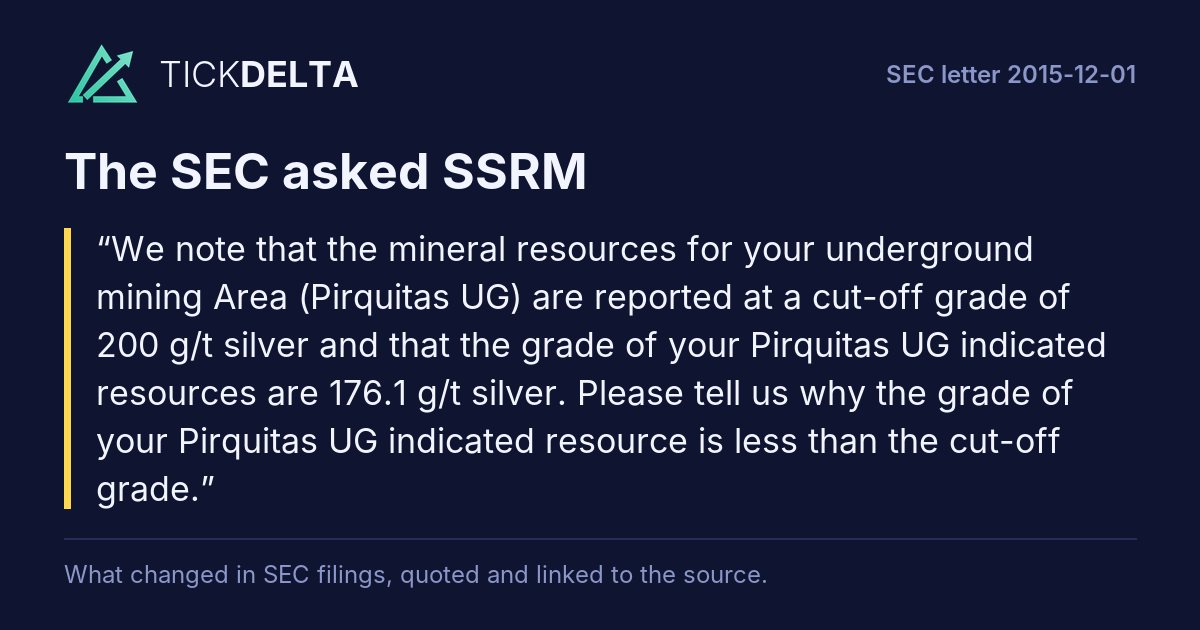
We note that the mineral resources for your underground mining Area (Pirquitas UG) are reported at a cut-off grade of 200 g/t silver and that the grade of your Pirquitas UG indicated resources are 176.1 g/t silver. Please tell us why the grade of your Pirquitas UG indicated resource is less than the cut-off grade.
SSRM answered

No reply letter found.

SEC letter of Dec 29, 2015 ↗ no reply letter on EDGAR
Mineral Properties · Summary of Mineral Reserves and Mineral Resources Estimates page 16
SEC asked
We note your response to comment 1. Please confirm that you will clarify in future filings.
SSRM answered

No reply letter found.

Also in this review: closing letter, 2015-12-31

Form 20-F

2012-12-12 to 2013-02-25 · 15 questions · 2 letters from the SEC, 2 from the company
Review closed 2013-02-25
Non-GAAP measuresInventoryRevenueReserves and insuranceResults discussion (MD&A)
Selected Financial Data, page 1
SEC asked (1)
We note your selected financial data prepared under IFRS is presented alongside your data prepared under Canadian GAAP. Please modify your presentation consistent with Instruction 3 of General Instruction G to Form 20-F. Additionally, please reconcile any selected financial data provided under Canadian GAAP to U.S. GAAP.
Rest of the question

For additional information, please refer to the highlights of the March 4, 2008 and May 22, 2012 meetings of the International Practices Task Force, which can be found at http://thecaq.org/iptf/highlights.htm.

SSRM answered
Presentation in accordance with Instruction 3 of General Instruction G on Form 20-F

“Companies electing to include or incorporate by reference Previous GAAP financial information shall not present that information side-by-side with IFRS financial information.”

The Company recognizes that this instruction was not adhered to in Table 1 of Item 3 A - Selected Financial Data. However, the Company believes that the disclosure in the table is clear as to which years are presented, and under which accounting basis.
Rest of the answer

The preamble above the table clearly outlines the accounting basis and each column is clearly labeled with either “IFRS” or “GAAP”. Because the Company believes the annual report on Form 20-F for its fiscal year ended December 31, 2011 is not materially misleading in its presentation of the selected financial data, the Company respectfully requests that compliance with this Comment 1 apply to future reports and that the Company not be required to file an amendment to its annual report on Form 20-F for its fiscal year ended December 31, 2011. The Company expects to file an annual report on Form 40-F for its fiscal year ended December 31, 2012 by March 31, 2013 and will comply with this instruction in that filing.

Reconciliation to US GAAP for years 2007 to 2009

Under General instruction G(c), “the issuer shall present selected historical financial data in accordance with US GAAP for the five most recent financial years, except as the issuer is otherwise permitted to omit US GAAP information for any of the earliest of the five years pursuant to Item 3.A.1 (1).”

Under rule 3.A.1, “selected financial data for either or both of the earliest two years of the five-year period may be omitted…if the company represents to the host country regulator that such information cannot be provided, or cannot be provided on a restated basis, without unreasonable effort or expense.”

Further, the International Practices Task Force (“IPTF”) on November 24, 2009 confirmed that no US GAAP information is required to be included in selected financial data for any periods, unless a company voluntarily provides previous GAAP information in the selected financial data (for those years prior to IFRS adoption). Q&A 17 in IPTF meeting March 4, 2008 “A - A first-time adopter of IFRS is not required to present selected financial information in accordance with US GAAP for those periods that are presented in accordance with IFRS as issued by the IASB and are not required to be reconciled to US GAAP. First-time adopters of IFRS are permitted to follow the guidance in Item 3.A of Form 20-F, which does not require selected financial data on a US GAAP basis when the financial statements are presented in conformity with IFRS as issued by the IASB.”

It was noted that this conclusion was unclear, and the IPTF meeting November 24, 2009, concluded that “IFRS/IASB filers do not have to present US GAAP information for any of the years in the five-year period for selected financial data, unless a Company voluntarily provides Previous GAAP information.”

The Company misunderstood these requirements and it did not realize that ‘voluntarily’ including previous GAAP numbers created a US GAAP reconciliation requirement. Given that the voluntary information dates from 2007 to 2009 and that those years are reconciled to US GAAP in the relevant financial statements for those years, the Company believes the annual report on Form 20-F for the its fiscal year ended December 31, 2011 is not materially misleading. The Company will comply with all reconciliation requirements going forward and respectfully requests that compliance with this Comment 1 not require that the Company file an amendment to its annual report on Form 20-F for its fiscal year ended December 31, 2011. The Company expects to file an annual report on Form 40-F for its fiscal year ended December 31, 2012 by March 31, 2013 and will comply with these requirements in that filing.

Read in the reply
Operating Results, page 67
SEC asked (2)
Throughout your review of the annual financial results, including your tabular presentation of financial results on page 70, we note you have included comparisons of operating results prepared under IFRS for 2011 and 2010 to those prepared under Canadian GAAP for earlier years. Please modify your presentation in accordance with General Instruction G(e) of Form 20-F.
SSRM answered
General Instruction G(e) – “The issuer shall present the information required pursuant to Item 5. The discussion should focus on the financial statements for the two most recent financial years prepared in accordance with IFRS as issued by the IASB. No part of the discussion should relate to financial statements prepared in accordance with Previous GAAP.”

Item 5 requires the operating analysis for the historical periods covered by the financial statements, and the Company understood this to be three years of financial information as normally required for annual reports filed on Form 20-F.
Rest of the answer

The Company did not realize that General Instruction G(e) provided an exemption from providing information prior to the adoption of IFRS. In situations where a material GAAP difference impacted the analysis, the Company believes it clearly illustrated such impact in the accompanying commentary. For example, on page 72 the Company states: “The unrealized gain on financial instruments at fair value through profit and loss (“FVTPL”) is primarily from the convertible notes, for which a gain of $20.2 million was recorded in 2011 compared to a loss of $1.1 million in 2010. This item was not recorded in 2009 as this instrument did not meet the definition of a derivative liability under Canadian GAAP.”

The Company believes that, although not in conformance with General Instruction G(e), the disclosure provided is not materially misleading to a reader of the report and provides a fulsome analysis of the Company’s performance over a three year period. The Company will comply with all General Instruction G(e) requirements going forward and respectfully requests that compliance with this Comment 2 apply to future reports and that the Company not be required to file an amendment to its annual report on Form 20-F for its fiscal year ended December 31, 2011. The Company expects to file an annual report on Form 40-F for its fiscal year ended December 31, 2012 by March 31, 2013 and will comply with this instruction in that filing.

Read in the reply
Non-GAAP Financial Performance Measures, page 86
SEC asked (3)
Your computation of cash cost per ounce of silver begins with “cost of inventory per income statement” which does not appear to correspond with the amounts presented on your statements of income. Please modify your disclosure to reconcile your non-GAAP measure with the most directly comparable financial measure or measures calculated and presented in accordance with IFRS.
Rest of the question

Refer to Item 10(e)(1)(i)(B) of Regulation S-K. Please also clarify what “movement in inventory” represents and how this adjustment is derived.

SSRM answered
Item 10(e)(1)(i)(B) of Regulation S-K states “A reconciliation (by schedule or other clearly understandable method), which shall be quantitative, to the extent available without unreasonable efforts, for forward looking information, of the differences between the non-GAAP financial measure disclosed or released with the most directly comparable financial measure of measures calculated and presented in accordance with GAAP identified in paragraph (e)(1)(i)(A) of this section.”

The Company believes that it complied with Item 10(e)(1)(i)(B) of Regulation S-K.
Rest of the answer

The cost per ounce starts with “cost of inventory per income statement” (YTD2011=$66,694,000) which corresponds to Note 17 of the financial statements which has the same naming convention, and represents the most directly comparable

GAAP financial measure. Cost of inventory is ‘per’ the income statement as it is a component of Cost of sales which appears on the face of the income statement.

The Company appreciates the Staff's comment, and believes that a footnote reference to Note 17 in the financial statements would make the reconciliation clearer. The Company will ensure that such clarifying footnote references are included in future filings.

‘Movement in inventory’ represents the change in inventory between costs recognized through the income statement and those remaining on the balance sheet due to timing differences between mining and milling (processing of material) activities, and sales. As per the Company’s accounting policy, in compliance with IFRS IAS16, costs are initially allocated to inventory as incurred, and then are removed from inventory through cost of sales. In 2011 production exceeded sales and thus costs (which are recorded as incurred) recorded to inventory were higher than the amount of cost removed from inventory and recognized in the income statement. This disclosure is very similar to that of industry peers.

Notes to the Consolidated Financial Statements, page F-11

Note 2a – Basis of Presentation and First Time Adoption of International Financial Reporting Standards, page F-11

Read in the reply
Note 2a – Basis of Presentation and First Time Adoption of International Financial Reporting · Standards, page F-11
SEC asked (4)
We note your disclosure that “The policies applied in these consolidated financial statements are based on IFRS issued and outstanding as of March 11, 2012, the date the statements were issued.” This appears to be inconsistent with the requirements of IFRS 1, particularly paragraphs 7 and 8. Please clarify or revise.
SSRM answered
In the December 31, 2011 financial statements, the Company applied the same accounting policies as in its opening IFRS statement of financial position for all periods presented in our financial statements. These policies were based on IFRS effective as at December 31, 2011, as required by paragraph 7 of IFRS 1.

The Company acknowledges that the disclosure could have more clearly noted that IFRS in effect on the date that the Company’s Directors approved the financial statements, March 11, 2012, was the same as IFRS in effect on December 31, 2011 and will provide clear disclosure of this
Rest of the answer

issue going forward. However, the Company believes that the disclosure in its annual report on Form 20-F for the year ended December 31, 2011 is not materially misleading and respectfully requests that compliance with this Comment 4 apply to future reports and that the Company not be required to file an amendment to its annual report on Form 20-F for its fiscal year ended December 31, 2011. The Company expects to file an annual report on Form 40-F for its fiscal year ended December 31, 2012 by March 31, 2013 and will comply with these requirements in that filing.

Read in the reply
Note 2a – Basis of Presentation and First Time Adoption of International Financial Reporting · Standards, page F-11
SEC asked (5)
We note that you do not address the mandatory exceptions, as set forth in paragraphs 1417 and Appendix B of IFRS 1 that you applied upon adoption of IFRS. To the extent that your primary financial statements reflect the use of mandatory exceptions, please identify the items or class of items to which the exceptions were applied and describe the accounting principle that was used and how it was applied.
Rest of the question

In addition and to the extent material, also qualitatively describe the impact on the financial condition, changes in financial condition and results of operations that the treatment specified by IFRS would have had absent these mandatory exceptions. Refer to paragraph 23 of IFRS 1.

SSRM answered
In preparing the financial statements under IFRS as at January 1, 2010, the Company believes that it complied with the requirements of IFRS 1, paragraphs 14-17 and Appendix B. The disclosures under paragraph 23, and further detailed in paragraphs 24-31C, are included primarily in Note 2 “Summary of Significant Accounting Policies” and Note 26, “Transition to International Financial Reporting Standards” of the Company’s financial statements.
Rest of the answer

The Company does not believe that further disclosures are required by paragraphs 14-17 or Appendix B that are not included in our financial statements.

The most significant items in the financial statements impacted by the mandatory exceptions of IFRS 1 were various estimates. IFRS 1 requires that estimates in accordance with IFRS at the date of transition be consistent with estimates made for the same date in accordance with previous GAAP, this is specifically addressed in Note 2(a). In the financial statements, Note 2(u) – “Significant Accounting Judgments and Estimates” sets out a summary of our significant estimates. Certain of the estimates disclosed in Note 2(u) were impacted by the application of mandatory exceptions. The Company did not evaluate the impact of hindsight on previous estimates; however, in certain cases the recorded amounts associated with our estimates may have been different.

A summary of the Company’s consideration of IFRS, Appendix B is as follows:

1. IFRS 1, Appendix B2 and B3 – Derecognition of financial assets and financial liabilities

The Company did not have any historical transactions impacted by these items.

2. IFRS 1, Appendix B4, B5 and B6 – Hedge Accounting

This exception did not impact the financial statements because (a) all derivatives recognized in our financial statements under Canadian GAAP were already measured at fair value which is consistent with the IFRS requirements; (b) the Company did not have deferred gains or losses relating to derivatives on our financial statements under Canadian GAAP; and (c) the Company did not apply hedge accounting under Canadian GAAP.

3. IFRS 1, Appendix B7 – Non-controlling interests

The only impact that this exception had on the Company’s financial statements was that the Company’s total comprehensive income was attributed to the owners of the parent and non-controlling interests (IFRS 1, B7 (a)).

4. IFRS 1, Appendix B8 – Classification and measurement of financial assets

This exception did not impact the financial statements because there were no measurement differences between Canadian GAAP and IFRS.

5. IFRS 1, Appendix B9 – Embedded derivatives

This exception did not impact the financial statements because there were no separately identifiable embedded derivatives other than the convertible notes which had a different accounting treatment under IFRS and was fully disclosed in Note 26 (v) in the financial statements.

Read in the reply
Note 2e – Revenue Recognition, page F-14
SEC asked (6)
We note you disclose that by-product sales proceeds are credited against cost of sales when they are not regarded as significant. Please provide us with the amount of byproduct sales that were credited against cost of sales in 2010 and 2011.
SSRM answered
The by-product that the Company considered insignificant was gold from the Pirquitas mine. Proceeds from sales of gold were $31,883 and $1,564 in the years ended December 31, 2010 and 2011, respectively.
Read in the reply
Note 2h – Exploration and Evaluation Expenditure, page F-15
SEC asked (7)
Please expand your disclosure to clarify whether you capitalize any exploration and evaluation expenditures (e.g. greenfield exploration and prospecting activities) prior to obtaining the legal right to explore a specific area.
SSRM answered
The Company does not capitalize any costs prior to obtaining the legal right to explore an area. The Company does not believe that its accounting policy as disclosed in Note 2(h) to the financial statements is materially misleading and respectfully requests that compliance with this Comment 7 not require the Company to file and amendment to its annual report on Form 20-F for the fiscal year ending December 31, 2011.
Rest of the answer

The Company expects to file an annual report on Form 40-F for its fiscal year ended December 31, 2012 by March 31, 2013 and will clarify the policy wording to include the reference to the legal rights to explore an area in response to IFRS 6 paragraph 5(a) in that filing and other future filings.

Read in the reply
Note 2h – Exploration and Evaluation Expenditure, page F-15
SEC asked (8)
We note you disclose that general exploration costs are expensed in the period incurred. We also note exploration and evaluation expenditures on identifiable non-operating properties are capitalized. Please expand your disclosure to clarify the distinction between these two types of expenditures and how these determinations are made.
Rest of the question

Please also tell us whether your capitalization of exploration and evaluation expenses corresponds to your resource or reserve determinations.

SSRM answered
The Company believes that its disclosure clearly identifies the nature of exploration and evaluation expenditure in note 2(h) to the financial statements, and believes that the policies presented meet the disclosure requirements of IFRS 6 paragraphs 23-25.

Capitalization does not correspond to mineral resource or mineral reserve determinations.

The Company respectfully requests that compliance with this Comment 8 not require that the Company file an amendment to its annual report on Form 20-F for its fiscal year ended December 31, 2011.
Read in the reply
Note 2h – Exploration and Evaluation Expenditure, page F-15
SEC asked (9)
You disclose that exploration costs at operating properties are expensed as incurred until a proven economically recoverable reserve is identified. Please tell us how this determination is made and whether it corresponds to your resource or reserve determinations prepared under NI 43-101.
SSRM answered
Operating mining properties do not fall under the scope of IFRS 6. Therefore, for an exploration and evaluation asset to be recognized there must be a future economic benefit to the Company, consistent with the IASB framework. Thus, costs incurred are expensed until an economically recoverable mineral reserve is identified, i.e. a mineral reserve as defined under NI 43-101. Once a mineral reserve that meets the NI 43-101 definition is defined, the Company commences capitalizing additional costs incurred.
Read in the reply
Note 2i – Property, Plant and Equipment, page F-16
SEC asked (10)
We note costs of major overhauls of existing equipment are capitalized within property, plant and equipment. Please provide a detailed discussion of what constitutes a major overhaul and how these costs meet the recognition criteria of IAS 16.
SSRM answered
(IAS 16 para 7) “The cost of an item of property, plant and equipment is recognized as an asset if, and only if;

(a)

It is probable that future economic benefits associated with the item will flow to the entity; and

(b)

The cost of the item can be measured reliably.”

IAS 16 also notes that subsequent expenditures on an item may be capitalized only if they meet the same recognition criteria as for initial recognition as noted above.
Rest of the answer

Therefore subsequent costs that maintain the economic benefits originally expected would be considered as repairs and maintenance and recognized as an expense when incurred. Subsequent costs that result in incremental economic benefits are considered improvements and recognized as an asset (these typically would be an increase in productive capacity, additional ability to generate future economic benefits or an extension of expected useful life).

Major overhauls are defined as improvement programs that increase the productivity or extend the useful life of the asset beyond that initially envisaged.

_____________________________

In connection with responding to the Comment Letter, the Company acknowledges that:

·

The Company is responsible for the adequacy and accuracy of the disclosure in the filing;

Staff comments or changes to disclosure in response to Staff comments do not foreclose the Commission from taking any action with respect to the filing; and

The Company may not assert Staff comments as a defense in any proceeding initiated by the Commission or any person under federal securities laws of the United States.

Read in the reply
Item 5. Operating and Financial Review and Prospects, page 67 · Non-GAAP Financial Performance Measures, page 86
SEC asked (1)
We note your response to our prior comment 3 noting an inventory cost measure that excludes certain costs directly attributable to the production of that inventory (i.e. depletion, depreciation and amortization and export duties) does not constitute a GAAP measure.
Rest of the question

Please confirm in future filings you will reconcile your cash cost per ounce to the most directly comparable financial measure on the face of your financial statements, such as cost of sales. Please also expand your future disclosure to clarify what “movement in inventory” represents and how this adjustment is derived in a manner as provided in your response. Please provide us with draft disclosure of planned changes.

SSRM answered
The Company confirms that it will reconcile its cash cost per ounce disclosures to the most directly comparable financial measure on the face of the income statement, which is “cost of sales”.

In a news release dated January 8, 2013 the Company announced its intention to change its presentation of this non-GAAP measure. Under the revised methodology, the Company will report total cash costs on a “per payable ounce sold” basis rather than a “per ounce produced” basis.
Rest of the answer

This change in presentation is designed to simplify the non-GAAP measures and make it more useful for readers of the Company’s financial statements. This revised presentation remains in accordance with the Silver Institute suggested disclosure (which allows the option of either production or sales basis) and is also used by certain industry peers.

Costs are added to inventory as incurred and recorded in the income statement when sales are recognized. ‘Movement in inventory’ represents the difference between costs recognized through the income statement and those which remain in inventory due to timing differences between production and sale of concentrate. Previously the non-GAAP measure has been based upon direct mining costs added to inventory, but the proposed change in presentation results in the non-GAAP measure being based upon costs per the income statement. Therefore the “movement in inventory” line item will no longer be applicable as the timing difference between costs recognized in the income statement and those used in the total cash cost non-GAAP measure is eliminated.

Please see below for the draft disclosure reflecting the proposed presentation of the non-GAAP measure reconciling total cash costs to cost of sales on the face of the income statement for the year ended December 31, 2011:

The following table provides a reconciliation of cost of inventory, total cash costs and total costs to cost of sales, as reported in the Company’s Consolidated Statement of Income:

Total

2011

Cost of Sales per consolidated financial statements

95,926

Less: Depreciation, depletion and amortization

(16,546

)

Less: Export duties

(12,686

Cost of Inventory

66,694

Treatment, refining and transportation charges on concentrate sales

23,659

By-product revenue

(5,620

Read in the reply
Item 5. Operating and Financial Review and Prospects, page 67 · Non-GAAP Financial Performance Measures, page 86
SEC asked (2)
In future filings, please confirm you will modify your disclosure here and throughout your filings to clarify that your per-ounce measures are “per ounce produced” (versus “per ounce sold”).
SSRM answered
As discussed above, the Company plans to revise its presentation of this non-GAAP measure to present on a per payable ounce sold basis.
Read in the reply
Notes to the Consolidated Financial Statements, page F-11 · Note 2e – Revenue Recognition, page F-14
SEC asked (3)
We note your response to our prior comment 6 that the by-product credits were $1,564 and $31,883 for 2011 and 2010, respectively. Please clarify whether this amount was in dollars or thousands of dollars. In addition, please tell us why these amounts differ from the by-product credits disclosed in your reconciliation of cash cost per ounce of silver produced (on page 87) of $5,620,000 and $204,000 for 2011 and 2010,
Rest of the question

respectively.

SSRM answered
The Company acknowledges the Staff’s comment and confirms that the by-product credit amounts are stated in dollars.

The Company’s accounting policy in note 2(e) “revenue recognition” in the consolidated financial statements for the year ended December 31, 2011 states, “revenues from the sale of significant by-products are included within revenue.
Rest of the answer

Where a by-product is not regarded as significant, sales proceeds may be credited against cost of sales.”

The Staff’s initial letter dated December 17, 2012 requested that the Company provide the amount of by-product income that was credited against cost of sales. The amounts noted above, $1,564 and $31,883, relate to credits from the sale of gold which is a by-product that the Company concluded was not significant.

The Company, however, also produces zinc concentrate from the Pirquitas mine in Argentina (as presented in note 21 to the consolidated financial statements for the year ended December 31, 2011). The revenue from zinc concentrate on a life of mine basis is anticipated to total approximately 10% of total revenue, and thus the Company concluded zinc concentrate is a significant by-product. Revenue from zinc is therefore included within revenue, as per the above accounting policy, but is deducted from cash costs as a by-product credit in the non-GAAP disclosures. Accordingly, the by-product credit in the reconciliation of cash cost per ounce included both zinc and gold by-product credits which totaled $5,620,000 and $204,000 for 2011 and 2010 respectively.

Read in the reply
Note 2h – Exploration and Evaluation Expenditure, page F-15
SEC asked (4)
We have reviewed your response noting it does not appear to address our prior comment 8, therefore it is being reissued. We note you disclose that general exploration costs are expensed in the period incurred. We also note exploration and evaluation expenditures on identifiable non-operating properties are capitalized.
Rest of the question

Please provide us with a detailed discussion to clarify the distinction between these two types of expenditures and how these determinations are made. In addition, please expand your disclosure in future filings to clarify the difference between general exploration costs, which are expensed, and evaluation and exploration costs, which are capitalized.

SSRM answered
The Company acknowledges the Staff’s comment and wishes to clarify that the nature of the expenses incurred is not the determining factor of their classification; rather, the status and nature of the project determines the classification of expenses.

As disclosed in the Company’s consolidated financial statements (note 2(h)) for the year ended December 31, 2012, exploration and evaluation expenses include:

- acquiring the rights to explore;

researching and analyzing historical exploration data;

gathering exploration data through topographical, geochemical and geophysical
Rest of the answer

studies;

exploratory drilling, trenching and sampling;

determining and examining the volume and grade of the resource;

surveying transportation and infrastructure requirements; and compiling pre-feasibility and feasibility studies.

General exploration costs are costs incurred in generative work programs designed to identify potential mineral projects and/or evaluate other projects that are not within the legal control of the Company. The types of costs incurred in such projects are typically researching and analyzing historical data and preliminary site visits to greenfield areas or properties owned by other parties.

The Company formally identifies a project after it has acquired a legal right to explore an area (for example, through the acquisition of concessions, claims, rights, or the payment of taxes). The types of costs incurred during this phase are typically gathering exploration data, exploratory drilling, trenching sampling, and evaluation costs as a project moves towards a feasibility study.

The Company will ensure that the future disclosure will be expanded, including in the Company’s Form 40-F for the year ended December 31, 2012, to clearly outline the requirement under IFRS 6 to have a legal right to explore an area prior to capitalizing any costs.

Read in the reply
Note 2i – Property, Plant and Equipment, page F-16
SEC asked (5)
We note from your response to our prior comment 10 that major overhauls, which are capitalized, are those which increase the productivity or extend the useful life of your asset. To clarify your policy disclosure, please confirm you will expand your disclosure in future filings to include this information.
SSRM answered
The Company confirms that the policy disclosure will be expanded in future filings.
Read in the reply

Also in this review: request for more time, Dec 13, 2012, closing letter, 2013-02-25

Form 20-F

2011-12-07 to 2012-01-11 · 3 questions · 1 letter from the SEC, 1 from the company
Review closed 2012-01-11
Reserves and insurance
Form 20 - F for Fiscal Year Ended December 31, 2010 · General
SEC asked (1)
It appears the reserv es that you have reported for your Pirquitas Project have not changed from the reserves reported in your Form 20-F for the fiscal year ended December 31, 2009 filed March 31, 2010. In this regard, please update the reserves reported for your operating mines to correspond to your fiscal year end.
SSRM answered
The Company acknowledges the Staff’s comment. As discussed with the Staff on December 9, 2011, information regarding depletion of the reserves was provided in the Form 20-F, although not in the reserves table. Reserves data for the Pirquitas Project was presented on p.38 of the Form 20-F under “Item 4. Information on the Company – D.
Rest of the answer

Property, Plant and Equipment – Pirquitas Project – Reserve Estimates.” This section was immediately preceded by section “– Production Status” on the same page, which contained the following information: “The [Pirquitas] mine reached production status in December 2009, and produced 1.1 million ounces of silver during that year. In 2010, the mine produced 6.3 million ounces of silver, and we shipped 5.9 million ounces of silver.” Section “– Production Status” also cross-referenced “Item 5. Operating and Financial Review and Prospects – B. Liquidity and Capital Resources – Non-GAAP Financial Performance Measures” of the Form 20-F, which set forth additional data, including silver recoveries since the commencement of commercial production. The reserves table included in the Form 20-F under “– Reserve Estimates” contained data from 2008 and reported total reserves of 195.1 million ounces of silver for the Pirquitas Project. Taking into account production data and recoveries for 2009 and 2010, the depleted total project reserves for the Pirquitas Project as of December 31, 2010 were 183.0 million contained ounces of silver. The Company confirms that the financial statements filed with the Form 20-F reflected the depletion of the reserves. In its future filings with the Commission, the Company undertakes to reflect reserve depletion for its operating mines in the reserves table to correspond with the applicable fiscal year end.

In a news release dated November 9, 2011, the Company reported significantly lowered reserve estimates at the Pirquitas mine (93.1 million ounces of silver as of September 30, 2011). The news release and the related Material Change Report as well as the Company’s MD&A containing the revised reserve estimates were filed with the Commission as exhibits to Form 6-K on November 10, 2011. Under these circumstances, the Company believes that it would be confusing rather than clarifying for investors if the Company now filed an amended Form 20-F, revising the old reserve data. Therefore, the Company respectfully requests the Staff’s permission not to file an amended Form 20-F.

Read in the reply
Form 20 - F for Fiscal Year Ended December 31, 2010 · General
SEC asked (2)
In future filings please disclose the material information associated with the calculation of your reserves and resources pursuant to Item 4 of Form 20-F; including the metal prices, the cut-off grade, the metallurgical recoveries, the date of the resource or reserve, the technical report associated with the reserve that has been filed on SEDAR, and the name of the individual responsible for the resource or reserve.
SSRM answered
The Company acknowledges the Staff’s comment and will revise the disclosure regarding the calculation of reserves and resources as requested in its future filings with the Commission.
Read in the reply
Item 12. Description of Securities Other than Equity Securities, page 150
SEC asked (3)
We note your position that you are not required to provide any information under this Item. However, Instruction 1 to Item 12 of Form 20-F sets forth disclosure requirements for entities filing annual reports after December 15, 2009. Confirm that in future filings you will provide the disclosure, if applicable, required by this Item.
SSRM answered
The Company acknowledges the Staff’s comment and will provide the disclosure required by Item 12 of Form 20-F, if applicable, in its future filings with the Commission. In 2010 the Company did not have any securities represented by American Depositary Receipts.
Read in the reply

Also in this review: closing letter, 2012-01-11

From the SEC's correspondence on EDGAR: staff letters (form UPLOAD) and company letters (form CORRESP), 25 letters filed since 2011-12-07. Questions and answers are matched by their numbers; topics come from words in each question. The reports are compared word for word (same form, before the first SEC letter against the first report after the company's reply). No AI.

Sources

The SEC's correspondence on EDGAR: staff letters (form UPLOAD) and company letters (form CORRESP), matched question by question. No AI.

Also

Filings: the letters in the filing list.

Work with it

Excel workbook · CSV. Google Sheet that stays up to date: paste =IMPORTDATA("https://tickdelta.com/company/SSRM/export.csv") into a cell.

Next in Owners and insiders:Insider trades
Esc

Type a ticker such as AAPL, a name, an investor such as Buffett, or a topic such as tariffs. ↑ ↓ to move, Enter to open.