Paragraph 55 · 36% changed
Every version of it
Screener
/
SEC EDGAR
/CIK 0001477294
/10-K filed Feb 27, 2026, compared with Feb 28, 2025
/Numbers from the XBRL of the 10-Ks
NYSE
Technology · Industrial Instruments
Sensata Technologies Holding plc ST
The 10-K against last year's
179 changes: 33 added, 85 removed, 61 reworded
10-K Feb 27, 2026 vs Feb 28, 2025
Risk Factors
15.6%
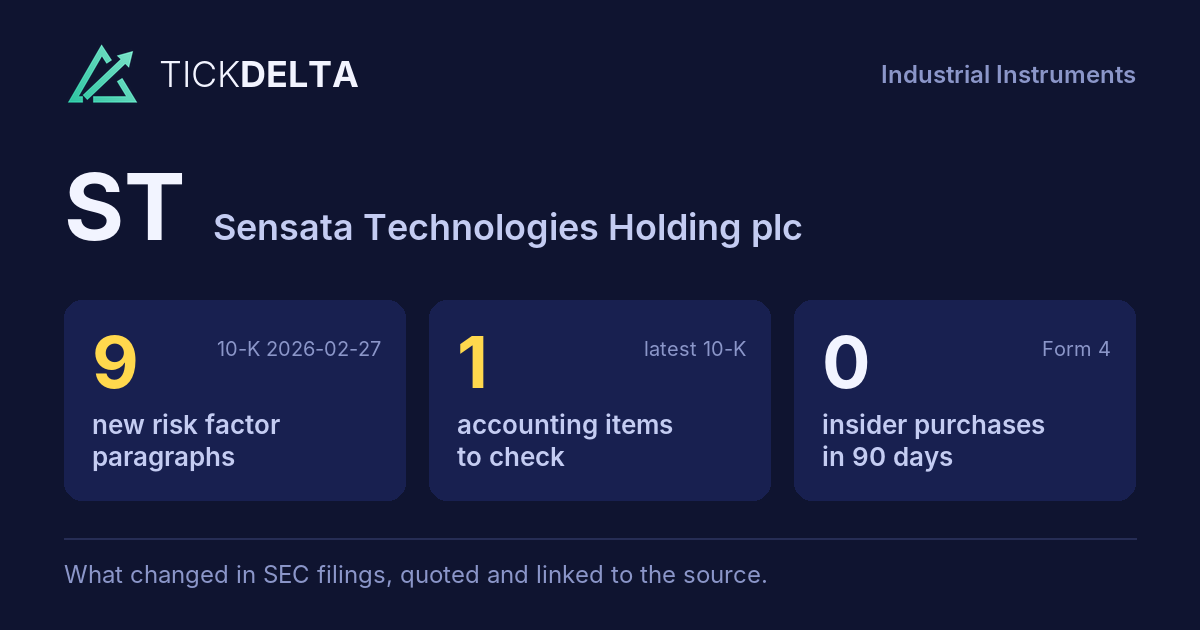
of the text changed · 10,511 words now · 9 new paragraphs, 12 gone
MD&A
35.4%
of the text changed · 12,112 words now · 24 new paragraphs, 73 gone
Legal Proceedings
1.7%
of the text changed · 1,226 words now
Accounting Policies
14.7%
of the text changed · 8,367 words now
10-K 0001477294-26-000007 (Feb 27, 2026) vs 10-K 0001477294-25-000022 (Feb 28, 2025)
Every paragraph, and how much of it changed
One bar per paragraph, in the order of the 10-K. Height and colour show the share of its words not in the closest paragraph a year earlier; the tallest bars are new paragraphs.
Risk Factors
114 paragraphs · 9 new · 27 reworded · 12 gone · 10-K Feb 27, 2026 against Feb 28, 2025
New paragraph
Reworded (5% of its words or more)
Same or nearly
Paragraph 44 · 31% changed
Every version of it
Finally, given the worldwide scope of our supply chain and operations, we and our suppliers face a risk of disruption or operating inefficiencies that may increase costs due to the adverse physical effects of climate change, which are predicted to increase the frequency and severity of weather and other natural events, e.g., tropical cyclones, extended droughts, and extreme temperatures. Climate change could also disrupt our operations by impacting the availability and cost of materials within our supply chain, and could also increase insurance and other operating costs. These factors may impact our decisions to construct new facilities. If a business interruption occurs and we are unsuccessful in our continuing efforts to minimize the impact of these events, our business, results of operations, financial position, and cash flows could be materially adversely affected.
Paragraph 85 · 30% changed
Every version of it
We are organized as a holding company, a legal entity that is separate and distinct from our operating entities. As a holding company without significant operations of its own, our principal assets are the shares of capital stock of our subsidiaries. We rely on dividends, interest, and other payments from these subsidiaries to meet our obligations for paying principal and interest on outstanding debt, repurchasing ordinary shares, and corporate expenses. Certain of While our subsidiaries generally may remit funds to us, certain foreign subsidiaries are subject to foreign‑exchange verification and other regulatory requirements of the jurisdictions processes that can create compliance complexity and timing delays in which they operate making dividend or other restrictions payments. No assurance can be given that future changes in law, regulatory actions, or other circumstances will not further restrict, delay, or otherwise affect our ability to receive funds from these subsidiaries. Furthermore, no assurance can be given that our subsidiaries may limit the amounts that subsidiaries can pay be able to make timely payments to us in order for us to meet our obligations.
Paragraph 64 · 28% changed
Every version of it
Our substantial indebtedness could have important consequences. For example, it could make it more difficult for us to satisfy our debt obligations; restrict us from making strategic acquisitions; limit our ability to repurchase shares; limit our flexibility in planning for, or reacting to, changes in our business and future business opportunities, thereby placing us at a competitive disadvantage if our competitors are not as highly-leveraged; increase our vulnerability to general adverse economic and market conditions; or require us to dedicate a substantial portion of our cash flows from operations to payments on our indebtedness if we do not maintain specified financial ratios or are not able to refinance our indebtedness as it comes due, thereby reducing the availability of our cash flows for other purposes. In addition, the Accordion permits us to incur additional secured credit facilities in certain circumstances in the future, subject to certain limitations as defined in the indentures under which the Senior Notes were issued. This could allow us to issue additional secured debt or increase the capacity of the Revolving Credit Facility. If we increase our indebtedness by borrowing under the Revolving Credit Facility or incur other new indebtedness under the Accordion, the risks described above would increase.
Paragraph 65 · 25% changed
Every version of it
Paragraph 10 · 24% changed
Every version of it
In addition, a product recall could generate substantial negative publicity about our business and interfere with our manufacturing plans and product delivery obligations as we seek to repair affected products. Our costs associated with product liability, warranty, and recall claims could be material. The insurance coverages that the Company maintains may not apply to all types of claims and proceedings, and, where insurance exists, the amount of insurance coverage may not be adequate to cover the total claims and liabilities.
Paragraph 74 · 24% changed
Every version of it
In the third quarter of 2024, 2025, impairment indicators were identified that suggested the carrying value of the Dynapower reporting unit could exceed its fair values. value. Accordingly, we evaluated the Dynapower reporting unit for impairment and determined that our Dynapower reporting unit it was impaired. In the third quarter of 2024, 2025, we recorded a $150.1 $225.7 million non-cash impairment charge. This impairment was primarily driven by a lower long-range financial forecast resulting from specific discrete events outlook within certain markets that changed the timing reporting unit operates in following recent tax legislation being enacted and a strategic shift to focus on other markets. This revised outlook led to downward revisions of our forecasted performance. future cash flows. If Dynapower does not achieve the forecasted future cash flows, there is a possibility that additional impairments of the remaining $229.8 $4.1 million of goodwill may be recognized in the future.
Paragraph 45 · 21% changed
Every version of it
Paragraph 55 · 36% changed
Every version of it
10-K Feb 28, 2025In pursuing our corporate strategy, we have in the past, and may in the future, acquire other businesses. The success of this strategy is dependent upon our ability to identify appropriate acquisition targets, negotiate transactions on favorable terms, complete transactions, and successfully integrate them into our existing businesses. There can be no assurance that we will realize the anticipated synergies or cost savings related to acquisitions, including, but not limited to, revenue growth and operational efficiencies, or that they will be achieved in our estimated timeframe. We may not be able to successfully integrate and streamline overlapping functions from future acquisitions, and integration may be more costly to accomplish than we expect. There is also no guarantee that the acquired businesses will perform according to the business case used in justifying the acquisition. In addition, we could encounter difficulties in managing our combined company due to its increased size and scope.
10-K Feb 27, 2026
and streamline overlapping functions from future acquisitions, and integration may be more costly to accomplish than we expect. There is also no guarantee that the acquired businesses will perform according to the business case used in justifying the acquisition. In addition, we could encounter difficulties in managing our combined company due to its increased size and scope.
Paragraph 44 · 31% changed
Every version of it
10-K Feb 28, 2025
Finally, given the worldwide scope of our supply chain and operations, we and our suppliers face a risk of disruption or operating inefficiencies that may increase costs due to the adverse physical effects of climate change, which are predicted to increase the frequency and severity of weather and other natural events, e.g., tropical cyclones, extended droughts, and extreme temperatures. Climate change could also disrupt our operations by impacting the availability and cost of materials within our supply chain, and could also increase insurance and other operating costs. These factors may impact our decisions to construct new facilities. If a business interruption occurs and we are unsuccessful in our continuing efforts to minimize the impact of these events, our business, results of operations, financial position, and cash flows could be materially adversely affected.
10-K Feb 27, 2026
Finally, given the worldwide scope of our supply chain and operations, we and our suppliers face a risk of disruption or operating inefficiencies that may increase costs due to the adverse physical effects of climate change, which are predicted to increase the frequency and severity of weather and other natural events, e.g., tropical cyclones, extended droughts, and extreme
Paragraph 85 · 30% changed
Every version of it
10-K Feb 28, 2025
We are organized as a holding company, a legal entity that is separate and distinct from our operating entities. As a holding company without significant operations of its own, our principal assets are the shares of capital stock of our subsidiaries. We rely on dividends, interest, and other payments from these subsidiaries to meet our obligations for paying principal and interest on outstanding debt, repurchasing ordinary shares, and corporate expenses. Certain of our subsidiaries are subject to regulatory requirements of the jurisdictions in which they operate or other restrictions that may limit the amounts that subsidiaries can pay
10-K Feb 27, 2026
We are organized as a holding company, a legal entity that is separate and distinct from our operating entities. As a holding company without significant operations of its own, our principal assets are the shares of capital stock of our subsidiaries. We rely on dividends, interest, and other payments from these subsidiaries to meet our obligations for paying principal and interest on outstanding debt, repurchasing ordinary shares, and corporate expenses. While our subsidiaries generally may remit funds to us, certain foreign subsidiaries are subject to foreign‑exchange verification and other regulatory processes that can create compliance complexity and timing delays in making dividend or other payments. No assurance can be given that future changes in law, regulatory actions, or other circumstances will not further restrict, delay, or otherwise affect our ability to receive funds from these subsidiaries. Furthermore, no assurance can be given that our subsidiaries may be able to make timely payments to us in order for us to meet our obligations.
Paragraph 64 · 28% changed
Every version of it
10-K Feb 28, 2025
Our substantial indebtedness could have important consequences. For example, it could make it more difficult for us to satisfy our debt obligations; restrict us from making strategic acquisitions; limit our ability to repurchase shares; limit our flexibility in planning for, or reacting to, changes in our business and future business opportunities, thereby placing us at a competitive disadvantage if our competitors are not as highly-leveraged; increase our vulnerability to general adverse economic and market conditions; or require us to dedicate a substantial portion of our cash flows from operations to payments on our indebtedness if we do not maintain specified financial ratios or are not able to refinance our indebtedness as it comes due, thereby reducing the availability of our cash flows for other purposes. In addition, the Accordion permits us to incur additional secured credit facilities in certain circumstances in the future, subject to certain limitations as defined in the indentures under which the Senior Notes were issued. This could allow us to issue additional secured debt or increase the capacity of the Revolving Credit Facility. If we increase our indebtedness by borrowing under the Revolving Credit Facility or incur other new indebtedness under the Accordion, the risks described above would increase.
10-K Feb 27, 2026
Our substantial indebtedness could have important consequences. For example, it could make it more difficult for us to satisfy our debt obligations; restrict us from making strategic acquisitions; limit our ability to repurchase shares; limit our flexibility in planning for, or reacting to, changes in our business and future business opportunities, thereby placing us at a competitive disadvantage if our competitors are not as highly-leveraged; increase our vulnerability to general adverse economic and market conditions; or require us to dedicate a substantial portion of our cash flows from operations to payments on our indebtedness if
Paragraph 65 · 25% changed
Every version of it
10-K Feb 28, 2025Our substantial indebtedness could have important consequences. For example, it could make it more difficult for us to satisfy our debt obligations; restrict us from making strategic acquisitions; limit our ability to repurchase shares; limit our flexibility in planning for, or reacting to, changes in our business and future business opportunities, thereby placing us at a competitive disadvantage if our competitors are not as highly-leveraged; increase our vulnerability to general adverse economic and market conditions; or require us to dedicate a substantial portion of our cash flows from operations to payments on our indebtedness if we do not maintain specified financial ratios or are not able to refinance our indebtedness as it comes due, thereby reducing the availability of our cash flows for other purposes. In addition, the Accordion permits us to incur additional secured credit facilities in certain circumstances in the future, subject to certain limitations as defined in the indentures under which the Senior Notes were issued. This could allow us to issue additional secured debt or increase the capacity of the Revolving Credit Facility. If we increase our indebtedness by borrowing under the Revolving Credit Facility or incur other new indebtedness under the Accordion, the risks described above would increase.
10-K Feb 27, 2026
we do not maintain specified financial ratios or are not able to refinance our indebtedness as it comes due, thereby reducing the availability of our cash flows for other purposes. In addition, the Accordion permits us to incur additional secured credit facilities in certain circumstances in the future, subject to certain limitations as defined in the indentures under which the Senior Notes were issued. This could allow us to issue additional secured debt or increase the capacity of the Revolving Credit Facility. If we increase our indebtedness by borrowing under the Revolving Credit Facility or incur other new indebtedness under the Accordion, the risks described above would increase.
Paragraph 10 · 24% changed
Every version of it
10-K Feb 28, 2025
In addition, a product recall could generate substantial negative publicity about our business and interfere with our manufacturing plans and product delivery obligations as we seek to repair affected products. Our costs associated with product liability, warranty, and recall claims could be material.
10-K Feb 27, 2026
In addition, a product recall could generate substantial negative publicity about our business and interfere with our manufacturing plans and product delivery obligations as we seek to repair affected products. Our costs associated with product liability, warranty, and recall claims could be material. The insurance coverages that the Company maintains may not apply to all types of claims and proceedings, and, where insurance exists, the amount of insurance coverage may not be adequate to cover the total claims and liabilities.
Paragraph 74 · 24% changed
Every version of it
10-K Feb 28, 2025
In the third quarter of 2024, impairment indicators were identified that suggested the carrying value of the Dynapower reporting unit could exceed its fair values. Accordingly, we evaluated the Dynapower reporting unit for impairment and determined that our Dynapower reporting unit was impaired. In the third quarter of 2024, we recorded a $150.1 million non-cash impairment charge. This impairment was primarily driven by a lower long-range financial forecast resulting from specific discrete events that changed the timing of our forecasted performance. If Dynapower does not achieve the forecasted future cash flows, there is a possibility that additional impairments of the remaining $229.8 million of goodwill may be recognized in the future.
10-K Feb 27, 2026
In the third quarter of 2025, impairment indicators were identified that suggested the carrying value of the Dynapower reporting unit could exceed its fair value. Accordingly, we evaluated the Dynapower reporting unit for impairment and determined that it was impaired. In the third quarter of 2025, we recorded a $225.7 million non-cash impairment charge. This impairment was primarily driven by a lower outlook within certain markets that the reporting unit operates in following recent tax legislation being enacted and a strategic shift to focus on other markets. This revised outlook led to downward revisions of forecasted future cash flows. If Dynapower does not achieve the forecasted future cash flows, there is a possibility that additional impairments of the remaining $4.1 million of goodwill may be recognized in the future.
Paragraph 45 · 21% changed
Every version of it
10-K Feb 28, 2025Finally, given the worldwide scope of our supply chain and operations, we and our suppliers face a risk of disruption or operating inefficiencies that may increase costs due to the adverse physical effects of climate change, which are predicted to increase the frequency and severity of weather and other natural events, e.g., tropical cyclones, extended droughts, and extreme temperatures. Climate change could also disrupt our operations by impacting the availability and cost of materials within our supply chain, and could also increase insurance and other operating costs. These factors may impact our decisions to construct new facilities. If a business interruption occurs and we are unsuccessful in our continuing efforts to minimize the impact of these events, our business, results of operations, financial position, and cash flows could be materially adversely affected.
10-K Feb 27, 2026
temperatures. Climate change could also disrupt our operations by impacting the availability and cost of materials within our supply chain, and could also increase insurance and other operating costs. These factors may impact our decisions to construct new facilities. If a business interruption occurs and we are unsuccessful in our continuing efforts to minimize the impact of these events, our business, results of operations, financial position, and cash flows could be materially adversely affected.
MD&A
170 paragraphs · 24 new · 85 reworded · 73 gone · 10-K Feb 27, 2026 against Feb 28, 2025
New paragraph
Reworded (5% of its words or more)
Same or nearly
Paragraph 99 · 50% changed
1.Fiscal year 2024 2025 includes a loss of $98.8 million on costs and losses associated with the sale disposition of the Insights MSP Business.
Paragraph 34 · 48% changed
Paragraph 20 · 48% changed
Interest income expense relates to interest earned owed on our cash and cash equivalent balances, gross outstanding indebtedness, and varies according to the balances in, of, and the interest rates provided by, these investments. assigned to, this indebtedness.
Paragraph 157 · 47% changed
Paragraph 53 · 42% changed
In the year ended December 31, 2024, 2025, operating income decreased $32.4 increased $88.2 million, or 17.8%, 59.1%, to $149.3 $237.5 million (3.8% (6.4% of net revenue) compared to $181.7 $149.3 million (4.5% (3.8% of net revenue) in the prior year, primarily due to (1) a $150.1 million goodwill impairment charge related to the Dynapower business, decrease in product line and product lifecycle management charges, (2) a $98.8 million loss on the sale of the Insights Business, (3) higher SG&A expense, (4) the impact of organic revenue declines together with the net impact of customer pricing and manufacturing efficiencies, and (5) the unfavorable impact of foreign exchange rates, partially offset by (1) a $321.7 million goodwill impairment charge related to the Insights reporting unit in the prior year and (2) a $28.1 million decrease in amortization of intangibles. intangibles, and (3) cost savings as a result of actions taken as part of our restructuring plans, partially offset by a larger goodwill impairment charge taken in the current year than the prior year.
Paragraph 14 · 39% changed
Paragraph 43 · 38% changed
In the year ended December 31, 2024, 2025, cost of revenue as a percentage of net revenue increased versus the prior year period, due to (1) higher depreciation expense, (2) lower net revenues, and (3) the net impacts of customer pricing inflation on material and manufacturing efficiencies. logistics costs and the unfavorable effects of changes in foreign currency rates, partially offset by the favorable effects of divestitures.
Paragraph 118 · 38% changed
Paragraph 99 · 50% changed
10-K Feb 28, 2025
1.Fiscal year 2024 includes a loss of $98.8 million on the sale of the Insights Business.
10-K Feb 27, 2026
1.Fiscal year 2025 includes costs and losses associated with the disposition of the MSP Business.
Paragraph 34 · 48% changed
10-K Feb 28, 2025The table below presents our historical results of operations in millions of dollars and as a percentage of net revenue. We have derived these results of operations from our Financial Statements. In the three months ended March 31, 2024, we realigned our business as a result of organizational changes that better allocate our resources to support changes to our business strategy. The most significant changes include combining our Automotive and HVOR businesses (with the combined business remaining in Performance Sensing) and moving the Insights Business out of Performance Sensing to a new operating segment, which is not aggregated within either of our reportable segments. We combined the Automotive and HVOR businesses to better leverage our core capabilities and prioritize product focus. We also moved certain shorter-cycle businesses from Performance Sensing to Sensing Solutions, which will benefit from organizing our predominantly shorter-cycle businesses together, by allowing us to scale core capabilities and better serve our customers. Prior year amounts in this Report have been recast to reflect this
10-K Feb 27, 2026
In the three months ended December 31, 2025, we realigned our business as a result of organizational changes that better allocate our resources to support changes to our business strategy. These changes resulted in the dissolution of our prior segments, Performance Sensing and Sensing Solutions, and the creation of three new segments. Our Automotive segment includes our Automotive and Aftermarket businesses. The Industrials segment includes our Industrial and Dynapower businesses. The Aerospace, Defense, and Commercial Equipment segment includes our Aerospace and Commercial Equipment businesses. Results of the Insights Business, which was sold during the third quarter of 2024, are presented in the Other non-operating segment, which is not aggregated within any of our reportable segments. Our new operating structure allows us to more effectively allocate capital and investment dollars based on different end market and growth dynamics in each of these segments. Prior year amounts in this Report have been recast to reflect this realignment. Refer to Note 20: Segment Reporting for additional information.
Paragraph 20 · 48% changed
10-K Feb 28, 2025
Interest income relates to interest earned on our cash and cash equivalent balances, and varies according to the balances in, and the interest rates provided by, these investments.
10-K Feb 27, 2026
Interest expense relates to interest owed on our gross outstanding indebtedness, and varies according to the balances of, and the interest rates assigned to, this indebtedness.
Paragraph 157 · 47% changed
10-K Feb 28, 2025Evaluation of goodwill for impairment. We have the option to first assess qualitative factors to determine whether a quantitative goodwill impairment analysis must be performed. The objective of a qualitative analysis is to assess whether it is more likely than not that the fair value of a reporting unit is less than its carrying value. We make this assessment based on macroeconomic conditions, industry and market considerations, cost factors, overall financial performance, and other relevant factors as applicable. If we elect not to use this option, or if we determine that it is more likely than not that the fair value of a reporting unit is less than its carrying value, then we prepare a discounted cash flow analysis to determine whether the carrying value of the reporting unit exceeds its estimated fair value. If the carrying value of a reporting unit exceeds its estimated fair value, we recognize an impairment of goodwill for the amount of this excess, in accordance with the guidance in FASB ASC Topic 350.
10-K Feb 27, 2026
A qualitative analysis is performed by evaluating events and circumstances that most affect the fair value of each reporting unit, including macroeconomic conditions, market conditions, industry trends, cost factors, financial performance, and other relevant qualitative factors. Based on an evaluation of the factors that most affect the fair value of each reporting unit, we determine whether it is more likely than not that a reporting unit's fair value exceeds its carrying amount. If we conclude that it is more likely than not that the fair value of a reporting unit is less than its carrying amount, we perform a goodwill impairment test using the quantitative method. If we conclude that it is more likely than not that the fair value of a reporting unit exceeds its carrying amount, it is not necessary to perform the quantitative goodwill impairment test and no further testing is required. The results of the qualitative analyses performed as of October 1, 2025, did not indicate a need to perform quantitative analysis, as we determined that it is more likely than not that the fair value of each of our reporting units exceeded their respective carrying values. No events or circumstances occurred between October 1, 2025 and December 31, 2025 that would more likely than not reduce the fair values of the reporting units below their carrying amounts
Paragraph 53 · 42% changed
10-K Feb 28, 2025
In the year ended December 31, 2024, operating income decreased $32.4 million, or 17.8%, to $149.3 million (3.8% of net revenue) compared to $181.7 million (4.5% of net revenue) in the prior year, primarily due to (1) a $150.1 million goodwill impairment charge related to the Dynapower business, (2) a $98.8 million loss on the sale of the Insights Business, (3) higher SG&A expense, (4) the impact of organic revenue declines together with the net impact of customer pricing and manufacturing efficiencies, and (5) the unfavorable impact of foreign exchange rates, partially offset by (1) a $321.7 million goodwill impairment charge related to the Insights reporting unit in the prior year and (2) a $28.1 million decrease in amortization of intangibles.
10-K Feb 27, 2026
In the year ended December 31, 2025, operating income increased $88.2 million, or 59.1%, to $237.5 million (6.4% of net revenue) compared to $149.3 million (3.8% of net revenue) in the prior year, primarily due to (1) a decrease in product line and product lifecycle management charges, (2) a decrease in amortization of intangibles, and (3) cost savings as a result of actions taken as part of our restructuring plans, partially offset by a larger goodwill impairment charge taken in the current year than the prior year.
Paragraph 14 · 39% changed
10-K Feb 28, 2025R&D expense consists of costs related to product design, development, and process engineering. Costs related to modifications of existing products for use by new and existing customers in familiar applications are presented in cost of revenue and are not included in R&D expense. The level of R&D expense in any period is related to the number of products in development, the stage of the development process, the complexity of the underlying technology, the potential scale of the product upon successful commercialization, and the level of our exploratory research.
10-K Feb 27, 2026
Research and development ("R&D") expense consists of costs related to product design and development. Our development expense is typically associated with engineering core technology platforms to specific applications and engineering major upgrades that improve the functionality or reduce the cost of existing products. Costs related to modifications of existing products for use by new and existing customers in familiar applications are presented in cost of revenue and are not included in R&D expense.
Paragraph 43 · 38% changed
10-K Feb 28, 2025
In the year ended December 31, 2024, cost of revenue as a percentage of net revenue increased versus the prior year period, due to (1) higher depreciation expense, (2) lower net revenues, and (3) the net impacts of customer pricing and manufacturing efficiencies.
10-K Feb 27, 2026
In the year ended December 31, 2025, cost of revenue as a percentage of net revenue increased versus the prior year period, due to the net impacts of inflation on material and logistics costs and the unfavorable effects of changes in foreign currency rates, partially offset by the favorable effects of divestitures.
Paragraph 118 · 38% changed
10-K Feb 28, 2025Net cash used in investing activities for the year ended December 31, 2024 decreased compared to the corresponding period of the prior year, primarily due to cash received for the divestiture of the Insights Business in the year ended December 31, 2024, and a decrease in cash paid for capital expenditures. In the year ended December 31, 2024, we received cash proceeds of $135.7 million from the sale of a business, compared to $19.0 million in the year ended December 31, 2023.
10-K Feb 27, 2026
received cash proceeds of $33.7 million from the sale of a business, compared to $135.7 million and $19.0 million in the years ended December 31, 2024 and 2023.
A paragraph is matched with the one last year that shares the most of its words; under half in common makes it new. The paragraphs shown are the 8 reworded the most in each section.
The paragraph that changed most in each section
The redline
Marked against last year's 10-K: cut words struck through, new words highlighted.
MD&A229 words changed in this paragraph; it is 34% similar to last year's version.
Source: Item 7, 10-K 0001477294-26-000007 vs Item 7, 10-K 0001477294-25-000022
Accounting Policies215 words changed in this paragraph; it is 41% similar to last year's version.
In November December 2023, the FASB issued Accounting Standards Update ("ASU") No. 2023-07, Segment Reporting 2023-09, Income taxes (Topic 280), 740): Improvements to Reportable Segment Income Tax Disclosures, which requires (1) consistent categories and greater disaggregation of information in the rate reconciliation and (2) disclosure of income taxes paid disaggregated by jurisdiction. ASU No. 2023-09 also includes certain other updates to improve disclosures about a public entity's reportable segments. This guidance requires that a public entity disclose, on an annual and interim basis, significant segment expenses that are regularly provided to the chief operating decision maker and included within each reported measure effectiveness of segment profit or loss and an amount for "other segment items" included in the determination of segment operating income. The guidance also requires that a public entity provide all annual disclosures about a reportable segment's profit or loss and assets currently required by FASB ASC Topic 280, Segment Reporting, in interim periods, and that a public entity provide the title and position of the chief operating decision maker. Other requirements of the guidance are not expected to be material. There is no change to the guidance for identification or aggregation of operating or reportable segments. FASB income tax disclosures. ASU No. 2023-07 will be 2023-09 is effective for annual periods beginning after December 15, 2023 31, 2024, and interim periods within fiscal years beginning after December 15, 2024. The guidance must should be applied retrospectively to all prior periods presented. prospectively, with retrospective application also a permitted option. We prospectively adopted ASU No. 2023-07 2023-09 on January 1, 2024 2025 and have included the required new annual and disclosures in our Annual Report on Form 10-K for the period ended December 31, 2024. 2025. Refer to Note 20: Segment Reporting 7: Income Taxes for additional information.
Source: Item 8, Note 2 – Financial Statement Schedule, 10-K 0001477294-26-000007 vs Item 8, Note 2 – Financial Statement Schedules, 10-K 0001477294-25-000022
Risk Factors160 words changed in this paragraph; it is 38% similar to last year's version.
We operate in markets that are highly competitive, and we compete on the basis of product performance in mission-critical operating environments, quality, service, reliability, manufacturing footprint, and commercial competitiveness across the industries and end markets we serve. A significant element of our competitive strategy is to design and manufacture high-quality products that meet the needs of our customers at a commercially competitive price, particularly in markets where low-cost, country-based suppliers, primarily in China with respect to the Sensing Solutions segment, have entered the markets or increased their per-unit sales in these markets by delivering products at low cost to local OEMs. In addition, certain of our competitors in the transportation sensor market are influenced or controlled by major OEMs or suppliers, thereby limiting our access to these customers. These customers may choose to develop relationships with additional suppliers or elect to produce some or all of these products internally, primarily to reduce risk of delivery interruptions or as a means of extracting more value from us. Certain of our customers currently have, or may develop in the future, the capability to internally produce the products that we sell to them and may compete with us with respect to those and other products and with respect to other customers. high-
Source: Item 1A, 10-K 0001477294-26-000007 vs Item 1A, 10-K 0001477294-25-000022
Legal ProceedingsNew paragraph this year (42 words), with no similar paragraph last year.
In April 2025, we experienced a ransomware incident that encrypted certain devices in our network. The incident temporarily impacted our operations, but the incident did not have a material impact on the Company’s financial results and operations for the year ended 2025.
Source: Item 3, via Note 15 – Commitments and Contingencies, 10-K 0001477294-26-000007 vs Item 3, via Note 15 – Commitments and Contingencies, 10-K 0001477294-25-000022
Sentences and paragraphs added, removed or reworded
Every change, by type
Sentences and paragraphs of ST's Risk Factors and MD&A, 10-K Feb 27, 2026 against 10-K Feb 28, 2025. Each links to the text at sec.gov.
Quiet changes are sentences kept from last year with one to four words changed, at least one of them a hedge, a modal or a qualifier (may, could, will, not, significant, material…). A year or date rolling forward is not counted.
The full word list
adverse, adversely, all, although, anticipate, anticipates, any, approximately, believe, believes, can, cannot, certain, could, expect, expects, generally, however, if, intend, intends, largely, likely, many, material, materially, may, might, most, must, never, no, not, possible, primarily, probable, should, significant, significantly, some, substantial, substantially, unlikely, will, would
AddedRisk Factors
We operate in markets that are highly competitive, and we compete on the basis of product performance in mission-critical operating environments, quality, service, reliability, manufacturing footprint, and commercial competitiveness across the industries and end markets we serve. A significant element of our competitive strategy is to design and manufacture high-
Read it in 10-K Feb 27, 2026 at sec.gov
AddedRisk Factors
damage to our reputation, affect our relationships with our customers, lead to claims against us, and ultimately harm our business, financial condition, and/or results of operations.
Read it in 10-K Feb 27, 2026 at sec.gov
AddedRisk Factors
Our global effective tax rate ("ETR") may be volatile and could increase due to changes in our geographic mix of earnings, tax laws and rates, and the outcome of tax audits, which could adversely affect our results of operations, cash flows, and financial condition.
Read it in 10-K Feb 27, 2026 at sec.gov
AddedRisk Factors
We are subject to income taxes in the United Kingdom, the United States, China, the Netherlands, Mexico, and numerous other jurisdictions. Our ETR can vary materially from period to period due to factors outside our control, including changes in tax laws and rates, differences between statutory and effective rates across jurisdictions, the utilization and expiration of tax attributes (such as net operating losses and tax credits), valuation allowance assessments, and the tax effects of acquisitions, dispositions, restructurings, and other strategic transactions. The determination of our provision for (or benefit from) income taxes requires significant judgment and is inherently uncertain. Changes in facts and circumstances, audit outcomes, or interpretations of tax laws could result in our actual tax liabilities differing from amounts previously recognized, which could require us to record additional tax expense, interest, or penalties in future periods.
Read it in 10-K Feb 27, 2026 at sec.gov
AddedRisk Factors
Global tax reforms—including the OECD Pillar Two global minimum tax and related local implementations—may increase our tax compliance costs and ETR and create additional uncertainty in our financial results.
Read it in 10-K Feb 27, 2026 at sec.gov
AddedRisk Factors
Many jurisdictions in which we operate have enacted or proposed significant tax changes, including the OECD’s Pillar Two framework, which establishes a global minimum jurisdictional ETR for large multinational enterprises and became effective for fiscal years beginning on or after December 31, 2024. Based on our current operating structure and geographic mix of earnings, taxes arising under the Pillar Two framework were not significant to our overall income tax provision for the year ended December 31, 2025. However, the Pillar Two rules are complex and continue to evolve through legislative amendments, administrative guidance, and differing local interpretations. As additional jurisdictions implement the rules, or as guidance and enforcement practices develop, the impact of Pillar Two on our tax profile may increase. Changes in our business activities, acquisitions, or geographic mix of earnings could also result in higher exposure to minimum taxes, incremental cash tax obligations, and increased compliance and administrative costs. In addition, the European Commission has conducted, and may continue to conduct, investigations into whether certain tax rulings or regimes in European Union member states constitute impermissible state aid. Adverse findings in these investigations may have retroactive effect and could result in additional tax liabilities, even where we believe we have complied with applicable local tax laws.
Read it in 10-K Feb 27, 2026 at sec.gov
AddedRisk Factors
Changes in U.S. federal tax laws and regulations—including modifications to international tax rules—could increase our tax liabilities, compliance costs, and earnings volatility and adversely affect our financial results.
Read it in 10-K Feb 27, 2026 at sec.gov
AddedRisk Factors
U.S. federal income tax laws and regulations are subject to ongoing change through legislation, administrative guidance, and judicial interpretation. Such changes may affect, among other things, the taxation of foreign subsidiaries, limitations on the deductibility of interest and other expenses, the treatment of cross-border payments, and the availability and utilization of foreign tax credits. New or amended U.S. tax rules may be effective retroactively or include transition provisions that require us to reassess deferred tax assets and liabilities, valuation allowances, and prior-year tax positions. In addition, interactions between U.S. tax rules and foreign tax regimes, including global minimum tax frameworks, may increase complexity and reduce the expected benefits of our current tax structure. Our ability to anticipate and effectively respond to changes in U.S. tax laws may be limited, particularly where guidance continues to evolve. For a more detailed discussion of our income tax provision, effective tax rate, deferred taxes, valuation allowances, uncertain tax positions, cash taxes, and the impact of recent tax law developments, see Note 7: Income Taxes to our consolidated financial statements included elsewhere in this Annual Report on Form 10-K.
Read it in 10-K Feb 27, 2026 at sec.gov
Show the other 61
AddedRisk Factors
shares is currently considered an "off-market purchase." Our current authorization expires on June 10, 2030, and we intend to renew this authorization periodically.
Read it in 10-K Feb 27, 2026 at sec.gov
RemovedRisk Factors
RemovedRisk Factors
RemovedRisk Factors
RemovedRisk Factors
RemovedRisk Factors
RemovedRisk Factors
RemovedRisk Factors
RemovedRisk Factors
RemovedRisk Factors
RemovedRisk Factors
RemovedRisk Factors
RemovedRisk Factors
RewordedRisk Factors
For example, it could make it more difficult for us to satisfy our debt obligations; restrict us from making strategic acquisitions; limit our ability to repurchase shares; limit our flexibility in planning for, or reacting to, changes in our business and future business opportunities, thereby placing us at a competitive disadvantage if our competitors are not as highly-leveraged; increase our vulnerability to general adverse economic and market conditions; or require us to dedicate a substantial portion of our cash flows from operations to payments on our indebtedness if we do not maintain specified financial ratios or are not able to refinance our indebtedness as it comes due, thereby reducing the availability of our cash flows for other purposes.
Read it in 10-K Feb 27, 2026 at sec.gov
RewordedRisk Factors
Further, to the extent that any disruption or security incident results in a loss of, or damage to, our data, or an inappropriate disclosure of confidential information, it could cause significant damage to our reputation, affect our relationships with our customers, lead to claims against us, and ultimately harm our business, financial condition, and/or results of operations.
Read it in 10-K Feb 27, 2026 at sec.gov
RewordedRisk Factors
In addition, we may be required to pay damage awards or settlements, or become subject to injunctions or other equitable remedies, that could cause a material adverse effect on our results of operations, financial condition, and/or cash flows.
Read it in 10-K Feb 27, 2026 at sec.gov
RewordedRisk Factors
The credit agreement governing our secured credit facility (as amended, supplemented, waived, or otherwise modified, the "Credit Agreement") provides for senior secured credit facilities (the "Senior Secured Credit Facilities") consisting of a term loan facility (the "Term Loan"), a $750.0 $650.0 million revolving credit facility (the "Revolving Credit Facility"), Facility") and incremental availability (the "Accordion") under which additional secured credit facilities could be issued under certain circumstances.
Read it in 10-K Feb 27, 2026 at sec.gov
RewordedRisk Factors
Changes in consumer preferences due to transitioning to a greener economy and government regulations may result in increased costs, reduced demand for our ICE products, and reduced profits.
Read it in 10-K Feb 27, 2026 at sec.gov
RewordedRisk Factors
We use a broad range of manufactured components, subassemblies, and raw materials in the manufacture of our products in both all of our Performance Sensing and Sensing Solutions segments, including those containing certain commodities (e.g., semiconductors, resins, and metals), which may experience significant volatility in their price and availability due to, among other things, new laws or regulations, including the impact of tariffs, trade barriers, trade disputes, export or sourcing restrictions, economic sanctions, and global economic or political events including government actions, labor strikes, suppliers' allocations to other purchasers, interruptions in production by suppliers, changes in foreign currency exchange rates, and prevailing price levels.
Read it in 10-K Feb 27, 2026 at sec.gov
RewordedRisk Factors
Our subsidiaries located outside of the U.S. generated approximately 60% 61% of our net revenue in fiscal year 2024 2025 (including approximately 18% 20% in China) China), and we expect sales from non-U.S. markets to continue to represent a significant portion of our total net revenue.
Read it in 10-K Feb 27, 2026 at sec.gov
RewordedRisk Factors
If, when required, we are unable to repay, refinance, or restructure our indebtedness under, or amend the covenants contained in, the Credit Agreement, or if a default otherwise occurs, the lenders under the Senior Secured Credit Facilities could: elect to terminate their commitments thereunder; cease making further loans; declare all borrowings outstanding, together with accrued interest and other fees, to be immediately due and payable; institute foreclosure proceedings against those assets that secure the borrowings under the Senior Secured Credit Facilities; and prevent us from making payments on the Senior Notes.
Read it in 10-K Feb 27, 2026 at sec.gov
RewordedRisk Factors
The COVID-19 pandemic has had, and could continue to have, had these effects on the economy and our business.
Read it in 10-K Feb 27, 2026 at sec.gov
RewordedRisk Factors
Consequently, any repurchase of our shares is currently considered an "off-market purchase.
Read it in 10-K Feb 27, 2026 at sec.gov
RewordedRisk Factors
As of December 31, 2024, 2025, we had $3,223.4 million $2.9 billion of gross outstanding indebtedness, including various tranches of senior unsecured notes (the “Senior Notes”).
Read it in 10-K Feb 27, 2026 at sec.gov
RewordedRisk Factors
Goodwill and other intangible assets, net totaled approximately $3.9 $3.6 billion as of December 31, 2024, 2025, or 54% 53% of our total assets.
Read it in 10-K Feb 27, 2026 at sec.gov
AddedMD&A
The provision for (or benefit from) income taxes reflects taxes on our earnings in the various jurisdictions in which we operate and can vary significantly from period to period. Our income tax provision (or benefit) consists of current tax expense (or benefit), which represents taxes payable based on taxable income for the period, and deferred tax expense (or benefit), which results from changes in deferred tax assets and liabilities arising from temporary differences between the financial reporting and tax bases of our assets and liabilities.
Read it in 10-K Feb 27, 2026 at sec.gov
AddedMD&A
Our effective tax rate is influenced by a number of factors, including the geographic mix of our earnings and losses, changes in tax laws and statutory tax rates, the availability and utilization of tax attributes such as net operating losses and tax credits, valuation allowance assessments, and the tax effects of acquisitions, dispositions, restructurings, and other strategic transactions. As these factors fluctuate from period to period, our effective tax rate may differ materially from the statutory tax rate applicable in any single jurisdiction and from our expectations.
Read it in 10-K Feb 27, 2026 at sec.gov
AddedMD&A
The determination of our income tax provision requires significant judgment, including estimates related to future taxable income in different jurisdictions, the realizability of deferred tax assets, and the measurement of uncertain tax positions. Changes in these estimates, including as a result of new information, audit outcomes, or changes in facts and circumstances, may result in adjustments to our tax provision in future periods.
Read it in 10-K Feb 27, 2026 at sec.gov
AddedMD&A
In addition, our effective tax rate may be impacted by discrete items, including non‑deductible expenses, changes in valuation allowances, audit settlements, the expiration of statutes of limitation, and the tax effects of unusual or infrequently occurring transactions. These items may cause significant variability in our effective tax rate from year to year and may not be indicative of our ongoing tax profile.
Read it in 10-K Feb 27, 2026 at sec.gov
AddedMD&A
We continue to monitor global tax developments, including changes in domestic and international tax rules. While certain recent tax law changes, including global minimum tax regimes, were not significant to our overall income tax provision for the year ended December 31, 2025, future changes in tax laws, interpretations, enforcement practices, or our business and
Read it in 10-K Feb 27, 2026 at sec.gov
AddedMD&A
geographic mix of earnings could increase our effective tax rate, cash tax obligations, and compliance costs in future periods.
Read it in 10-K Feb 27, 2026 at sec.gov
AddedMD&A
The table below presents our historical results of operations in millions of dollars and as a percentage of net revenue. We have derived these results of operations from our Financial Statements. Our business strategy involves leveraging new and emerging technologies, which complement our existing product offerings, and we refer to these trends collectively as "megatrends". Our operating segments' performance is primarily evaluated based on segment operating income. In the three months ended March 31, 2025, we realigned the definition of segment operating income to include megatrend costs, which were previously excluded from segment operating income and included in corporate and other costs.
Read it in 10-K Feb 27, 2026 at sec.gov
AddedMD&A
R&D expense decreased in the year ended December 31, 2025 primarily as a result of the divestiture of the Insights Business in the third quarter of 2024 and cost reductions attributable to previously announced restructuring actions.
Read it in 10-K Feb 27, 2026 at sec.gov
AddedMD&A
SG&A expense decreased in the year ended December 31, 2025 primarily due to the absence of charges related to the Insights Business in the current year.
Read it in 10-K Feb 27, 2026 at sec.gov
AddedMD&A
The provision for (or benefit from) income taxes and our effective tax rate can vary significantly from period to period due to changes in our pre-tax income, geographic mix of earnings, discrete tax items, and other factors discussed below.
Read it in 10-K Feb 27, 2026 at sec.gov
AddedMD&A
For the year ended December 31, 2025, our effective tax rate was 74.6%, compared to 1,185.4% in 2024 and 121.9% in 2023. The unusually high and volatile effective tax rates primarily reflect the impact of non-deductible goodwill impairment charges, the 2024 capital restructuring to secure future IP deductibility, and other non-recurring items including unbenefited losses on asset sales and restructuring costs. Because many of these items are either non-deductible or only partially deductible, they had a disproportionate impact relative to the level of pre-tax income in each period.
Read it in 10-K Feb 27, 2026 at sec.gov
AddedMD&A
As a U.K. tax-resident company, our statutory corporate tax rate is 25%. Our effective tax rate differs from this. statutory rate due to:
Read it in 10-K Feb 27, 2026 at sec.gov
RemovedMD&A
RemovedMD&A
RemovedMD&A
RemovedMD&A
RemovedMD&A
RemovedMD&A
RemovedMD&A
RemovedMD&A
RemovedMD&A
RemovedMD&A
RemovedMD&A
RemovedMD&A
RewordedMD&A
Restructuring related and other (a) 321.4 8.2 (5.1) 316.4 2.10 352.2 9.5 (5.3) 347.0 2.36 Financing and other transaction costs (b) 133.1 3.4 (1.4) 155.4 1.03 34.9 0.9 (0.1) 34.9 0.24 Amortization of intangible assets (c) 142.1 3.6 80.2 2.2 — 142.1 0.94 Deferred loss/(gain) on derivative instruments 2.6 0.1 0.5 (0.4) — 80.2 0.55 Amortization of debt issuance costs — — — 5.7 0.04 4.7 0.03 Other, net — — 3.9 (12.0) (0.08) Deferred taxes and other tax related (d) — — (228.7) (228.7) (1.52) 17.2 17.2 0.12 Total adjustments 599.2 15.2 (234.6) 390.6 2.59 467.4 12.6 15.7 471.9 3.21 Adjusted (non-GAAP) $ 748.5 704.9 19.0% $ 94.3 76.3 $ 519.1 503.2 $ 3.44 3.42
Read it in 10-K Feb 27, 2026 at sec.gov
RewordedMD&A
As of December 31, 2024, 2025, our debt instruments included $646.0 million of 4.0% Senior Notes, $450.0 million aggregate principal amount of 4.375% senior notes due 2030 (the "4.375% Senior Notes"), $750 million aggregate principal amount of 3.75% senior notes due 2031 (the "3.75% Senior Notes"), $1.0 billion aggregate principal amount of 4.0% senior notes due 2029 (the "4.0% Senior Notes"), $500.0 million aggregate principal amount of 5.875% senior notes due 2030 (the "5.875% Senior Notes"), $750.0 million aggregate principal amount of 3.75% senior notes due 2031 (the "3.75% Senior Notes"), and $500 $500.0 million aggregate principal amount of 6.625% senior notes due 2032 (the "6.625% Senior Notes").
Read it in 10-K Feb 27, 2026 at sec.gov
RewordedMD&A
Restructuring related and other (a) 411.5 10.2 (3.7) 407.8 2.67 407.4 10.0 (2.8) 404.6 2.66 Financing and other transaction costs (b) 16.3 17.2 0.4 2.7 24.2 0.16 19.9 0.13 Amortization of intangible assets (c) 168.6 4.2 167.7 4.1 — 168.6 1.11 Deferred gain on derivative instruments (4.1) (0.1) 0.3 (1.7) (0.01) 167.7 1.10 Amortization of debt issuance costs — — — 6.8 0.04 Other, net — — (1.6) 11.4 0.07 Deferred taxes and other tax related (d) — — (50.4) (50.4) (0.33) Total adjustments 592.3 14.6 (51.1) 555.3 3.64 (52.1) 560.0 3.68 Adjusted (non-GAAP) $ 774.0 19.1% $ 72.8 73.8 $ 551.4 556.0 $ 3.61 3.66
Read it in 10-K Feb 27, 2026 at sec.gov
RewordedMD&A
For the year ended December 31, (In millions) 2025 2024 2023 2022 Corporate and other expenses (GAAP) $ (572.5) (344.1) $ (633.2) (360.1) $ (294.4) (245.0) Non-GAAP adjustments Restructuring related and other 284.4 366.5 11.9 107.6 136.9 40.7 Financing and other transaction costs 20.8 6.8 15.7 Amortization of intangible assets and other 0.8 0.9 1.2 Deferred loss/(gain) on derivative instruments 2.6 (4.1) (1.5) 3.1 21.6 7.7 Total adjustments 308.6 370.1 27.3 110.7 158.5 48.4 Adjusted corporate and other expenses (non-GAAP) $ (263.9) (233.4) $ (263.1) (201.6) $ (267.1) (196.6)
Read it in 10-K Feb 27, 2026 at sec.gov
RewordedMD&A
Restructuring related and other (a) 321.4 324.0 8.2 (5.1) 316.4 2.10 (5.5) 318.5 2.11 Financing and other transaction costs (b) 133.1 133.8 3.4 (1.4) 155.4 1.03 (1.7) 132.1 0.88 Amortization of intangible assets (c) 142.1 141.4 3.6 — 142.1 141.4 0.94 Deferred loss/(gain) on derivative instruments 2.6 0.1 0.5 (0.4) — Amortization of debt issuance costs — — — 5.7 0.04 Other, net — — 0.3 21.8 0.14 Deferred taxes and other tax related (d) — — (228.7) (228.7) (1.52) Total adjustments 599.2 15.2 (234.6) 390.6 (235.6) 390.8 2.59 Adjusted (non-GAAP) $ 748.5 19.0% $ 94.3 95.3 $ 519.1 519.3 $ 3.44
Read it in 10-K Feb 27, 2026 at sec.gov
RewordedMD&A
RewordedMD&A
In the year ended December 31, 2024, 2025, cost of revenue as a percentage of net revenue increased versus the prior year period, due to (1) higher depreciation expense, (2) lower net revenues, and (3) the net impacts of customer pricing inflation on material and manufacturing efficiencies. logistics costs and the unfavorable effects of changes in foreign currency rates, partially offset by the favorable effects of divestitures.
Read it in 10-K Feb 27, 2026 at sec.gov
RewordedMD&A
For the year ended December 31, (In millions) 2025 2024 2023 2022 Transaction loss/(gain), net (i) $ 33.9 $ 121.9 $ (1.2) $ (115.4) Merger and acquisition compensation arrangements (ii) — 11.1 17.4 42.3 Loss on debt financing (iii) 9.8 5.4 5.5 Loss/(gain) on investments (iv) 14.0 (0.2) 75.6 Other 1.0 0.8 1.0 Income tax effect (v) (1.4) (0.1) (1.7) 2.7 2.8 Total financing and other transaction costs (vi) $ 155.4 34.9 $ 24.2 132.1 $ 10.7 19.9
Read it in 10-K Feb 27, 2026 at sec.gov
RewordedMD&A
Net cash used in investing activities for the year ended December 31, 2024 decreased 2025 increased compared to the corresponding period of the prior year, primarily due to cash lower proceeds received for from the divestiture sale of the MSP Business in 2025 compared to the proceeds received from sale of the Insights Business in the year ended December 31, 2024, 2024 , and a decrease in cash paid for lower capital expenditures.
Read it in 10-K Feb 27, 2026 at sec.gov
RewordedMD&A
(In millions) Balance as of December 31, 2024 2025 Interest Expense for the year ended December 31, 2024 5.0% 2025 4.0% Senior Notes (1) — 18.9 646.0 38.1 4.375% Senior Notes 450.0 19.7 5.875% Senior Notes 500.0 29.4 3.75% Senior Notes 750.0 28.1 4.0% Senior Notes 1,000.0 40.0 5.875% Senior Notes 500.0 29.4 6.625% Senior Notes 500.0 18.8 33.1 Finance lease obligations 23.4 2.1 21.2 1.9 Total gross outstanding indebtedness $ 3,223.4 2,867.2 Amortization of debt issuance costs 5.7 4.7 Capitalized interest costs (2) (7.9) (7.0) Other interest expense (3) 1.1 Interest expense $ 155.8 149.1
Read it in 10-K Feb 27, 2026 at sec.gov
RewordedMD&A
Amortization expense decreased in the year ended December 31, 2024, 2025, primarily due to (1) $9.6 million of accelerated amortization related to our decision to exit the Spear aerospace and defense business in the third quarter of 2024, (2) the divestiture of the Insights Business resulting in approximately $12.0 $26.2 million of lower amortization expense during fiscal year 2024 2025, and (3) the effect of amortization of intangible assets in accordance with their expected economic benefit, which generally results in acceleration of amortization expense in the early years of the life of an intangible asset.
Read it in 10-K Feb 27, 2026 at sec.gov
RewordedMD&A
Sources
The two latest 10-Ks on EDGAR, section by section. Each change links to the text at sec.gov.
Also
New risk factors: paragraphs with nothing like them last year, quoted in full.
Work with it
Excel workbook · CSV. Google Sheet that stays up to date: paste =IMPORTDATA("https://tickdelta.com/company/ST/export.csv") into a cell.