Paragraph 58 · 45% changed
Every version of it
Screener
/
SEC EDGAR
/CIK 0001479094
/10-K filed Feb 11, 2026, compared with Feb 12, 2025
/Numbers from the XBRL of the 10-Ks
NYSE
Real estate · REIT
STAG Industrial, Inc. STAG
The 10-K against last year's
137 changes: 9 added, 20 removed, 104 reworded, 4 quiet changes
10-K Feb 11, 2026 vs Feb 12, 2025
Risk Factors
17.3%
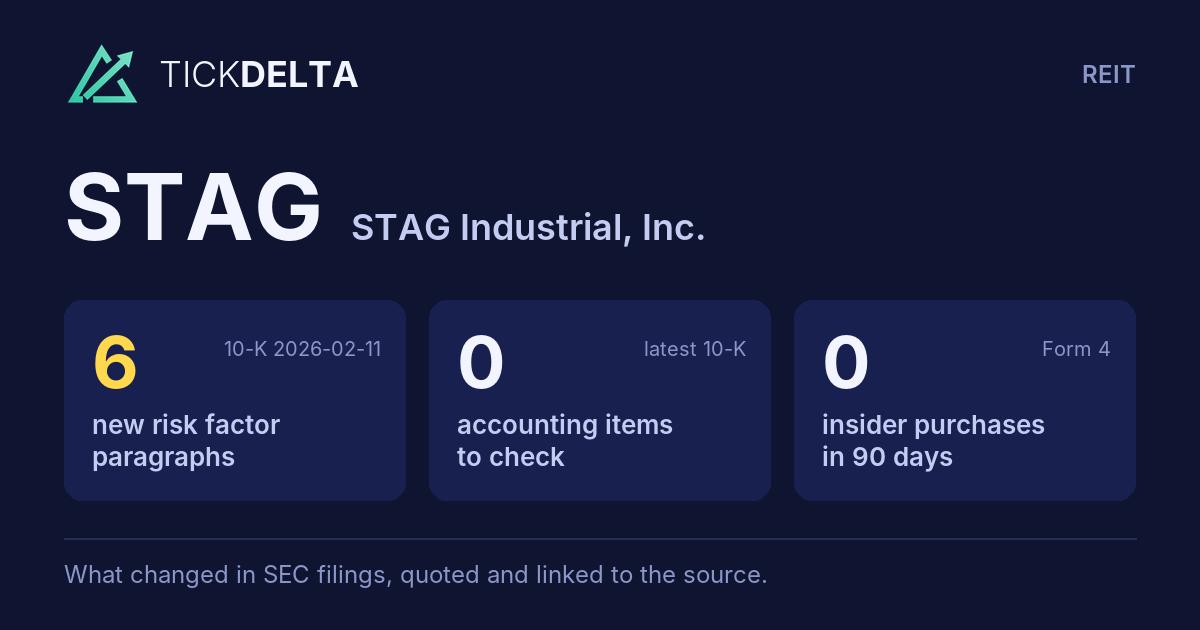
of the text changed · 10,736 words now · 6 new paragraphs, 12 gone
MD&A
17.3%
of the text changed · 11,249 words now · 3 new paragraphs, 8 gone
10-K 0001479094-26-000009 (Feb 11, 2026) vs 10-K 0001479094-25-000006 (Feb 12, 2025) Not compared: Legal Proceedings, Accounting Policies.
Every paragraph, and how much of it changed
One bar per paragraph, in the order of the 10-K. Height and colour show the share of its words not in the closest paragraph a year earlier; the tallest bars are new paragraphs.
Risk Factors
120 paragraphs · 6 new · 44 reworded · 12 gone · 10-K Feb 11, 2026 against Feb 12, 2025
New paragraph
Reworded (5% of its words or more)
Same or nearly
Paragraph 97 · 34% changed
Every version of it
Paragraph 20 · 32% changed
Every version of it
Paragraph 19 · 30% changed
Every version of it
Our operating results, cash flows, cash available for distribution, and the market price of our securities would be adversely affected if we are unable to lease, on economically favorable terms, a significant amount of space in our properties. Our properties may have some level of vacancy at the time of our acquisition and may incur a vacancy either by the continued default of a tenant under its lease or the expiration of one of our leases. As of December 31, 2024, 2025, leases with respect to approximately 22.7% 21.8% (excluding month-to-month leases) of our total annualized base rental revenue will expire before December 31, 2026. 2027. We cannot assure you that expiring leases will be renewed or that our properties will be re-leased at base rental rates equal to or above the current market rental rates. In addition, our ability to release space at attractive rental rates will depend on (i) whether the property is specifically suited to the particular needs of a tenant, and (ii) the number of vacant or partially vacant industrial properties in a market or sub-market. In connection with a vacancy at one of our properties, we may face difficulty obtaining, or be unable to obtain, a new tenant for the vacant space. If the vacancy continues for a long period of time, we may suffer reduced revenue resulting in less cash available for distribution to stockholders and the resale value of the property could be diminished.
Paragraph 43 · 26% changed
Every version of it
We have fiduciary duties to the limited partners in our Operating Partnership, including members of our management team and board of directors, the discharge of which may conflict with the interests of our stockholders. In addition, those persons holding common units will have the right to vote on certain amendments to the Operating Partnership agreement. These voting rights may be exercised in a manner that conflicts with the interests of our stockholders. Conflicts also may arise when the interests of our stockholders and the limited partners of our Operating Partnership diverge, particularly in circumstances in which there may be an adverse tax consequence to the limited partners. As a result of unrealized built-in gain attributable to contributed properties at the time of contribution, some holders of common units, including members of our management team, may suffer more adverse tax consequences than our stockholders upon the sale or refinancing of certain properties, including disproportionately greater allocations of items of taxable income and gain upon a realization event. As those holders will not receive a correspondingly greater distribution of cash proceeds, they may have different objectives regarding the appropriate pricing, timing and other material terms of any sale or refinancing of certain properties, or whether to sell or refinance such properties at all.
Paragraph 6 · 23% changed
Every version of it
Inflation adversely affects our financing costs (either through near-term borrowings on our variable rate debt, including our unsecured credit facility, or refinancing of existing debt at higher interest rates), and our general and administrative expenses and property operating expenses, as these costs and expenses could increase at a rate higher than our rental and other revenue. To the extent our exposure to increases in interest rates is not eliminated through interest rate swaps or other protection agreements, such increases may also result in higher debt service costs, which will adversely affect our cash flows. Historically, during periods of increasing interest rates, real estate valuations have generally decreased due to rising capitalization rates, which tend to move directionally with interest rates. Consequently, prolonged periods of higher interest rates may negatively impact the valuation of our real estate assets and could result in the decline of properties, the market price of our common stock, which may adversely impact our ability and willingness to raise equity capital on favorable terms, including through our at-the-market (“ATM”) common stock offering program. Although the extent of any prolonged periods of higher interest rates remains unknown at this time, negative impacts to our cost of capital may adversely affect and our future business plans and growth, at least growth. In addition, our access to funding sources and other credit arrangements could be significantly impaired by factors that affect us, the financial services industry or economy in general, including, among others, liquidity constraints or failures, the ability to perform obligations under financial, credit or liquidity agreements or arrangements, disruptions or instability in the near term. financial services industry or financial markets, or concerns or negative expectations about the prospects for the financial services industry.
Paragraph 57 · 23% changed
Every version of it
Our ability to execute our business strategy depends on our access to an appropriate blend of equity and debt financing. We have filed a registration statement with the SEC allowing us to offer, from time to time, an indefinite amount of equity and debt securities on an as-needed basis, including shares under our ATM at-the-market (“ATM”) common stock offering program. Sales of a substantial number of shares of our common stock (or the perception that such sales might occur), the vesting of equity awards under the 2011 Plan, the issuance of common stock or common units in connection with acquisitions, and other equity issuances may dilute the holdings of our existing stockholders or reduce the market prices of our securities, or both. securities. Holders of our common stock are not entitled to preemptive rights or other protections against dilution. In addition, we may attempt to increase our capital resources by issuing preferred stock or debt securities (including commercial paper, medium-term notes and senior or subordinated notes). Any future issuances of preferred stock will rank senior to our common stock with respect to distributions and liquidation rights, which could limit our ability to make distributions to holders of common stock. In addition, upon liquidation, holders of debt securities would receive a distribution of our available assets prior to any distribution to the holders of common stock. Because our decision to issue securities in any future offering will depend on market conditions and other factors beyond our control, we cannot predict or estimate the amount, timing, or nature of our future offerings. Thus, our stockholders bear the risk of future offerings reducing the market prices of our securities and diluting their proportionate ownership.
Paragraph 99 · 20% changed
Every version of it
If debt is unavailable at reasonable rates, we may not be able to finance acquisitions or refinance existing debt when the loans come due on favorable terms, or at all. Most of our financing arrangements require us to make a lump-sum or “balloon” payment at maturity. Our ability to make a payment at maturity is uncertain and, in the event that we do not have sufficient funds, we will need to refinance this debt. If interest rates are higher when we refinance such debt, our net income, cash flow, and, consequently, our cash available for distribution to stockholders could be reduced. If the credit environment is constrained at the time a payment is due, we may not be able to refinance the existing debt on acceptable terms and may be forced to choose from a number of unfavorable options, including accepting unfavorable financing terms, selling properties on disadvantageous terms or defaulting and permitting the lender to foreclose. In addition, adverse developments affecting the financial services industry or investor concerns regarding the U.S. or international financial systems could result in less favorable commercial financing terms, including higher interest rates or costs and more restrictive financial and operating covenants, or systemic limitations on access to credit and liquidity sources, thereby making it more difficult for us to acquire financing on acceptable terms or at all. Any decline in available funding or access to our cash and liquidity resources could, among other risks, adversely impact our ability to meet our financial or other obligations or reduce our net income and cash available for distribution to stockholders.
Paragraph 58 · 45% changed
Every version of it
10-K Feb 12, 2025filed a registration statement with the SEC allowing us to offer, from time to time, an indefinite amount of equity and debt securities on an as-needed basis, including shares under our ATM common stock offering program. Sales of a substantial number of shares of our common stock (or the perception that such sales might occur), the vesting of equity awards under the 2011 Plan, the issuance of common stock or common units in connection with acquisitions, and other equity issuances may dilute the holdings of our existing stockholders or reduce the market prices of our securities, or both. Holders of our common stock are not entitled to preemptive rights or other protections against dilution. In addition, we may attempt to increase our capital resources by issuing preferred stock or debt securities (including commercial paper, medium-term notes and senior or subordinated notes). Any future issuances of preferred stock will rank senior to our common stock with respect to distributions and liquidation rights, which could limit our ability to make distributions to holders of common stock. In addition, upon liquidation, holders of debt securities would receive a distribution of our available assets prior to any distribution to the holders of common stock. Because our decision to issue securities in any future offering will depend on market conditions and other factors beyond our control, we cannot predict or estimate the amount, timing, or nature of our future offerings. Thus, our stockholders bear the risk of future offerings reducing the market prices of our securities and diluting their proportionate ownership.
10-K Feb 11, 2026
distributions and liquidation rights, which could limit our ability to make distributions to holders of common stock. In addition, upon liquidation, holders of debt securities would receive a distribution of our available assets prior to any distribution to the holders of common stock. We cannot predict or estimate the amount, timing, or nature of our future offerings. Thus, our stockholders bear the risk of future offerings reducing the market prices of our securities and diluting their proportionate ownership.
Paragraph 97 · 34% changed
Every version of it
10-K Feb 12, 2025We are a holding company and conduct substantially all of our business through our Operating Partnership. As a result, we rely on distributions from our Operating Partnership to pay dividends and meet our debt service and other obligations. The ability of our Operating Partnership to make distributions to us depends on the operating results of our Operating Partnership and the terms of any loans that encumber our properties. Such loans may contain lock box arrangements, reserve requirements, financial covenants, and other provisions that restrict the distribution of funds in the event of a default.
10-K Feb 11, 2026
terms of any loans that encumber our properties. Such loans may contain lock box arrangements, reserve requirements, financial covenants, and other provisions that restrict the distribution of funds in the event of a default.
Paragraph 20 · 32% changed
Every version of it
10-K Feb 12, 2025Our operating results, cash flows, cash available for distribution, and the market price of our securities would be adversely affected if we are unable to lease, on economically favorable terms, a significant amount of space in our properties. Our properties may have some level of vacancy at the time of our acquisition and may incur a vacancy either by the continued default of a tenant under its lease or the expiration of one of our leases. As of December 31, 2024, leases with respect to approximately 22.7% (excluding month-to-month leases) of our total annualized base rental revenue will expire before December 31, 2026. We cannot assure you that expiring leases will be renewed or that our properties will be re-leased at base rental rates equal to or above the current market rental rates. In addition, our ability to release space at attractive rental rates will depend on (i) whether the property is specifically suited to the particular needs of a tenant, and (ii) the number of vacant or partially vacant industrial properties in a market or sub-market. In connection with a vacancy at one of our properties, we may face difficulty obtaining, or be unable to obtain, a new tenant for the vacant space. If the vacancy continues for a long period of time, we may suffer reduced revenue resulting in less cash available for distribution to stockholders and the resale value of the property could be diminished.
10-K Feb 11, 2026
release space at attractive rental rates will depend on (i) whether the property is specifically suited to the particular needs of a tenant, and (ii) the number of vacant or partially vacant industrial properties in a market or sub-market. In connection with a vacancy at one of our properties, we may face difficulty obtaining, or be unable to obtain, a new tenant for the vacant space. If the vacancy continues for an extended period of time, we may suffer reduced revenue resulting in less cash available for distribution to stockholders and the resale value of the property could be diminished.
Paragraph 19 · 30% changed
Every version of it
10-K Feb 12, 2025
Our operating results, cash flows, cash available for distribution, and the market price of our securities would be adversely affected if we are unable to lease, on economically favorable terms, a significant amount of space in our properties. Our properties may have some level of vacancy at the time of our acquisition and may incur a vacancy either by the continued default of a tenant under its lease or the expiration of one of our leases. As of December 31, 2024, leases with respect to approximately 22.7% (excluding month-to-month leases) of our total annualized base rental revenue will expire before December 31, 2026. We cannot assure you that expiring leases will be renewed or that our properties will be re-leased at base rental rates equal to or above the current market rental rates. In addition, our ability to release space at attractive rental rates will depend on (i) whether the property is specifically suited to the particular needs of a tenant, and (ii) the number of vacant or partially vacant industrial properties in a market or sub-market. In connection with a vacancy at one of our properties, we may face difficulty obtaining, or be unable to obtain, a new tenant for the vacant space. If the vacancy continues for a long period of time, we may suffer reduced revenue resulting in less cash available for distribution to stockholders and the resale value of the property could be diminished.
10-K Feb 11, 2026
Our operating results, cash flows, cash available for distribution, and the market price of our securities would be adversely affected if we are unable to lease, on economically favorable terms, a significant amount of space in our properties. As of December 31, 2025, leases with respect to approximately 21.8% (excluding month-to-month leases) of our total annualized base rental revenue will expire before December 31, 2027. We cannot assure you that expiring leases will be renewed or that our properties will be re-leased at base rental rates equal to or above the current market rental rates. In addition, our ability to
Paragraph 43 · 26% changed
Every version of it
10-K Feb 12, 2025
built-in gain attributable to contributed properties at the time of contribution, some holders of common units, including members of our management team, may suffer more adverse tax consequences than our stockholders upon the sale or refinancing of certain properties, including disproportionately greater allocations of items of taxable income and gain upon a realization event. As those holders will not receive a correspondingly greater distribution of cash proceeds, they may have different objectives regarding the appropriate pricing, timing and other material terms of any sale or refinancing of certain properties, or whether to sell or refinance such properties at all.
10-K Feb 11, 2026
We have fiduciary duties to the limited partners in our Operating Partnership, including members of our management team and board of directors, the discharge of which may conflict with the interests of our stockholders. In addition, those persons holding common units will have the right to vote on certain amendments to the Operating Partnership agreement. These voting rights may be exercised in a manner that conflicts with the interests of our stockholders. Conflicts also may arise when the interests of our stockholders and the limited partners of our Operating Partnership diverge, particularly in circumstances in which there may be an adverse tax consequence to the limited partners. As a result of unrealized built-in gain attributable to contributed properties at the time of contribution, some holders of common units, including members of our management team, may suffer more adverse tax consequences than our stockholders upon the sale or refinancing of certain properties, including disproportionately greater allocations of items of taxable income and gain upon a realization event. As those holders will not receive a correspondingly greater distribution of cash proceeds, they may have different objectives regarding the appropriate pricing, timing and other terms of any sale or refinancing of certain properties, or whether to sell or refinance such properties at all.
Paragraph 6 · 23% changed
Every version of it
10-K Feb 12, 2025
Inflation adversely affects our financing costs (either through near-term borrowings on our variable rate debt, including our unsecured credit facility, or refinancing of existing debt at higher interest rates), and our general and administrative expenses and property operating expenses, as these costs and expenses could increase at a rate higher than our rental and other revenue. To the extent our exposure to increases in interest rates is not eliminated through interest rate swaps or other protection agreements, such increases may also result in higher debt service costs, which will adversely affect our cash flows. Historically, during periods of increasing interest rates, real estate valuations have generally decreased due to rising capitalization rates, which tend to move directionally with interest rates. Consequently, prolonged periods of higher interest rates may negatively impact the valuation of our real estate assets and could result in the decline of the market price of our common stock, which may adversely impact our ability and willingness to raise equity capital on favorable terms, including through our at-the-market (“ATM”) common stock offering program. Although the extent of any prolonged periods of higher interest rates remains unknown at this time, negative impacts to our cost of capital may adversely affect our future business plans and growth, at least in the near term.
10-K Feb 11, 2026
Inflation adversely affects our financing costs (either through near-term borrowings on our variable rate debt, including our unsecured credit facility, or refinancing of existing debt at higher interest rates), and our general and administrative expenses and property operating expenses, as these costs and expenses could increase at a rate higher than our revenue. To the extent our exposure to interest rates is not eliminated through interest rate swaps or other agreements, such increases may also result in higher debt service costs, which will adversely affect our cash flows. Historically, during periods of increasing interest rates, real estate valuations have generally decreased due to rising capitalization rates, which tend to move directionally with interest rates. Consequently, prolonged periods of higher interest rates may negatively impact the valuation of our properties, the market price of our common stock, our ability to raise equity capital on favorable terms, and our future business plans and growth. In addition, our access to funding sources and other credit arrangements could be significantly impaired by factors that affect us, the financial services industry or economy in general, including, among others, liquidity constraints or failures, the ability to perform obligations under financial, credit or liquidity agreements or arrangements, disruptions or instability in the financial services industry or financial markets, or concerns or negative expectations about the prospects for the financial services industry.
Paragraph 57 · 23% changed
Every version of it
10-K Feb 12, 2025
filed a registration statement with the SEC allowing us to offer, from time to time, an indefinite amount of equity and debt securities on an as-needed basis, including shares under our ATM common stock offering program. Sales of a substantial number of shares of our common stock (or the perception that such sales might occur), the vesting of equity awards under the 2011 Plan, the issuance of common stock or common units in connection with acquisitions, and other equity issuances may dilute the holdings of our existing stockholders or reduce the market prices of our securities, or both. Holders of our common stock are not entitled to preemptive rights or other protections against dilution. In addition, we may attempt to increase our capital resources by issuing preferred stock or debt securities (including commercial paper, medium-term notes and senior or subordinated notes). Any future issuances of preferred stock will rank senior to our common stock with respect to distributions and liquidation rights, which could limit our ability to make distributions to holders of common stock. In addition, upon liquidation, holders of debt securities would receive a distribution of our available assets prior to any distribution to the holders of common stock. Because our decision to issue securities in any future offering will depend on market conditions and other factors beyond our control, we cannot predict or estimate the amount, timing, or nature of our future offerings. Thus, our stockholders bear the risk of future offerings reducing the market prices of our securities and diluting their proportionate ownership.
10-K Feb 11, 2026
Our ability to execute our business strategy depends on our access to an appropriate blend of equity and debt financing. We have filed a registration statement with the SEC allowing us to offer, from time to time, an indefinite amount of equity and debt securities on an as-needed basis, including shares under our at-the-market (“ATM”) common stock offering program. Sales of a substantial number of shares of our common stock (or the perception that such sales might occur), the vesting of equity awards under the 2011 Plan, the issuance of common stock or common units in connection with acquisitions, and other equity issuances may dilute the holdings of our existing stockholders or reduce the market prices of our securities. Holders of our common stock are not entitled to preemptive rights or other protections against dilution. In addition, we may attempt to increase our capital resources by issuing preferred stock or debt securities (including commercial paper, medium-term notes and senior or subordinated notes). Any future issuances of preferred stock will rank senior to our common stock with respect to
Paragraph 99 · 20% changed
Every version of it
10-K Feb 12, 2025
If debt is unavailable at reasonable rates, we may not be able to finance acquisitions or refinance existing debt when the loans come due on favorable terms, or at all. Most of our financing arrangements require us to make a lump-sum or “balloon” payment at maturity. Our ability to make a payment at maturity is uncertain and, in the event that we do not have sufficient funds, we will need to refinance this debt. If interest rates are higher when we refinance such debt, our net income, cash flow, and, consequently, our cash available for distribution to stockholders could be reduced. If the credit environment is constrained at the time a payment is due, we may not be able to refinance the existing debt on acceptable terms and may be forced to choose from a number of unfavorable options, including accepting unfavorable financing terms, selling properties on disadvantageous terms or defaulting and permitting the lender to foreclose.
10-K Feb 11, 2026
If debt is unavailable at reasonable rates, we may not be able to finance acquisitions or refinance existing debt when the loans come due on favorable terms, or at all. Most of our financing arrangements require us to make a lump-sum or “balloon” payment at maturity. Our ability to make a payment at maturity is uncertain and, in the event that we do not have sufficient funds, we will need to refinance this debt. If interest rates are higher when we refinance such debt, our net income, cash flow, and, consequently, our cash available for distribution to stockholders could be reduced. If the credit environment is constrained at the time a payment is due, we may not be able to refinance the existing debt on acceptable terms and may be forced to choose from a number of unfavorable options, including accepting unfavorable financing terms, selling properties on disadvantageous terms or defaulting and permitting the lender to foreclose. In addition, adverse developments affecting the financial services industry or investor concerns regarding the U.S. or international financial systems could result in less favorable commercial financing terms, including higher interest rates or costs and more restrictive financial and operating covenants, or systemic limitations on access to credit and liquidity sources, thereby making it more difficult for us to acquire financing on acceptable terms or at all. Any decline in available funding or access to our cash and liquidity resources could, among other risks, adversely impact our ability to meet our financial or other obligations or reduce our net income and cash available for distribution to stockholders.
MD&A
157 paragraphs · 3 new · 54 reworded · 8 gone · 10-K Feb 11, 2026 against Feb 12, 2025
New paragraph
Reworded (5% of its words or more)
Same or nearly
Paragraph 25 · 41% changed
Paragraph 120 · 39% changed
On March 13, 2024, April 15, 2025, we entered into a note purchase agreement (the “March 2024 NPA”) for the private placement by the Operating Partnership of $175.0 $350.0 million of senior unsecured notes (the “Series O Unsecured Notes”) maturing May 28, 2029, June 25, 2030 with a fixed annual interest rate of 6.05%, $125.0 5.50%, $100.0 million of senior unsecured notes (the “Series P Unsecured Notes”) maturing May 28, 2031, June 25, 2033 with a fixed annual interest rate of 6.17%, 5.82%, and $150.0 $100.0 million of senior unsecured notes (the “Series Q Unsecured Notes”) maturing May 28, 2034, June 25, 2035 with a fixed annual interest rate of 6.30%. The March 2024 NPA contains a number of financial covenants substantially similar to 5.99%. On June 25, 2025, Operating Partnership issued the financial covenants contained in our unsecured credit facility Series O Unsecured Notes, Series P Unsecured Notes, and other unsecured notes, plus a financial covenant that requires us to maintain a minimum interest coverage ratio of not less than 1.50:1.00. Series Q Unsecured Notes (collectively, the “2025 Notes”) and received the proceeds therefrom. The Company and certain wholly owned subsidiaries of the Operating Partnership are guarantors of the unsecured notes. On May 28, 2024, we issued all The Operating Partnership offered and sold the 2025 Notes in reliance on the registration exemption provided by Section 4(a)(2) of the notes under the March 2024 NPA. Securities Act.
Paragraph 118 · 39% changed
On March 25, 2024, September 15, 2025, we entered into a second amended and restated term loan agreement for the amendments to our Unsecured Credit Facility, Unsecured Term Loan F A, Unsecured Term Loan F, Unsecured Term Loan H, and Unsecured Term Loan I to (i) extend remove the maturity date to March 25, 2027, with two one-year extension options, subject to 0.10% interest rate adjustment for certain conditions, that would extend loans, and in the maturity date to March 23, 2029 if both exercised, case of our Unsecured Term Loans A, H, and (ii) I, provide that borrowings under the Unsecured Term Loan F respective term loans will, at our election, bear interest based on a Base Rate, Adjusted Term SOFR, or Adjusted Daily Simple SOFR (each as defined in the respective loan agreement), which interest rate will be increased by 0.10% for any SOFR Loan (as defined in the loan agreement), plus an applicable spread based on our debt rating and leverage ratio (each as defined in the loan agreement), less a sustainability-related adjustment. agreement). Other than the maturity and interest rate provisions described above, the material terms of our Unsecured Term Loans A, F, H, and I remain unchanged.
Paragraph 47 · 37% changed
We record all derivatives on the accompanying Consolidated Balance Sheets at fair value. The accounting for changes in the fair value of derivatives depends on the intended use of the derivative, whether we have elected to designate a derivative in a hedging relationship and apply hedge accounting, and whether the hedging relationship has satisfied the criteria necessary to apply hedge accounting. Derivatives designated and qualifying as a hedge of the exposure to changes in the fair value of an asset, liability, or firm commitment attributable to a particular risk, such as interest rate risk, are considered fair value hedges. Derivatives designated and qualifying as a hedge of the exposure to variability in expected future cash flows, or other types of forecasted transactions, are considered cash flow hedges. Hedge accounting generally provides for the matching of the timing of gain or loss recognition on the hedging instrument with the recognition of the changes in the fair value of the hedged asset or liability that are attributable to the hedged risk in a fair value hedge or the earnings effect of the hedged forecasted transactions in a cash flow hedge. We may enter into derivative contracts that are intended to economically hedge certain of its risks, even though hedge accounting does not apply or we elect not to apply hedge accounting.
Paragraph 136 · 36% changed
We have filed a registration statement with the SEC allowing us to offer, from time to time, an indefinite amount of equity and debt securities on an as-needed basis, including debt securities of our Operating Partnership that are guaranteed by the Company. Any such guarantees issued by the Company will be full, irrevocable, unconditional, and absolute joint and several guarantees to the holders of each series of such outstanding guaranteed debt securities. Pursuant to Rule 3-10 of Regulation S-X, subsidiary issuers of obligations guaranteed by the parent are not required to provide separate financial statements, provided that the subsidiary obligor is consolidated into the parent company’s consolidated financial statements, the parent guarantee is “full and unconditional” and, subject to certain exceptions as set forth below, the alternative disclosure required by Rule 13-01 of Regulation S-X is provided, which includes narrative disclosure and summarized financial information. Accordingly, we have not presented separate consolidated financial statements of our Operating Partnership. Furthermore, as permitted under Rule 13-01(a)(4)(vi) of Regulation S-X, we have not presented summarized financial information for our Operating Partnership because the assets, liabilities, and results of operations of our Operating Partnership are not materially different than the corresponding amounts in the Company’s consolidated financial statements, and we believe the inclusion of such summarized financial information would be repetitive and would not provide incremental value to investors. S-
Paragraph 39 · 36% changed
Paragraph 12 · 35% changed
Paragraph 109 · 33% changed
(2)Our unsecured credit facility has a stated interest rate of one-month Term SOFR plus a 0.10% adjustment and a spread of 0.775%. Our unsecured term loans Unsecured Term Loans A, G, H, and I have a stated interest rate of one-month Term SOFR plus a 0.10% adjustment and a spread of 0.85%. As of December 31, 2024, one-month Term SOFR for the Unsecured Term Loans A, F, G, H, and I was swapped to a fixed rate of 1.31%, 2.11%, 0.95%, 2.50%, and 2.66%, respectively (which includes the 0.10% adjustment). The Our Unsecured Term Loan F provides for the election has a stated interest rate of Daily Simple Secured Overnight Financing Rate (“Daily SOFR”), and effective January 15, 2025, Daily SOFR was swapped to plus a fixed rate of 3.98%. spread
Paragraph 25 · 41% changed
10-K Feb 12, 2025Our property operating expenses generally consist of utilities, real estate taxes, management fees, insurance, and site repair and maintenance costs. For the majority of our tenants, our property operating expenses are controlled, in part, by the triple net provisions in tenant leases. In our triple net leases, the tenant is responsible for all aspects of and costs related to the building and its operation during the lease term, including utilities, taxes, insurance, and maintenance costs, but typically excluding roof and building structure. However, we also have modified gross leases and gross leases, as well as leases with expense caps, in our building portfolio, which may require us to absorb certain building related expenses of our tenants. In our modified gross leases, we are responsible for certain building related expenses during the lease term, but most of the expenses are passed through to the tenant for reimbursement to us. In our gross leases, we are responsible for all expenses related to the building and its operation during the lease term. Our overall performance will be affected by the extent to which we are able to pass-through property operating expenses to our tenants.
10-K Feb 11, 2026
through to the tenant for reimbursement to us. In our gross leases, we are responsible for all expenses related to the building and its operation during the lease term. Our overall performance will be affected by the extent to which we are able to pass-through property operating expenses to our tenants.
Paragraph 120 · 39% changed
10-K Feb 12, 2025
On March 13, 2024, we entered into a note purchase agreement (the “March 2024 NPA”) for the private placement by the Operating Partnership of $175.0 million senior unsecured notes maturing May 28, 2029, with a fixed annual interest rate of 6.05%, $125.0 million senior unsecured notes maturing May 28, 2031, with a fixed annual interest rate of 6.17%, and $150.0 million senior unsecured notes maturing May 28, 2034, with a fixed annual interest rate of 6.30%. The March 2024 NPA contains a number of financial covenants substantially similar to the financial covenants contained in our unsecured credit facility and other unsecured notes, plus a financial covenant that requires us to maintain a minimum interest coverage ratio of not less than 1.50:1.00. The Company and certain wholly owned subsidiaries of the Operating Partnership are guarantors of the unsecured notes. On May 28, 2024, we issued all of the notes under the March 2024 NPA.
10-K Feb 11, 2026
On April 15, 2025, we entered into a note purchase agreement for the private placement by the Operating Partnership of $350.0 million of senior unsecured notes (the “Series O Unsecured Notes”) maturing June 25, 2030 with a fixed annual interest rate of 5.50%, $100.0 million of senior unsecured notes (the “Series P Unsecured Notes”) maturing June 25, 2033 with a fixed annual interest rate of 5.82%, and $100.0 million of senior unsecured notes (the “Series Q Unsecured Notes”) maturing June 25, 2035 with a fixed annual interest rate of 5.99%. On June 25, 2025, Operating Partnership issued the Series O Unsecured Notes, Series P Unsecured Notes, and Series Q Unsecured Notes (collectively, the “2025 Notes”) and received the proceeds therefrom. The Company and certain wholly owned subsidiaries of the Operating Partnership are guarantors of the unsecured notes. The Operating Partnership offered and sold the 2025 Notes in reliance on the registration exemption provided by Section 4(a)(2) of the Securities Act.
Paragraph 118 · 39% changed
10-K Feb 12, 2025
On March 25, 2024, we entered into a second amended and restated term loan agreement for the Unsecured Term Loan F to (i) extend the maturity date to March 25, 2027, with two one-year extension options, subject to certain conditions, that would extend the maturity date to March 23, 2029 if both exercised, and (ii) provide that borrowings under the Unsecured Term Loan F will, at our election, bear interest based on a Base Rate, Adjusted Term SOFR, or Adjusted Daily Simple SOFR (each as defined in the loan agreement), which interest rate will be increased by 0.10% for any SOFR Loan (as defined in the loan agreement), plus an applicable spread based on our debt rating and leverage ratio (each as defined in the loan agreement), less a sustainability-related adjustment. Other than the maturity and interest rate provisions described above, the material terms remain unchanged.
10-K Feb 11, 2026
On September 15, 2025, we entered into amendments to our Unsecured Credit Facility, Unsecured Term Loan A, Unsecured Term Loan F, Unsecured Term Loan H, and Unsecured Term Loan I to remove the 0.10% interest rate adjustment for certain loans, and in the case of our Unsecured Term Loans A, H, and I, provide that borrowings under the respective term loans will, at our election, bear interest based on a Base Rate, Term SOFR, or Daily Simple SOFR (each as defined in the respective loan agreement). Other than the interest rate provisions described above, the material terms of our Unsecured Term Loans A, F, H, and I remain unchanged.
Paragraph 47 · 37% changed
10-K Feb 12, 2025
We record all derivatives on the accompanying Consolidated Balance Sheets at fair value. The accounting for changes in the fair value of derivatives depends on the intended use of the derivative, whether we have elected to designate a derivative in a hedging relationship and apply hedge accounting, and whether the hedging relationship has satisfied the criteria necessary to apply hedge accounting. Derivatives designated and qualifying as a hedge of the exposure to changes in the fair value of an asset, liability, or firm commitment attributable to a particular risk, such as interest rate risk, are considered fair value hedges. Derivatives designated and qualifying as a hedge of the exposure to variability in expected future cash flows, or other types of forecasted transactions, are considered cash flow hedges. Hedge accounting generally provides for the matching of the timing of gain or loss recognition on the hedging instrument with the recognition of the changes in the fair value of the hedged asset or liability that are attributable to the hedged risk in a fair value hedge or the earnings effect of the hedged forecasted transactions in a cash flow hedge. We may enter into derivative contracts that are intended to economically hedge certain of its risks, even though hedge accounting does not apply or we elect not to apply hedge accounting.
10-K Feb 11, 2026
We record all derivatives on the accompanying Consolidated Balance Sheets at fair value. The accounting for changes in the fair value of derivatives depends on the intended use of the derivative, whether we have elected to designate a derivative in a hedging relationship and apply hedge accounting, and whether the hedging relationship has satisfied the criteria necessary to apply hedge accounting. Derivatives designated and qualifying as a hedge of the exposure to changes in the fair value of an
Paragraph 136 · 36% changed
10-K Feb 12, 2025
We have filed a registration statement with the SEC allowing us to offer, from time to time, an indefinite amount of equity and debt securities on an as-needed basis, including debt securities of our Operating Partnership that are guaranteed by the Company. Any such guarantees issued by the Company will be full, irrevocable, unconditional, and absolute joint and several guarantees to the holders of each series of such outstanding guaranteed debt securities. Pursuant to Rule 3-10 of Regulation S-X, subsidiary issuers of obligations guaranteed by the parent are not required to provide separate financial statements, provided that the subsidiary obligor is consolidated into the parent company’s consolidated financial statements, the parent guarantee is “full and unconditional” and, subject to certain exceptions as set forth below, the alternative disclosure required by Rule 13-01 of Regulation S-X is provided, which includes narrative disclosure and summarized financial information. Accordingly, we have not presented separate consolidated financial statements of our Operating Partnership. Furthermore, as permitted under Rule 13-01(a)(4)(vi) of Regulation S-X, we have not presented summarized financial information for our Operating Partnership because the assets, liabilities, and results of operations of our Operating Partnership are not materially different than the corresponding amounts in the Company’s consolidated financial statements, and we believe the inclusion of such summarized financial information would be repetitive and would not provide incremental value to investors.
10-K Feb 11, 2026
We have filed a registration statement with the SEC allowing us to offer, from time to time, an indefinite amount of equity and debt securities on an as-needed basis, including debt securities of our Operating Partnership that are guaranteed by the Company. Any such guarantees issued by the Company will be full, irrevocable, unconditional, and absolute joint and several guarantees to the holders of each series of such outstanding guaranteed debt securities. Pursuant to Rule 3-10 of Regulation S-
Paragraph 39 · 36% changed
10-K Feb 12, 2025In determining the fair value of the debt assumed, we discount the spread between the future contractual interest payments and hypothetical future interest payments on mortgage debt based on a current market rate. The associated fair market value debt adjustment is amortized through interest expense over the life of the debt on a basis which approximates the effective interest method.
10-K Feb 11, 2026
adjustment is amortized through interest expense over the life of the debt on a basis which approximates the effective interest method.
Paragraph 12 · 35% changed
10-K Feb 12, 2025Due to demographic/consumer trends, geopolitical uncertainty and recent legislation supporting U.S. infrastructure, we expect industrial-specific trends to support stronger long term demand, including:
10-K Feb 11, 2026
Alternatively, demographic/consumer trends, geopolitical uncertainty and recent legislation supporting U.S. infrastructure may accelerate trends that support stronger long term demand for industrial space, including:
Paragraph 109 · 33% changed
10-K Feb 12, 2025
(2)Our unsecured credit facility has a stated interest rate of one-month Term SOFR plus a 0.10% adjustment and a spread of 0.775%. Our unsecured term loans have a stated interest rate of one-month Term SOFR plus a 0.10% adjustment and a spread of 0.85%. As of December 31, 2024, one-month Term SOFR for the Unsecured Term Loans A, F, G, H, and I was swapped to a fixed rate of 1.31%, 2.11%, 0.95%, 2.50%, and 2.66%, respectively (which includes the 0.10% adjustment). The Unsecured Term Loan F provides for the election of Daily Simple Secured Overnight Financing Rate (“Daily SOFR”), and effective January 15, 2025, Daily SOFR was swapped to a fixed rate of 3.98%.
10-K Feb 11, 2026
(2)Our unsecured credit facility has a stated interest rate of one-month Term SOFR plus a spread of 0.775%. Our Unsecured Term Loans A, G, H, and I have a stated interest rate of one-month Term SOFR plus a spread of 0.85%. Our Unsecured Term Loan F has a stated interest rate of Daily SOFR plus a spread
A paragraph is matched with the one last year that shares the most of its words; under half in common makes it new. The paragraphs shown are the 8 reworded the most in each section.
The paragraph that changed most in each section
The redline
Marked against last year's 10-K: cut words struck through, new words highlighted.
MD&A163 words changed in this paragraph; it is 61% similar to last year's version.
The industrial real estate business is affected by general macro-economic trends including recent changes in interest rates, inflation, trade policies, fiscal policy, technology (e.g., artificial intelligence), and geopolitical tensions. These factors are key drivers of financial market volatility and raise concerns about a slowing global economy. While economic volatility. In 2025, U.S. real gross domestic product (“GDP”) declined during 0.5% in the first two quarters of 2022, real GDP has increased for nine consecutive quarters with the most recent measure showing 3.1% growth quarter before increasing 3.8% and 4.3% in the third quarter of 2024. subsequent two quarters, respectively. Labor conditions are slowing but holding solid slowing, with a 4.1% unemployment rate rising to 4.4% as of December 2024. The 2025 compared to 4.1% at the end of June 2025. In the fourth quarter of 2025, following weaker employment data, the Federal Open Market Committee lowered the federal funds rate range twice, in each instance a reduction of 25 basis points, to a target range of 3.50-3.75%. Currently, the general consensus among economists is low growth in the United States with a continued historically elevated higher risk of recession. recession or stagflation. While the trade policies and macro-economic conditions will continue to evolve and could result in tighter credit conditions, weakening tenant cash flows, and rising vacancy rates, we believe we will continue to benefit on a relative basis from having a well-diversified portfolio across various markets, tenant industries, and lease terms. Additionally, we believe that recent moves toward more regional supply chains and geopolitical tensions have accelerated a number of trends that positively affect impact U.S. industrial demand. However, given the current uncertainty and events discussed above, our acquisition activity slowed has continued to slow since 2022. 2022 relative to our historical acquisition pace.
Source: Item 7, 10-K 0001479094-26-000009 vs Item 7, 10-K 0001479094-25-000006
Risk Factors138 words changed in this paragraph; it is 59% similar to last year's version.
Our operating results, cash flows, cash available for distribution, and the market price of our securities would be adversely affected if we are unable to lease, on economically favorable terms, a significant amount of space in our properties. Our properties may have some level of vacancy at the time of our acquisition and may incur a vacancy either by the continued default of a tenant under its lease or the expiration of one of our leases. As of December 31, 2024, 2025, leases with respect to approximately 22.7% 21.8% (excluding month-to-month leases) of our total annualized base rental revenue will expire before December 31, 2026. 2027. We cannot assure you that expiring leases will be renewed or that our properties will be re-leased at base rental rates equal to or above the current market rental rates. In addition, our ability to release space at attractive rental rates will depend on (i) whether the property is specifically suited to the particular needs of a tenant, and (ii) the number of vacant or partially vacant industrial properties in a market or sub-market. In connection with a vacancy at one of our properties, we may face difficulty obtaining, or be unable to obtain, a new tenant for the vacant space. If the vacancy continues for a long period of time, we may suffer reduced revenue resulting in less cash available for distribution to stockholders and the resale value of the property could be diminished.
Source: Item 1A, 10-K 0001479094-26-000009 vs Item 1A, 10-K 0001479094-25-000006
Sentences and paragraphs added, removed or reworded
Every change, by type
Sentences and paragraphs of STAG's Risk Factors and MD&A, 10-K Feb 11, 2026 against 10-K Feb 12, 2025. Each links to the text at sec.gov.
Quiet changes are sentences kept from last year with one to four words changed, at least one of them a hedge, a modal or a qualifier (may, could, will, not, significant, material…). A year or date rolling forward is not counted.
The full word list
adverse, adversely, all, although, anticipate, anticipates, any, approximately, believe, believes, can, cannot, certain, could, expect, expects, generally, however, if, intend, intends, largely, likely, many, material, materially, may, might, most, must, never, no, not, possible, primarily, probable, should, significant, significantly, some, substantial, substantially, unlikely, will, would
AddedRisk Factors
Trade policies, tariffs and related government actions may cause a decline in economic activity and have a material adverse impact on our business.
Read it in 10-K Feb 11, 2026 at sec.gov
AddedRisk Factors
The U.S. government indicated its intent to alter its approach to international trade policy and in some cases to renegotiate, or potentially terminate, certain existing trade agreements and treaties with foreign countries, and has made proposals and taken actions related thereto. During 2025, new tariffs were imposed in the United States for imports from a broad range of countries and on certain materials. Several countries also implemented or proposed retaliatory tariffs on imports from the United States and introduced additional trade barriers. Further governmental actions related to the imposition of tariffs or other trade barriers by the United States or foreign countries or changes to international trade agreements or policies, or uncertainty related to any such actions, could further increase costs, decrease margins, reduce the competitiveness of products and services offered by our current and future tenants and adversely affect the revenues and profitability of our tenants whose businesses rely on goods imported from such impacted jurisdictions. Such action, changes or uncertainty could also increase the costs and decrease margins on our development or expansion projects. Any of these impacts could have a material adverse effect on the businesses of our current and future tenants as well as on our business, financial condition and results of operations.
Read it in 10-K Feb 11, 2026 at sec.gov
AddedRisk Factors
In order to maintain our qualification as a REIT, we are generally required under the Code to annually distribute at least 90% of our net taxable income, determined without regard to the dividends paid deduction and excluding any net capital gain. In
Read it in 10-K Feb 11, 2026 at sec.gov
AddedRisk Factors
Our bylaws contain exclusive forum provisions for certain types of actions, which could limit our stockholders’ ability to bring a claim in a judicial forum that the stockholders believe is a more favorable judicial forum.
Read it in 10-K Feb 11, 2026 at sec.gov
AddedRisk Factors
Our bylaws provide that, unless we consent in writing to the selection of an alternative forum, any state court of competent jurisdiction in the State of Maryland, or, if such state courts do not have jurisdiction, the United States District Court located within the State of Maryland will, to the fullest extent permitted by law, be the sole and exclusive forum for (i) any derivative action or proceeding brought on our behalf, other than actions arising under federal securities laws, (ii) any Internal Corporate Claim, as such term is defined in the Maryland General Corporation Law (the “MGCL”), and any action or proceeding asserting any Internal Corporate Claim, including, without limitation, (a) any claim based on an alleged breach of any duty owed by any of our directors, officers, employees or agents to us or to our stockholders, or (b) any claim against us or any of our directors, officers, employees, or agents arising pursuant to any provision of the MGCL or our charter or bylaws, or (iii) any other action asserting a claim against us or any of our directors, officers, employees, or agents that is governed by the internal affairs doctrine. Furthermore, our bylaws provide that, unless we consent in writing to the selection of an alternative forum, the federal district courts of the United States of America will, to the fullest extent permitted by law, be the sole and exclusive forum for the resolution of any complaint asserting a cause of action arising under the Securities Act. This provision may limit a stockholder’s ability to bring a claim in a judicial forum that the stockholder believes is more favorable for disputes against us or our directors, officers, employees, or agents, which may discourage such lawsuits against us and our directors, officers, employees, and agents.
Read it in 10-K Feb 11, 2026 at sec.gov
AddedRisk Factors
We engage in development of new industrial properties, as well as redevelopment and expansion of existing properties, which involve risks in addition to the general risks associated with real estate assets, including delays or failure to obtain required zoning, land use, building, occupancy, entitlement or other governmental approvals; construction delays and cost overruns due to labor, materials, supply chain or other issues; nonperformance, insolvency or disputes involving development partners, general contractors or subcontractors; misjudging tenant demand, achievable rental rates, competitive supply or other local market conditions; lower‑than‑expected lease‑up, rents or occupancy; design or construction defects leading to remediation costs, liability or code noncompliance; extended periods of limited or negative cash flow before stabilization; and the need to fund additional costs from corporate cash or debt, reducing funds available for other purposes and distributions.
Read it in 10-K Feb 11, 2026 at sec.gov
RemovedRisk Factors
RemovedRisk Factors
Show the other 49
RemovedRisk Factors
RemovedRisk Factors
RemovedRisk Factors
RemovedRisk Factors
RemovedRisk Factors
RemovedRisk Factors
RemovedRisk Factors
RemovedRisk Factors
RemovedRisk Factors
RemovedRisk Factors
RewordedRisk Factors
Consequently, prolonged periods of higher interest rates may negatively impact the valuation of our real estate assets and could result in the decline of properties, the market price of our common stock, which may adversely impact our ability and willingness to raise equity capital on favorable terms, including through and our at-the-market (“ATM”) common stock offering program. future business plans and growth.
Read it in 10-K Feb 11, 2026 at sec.gov
RewordedRisk Factors
In the event that we recognize a significant gain from a forward sale agreement, agreement or the Internal Revenue Service (“IRS”) otherwise re-characterizes the tax treatment of the forward sale agreement in a manner that results in the recognition of income by us, we may not be able to satisfy the gross income requirements applicable to REITs under the Code, may not be able to rely upon certain relief provisions and could lose our REIT status under the Code.
Read it in 10-K Feb 11, 2026 at sec.gov
RewordedRisk Factors
RewordedRisk Factors
When we acquire properties located in these markets, we face risks associated with a lack of market knowledge or understanding of the local economy (including that competitors and counterparties may have much greater knowledge and understanding), forging new business relationships in the area and unfamiliarity with local government and laws.
Read it in 10-K Feb 11, 2026 at sec.gov
RewordedRisk Factors
RewordedRisk Factors
Our bylaws require us to indemnify our directors and officers to the maximum extent permitted by Maryland law for liability actually incurred in connection with any proceeding to which they may be made, or threatened to be made, a party, proceeding, except to the extent that the act or omission of the director or officer was material to the matter giving rise to the proceeding and was either committed in bad faith or was the result of active and deliberate dishonesty, the director or officer actually received an improper personal benefit in money, property or services, or, in the case of any criminal proceeding, the director or officer had reasonable cause to believe that the act or omission was unlawful.
Read it in 10-K Feb 11, 2026 at sec.gov
RewordedRisk Factors
There can be no assurance that we will be able to maintain our current credit ratings, and in the event our credit ratings are downgraded, we would incur greater borrowing costs and may encounter difficulty in obtaining additional financing. financing, additional payments obligations, or other negative consequences under our unsecured credit facility and other debt instruments.
Read it in 10-K Feb 11, 2026 at sec.gov
RewordedRisk Factors
Our ability to continue to acquire properties in our pipeline that we believe to be suitable and compatible with our growth strategy may be constrained by numerous factors, including our ability to negotiate and execute a mutually-acceptable definitive purchase and sale agreement with the seller, agreement, our completion of satisfactory due diligence and the satisfaction of customary closing conditions, including the receipt of third-party consents and approvals.
Read it in 10-K Feb 11, 2026 at sec.gov
RewordedRisk Factors
Any future issuances of preferred stock will rank senior to our common stock with respect to distributions and liquidation rights, which could limit our ability to make distributions to holders of common stock.
Read it in 10-K Feb 11, 2026 at sec.gov
RewordedRisk Factors
RewordedRisk Factors
RewordedRisk Factors
Distributions will be authorized and determined by our board of directors in its sole discretion from time to time and will depend upon a number of factors, including cash available for distribution, our operating results, operating expenses and expenses, financial condition (especially in relation to our anticipated future capital needs), condition, REIT distribution requirements under the Code and other factors the board deems relevant.
Read it in 10-K Feb 11, 2026 at sec.gov
Quiet changesRisk Factors
As those holders will not receive a correspondingly greater distribution of cash proceeds, they may have different objectives regarding the appropriate pricing, timing and other material terms of any sale or refinancing of certain properties, or whether to sell or refinance such properties at all.
Read it in 10-K Feb 11, 2026 at sec.gov
Quiet changesRisk Factors
Furthermore, we cannot assure you that we will have the funds that may be required to correct defects or to make improvements before a property can be sold.
Read it in 10-K Feb 11, 2026 at sec.gov
Quiet changesRisk Factors
We face risks associated with security breaches, cyber-attacks, and other significant disruptions of our IT networks and related systems.
Read it in 10-K Feb 11, 2026 at sec.gov
AddedMD&A
Overall, demand across the industrial market is moderating relative to recent peaks. Vacancy and availability rates are near historical standards in many markets. The supply pipeline remains active, albeit with lower volume and more notably concentrated in build-to-suits as speculative construction remains low due to moderating demand and volatile capital markets.
Read it in 10-K Feb 11, 2026 at sec.gov
AddedMD&A
of 0.85%. All our unsecured term loans have been swapped to a fixed rate, and such fixed rates inclusive of the spreads are presented in the table above. Effective February 5, 2026, our Unsecured Term Loan G was swapped to a fixed rate inclusive of the spread of 3.94%.
Read it in 10-K Feb 11, 2026 at sec.gov
AddedMD&A
(1)We define Net Debt as the outstanding principal balance of the Company’s total debt, less cash and cash equivalents and proceeds from pending reverse Section 1031 like-kind exchanges that are included in restricted cash. We define Real Estate Cost Basis as the book value of rental property and deferred leasing intangibles, exclusive of the related accumulated depreciation and amortization.
Read it in 10-K Feb 11, 2026 at sec.gov
RemovedMD&A
RemovedMD&A
RemovedMD&A
RemovedMD&A
RemovedMD&A
RemovedMD&A
RemovedMD&A
RemovedMD&A
RewordedMD&A
On September 10, 2024, 15, 2025, we entered into the a second amended and restated credit term loan agreement for our unsecured credit facility (the “2024 Credit Agreement”) to, Unsecured Term Loan G to (i) extend the maturity date to September 8, 2028, March 15, 2030, or such later date which may be extended pursuant to two six-month a one-year extension options option exercisable by us at in our discretion, discretion upon advance written notice, subject to certain conditions, including the payment of a fee, (ii) remove the 0.10% interest rate adjustment certain loans, and (ii) (iii) provide that borrowings under our unsecured credit facility the Unsecured Term Loan G will, at our election, bear interest based on a Base Rate, Adjusted Term SOFR SOFR, or Adjusted Daily Simple SOFR (each as defined in the 2024 Credit Agreement), which interest rate will be increased by 0.10% for any SOFR Loan (as defined in the 2024 Credit Agreement), loan agreement), plus an applicable spread based on our debt rating and leverage ratio (each as defined in the 2024 Credit Agreement). loan agreement).
Read it in 10-K Feb 11, 2026 at sec.gov
RewordedMD&A
RewordedMD&A
On March 13, 2024, April 15, 2025, we entered into a note purchase agreement (the “March 2024 NPA”) for the private placement by the Operating Partnership of $175.0 $350.0 million of senior unsecured notes (the “Series O Unsecured Notes”) maturing May 28, 2029, June 25, 2030 with a fixed annual interest rate of 6.05%, $125.0 5.50%, $100.0 million of senior unsecured notes (the “Series P Unsecured Notes”) maturing May 28, 2031, June 25, 2033 with a fixed annual interest rate of 6.17%, 5.82%, and $150.0 $100.0 million of senior unsecured notes (the “Series Q Unsecured Notes”) maturing May 28, 2034, June 25, 2035 with a fixed annual interest rate of 6.30%. 5.99%.
Read it in 10-K Feb 11, 2026 at sec.gov
RewordedMD&A
RewordedMD&A
Forward Sale Agreements Shares Gross Sales Proceeds Weighted Average Gross Sales Price Per Share Weighted Average Net Sales Price Per Share Sales Commissions Per Share(1) Net Proceeds Received Per Share(2) Share (in thousands) Forward Sale Agreements Outstanding at September 30, 2024 4,228,508 165,841 New forward sale agreements 79,500 3,109 $39.12 $38.73 $0.39 Forward sale agreements settled(3) (4,308,008) (168,950) $38.93 Forward Sale Agreements Outstanding at December 31, 2024 — $ — New forward sale agreements 4,169,738 159,061 $38.15 $37.77 $0.38 Forward sale agreements settled(2) (4,169,738) (159,061) $37.75 Outstanding at December 31, 2025 — $ —
Read it in 10-K Feb 11, 2026 at sec.gov
RewordedMD&A
RewordedMD&A
The increase was attributable to an increase of approximately $5.3 $3.3 million in other expense reimbursements which was primarily due to an increase in corresponding expenses. expenses, as well as an increase in real estate tax reimbursements of approximately $0.7 million due to an increase in real estate taxes levied by the taxing authority and vacancy of previously occupied buildings.
Read it in 10-K Feb 11, 2026 at sec.gov
RewordedMD&A
RewordedMD&A
RewordedMD&A
These increases decreases were partially offset by a decrease reduction in net borrowings payments of loan fees and costs of approximately $220.0 $7.5 million under our unsecured credit facility and an increase of approximately $7.4 million in dividends and distributions paid during the year ended December 31, 2024 2025 compared to the year ended December 31, 2023. 2024.
Read it in 10-K Feb 11, 2026 at sec.gov
RewordedMD&A
Forward Sale Agreements Shares Gross Sales Proceeds Weighted Average Gross Sales Price Per Share Weighted Average Net Sales Price Per Share Sales Commissions Per Share(1) Net Proceeds Received Per Share(2) Share (in thousands) Forward Sale Agreements Outstanding at September 30, 2024 4,228,508 165,841 2025 1,300,725 $ 47,771 New forward sale agreements 79,500 3,109 $39.12 $38.73 $0.39 2,869,013 111,290 $38.79 $38.41 $0.38 Forward sale agreements settled(3) (4,308,008) (168,950) $38.93 Forward Sale Agreements settled(2) (4,169,738) (159,061) $37.75 Outstanding at December 31, 2024 2025 — $ —
Read it in 10-K Feb 11, 2026 at sec.gov
RewordedMD&A
(i) absence of a default immediately before the extension and immediately after giving effect to the extension, (ii) accuracy of representations and warranties as of the extension date (both immediately before and after the extension), as if made on the extension date, and (iii) payment of a fee. extension;
Read it in 10-K Feb 11, 2026 at sec.gov
Quiet changesMD&A
Sources
The two latest 10-Ks on EDGAR, section by section. Each change links to the text at sec.gov.
Also
New risk factors: paragraphs with nothing like them last year, quoted in full.
Work with it
Excel workbook · CSV. Google Sheet that stays up to date: paste =IMPORTDATA("https://tickdelta.com/company/STAG/export.csv") into a cell.