Screener / SEC EDGAR /CIK 0001465128 /10-K filed Feb 25, 2026, compared with Feb 27, 2025 /Numbers from the XBRL of the 10-Ks
NYSE Real estate · REIT

Starwood Property Trust, Inc. STWD

Compare with peers Embed
SEC comment letters, last 20 years

9 reviews of STWD's filings by SEC staff

UPLOAD and CORRESP
Reviews 9 latest letter Jul 6, 2022
Questions asked 104 each answered in the company's own letter
No closing letter 2 reviews without a letter saying the staff completed it

When the SEC's staff reviews a filing, it writes to the company with numbered questions, and the company answers each one in a letter. SEC publishes the exchange once the review is over, at least 20 business days later. A question is not an accusation; most reviews end with the company adding detail to its next filing.

How the reviews went

Every review on EDGAR, from the first staff letter to the letter that closes it

  1. 1. Staff letters 19 UPLOAD
  2. 2. Questions in them 104 numbered comments
  3. 3. Company replies 18 CORRESP
  4. 4. Reviews closed 7 of 9 closing letter

Half the closed reviews took 54 days or less from the first letter to the closing letter.

Form 10-K for the year ended December 31, 2021

2022-07-06 to 2023-01-20 · 5 questions · 3 letters from the SEC, 4 from the company
Review closed 2023-01-20
Non-GAAP measuresSegmentsChina
Non-GAAP Financial Measures, page 76
SEC asked (1)
We note your disclosure that you modified the definition of Distributable Earnings to allow for the treatment of sales as realized if GAAP would otherwise view them as realized even when not recorded in GAAP earnings. As a result you made an adjustment to Distributable Earnings to include the cash portion received for the sale of a 20.6% interest in the Woodstar Fund to a third party.
Rest of the question

Please tell how you considered Question 100.04 of the Compliance and Disclosure Interpretations on Non-GAAP Financial Measures when determining that the adjustment was appropriate.

STWD answered
We have consistently disclosed in our public filings that in order to address unusual transactions, our definition of DE allows management to make adjustments, subject to the approval of a majority of our independent directors, when such adjustments are appropriate in order for DE to be calculated in a manner consistent with its definition and objective. We encountered such a situation with the sale of an interest in the Woodstar Fund to third parties. The GAAP and tax treatment of this transaction differed.
Rest of the answer

Under GAAP, the transaction was accounted for as an adjustment to equity resulting in no earnings impact, while the tax rules treated this as a taxable event with a gain recognized for the difference between the $214 million of cash that we received and our tax basis. This gain substantially increased our taxable income for 2021, and thus likewise increased our required distribution under the 90% Test discussed above.

The taxable income and resulting required distribution are very relevant to our dividend outlook. Because we report DE primarily to assist our analysts and investors in assessing the outlook for our dividends, the inclusion of the Woodstar Fund transaction in DE was fundamental to the usefulness and intended purpose of presenting DE. As a result, our management recommended, and our independent directors unanimously approved, that we include the transaction in computing DE. We believe that excluding the impact of this significant transaction from DE would have caused DE to be significantly understated relative to the REIT dividend requirement and to taxable income, and therefore would have been misleading to our stakeholders who use this measure as an indicator of our dividend.

Question 100.04 (and the corresponding answer) relates to non-GAAP measures that substitute individually tailored recognition and measurement methods for GAAP revenues and/or other financial statement line items that could violate Rule 100(b) of Regulation G. In this case, we do not view inclusion of the Woodstar Fund transaction as an individually tailored recognition method, but rather the application of our definition of DE, a longstanding and widely-used measure for CM REITs, to a specific and unusual transaction. Our definition contemplates adjustments appropriate to avoid the measure from being misleading and requires a formal process for independent board approval in such cases.

It should also be noted that inclusion of the Woodstar Fund transaction does not accelerate the recognition of a gain from a future period. Because of the GAAP-prescribed equity treatment for this transaction, the gain will never impact GAAP earnings in a future period. We also note that our treatment is factually distinguishable from the situation described in Question 100.04 in a manner that is meaningful to the appropriateness of our presentation. The question presented in 100.04 describes a registrant that adjusts its non-GAAP performance measure to accelerate revenue recognized ratably over time in accordance with GAAP as though it earned revenue when customers are billed. The Woodstar Fund transaction relates to a completed event for which full payment was received and for which there is no GAAP gain to be recognized in future periods.

Read in the reply
In its next report

First report after the company's reply of Aug 18, 2022: 10-Q filed Nov 9, 2022 ↗, against the 10-Q filed May 4, 2022 ↗.

Tickdelta does not hold the text of both reports, so they are not compared here.

Non-GAAP Financial Measures, page 76
SEC asked (2)
We note your adjustments to Distributable Earnings under the heading Recognition of Distributable realized gains (losses) on page 77. Please clarify what each adjustment represents and where the amounts are located on your income statement.
Rest of the question

In closing, we remind you that the company and its management are responsible for the accuracy and adequacy of their disclosures, notwithstanding any review, comments, action or absence of action by the staff.

STWD answered
The adjustments to DE under the heading “Recognition of Distributable realized gains (losses)” represent the inclusion of the realized portion of GAAP gains and losses that have previously been excluded from DE in the reconciliation section entitled “Reversal of GAAP unrealized (gains) losses.” The purpose of this portion of our reconciliation is to exclude unrealized items that are accounted for at fair value pursuant to GAAP and only include gains or losses once they are realized.
Rest of the answer

We have applied this approach consistently since our inception, and it aligns with the usefulness and intended purpose of presenting DE as an indicator of our dividend. Realization typically occurs upon a cash event (i.e. sale, settlement or an event which results in the payment or receipt of cash). These adjustments from GAAP to DE can be positive or negative, depending on the direction of the unrealized marks that are included in our GAAP net income in a particular reporting period. However, in all cases, there is no acceleration of income from a future period. These items consist of the following specific adjustments for the year ended December 31, 2021:

•Loans – This line item represents the realized portion of GAAP gains (losses) on residential and commercial conduit loans sold during the period that are carried under the fair value option. We regularly securitize and sell residential and commercial mortgage loans, and given our intention to sell or securitize, we elect the fair value option for these loans. Our hold period between the origination or purchase of a loan and its securitization is approximately three to six months for residential loans and 30 to 45 days for commercial loans. During such hold period, the loans are marked to fair value through the GAAP income statement within “Change in fair value of mortgage loans, net.” When a securitization occurs, the difference between (i) the net proceeds received in connection with the securitization or sale, and (ii) the historical cost basis of the underlying loans is treated as a realized gain or loss for DE purposes. Because of the crossover in financial reporting periods between origination/purchase and securitization/sale, the exact number included in the adjustment cannot be specifically found on our GAAP income statement. However, cumulatively over time, the fair value mark in the GAAP income statement will equal the total realized gain or loss in DE.

To illustrate this point, please consider the following example: Assume we acquire a loan for $100 in Q1, mark it to $105 in Q2, and sell it for $107 in Q3. Recognition would be as follows:

Period GAAP P&L DE Adjustments

Q1 N/A N/A

Q2 +$5 Change in fair value of mortgage loans, net -$5 Exclusion of unrealized gain on loans

Q3 +$2 Change in fair value of mortgage loans, net

-$2 Exclusion of unrealized gain on loans

+$7 Recognition of realized gain on loans

Cumulative YTD Q1-Q3 +$7 Change in fair value of mortgage loans, net +$7 Recognition of realized gain on loans

As you can see from the table above, the cumulative GAAP and DE impact of a $7 gain is the same, but timing differs.

•Realized credit loss – As noted above and in our 2021 Form 10-K, we consider a credit loss realized when such amounts are deemed nonrecoverable. This is generally upon a realization event, such as when a loan is repaid, or in the case of foreclosure, when the underlying asset is sold. Non-recoverability may also be determined if, in our determination, it is nearly certain that amounts due will not be collected. The realized loss amount reflected in DE will equal the difference between the cash received and the book value of the asset. The CECL provision will have previously been reflected within “Credit loss provision, net” in our GAAP income statement.

From our inception through December 31, 2021, we have only foreclosed on five loans totaling an unpaid principal balance of $159 million, out of more than $48 billion of loans originated during this same time period. We have since resolved three of those loans with an unpaid principal balance of $42 million. The GAAP loss reserves on these three loans totaled $15 million. Upon resolution of these foreclosures via sale of the underlying real estate, only one asset resulted in a realized loss of $7 million, while the other two assets resulted in realized gains totaling $93 million and the reversal of $8 million of previously recorded GAAP impairments. This illustrates the usefulness of excluding unrealized amounts from DE. It is also consistent with the tax treatment which drives our distribution requirement. Under the tax rules, a realized loss on a receivable represents the “abandonment of any expectation of receiving the amount.”

•Securities – Similar to loans, this line item represents the realized portion of GAAP gains or losses on commercial mortgage backed securities (“CMBS”) and residential mortgage backed securities (“RMBS”) sold or impaired during the period which are carried under the fair value option. These securities are generally held for investment, but are carried under the fair value option for GAAP purposes because in the vast majority of cases, the securitizations to which they relate are consolidated. During our hold period, the securities are marked to fair value through the GAAP income statement within “Change in fair value of investment securities, net.” If we choose to sell a security, the difference between the cash proceeds received in connection with the sale and the historical cost basis of the underlying security is treated as a realized gain or loss for DE purposes. Similar to realized credit losses on loans, we consider an RMBS or CMBS credit loss to be realized when such amounts are deemed nonrecoverable. Non-recoverability is likewise generally at the time the underlying assets within the securitization are liquidated, but non-recoverability may also be determined if, in our determination, it is nearly certain that all amounts due will not be collected. The realized loss amount reflected in DE will equal the difference between the cash received and the historical cost basis of the security. The credit loss will have previously been reflected within “Change in fair value of investment securities, net” in our GAAP income statement.

•Woodstar Fund investments – This line item represents GAAP income from the Woodstar Fund investments excluding unrealized changes in fair value of its underlying assets and liabilities. Because the Woodstar Fund is required to carry its investments at fair value, we exclude all unrealized gains (losses) from DE, similar to the treatment of loans and securities noted above which are likewise accounted for at fair value pursuant to GAAP. The difference between the Woodstar Fund’s GAAP net income and its unrealized gains (losses) represents changes in working capital and actual cash distributions received. This difference is the component that we treat as realized for DE purposes. Exclusion of the unrealized changes in fair value related to these investments is critical to the DE measure because the unrealized gains related to this fund can be significant, but are not considered taxable income and therefore are not considered in the determination of our dividend to investors.

•Sale of interest in Woodstar Fund – Please refer to the response to Comment #1 above.

•Derivatives – This line item represents the realized portion of GAAP gains or losses on the termination or settlement of derivatives which are accounted for at fair value. Despite serving as effective economic hedges, none of our derivatives are designated in hedging relationships, and therefore changes in their fair value are recorded in GAAP net income. Similar to the other assets noted above that are likewise marked to fair value through net income under GAAP, derivatives are only treated as realized for DE when they are terminated or settled and cash is exchanged. During our hold period, derivatives are marked to fair value through the GAAP income statement within “Gain (loss) on derivative financial instruments, net.” The amount of cash received or paid to terminate or settle the derivative is the amount treated as realized for DE purposes at the time of such termination or settlement.

•Foreign currency – This line item represents the realized portion of foreign currency gains or losses related to assets (principally our commercial loans) and liabilities (principally the related financing) denominated in foreign currency. Because these assets and liabilities represent monetary items, they are included in the determination of GAAP earnings upon translation and are reported as “Foreign currency (loss) gain, net” in our GAAP income statement. Similar to the other assets described above, DE excludes these unrealized changes in fair value until the foreign currency is converted back to USD and the gains or losses are considered realized. The realized portion of foreign currency is calculated as the difference between the foreign exchange rate at the time the asset was placed on the balance sheet (e.g. the time when the loan was originated) and the foreign exchange rate at the time cash is received (e.g. following repayment of a loan) and is offset by the related foreign currency derivative at settlement. Cumulatively over the loan’s life, the GAAP gain or loss from foreign currency translation during the hold period equals the DE recognition upon repayment of the loan and conversion of the foreign currency back to USD. However, the timing of recognition between GAAP and DE differs as these loans typically have a 3-year life.

•Earnings (loss) from unconsolidated entities – This line item represents GAAP earnings (loss) from unconsolidated entities excluding non-cash items and unrealized changes in fair value recorded on the books and records of the unconsolidated entities. Said differently, this is our share of the unconsolidated entities’ DE. Given the nature of our unconsolidated entities, the difference between GAAP and DE for these entities relates to depreciation and unrealized changes in the fair value of mortgage loans and securities.

•Sales of properties – This line item represents the realized gain or loss on sales of properties held at depreciated cost. Because depreciation is a non-cash expense that is excluded from DE, the GAAP gain upon sale of a property is higher than the realized gain reflected in DE (i.e. sales proceeds less undepreciated cost). Effectively, this adjustment represents accumulated depreciation on the sold property and is subtracted from the GAAP gain to arrive at the DE gain. For added transparency and consistency of presentation, we reverse the GAAP gain in the unrealized section of our DE reconciliation, and then include the DE gain in the realized section. GAAP gains on the sales of properties are reflected within “Gain on sale of investments and other assets, net” in our income statement.

As an example, if we acquire a property in Year 1 for $200, depreciate it by $25 in Year 1 and sell it at the beginning of Year 2 for $250, recognition would be as follows:

Year 1 -$25 Depreciation expense +$25 Exclusion of depreciation expense

Year 2 +$75 Gain on sale of investments and other assets, net

-$75 Exclusion of GAAP gain on sale

+$50 Recognition of DE gain on sale

Cumulative LTD +$50 Net P&L +$50 Net P&L

The table above illustrates that cumulative income recognition is the same for GAAP and DE, but timing differs.

* * * * *

Starwood hereby acknowledges that Starwood is responsible for the adequacy and accuracy of the disclosures it has made in its filings, including the 2021 Form 10-K, notwithstanding any review, comments, action or absence of action by the Staff.

We respectfully believe that the above responses are responsive to the Staff’s comments. If you have any questions or would like further information concerning our response, please do not hesitate to contact me by phone at 305-695-5470 or by email at [email protected].

Read in the reply
In its next report

First report after the company's reply of Aug 18, 2022: 10-Q filed Nov 9, 2022 ↗, against the 10-Q filed May 4, 2022 ↗.

Tickdelta does not hold the text of both reports, so they are not compared here.

Non-GAAP Financial Measures, page 76
SEC asked (1)
We note your response to prior comment 1 regarding the adjustment to Distributable Earnings to include the cash portion received for the sale of a 20.6% interest in the Woodstar Fund and your description of Distributable Earnings as an indicator of your dividends per share.
Rest of the question

During the fourth quarter, you modified the definition of this non- GAAP measure for this sale; however, you also stated in that earnings call that a special tax distribution was not paid as a result, since you were able to meet the distribution requirements through your carryover dividend from the fourth quarter of 2020 and the quarterly dividends in 2021. Considering your description of Distributable Earnings and the information available to you when disclosing this new adjustment, it appears that Distributable Earnings may be misleading with this adjustment. The application of your definition of Distributable Earnings also should not override the SEC rules, regulations and guidance on non-GAAP. We believe that your adjustments for the sale of interest in Woodstar Fund is inconsistent with the guidance in Question 100.04 of the Non-GAAP Financial Measures Compliance and Disclosure Interpretations. Please exclude this adjustment related to the sale of the interest in the Woodstar fund in your calculation of Distributable Earnings and any other non-GAAP financial measures presented in accordance with Item 10(e) of Regulation S-K or Regulation G.

STWD answered
For the reasons discussed below, we respectfully disagree with the Staff’s conclusion and kindly request a reconsideration.

The purpose of Distributable Earnings.

As noted in our letter dated August 18, 2022, and as we have consistently disclosed, the primary reason we disclose Distributable Earnings (“DE”) is that we believe it is useful to our investors because “historically, over time, Distributable Earnings has been a strong indicator of our dividends per share” (2021 Form 10-K, page 75).
Rest of the answer

DE is a strong indicator of dividends because it approximates taxable income far better than GAAP net income, and taxable income significantly influences our dividends per share because as a real estate investment trust (“REIT”), we are required to distribute at least 90% of our taxable income to shareholders each year (the “90% Test”) to maintain our REIT status under the Internal Revenue Code (the “Code”). Further, DE is an important metric that our board of directors considers, in addition to our taxable income, when setting our quarterly dividend. For the same reasons we disclose DE, DE is also widely reported by other commercial mortgage REITs (“CM REITs”). Through our ongoing conversations with CM REIT analysts and investors in the CM REIT sector, it is clear that DE disclosures are broadly used by these constituents as a key indicator of REIT dividends.

The amount of dividends required to be distributed should not be conflated with the timing of those dividends.

In the Comment Letter, the Staff seems to suggest that because the Woodstar Fund distribution did not cause the Company to have to pay a “special dividend” in 2022, the Woodstar Fund distribution adjustment is not necessary to maintain DE’s purpose as an indicator of dividends. However, the annual distribution requirement related to the Woodstar Fund transaction was satisfied. In other words, the gain was distributed as it was required to be under the tax rules in order to comply with the 90% Test.

The purpose of DE is not to precisely determine the quarter in which a distribution must take place during any given year. Not even the tax rules have that goal in mind. Instead, the purpose of DE is to attempt to quantify the amount of income or gain that must be distributed over the course of any given year. It is important to understand that the REIT distribution requirement is an annual requirement, not a quarterly one. If a given REIT earned all of its income in the first quarter or instead that REIT earned all of that same income entirely in the fourth quarter, the satisfaction of the distribution requirement would not depend on ensuring that the associated distribution happened in the same quarter, only that it happened at some point during the year, even if in an entirely different quarter.

We believe the Staff may have misinterpreted the meaning of “special dividend” and may be conflating two separate concepts—the amount of taxable income required to be distributed and the timing of such distributions. The term “special dividend” or “special tax distribution” is not a tax technical term, nor is it a technical term for either DE or GAAP. The term is nothing more than an indication of whether an additional distribution may be required above and beyond already distributed amounts.

It would be a mistake to conclude that simply because no additional amounts were required in order satisfy the annual REIT distribution requirement that the amount of income related to the Woodstar Fund was not distributed. To the contrary, the annual distribution requirement related to the Woodstar Fund transaction was in fact satisfied, and the gain was distributed as it was required to be under the tax rules.

The calculation of the amount of taxable income that is required to be distributed under the REIT tax rules is relatively straightforward, and the taxable gain generated by the Woodstar Fund transaction was included in taxable income for 2021 reported to investors. If we, as the Staff directs, exclude this material distributable gain from DE, we would grossly understate the Company’s distribution requirement and would create a wide chasm between DE and taxable income as opposed to doing what DE is intended to do, which is to eliminate these differences. Doing so would undermine the fundamental framework and purpose of DE.

The reason we did not have to pay a special dividend in 2021 is because the REIT tax rules permit us to count the portion of the fourth quarter 2020 dividend (paid in January 2021) that exceeded our 2020 taxable income as a 2021 dividend for purposes of computing 2021 dividends paid. This excess dividend paid is then carried forward and can be used against taxable income in 2021.

We offer three examples to help illustrate this concept:

1.Assume we had zero DE in the fourth quarter of Year 1. Also assume we paid our normal quarterly dividend of $150 million. This is a plausible scenario for REITs because the consistency of a REIT’s dividend is critical to investors, irrespective of quarterly taxable earnings volatility. Also assume in the immediately succeeding first quarter of Year 2, we had $295 million of DE and likewise paid our normal quarterly dividend of $150 million (so DE exceeded the dividend by $145 million).

In this example, during the first quarter earnings call, we would indicate to our investors exactly what we said during the earnings call that the Staff referenced in the Comment

Letter, which is that there would be no special dividend in the quarter. This does not mean that the $145 million of “excess DE” was not distributable. To the contrary, from a tax perspective, it was required to be distributed and was in fact distributed. However, because we had a carryover distribution from the fourth quarter when the dividend exceeded DE by $150 million, no special distribution would be made.

If we do as the Staff suggests and exclude $145 million from the first quarter DE simply because there was no special distribution, it would indicate that our six-month DE was only $150 million, when in fact, it was $295 million. The $295 million aligns with the $300 million that was distributed, while the $150 million does not.

Read in the reply
In its next report

First report after the company's reply of Oct 18, 2022: 10-Q filed Nov 9, 2022 ↗, against the 10-Q filed May 4, 2022 ↗.

Tickdelta does not hold the text of both reports, so they are not compared here.

Non-GAAP Financial Measures, page 76
SEC asked (2)
We note your response to prior comment 2. In future filings, please revise your disclosure to include the following: • Clarify that consolidated variable interest entities are excluded from Distributable Earnings, and the reasons for such exclusion. • Disclose that line items in the section “Reversal of GAAP unrealized (gains) losses” include both unrealized and realized (gains) and losses under GAAP.
Rest of the question

• Include footnotes to the table describing what each adjustment represents and how the amounts are determined. When applicable, include a cross-reference to where in your financial statements (e.g. the face of the statement of operations, the segment footnote, etc.) that amounts can be tied to. Please include a sample of your intended disclosure within your response. Additionally, please clarify if the Loans adjustment includes realized gains on loan sales that do not meet the treatment as a sale under GAAP. If true, please tell us why you believe such adjustment is appropriate

STWD answered
As another example, assume in the first quarter of Year 2 we had a carryover dividend from the prior year of $150 million because our actual dividends exceeded taxable income in Year 1. In the first quarter of Year 2, assume we had DE (pursuant to the definition as disclosed in our Form 10K) of $150 million. In that instance, we could elect to not pay any distribution in the first quarter because the carryover from Year 1 is treated under the tax rules as a dividend paid in the first quarter of Year 2, the year in which that amount was actually paid.
Rest of the answer

The fact that we did not make an additional distribution the first quarter of Year 2 should not be taken to mean that we had DE of zero for the quarter.

Read in the reply
In its next report

First report after the company's reply of Oct 18, 2022: 10-Q filed Nov 9, 2022 ↗, against the 10-Q filed May 4, 2022 ↗.

Tickdelta does not hold the text of both reports, so they are not compared here.

Non-GAAP Financial Measures, page 76
SEC asked
We note your response to comment 1 and that the presentation of Distributable Earnings (DE) is intended to eliminate differences between DE and taxable income. Please provide a comparison of DE to taxable income for the years ended December 2020 and 2021 and a comparison of DE to estimated taxable income for the period ended September 30, 2022.
Rest of the question

To the extent historical and estimated taxable income differs from DE please explain to us the material differences.

STWD answered
The disclosures in our periodic filings indicate that over time Distributable Earnings (“DE”) has been a strong indicator of our dividends, but our disclosures also caution that DE does not represent a measure of our taxable income. While DE is not intended to entirely eliminate the differences between GAAP net income and taxable income, DE does have a stronger correlation to our dividend than GAAP net income, which is the primary reason this non-GAAP measure was created.

As noted in our prior communications, one of the principal reasons investors invest in commercial mortgage REITs is to
Rest of the answer

earn a dividend. Given the low correlation between GAAP earnings and our dividend, DE was designed by commercial mortgage REITs to provide stakeholders with the means to assess our ability to pay dividends while simultaneously attempting to keep this non-GAAP measure as simple, understandable and verifiable as possible. As the dividend coverage data below illustrates, there is a very strong and consistent correlation between DE and our dividend.

While DE is a strong indicator of dividends, it was not designed to equal, and generally will not equal, taxable income. The reasons for this are multifold: (i) the rules under the Internal Revenue Code (the “Code”) are incredibly complex and not generally well-understood by typical REIT investors; (ii) the tax rules are often very different from GAAP; and (iii) taxable income cannot be reliably estimated on an interim basis because it is, by definition, an annual calculation under the Code.

In contrast, the DE construct was designed to be as simple as possible, with adjustments grounded in GAAP. The adjustments in our GAAP to DE reconciliation either equal an amount in our GAAP income statement or are derived by using a GAAP based formulation. Doing so allows such adjustments to be easily understood by readers of the financial statements who are more likely to be familiar with GAAP than the intricate tax rules. As a result, DE is not designed to, and will never, replicate taxable income. In addition, computing taxable income on an interim basis is simply not possible given that the underlying framework is annual.

Further, there is a distinction between taxable income (i.e., the amount that must be distributed) and DE (i.e., the amount of earnings available to be distributed). The former effectively sets a floor on dividends because to comply with the REIT rules, a REIT needs to distribute each year substantially all taxable income to its shareholders. The latter provides a critical measure by which management, boards of directors, analysts and investors can assess the degree to which a commercial mortgage REIT’s dividends are sustainably covered by distributable earnings. Together, these two measures serve as key indicators of the dividends that are paid. Some

REITs, like us, generally set their dividend at levels close to the amount of taxable income and retain the excess available distributable earnings to reinvest in the business. Other REITs distribute a higher percentage of their DE in order to maintain dividends at levels they deem in the company’s best interests, and some REITs pay dividends in excess of DE, presumably in the hopes that future DE will increase and cover the dividend. Investors rely on DE coverage ratios to understand these different practices and assess the long-term viability of the current dividend level.

As reflected in the tables below, the significant differences between taxable income and DE for the periods presented have generally been stock compensation and depreciation. While each of these items represent a deduction in computing taxable income, both of these non-cash amounts have traditionally been added back to GAAP net income to calculate DE.

As discussed above, although taxable income effectively establishes the amount a REIT is required to distribute, large non-cash deductions like depreciation mean that taxable income is not always an accurate measure of earnings that a REIT is able to distribute. This helps explain why DE is not intended to be a measure of taxable income, but rather of distributable income.

As illustrated in the following table, DE, taxable income and dividends paid are highly correlated, while there is traditionally a low correlation between GAAP earnings, taxable income and our dividends paid. Not surprisingly, neither our management, our board, our analysts, nor to our knowledge our investors, consider GAAP net income as an indicator of our dividend or use it to assess dividend sustainability.

In sum, the above illustrates that our GAAP net income is not correlated to our dividend, with coverage ranging from 67% to 150% over the periods presented. In contrast, DE provides a much more consistent and highly correlated metric to the dividend and to taxable income, with coverage ranging from 116% to 130% before adjusting for non-cash tax deductions such as stock compensation and depreciation, which brings the coverage range to 95% to 99%. These non-cash tax deductions effectively permit us to distribute less than our full DE and retain the excess to reinvest in our business. To the extent our peer commercial mortgage REITs were consistently not covering the dividend with DE, this would be a crucial signal to investors that the dividend rate may not be sustainable.

Given this relationship between taxable income (an effective floor), DE (an effective ceiling over the long-term) and dividends paid, it is important to monitor whether material differences between the calculations of DE and taxable income exist. It is for this reason that our definition of DE provides for special adjustments which require approval of our independent directors. It is likewise the reason we determined that the Woodstar gain needed to be included in DE. Without this adjustment, the relationship between these three metrics would be materially disconnected.

The Importance of Taxable Deductions to REITs

As a REIT, we are required to distribute at least 90% of our taxable income to shareholders each year to maintain our REIT status under the Code and pay corporate income tax on any undistributed portion between 90% and 100% of earnings. Because of these requirements, REITs have significant constraints on their ability to retain earnings. By acquiring depreciable assets, REITs are able to retain earnings that can be redeployed into additional investments. This is a clear example of how the depreciation adjustment made in computing DE helps arrive at the amount of earnings that are distributable, even if that amount does not represent the amount of earnings required to be distributed pursuant to the Code, which amount is reduced by the deduction for depreciation.

Regarding the addback of stock compensation, it is important to note that while the GAAP expense is added back in arriving at DE, the shares related to this compensation are considered in the fully diluted denominator of DE per weighted average diluted share.

Proposed Enhanced Disclosure

As a result of our engagement with the Staff through this comment letter process, we intend to enhance our future disclosures regarding DE in order to further assist readers in understanding the purpose and utility of DE, and specifically the correlation to our dividend. We propose enhancing our disclosures on the usefulness of DE as follows:

Existing Disclosure Excerpt: We believe that Distributable Earnings (“DE”) provides meaningful information to consider in addition to our net income (loss) and cash flow from operating activities determined in accordance with GAAP. We believe DE is a useful financial metric for existing and potential future holders of our common stock as historically, over time, DE has been a strong indicator of our dividends per share. As a REIT, we generally must distribute annually at least 90% of our net taxable income, subject to certain adjustments, and therefore we believe our dividends are one of the principal reasons stockholders may invest in our common stock.

Proposed Additional Disclosure: DE was designed to provide stakeholders with a relatively simple, understandable, and verifiable way to assess our ability to pay dividends. The nature of the adjustments made to our GAAP net income in order to arrive at DE are similar to those made in arriving at taxable income, although the amounts may differ due to differences between GAAP and tax rules. For purposes of reconciling GAAP to DE, the adjustments are either already included in our GAAP income statement or are determined by reference to the overall GAAP framework.

However, there is a distinction between taxable income (i.e., the amount which determines what we are required to distribute) and DE (i.e., the amount of earnings available to be distributed). DE is not intended to entirely eliminate the differences between GAAP net income and taxable income, but instead is intended to provide investors with a more highly correlated metric to our dividend than GAAP net income. Taxable income cannot be reliably estimated on an interim basis because it is, by definition, an annual calculation under the Internal Revenue Code. In addition, the computation of taxable income is complex and subject to an entirely different set of rules than those prescribed by GAAP. As a result, DE will not, and cannot, equal taxable income. However, given that it has traditionally proven to be a stronger indicator of our dividend than GAAP, DE provides a critical measure which management and our board of directors utilize to determine our ability to pay our dividend and decide whether changes to our existing dividend levels are warranted.

* * * * *

If you should have any questions regarding the above or require further information, please do not hesitate to contact me by phone at 305-695-5470 or by email at [email protected].

Read in the reply
In its next report

First report after the company's reply of Dec 20, 2022: 10-K filed Mar 1, 2023 ↗, against the 10-K filed Feb 25, 2022 ↗.

Tickdelta does not hold the text of both reports, so they are not compared here.
Also in this review: company letter, Jan 19, 2023, closing letter, 2023-01-20
Form 10-K for the year ended December 31, 2018

2019-04-24 to 2019-06-17 · 2 questions · 2 letters from the SEC, 2 from the company
Review closed 2019-06-17
Fair Value on a Recurring Basis · Liabilities of Consolidated VIEs, page 175
SEC asked
We note your disclosure that liabilities of consolidated VIEs are classified in either Level II or Level III of the fair value hierarchy depending upon the significance of the fair value inputs used in determining these fair values. Please tell us and disclose the specific valuation techniques you used, and the inputs applicable to such valuation techniques, to determine the fair value of these liabilities.
Rest of the question

Refer to ASC 820-10-50-2.bbb. In closing, we remind you that the company and its management are responsible for the accuracy and adequacy of their disclosures, notwithstanding any review, comments, action or absence of action by the staff.

STWD answered
The vast majority of variable interest entities (“VIEs”) that Starwood consolidates are commercial mortgage backed securities (“CMBS”) trusts. These structures are typically created when a third party (normally a financial institution) originates commercial mortgage loans and then securitizes those loans into a special purpose vehicle known as a CMBS trust. The trust then issues various tranches of CMBS debt, including investment grade, unrated and non-investment grade securities. In the normal course of business, Starwood invests in the most subordinate tranche of debt issued by the trust.
Rest of the answer

This tranche is typically referred to as the “controlling class”, which carries the right to name the special servicer of the trust. Starwood often names itself as special servicer.

As a result of Starwood’s dual role as special servicer and investor in subordinate securities, Starwood is deemed to have both the power to direct activities of the trust and potentially significant exposure to the economics of the trust. Because CMBS trusts are generally considered to be VIEs, Starwood consolidates the VIE, and in doing so, accounts for both the assets and liabilities of the VIE. The liabilities of these consolidated VIEs consist solely of obligations to the bondholders of the related trusts, as discussed under “Variable Interest Entities” in Note 2 to the consolidated financial statements in the 2018 Form 10-K.

The vast majority, constituting approximately 98%, of Starwood’s consolidated VIE liabilities represent bonds that are actively traded in the marketplace. As a result, independent benchmark pricing related to these bonds is readily available. In such cases, the pricing is considered to be Level II, where the valuation is based upon quoted prices for similar instruments in active markets. Starwood utilizes a nationally recognized third party pricing service that is a leader in providing CMBS and commercial mortgage information and analytics to obtain this information. This pricing service obtains up to six independent quotes for each security, information that is readily obtainable by the service due to the significant volume of daily trading activity related to these liabilities. Starwood’s capital markets team monitors pricing of these liabilities on a daily basis in order to conduct its CMBS trades. As a result, management has significant transparency into these prices.

For the remaining 2% of Starwood’s consolidated VIE liabilities, consisting of unrated or non-investment grade bonds, pricing may be either Level II or Level III. If independent third party pricing similar to that noted above is available, Starwood considers the valuation to be Level II. If such third party pricing is not available, the valuation is generated from model-based techniques that use significant unobservable assumptions, and Starwood considers the valuation to be Level III. For bonds classified as Level III, valuation is determined based on discounted expected future cash flows which take into consideration expected duration and yields based on market transaction information, ratings, subordination levels, vintage and current market spread.

In order to clarify the inputs and valuation techniques utilized in the valuation of its consolidated VIE liabilities, in future filings, Starwood will narratively disclose the specific Level II and Level III inputs and valuation techniques as indicated above.

* * * * *

Starwood hereby acknowledges that:

·

Starwood is responsible for the adequacy and accuracy of the disclosures it has made in its filings, including the 2018 Form 10-K;

Staff comments or changes to disclosure in response to Staff comments do not foreclose the SEC from taking any action with respect to Starwood’s filings; and

Starwood may not assert Staff comments as a defense in any proceeding initiated by the SEC or any person under the federal securities laws of the United States.

If you need any further information, please contact Rina Paniry, Chief Financial Officer, by phone at 305-695-5470 or by email at [email protected].

Read in the reply
In its next report

First report after the company's reply of May 8, 2019: 10-Q filed Aug 7, 2019 ↗, against the 10-Q filed Nov 9, 2018 ↗.

Tickdelta does not hold the text of both reports, so they are not compared here.

Fair Value on a Recurring Basis · Liabilities of Consolidated VIEs, page 175, page 175
SEC asked
We note your response to prior comment 1. We note that for your consolidated VIEs liabilities classified in Level II you utilize a third party pricing service that obtains up to six independent quotes for each security. Please describe the process for evaluating these independent quotes and revise your disclosure in future filings accordingly.
Rest of the question

Tell us whether the quotes are typically consistent and how the ultimate value is determined.

STWD answered
In order to fully understand the disclosure of our consolidated variable interest entities (“VIEs”), it is important to understand the nature of these vehicles and the impact to our financial statements in accordance with generally accepted accounting principles (“GAAP”). The beneficial interests that we own in commercial mortgage backed securities (“CMBS”) trusts are insignificant when compared to the fair value of the assets held by these trusts that we consolidate. As of December 31, 2018, we owned $1.2 billion of beneficial interests in CMBS trusts.
Rest of the answer

Our mark-to-market process and transparency into the pricing of these owned bonds is substantial and extensive. Also as of this date, we consolidated CMBS trusts of $53.4 billion. Pursuant to the consolidation rules, our $1.2 billion of owned CMBS, representing just 2% of the trusts we consolidate, are eliminated from both the investment securities and VIE liabilities lines in our GAAP balance sheet. This leaves our GAAP balance sheet with $52.2 billion of VIE liabilities that we do not owe, representing CMBS assets that we do not own. These VIE liabilities are the subject of this response.

As noted in our prior response, we utilize a nationally recognized third party pricing service, who is an industry leader in providing CMBS and commercial mortgage information and analytics, to value these non-owned bonds. In order to determine whether to utilize the valuations provided by this service for our non-owned bonds, we conduct an ongoing evaluation of their valuation methodologies and processes. We have consistently found them to be thorough and extensive. In addition to reviewing their processes, we review the individual bond values provided by the service for reasonableness based on the information we have available to us.

The vast majority of the bonds valued by the service are similar, but not identical, to those that are actively traded on any given day. While the service obtains up to six independent quotes for each security, we do not request these quotes from the service unless we believe the pricing they have provided appears unreasonable.

In evaluating the service’s pricing for reasonableness, we consider a variety of factors, including market transaction information for that particular bond, market transaction information for bonds within the same trust, market transaction information for similar bonds, the bond’s ratings and the bond’s subordination levels. Our focus is typically on data related to our owned bonds, and how that data correlates to the more senior bonds in the trust given their ratings and subordination levels. This is because we have the most transparency into pricing and valuation for our owned bonds.

With respect to our owned bonds, we follow a detailed process to determine value. On a monthly basis, we conduct a pricing meeting whereby each bond is reviewed and discussed individually. Prior to the meeting, we collect a variety of data points, including projected future cash flows which we estimate internally, ratings, subordination levels, vintage, duration, credit issues, and market spreads. We also obtain independent third party pricing where available, and evaluate recent trades of similar securities. Given the extensive efforts that we undertake to value our owned bonds, these valuations and all related data are utilized to help benchmark the third party service’s pricing on our non-owned VIE liabilities.

While we disclose our various methodologies to validate pricing data from approved external sources under “Valuation Process – Pricing Verification” on page 173 of the 2018 Form 10-K, we will revise our disclosure in future filings to more specifically address our evaluation of this pricing data as indicated above.

We respectfully note to the Staff that, since the consolidation rules were contemplated, Starwood, its wholly-owned subsidiary LNR Property LLC and related parties have engaged in numerous discussions, both written and oral, with the Financial Accounting Standards Board and the SEC on the topic of consolidation and VIEs, with such discussions directed towards the seemingly unintended financial statement consequences of these standards on a business such as ours.

* * * * *

Starwood hereby acknowledges that:

·

Starwood is responsible for the adequacy and accuracy of the disclosures it has made in its filings, including the 2018 Form 10-K;

Staff comments or changes to disclosure in response to Staff comments do not foreclose the SEC from taking any action with respect to Starwood’s filings; and

Starwood may not assert Staff comments as a defense in any proceeding initiated by the SEC or any person under the federal securities laws of the United States.

We acknowledge and appreciate that the nature of our VIEs and their implications to our financial statements are complex. We would welcome a discussion with you on this topic to assist you in better understanding these vehicles. In the meantime, should you need any further information, please contact Rina Paniry, Chief Financial Officer, by phone at 305-695-5470 or by email at [email protected].

Read in the reply
In its next report

First report after the company's reply of Jun 5, 2019: 10-Q filed Aug 7, 2019 ↗, against the 10-Q filed Nov 9, 2018 ↗.

Tickdelta does not hold the text of both reports, so they are not compared here.

Also in this review: closing letter, 2019-06-17

Form S-4

2017-05-11 to 2017-06-12 · 1 question · 1 letter from the SEC, 3 from the company
No closing letter
General
SEC asked
We note that you are registering the exchange notes in reliance on our position enunciated in Exxon Capital Holdings Corp., SEC No-Action Letter (April 13, 1988). See also Morgan Stanley & Co. Inc., SEC No-Action Letter (June 5, 1991) and Shearman & Sterling, SEC No-Action Letter (July 2, 1993). However, the prospectus does not contain all of the representations required by the no-action letters.
Rest of the question

Specifically, the company must represent that it has not entered into any arrangement or understanding with any person who will receive exchange securities in the exchange offer to distribute those securities following completion of the offering, and that it is not aware of any person that will participate in the exchange offer with a view to distribute the exchange securities. Please revise your prospectus accordingly. Alternatively, you may provide us with a supplemental letter that includes this representation.

STWD answered
In response to the Staff’s comment, Starwood has filed simultaneously herewith as correspondence in connection with the Registration Statement a supplemental letter stating that Starwood is registering the exchange notes in reliance on the Staff’s position enunciated in Exxon Capital Holdings Corp., SEC No-Action Letter (April 13, 1988), Morgan Stanley & Co. Inc., SEC No-Action Letter (June 5, 1991) and Shearman & Sterling, SEC No-Action Letter (July 2, 1993).
Rest of the answer

The supplemental letter includes the representations contained in the Morgan Stanley and Shearman & Sterling no-action letters.

* * * * *

Starwood hereby acknowledges that:

· Starwood is responsible for the adequacy and accuracy of the disclosures it has made in its filings, including the Registration Statement;

· Staff comments or changes to disclosure in response to Staff comments do not foreclose the SEC from taking any action with respect to Starwood’s filings; and

· Starwood may not assert Staff comments as a defense in any proceeding initiated by the SEC or any person under the federal securities laws of the United States.

If you need any further information, please contact Andrew J. Sossen, Chief Operating Officer, General Counsel, Chief Compliance Officer, Secretary and Executive Vice President, by phone at 203-422-8191 or by email at [email protected] or Rina Paniry, Chief Financial Officer, Treasurer, Principal Financial Officer and Chief Accounting Officer, by phone at 305-695-5470 or by email at [email protected].

Read in the reply

Also in this review: company letter, May 19, 2017, company letter, Jun 12, 2017

Form 10-K

2017-03-31 to 2017-04-24 · 1 question · 1 letter from the SEC, 1 from the company
Review closed 2017-04-24
Item 15. Exhibits and Financial Statement Schedules, page 177
SEC asked
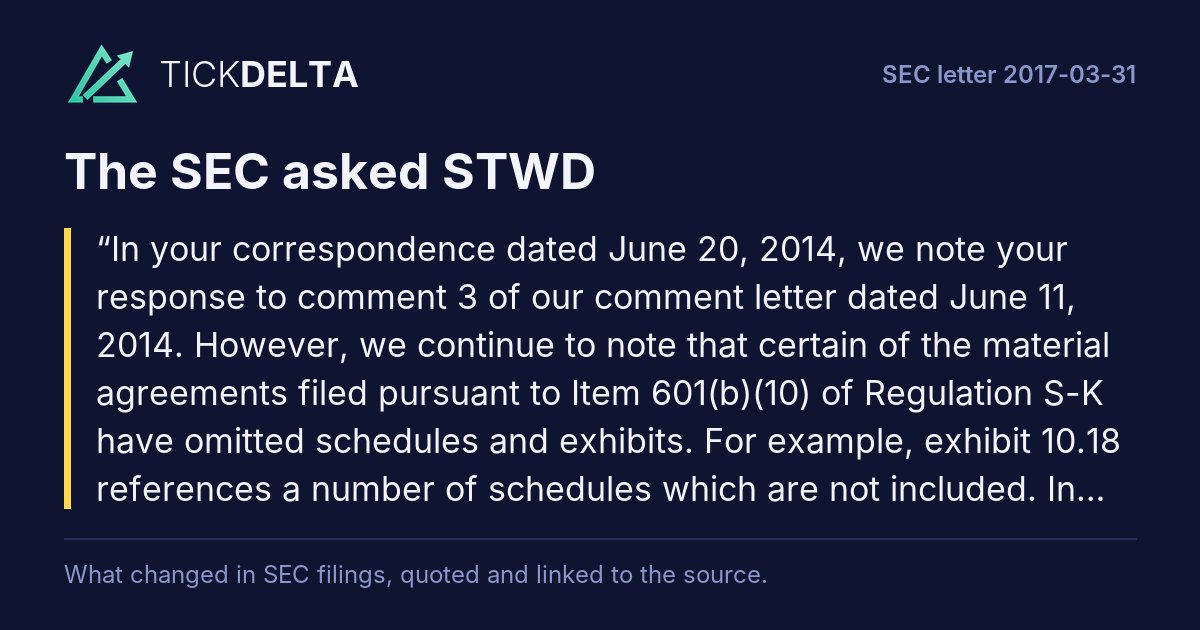
In your correspondence dated June 20, 2014, we note your response to comment 3 of our comment letter dated June 11, 2014. However, we continue to note that certain of the material agreements filed pursuant to Item 601(b)(10) of Regulation S-K have omitted schedules and exhibits. For example, exhibit 10.18 references a number of schedules which are not included.
Rest of the question

In addition, exhibit 10.16 appears to omit information from exhibits G-2, H, and I. Please file the complete agreements as required by Item 601(b)(10) or tell us why you believe the omitted schedules and exhibits are not required to be filed.

STWD answered
Starwood has reviewed the above mentioned material agreements previously filed under Item 601(b)(10) of Regulation S-K and will re-file the complete agreements with our Form 10-Q for the quarter ending March 31, 2017 with the schedules and exhibits included.

* * * * *

Starwood hereby acknowledges that:

· Starwood is responsible for the adequacy and accuracy of the disclosures it has made in its filings, including the 2016 Form 10-K;

· Staff comments or changes to disclosure in response to Staff comments do not foreclose the SEC from taking any action with respect to Starwood’s filings;
Rest of the answer

and

· Starwood may not assert Staff comments as a defense in any proceeding initiated by the SEC or any person under the federal securities laws of the United States.

If you need any further information, please contact Andrew J. Sossen, Chief Operating Officer, General Counsel, Chief Compliance Officer, Secretary and Executive Vice President, by phone at 203-422-8191 or by email at [email protected] or Rina Paniry, Chief Financial Officer, Treasurer, Principal Financial Officer and Chief Accounting Officer, by phone at 305-695-5470 or by email at [email protected].

Read in the reply
In its next report

First report after the company's reply of Apr 11, 2017: 10-Q filed May 9, 2017 ↗, against the 10-Q filed Nov 2, 2016 ↗.

Tickdelta does not hold the text of both reports, so they are not compared here.

Also in this review: closing letter, 2017-04-24

Form 10-K

2015-03-25 to 2015-08-25 · 10 questions · 4 letters from the SEC, 4 from the company
Review closed 2015-08-25
ChinaResults discussion (MD&A)Derivatives and hedgingNon-GAAP measuresRevenue
Item 7. Management’s Discussion and Analysis of Financial Condition and Results of · Operations, page 57
SEC asked (1)
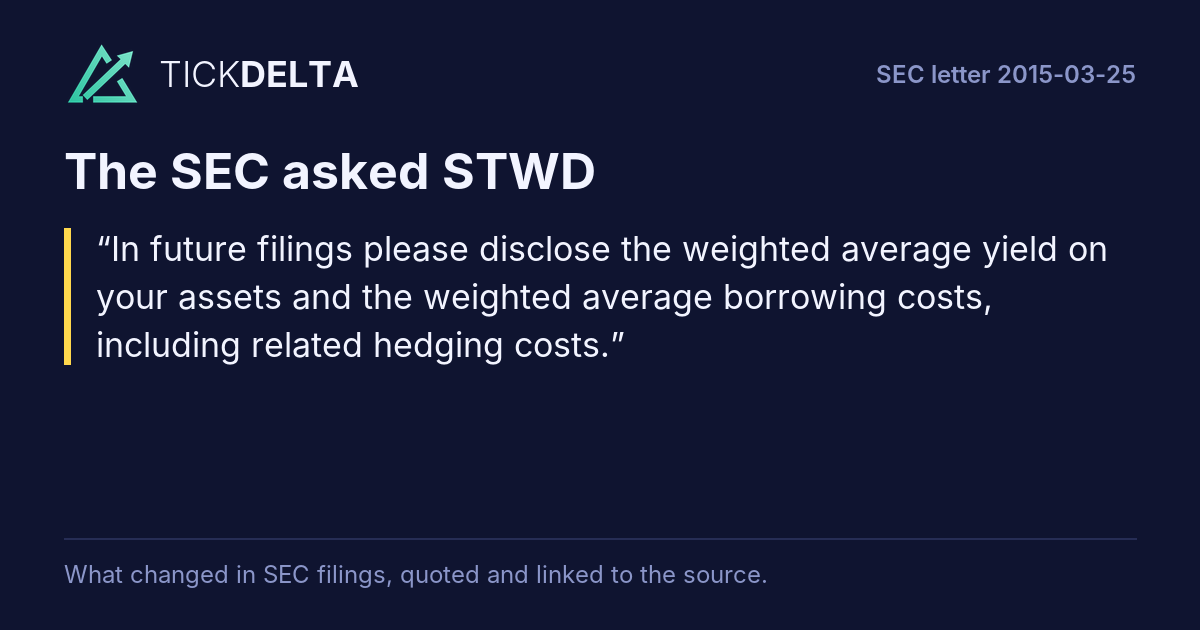
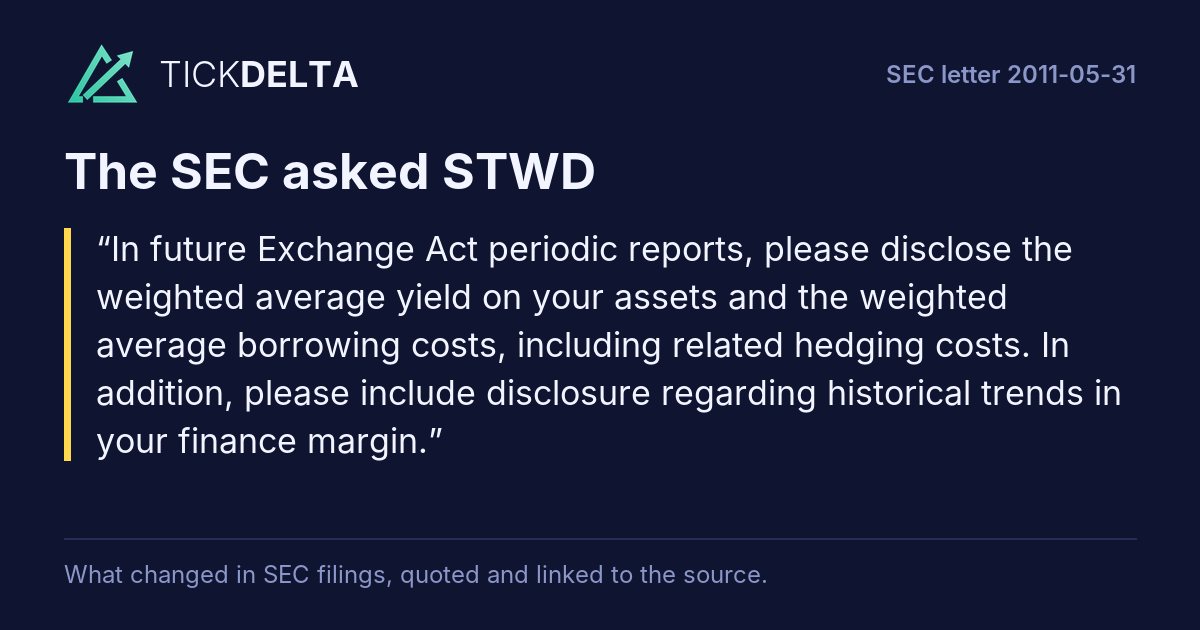
In future filings please disclose the weighted average yield on your assets and the weighted average borrowing costs, including related hedging costs.
STWD answered
Beginning with our Form 10-Q filing for the quarter ended March 31, 2015, we will disclose the weighted average yield on our investment portfolio and our weighted average borrowing costs inclusive of related hedging costs.
Read in the reply
In its next report

First report after the company's reply of Apr 8, 2015: 10-Q filed May 5, 2015 ↗, against the 10-Q filed Nov 5, 2014 ↗.

Tickdelta does not hold the text of both reports, so they are not compared here.

Non-GAAP Financial Measures, page 65
SEC asked (2)
Please reconcile the number of diluted weighted average shares used in Core Earnings per share to the number of diluted weighted average shares used in your GAAP EPS measures.
STWD answered
In our 2014 Form 10-K, we disclosed the following in an effort to reconcile the number of diluted weighted average shares used in our earnings per share (“EPS”) calculation as determined pursuant to generally accepted accounting principles (“GAAP”) to the shares used in our Core EPS calculation:

“In assessing the appropriate weighted average diluted share count to apply to Core Earnings for purposes of determining Core earnings per share (“EPS”), management considered the following attributes of our current GAAP diluted share methodology: (i) our participating securities were determined to
Rest of the answer

be anti-dilutive and were thus excluded from the denominator of the EPS calculation; and (ii) the portion of the Convertible Notes that are “in-the-money” (referred to as the “conversion spread value”), representing the value that would be delivered to investors in shares upon an assumed conversion, is included in the denominator. Because compensation expense related to participating securities is added back for Core Earnings purposes pursuant to the definition above, there is no dilution to Core Earnings resulting from the associated expense recognition. As a result, our GAAP EPS methodology was adjusted to include (instead of exclude) participating securities. Further, conversion of the Convertible Notes is an event that is contingent upon numerous factors, none of which are in our control, and is an event that may or may not occur. Consistent with the treatment of other unrealized adjustments to Core Earnings, our GAAP EPS methodology was adjusted to exclude (instead of include) the conversion spread value in determining Core EPS until a conversion actually occurs. For the year ended December 31, 2014, 3.4 million shares, representing the conversion spread value, were excluded from Core EPS.”

Beginning with our Form 10-Q filing for the quarter ended March 31, 2015, in addition to the written reconciliation disclosed above, we will disclose a tabular reconciliation of diluted weighted average shares used in our calculation of Core Earnings per share to diluted weighted average shares used to calculate diluted GAAP earnings per share. A pro forma of this reconciliation for the year ended December 31, 2014 is as follows:

GAAP Diluted Weighted Average Shares

218,781

Add: Participating Securities

2,650

Less: Conversion Spread Value

(3,432

Read in the reply
In its next report

First report after the company's reply of Apr 8, 2015: 10-Q filed May 5, 2015 ↗, against the 10-Q filed Nov 5, 2014 ↗.

Tickdelta does not hold the text of both reports, so they are not compared here.

Consolidated Balance Sheets, page 91
SEC asked (3)
We note that you separately present the assets and liabilities held by variable interest entities on your balance sheet. In future filings, please recast your balance sheet to present the consolidated totals for each line item required by Rule 5-02 of Regulation S-X.
Rest of the question

Please note that you may state parenthetically after each line item the amount that relates to consolidated VIEs, or you may include a table following the consolidated balance sheets to present assets and liabilities of consolidated VIEs that have been included in the preceding balance sheet.

STWD answered
We respectfully note to the Staff that, since the consolidation rules were contemplated, LNR Property LLC (“LNR”), our wholly-owned subsidiary that we acquired on April 19, 2013, and related parties have engaged in numerous discussions, both written and oral, with the Financial Accounting Standards Board (“FASB”) and the SEC on this topic, with such discussions directed towards the seemingly unintended financial statement consequences of these standards on a unique business such as ours.
Rest of the answer

In that regard, we are providing, under separate cover and with a request for confidential treatment, correspondence with the SEC’s Office of the Chief Accountant of the Division of Corporation Finance describing the facts and circumstances surrounding our financial statement presentation of VIEs. We also note that, as a result of these discussions, we assisted the FASB in understanding the nature of commercial mortgage-backed securities (“CMBS”) trusts and the impact of consolidation of these vehicles in order to arrive at the ultimate conclusions outlined in Accounting Standards Update (“ASU”) 2014-13, “Measuring the Financial Assets and the Financial Liabilities of a Consolidated Collateralized Financing Entity.”

In order to fully understand the presentation of our consolidated variable interest entities (“VIEs”), it is important to understand the nature of these vehicles and the careful consideration we have dedicated to determining the most appropriate presentation of the consolidation of these vehicles. Since our acquisition of LNR on April 19, 2013, Starwood owns one of the nation’s largest commercial mortgage special servicers, which comprised approximately 44% of our 2014 net income on a GAAP basis. LNR services nearly one third of the nation’s CMBS trusts, and is the only commercial mortgage special servicer whose financial results are included in a public filing. The nature of LNR’s business is vastly different from the more typical residential mortgage servicers and other structures for which we believe the consolidation literature was intended and structured.

In the normal course of business, LNR, comprising our real estate investing and servicing (“REIS”) segment, invests in investment grade, unrated and non-investment grade portions of various issues of CMBS. The securities are issued by special purpose trusts, which are structured as pass through entities. A significant portion of LNR’s CMBS holdings are in the lowest tranche of the issued debt of these CMBS trusts. This tranche is typically referred to as the “controlling class”, which carries the right to name the special servicer of the trust.

In structuring these trusts, a third party (normally a financial institution) originates loans and then securitizes those loans into a special purpose vehicle. Once securitized into a CMBS trust structure, the loans do not trade. At that point, the loans become part of a closed system, with the special purpose structure effectively transforming the loans into a mathematical waterfall of liability cash flows. After securitization, the sole purpose of the loans is to provide cash flows to the bondholders of the structure. While the loans are restricted from being traded, the liabilities trade regularly, with observable market prices readily available. At inception, a CMBS trust consists only of commercial real estate loans as its assets and debt to bondholders as its liabilities. Over time, some of those loans default and are foreclosed upon, creating a second asset category of foreclosed real estate (“REO”) within the trust prior to the asset being liquidated.

The CMBS trusts in which LNR invests are generally considered VIEs under ASC 810. The VIE is deliberately structured as passive whereby a pool of commercial real estate loans is selected for transfer into the VIE and then held constant over its life. No reinvestment is permitted and the entities are not actively managed. As a result, individual loans are not permitted to be sold from the trust or traded in the marketplace. These assets are restricted and can only be used to fulfill the obligations of the trust. The fair value of this type of loan is very different from a loan which would trade freely outside of such a structure.

Due to the difficulties in valuing loans within this type of structure, the guidance outlined in ASU 2014-13 permits an entity to use the financial liabilities of the VIE to value the overall pool of assets of a VIE. This guidance indicates that the financial assets and financial liabilities of a consolidated collateralized financing entity (“CFE”, which is used synonymously with VIE for purposes of this letter) should be measured using the “more observable of the fair value of the financial assets and the fair value of the financial liabilities.” In the case of our VIEs, the financial liabilities of a CMBS trust are more observable, and we thus apply this approach in consolidating these vehicles.

Other than loans, the only other potential assets of a CMBS trust are REO. In the context of CMBS trusts consolidated pursuant to ASC 810, an REO asset only appears on a reporting entity’s balance sheet in one of two instances: (1) the new consolidation of a CMBS trust structure; and (2) the foreclosure of a loan in an already consolidated CMBS trust structure. When an asset becomes REO, it is due to nonperformance of the loan, which is already at fair value due to the election of the fair value option. The valuation of REO assets at fair value occurs quite often under the current ASC 810 model. As a result, the carrying value of an REO asset is generally fair value under existing GAAP. In addition, once an asset becomes REO, its disposition time is relatively short, and deconsolidation of the trust could occur during that time if we are terminated as special servicer of the trust. As a result, distinguishing an asset between a loan and an REO does not provide any incremental value in this context.

In addition, REO assets generally represent a very small percentage of the overall asset pool of a CMBS trust, and for our portfolio, are 4% of our VIE assets. In a new issue CMBS trust, REO is zero. This is supported by the Basis of Conclusions section of ASU 2014-13, paragraph BC18, which states, in part, “… respondents to the proposed Update indicated that the value of any nonfinancial assets held by a collateralized financing entity is generally insignificant and nonfinancial assets are held temporarily.” Consistent with Rule 5-02 of Regulation S-X, any balance sheet line item which does not exceed 5% of an entity’s assets need not be separately presented.

In addition, ASC 810-10-45-25 requires that a reporting entity present each of the following separately on the face of the statement of financial position:

“a. Assets of a consolidated variable interest entity (VIE) that can be used only to settle obligations of the consolidated VIE b. Liabilities of a consolidated VIE for which creditors (or beneficial interest holders) do not have recourse to the general credit of the primary beneficiary.”

In its deliberations of ASC 810, the FASB considered, but rejected, a single-line-item display of assets and liabilities that meet the separate presentation criteria. In order to avoid potential inconsistency and comparability issues in a reporting entity’s consolidated financial statements, the FASB decided to require separate presentation of elements of consolidated variable interest entities as described in the excerpt above. While some could interpret this requirement to mean that each consolidated VIE’s assets and liabilities that qualify for disclosure must be separately presented, certain of the large accounting firms have issued guidance stating their understanding that this requirement means that the same or similar assets of all consolidated VIEs that meet this separate presentation criterion could be presented in the aggregate on the relevant balance sheet line item. This guidance states, in part:

“The VIE model does not provide guidance on how assets and liabilities that meet the separate presentation criteria should be presented in the primary beneficiary’s balance sheet. We believe that a reporting entity has presentation alternatives provided the assets and liabilities that meet the separate presentation criteria are separately presented on the face of the balance sheet. For example, a reporting entity that is the primary beneficiary of a VIE could present each asset element that meets the separate presentation criteria as one line item and parenthetically disclose the amount of the asset in a VIE. Alternatively, the reporting entity could present an asset element in two separate line items, one line item for the asset in a VIE that meet the separate presentation criteria and another line item for the reporting entity’s corresponding asset. There may be other acceptable alternatives.”

While on a dollars basis, REO assets are insignificant to VIE assets and to our consolidated assets overall, our VIE asset pool currently contains approximately 500 REO properties. As a result, determining fair value for each of these 500 properties on a quarterly basis would be an extremely time consuming effort. More importantly, it would result in no incremental utility to the users of our financial statements, and ultimately, would be less accurate than our current methodology, particularly since the assets of the VIE can only be used to settle the obligations of the VIE. This approach is consistent with the disclosure objectives of ASC 810, as published in ASC 810-10-50-10:

“A reporting entity shall determine, in light of the facts and circumstances, how much detail it shall provide to satisfy the requirements of the Variable Interest Entities Subsections. A reporting entity shall also determine how it aggregates information to display its overall involvements with VIEs with different risk characteristics. The reporting entity must strike a balance between obscuring important information as a result of too much aggregation and overburdening financial statements with excessive detail that may not assist financial statement users to understand the reporting entity’s financial position. For example, a reporting entity shall not obscure important information by including it with a large amount of insignificant detail.”

Because CMBS trust financial liabilities are more observable, the methodology prescribed by ASU 2014-13 effectively results in a derived number for VIE assets as a pool. This makes sense because, in the case of a CMBS trust, all of the assets as a pool are used to satisfy the liabilities of the trust. This methodology is ultimately designed to arrive at the critical conclusion for investors, which is for the consolidated net income (loss) of a reporting entity to only reflect amounts that reflect changes in its own economic interests in the consolidated trust. Any segregation of the assets beyond the total pool would result in balances that are not meaningful because (i) a bondholder could not access those assets individually; and (ii) determining a precise value for these assets would be nearly impossible. Said another way, as two lines in our balance sheet, the numbers would be estimates and allocations of a total liability number, whereas in total, they agree to a market value that is observable.

As one of the nation’s largest special servicers, servicing nearly one third of the nation’s CMBS trusts, our entire business is predicated on owning the controlling class. As a result, consolidation of CMBS structures is commonplace; we regularly consolidate and deconsolidate CMBS trusts due to ordinary course transactions such as purchases and sales of CMBS and special servicer appointments. As a public company, we are concerned about creating any confusion for users beyond that which already exists as a result of consolidating these vehicles.

Based on the above, we arrived at our current presentation of including all of the assets of a VIE in a single line on our balance sheet. We believe this presentation is consistent with Rule 5-02 of Regulation S-X based on the insignificance of the REO balance generally, with the requirements of ASC 810-10-45-25, with certain public accounting firms’ published interpretive guidance, with the above-referenced correspondence with the SEC, which we are providing to the Staff under separate cover and with a request for confidential treatment, and with the overall objective of financial reporting to provide meaningful information to investors. The liabilities of our VIEs consist solely of debt to bondholders of the CMBS trust, and are thus properly classified as a single line item in accordance with Rule 5-02 of Regulation S-X.

Read in the reply
In its next report

First report after the company's reply of Apr 8, 2015: 10-Q filed May 5, 2015 ↗, against the 10-Q filed Nov 5, 2014 ↗.

Tickdelta does not hold the text of both reports, so they are not compared here.

Consolidated Statements of Operations, page 92
SEC asked (4)
We note your separate presentation of income of consolidated VIE’s, net related to the assets and liabilities of your consolidated VIEs. Please tell us your basis for this presentation and specifically address how it complies with the requirements of Rule 5-03 of Regulation S-X which requires consolidated totals for each line item.
STWD answered
Similar to our response to Comment 3, we respectfully note to the Staff that the basis for our income statement presentation was determined after careful consideration of the impact of CMBS trust consolidation to our financial statements and which presentation would be most meaningful to the users of our financial statements. As noted in our response to Comment 3, the critical conclusion that is contained in ASU 2014-13 is that a reporting entity’s consolidated net income (loss) should only reflect the reporting entity’s own economic interests in the consolidated VIE.
Rest of the answer

In the context of consolidated CMBS trusts, LNR’s economic interest is its ownership of a CMBS security.

Because we elect the fair value option for initial and subsequent recognition of our consolidated VIE assets and liabilities, and because the fair value of the VIE assets equals the fair value of the liabilities pursuant to ASU 2014-13, the only change to VIE assets each period is the change in fair value of the liabilities. As a result, the two primary line items which would appear in our income statement on a gross basis would be the inflated change in fair value of VIE assets and the change in fair value of VIE liabilities, both of which would appear within the “other income” section of our consolidated statement of operations, consistent with Rule 5-03 of Regulation S-X. Before consolidation, these two numbers are the same because total VIE assets equal total VIE liabilities under ASU 2014-13. The numbers individually total in the billions, but net to zero. However, in consolidation, we would eliminate the portion of the change in fair value of VIE liabilities that pertains to our beneficial interest in the CMBS trust (i.e., the CMBS security asset we hold, which is reflected as debt on the VIE’s balance sheet). The resulting net number is the portion that pertains to our economic interest in the consolidated VIE.

Additionally, as discussed above, we elected the fair value option for both our VIE assets and liabilities in the trust; therefore, interest income and interest expense presentation as separate line items are no longer relevant on a standalone basis. These amounts are effectively included in the total fair value changes period to period, but obviated because of the overlay of the fair value option. ASC 825-10 does not include guidance on geography for items measured at fair value under the fair value option. Rather, it implies that the presentation of such items is a policy election. Since adoption of ASC 810, our elected policy has been to present these items through the same line item on our statement of operations. Certain of the large accounting firms have published interpretive guidance supporting this. In discussing the segregation of interest income from other changes in fair value, one such publication states, “We encourage reporting entities to use the single line presentation because splitting the change in fair value creates an amount in a line item that is just a residual difference. In either case, reporting entities should select a policy for income statement presentation that is appropriate for their facts and circumstances, disclose the policy in the footnotes, and follow it consistently.” In our case, the difference between the change in fair value of VIE assets and the change in fair value of VIE liabilities is simply the residual difference attributable to our beneficial interest in the VIE.

Similar to our response to Comment 3, we respectfully submit that we do not see any added benefit to providing the users of our financial statements with two inflated line items in our statement of operations, neither of which individually pertains to our beneficial interest in the VIE. In fact, we would view this presentation as somewhat distortive because our beneficial interest in the VIE would be eliminated and hidden in the residual difference between the change in fair value of assets and the change in fair value of liabilities. Consistent with the underlying purpose of ASU 2014-13, the consolidation of VIEs should result in a reporting entity only reflecting its own economic interest in the VIE. We believe that netting the changes in fair value of liabilities against the changes in fair value of assets on a consolidated basis accomplishes this objective. However, we will include in future filings additional disclosure in Footnote 2, Summary of Significant Account Policies, related to our financial statement presentation of consolidated VIEs.

Read in the reply
In its next report

First report after the company's reply of Apr 8, 2015: 10-Q filed May 5, 2015 ↗, against the 10-Q filed Nov 5, 2014 ↗.

Tickdelta does not hold the text of both reports, so they are not compared here.

Consolidated Statements of Operations, page 92
SEC asked (5)
We note that a majority of your revenue is derived from the interest on leveraged investments. Please tell us why interest expense has been presented as a component of cost and expenses, rather than as part of net interest margin. In this regard, a “net interest income” presentation is generally appropriate for companies with interest expense related to financing its investments earning interest income.
Rest of the question

Please see ASC 942-10-S99-4 for reference.

STWD answered
As discussed in our response to Comment 3, on April 19, 2013, Starwood and its affiliates acquired LNR, a diversified real estate operating business which houses one of the nation’s largest special servicers. Prior to the LNR acquisition, Starwood applied the “net interest income” presentation prescribed by ASC 942-10-S99-4. Because our operations at that time consisted principally of originating and acquiring commercial mortgage loans, the industry-specific accounting and reporting guidance for depository and lending financial institutions that is outlined in ASC 942 was appropriate.
Rest of the answer

This was the same presentation followed by our competitors who were strictly mortgage real estate investment trusts (“REITs”).

However, with the acquisition of LNR and our growing single-family residential real estate rental portfolio, our business became much more diversified, as did our operating results. As a result, we reevaluated the presentation of our statement of operations. In connection with that evaluation, we determined that the more general income statement presentation outlined in Rule 5-03 of Regulation S-X was more appropriate. We disclosed this change in presentation in our Form 10-Q for the quarter ended June 30, 2013, our Form 10-Q for the quarter ended September 30, 2013, and our Form 10-K for the year ended December 31, 2013.

The LNR acquisition set Starwood apart from its competitors, establishing it as a diversified commercial real estate finance operating business, which now includes not only a traditional commercial mortgage lending business, but also a special servicing operation, a conduit loan origination platform, a CMBS investment portfolio, a growing portfolio of real estate equity investments and, until its spin-off in early 2014, a billion-dollar single-family residential real estate rental portfolio.

We respectfully note to the Staff that we believe the diverse nature of Starwood’s operations justifies our use of the general income statement presentation outlined in Rule 5-03 versus the “net interest income” presentation in ASC 942-10-S99-4, which is intended for depository and lending financial institutions, such as traditional mortgage REITs. Referencing our segment disclosure, during the year ended December 31, 2014, only 56% of our net income on a GAAP basis came from our commercial mortgage lending business (i.e., our Lending Segment, as defined in our 2014 Form 10-K), while the remainder was sourced from our other operating businesses described above. For the latter 44%, we do not believe a “net interest income” presentation would be appropriate.

In addition, because we use corporate level debt to fund business acquisitions (i.e., LNR), investments other than loans, as well as construction and similar loans which cannot be leveraged with traditional repurchase financing, the interest expense associated with this debt would not be appropriate for a “net interest income” presentation. We believe a hybrid of “net interest income” presentation and the more traditional presentation which we currently provide for operating businesses would only further confuse our investors and the users of our financial statements. However, we do believe that net interest income disclosure for just our Lending Segment would be useful to investors. As a result, we will include this as a supplemental disclosure in future filings, beginning with our Form 10-Q filing for the quarter ended March 31, 2015.

* * * * *

Starwood hereby acknowledges that:

· Starwood is responsible for the adequacy and accuracy of the disclosures it has made in its filings, including the 2014 Form 10-K;

· Staff comments or changes to disclosure in response to Staff comments do not foreclose the SEC from taking any action with respect to Starwood’s filings; and

· Starwood may not assert Staff comments as a defense in any proceeding initiated by the SEC or any person under the federal securities laws of the United States.

We acknowledge and appreciate that the discussion of VIEs, as outlined above and in various communications with the FASB and the SEC, is complex. As a result, we would welcome a discussion with you on this topic to assist you in better understanding the nature of these vehicles and the resulting impact to our consolidated financial statements. In the meantime, if you should need any further information, please contact Rina Paniry, Chief Financial Officer, by phone at 305-695-5470 or by email at [email protected].

Read in the reply
In its next report

First report after the company's reply of Apr 8, 2015: 10-Q filed May 5, 2015 ↗, against the 10-Q filed Nov 5, 2014 ↗.

Tickdelta does not hold the text of both reports, so they are not compared here.

Form 10-K for the Year Ended December 31, 2014 · Consolidated Balance Sheets, page 91
SEC asked (1)
We have reviewed your responses to comments 3 and 4. We are considering your responses and we may have further comments.
STWD answered
We acknowledge and appreciate that the discussion of our variable interest entities (VIEs) is complex. As a result, we would welcome a discussion with you on this topic to assist you in better understanding the nature of these vehicles and the resulting impact to our consolidated

U.S. Securities and Exchange Commission financial statements. In the meantime, if you should need any further information, please do not hesitate to contact us.
Read in the reply
In its next report

First report after the company's reply of Jun 3, 2015: 10-Q filed Aug 4, 2015 ↗, against the 10-Q filed Nov 5, 2014 ↗.

Tickdelta does not hold the text of both reports, so they are not compared here.

Consolidated Statements of Operations, page 92
SEC asked (2)
We note your response to comment 4. Please confirm to us the nature of the $212,506 and $116,377 recorded as income of consolidated VIEs, net in 2014 and 2013, respectively. If this represents the change in fair value of your economic interest in consolidated VIEs, please consider using a more descriptive label in future filings.
STWD answered
Amounts recorded as “income of consolidated VIEs, net” relate to the change in fair value of our economic interests in the VIEs which we consolidate. In future filings, we will use a more descriptive label for this line item.
Read in the reply
In its next report

First report after the company's reply of Jun 3, 2015: 10-Q filed Aug 4, 2015 ↗, against the 10-Q filed Nov 5, 2014 ↗.

Tickdelta does not hold the text of both reports, so they are not compared here.

Item 2. Management’s Discussion and Analysis of Financial Condition and Results of · Operations, page 50
SEC asked (3)
We note your response to comment 1. As previously requested, please disclose the weighted average yield on your investment assets, or tell us where this disclosure has been provided. Please also include a discussion of any trends in the weighted average yield on assets and weighted average borrowing costs for those assets.
STWD answered
We have disclosed the weighted average yields on each of our investment assets within the table on page 62 of our Form 10-Q for the quarter ended March 31, 2015 under the column heading “Unlevered Return on Asset.” Beginning with our Form 10-Q filing for the quarter ended June 30, 2015, we will include a discussion of any established trends in our weighted average yield on assets and weighted average borrowing costs for those assets.

* * * * *

Starwood hereby acknowledges that:

·

Starwood is responsible for the adequacy and accuracy of the disclosures it has made in its filings, including
Rest of the answer

the 2014 Form 10-K;

Staff comments or changes to disclosure in response to Staff comments do not foreclose the SEC from taking any action with respect to Starwood’s filings; and

Starwood may not assert Staff comments as a defense in any proceeding initiated by the SEC or any person under the federal securities laws of the United States.

Should you need any further information, please contact Rina Paniry, Chief Financial Officer, by phone at 305-695-5470 or by email at [email protected].

Read in the reply
In its next report

First report after the company's reply of Jun 3, 2015: 10-Q filed Aug 4, 2015 ↗, against the 10-Q filed Nov 5, 2014 ↗.

Tickdelta does not hold the text of both reports, so they are not compared here.

Form 10-K for the Year Ended December 31, 2014 · Consolidated Balance Sheets, page 91
SEC asked
We have reviewed your response to comment 3. We continue to believe that your balance sheet is not in compliance with Rule 5-02 of Regulation S-X. Please recast your balance sheet to present the consolidated totals for each line item required by Rule 5-02.
Rest of the question

Please note that you may state parenthetically after each line item the amount that relates to consolidated VIEs, or you may include a table following the consolidated balance sheets to present assets and liabilities of consolidated VIEs that have been included in the preceding balance sheet.

STWD answered
We believe that Starwood is dissimilar to all other companies in the mortgage real estate investment trust (“MREIT”) space. The reason for this is the acquisition by Starwood of LNR Property LLC (“LNR”) on April 19, 2013, which appended a special servicer that invests in subordinate commercial mortgage backed securities (“CMBS”) to a traditional MREIT, setting Starwood in a class by itself with no single competitor containing a comparative business model.
Rest of the answer

At that point, Starwood began trading, and continues to trade, vastly different from its competitors.

Prior to the acquisition of LNR, Starwood was not meaningfully impacted by the amendments to Accounting Standards Codification (“ASC”) 810, Consolidation, included in Accounting Standards Update (“ASU”) 2009-17, and as a result, its financial statements looked very similar to traditional MREITs. However, LNR’s financial statements were significantly impacted by these amendments due to its dual role as special servicer and investor in subordinate securities for the same trusts, which led to the consolidation of over 100 CMBS trusts. The nature of LNR’s business is vastly different from the more typical residential mortgage servicers and other structures for which we believe the consolidation literature was intended and structured. These other structures are what we believe other MREITs are investing in.

However, Starwood now consolidates over 100 CMBS trusts due solely to LNR’s dual role as CMBS investor and special servicer, a role that is not shared by any other public filer, let alone any filer in the MREIT space. It is important to note that the legacy Starwood business has no impact to the consolidation of these structures. In the normal course of business, LNR, comprising our real estate investing and servicing (“REIS”) segment, invests in investment grade, unrated and non-investment grade portions of various issues of CMBS. A significant portion of LNR’s CMBS holdings are in the lowest tranche of the issued debt of these CMBS trusts. This tranche is typically referred to as the “controlling class”, which carries the right to name the special servicer of the trust. LNR’s investment in the controlling class and its role as special servicer together trigger consolidation of these trusts.

In order to understand our presentation for these trusts, it is important to understand the nature of the vehicles themselves. In structuring these trusts, a third party (normally a financial institution) originates loans and then securitizes those loans into a special purpose vehicle. Once securitized into a CMBS trust structure, the loans do not trade. At that point, the loans become part of a closed system, with the special purpose structure effectively transforming the loans into a mathematical waterfall of liability cash flows. After securitization, the sole purpose of the loans is to provide cash flows to the bondholders of the structure. LNR is typically a bondholder at the most subordinate level within these structures. While the loans are restricted from being traded, the liabilities trade regularly, with observable market prices readily available.

At inception, a CMBS trust consists only of performing commercial real estate loans as its assets and debt to bondholders as its liabilities. Over time, some of those loans default, becoming nonperforming loans which LNR services, and relatively infrequently, nonperforming loans are foreclosed upon, creating a second asset category of foreclosed real estate (“REO”) within the trust prior to the asset being liquidated.

The VIE is deliberately structured as passive whereby a pool of commercial real estate loans is selected for transfer into the VIE and then held constant over its life. No reinvestment is permitted and the entities are not actively managed. As a result, individual loans are not permitted to be sold from the trust or traded in the marketplace. These assets are restricted and can only be used to fulfill the obligations of the trust. The fair value of this type of loan is very different from a loan which would trade freely outside of such a structure.

Due to the difficulties in valuing loans within this type of structure, the guidance outlined in Accounting Standards Update (“ASU”) 2014-13, “Measuring the Financial Assets and the Financial Liabilities of a Consolidated Collateralized Financing Entity,” permits an entity to use the financial liabilities of the VIE to value the overall pool of assets of a VIE. This guidance indicates that the financial assets and financial liabilities of a consolidated collateralized financing entity (“CFE”, which is used synonymously with VIE for purposes of this letter) should be measured using the “more observable of the fair value of the financial assets and the fair value of the financial liabilities.” In the case of our VIEs, the financial liabilities of a CMBS trust are more observable, and we thus apply this approach in consolidating these vehicles.

This approach results in the fair value of the assets of the VIE equaling the liabilities of the VIE. Because VIE assets in total equal VIE liabilities in total, distinguishing an asset between a loan and an REO does not provide any incremental value and would result in assigning a residual number to either loans or REO. Further, distinguishing between loans and REO would be arbitrary given the VIE liabilities are measured by looking into securitization markets, while the unit of account for the loans and REO would be the individual asset level. The difficulties of reliably fair valuing the assets inside a CMBS structure was detailed in our comment letter to the FASB dated October 15, 2013. Relevant portions of that letter are repeated herein.

Upon our initial adoption of the provisions of ASU 2009-17, we attempted to implement the standard using a very similar methodology to what you are requesting. In doing so, we encountered numerous difficulties and significant limitations, some of which we found impossible to overcome. We spent significant resources, both in time and cost, in the over twelve months in which we attempted to implement the standard pursuant to this approach. We consulted with the most experienced experts in this space, and ultimately concluded that the results were unreliable measurements that could not be validated by management.

The reason the assets of a CMBS trust are difficult to value, particularly for a special servicer, are multifold. A special servicer has no visibility into the performing loans of a CMBS trust. The industry delinquency rate for U.S. issued conduit CMBS has averaged less than 10% historically. This is the only portion of the assets for which the special servicer has detailed knowledge. As such, in order to determine the value of the remaining 90% of the trust’s assets that are performing, we engaged a nationally recognized third party pricing service. The results proved to be inconsistent and were formulated by a proprietary, statistical regression created by the third party pricing service that Starwood management had no ability to verify or observe.

The determination of fair value for the loans securitized by a securitization trust contains inherent limitations and is subject to significant judgment. As noted above, these loans are maintained in a static CMBS trust and are unable to be sold if the loans are performing. As such, there is no active market related to these assets. In order to properly fair value this pool of commercial real estate loans, certain factors related to the loans and the underlying real estate collateral must be considered. Certain of these factors are objective and observable such as loan vintage, loan interest rate, market interest rate, loan to value ratio at origination, debt service coverage ratio, payment history, collateral type and collateral location.

These are the factors which were utilized by the pricing service in valuing the loans. However, we have no visibility into the details behind the pricing service’s calculation of each loan’s fair value. The pricing service collects a standardized set of information which they believe to be predictive of a loan’s selling price. Through a multiple regression analysis based on actual loan trade data, the pricing service determines a set of statistically relevant variables that affect an asset’s price and estimates its corresponding coefficients. Fair value is estimated by applying these coefficients to an existing loan’s relevant variables. This formula is inherently very subjective, and due to its proprietary nature, is invisible to management of the entity that has to report these values in its financial statements.

In addition to factors that may be deemed objective, other more subjective factors are often unobservable and unavailable, including borrower intent with respect to the asset, whether the asset is a “trophy” asset, the special servicer of the asset, the experience, expertise and sophistication of the property owner/manager, and the structure of the loan itself. In addition to these factors, other factors inherent in a securitization structure should ideally be considered, including diversification of the assets, credit enhancement, liquidity of the debt and desired yield of investors.

However, these factors are not considered in pricing an individual loan. Rather, pricing is based on inputs which are not necessarily all inclusive, with the determination of price made by a third party pricing service who may not have access to all relevant data related to the loan. While the pricing service maintains comparable data for both nonperforming loans inside the CMBS trust and values for the underlying collateral, the exact asset is not traded and the assets which do trade may not necessarily be deemed similar to the asset being priced. The evaluation of price is based on the perception of one market participant and lacks transparency in terms of the specific computation behind the regression analysis which ultimately determines the price. Many of the inputs discussed above are not able to be derived (or individually inferred) from transparent, market-based data.

The area where we as special servicer have some visibility is on the REO assets. However, on a dollars basis, the REO assets are insignificant to VIE assets, representing only 4% of such assets. From a practical standpoint, our VIE asset pool currently contains approximately 500 REO properties, and determining a fair value for each of these 500 properties on a quarterly basis would be an extremely time consuming effort because it would involve tracking each of these 500 real estate assets during a relatively short holding period. More importantly, it would not result in the most accurate information. Under ASU 2014-13, we would still have to fair value the liabilities for each VIE and subtract this number to arrive at a residual for the loan pool. Given the relatively small balance of REO and the short period until liquidation of this real estate, we do not believe this exercise would result in any incremental utility to the users of our financial statements, and ultimately, would be less accurate than our current methodology. It would force us to present a line item on our balance sheet for the loan pool that is simply a residual difference as opposed to a number that is meaningful and correct on a stand-alone basis.

Management would have to assert that each of the two line items for REO and loans is correct, knowing that VIE assets can only be correct in total.

Because CMBS trust financial liabilities are more observable, the methodology prescribed by ASU 2014-13 effectively results in a derived number for VIE assets as a pool. This makes sense because, in the case of a CMBS trust, all of the assets as a pool are used to satisfy the liabilities of the trust. This methodology is ultimately designed to arrive at the critical conclusion for investors, which is for the consolidated net income (loss) of a reporting entity to only reflect amounts that reflect changes in its own economic interests in the consolidated trust. Any segregation of the assets beyond the total pool would result in balances that are not meaningful because (i) a bondholder could not access those assets individually; and (ii) determining a precise value for these assets would be nearly impossible. Said another way, as two lines in our balance sheet, the numbers would be allocations of a total liability number, one of which is a residual difference, whereas in total, they agree to a market value that is observable.

Based on the above, we arrived at our current presentation of including all of the assets of a VIE in a single line on our balance sheet. We continue to believe this presentation is consistent with Rule 5-02 of Regulation S-X and results in the most accurate and reliable measure of assets, with the overall objective of financial reporting to provide meaningful information to investors. We suggest including as a supplemental disclosure in future filings, added disclosure to our footnotes describing the components of VIE assets and the reasons for which the presentation is more appropriate and correct as a single line item.

* * * * *

Starwood hereby acknowledges that:

·

Starwood is responsible for the adequacy and accuracy of the disclosures it has made in its filings, including the 2014 Form 10-K;

Staff comments or changes to disclosure in response to Staff comments do not foreclose the SEC from taking any action with respect to Starwood’s filings; and

Starwood may not assert Staff comments as a defense in any proceeding initiated by the SEC or any person under the federal securities laws of the United States.

We acknowledge and appreciate that the nature of our VIEs and their implications to our financial statements are complex. We would welcome a discussion with you on this topic to assist you in better understanding these vehicles. In the meantime, should you need any further information, please contact Rina Paniry, Chief Financial Officer, by phone at 305-695-5470 or by email at [email protected].

Read in the reply
In its next report

First report after the company's reply of Jun 22, 2015: 10-Q filed Aug 4, 2015 ↗, against the 10-Q filed Nov 5, 2014 ↗.

Tickdelta does not hold the text of both reports, so they are not compared here.

Form 10-K for the Year Ended December 31, 2014 · Consolidated Balance Sheets, page 91
SEC asked
We note your response to comment 1. In future filings please provide clear and robust footnote disclosure describing the components of VIE assets and liabilities recorded on your balance sheet, including the approximate relative values of each type of VIE asset. Please also include a discussion of the reasons why you believe the presentation of these assets as a single line item is more appropriate.
Rest of the question

Please provide us with your proposed disclosure in your response.

STWD answered
Within the summary of significant accounting policies section of our Form 10-Q for the three months ended June 30, 2015, we included supplemental disclosure describing the components of VIE assets and the reasons why the presentation is more appropriate as a single line item. We propose enhancing this disclosure to incorporate the additional items you have requested.

The proposed disclosure in its entirety is as follows:

“We separately present the assets and liabilities of our consolidated VIEs as individual line items on our consolidated balance sheets.
Rest of the answer

The liabilities of our consolidated VIEs consist solely of obligations to the bondholders of the related CMBS trusts, and are thus presented as a single line item entitled “VIE liabilities.” The assets of our consolidated VIEs consist principally of loans, but at times, also include foreclosed loans which have been temporarily converted into real estate owned (“REO”). These assets in the aggregate are likewise presented as a single line item entitled “VIE assets.”

Loans comprise the vast majority of our VIE assets and are carried at fair value due to the election of the fair value option. When an asset becomes REO, it is due to nonperformance of the loan. Because the loan is already at fair value, the carrying value of an REO asset is also initially at fair value. Furthermore, when we consolidate a CMBS trust, any existing REO would be consolidated at fair value. Once an asset becomes REO, its disposition time is relatively short. As a result, the carrying value of an REO generally approximates fair value under existing GAAP.

In addition to sharing a similar measurement method as the loans in a CMBS trust, the VIE assets as a whole can only be used to settle the obligations of the consolidated VIE. The assets of our VIEs are not individually accessible by the bondholders, which creates inherent limitations from a valuation perspective. Also creating limitations from a valuation perspective is our role as special servicer, which provides us very limited visibility, if any, into the performing loans of a CMBS trust.

REO assets generally represent a very small percentage of the overall asset pool of a CMBS trust. In a new issue CMBS trust, REO is zero. We estimate that REO assets constitute approximately 4% of our consolidated VIE assets, with the remaining 96% representing loans. However, it is important to note that the fair value of our VIE assets is determined by reference to our VIE liabilities as permitted under ASU 2014-13. In other words, our VIE liabilities are more reliably measurable than the VIE assets, resulting in our current measurement methodology which utilizes this value to determine the fair value of our VIE assets as a whole. As a result, these percentages are not necessarily indicative of the relative fair values of each of these asset categories if the assets were to be valued individually.

Due to our accounting policy election under ASU 2014-13, separately presenting two different asset categories would result in an arbitrary assignment of value to each, with one asset category representing a residual amount, as opposed to its fair value. However, as a pool, the fair value of the assets in total is equal to the fair value of the liabilities.

For these reasons, the assets of our VIEs are presented in the aggregate.”

* * * * *

Starwood hereby acknowledges that:

·

Starwood is responsible for the adequacy and accuracy of the disclosures it has made in its filings, including the 2014 Form 10-K;

Staff comments or changes to disclosure in response to Staff comments do not foreclose the SEC from taking any action with respect to Starwood’s filings; and

Starwood may not assert Staff comments as a defense in any proceeding initiated by the SEC or any person under the federal securities laws of the United States.

Read in the reply
In its next report

First report after the company's reply of Aug 13, 2015: 10-Q filed Nov 5, 2015 ↗, against the 10-Q filed Nov 5, 2014 ↗.

Tickdelta does not hold the text of both reports, so they are not compared here.

Also in this review: closing letter, 2015-08-25

Form 10-K for the fiscal year ended December 31, 2013

2014-06-11 to 2014-06-26 · 3 questions · 1 letter from the SEC, 1 from the company
Review closed 2014-06-26
AcquisitionsDerivatives and hedging
Item 7A. Quantitative and Qualitative Disclosures About Market Risk, page 81
SEC asked (1)
We note your disclosure regarding your acquisition of LNR Property, LLC. In future Exchange Act periodic reports, if you have material asset acquisitions or originations, please provide disclosure regarding the credit quality of such acquisitions or originations as compared to your existing portfolio.
STWD answered
In future Exchange Act periodic reports, we will provide disclosure regarding the credit quality of any material asset acquisitions or originations as compared to our existing portfolio.
Read in the reply
In its next report

First report after the company's reply of Jun 20, 2014: 10-Q filed Aug 6, 2014 ↗, against the 10-Q filed May 6, 2014 ↗.

Tickdelta does not hold the text of both reports, so they are not compared here.

Item 7A. Quantitative and Qualitative Disclosures About Market Risk, page 81
SEC asked (2)
We note your disclosure here regarding your hedging activities. In future Exchange Act periodic reports, please provide disclosure regarding the extent of your hedging activities and the extent of the gap between the duration of your swaps and your assets or liabilities or tell us why this disclosure is not material.
STWD answered
Beginning with our Form 10-Q filing for the quarter ending June 30, 2014, we will provide disclosure regarding the extent of our hedging activities, as well as information regarding the duration of our hedges and the related hedged items.
Read in the reply
In its next report

First report after the company's reply of Jun 20, 2014: 10-Q filed Aug 6, 2014 ↗, against the 10-Q filed May 6, 2014 ↗.

Tickdelta does not hold the text of both reports, so they are not compared here.

Item 15. Exhibits and Financial Statement Schedules, page 180
SEC asked (3)
In your correspondence dated August 9, 2011, we note your response to comment 1 of our comment letter dated August 2, 2011. However, we continue to note that several of the material agreements filed pursuant to Item 601(b)(10) of Regulation S-K have omitted schedules and exhibits. Please file the complete agreements as required by Item 601(b)(10) or advise.
STWD answered
Starwood has reviewed the material agreements previously filed under Item 601(b)(10) of Regulation S-K and will re-file with our Form 10-Q for the quarter ending June 30, 2014 any documents to the extent that schedules or exhibits to such documents that are required to be filed were omitted and pursuant to which Starwood had material obligations to be performed in whole or in part after February 26, 2014 (the date of the 2013 Form 10-K), or that was entered into not more than two years prior to such date, provided that certain information contained in such schedules and exhibits might be the
Rest of the answer

subject of a request for confidential treatment. Starwood notes that certain material contracts previously filed under Item 601(b)(10) of Regulation S-K without referenced schedules or exhibits were entered into more than two years prior to February 26, 2014 and do not contain any material obligations to be performed by Starwood in whole or in part after that date. Accordingly, Starwood intends to remove such material agreements from the exhibit list that will be contained in Starwood’s Annual Report on Form 10-K for the fiscal year ending December 31, 2014.

* * * * *

Starwood hereby acknowledges that:

· Starwood is responsible for the adequacy and accuracy of the disclosures it has made in its filings, including the 2013 Form 10-K;

· Staff comments or changes to disclosure in response to Staff comments do not foreclose the Commission from taking any action with respect to Starwood’s filings; and

· Starwood may not assert Staff comments as a defense in any proceeding initiated by the Commission or any person under the federal securities laws of the United States.

If you need any further information, please contact Andrew J. Sossen, Chief Operating Officer and General Counsel by phone at 203-422-8191 or by email at [email protected] or Rina Paniry, Chief Financial Officer, Treasurer and Principal Financial Officer by phone at 305-695-5470 or by email at [email protected].

Read in the reply
In its next report

First report after the company's reply of Jun 20, 2014: 10-Q filed Aug 6, 2014 ↗, against the 10-Q filed May 6, 2014 ↗.

Tickdelta does not hold the text of both reports, so they are not compared here.

Also in this review: closing letter, 2014-06-26

Form 10-K for the fiscal year ended December 31, 2011

2012-06-13 to 2012-07-13 · 2 questions · 1 letter from the SEC, 1 from the company
Review closed 2012-07-13
Liquidity and cash
Form 10-K for the Year Ended December 31, 2011 · Liquidity and Capital Resources, page 55
SEC asked (1)
We note that you have entered into a significant amount of repurchase agreements accounted for as collateralized borrowings. For each of the quarters in the last two years, please provide us with a table showing the average amount of repurchase transactions outstanding during the quarter and the amount of these repurchase transactions outstanding as of the end of each quarter.
Rest of the question

To the extent there are significant variations between the average level of these transactions and the amounts outstanding at each quarter end, please explain to us why. In future periodic filings we believe the inclusion of the information described above would be useful to investors and should be included. 7. Loan Securitization/Sale Activities, page 94

STWD answered
In response to the first request, we refer the Staff to the table below showing the Company’s aggregate outstanding balance under its various repurchase agreements as of the respective quarter-end dates, as well as the weighted-average balances for the respective quarters then ended.

To help facilitate the Staff’s review of the table below, the Company offers the following additional information regarding its repurchase financing arrangements. The Company generally has two types of repurchase agreements.
Rest of the answer

The first type of facility has material terms contractually defined at inception, including the specific assets to be pledged as collateral, the collateral value, and the advance rates. In addition, the amounts outstanding over the term of the facilities curtail as principal payments are received on the loan collateral the Company has pledged, such that the advance rates are expected to remain fairly constant over the term of the facilities and the collateral pledged does not change. The second type is a revolving credit facility for which the Company’s outstanding balances are inherently more variable. Under its typical revolving credit facility, the Company submits to its lenders the specific asset(s) it proposes to pledge as collateral. For each asset accepted, the lenders designate a maximum advance rate and a defined collateral value. From that point in time, the Company generally can (assuming no material negative credit events have occurred, such as an event of default) borrow, repay, and re-borrow against such collateral (up to the maximum approved borrowing amount). While the effective borrowing costs of its revolving facilities are typically higher due to the potential for costs such as unused commitment fees, these facilities provide the Company with greater flexibility to meet its liquidity needs.

The defined terms referenced below are further described in Note 6 to the Company’s consolidated financial statements included in the Form 10-K. In addition, note that the Company intends to include in future filings disclosure of significant variations between the average amount of repurchase transactions outstanding during the applicable quarter and the amount of repurchase transactions outstanding at quarter end.

Quarter-End Date

Quarter-

End

Balance

(in 000’s)

Weighted-

Average

During

Quarter

Variance

Explanations for Significant Variances

(Defined as greater than $10 million)

March 31, 2010

$

196,350

196,362

(12

)

Insignificant variance.

June 30, 2010

449,548

292,788

156,760

Variance is primarily due to the draws of $278.2 million related to 19 loans that were initially pledged in late May under the Wells Repurchase Agreement. The loans were part of the TIAA Assets that had been acquired in February 2010.

September 30, 2010

452,731

448,554

4,177

December 31, 2010

579,659

601,878

(22,219

Variance is primarily due to initial draws of $18.6 million in late October 2010 and $45.0 million under the Second Wells Repurchase Agreement in early December 2010, offset by a $64.6 million pay-down on the same revolving credit facility in late December 2010 with funds generated by the Company’s

December 2010 common stock offering.

March 31, 2011

804,558

679,616

124,942

Variance is primarily due to the following transactions: (i) approximately $207.6 million drawn under the Second Wells Repurchase Agreement in March 2011 related to five loans that were pledged, (ii) pay-down of $12.3 million in late March 2011 using proceeds from sales of TALF securities; and (iii) $78.4 million initially drawn under the Third Wells Repurchase Agreement in mid-March 2011, of which $40.0 million was repaid at the end of March 2011 using excess proceeds from third party asset sales.

June 30, 2011

697,668

733,743

(36,075

Variance is primarily due to the following transactions: (i) repayment of $158.9 million in debt concurrent with CMBS sales under the TALF financing in late June 2011; (ii) repayment of $70 million on the facility upon maturity of 10 loans under the Wells Repurchase Agreement in early April 2011; and (iii) draws of $83.9 million on the Goldman line related to six conduit loans in mid-late June of 2011.

September 30, 2011

604,335

711,823

(107,488

Variance is primarily due to the following transactions: (i) repayment of $62.1 million in debt concurrent with the maturity of a loan under the Wells Repurchase Agreement in early September 2011 and (ii) a pay-down of $68.2 million in debt concurrent with two loans sold into securitization under the Second Wells Repurchase Agreement in late August 2011.

December 31, 2011

1,103,517

847,026

256,491

Variance is primarily due to the following transactions: (i) $117 million drawn on 4 newly pledged loans under the Second Wells Repurchase Agreement with the majority drawn during the latter part of the quarter, (ii) an additional $42 million drawn on existing assets under the Second Wells Repurchase Agreement in December 2011, and (iii) a draw under the Second Deutsche Repurchase Agreement in the amount of $112 million on December 27, 2011. These draws were made to provide liquidity for the acquisition of a separate portfolio of loans in the amount of $333 million, which closed on December 30, 2011. Draws under the Second Deutsche Repurchase Agreement were subsequently repaid in Q1 2012 when loans from the December 30, 2011 portfolio acquisition were approved for financing under the Fourth Wells Repurchase Agreement in Q1 2012.

7. Loan Securitization/Sale Activities, page 94

Read in the reply
In its next report

First report after the company's reply of Jun 26, 2012: 10-Q filed Aug 7, 2012 ↗, against the 10-Q filed May 8, 2012 ↗.

Tickdelta does not hold the text of both reports, so they are not compared here.

Form 10-K for the Year Ended December 31, 2011 · Liquidity and Capital Resources, page 55
SEC asked (2)
Please expand your disclosure in future filings to provide all disclosures required by ASC 860-20-50. In your response, please tell us what continuing involvement you have in each loan sold or securitized.
STWD answered
The Company informs the Staff that it evaluates each of its loan sales and securitizations at closing to determine whether such transactions qualify for sale accounting under ASC 860. During the period covered by the Form 10-K, there were no loan sale or securitization transactions that the Company accounted for as a sale where the Company has had continuing involvement as defined in ASC 860.

The Company respectfully submits that no additional disclosure is required by ASC 860-20-50, but in future filings it will clarify where applicable that it has no continuing involvement in loans, the
Rest of the answer

transfers of which were accounted for as sales.

As requested, the Company also acknowledges that:

· the Company is responsible for the adequacy and accuracy of the disclosure in the filing;

· Staff comments or changes to disclosure in response to Staff comments do not foreclose the Commission from taking any action with respect to the filings; and

· the Company may not assert Staff comments as a defense in any proceeding initiated by the Commission or any person under the federal securities laws of the United States.

Read in the reply
In its next report

First report after the company's reply of Jun 26, 2012: 10-Q filed Aug 7, 2012 ↗, against the 10-Q filed May 8, 2012 ↗.

Tickdelta does not hold the text of both reports, so they are not compared here.

Also in this review: closing letter, 2012-07-13

Form 10-K

2011-05-31 to 2011-08-12 · 9 questions · 2 letters from the SEC, 2 from the company
Review closed 2011-08-12
Results discussion (MD&A)Derivatives and hedgingLiquidity and cash
Form 10-K for the Fiscal Year Ended December 31, 2010 · Management’s Discussion and Analysis of Financial Condition and Results of Operations, page
SEC asked (1)
In future Exchange Act periodic reports, please disclose the weighted average yield on your assets and the weighted average borrowing costs, including related hedging costs. In addition, please include disclosure regarding historical trends in your finance margin.
STWD answered
The Company will revise the disclosure as requested in future Exchange Act periodic reports.
Read in the reply
In its next report

First report after the company's reply of Jul 15, 2011: 10-Q filed Aug 5, 2011 ↗, against the 10-Q filed May 10, 2011 ↗.

Tickdelta does not hold the text of both reports, so they are not compared here.

Form 10-K for the Fiscal Year Ended December 31, 2010 · Management’s Discussion and Analysis of Financial Condition and Results of Operations, page
SEC asked (2)
We note your focus on risk-adjusted returns and your disclosure regarding credit ratings on your MBS assets. However, it does not appear that you provide disclosure that addresses the credit risk of your non-MBS assets. Please advise us how management assesses the credit risk of the non-MBS portfolio, including internal risk ratings, LTV metrics, watch lists or similar measures. We may have further comment.
STWD answered
The Company refers the Staff to the description of its process for assessing credit risk on its held-for-investment loan portfolio contained in the “Loan Impairment” section of its “Critical Accounting Policies and Use of Estimates” disclosure, located on page 49 of the Form 10-K. In addition, similar disclosure is contained in Note 2 to the Consolidated Financial Statements (“Summary of Significant Accounting Policies”), beginning on page 71 of the Form 10-K.

In addition, in response to the amended disclosure requirements as prescribed in Accounting Standards Update No.
Rest of the answer

2010-20, the Company has begun disclosing additional detailed qualitative and quantitative information regarding its internal risk rating process and the results thereof, including the aggregate amounts within each risk rating category (i.e., 1–5) and by type of loan (e.g., first mortgages and subordinated mortgages). This additional disclosure first appeared in Note 4 to the Consolidated Financial Statements (“Loans”) in its Form 10-Q for the quarterly period ended March 31, 2011, and the Company intends to include this additional disclosure in future Exchange Act periodic reports.

Read in the reply
In its next report

First report after the company's reply of Jul 15, 2011: 10-Q filed Aug 5, 2011 ↗, against the 10-Q filed May 10, 2011 ↗.

Tickdelta does not hold the text of both reports, so they are not compared here.

Liquidity and Capital Resources, page 53
SEC asked (3)
In future Exchange Act periodic reports, please supplement the disclosure regarding your primary sources of liquidity with disclosure about the dollar amount you expect to receive in loan repayments/maturities in the current reporting year.
STWD answered
The Company will supplement the disclosure as requested in future Exchange Act periodic reports.
Read in the reply
In its next report

First report after the company's reply of Jul 15, 2011: 10-Q filed Aug 5, 2011 ↗, against the 10-Q filed May 10, 2011 ↗.

Tickdelta does not hold the text of both reports, so they are not compared here.

Borrowings under Various Financing Arrangements, page 54
SEC asked (4)
We note that in your repurchase agreements your counterparty retains the sole discretion over the market value of your loan for the purposes of determining whether you are required to pay margin. In future Exchange Act periodic reports, please provide additional discussion regarding the margin call provisions of these agreements.
Rest of the question

For example, please disclose the loss percentage or range of percentages which would trigger a margin call under your repurchase agreements as well as the haircut percentage or range of percentages that you are required to take.

STWD answered
The Company will revise the disclosure as requested in future Exchange Act periodic reports.
Read in the reply
In its next report

First report after the company's reply of Jul 15, 2011: 10-Q filed Aug 5, 2011 ↗, against the 10-Q filed May 10, 2011 ↗.

Tickdelta does not hold the text of both reports, so they are not compared here.

Borrowings under Various Financing Arrangements, page 54
SEC asked (5)
We note that you have omitted to file the schedules to the master repurchase agreements, and that these schedules appear to provide information related to the margin percentages. Please advise us as to your basis for not filing the complete agreements. Refer to Item 601(b) of Regulation S-K.
STWD answered
The Company believes that it has disclosed all material information related to the master repurchase agreements and that disclosure of the schedules to the master repurchase agreements is not necessary for a material understanding thereof. In addition, a description of the range of margin percentages was included in the Company’s filings with the Securities and Exchange Commission to which the master repurchase agreements were initially included as exhibits.
Rest of the answer

Please see the Company’s Quarterly Report on Form 10-Q filed May 10, 2010, the Company’s Current Report on Form 8-K filed August 12, 2010 and the Company’s Current Report on Form 8-K filed December 6, 2010.

Read in the reply
In its next report

First report after the company's reply of Jul 15, 2011: 10-Q filed Aug 5, 2011 ↗, against the 10-Q filed May 10, 2011 ↗.

Tickdelta does not hold the text of both reports, so they are not compared here.

Summary of Significant Accounting Policies, page 71
SEC asked (6)
Please tell us why you have not disclosed your accounting policy for accounting for securitization transactions.
STWD answered
The Company refers the Staff to Note 7 to the Consolidated Financial Statements (“Securitization and Financing Arrangements”), beginning on page 84 of the Form 10-K, which contains a description of the material terms and accounting treatment of the only securitization transaction in which the Company participated during the fiscal year ended December 31, 2010. Furthermore, through the end of the fiscal year ended December 31, 2010, the Company did not sponsor any securitizations nor did it operate a conduit platform.
Rest of the answer

The Company therefore concluded that additional disclosure in the form of an overall accounting policy for securitization transactions within Note 2 was not necessary.

As requested, the Company also acknowledges that:

· the Company is responsible for the adequacy and accuracy of the disclosure in the filings;

· Staff comments or changes to disclosure in response to Staff comments do not foreclose the Commission from taking any action with respect to the filings; and

· the Company may not assert Staff comments as a defense in any proceeding initiated by the Commission or any person under the federal securities laws of the United States.

* * * * * * *

Please telephone me at (203) 422-8191 or, in my absence, Stew Ward, Chief Financial Officer, Treasurer and Principal Financial Officer, at (203) 422-7887, if you require additional information or wish to comment further orally. If you wish to comment in writing, please send such comment to me by facsimile at (203) 422-8192 or by email to [email protected].

Read in the reply
In its next report

First report after the company's reply of Jul 15, 2011: 10-Q filed Aug 5, 2011 ↗, against the 10-Q filed May 10, 2011 ↗.

Tickdelta does not hold the text of both reports, so they are not compared here.

Form 10-K for the Fiscal Year Ended December 31, 2010 · Borrowings under Various Financing Arrangements, page 54
SEC asked (1)
We note your response to comment 5 in our letter dated May 31, 2011, including your references to the disclosure of the omitted information. Unlike Item 601(b)(2), Item 601(b)(10) does not provide a materiality qualifier for schedules or exhibits.
Rest of the question

Please confirm that in future Exchange Act reports you will file complete agreements, including schedules and exhibits, for any material agreements filed as exhibits pursuant to Item 601(b)(10) of Regulation S-K, or that you will file a confidential treatment request with respect to any omitted information.

STWD answered
In future Exchange Act reports, the Company will file complete agreements, including schedules and exhibits, for any material agreements filed as exhibits pursuant to Item 601(b)(10) of Regulation S-K and for which confidential treatment has not been requested.
Read in the reply
In its next report

First report after the company's reply of Aug 9, 2011: 10-Q filed Nov 4, 2011 ↗, against the 10-Q filed May 10, 2011 ↗.

Tickdelta does not hold the text of both reports, so they are not compared here.

Summary of Significant Accounting Policies, page 71
SEC asked (2)
In future filings, please disclose your policy for accounting for securitization transactions. Form 10-Q for the Quarter Ended March 31, 2011 4. Loans, page 14
STWD answered
The Company refers the Staff to the description contained under the heading “Securitization/Sale and Financing Arrangements” located under Note 2 to the Condensed Consolidated Financial Statements (“Summary of Significant Accounting Policies”) on page 10 of its Form 10-Q for the quarter ended June 30, 2011. The Company intends to include this disclosure in its future Exchange Act reports.
Read in the reply
In its next report

First report after the company's reply of Aug 9, 2011: 10-Q filed Nov 4, 2011 ↗, against the 10-Q filed May 10, 2011 ↗.

Tickdelta does not hold the text of both reports, so they are not compared here.

Summary of Significant Accounting Policies, page 71
SEC asked (3)
Please tell us, and disclose in future filings, how each risk rating category relates to the likelihood of recognition of a loss. Additionally, please tell us the amount of loans that were delinquent at March 31, 2011, and provide us with a breakdown by delinquency period.
STWD answered
The overall risk rating for each loan represents the weighted average of the ratings the Company assigns to its attributes in various categories, as described in Note 4 to the Condensed Consolidated Financial Statements (“Loans”) in its Form 10-Q for the quarter ended June 30, 2011. The Company utilizes the overall risk ratings as a concise means to monitor any credit migration on a loan as well as on the whole portfolio.
Rest of the answer

While the overall risk rating is not the sole factor the Company uses in determining whether a loan is impaired, a loan with a higher overall risk rating would tend to have more adverse indicators of impairment, and therefore would be more likely to experience a credit loss. The Company refers the Staff to the disclosure of the information above that it added under Note 4 to the Condensed Consolidated Financial Statements (“Loans”) on page 15 of its Form 10-Q for the quarter ended June 30, 2011.

With regard to the Staff’s specific inquiry as to status, none our loans were delinquent as of March 31, 2011.

As requested, the Company also acknowledges that:

· the Company is responsible for the adequacy and accuracy of the disclosure in the filings;

· Staff comments or changes to disclosure in response to Staff comments do not foreclose the Commission from taking any action with respect to the filings; and

· the Company may not assert Staff comments as a defense in any proceeding initiated by the Commission or any person under the federal securities laws of the United States.

* * * * * * *

Please telephone me at (203) 422-8191 or, in my absence, Stew Ward, Chief Financial Officer, Treasurer and Principal Financial Officer, at (415) 633-4203, if you require additional information or wish to comment further orally. If you wish to comment in writing, please send such comment to me by facsimile at (203) 422-8192 or by email to [email protected].

Read in the reply
In its next report

First report after the company's reply of Aug 9, 2011: 10-Q filed Nov 4, 2011 ↗, against the 10-Q filed May 10, 2011 ↗.

Tickdelta does not hold the text of both reports, so they are not compared here.

Also in this review: closing letter, 2011-08-12

Form S-11

2009-07-01 to 2009-08-10 · 71 questions · 4 letters from the SEC, 0 from the company
No closing letter
Risk factorsDebtAcquisitionsLiquidity and cashResults discussion (MD&A)Income taxes
SEC letter of Jul 1, 2009 ↗ no reply letter on EDGAR (the company may have answered in an amended filing)
General
SEC asked (1)
Please provide us with copies of all graphics, maps, photographs, and related captions or other artwork including logos that you intend to use in the prospectus.
STWD answered

No reply letter found.

General
SEC asked (2)
Please note that any sales literature that is to be used in connection with this offering must be submitted to us prior to use, including sales literature intended for broker-dealer use only. Please submit all written sales materials proposed to be transmitted to prospective investors, orally or in writing. Please be aware that we will need time to review these materials.
Rest of the question

In addition, note that sales materials must set forth a balanced presentation of the risks and rewards to investors and should not contain any information or disclosure that is inconsistent with or not also provided in the prospectus. For guidance, refer to Item 19.D of Industry Guide 5.

STWD answered

No reply letter found.

General
SEC asked (3)
Please provide prior performance tables, as specified by Item 8 of Industry Guide 5, or tell us why you believe this information is not applicable to your filing.
STWD answered

No reply letter found.

General
SEC asked (4)
We note that you intend to operate your business in a manner that will permit you to maintain your exemption from registration under the 1940 Act. Please note that we have referred your disclosure to the Division of Investment Management for further review.
STWD answered

No reply letter found.

General
SEC asked (5)
We note that SPT Investment, LLC has agreed to acquire shares of your common stock in a concurrent private placement. Please provide us with a detailed analysis regarding why the concurrent private placement should not be integrated into your current public offering. Please see Securities Act Release No. 8828 (Aug. 10, 2007).
STWD answered

No reply letter found.

Prospectus Cover Page
SEC asked (6)
Please limit the cover page to the information that is required by Item 501 of Regulation S-K and other information that is key to an investment decision. For example, details about Mr. Sternlicht’s experience with Starwood Capital Group and its affiliates are more appropriate for the prospectus summary and the body of the prospectus.
STWD answered

No reply letter found.

Summary, page 1
SEC asked (7)
The prospectus summary contains a lengthy description of your business and business strategy. Further, we note the identical disclosure appears later in your prospectus. In the summary, you should carefully consider and identify those aspects of the offering that are the most significant and determine how to best highlight those points in clear, plain language.
Rest of the question

More detailed information is better suited for the body of the prospectus. At a minimum, please revise to substantially limit the summary disclosure under the following headings: • Market Opportunities • Our Manager’s Competitive Strengths • Our Investment Strategy • Investment Guidelines • Investment Committee • Risk Management Refer to Item 503(a) of Regulation S-K, which states that the summary should be brief.

STWD answered

No reply letter found.

Summary, page 1
SEC asked (8)
Much of the disclosure about your manager under “Our Company” is repeated on the next page under “Our Manager and Starwood Capital Group.” Please revise to eliminate repetitive disclosure.
STWD answered

No reply letter found.

Our Manager’s Competitive Strengths, page 5
SEC asked (9)
Please provide us with support for the following statement: “Our Manager’s executive team has managed funds through multiple recessions and market downturns with successful results.”
STWD answered

No reply letter found.

Our Target Assets, page 8
SEC asked (10)
In this section and in your “Use of Proceeds” section, please provide your anticipated holdings in each target asset class.
STWD answered

No reply letter found.

Our Financing Strategy, page 9
SEC asked (11)
We note that you have disclosed significant uncertainties regarding the availability of financing under the PPIP and TALF programs. Please revise to clarify how you intend to finance acquisition of your target assets in the short term and whether delays and uncertainties associated with government funding programs may cause you to postpone your initial acquisitions until funding is available through these programs.
STWD answered

No reply letter found.

Leverage Policies, page 11
SEC asked (12)
We note that you intend to employ “prudent” leverage to finance your investments. Please revise your disclosure to quantify the amount of leverage that your manager considers to be prudent, along with the maximum amount you expect to utilize. Similarly, we note from your risk factor disclosure on page 38 that you initially anticipate using only “moderate” leverage.
Rest of the question

Please revise your disclosure to quantify the amount of leverage that your manager considers to be moderate.

STWD answered

No reply letter found.

Investment Committee, page 12
SEC asked (13)
Please disclose how often the periodic review of your investment portfolio and compliance with your investment guidelines is expected to take place.
STWD answered

No reply letter found.

Summary Risk Factors, page 14
SEC asked (14)
Refer to the fourth bullet point on page 15. Please add that there are no limitations on your leverage ratio. We note your related disclosure on page 11.
STWD answered

No reply letter found.

Management Agreement, page 16
SEC asked (15)
Refer to your fee table on page 18. In the incentive fee portion of the table, we note your example that shows that net income will be offset by past net losses. Please confirm, if true, that net income will not be offset by future net losses, even though the fee is payable in arrears.
Rest of the question

For example, if you have net income in one quarter (Q1) followed by a net loss the next quarter (Q2), clarify whether you will still pay an incentive fee for Q1.

STWD answered

No reply letter found.

Management Agreement, page 16
SEC asked (16)
Refer to your disclosure regarding the fee waiver. Please disclose specifically which fees will be waived. For example, with respect to the management fee it is not clear how stockholders equity would be reduced in a manner that reflects the fee waiver.
STWD answered

No reply letter found.

Management Agreement, page 16
SEC asked (17)
Please disclose how you will calculate the termination fee if the management agreement is terminated prior to the 24-month mark.
STWD answered

No reply letter found.

Conflicts of Interest and Related Policies, page 19
SEC asked (18)
Refer to the last sentence of the first paragraph on page 20. Please explain what you mean by “capital required for any proposed investment” (emphasis added).
STWD answered

No reply letter found.

The Offering, page 24
SEC asked (19)
Distribution Policy. We note that you may make your initial distribution prior to the time that you have fully invested the net proceeds from this offering in your target assets. Please revise to clarify that you may fund such distributions from the net proceeds of this offering, consistent with your disclosure on page 70.
Rest of the question

Also, please refer to this payment as a distribution rather than a dividend since it could be paid from sources other than cash flows from operations.

STWD answered

No reply letter found.

Liability relating to environmental matters…, page 52
SEC asked (20)
Please explain why you have included this risk factor, since it relates to properties. We note that properties are not included in your target asset classes.
STWD answered

No reply letter found.

Use of Proceeds, page 69
SEC asked (21)
Please describe in greater detail the short term investments (other than money market accounts) that the company may invest in prior to the full investment of the offering proceeds.
STWD answered

No reply letter found.

Distribution Policy, page 74
SEC asked (22)
We note that you may fund your distributions out of offering proceeds. Please add risk factor disclosure to address the related risks, specifically the effect it would have on cash available for investing purposes and for distribution purposes, as well as the potential dilution effects.
Rest of the question

In addition, please state that funding distributions from offering proceeds could constitute a return of capital, which would have the effect of reducing the shareholder’s basis in your stock.

STWD answered

No reply letter found.

Our Company, page 87
SEC asked (23)
Please revise to identify the Manager’s other funds that have investment objectives similar to yours.
STWD answered

No reply letter found.

Residential Mortgage Loans, page 90
SEC asked (24)
We note that you expect to utilize Starwood Capital Group’s joint venture platform. Please expand your disclosure to describe how this platform will enable you to identify opportunities and better underwrite your investments.
STWD answered

No reply letter found.

Our Manager’s Competitive Strengths, page 90
SEC asked (25)
We refer to your statement that you believe you will benefit from the “deep experience and significant expertise” of your manager’s executive team. It appears from your disclosure that much of your manager’s experience relates to investing directly in residential and commercial properties, as opposed to mortgage-backed securities and mortgage loans.
Rest of the question

As it is not your intent to invest directly in residential and commercial properties, please clarify how such experience will assist you in investing in mortgage-backed securities and mortgage loans. Please also clarify, here and elsewhere throughout the prospectus, your manager’s experience in investing in your target asset classes.

STWD answered

No reply letter found.

Our Investment Strategy, page 92
SEC asked (26)
Please revise the second bullet point to describe this aspect of your strategy in clear, plain language. Also, briefly explain how you will achieve the goals of sustainable cash flow, residual value, and sustainable yield.
STWD answered

No reply letter found.

Our Investment Strategy, page 92
SEC asked (27)
In the first full paragraph on page 93, you state that your manager will employ a “bottom-up” approach to asset and security valuation. Please expand your disclosure to explain this approach in greater detail.
STWD answered

No reply letter found.

Targeted Asset Classes, page 93
SEC asked (28)
Please disclose your portfolio turnover policy. Please see Item 13(b)(2) of Form S-11.
STWD answered

No reply letter found.

Conflicts of Interest with Related Parties, page 104
SEC asked (29)
Please revise to describe the potential conflicts of interests relating to the manner of determining the management fee and the incentive fee. Considering that these fees are based on retained earnings and net income, they may create an incentive for your manager to invest in more risky assets to increase your short-term net income and thereby increase the fees it earns.
Rest of the question

Please also add related risk factors, as appropriate.

STWD answered

No reply letter found.

Conflicts of Interest with Related Parties, page 104
SEC asked (30)
Please explain in greater detail the opportunity allocation provisions that will apply to you. Disclosure on page 1 of the prospectus suggests that your coinvestment right will be the inverse of the rights of the Starwood private real estate funds, but the allocation provisions applicable to you are not expressly described in this section.
Rest of the question

Clarify what factors will determine your investment percentage within the range of 67.5% to 90%. Expand the disclosure to provide an example of how this allocation provision will work. Also, please clarify whether these allocation provisions are included in your bylaws or some other contractual agreement and identify the other parties to any such agreement.

STWD answered

No reply letter found.

Conflicts of Interest with Related Parties, page 104
SEC asked (31)
Refer to the second full paragraph on page 105. We note that you expect your board to adopt a policy that prohibits the directors and officers of your Manager from investing more than $10 million in your target assets for their own account, which presumably means that they could invest up to $10 million.
Rest of the question

You also state that your code of business conduct and ethics prohibits your directors and officers and personnel of Starwood Capital Group who provide services to you from engaging in any transaction that involves an actual conflict of interest. Please explain how you will ensure that an investment of up to $10 million by the directors and officers of your Manager will not be considered a conflict of interest. We note your related risk factor disclosure on page 27 that such investments may present certain conflicts of interest.

STWD answered

No reply letter found.

Our Manager and the Management Agreement · “Starwood” License Agreement, page 126
SEC asked (32)
You disclose that you entered into a license agreement with Starwood Capital Group Global, L.P. pursuant to which it has granted you a non-exclusive, royaltyfree license to use the name and trademark “Starwood.” Please tell us how you determined the appropriate accounting treatment for this license.
Rest of the question

Please tell us what guidance you considered/relied upon in determining not to reflect this license agreement in your financial statements.

STWD answered

No reply letter found.

Description of Capital Stock, page 132
SEC asked (33)
The statement that all of the common stock offered will be “duly authorized, fully paid and nonassessable” is a legal conclusion that you are not qualified to make. Please revise to disclose that you have received an opinion of counsel to this effect and file counsel’s consent to be named in this section or delete the statement.
STWD answered

No reply letter found.

U.S. Federal Income Tax Considerations · Taxation of Starwood Property Trust, Inc., page 147
SEC asked (34)
We note that you intend to elect to be taxed as a REIT commencing with your taxable year ending December 31, 2009. Please revise the description of the tax opinion to clarify that counsel has opined on your REIT status commencing with the same taxable year.
STWD answered

No reply letter found.

Item 36. Financial Statements and Exhibits, page II-3
SEC asked (35)
Please file your legal and tax opinions with your next amendment or provide drafts for us to review. We must review the exhibits before we declare the registration statement effective, and we may have comments. * * * * * As appropriate, please amend your registration statement in response to these comments. You may wish to provide us with marked copies of the amendment to expedite our review.
Rest of the question

Please furnish a cover letter with your amendment that keys your responses to our comments and provides any requested supplemental information. Detailed cover letters greatly facilitate our review. Please understand that we may have additional comments after reviewing your amendment and responses to our comments.

STWD answered

No reply letter found.

SEC letter of Jul 24, 2009 ↗ no reply letter on EDGAR (the company may have answered in an amended filing)
Prospectus Summary, page 1
SEC asked (1)
We note your response to prior comment 7. While you have revised some of the disclosure to provide a more concise summary, other portions of your summary remain lengthy and are nearly identical to disclosure in the body of your prospectus. In addition, we note that the summary in this amendment is almost as long as the summary in your initial filing.
Rest of the question

Please further revise to provide a more concise summary of the information found elsewhere in the prospectus. We note the following sections as examples only: • Our Company. The additional disclosure regarding opportunity allocation and conflicts of interest repeats disclosure elsewhere in the summary. Please eliminate repetitive disclosure within the summary. • Our Financing Strategy. The detailed descriptions of PPIP and TALF appear to be more appropriate for the body of the prospectus. In addition, most of the information under the sub-heading “Other Potential Sources of Financing” repeats disclosure already stated in the introductory paragraph of this section. • Conflicts of Interest and Related Policies. The disclosure under this heading is more detailed than in your original filing and is almost identical to the disclosure beginning on page 98. In addition, the disclosure regarding your policies for related party transactions and other conflicts does not appear to be necessary in the summary.

STWD answered

No reply letter found.

Our Financing Strategy, page 7
SEC asked (2)
We note your response to comment 11 that if you are unable to obtain financing through the U.S. Government programs and unable to invest in the asset classes at attractive rates, then you will utilize other financing sources or will not invest in these asset classes.
Rest of the question

Please revise to state how long you plan to postpone your initial acquisitions before you will utilize other financing sources or make the determination to not invest in the asset classes.

STWD answered

No reply letter found.

Management Agreement, page 13
SEC asked (3)
We note your revised disclosure regarding fee reductions in response to comment 16. Please revise to clarify whether you will reduce each of the base fee and the incentive fee by the separate fee amount, or whether the fees will be reduced on an aggregate basis. If you plan to reduce the fees on an aggregate basis, please clarify how you intend to determine the respective reduction amounts.
STWD answered

No reply letter found.

Risk Factors, page 24
SEC asked (4)
We note your response to comment 25. Please add a risk factor related to the fact that your manager has limited experience investing in mortgage-backed securities and mortgage loans.
STWD answered

No reply letter found.

Use of Proceeds, page 65
SEC asked (5)
We note your response to comment 21 and your revised disclosure. Please include in the risk factors section any material risks related to these investments.
STWD answered

No reply letter found.

Business, page 82
SEC asked (6)
Please explain why your investment rights are limited to 90% of the equity capital proposed to be invested. We note from your disclosure on page 17 that the Starwood Unlevered Debt Fund “has the right” to invest 10% of the equity capital proposed to be invested; however, it is not clear from your disclosure that it will always exercise this right. Please revise to clarify.
STWD answered

No reply letter found.

Conflicts of Interest and Related Policies, page 98
SEC asked (7)
The disclosure regarding your co-investment rights and obligations is extremely dense and difficult to read. In addition, the use of embedded lists in a single paragraph makes the disclosure difficult to follow. Please revise to eliminate the use of embedded lists and instead present the disclosure in separate sentences and multiple paragraphs.
STWD answered

No reply letter found.

Limitation on Personal Investments, page 100
SEC asked (8)
We note your disclosure on page 18, which defines the personal investment limit as being the “lesser of (x) $5 million, or (y) 1% of [y]our total stockholder’s equity as of the most recent month end.” Please revise your disclosure here to include this definition.
STWD answered

No reply letter found.

Historical Performance, page 120
SEC asked (9)
Please revise this heading to clarify that the disclosure relates to the historical performance of your sponsor.
STWD answered

No reply letter found.

Historical Performance, page 120
SEC asked (10)
In the narrative section, please provide a description of the sponsor’s experience in the last ten years with all other programs, public and nonpublic, that have invested primarily in real estate and real estate related assets, regardless of the investment objective of the programs. Refer to Item 8.A.1 of Guide 5.
Rest of the question

Also disclose whether any of the prior programs have experienced any major adverse business developments or conditions. If so, please explain. Refer to Item 8.A.2 of Guide 5.

STWD answered

No reply letter found.

Historical Performance, page 120
SEC asked (11)
We note that your manager is currently the advisor to several other programs that may or may not have investment objectives similar to yours. We further note that you do not include most of these programs in your prior performance tables.
Rest of the question

Please refer to Instruction 3 to Tables I – III of Guide 5, which makes clear that even programs that do not have similar investment objectives may be required to be included in the prior performance tables. Please revise your tables to include the appropriate programs or advise us as to why you do not believe such revision is necessary.

STWD answered

No reply letter found.

Historical Performance, page 120
SEC asked (12)
Please revise your prior performance tables to present the information in accordance with Tables I, II, and III of Guide 5. Please include separate tables for experience in raising and investing funds, compensation to sponsor, and operating results of prior programs. Please advise us of any line items in the tables that you believe are not applicable.
STWD answered

No reply letter found.

Historical Performance, page 120
SEC asked (13)
Please confirm that “Starwood Debt Fund II-U LP” refers to the Starwood Unlevered Debt Fund.
STWD answered

No reply letter found.

Exhibits
SEC asked (14)
We note the description of your co-investment and allocation agreement on page 120. Please file this agreement as an exhibit to the registration statement or tell us why you believe it does not constitute a material contract.
STWD answered

No reply letter found.

Exhibit 5.1, filed as Annex I to Response Letter, dated July 7, 2009
SEC asked (15)
Assumptions 2 and 3 on page 2 of the opinion should be limited to parties other than the issuer. With respect to the issuer, these assumptions relate to factual matters that counsel can readily determine. Please provide a revised opinion that limits these assumptions.
STWD answered

No reply letter found.

Exhibit 5.1, filed as Annex I to Response Letter, dated July 7, 2009
SEC asked (16)
It is not clear whether assumption 5 is appropriate. Please explain to us the reason for this assumption and the nature of the resolutions that will satisfy the requirements of Sections 2-203 and 2-208 of the Maryland General Corporation Law.
STWD answered

No reply letter found.

Exhibit 5.1, filed as Annex I to Response Letter, dated July 7, 2009
SEC asked (17)
In assumption 6, we note that counsel has assumed that, “[p]rior to the issuance of any Shares, the Company will have available for issuance, under the Charter, the requisite number of authorized but unissued Common Stock.” Since counsel is opining on whether the securities are duly authorized, it is not appropriate for counsel to make this assumption.
Rest of the question

Please provide a revised opinion that omits the assumption or tell us why you believe it is appropriate. * * * * * As appropriate, please amend your registration statement in response to these comments. You may wish to provide us with marked copies of the amendment to expedite our review. Please furnish a cover letter with your amendment that keys your responses to our comments and provides any requested supplemental information. Detailed cover letters greatly facilitate our review. Please understand that we may have additional comments after reviewing your amendment and responses to our comments.

STWD answered

No reply letter found.

SEC letter of Aug 5, 2009 ↗ no reply letter on EDGAR (the company may have answered in an amended filing)
Executive Officers, page 109
SEC asked (1)
Please disclose any positions held by Barbara Anderson from 2006 to the present.
STWD answered

No reply letter found.

Investment Committee of Our Board of Directors, page 111
SEC asked (2)
Please state how often you expect the periodic review of your investment portfolio to occur.
STWD answered

No reply letter found.

Manager Equity Plan, page 113
SEC asked (3)
We note that you plan to grant to your Manager restricted stock units equal to 2.5% of the number of shares sold in this offering and the concurrent private placement, concurrently with the closing of this offering. Please expand your disclosure to explain the purpose for granting such compensation in light of the incentive provisions already built into the Manager’s fee structure.
STWD answered

No reply letter found.

Manager Equity Plan, page 113
SEC asked (4)
We note that your Manager will be entitled to receive “distribution equivalents” with respect to the restricted stock units, whether or not vested. Please confirm that the per share amount of such distributions will be equal to the per share distributions granted to the common stockholders.
STWD answered

No reply letter found.

Incentive Fee, page 123
SEC asked (5)
The current description of your incentive fee is complex and difficult to follow. Please revise to provide an example illustrating how the fee will be calculated.
STWD answered

No reply letter found.

Historical Performance of Starwood Capital Group, page 126
SEC asked (6)
Please confirm that the disclosure required by Tables IV – VI of Guide 5 does not apply to any of your prior programs.
STWD answered

No reply letter found.

Historical Performance of Starwood Capital Group, page 126
SEC asked (7)
Please tell us why you have not included iStar Financial, Inc. in your prior performance tables.
STWD answered

No reply letter found.

Debt Programs Sponsored by Starwood Capital Group, page 126
SEC asked (8)
We note that Starwood Mezzanine Investors, L.P. and Starwood Opportunity Fund IV, L.P. both closed more than 10 years ago. Please explain why you have included disclosure regarding these funds, and the performance data for these funds, or omit the disclosure. Refer to Item 8 of Industry Guide 5, which generally limits disclosure to the sponsor’s experience in the last 10 years.
STWD answered

No reply letter found.

Debt Programs Sponsored by Starwood Capital Group, page 126
SEC asked (9)
Please explain why the performance table includes data from inception to March 31, 2009. We note that both funds contributed their assets to iStar Financial, Inc.
STWD answered

No reply letter found.

Prior Performance of Certain Real Estate Programs Sponsored by Starwood Capital · Group, page 128
SEC asked (10)
Please revise to disclose the date that each program closed. Also, please limit the disclosure to programs that have closed within the last 10 years.
STWD answered

No reply letter found.

Prior Performance of Certain Real Estate Programs Sponsored by Starwood Capital · Group, page 128
SEC asked (11)
In Table I, please indicate, by footnote or otherwise, that the offering periods for Starwood Opportunity Fund VIII and Starwood Capital Hospitality Fund II have not yet closed.
STWD answered

No reply letter found.

Prior Performance of Certain Real Estate Programs Sponsored by Starwood Capital · Group, page 128
SEC asked (12)
Please explain why you have included information for the “Equity Funds” in Tables II and III but have not included information for the “Equity Funds” in Table I. Alternatively, revise Table I to include the additional disclosure.
STWD answered

No reply letter found.

Prior Performance of Certain Real Estate Programs Sponsored by Starwood Capital · Group, page 128
SEC asked (13)
In Table II, please separate out Starwood Opportunity Fund IV from the other Equity Funds, since that fund has similar investment objectives to you. Please refer to Instruction 3 to Table II of Guide 5.
STWD answered

No reply letter found.

Certain Relationships and Related Transactions, page 133
SEC asked (14)
In the “Restricted Common Stock and Other Equity-Based Awards” section on page 134, please disclose who will receive these grants of restricted stock and other equity-based awards. Refer to Item 404 of Regulation S-K.
STWD answered

No reply letter found.

Exhibit 5.1, filed as Annex I to Response Letter, dated July 7, 2009
SEC asked (15)
We note your response to comment no. 16. However, it appears that you have already fixed the price at $20/share. Therefore, please provide us with a revised legality opinion that eliminates this assumption, or tell us why you believe the assumption is still appropriate.
STWD answered

No reply letter found.

Exhibit 5.1, filed as Annex I to Response Letter, dated July 7, 2009
SEC asked (16)
We note your response to comment 17; however, we continue to believe that the assumption in paragraph 6 is inappropriate. The determination that the shares are duly authorized requires a finding that the corporation has the power to issue the shares and took all corporate actions necessary to authorize the issuance of the shares.
Rest of the question

The company having available for issuance the requisite number of authorized but unissued shares is part of this finding. Therefore, please provide us with a revised legality opinion that eliminates this assumption. As you note, the fact that you assume no obligation to supplement the opinion if you become aware of any fact that might change the opinion, should serve the same purpose as your stated purpose for this assumption. * * * * * As appropriate, please amend your registration statement in response to these comments. You may wish to provide us with marked copies of the amendment to expedite our review. Please furnish a cover letter with your amendment that keys your responses to our comments and provides any requested supplemental information. Detailed cover letters greatly facilitate our review. Please understand that we may have additional comments after reviewing your amendment and responses to our comments.

STWD answered

No reply letter found.

SEC letter of Aug 10, 2009 ↗ no reply letter on EDGAR (the company may have answered in an amended filing)
Historical Performance of Starwood Capital Group, page 126
SEC asked (1)
We note your responses to prior comments 8 and 9. It appears that the “realized returns” for Starwood Mezzanine Investors, L.P. after 1998 consisted of returns on iStar stock. Similarly, the realized returns for Starwood Opportunity Fund IV, L.P. after 1998 consisted of returns on equity investments in real estate, rather than real estate-related debt.
Rest of the question

Thus, it is not clear how the performance information presented on page 127 is relevant to investors in this offering. Please revise to omit the performance data or provide a further analysis supporting inclusion of this information in the prospectus.

STWD answered

No reply letter found.

Exhibit 5.1, filed as Annex I to Response Letter, dated July 7, 2009
SEC asked (2)
We note your response to prior comment 15; however, we continue to believe that this assumption is not appropriate. Your response letter dated July 28, 2009 states that the Board has taken all action required to be taken by it prior to the issuance of the shares. Thus, it is not clear why counsel would include a further assumption regarding action by the pricing committee of the board.
Rest of the question

Please provide a revised opinion that removes this assumption.

STWD answered

No reply letter found.

Exhibit 5.1, filed as Annex I to Response Letter, dated July 7, 2009
SEC asked (3)
We note your response to prior comment 16; however, we continue to believe that this assumption is not appropriate. Counsel must be able to opine that, as of the date of this opinion, the company has available for issuance the requisite number of authorized but unissued common stock. Please provide a revised opinion that omits this assumption.
Rest of the question

* * * * * As appropriate, please amend your registration statement in response to these comments. You may wish to provide us with marked copies of the amendment to expedite our review. Please furnish a cover letter with your amendment that keys your responses to our comments and provides any requested supplemental information. Detailed cover letters greatly facilitate our review. Please understand that we may have additional comments after reviewing your amendment and responses to our comments.

STWD answered

No reply letter found.

Letters without questions

Other letters

UPLOAD and CORRESP
5 other letters: notices that a filing will not be reviewed, requests to declare a registration effective, and the like

From the SEC's correspondence on EDGAR: staff letters (form UPLOAD) and company letters (form CORRESP), 49 letters filed since 2009-07-06. Questions and answers are matched by their numbers; topics come from words in each question. The reports are compared word for word (same form, before the first SEC letter against the first report after the company's reply). No AI.

Sources

The SEC's correspondence on EDGAR: staff letters (form UPLOAD) and company letters (form CORRESP), matched question by question. No AI.

Also

Filings: the letters in the filing list.

Work with it

Excel workbook · CSV. Google Sheet that stays up to date: paste =IMPORTDATA("https://tickdelta.com/company/STWD/export.csv") into a cell.

Next in Owners and insiders:Insider trades
Esc

Type a ticker such as AAPL, a name, an investor such as Buffett, or a topic such as tariffs. ↑ ↓ to move, Enter to open.