Form 10-K for the year ended December 31, 2008
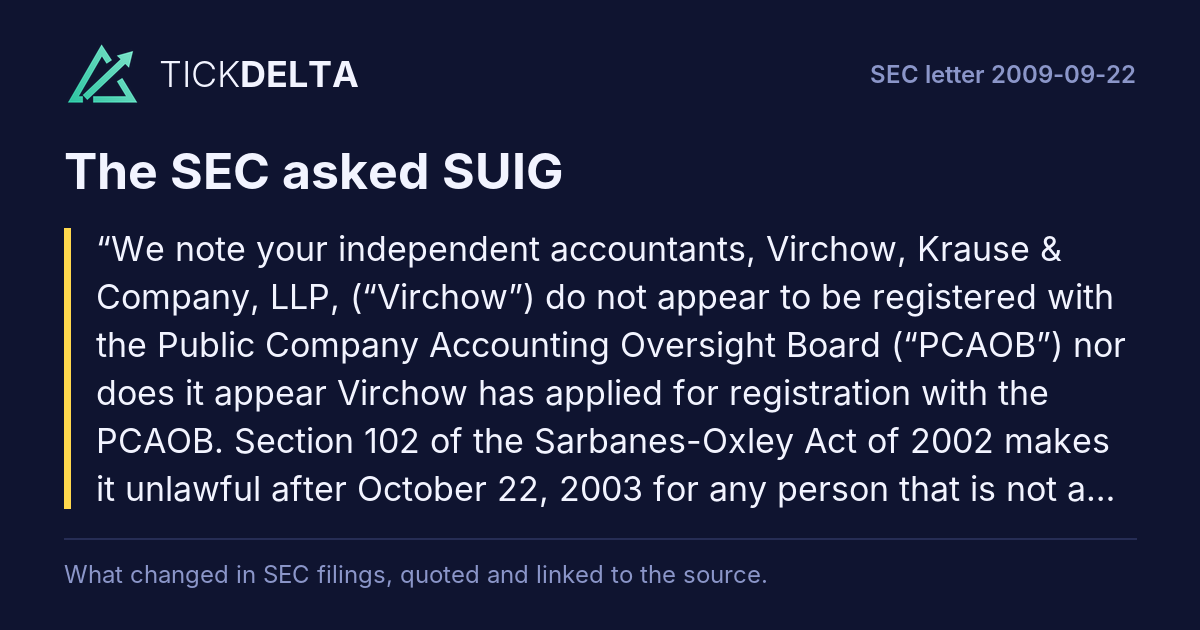
We note your independent accountants, Virchow, Krause & Company, LLP, (“Virchow”) do not appear to be registered with the Public Company Accounting Oversight Board (“PCAOB”) nor does it appear Virchow has applied for registration with the PCAOB. Section 102 of the Sarbanes-Oxley Act of 2002 makes it unlawful after October 22, 2003 for any person that is not a registered public accounting firm (i.e.Rest of the question
registered with the PCAOB) to prepare or issue, or to participate in the preparation or issuance of, any audit report (or review report) with respect to any issuer. You must engage a new accountant that is a publicly registered accounting firm to perform review or audit work for the company.
Our independent accountants, Baker Tilly Virchow Krause, LLP (formerly known as
Virchow, Krause & Company, LLP at the time of the filing of the Form 10-K for Poker Magic, Inc.) is registered with the PCAOB. The firm changed their name effective June 1, 2009 with the name listing on the PCAOB website for registered firms updated on June 25, 2009.Read in the reply ↗Rest of the answer
The PCAOB’s recognition of the name change can be found on the PCAOB website under “Name Changes of
Registered Public Accounting Firms” which shows the “Current Name” as Baker
Tilly Virchow Krause, LLP with the corresponding “Previous Name” of Virchow,
Krause & Company, LLP. The firm’s inspection report, issued June
14, 2007, from the 2006 PCAOB inspection, is also available on the PCAOB website.
First report after the company's reply of Oct 12, 2009: 10-Q filed Nov 13, 2009 ↗, against the 10-Q filed Aug 14, 2009 ↗.
Tickdelta does not hold the text of both reports, so they are not compared here.
To the extent Virchow is registered with the PCAOB (or registered under a different name), please advise and have them provide us with supporting documentation as to their registration with the PCAOB. To the extent Virchow is not registered with the PCAOB or were not registered at the time you filed your December 31, 2008 Annual Report on Form 10-K and March 31, 2009 and June 30, 2009 Quarterly Reports on Form 10-Q,Rest of the question
such financial statements are not acceptable in filings with us and are considered to be materially deficient. The financial statements in these filings will need to be re-audited (with respect to the Form 10-K) and re-reviewed (with respect to the Forms 10-Q) by a PCAOBregistered independent public accounting firm and re-filed in amendments to the 30, 2009 Quarterly Reports on Form 10-Q. Please advise and file the requested amendments as soon as practicable. We may have further comment after review of your response.
Please see the Company’s response to Comment 1. Read in the reply ↗
First report after the company's reply of Oct 12, 2009: 10-Q filed Nov 13, 2009 ↗, against the 10-Q filed Aug 14, 2009 ↗.
Tickdelta does not hold the text of both reports, so they are not compared here.
Please file an Item 4.01 Form 8-K after you have engaged new accountants that are registered with the PCAOB. Provide all of the disclosures required by Item 304(a)(1) of Regulation S-K regarding the period of engagement of Virchow, Krause & Company, LLP which should include an Exhibit 16 letter from Virchow, Krause & Company, LLP.
Please Read in the reply ↗
First report after the company's reply of Oct 12, 2009: 10-Q filed Nov 13, 2009 ↗, against the 10-Q filed Aug 14, 2009 ↗.
Tickdelta does not hold the text of both reports, so they are not compared here.
Also, if and when you engage new accountants, please report the engagement in an Item 4.01 Form 8-K and comply with the requirements of Regulation S-K Item 304(a)(2). In making any disclosures about consultations with your new accountants, please ensure you disclose any consultations up through the date of engagement.
Please Read in the reply ↗
First report after the company's reply of Oct 12, 2009: 10-Q filed Nov 13, 2009 ↗, against the 10-Q filed Aug 14, 2009 ↗.
Tickdelta does not hold the text of both reports, so they are not compared here.
See the paragraph discussion that begins with “Shares issued to our executive management personnel…” For the aggregated amounts listed in the first and second sentences for the years ended December 31, 2008 and 2007, please tell us how each of these amounts reconcile with the individual line item amounts for the line items “Consulting Expenses” and “Executive Management Compensation” shown in the table on page 13.Rest of the question
For the amounts listed in the third sentence, please disclose and also tell us where the expense is reflected in the table on page 13.
13. Response: The expense related to executive management personnel and consultants of $69,879 and
$105,171 for the years ended December 31, 2008 and 2007 are included in the various expense categories noted in the table along with other expenses not considered material to specifically disclose and will not reconcile to an exact line in the table. The detail of the amounts in this MD&A paragraph does reconcile to the Company’s cash flow statement. Management disclosed this information separately for transparency to the investors.Read in the reply ↗Rest of the answer
Executive management compensation for
2008 in the amount of $56,000 includes $10,000 for value of shares issued for services, $8,000 of cash paid, and $38,000 of contributed capital for value of services rendered. All expenses described in this paragraph are included in operating expenses on the statement of operations.
First report after the company's reply of Oct 12, 2009: 10-Q filed Nov 13, 2009 ↗, against the 10-Q filed Aug 14, 2009 ↗.
Tickdelta does not hold the text of both reports, so they are not compared here.
Please revise the third sentence to clarify that your independent registered public accountants, because of the factors disclosed, among others, have issued a going concern opinion that raises substantial doubt about your ability to continue as a going concern.
We note your comment and, because (i) the existing disclosure already indicates that there is substantial doubt about our ability to continue as a going concern and
(ii) the report of the auditor contained in the same report plainly contains a going concern opinion, we would like to incorporate your suggested revision in future annual report filings. Read in the reply ↗
First report after the company's reply of Oct 12, 2009: 10-Q filed Nov 13, 2009 ↗, against the 10-Q filed Aug 14, 2009 ↗.
Tickdelta does not hold the text of both reports, so they are not compared here.
Please expand the disclosure under this heading to further identify and describe those policies, included within your significant accounting policies at Note 1 to the audited financial statements, that are critical accounting policies according to your definition in the second paragraph under this heading where you indicate those are “policies that represent the more significant judgments and estimates used in theRest of the question
preparation of the Company’s financial statements…” The MD&A should disclose those accounting policies that are critical policies where estimates and judgments are used that could have material impact. For example, but not limited to, your more critical accounting policies and estimates could be revenue recognition, impairment of intangible and long-lived assets, and income taxes.
We note your comment and we would like to incorporate your suggestions in future filings. In particular, we would like to include disclosure in substantially the following form:
Our policy for the recognition of revenue is a critical accounting policy. The Company recognizes revenue from sales under a license agreement when the following four criteria are met: (1) there exists persuasive evidence of an arrangement (e.g., a fully executed license agreement); (2) delivery of the Winner’s Pot Poker game, felt and instructions has been made and the licensee thereafter becomes responsible toRead in the reply ↗Rest of the answer
replace such materials in the event of damage or normal wear and tear; (3) the price is fixed or determinable; and (4) the ability of the Company to collect amounts owed is reasonably assured.
policy regarding the determination of impairment of long-lived and intangible assets is another critical accounting policy. In this regard, our management reviews the Company’s long-lived assets for impairment whenever events or changes in circumstances indicate that the carrying amount of a long-lived or intangible asset may not be recoverable. If indications of impairment are present and the estimated future undiscounted cash flows are less than the carrying value of the asset under scrutiny, the value of that asset will be adjusted appropriately. No impairment indicators were present as of December 31, 2008 or December 31, 2007.
First report after the company's reply of Oct 12, 2009: 10-Q filed Nov 13, 2009 ↗, against the 10-Q filed Aug 14, 2009 ↗.
Tickdelta does not hold the text of both reports, so they are not compared here.
Refer to the May 28, 2008 transaction of the warrant issuance. Disclose the value assigned to the warrants and how you determined the value. If the warrants were determined to have minimal or no value, please so state; otherwise it is unclear why the value of the warrant has not been reflected in the financial statements. Please advise or revise.
Determination of the value of the warrants is not considered necessary because the warrants were issued to an investor in connection with that investor’s purchase of common stock. The warrants are properly classified as permanent equity and do not have any terms which would require a classification as a liability, nor do they possess any embedded derivative features. Read in the reply ↗
First report after the company's reply of Oct 12, 2009: 10-Q filed Nov 13, 2009 ↗, against the 10-Q filed Aug 14, 2009 ↗.
Tickdelta does not hold the text of both reports, so they are not compared here.
Refer to the paragraph that begins “Based on this assessment…” Please revise the second sentence with respect to the use of the accounting firm, Virchow, Krause & Company, LLP, as such firm does not appear to be registered with the PCAOB, as noted in our comments above.Rest of the question
In this regard, upon the engagement of new registered independent public accountants, you may choose to revise to state: “This annual report does not include an attestation report of the company’s registered public accounting firm regarding internal control over financial reporting. Management’s report was not subject to attestation by the company’s registered public accounting firm pursuant to temporary rules of the Securities and Exchange Commission that permit the company to provide only management’s report in this annual report.” See Item 308T(a)(4) of Regulation S-K.
Please see the Company’s response to Comment 1. In addition, we believe our current disclosure about the absence of an attestation report is in a form substantially similar to that required by Item 308T(a)(4), and is neither misleading nor inaccurate. As such, we would prefer not to amend the
Annual Report to more closely adhere to the language in the Regulation S-K reporting Item. Read in the reply ↗
First report after the company's reply of Oct 12, 2009: 10-Q filed Nov 13, 2009 ↗, against the 10-Q filed Aug 14, 2009 ↗.
Tickdelta does not hold the text of both reports, so they are not compared here.
See note 2 to the table on page 34 regarding the stock awards received in fiscal year 2007. Please clarify whether each officer received 250,000 common shares (for an aggregate of 500,000 common shares valued at $48,000), as shown in the statements of shareholders’ equity and Note 4 to the audited financial statements pertaining to this January 2007 transaction.Rest of the question
Your current disclosure indicates each officer received 125,000 valued at $24,000 (for an aggregate of 250,000 common shares valued at $48,000). Please revise or advise.
The figures in footnote 2 of the table appear to have been in error since each executive received 250,000 shares having an aggregate value of $24,000 in
January 2007. We have corrected the disclosure in the amended filing. Read in the reply ↗
First report after the company's reply of Oct 12, 2009: 10-Q filed Nov 13, 2009 ↗, against the 10-Q filed Aug 14, 2009 ↗.
Tickdelta does not hold the text of both reports, so they are not compared here.
See paragraph number four where it appears certain disclosure has been inadvertently omitted. Please revise this paragraph to disclose “The registrant’s other certifying officer(s) and I are responsible…(as defined in Exchange Act Rules 13a-15(e) and 15d-15(e)) and internal control over financial reporting (as defined in Exchange Act Rules 13a-15(f) and 15d-15(f) for the registrant and have:” This comment is alsoRest of the question
applicable to your March 31, 2009 and June 30, 2009 Quarterly Reports on Form 10-Q.
We note the inadvertent omission you cite to and have corrected the certifications in all of the amended filings. Read in the reply ↗
First report after the company's reply of Oct 12, 2009: 10-Q filed Nov 13, 2009 ↗, against the 10-Q filed Aug 14, 2009 ↗.
Tickdelta does not hold the text of both reports, so they are not compared here.
Please expand this paragraph to disclose that the interim financial statements “include all adjustments that, in the opinion of management, are necessary in order to make the financial statements not misleading.” See Instruction 2 to Rule 8-03 of Regulation S-X.
We will undertake to include the following under the heading “Interim financial information” in our next Quarterly Report on Form 10-Q, and will update this disclosure as appropriate in future filings:
Interim financial information
The accompanying unaudited financial statements have been prepared in accordance with accounting principles generally accepted in the United States and pursuant to the rules and regulations of the Securities and Exchange Commission (the
“SEC”) for interim financial information.Read in the reply ↗Rest of the answer
Accordingly, certain information and footnote disclosures normally included in financial statements prepared in accordance with accounting principles generally accepted in the United States have been omitted pursuant to such rules and regulations. Operating results for the three and nine months ended September 30, 2009 are not necessarily indicative of the results that may be expected for the year ending December 31,
2009 or any other period. The accompanying financial statements and related notes should be read in conjunction with the audited Financial Statements of the
Company, and notes thereto, contained in this filing for the year ended December
31, 2008. The financial information furnished in this report is unaudited and reflects all adjustments which are normal recurring adjustments and, which in the opinion of management, are necessary to fairly present the results of the interim periods presented in order to make the financial statements not misleading.
Refer to Note 4 to the financial statements included in the June 30, 2009 Form
10-Q. Please tell us more about the redemption of common stock that occurred in February 2009. Specifically tell us whether the shareholder was a related party or affiliate and whether that individual paid $0.25 per share for the purchase of the stock. In addition, please explain why you elected to redeem these shares for cash given your current liquidity situation. If you were required to redeem the shares, tell us why and whether other shares may be subject to redemption.
Response: The shareholder from whom the shares were redeemed was neither an affiliate of nor a related party to the Company. The Company elected to redeem these shares for cash upon the request of the shareholder. The $0.25 was the original price paid for the redeemed shares. The Company was not obligated under any written or oral agreement or understanding to redeem the shares. The decision to redeem the shares was made primarily on the belief that the Company would be able to obtain sufficient capital for the short-term future of the Company from one or more sources, including affiliates of the Company. The Company was at the time of the redemption, and immediately after the redemption, able to meet its debts as they came due in the ordinary course. There are presently no other shares subject to redemption or under consideration for redemption.
14. Refer to Note 6 to the
10-Q. Please disclose the related party nature of the loan from
Lantern Advisers, LLC. We note this entity is owned equally by your two officers.
Response: Lantern
Advisers, LLC is equally owned by the Company’s CEO and CFO. We propose to appropriately disclose the related-party nature of loans in our future filings.
First report after the company's reply of Oct 12, 2009: 10-Q filed Nov 13, 2009 ↗, against the 10-Q filed Aug 14, 2009 ↗.
Tickdelta does not hold the text of both reports, so they are not compared here.
Refer to Note 4 to the financial statements included in the June 30, 2009 Form 10- Q. Please tell us more about the redemption of common stock that occurred in February 2009. Specifically tell us whether the shareholder was a related party or affiliate and whether that individual paid $0.25 per share for the purchase of the stock.Rest of the question
In addition, please explain why you elected to redeem these shares for cash given your current liquidity situation. If you were required to redeem the shares, tell us why and whether other shares may be subject to redemption.
No numbered answer found in the reply. Read the reply ↗
First report after the company's reply of Oct 12, 2009: 10-Q filed Nov 13, 2009 ↗, against the 10-Q filed Aug 14, 2009 ↗.
Tickdelta does not hold the text of both reports, so they are not compared here.
Refer to Note 6 to the financial statements included in the June 30, 2009 Form 10- Q. Please disclose the related party nature of the loan from Lantern Advisers, LLC. We note this entity is owned equally by your two officers.
No numbered answer found in the reply. Read the reply ↗
First report after the company's reply of Oct 12, 2009: 10-Q filed Nov 13, 2009 ↗, against the 10-Q filed Aug 14, 2009 ↗.
Tickdelta does not hold the text of both reports, so they are not compared here.
Notwithstanding the following comments shown below that request future filing disclosure and supplemental information, we note from your response letter to us dated October 12, 2009 that you propose future filing disclosure with respect to our prior comment numbers 6, 7, 12, and 14, and that you will amend the December 31, 2008 Annual Report on Form 10-K and March 31, 2009 and June 30, 2009 Quarterly Reports onRest of the question
Forms 10-Q with respect to our prior comments 10 and 11. Please note that we have no additional comments with respect to your response to our prior comments 1 through 4, 9 and 13.
We agree with your characterization, and are submitting amendments to the reports you refer to above. Read in the reply ↗
We have reviewed your response to our prior comment 5. We suggest you expand the narrative disclosure to also reconcile with the amounts shown in the table on page 13 for the line items “Consulting Expenses” and “Executive Management Compensation” as your current discussion of these costs do not appear to be solely included within these two line items but, as the last sentence of your response indicates, spreadRest of the question
among other line items within the table. In this regard, you may, for example, include the next to the last sentence of your response as it relates to the components of the tabular line item “Executive Management Compensation.” Also, given that the tabular line item “Consulting Expenses” shows amounts substantially lower than the amounts shown in the narrative discussion, we believe it would useful to the reader to reconcile or account for this difference in each period presented. Please revise in future filings.
As you request, we will expand the narrative disclosure in our future quarterly and annual reports to ensure that the amounts discussed in the narrative reconcile with the amounts shown in similar tables.
* * * * requested, on behalf of the Company, the Company acknowledges as follows:
[1] the
Company is responsible for the adequacy and accuracy of the disclosure in the filing;
[2] staff comments or changes to disclosure in response to staff comments do not foreclose the Commission from taking any action with respect to the filing;
and
[3] the
Company may not assert staff comments as aRead in the reply ↗Rest of the answer
defense in any proceeding initiated by the Commission or any person under the federal securities laws of the United
States.
First report after the company's reply of Oct 30, 2009: 10-Q filed Nov 13, 2009 ↗, against the 10-Q filed Aug 14, 2009 ↗.
Tickdelta does not hold the text of both reports, so they are not compared here.
Also in this review: closing letter, 2009-11-05