34 paragraphs in Risk Factors of the 10-K filed Nov 10, 2026
with nothing like them in the 10-K filed Nov 7, 2025. Quoted exactly.
Paragraphs that were only edited are under 10-K change.
Compared with the Risk Factors in the latest 10-K of the other 74 Technology companies:
a paragraph with at least half its words the same at another company is called similar, and the companies are listed under it.
A paragraph most of them have is marked boilerplate. No line means no other company has one like it.
This counts text; it does not say how serious a risk is.
Show the other 15
•our ability to negotiate agreements, social plans, and terms and conditions with our labor unions and works councils,
Read in the 10-K ↗
Operating expenses and certain working capital items related to our foreign-based operations are, in some instances, denominated in the local foreign currencies and therefore are affected by changes in the U.S. dollar exchange rate in relation to foreign currencies, such as the Euro, Japanese Yen, Mexican Peso, and Singapore Dollar. When the U.S. dollar weakens compared to these and other currencies, such as in fiscal 2026 with the Mexican Peso, our operating expenses for foreign operations are and will be higher when remeasured back into U.S. dollars.
Read in the 10-K ↗
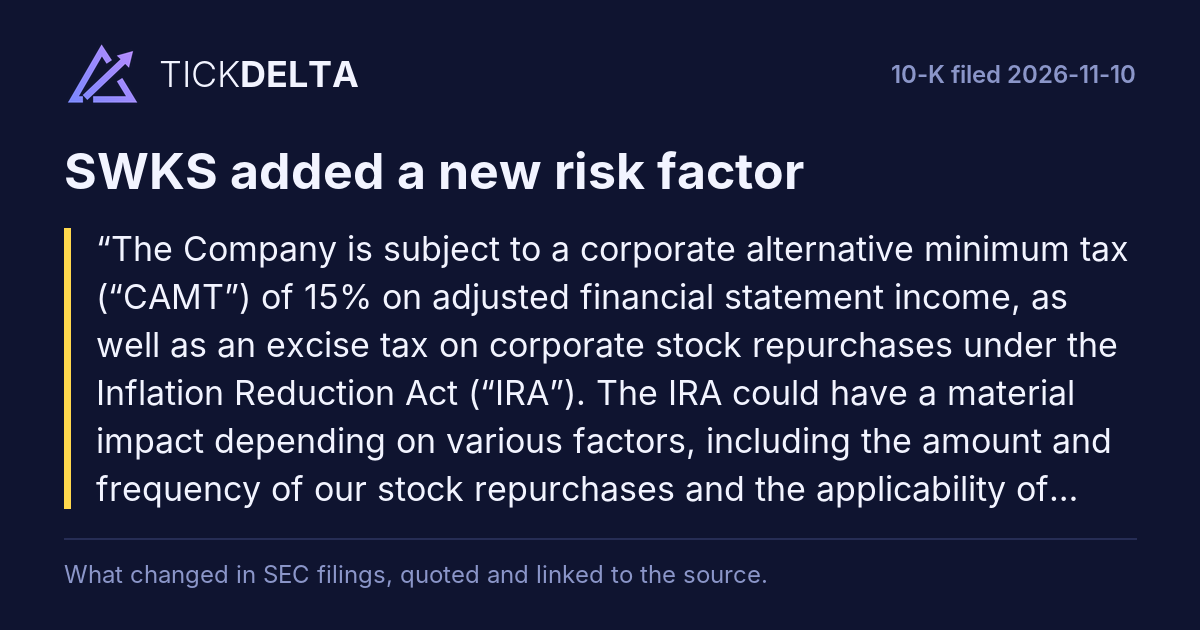
The Company is subject to a corporate alternative minimum tax (“CAMT”) of 15% on adjusted financial statement income, as well as an excise tax on corporate stock repurchases under the Inflation Reduction Act (“IRA”). The IRA could have a material impact depending on various factors, including the amount and frequency of our stock repurchases and the applicability of the CAMT to the Company.
Read in the 10-K ↗
Changes in our effective tax rate may adversely impact our results of operations and cash flow.
We are subject to taxation in the U.S. and numerous foreign jurisdictions. Our effective tax rate is subject to fluctuations and impacted by a number of factors, including the following:
Read in the 10-K ↗
•the resolution of issues arising from tax audits with various tax authorities, including those described in Note 8 to Item 8 of this Annual Report on Form 10-K;
•changes in the valuation of either our gross deferred tax assets or gross deferred tax liabilities;
Similar paragraph at 2 of 74 other Technology companies:
GEN,
INTC•changes in tax laws, domestic and foreign, or the interpretation of such tax laws and changes in generally accepted accounting principles.
Similar paragraph at 1 of 74 other Technology companies:
ADSKIn addition, on October 5, 2026, we completed the acquisition of Qorvo, pursuant to two merger transactions involving cash-and-stock consideration (the “Mergers”). The Mergers may result in greater-than-expected tax costs or liabilities. The Mergers significantly increase the complexity of the Company’s global tax profile. The Company may incur additional tax liabilities associated with the integration of legal entities, restructuring activities, transfer pricing arrangements, valuation of acquired deferred tax assets and liabilities, uncertain tax positions, limitations on tax attributes, and compliance with evolving international tax regimes, including Pillar Two. Future tax outcomes may differ from estimates due to changes in facts, interpretations of tax law, audit examinations, regulatory developments, or integration decisions. Such differences could materially affect the Company’s effective tax rate, cash tax obligations, and operating results.
As part of the Mergers, the Company is evaluating the impact of Sections 382 and 383 of the Internal Revenue Code and comparable state and foreign provisions on the availability of acquired and existing tax attributes. The analysis remains ongoing and may affect the amount and timing of realization of deferred tax assets, including tax credit carryforwards. Any resulting limitations, if any, could affect future tax expense, cash tax payments, and valuation allowance assessments.
In addition, following the Mergers, tax authorities may increase their scrutiny of the combined company’s historical and future tax positions, including those associated with integration activities, legal entity restructuring, transfer pricing arrangements, acquisition accounting, and the utilization of tax attributes. The resolution of tax examinations and related disputes may take several years and could have a material adverse effect on the Company’s financial condition, results of operations, cash flows, and effective tax rate.
Any significant increase in our future effective tax rates could reduce net income and cash flow for future periods.
Read in the 10-K ↗
•the gain or loss of significant customers, or content in any such customers’ products,
•our ability to align production capacity to customer demand, which may lead to underutilization of our capacity in periods of lower demand or the lack of capacity in periods of excess demand, and fluctuations in manufacturing yields,
Read in the 10-K ↗
We face risks of a loss of revenue if contracts with the U.S. government or defense and aerospace contractors are canceled or delayed or if defense spending is reduced.
We receive a portion of our revenue from the U.S. government and from prime contractors on U.S. government-sponsored programs, principally for defense and aerospace applications. These programs are subject to delays or cancellation. Further, spending on defense and aerospace programs can vary significantly depending on funding from the U.S. government. We believe our government and defense and aerospace business has been negatively affected in the past by external factors such as sequestration and political pressure to reduce federal defense spending. Reductions in defense and aerospace funding or the loss of a significant defense and aerospace program or contract could have a material adverse effect on our operating results. In addition, government, defense and aerospace customers and prime contractors often impose specific compliance, audit, documentation, qualification, security, approval and continuity requirements. Failure to maintain processes, systems and
controls sufficient to satisfy these requirements, including during the continued integration of Qorvo’s business and systems, could result in delayed awards, lost contracts, reduced revenue, compliance issues or reputational harm.
Read in the 10-K ↗
During fiscal 2026 [and subsequent to the end of fiscal 2026], in reaction to market demand factors impacting capacity at a number of our vendors, including increased demand that foundries have faced associated with data center and AI-related buildouts, we entered into or continued to perform under long-term capacity reservation and supply agreements with certain third-party foundries and OSATs, under which we agreed to certain minimum purchase commitments and/or upfront cash payments. We currently expect that market forces will require us to enter into additional long-term capacity reservation and supply agreements. These long-term capacity reservation agreements may have an adverse effect on our operating results in the event our future supply needs are reduced below the minimum purchase requirements as a result of a reduction in demand for our products. In addition, we may not be able to enter into new long-term capacity reservation and supply agreements. If we are unable to secure such supply agreements or even with such supply agreements, we are still subject to risks that a supplier will prioritize other customers’ capacity demands or be unable to meet its supply commitments, achieve anticipated manufacturing yields, produce wafers or other components on a timely basis, or provide additional capacity beyond its commitments sufficient to meet our supply needs. If so, we may experience delays in product launches or supply shortages for certain products, which could cause an unanticipated decline in our sales and damage our existing customer relationships and our ability to establish new customer relationships. In addition, if a supplier experiences financial difficulties or goes into bankruptcy, it could be difficult or impossible, or may require substantial time and expense, for us to recover any or all of our payments and deposits made as part of any supply agreement.
Read in the 10-K ↗
Imbalances in the supply of memory, storage and other components could increase our costs or our customers’ costs and product prices, which could reduce demand for our products.
While we do not directly or indirectly purchase memory or storage components such as DRAM and NAND for incorporation into our products, many of our customers, including our largest handset customers, do and have been experiencing and may continue to experience supply constraints and increasing costs for components driven by industry supply-demand imbalances. Our customers have taken action and may take further action to increase prices of their products, which may reduce the demand for our customers’ products. In addition, if memory or storage becomes constrained or more expensive, our customers may limit product configurations, delay product launches or shipments, prioritize certain end customers, or reduce purchases of components and subsystems, including our products. A reduction in the demand for our customers’ products or a disruption in our customers’ ability to manufacture or sell their products due to availability of memory, storage or other components could reduce the demand for our products and materially adversely affect the Company’s revenue, costs, gross margin, results of operations and financial condition. In addition, inflationary pressures and supply constraints, such as the tightening of supply conditions in the memory and silicon markets, have increased and may continue to increase costs for certain materials, components, supplies and services. As a result of cost inflation in our supply chain, we have implemented targeted price increases from time to time. However, these price increases could result in a decrease in demand for our products, which would decrease revenue and market share. Further, customers may resist price increases, delay or forego purchasing decisions, request
concessions, and seek offsetting commercial terms, which could reduce revenue, negatively affect margins, weaken customer relationships or reduce our market share.
Read in the 10-K ↗
We may not be able to effectively execute restructuring initiatives, which could result in total costs that are greater than expected and cause us not to achieve the expected long-term operational benefits of such initiatives.
We have, from time to time, implemented restructuring initiatives in the past and may continue to implement initiatives in the future that are aimed at reducing operating costs, streamlining our manufacturing footprint, and exiting certain product lines and businesses to focus on opportunities that align with our long-term strategy and profitability objectives. Because restructuring activities may involve changes to many aspects of our business, including but not limited to the location of our production facilities and personnel and the potential exit from certain product lines and businesses, our ability to successfully implement restructuring actions depends on a number of factors that we may not be able to predict. Risks associated with these actions include unexpected transition costs, disruption of our existing operations and productivity, diversion of management’s attention, employee attrition beyond any planned changes in personnel and the inability to replace the loss of revenue associated with a divested business. In addition, European Works Councils and other governing bodies representing our foreign employees, may require us to incur additional, unplanned compensation expenses associated with restructuring activities. The failure to successfully and timely realize the anticipated benefits of these restructuring actions could have a material adverse effect on our profitability, financial condition or results of operations. In addition, even if we fully execute and implement these actions, there may be other unforeseeable and unintended consequences that could materially adversely impact our profitability and business, including unintended employee attrition, harm to our competitive position or reputation, or inability to effectively scale our business in response to shifting demand. To the extent that we do not achieve the profitability enhancement or other anticipated benefits of restructuring initiatives, our results of operations may be materially adversely affected.
Similar paragraph at 1 of 74 other Technology companies:
ON
distributors or their failure to perform as expected could reduce our revenue. Our ability to add or replace distributors for some of our products may be limited because our end customers may be hesitant to accept the addition or replacement of a distributor due to advantages in the incumbent distributors’ technical support and favorable business terms related to payments, discounts and stocking of acceptable inventory levels. Using third parties for distribution exposes us to many risks, including competitive pressure, concentration, credit risk and compliance risks. Other third parties may use one of our distributors to sell products that compete with our products, and we may need to incentivize the distributors to focus on the sale of our products. Violations of the Foreign Corrupt Practices Act or similar laws by our distributors or other third-party intermediaries could have a material impact on our business. Failure to manage risks related to our use of distributors may reduce sales, increase expenses and weaken our competitive position.
Similar paragraph at 1 of 74 other Technology companies:
INTC
•integrating financial forecasting and controls, procedures, reporting cycles, accounting policies, disclosure controls, internal control over financial reporting, enterprise systems and financial reporting processes, and maintaining effective controls during system migrations and organizational changes;
Read in the 10-K ↗
•maintaining customer confidence, quote and order continuity, sales operations, forecast accuracy, customer master data, distributor alignment, pricing records, enterprise resource planning, and customer-care responsiveness during the period in which the combined company operates across separate or transitioning systems and processes;
Read in the 10-K ↗
Our acquisition of Qorvo will result in significant goodwill and acquired intangible assets, and changes in operating performance, market conditions, integration plans, product roadmaps or valuation assumptions could result in material impairment charges.
In connection with the Mergers, we will record acquired assets and assumed liabilities based on preliminary estimates of fair value. These estimates require significant judgments regarding expected revenue, margins, customer relationships, technology life cycles, discount rates, useful lives, inventory valuation, property and equipment, tax attributes, uncertain tax positions and other matters. These estimates may change during the measurement period as additional information becomes available. In addition, if the combined business does not achieve anticipated operating results, if product demand or expected synergies decline, or if technologies or acquired in-process research and development projects become obsolete or are abandoned, we may be required to record material impairment or other charges. Such charges could materially adversely affect our results of operations and financial condition.
Read in the 10-K ↗
While we have previously paid quarterly cash dividends, on July 28, 2026, we announced that our Board of Directors had determined not to declare quarterly cash dividends on our common stock going forward. Future dividends, if any, are subject to declaration by our Board of Directors, and we may not resume paying dividends at historical levels or at all.
Read in the 10-K ↗