Paragraph 81 · 48% changed
Every version of it
Screener
/
SEC EDGAR
/CIK 0000817720
/10-K filed Aug 10, 2026, compared with Aug 21, 2025
/Numbers from the XBRL of the 10-Ks
Nasdaq
Technology · Semiconductors
SYNAPTICS Inc SYNA
The 10-K against last year's
115 changes: 57 added, 10 removed, 48 reworded
10-K Aug 10, 2026 vs Aug 21, 2025
Risk Factors
26.2%
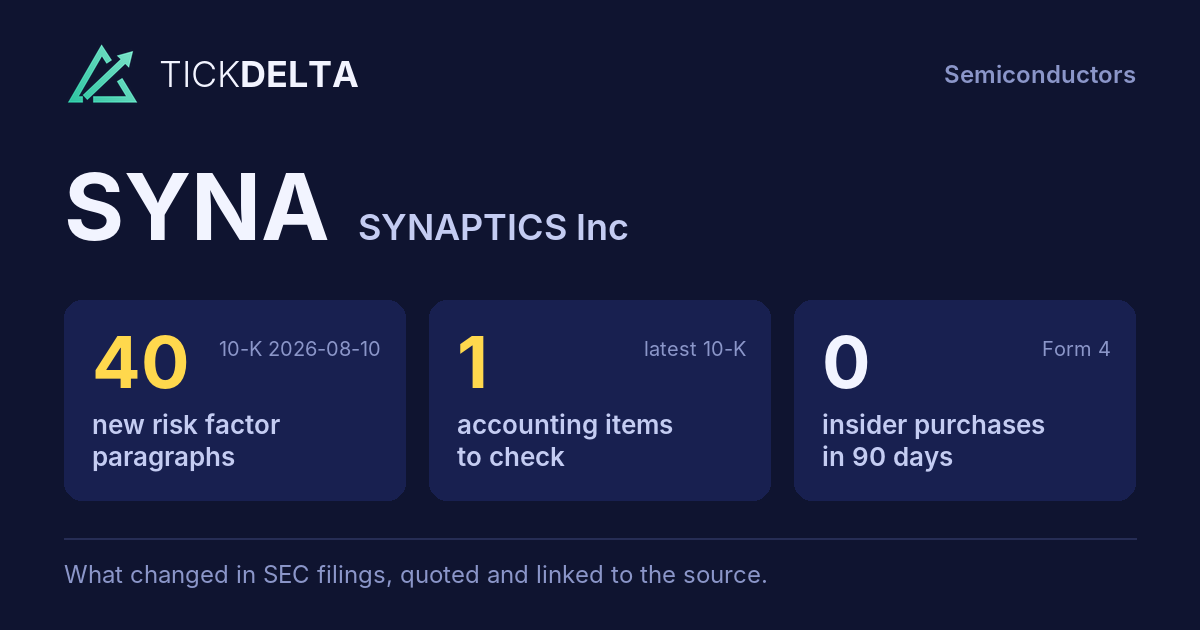
of the text changed · 11,684 words now · 40 new paragraphs, 5 gone
MD&A
39.5%
of the text changed · 5,109 words now · 17 new paragraphs, 5 gone
Legal Proceedings
8.7%
of the text changed · 450 words now
Accounting Policies
11.5%
of the text changed · 3,233 words now
10-K 0000817720-26-000055 (Aug 10, 2026) vs 10-K 0000817720-25-000073 (Aug 21, 2025)
Every paragraph, and how much of it changed
One bar per paragraph, in the order of the 10-K. Height and colour show the share of its words not in the closest paragraph a year earlier; the tallest bars are new paragraphs.
Risk Factors
123 paragraphs · 40 new · 27 reworded · 5 gone · 10-K Aug 10, 2026 against Aug 21, 2025
New paragraph
Reworded (5% of its words or more)
Same or nearly
Paragraph 38 · 42% changed
Every version of it
We derive a substantial portion of our revenue from our solutions for the Core IoT, Enterprise and Automotive and Mobile markets. These markets are highly competitive and subject to significant volatility, driven by macroeconomic conditions, evolving technical standards, shifting customer preferences, and rapid technological changes. For example, our products are embedded in discretionary consumer and industrial devices such as smartphones, tablets, notebooks, virtual reality systems, and automobiles. As a result, demand in these markets can fluctuate sharply based on factors such as inflation, interest rates, trade restrictions, or recessionary conditions. During periods of slowing growth or heightened uncertainty, customers may cancel, reduce or defer orders, reduce inventory levels, or adjust production forecasts. In addition, these economic conditions could result in higher inventory levels and the possibility of resulting excess capacity charges from our manufacturing partners if we need to slow production to reduce inventory levels. Macroeconomic conditions can also disrupt our supply chain and increase operational costs. If our manufacturing partners, suppliers, distributors and other third-party partners experience financial challenges, they may demand pricing accommodations, delay payment or become insolvent, which could harm our ability to meet our customer demands or collect revenue. Cyclical patterns in our end markets, particularly consumer electronics and automotive, have historically resulted in reduced demand, price erosion, overcapacity and increased inventory. These cycles are difficult to predict and may result in substantial fluctuations in our operating results. Moreover, each market presents unique risks. For example, the automotive industry is especially sensitive to inflation, interest rates and tariffs, all of which may raise vehicle production costs and depress consumer demand. Existing, new or retaliatory tariffs on automobiles and automobile components imported into the United States could disrupt the automotive supply chain and, in turn, adversely affect our growth rate in that industry.
Paragraph 107 · 40% changed
Every version of it
The trading price of the 2031 Notes may also be volatile due to fluctuations in our common stock price, and there is currently no active trading market for the 2031 Notes. The 2031 Notes are currently convertible at the holders’ option. If the holders of the 2031 Notes elect to convert their notes during this period or any future period in which the notes become convertible, we may be required to make substantial cash payments and/or issue shares of common stock, which could adversely affect our liquidity and result in dilution to our stockholders.
Paragraph 69 · 36% changed
Every version of it
Supply chain disruptions can also impact upstream demand for our solutions. Our products are used in complex devices and systems that depend on numerous components. Delays in one part of the chain can lead to a broader reduction in product builds that include our technologies. For example, the current global shortage and elevated pricing of certain memory components across the broader electronics supply chain have, at times, influenced the timing of orders for certain products, particularly for smaller customers. Limited visibility into future availability, timing, increased associated costs, and the potential for these conditions to persist could affect customer development timelines, purchasing behavior, production schedules, booking patterns, and the timing or visibility of orders in future periods. If these conditions persist, our customers’ ability to manufacture their end products may be limited, or they may adjust production schedules, delay product launches, or revise demand forecasts, which in turn could lead them to reduce, delay or cancel orders for our products, even when demand for their end products remains strong. Additionally, the current shortage and resulting price increase for memory components also may lead our customers to increase prices of their end products, which could lead to decreased demand for those products, ultimately negatively impacting orders for our products. If customers delay orders of our products for longer periods of time due to such supply conditions, or hold inventory of our products for longer periods of time, we could experience a decline in our revenue and excess inventory. In addition, we face ongoing risks from component and material shortages. Key inputs, including silicon wafers, substrates, and packaging materials, are sourced from a limited number of foreign suppliers. If these suppliers face capacity constraints, pricing shifts, or economic disruptions, we may be unable to obtain sufficient quantities or meet production timelines.
Paragraph 44 · 34% changed
Every version of it
Tariffs on imported components, especially from Asia, could increase our production costs, disrupt supply chains, or make our products and our customers’ end products less competitive in global markets. For example, in the first quarter of calendar 2025, 2025 and 2026, the U.S. government announced new tariffs on imports from several countries, including China, prompting reciprocal tariffs. Tariffs on our customers’ products may reduce their global competitiveness, particularly in China. Some OEMs in our industry have responded with short-term price adjustments and shifted production and sourcing outside of China. Additionally, on August 6, 2025, in January 2026, the U.S. government proposed implemented a 100% 25% tariff on certain imported semiconductors and chips, with possible exemptions chips not intended for companies that invest in U.S. manufacturing. While still use in the proposal phase, this U.S. These policies and the continued uncertainty and ongoing developments around trade policy could materially impact our sourcing strategy and component costs, depending on scope and implementation. We rely on global foundry partners, many based in Asia, for a significant portion of our silicon. If adopted, these tariffs could increase our manufacturing costs or require changes to our supply chain operations. Moreover, these tariffs and any other trade restrictions imposed on our customers or suppliers could adversely affect our financial results and position through reduced demand for our products and solutions, cancelled orders, supply chain disruptions, increased transaction costs, and increased expenses. If the United States’ relationship with countries subject to increased tariffs results in additional trade disputes, trade protection measures, retaliatory actions and increased barriers, policies that favor domestic industries, or increased import or export licensing requirements or restrictions, then our deployment of resources in jurisdictions affected by such measures could be misaligned and our operations may be adversely affected. We are actively evaluating strategies to mitigate such risks, including potential sourcing diversification or partnerships with U.S.-based manufacturers.
Paragraph 117 · 29% changed
Every version of it
Paragraph 88 · 24% changed
Every version of it
parties with access to our sensitive data, or the existence of computer viruses, ransomware or other malicious code in their data, software or hardware, could result in disruptions or failures of systems used in our business. Any of the foregoing, or the perception any of them has occurred, could have a material adverse impact on our business, operations and financial results. In addition, any compromise of security from a security breach or cyberattack could deter customers or business partners from entering into transactions that involve providing confidential information to us. As a result, any compromise to the security of our systems could have a material adverse effect on our business, reputation, financial condition and operating results.
Paragraph 116 · 24% changed
Every version of it
Our effective tax rate may vary significantly from period to period due to factors such as: shifts in the mix and geographic location of earnings and assets; changes in entity structure or business operations; audit outcomes and related interest or penalties; revaluations of deferred tax assets or changes in tax credit availability; new tax laws or accounting standards, including implementation of BEPS 2.0 or OBBBA; and our decision to repatriate foreign earnings subject to additional taxes.
Paragraph 81 · 48% changed
Every version of it
10-K Aug 21, 2025We rely on a combination of patents, trade secrets, trademarks, copyrights, and confidentiality agreements to protect our proprietary technologies. However, we cannot be certain that our technologies and products do not and will not infringe issued patents or other third-party proprietary rights. Patents may be challenged, invalidated, or circumvented. Trade secrets may be compromised if confidentiality measures fail or are not consistently applied, and trademark rights may be challenged or unenforceable in certain jurisdictions. Our protection efforts face limitations, particularly in foreign markets such as China, where IP enforcement is less predictable. In the past, we have not always required all employees, consultants, suppliers, or partners to enter into formal written agreement for the protection of our technology including confidentiality or invention assignment agreements, and some may seek to assert rights in our technologies or use them without authorization. The risk of inadvertent disclosure is further heightened by employee use of generative or third-party AI tools. Any claims, with or without merit, could result in significant litigation costs and diversion of resources, including the attention of management, and could require us to enter into royalty or licensing agreements, which may include terms that may not be commercially reasonable, which could have a material adverse effect on our business.
10-K Aug 10, 2026
AI tools. Any claims, with or without merit, could result in significant litigation costs and diversion of resources, including the attention of management, and could require us to enter into royalty or licensing agreements, which may include terms that may not be commercially reasonable, which could have a material adverse effect on our business.
Paragraph 38 · 42% changed
Every version of it
10-K Aug 21, 2025
We derive a substantial portion of our revenue from our solutions for the Core IoT, Enterprise and Automotive and Mobile markets. These markets are highly competitive and subject to significant volatility, driven by macroeconomic conditions, evolving technical standards, shifting customer preferences, and rapid technological changes. For example, our products are embedded in discretionary consumer and industrial devices such as smartphones, tablets, notebooks, virtual reality systems, and automobiles. As a result, demand in these markets can fluctuate sharply based on factors such as inflation, interest rates, trade restrictions, or recessionary conditions. During periods of slowing growth or heightened uncertainty, customers may cancel, reduce or defer orders, reduce inventory levels, or adjust production forecasts. In addition, these economic conditions could result in higher inventory levels and the possibility of resulting excess capacity charges from our manufacturing partners if we need to slow production to reduce inventory levels. Macroeconomic conditions can also disrupt our supply chain and increase operational costs. If our manufacturing partners, suppliers, distributors and other third-party partners experience financial challenges, they may demand pricing accommodations, delay payment or become insolvent, which could harm our ability to meet our customer demands or collect revenue. Cyclical patterns in our end markets, particularly consumer electronics and automotive, have historically resulted in reduced demand, price erosion, overcapacity and increased inventory. These cycles are difficult to predict and may result in substantial fluctuations in our operating results. Moreover, each market presents unique risks. For example, the automotive industry is especially sensitive to inflation, interest rates and tariffs, all of which may raise vehicle production costs and depress consumer demand. Existing, new or retaliatory tariffs on automobiles and automobile components imported into the United States could disrupt the automotive supply chain and, in turn, adversely affect our growth rate in that industry.
10-K Aug 10, 2026
We derive a substantial portion of our revenue from our solutions for the Core IoT, Enterprise and Automotive and Mobile markets. These markets are highly competitive and subject to significant volatility, driven by macroeconomic conditions, evolving technical standards, shifting customer preferences, and rapid technological changes. For example, our products are embedded in discretionary consumer and industrial devices such as smartphones, tablets, notebooks, virtual reality systems, and automobiles. As a result, demand in these markets can fluctuate sharply based on factors such as inflation, interest rates, trade restrictions, or recessionary conditions. During periods of slowing growth or heightened uncertainty,
Paragraph 107 · 40% changed
Every version of it
10-K Aug 21, 2025
The trading price of the 2031 Notes may also be volatile due to fluctuations in our common stock price, and there is currently no active trading market for the 2031 Notes.
10-K Aug 10, 2026
The trading price of the 2031 Notes may also be volatile due to fluctuations in our common stock price, and there is currently no active trading market for the 2031 Notes. The 2031 Notes are currently convertible at the holders’ option. If the holders of the 2031 Notes elect to convert their notes during this period or any future period in which the notes become convertible, we may be required to make substantial cash payments and/or issue shares of common stock, which could adversely affect our liquidity and result in dilution to our stockholders.
Paragraph 69 · 36% changed
Every version of it
10-K Aug 21, 2025
Supply chain disruptions can also impact upstream demand for our solutions. Our products are used in complex devices and systems that depend on numerous components. Delays in one part of the chain can lead to a broader reduction in product builds that include our technologies. In addition, we face ongoing risks from component and material shortages. Key inputs, including silicon wafers, substrates, and packaging materials, are sourced from a limited number of foreign suppliers. If these suppliers face capacity constraints, pricing shifts, or economic disruptions, we may be unable to obtain sufficient quantities or meet production timelines.
10-K Aug 10, 2026
Supply chain disruptions can also impact upstream demand for our solutions. Our products are used in complex devices and systems that depend on numerous components. Delays in one part of the chain can lead to a broader reduction in product builds that include our technologies. For example, the current global shortage and elevated pricing of certain memory components across the broader electronics supply chain have, at times, influenced the timing of orders for certain products, particularly for smaller customers. Limited visibility into future availability, timing, increased associated costs, and the potential for these conditions to persist could affect customer development timelines, purchasing behavior, production schedules, booking patterns, and the timing or visibility of orders in future periods. If these conditions persist, our customers’ ability to manufacture their end products may be limited, or they may adjust production schedules, delay product launches, or revise demand forecasts, which in turn could lead them to reduce, delay or cancel orders for our products, even when demand for their end products remains strong. Additionally, the current shortage and resulting price increase for memory components also may lead our customers to increase prices of their end products, which could lead to decreased demand for those products, ultimately negatively impacting orders for our products. If customers delay orders of our products for longer periods of time due to such supply conditions, or hold inventory of our products for longer periods of time, we could experience a decline in our revenue and excess inventory. In addition, we face ongoing risks from component and material shortages. Key inputs, including silicon wafers, substrates, and packaging materials, are sourced from a limited number of foreign suppliers. If these suppliers face capacity constraints, pricing shifts, or economic disruptions, we may be unable to obtain sufficient quantities or meet production timelines.
Paragraph 44 · 34% changed
Every version of it
10-K Aug 21, 2025
Tariffs on imported components, especially from Asia, could increase our production costs, disrupt supply chains, or make our products and our customers’ end products less competitive in global markets. For example, in the first quarter of calendar 2025, the U.S. government announced new tariffs on imports from several countries, prompting reciprocal tariffs. Tariffs on our customers’ products may reduce their global competitiveness, particularly in China. Some OEMs in our industry have responded with short-term price adjustments and shifted production and sourcing outside of China. Additionally, on August 6, 2025, the U.S. government proposed a 100% tariff on imported semiconductors and chips, with possible exemptions for companies that invest in U.S. manufacturing. While still in the proposal phase, this policy could materially impact our sourcing strategy and component costs, depending on scope and implementation. We rely on global foundry partners, many based in Asia, for a significant portion of our silicon. If adopted, these tariffs could increase our manufacturing costs or require changes to our supply chain operations. We are actively evaluating strategies to mitigate such risks, including potential sourcing diversification or partnerships with U.S.-based manufacturers.
10-K Aug 10, 2026
Tariffs on imported components, especially from Asia, could increase our production costs, disrupt supply chains, or make our products and our customers’ end products less competitive in global markets. For example, in calendar 2025 and 2026, the U.S. government announced new tariffs on imports from several countries, including China, prompting reciprocal tariffs. Tariffs on our customers’ products may reduce their global competitiveness, particularly in China. Some OEMs in our industry have responded with short-term price adjustments and shifted production and sourcing outside of China. Additionally, in January 2026, the U.S. government implemented a 25% tariff on certain imported semiconductors and chips not intended for use in the U.S. These policies and the continued uncertainty and ongoing developments around trade policy could materially impact our sourcing strategy and component costs, increase our manufacturing costs or require changes to our supply chain operations. Moreover, these tariffs and any other trade restrictions imposed on our customers or suppliers could adversely affect our financial results and position through reduced demand for our products and solutions, cancelled orders, supply chain disruptions, increased transaction costs, and increased expenses. If the United States’ relationship with countries subject to increased tariffs results in additional trade disputes, trade protection measures, retaliatory actions and increased barriers, policies that favor domestic industries, or increased import or export licensing requirements or restrictions, then our deployment of resources in jurisdictions affected by such measures could be misaligned and our operations may be adversely affected. We are actively evaluating strategies to mitigate such risks, including potential sourcing diversification or partnerships with U.S.-based manufacturers.
Paragraph 117 · 29% changed
Every version of it
10-K Aug 21, 2025Our effective tax rate may vary significantly from period to period due to factors such as: shifts in the mix and geographic location of earnings and assets; changes in entity structure or business operations; audit outcomes and related interest or penalties; revaluations of deferred tax assets or changes in tax credit availability; new tax laws or accounting standards, including implementation of BEPS 2.0 or OBBBA; and our decision to repatriate foreign earnings subject to additional taxes.
10-K Aug 10, 2026
penalties; revaluations of deferred tax assets or changes in tax credit availability; new tax laws or accounting standards, including implementation of BEPS 2.0 or OBBBA; and our decision to repatriate foreign earnings subject to additional taxes.
Paragraph 88 · 24% changed
Every version of it
10-K Aug 21, 2025
results. In addition, any compromise of security from a security breach or cyberattack could deter customers or business partners from entering into transactions that involve providing confidential information to us. As a result, any compromise to the security of our systems could have a material adverse effect on our business, reputation, financial condition and operating results.
10-K Aug 10, 2026
parties with access to our sensitive data, or the existence of computer viruses, ransomware or other malicious code in their data, software or hardware, could result in disruptions or failures of systems used in our business. Any of the foregoing, or the perception any of them has occurred, could have a material adverse impact on our business, operations and financial results. In addition, any compromise of security from a security breach or cyberattack could deter customers or business partners from entering into transactions that involve providing confidential information to us. As a result, any compromise to the security of our systems could have a material adverse effect on our business, reputation, financial condition and operating results.
Paragraph 116 · 24% changed
Every version of it
10-K Aug 21, 2025
Our effective tax rate may vary significantly from period to period due to factors such as: shifts in the mix and geographic location of earnings and assets; changes in entity structure or business operations; audit outcomes and related interest or penalties; revaluations of deferred tax assets or changes in tax credit availability; new tax laws or accounting standards, including implementation of BEPS 2.0 or OBBBA; and our decision to repatriate foreign earnings subject to additional taxes.
10-K Aug 10, 2026
Our effective tax rate may vary significantly from period to period due to factors such as: shifts in the mix and geographic location of earnings and assets; changes in entity structure or business operations; audit outcomes and related interest or
MD&A
60 paragraphs · 17 new · 25 reworded · 5 gone · 10-K Aug 10, 2026 against Aug 21, 2025
New paragraph
Reworded (5% of its words or more)
Same or nearly
Paragraph 20 · 50% changed
Interest and Other Income. Income, net. Interest and other income decreased $15.4 by $15.8 million, to $11.1 million, in fiscal 2026 compared with $26.9 million in fiscal 2025 compared with $42.3 million in fiscal 2024. 2025. The decrease was primarily driven by an overall a decrease in our interest income of $13.2 million due to the overall reduction in invested cash balances following the early repayment of our incremental term loan facility, which was scheduled to mature in December 2028 (“Term Loan Facility”), in November 2024 and the cash equivalents paid for the Broadcom acquisition in January 2025. The decrease also included an impairment charge of approximately $400.0 million. $5.0 million from a cost method investment during the fourth quarter of fiscal 2026, partially offset by miscellaneous other income of $2.3 million relating to a refund of amounts we paid previously to a third party recorded during the first quarter of fiscal 2026.
Paragraph 57 · 49% changed
Paragraph 6 · 46% changed
Cash and cash equivalents at the end of fiscal 2026 and 2025 totaled $442.5 million and $391.5 million, respectively. During fiscal 2025, 2026, we returned $128.3 $92.7 million to shareholders through repurchase of approximately 1.8 1.3 million shares. Our shares under the share repurchase program expired in July 2025 and a new repurchase program of $150.0 million was authorized thereafter, with no expiration date. program.
Paragraph 28 · 42% changed
Cash Flows from Investing Activities. Net cash used in provided by investing activities for fiscal 2025 2026 was $297.9 $13.0 million compared with cash used in investing activities of $157.7 $297.9 million during fiscal 2024. 2025. Net cash used in provided by investing activities for fiscal 2025 2026 primarily consisted of $200.3 million we paid to acquire certain assets and obtain non-exclusive licenses relating to Broadcom’s Wi-Fi technology and the purchase of $61.0 million in proceeds from maturities of short-term investments. investments which were not subsequently reinvested in short-term investments, partially offset by purchases of property and equipment of $48.0 million.
Paragraph 23 · 41% changed
On July 4, 2025, subsequent to the end of our fiscal 2025, the One Big Beautiful Bill Act (“OBBBA”) Act, or OBBBA, was signed into law. This The legislation includes a permanent extension and modification of certain provisions under the TCJA. We are Tax Cuts and Jobs Act of 2017. Provisions effective for Synaptics beginning June 29, 2025, were reflected in the process of evaluating Company’s income tax provision for fiscal 2026 and did not have a material impact on the effective tax rate or cash flows. We will continue to monitor forthcoming U.S. Treasury and Internal Revenue Service guidance related to OBBBA and assess potential impact of the OBBBA on our financial statements implications for future reporting periods.
Paragraph 22 · 41% changed
Paragraph 29 · 39% changed
Cash Flows from Financing Activities. Net cash used in financing activities for fiscal 2025 2026 was $331.4 $111.5 million compared with $25.1 $331.4 million used in financing activities for fiscal 2024. 2025. Net cash used by in financing activities for fiscal 2025 2026 primarily consisted of $583.5 million used to repay the remaining outstanding balance of our Term Loan Facility, $128.3 $92.7 million used to repurchase our common stock, exclusive of excise taxes, stock and $49.9 $48.4 million used for payroll taxes in connection with the payment delivery of capped call transactions associated with our 2031 Notes, the underlying shares for share-based awards, partially offset by $439.5 $17.2 million in net proceeds from the issuance of our 2031 Notes. common shares primarily under our employee stock purchase plan and $14.0 million from the refund of a deposit previously paid to a vendor.
Paragraph 31 · 39% changed
Our aggregate principal debt obligations were $850.0 million as of June 2025 2026 and mature at various dates through December 2031. In connection with our issuance of the 2031 Notes, we used a portion of the net proceeds from the 2031 Notes, along with our cash on hand, to repay the outstanding balance of our Term Loan Facility.
Paragraph 20 · 50% changed
10-K Aug 21, 2025
Interest and Other Income. Interest and other income decreased $15.4 million, to $26.9 million in fiscal 2025 compared with $42.3 million in fiscal 2024. The decrease was primarily driven by an overall decrease in our invested cash and cash equivalents of approximately $400.0 million.
10-K Aug 10, 2026
Interest and Other Income, net. Interest and other income decreased by $15.8 million, to $11.1 million, in fiscal 2026 compared with $26.9 million in fiscal 2025. The decrease was primarily driven by a decrease in interest income of $13.2 million due to the overall reduction in invested cash balances following the early repayment of our incremental term loan facility, which was scheduled to mature in December 2028 (“Term Loan Facility”), in November 2024 and the cash paid for the Broadcom acquisition in January 2025. The decrease also included an impairment charge of $5.0 million from a cost method investment during the fourth quarter of fiscal 2026, partially offset by miscellaneous other income of $2.3 million relating to a refund of amounts we paid previously to a third party recorded during the first quarter of fiscal 2026.
Paragraph 57 · 49% changed
10-K Aug 21, 2025Evaluating the need for a valuation allowance for deferred tax assets requires judgment and analysis of all positive and negative evidence available, including recent earnings history and taxable income in recent years, reversals of deferred tax liabilities, projected future taxable income and tax planning strategies to determine whether all or some portion of the deferred tax assets will not be realized. Using available evidence and judgment, we establish a valuation allowance for deferred tax assets when it is determined that it is more likely than not that they will not be realized. Valuation allowances have been provided primarily against state research and development credits and certain capital losses of foreign subsidiaries. A change in the assessment of the realizability of deferred tax assets may materially impact our tax provision in the period in which a change of assessment occurs.
10-K Aug 10, 2026
When assessing the need for a valuation allowance all positive and negative evidence is analyzed, including our ability to carry back net operating losses to prior periods, the reversal of deferred tax liabilities, tax planning strategies and projected future taxable income. Accordingly, as of June 2026, we had recorded a full valuation allowance on our net U.S. deferred tax assets based on our assessment that it is more likely than not that the deferred tax asset will not be realized. As a result of the losses incurred in fiscal 2026, we had a three-year cumulative loss, which represents significant negative evidence regarding the ability to realize deferred tax assets.
Paragraph 6 · 46% changed
10-K Aug 21, 2025
During fiscal 2025, we returned $128.3 million to shareholders through repurchase of approximately 1.8 million shares. Our share repurchase program expired in July 2025 and a new repurchase program of $150.0 million was authorized thereafter, with no expiration date.
10-K Aug 10, 2026
Cash and cash equivalents at the end of fiscal 2026 and 2025 totaled $442.5 million and $391.5 million, respectively. During fiscal 2026, we returned $92.7 million to shareholders through repurchase of approximately 1.3 million shares under the share repurchase program.
Paragraph 28 · 42% changed
10-K Aug 21, 2025
Cash Flows from Investing Activities. Net cash used in investing activities for fiscal 2025 was $297.9 million compared with cash used in investing activities of $157.7 million during fiscal 2024. Net cash used in investing activities for fiscal 2025 primarily consisted of $200.3 million we paid to acquire certain assets and obtain non-exclusive licenses relating to Broadcom’s Wi-Fi technology and the purchase of $61.0 million in short-term investments.
10-K Aug 10, 2026
Cash Flows from Investing Activities. Net cash provided by investing activities for fiscal 2026 was $13.0 million compared with cash used in investing activities of $297.9 million during fiscal 2025. Net cash provided by investing activities for fiscal 2026 primarily consisted of $61.0 million in proceeds from maturities of short-term investments which were not subsequently reinvested in short-term investments, partially offset by purchases of property and equipment of $48.0 million.
Paragraph 23 · 41% changed
10-K Aug 21, 2025
On July 4, 2025, subsequent to the end of our fiscal 2025, the One Big Beautiful Bill Act (“OBBBA”) was signed into law. This legislation includes a permanent extension and modification of certain provisions under the TCJA. We are in the process of evaluating the potential impact of the OBBBA on our financial statements for future periods.
10-K Aug 10, 2026
On July 4, 2025, the One Big Beautiful Bill Act, or OBBBA, was signed into law. The legislation includes a permanent extension and modification of certain provisions under the Tax Cuts and Jobs Act of 2017. Provisions effective for Synaptics beginning June 29, 2025, were reflected in the Company’s income tax provision for fiscal 2026 and did not have a material impact on the effective tax rate or cash flows. We will continue to monitor forthcoming U.S. Treasury and Internal Revenue Service guidance related to OBBBA and assess potential implications for future reporting periods.
Paragraph 22 · 41% changed
10-K Aug 21, 2025(Benefit)/Provision for Income Taxes. The (benefit)/provision for income taxes of $(65.7) million and $(250.2) million in fiscal 2025 and 2024, respectively, represented estimated federal, foreign and state income taxes. The effective tax rate for fiscal 2025 diverged from the combined U.S. federal and state statutory tax rate primarily due to a one-time tax benefit related to a U.S. “check-the-box” election made for our Israel subsidiary, favorable tax effects from the U.S. inclusion of foreign income, foreign earnings taxed at lower rates and a tax benefit associated with the fiscal 2018 U.S. transition tax under the Tax Cuts and Jobs Act (“TCJA”) resulting from a recent U.S. Tax Court decision in Varian Medical Systems, Inc. v. Commissioner. These benefits were partially offset by non-deductible share-based compensation and limitation on the deductibility of a certain officer’s compensation. See “Item 8. Financial Statements and Supplementary Data – Notes to Consolidated Financial Statements – Note 16. Income Taxes.”
10-K Aug 10, 2026
Provision (Benefit) for Income Taxes. The provision (benefit) for income taxes of $411.4 million and $(65.7) million in fiscal 2026 and 2025, respectively, represented estimated federal, foreign and state income taxes. The effective tax rate for fiscal 2026 diverged from the combined U.S. federal and state statutory tax rate primarily due to a significant non-cash tax expense associated with the establishment of a full valuation allowance against our U.S. federal deferred tax assets. This expense was partially offset by the benefits from research and development tax credits and foreign-derived deduction eligible income. See “Item 8. Financial Statements and Supplementary Data – Notes to Consolidated Financial Statements – Note 16. Income Taxes.”
Paragraph 29 · 39% changed
10-K Aug 21, 2025
Cash Flows from Financing Activities. Net cash used in financing activities for fiscal 2025 was $331.4 million compared with $25.1 million used in financing activities for fiscal 2024. Net cash used by financing activities for fiscal 2025 consisted of $583.5 million used to repay the remaining outstanding balance of our Term Loan Facility, $128.3 million used to repurchase our common stock, exclusive of excise taxes, and $49.9 million used for the payment of capped call transactions associated with our 2031 Notes, partially offset by $439.5 million in net proceeds from issuance of our 2031 Notes.
10-K Aug 10, 2026
Cash Flows from Financing Activities. Net cash used in financing activities for fiscal 2026 was $111.5 million compared with $331.4 million used in financing activities for fiscal 2025. Net cash used in financing activities for fiscal 2026 primarily consisted of $92.7 million used to repurchase our common stock and $48.4 million used for payroll taxes in connection with the delivery of the underlying shares for share-based awards, partially offset by $17.2 million in proceeds from the issuance of our common shares primarily under our employee stock purchase plan and $14.0 million from the refund of a deposit previously paid to a vendor.
Paragraph 31 · 39% changed
10-K Aug 21, 2025
Our aggregate principal debt obligations were $850.0 million as of June 2025 and mature at various dates through December 2031. In connection with our issuance of the 2031 Notes, we used a portion of the net proceeds from the 2031 Notes, along with our cash on hand, to repay the outstanding balance of our Term Loan Facility.
10-K Aug 10, 2026
Our aggregate principal debt obligations were $850.0 million as of June 2026 and mature at various dates through December 2031.
A paragraph is matched with the one last year that shares the most of its words; under half in common makes it new. The paragraphs shown are the 8 reworded the most in each section.
The paragraph that changed most in each section
The redline
Marked against last year's 10-K: cut words struck through, new words highlighted.
Risk Factors202 words changed in this paragraph; it is 49% similar to last year's version.
Supply chain disruptions can also impact upstream demand for our solutions. Our products are used in complex devices and systems that depend on numerous components. Delays in one part of the chain can lead to a broader reduction in product builds that include our technologies. For example, the current global shortage and elevated pricing of certain memory components across the broader electronics supply chain have, at times, influenced the timing of orders for certain products, particularly for smaller customers. Limited visibility into future availability, timing, increased associated costs, and the potential for these conditions to persist could affect customer development timelines, purchasing behavior, production schedules, booking patterns, and the timing or visibility of orders in future periods. If these conditions persist, our customers’ ability to manufacture their end products may be limited, or they may adjust production schedules, delay product launches, or revise demand forecasts, which in turn could lead them to reduce, delay or cancel orders for our products, even when demand for their end products remains strong. Additionally, the current shortage and resulting price increase for memory components also may lead our customers to increase prices of their end products, which could lead to decreased demand for those products, ultimately negatively impacting orders for our products. If customers delay orders of our products for longer periods of time due to such supply conditions, or hold inventory of our products for longer periods of time, we could experience a decline in our revenue and excess inventory. In addition, we face ongoing risks from component and material shortages. Key inputs, including silicon wafers, substrates, and packaging materials, are sourced from a limited number of foreign suppliers. If these suppliers face capacity constraints, pricing shifts, or economic disruptions, we may be unable to obtain sufficient quantities or meet production timelines.
Source: Item 1A, 10-K 0000817720-26-000055 vs Item 1A, 10-K 0000817720-25-000073
MD&A173 words changed in this paragraph; it is 60% similar to last year's version.
Source: Item 7, 10-K 0000817720-26-000055 vs Item 7, 10-K 0000817720-25-000073
Accounting Policies102 words changed in this paragraph; it is 64% similar to last year's version.
We recognize compensation expense for all of our share-based payment awards made to employees and directors based on estimated fair values. The determination of fair value of restricted and certain performance stock awards is based on the fair value of our stock on the grant date with performance awards adjusted for the actual outcome of the underlying performance condition. For awards with market-based performance conditions, we employ a Monte Carlo simulation valuation method to calculate the fair value of the awards based on the most likely outcome. We estimate the grant-date fair value of stock to be issued under our Employee Stock Purchase plan (“ESPP”) using the Black-Scholes model. Compensation expense is recognized over the vesting period of the applicable award using the straight-line method, except for awards with market conditions, which are recognized ratably for each vesting tranche from the service inception date to the end of the requisite service period. Compensation cost for performance-based awards is recognized when it becomes probable that the performance conditions will be met. Forfeitures are recorded when they occur and previously recognized compensation expense is reversed for the portion of awards forfeited prior to the vesting date.
Source: Item 8, Note 2 – Basis of Presentation and Significant Accounting Policies, 10-K 0000817720-26-000055 vs Item 8, Note 2 – Basis of Presentation and Significant Accounting Policies, 10-K 0000817720-25-000073
Legal Proceedings39 words changed in this paragraph; it is 77% similar to last year's version.
From time to time, we are subject to various claims and legal proceedings, either asserted or unasserted, that arise in the ordinary course of business. We accrue for loss contingencies when it is both probable that we will incur the loss and we can reasonably estimate the amount of the loss or range of loss. While we currently believe that resolving claims against us, individually or in the aggregate, will not have a material adverse impact on our business, financial condition or results of operations, these matters are subject to inherent uncertainties and our view of these matters may change in the future.
Source: Item 3, via Note 12 – Commitments and Contingencies, 10-K 0000817720-26-000055 vs Item 3, via Note 12 – Commitments and Contingencies, 10-K 0000817720-25-000073
Sentences and paragraphs added, removed or reworded
Every change, by type
Sentences and paragraphs of SYNA's Risk Factors and MD&A, 10-K Aug 10, 2026 against 10-K Aug 21, 2025. Each links to the text at sec.gov.
Quiet changes are sentences kept from last year with one to four words changed, at least one of them a hedge, a modal or a qualifier (may, could, will, not, significant, material…). A year or date rolling forward is not counted.
The full word list
adverse, adversely, all, although, anticipate, anticipates, any, approximately, believe, believes, can, cannot, certain, could, expect, expects, generally, however, if, intend, intends, largely, likely, many, material, materially, may, might, most, must, never, no, not, possible, primarily, probable, should, significant, significantly, some, substantial, substantially, unlikely, will, would
AddedRisk Factors
The completion of the proposed Merger with onsemi may be delayed or not occur at all for a variety of reasons, including that the Merger Agreement is terminated, and the failure to complete the Merger could adversely affect our business, financial condition and results of operations and the market price of our common stock.
Read it in 10-K Aug 10, 2026 at sec.gov
AddedRisk Factors
The completion of the proposed Merger with onsemi is subject to customary closing conditions, some of which are beyond our and onsemi’s control, including (1) the approval of the Merger Agreement by the holders of a majority of the shares of our common stock outstanding and entitled to vote (the “required Stockholder Vote”), (2) the expiration or early termination of the applicable waiting period under the Hart-Scott-Rodino Antitrust Improvements Act of 1976 (the “HSR Act”), and the approval of the Merger under certain other antitrust and foreign investment regimes, (3) the absence of any order, injunction or law of certain jurisdictions prohibiting the Merger, (4) the effectiveness of the registration statement pursuant to which shares of onsemi common stock to be issued in the Merger will be registered with the SEC, (5) the approval for listing on the Nasdaq Global Select Market of shares of onsemi common stock to be issued in the Merger, (6) the accuracy of the other party’s representations and warranties, subject to certain materiality and other standards set forth in the Merger Agreement, (7) compliance in all material respects with the other party’s covenants and other obligations under the Merger Agreement, (8) the absence of a continuing material adverse effect with respect to each of us or onsemi, and (9) the receipt by each party of customary closing tax opinions regarding the intended tax treatment of the Merger. There can be no assurance that the Merger will be completed in the expected timeframe, or at all. Subject to the terms and conditions of the Merger Agreement, the parties have agreed to use reasonable best efforts to take all actions reasonably necessary to consummate the Merger, including obtaining all required or necessary consents, approvals or waivers from third parties, and cooperating to obtain the regulatory approvals necessary to complete the Merger.
Read it in 10-K Aug 10, 2026 at sec.gov
AddedRisk Factors
The Merger Agreement may be terminated under certain circumstances, including (1) by either us or onsemi if the Merger is not completed by June 25, 2027, which date may be extended for up to three periods of three months each, in each case under certain circumstances (the “End Date”), (2) by either us or onsemi if any court or governmental authority of a specified jurisdiction has issued a final non-appealable order or injunction prohibiting the Merger, (3) by onsemi prior to the required Stockholder Vote if our Board of Directors fails to include in our proxy statement its recommendation to stockholders to vote in favor of the adoption of the Merger Agreement or changes its recommendation, (4) by us prior to the required Stockholder Vote in order to accept a Superior Proposal (as defined in the Merger Agreement) (subject to payment of a termination fee, described below), (5) by either us or onsemi if we fail to receive the required Stockholder Vote at our stockholder meeting (including any adjournments and postponements thereof), or (6) by either party if the other party materially breaches its covenants, or breaches its representations and warranties, in the Merger Agreement such that the applicable conditions to closing would not be satisfied, subject in certain cases to the right of the breaching party to cure the breach. We and onsemi may also terminate the Merger Agreement by mutual written consent.
Read it in 10-K Aug 10, 2026 at sec.gov
AddedRisk Factors
Upon termination of the Merger Agreement, we, under specified circumstances, including termination by us to accept a Superior Proposal or by onsemi following a change in recommendation by our Board of Directors, will be required to pay onsemi a termination fee of $235.0 million (the “Synaptics Termination Fee”). Additionally, onsemi, under specified circumstances, including termination following an injunction arising in connection with certain antitrust or foreign investment laws, or failure to receive certain required regulatory approvals of specified governmental authorities by the End Date, will be required to pay us a regulatory termination fee of $320.0 million (the “onsemi Regulatory Termination Fee”).
Read it in 10-K Aug 10, 2026 at sec.gov
AddedRisk Factors
We and onsemi may also be subject to lawsuits or other demands challenging the Merger or certain disclosures made with respect thereto, and adverse rulings in these lawsuits, or the existence or pendency of these matters, may delay or prevent the Merger from being completed or require us or onsemi to incur significant costs to defend or settle these matters. Any delay in completing the Merger could cause us to fail to realize, or to be delayed in realizing, some or all of the benefits that we expect to achieve if the Merger is successfully completed within the expected time frame.
Read it in 10-K Aug 10, 2026 at sec.gov
AddedRisk Factors
If the Merger is not completed, or if there are delays in completing the Merger, our business, financial condition, results of operations and the market price of our common stock may be adversely affected in a number of ways, including:
Read it in 10-K Aug 10, 2026 at sec.gov
AddedRisk Factors
•the market price of our common stock may decline to the extent that the current market price reflects an assumption that the Merger will be completed;
Read it in 10-K Aug 10, 2026 at sec.gov
AddedRisk Factors
•if the Merger Agreement is terminated under certain circumstances specified in the Merger Agreement, we would be required to pay a termination fee as described above;
Read it in 10-K Aug 10, 2026 at sec.gov
Show the other 50
AddedRisk Factors
•we have incurred, and will continue to incur, significant expenses for professional services in connection with the Merger for which we will have received little or no benefit if the Merger is not completed, as well as other significant expenses that may not be recoverable if the Merger is not completed;
Read it in 10-K Aug 10, 2026 at sec.gov
AddedRisk Factors
•the attention of our management will have been diverted to the Merger rather than our own operations and pursuit of other opportunities that could have been beneficial to us; and
Read it in 10-K Aug 10, 2026 at sec.gov
AddedRisk Factors
•we may experience negative publicity and/or reactions from our investors, employees, customers, suppliers, distributors and other business partners.
Read it in 10-K Aug 10, 2026 at sec.gov
AddedRisk Factors
The completion of the proposed Merger is subject to the satisfaction or waiver of closing conditions contained in the Merger Agreement, including certain regulatory approvals which may not be received, may take longer than expected or the receipt of which may impose conditions that are not presently anticipated or that cannot be met, and if these closing conditions are not satisfied or waived, the proposed Merger will not be completed.
Read it in 10-K Aug 10, 2026 at sec.gov
RemovedRisk Factors
RemovedRisk Factors
RemovedRisk Factors
RemovedRisk Factors
RemovedRisk Factors
RewordedRisk Factors
Any security breaches or incidents or other unauthorized access by third parties to the systems of our suppliers, service providers or other third parties with access to our sensitive data, or the existence of computer viruses, ransomware or other malicious code in their data, software or hardware, could result in disruptions or failures of systems used in our business.
Read it in 10-K Aug 10, 2026 at sec.gov
RewordedRisk Factors
Our effective tax rate may vary significantly from period to period due to factors such as: shifts in the mix and geographic location of earnings and assets; changes in entity structure or business operations; audit outcomes and related interest or penalties; revaluations of deferred tax assets or changes in tax credit availability; new tax laws or accounting standards, including implementation of BEPS 2.0 or OBBBA; and our decision to repatriate foreign earnings subject to additional taxes.
Read it in 10-K Aug 10, 2026 at sec.gov
RewordedRisk Factors
For example, in fiscal 2025, 2026, we recorded a $13.8 $6.8 million impairment charge related to technology in process research and development (“IPR&D”) acquired in fiscal 2024, 2025, reflecting changes in customer demand management’s decision to cease development and product development priorities. commercialization activities for the technology.
Read it in 10-K Aug 10, 2026 at sec.gov
RewordedRisk Factors
Additionally, on August 6, 2025, in January 2026, the U.S. government proposed implemented a 100% 25% tariff on certain imported semiconductors and chips, with possible exemptions chips not intended for companies that invest use in the U.S. manufacturing.
Read it in 10-K Aug 10, 2026 at sec.gov
RewordedRisk Factors
RewordedRisk Factors
Upon conversion of the 2031 Notes in accordance with their terms, unless we elect to solely deliver shares of our common stock to settle such conversion (other other than paying cash in lieu of delivering any fractional shares), shares, we will be required, under the default
Read it in 10-K Aug 10, 2026 at sec.gov
RewordedRisk Factors
While AI and ML technologies offer opportunities to enhance the functionality and efficiency of our product offerings, efficiency, they also introduce operational, compliance and reputational present significant risks.
Read it in 10-K Aug 10, 2026 at sec.gov
RewordedRisk Factors
During periods of slowing growth or heightened uncertainty, customers may cancel, reduce or defer orders, reduce inventory levels, or adjust production forecasts.
Read it in 10-K Aug 10, 2026 at sec.gov
RewordedRisk Factors
In addition, in connection with the issuance of each series of the convertible senior notes, 2031 Notes, we entered into capped call transactions with certain financial institutions to reduce the potential dilution to holders of our common stock upon any conversion or settlement of the convertible notes 2031 Notes and/or offset any cash payments we are required to make above the principal amount of such convertible senior notes. 2031 Notes.
Read it in 10-K Aug 10, 2026 at sec.gov
RewordedRisk Factors
RewordedRisk Factors
If we fail to win key design opportunities, or if we are not perceived as a technology or industry leader, our business, financial condition and results of operations could be materially harmed.
Read it in 10-K Aug 10, 2026 at sec.gov
RewordedRisk Factors
For example, in the first quarter of calendar 2025, 2025 and 2026, the U.S. government announced new tariffs on imports from several countries, including China, prompting reciprocal tariffs.
Read it in 10-K Aug 10, 2026 at sec.gov
AddedMD&A
We design and deliver AI-native edge solutions that bring AI closer to end users and transform how we engage with intelligent, connected devices, whether at home, at work, or on the move. We are a strategic partner for many global OEMs, offering standard and custom silicon and software platforms for Edge AI, Physical AI, wireless connectivity and human interface technologies. Our Synaptics Astra™ family of processors and wireless solutions combine embedded compute, connectivity, and multimodal sensing to support intuitive, secure, and seamless experiences. Our touch, biometrics, AI-enabled wireless connectivity, video, vision, audio, and speech processing solutions support the next generation of intelligent devices that enhance how people live, work and interact with technology.
Read it in 10-K Aug 10, 2026 at sec.gov
AddedMD&A
On June 25, 2026, we entered into the Merger Agreement, by and among Synaptics, onsemi and Merger Sub, pursuant to which the Merger will be effected, with Synaptics surviving as a wholly-owned subsidiary of onsemi. Subject to the terms and conditions set forth in the Merger Agreement, at the Effective Time, by virtue of the Merger, each share of Synaptics common stock outstanding immediately prior to the Effective Time, subject to limited exceptions in the Merger Agreement, will be converted into the right to receive 1.350 validly issued, fully paid and non-assessable shares of common stock of onsemi. No fractional shares of onsemi common stock will be issued in connection with the Merger. Instead, any Synaptics stockholder who would otherwise be entitled to receive a fractional share of onsemi common stock will instead receive a cash payment (without interest) equal to such fraction multiplied by the “Average Parent Stock Price,” which is defined in the Merger Agreement as the average of the volume-weighted average trading prices per share of onsemi common stock on the Nasdaq Global Select Market on each of the five consecutive trading days ending on (and including) the trading day that is three trading days prior to the closing date (as reported by Bloomberg L.P. or another authoritative source mutually selected by the parties). The transaction is expected to close in mid-2027, subject to customary closing conditions, including approval by Synaptics stockholders and the receipt of required regulatory approvals.
Read it in 10-K Aug 10, 2026 at sec.gov
AddedMD&A
As a global company, we are exposed to and impacted by global macroeconomic factors and geopolitical conditions including military conflicts (such as the ongoing conflict involving the United States, Israel, Iran and other countries in the Middle East and beyond), U.S. and foreign government policies, inflation, tariffs, interest rates, foreign exchange fluctuations, potential economic slowdowns, and evolving trade regulations and sanctions. These factors may affect our operating environment, costs and financial results.
Read it in 10-K Aug 10, 2026 at sec.gov
AddedMD&A
The ongoing conflict in the Middle East has increased geopolitical tensions, including sanctions and restrictions affecting key transportation routes such as the Strait of Hormuz, contributing to volatility in global energy prices. As a result, we may experience disruptions to transportation routes and supply chains, including those involving third-party vendors, as well as higher transportation and logistics costs and broader inflationary pressures, which could adversely affect our revenue and gross margin. The extent and duration of these impacts remain uncertain, and further escalation and continued duration could materially and adversely affect our business and financial results.
Read it in 10-K Aug 10, 2026 at sec.gov
AddedMD&A
The continuing constrained availability and elevated pricing of certain memory components across the broader electronics supply chain have, at times, influenced the timing of orders for certain products, particularly for smaller customers. These conditions did not have a material impact on our results of operations during fiscal 2026; however, limited visibility into future availability, timing, increased associated costs, and the potential for these conditions to persist, could affect customer development timelines, purchasing behavior, production schedules, booking patterns, and the timing or visibility of orders in future periods. We continue to monitor these conditions and their potential impact on customer demand and ordering behavior.
Read it in 10-K Aug 10, 2026 at sec.gov
AddedMD&A
The Organization for Economic Co-operation and Development, or OECD, introduced Pillar Two model rules for a global minimum tax of 15% applicable to large multinational corporations. Many countries in which we have business operations, including the United Kingdom, Hong Kong, Switzerland, and Japan, have implemented certain aspects of Pillar Two. The OECD and the implementing countries are expected to continue issuing guidance and refining their laws. Based on the latest legislation, Pillar Two had immaterial impact on our effective tax rate or cash flows for fiscal 2026. We will continue to evaluate the potential impact of these developments as additional guidance is issued and further local enactments occur.
Read it in 10-K Aug 10, 2026 at sec.gov
AddedMD&A
The net carrying amount of our 2031 Notes, which have an aggregate principal balance of $450.0 million maturing in 2031, of $439.6 million is presented in the current portion of long-term debt in our consolidated balance sheets as of June 2026. During the fourth quarter of fiscal 2026, the last reported sale price per share of our common stock exceeded 130% of the conversion price for at least 20 trading days during the 30 consecutive trading days of the calendar quarter, which caused the 2031 Notes to be convertible by the holders for the calendar quarter ending September 30, 2026.
Read it in 10-K Aug 10, 2026 at sec.gov
AddedMD&A
The net carrying amount of our Senior Notes, which have an aggregate principal balance of $400.0 million maturing in 2029, of $397.7 million is presented in long-term debt in our consolidated balance sheets as of June 2026.
Read it in 10-K Aug 10, 2026 at sec.gov
AddedMD&A
Working Capital Needs. We believe our existing cash and cash equivalents, anticipated cash flows from operating activities and available credit under our revolving credit facility will be sufficient to meet our working capital and other cash
Read it in 10-K Aug 10, 2026 at sec.gov
AddedMD&A
We assess the impairment of long-lived assets and definite-lived intangible assets whenever events or changes in circumstances indicate that the carrying amount of long-lived assets may not be recoverable. We assess the impairment of indefinite-lived intangible assets annually, and more frequently, if events or changes in circumstances indicate that it is more likely than not that the asset is impaired. Circumstances which could trigger a review include, but are not limited to the following:
Read it in 10-K Aug 10, 2026 at sec.gov
AddedMD&A
•Accumulation of costs significantly in excess of the amount originally expected for the acquisition or construction of the asset;
Read it in 10-K Aug 10, 2026 at sec.gov
AddedMD&A
•Current period cash flow or operating losses combined with a history of losses or a forecast of continuing losses associated with the use of the asset; and
Read it in 10-K Aug 10, 2026 at sec.gov
RemovedMD&A
RemovedMD&A
RemovedMD&A
RemovedMD&A
RemovedMD&A
RewordedMD&A
The primary drivers of the change in operating assets and liabilities relate to a decrease of $30.9 million in income taxes payable other accrued liabilities primarily associated with customer related to net tax payments of approximately $43.3 million made to various tax jurisdictions and liabilities, an increase in net inventory inventories of $25.1 $17.1 million, related to the availability of supply and the impact of variations between forecasted and actual demand, offset by a decrease and an increase in accounts receivable of $12.3 $33.7 million, primarily related to the timing of collections and billings, and an increase of $31.5 million in accrued compensation primarily related to the accrual of our annual bonus. billings.
Read it in 10-K Aug 10, 2026 at sec.gov
RewordedMD&A
RewordedMD&A
The increase in research and development expenses primarily reflected a $19.8 an $18 million increase in variable share-based compensation related to bonus accruals and a $7.9 million increase in stock-based compensation charges primarily driven by the charges related to the awards granted to the Broadcom employees we onboarded during the third quarter of fiscal 2025. 2025, a $10.6 million increase in personnel-related costs, and a $3.9 million increase in project specific costs.
Read it in 10-K Aug 10, 2026 at sec.gov
RewordedMD&A
Net revenue from Enterprise and Automotive Core IoT product applications increased as a result of $117.3 million, driven by an increase in units sold (which increased 10.4%) (25.8%) and an increase in average selling prices (which increased 2.4%) (8.0%) due to our product sales mix compared to the same period a year ago, inclusive of the contribution from the Broadcom transaction.
Read it in 10-K Aug 10, 2026 at sec.gov
RewordedMD&A
While the broader implications of these activities remain uncertain, based on our current lead times and order activity, we are have not seeing unusual activity that would suggest any acceleration observed material changes in order patterns or delays in orders timing due to tariffs tariffs, the ongoing conflict in the Middle East, or related geopolitical developments that would be likely to impact our near-term financial performance.
Read it in 10-K Aug 10, 2026 at sec.gov
RewordedMD&A
In fiscal 2025, 2026, net cash provided by operating activities was the primarily driven by our results of operations, adjusted for non-cash charges of $219.0 million, $728.3 million primarily related to deferred taxes due to an establishment of valuation allowance against U.S. deferred tax assets, share-based compensation costs, and acquired intangible amortization, and net cash outflows of $29.2 $88.1 million from changes in our operating assets and liabilities.
Read it in 10-K Aug 10, 2026 at sec.gov
RewordedMD&A
RewordedMD&A
Our cash and cash equivalents were $442.5 million as of the end of fiscal 2026 compared with $391.5 million as of the end of fiscal 2025 compared with $876.9 million as 2025, an increase of the end of fiscal 2024, a decrease of $485.4 $51.0 million.
Read it in 10-K Aug 10, 2026 at sec.gov
RewordedMD&A
The effective tax rate for fiscal 2025 2026 diverged from the combined U.S. federal and state statutory tax rate primarily due to a one-time significant non-cash tax benefit related to expense associated with the establishment of a full valuation allowance against our U.S. federal deferred tax assets.
Read it in 10-K Aug 10, 2026 at sec.gov
RewordedMD&A
This estimate qualifies as a critical accounting estimate due to the subjective judgments required to assess variable consideration and the potential impact on revenue recognition timing and amount, even if the current magnitude of such estimates is limited.
Read it in 10-K Aug 10, 2026 at sec.gov
RewordedMD&A
Net revenue was $1,197.2 million for fiscal 2026 compared with $1,074.3 million for fiscal 2025 compared with $959.4 million for fiscal 2024, 2025, an increase of $114.9 $122.9 million, or 12.0%. 11.4%.
Read it in 10-K Aug 10, 2026 at sec.gov
RewordedMD&A
Interest and other income decreased $15.4 by $15.8 million, to $11.1 million, in fiscal 2026 compared with $26.9 million in fiscal 2025 compared with $42.3 million in fiscal 2024. 2025.
Read it in 10-K Aug 10, 2026 at sec.gov
Sources
The two latest 10-Ks on EDGAR, section by section. Each change links to the text at sec.gov.
Also
New risk factors: paragraphs with nothing like them last year, quoted in full.
Work with it
Excel workbook · CSV. Google Sheet that stays up to date: paste =IMPORTDATA("https://tickdelta.com/company/SYNA/export.csv") into a cell.