Molson Coors Beverage Co TAP
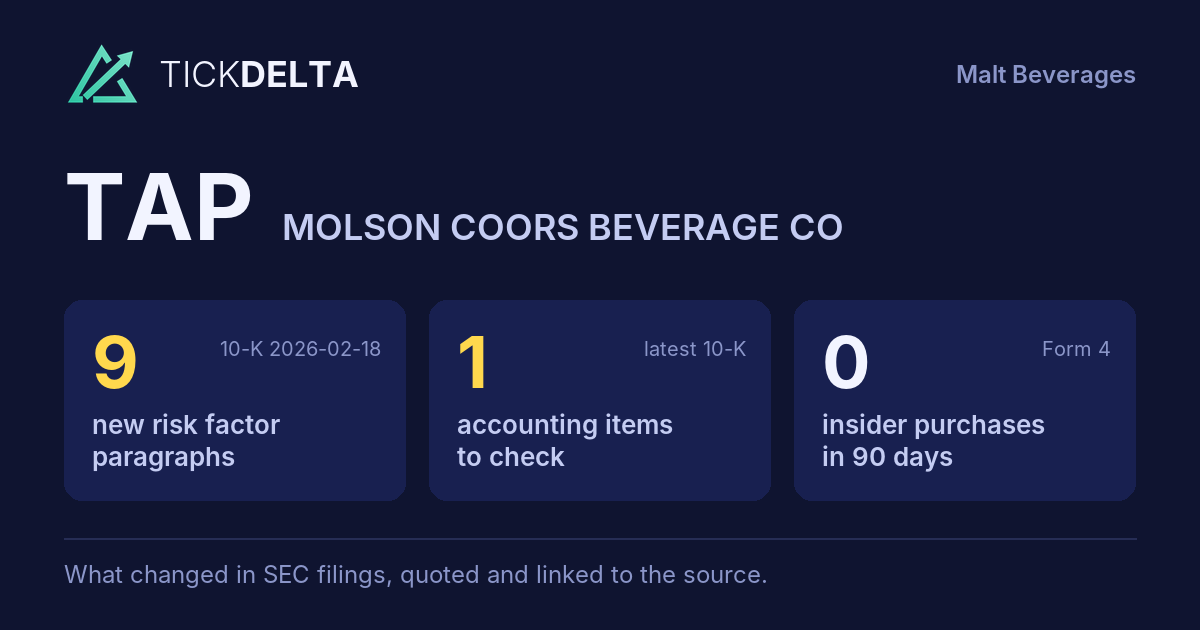
What the 10-K filed Feb 18, 2026 says off the balance sheet
10-K notesRisks that are not on the face of the balance sheet. Tickdelta picks sentences with specifics and quotes them as filed. New marks a sentence with nothing like it in the 10-K filed Feb 18, 2025.
Big customers
Customers the company names as a large share of revenue or receivables (it must name any worth 10% of revenue).
“No single customer accounted for more than 10% of our consolidated net sales for the years ended December 31, 2025, 2024 or 2023.”
10% in the 10-K filed 2026-02-18, 10% in the one filed 2025-02-18
Read it in the 10-K
Key suppliers
Parts or manufacturing that depend on one or a few suppliers.
“We rely on a small number of suppliers to obtain the input materials, in particular the packaging materials, we need to operate our business.”
Read it in the 10-K
“We purchase certain types of input and other packaging materials, including aluminum cans and bottles, glass bottles, paperboard and carbon dioxide from a small number of suppliers.”
Read it in the 10-K
Lawsuits and legal claims
Pending cases, settlements and what the company has set aside for them.
New “Net cash provided by operating activities of $1,784.4 million for the year ended December 31, 2025, decreased $125.9 million from $1,910.3 million for the year ended December 31, 2024, primarily due to lower net income adjusted for non-cash items, a $60.6 million payment as final resolution of the Keystone litigation case and higher interest paid, partially offset by lower payments for prior year annual incentive compensation and lower income taxes paid including the approximate $80 million impact from the passage of the OBBBA in the U.S. and the favorable timing of working capital.”
Read it in the 10-K
“In the instance of gain contingencies resulting from favorable litigation, due to the numerous uncertainties inherent in a legal proceeding, gain contingencies resulting from legal settlements are not recognized in income until cash or other forms of payment are received.”
Read it in the 10-K
“Related to litigation, other disputes and environmental issues, we had an aggregate accrued contingent liability of $41.6 million and $71.1 million as of December 31, 2025 and December 31, 2024, respectively.”
Read it in the 10-K
“The jury concluded that trademark infringement had occurred and awarded Stone Brewing Company $56.0 million in damages.”
Read it in the 10-K
“In 1990, we recorded a pretax charge of $30 million, a portion of which was put into a trust in 1993 as part of a settlement with Denver and Waste Management regarding the then-outstanding litigation.”
Read it in the 10-K
Guarantees and indemnities
Promises to pay someone else's debts or losses if they cannot.
“Standby letters of credit $ 45.2 $43.4 $1.6 $ $0.2”
Read it in the 10-K
“As a result, we have a guarantee liability of $11.2 million and $30.1 million recorded as of December 31, 2025 and December 31, 2024, respectively, which is presented within accounts payable and other current liabilities on the consolidated balance sheets and represents our proportionate share of the outstanding balance of these debt instruments.”
Read it in the 10-K
“As of December 31, 2025 and December 31, 2024, the consolidated balance sheets included liabilities related to these guarantees of $15.8 million and $34.2 million, respectively.”
Read it in the 10-K
Debt covenants
Conditions in loan agreements that, if broken, can make debt due early.
“These include customary events of default and specified representations, warranties and covenants, as well as covenants that restrict our ability to incur certain additional priority indebtedness (certain thresholds of secured consolidated net tangible assets), certain leverage threshold percentages, create or permit liens on assets and restrictions on mergers, acquisitions and certain types of sale lease-back transactions.”
Read it in the 10-K
“As of December 31, 2025 and December 31, 2024, we were in compliance with all of these restrictions and covenants, have met such financial ratios and have met all debt payment obligations.”
Read it in the 10-K
“These include customary events of default and specified representations, warranties and covenants, as well as covenants that restrict our ability to incur certain additional priority indebtedness (certain thresholds of secured consolidated net tangible assets), certain leverage threshold percentages, create or permit liens on assets, and restrictions on mergers, acquisitions and certain types of sale lease-back transactions.”
Read it in the 10-K
“As of December 31, 2025 and December 31, 2024, we were in compliance with all of these restrictions and covenants, have met such financial ratios, and have met all debt payment obligations.”
Read it in the 10-K
Commitments off the balance sheet
Contracts the company must pay for later: purchase obligations, take-or-pay deals.
No specific sentence about this in the 10-K.
Companies it names
Tracked companies that its latest 10-K or its 8-Ks of the last year call a customer or a supplier.
No other tracked company is named as a customer or a supplier in the latest filings.
Companies that name it
Tracked companies whose latest 10-K or 8-Ks call it a customer or a supplier.
No other tracked company names it as a customer or a supplier in the latest filings.
Sentences are chosen by their words, not read by AI, so some can be off topic. Always check the filing. Open the 10-K
Sources
The notes to the financial statements, Legal Proceedings and the MD&A of the latest 10-K (and, for customers and suppliers, Business and Risk Factors), quoted as filed.
Also
Debt: the debt note in numbers.
Work with it
Excel workbook · CSV. Google Sheet that stays up to date: paste =IMPORTDATA("https://tickdelta.com/company/TAP/export.csv") into a cell.