Added10-Q Nov 3, 2026 vs 10-K Feb 23, 2026
• maintain, protect, enforce and expand our intellectual property portfolio; and
Each branch is a paragraph in Risk Factors with nothing like it in the 10-K filed Feb 25, 2025. A box jumps to the paragraph as filed, below.
25 paragraphs in Risk Factors of the 10-K filed Feb 23, 2026 with nothing like them in the 10-K filed Feb 25, 2025. Quoted exactly. Paragraphs that were only edited are under 10-K change.
Our future financial performance and our ability to develop, manufacture and commercialize our product candidates will depend, in part, on our ability to effectively manage any future growth, and our management may also have to
Additionally, the U.S. government has made statements and taken certain actions including the imposition of tariffs, that have led to changes in U.S. and international trade policies towards China and other countries. It remains unclear what additional actions, if any, will be taken by the U.S. or other governments with respect to international trade agreements, the imposition of tariffs on goods imported into the United States, tax policy related to international commerce, or other trade matters or whether the imposition of tariffs will be upheld by courts or other governmental bodies. For example, on February 20, 2026, the U.S. Supreme Court struck down the international tariffs imposed by President Trump in 2025, but President Trump subsequently expressed his intent to reinstate the tariffs through other means, which he has not yet disclosed. We are closely monitoring changes and developments in international trade policy and assessing the potential impact of these and other trade policy changes on our business operations and financial performance. XDEMVY is currently being filled and finished by a reputable contract manufacturer in Europe, and we are in discussions to potentially add a second contract manufacturer domiciled in the U.S. If tariffs are imposed on any products we import, we believe the potential impact will be insignificant to our gross margins or other operating expenses.
Any unfavorable government policies on international trade, such as capital controls or tariffs, or any countermeasures imposed in response thereto, may negatively affect the demand and competitive position of our product or future products to the extent any of our product candidates are approved for commercial sale, negatively affect our costs, or negatively impact our supply chain, among other potential negative impacts. If any tariffs are reinstated, any new tariffs, legislation and/or regulations are implemented, or if existing trade agreements are renegotiated or, in particular, if the U.S.
government, or other governments take retaliatory trade actions due to the recent trade tensions, including U.S.-China trade tensions, such changes could have an adverse effect on our business, financial condition and results of operations.
We received approval by the FDA for XDEMVY for the treatment of Demodex blepharitis in the U.S. and began generating revenue from product sales during the third quarter of 2023. Our ability to become and remain profitable is heavily
•regulatory requirements and potential additional restrictions by the FDA or other regulatory authorities on direct-to-consumer advertising;
A further example of comprehensive and evolving regulatory requirements is data privacy regulations surrounding personal data and protected health information including the EU’s General Data Protection Regulation, or GDPR, which imposes strict requirements on controllers and processors of personal data, including special protections for “special category data,” which includes health, biometric and genetic information of data subjects located in the EEA and UK. Further, the GDPR provides a broad right for EEA Member States to create supplemental national laws, such as laws relating to the processing of health, genetic and biometric data, which could further limit our ability to use and share such data or could cause our costs to increase, and harm our business and financial condition. Furthermore, there are evolving European privacy laws on electronic marketing and cookies.
Actual events involving limited liquidity, defaults, non-performance or other adverse developments that affect financial institutions, transactional counterparties or other companies in the financial services industry or the financial services industry generally, or concerns or rumors about any events of these kinds or other similar risks, have in the past and may in the
equity securities to the stockholders of the acquired company, which would reduce the percentage ownership of our existing stockholders.
Our reliance on these third parties for such development activities will reduce our control over these activities but will not relieve us of our regulatory responsibilities. For example, we will remain responsible for ensuring that each of our clinical trials is conducted in accordance with the general investigational plan and protocols for the trial. Moreover, the FDA
materials to manufacture our products and product candidates, we may experience delays in our commercialization and development efforts, which would have an adverse effect on our business and results of operations.
delay commercialization efforts of XDEMVY or any future products, if approved, clinical development of product candidates or marketing approval of current or future product candidates.
Our owned and licensed patent estate includes patent applications, many of which are at an early stage of prosecution. The coverage claimed in a patent application can be significantly reduced before the patent is issued, and its scope
be diverted in pursuing these proceedings, which could have a material adverse effect on our business and operations. In addition, we may not have sufficient resources to bring these actions to a successful conclusion.
or the improper use of artificial intelligence or automated tools) of our trade secrets or proprietary information could enable competitors to duplicate or surpass our technological achievements, thus eroding our competitive position in our market.
The increasing use of AI technologies, including generative AI tools, by us, our employees, and third-party vendors may create additional risks to our trade secrets and proprietary information. AI tools may involve the processing, storage, or transmission of data in ways that are not fully transparent and, if used improperly or outside of approved controls, could result in the unintended disclosure, loss, or misuse of confidential or proprietary information. In addition, the use of AI by third parties with whom we share data or collaborate may increase the risk that our trade secrets or proprietary know-how are exposed, incorporated into training data, or otherwise used in ways that could impair our ability to protect or enforce our intellectual property rights.
As AI technologies continue to evolve and regulatory and legal standards governing their use remain unsettled, our ability to identify, prevent, or remedy AI-related misuse or misappropriation of our proprietary information may be limited, which could harm our business, financial condition, and competitive position.
The current presidential administration is also pursuing policies intended to, among other things, lower prescription drug prices and enhance drug price transparency. These actions, such as those directed by executive orders, may propose policy changes that create additional uncertainty for our business. For example, on April 15, 2025, the presidential administration released an executive order entitled, “Lower Drug Prices by Once Again Putting Americans First,” which among other things, included multiple directives to various agencies aimed at lowering prescription drug prices. Additionally, on September 30, 2025, the presidential administration announced the first agreement with a major pharmaceutical company that requires the drug manufacturer to offer, through a direct-to-consumer platform, U.S. patients and Medicaid programs prescription drug MFN pricing equal to or lower than those paid in other developed nations, with additional mandates for direct-to-patient discounts and repatriation of foreign revenues. Other recent actions and proposals include, for example, (1) rescinding a Biden administration executive order tasking the Center for Medicare and Medicaid Innovation to consider new payment and healthcare models to limit drug spending and eliminating the Biden administration’s executive order that directed the Department of Health and Human Services (“HHS”) to establishing an AI task force and developing a strategic plan; (2) directing HHS and other agencies to lower prescription drug costs for Medicare through a variety of initiatives, including by improving upon the Medicare Drug Price Negotiation Program and establishing MFN pricing for pharmaceutical products; and (3) directing certain federal agencies to enforce existing law regarding hospital and price plan price transparency and by standardizing prices across hospitals and health plans.
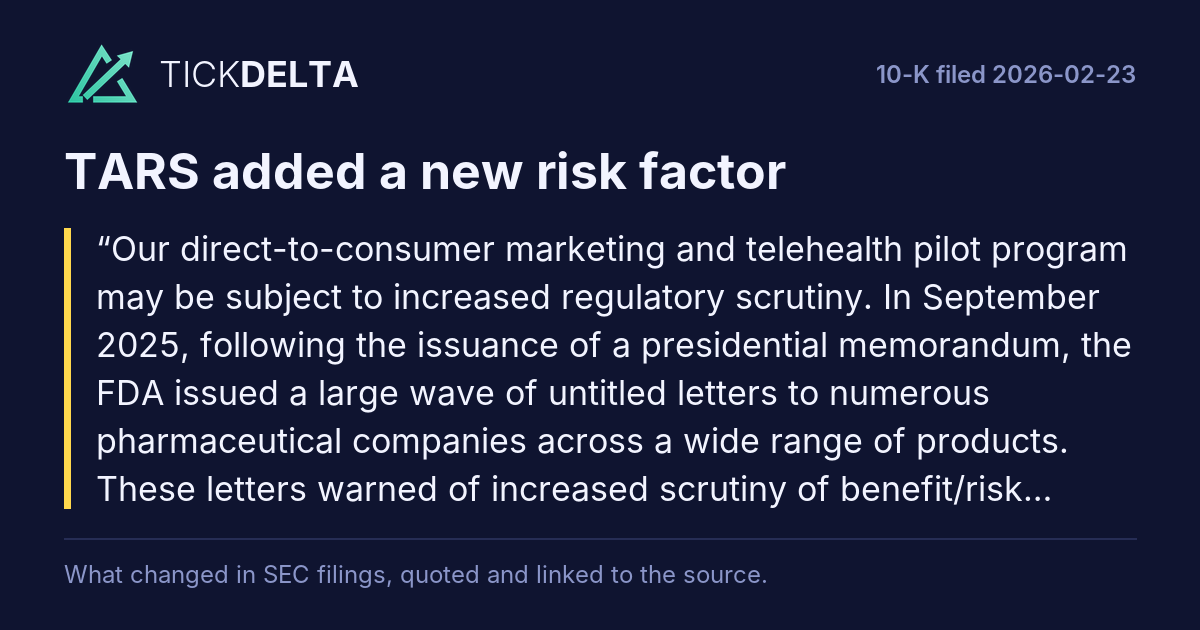
Our direct-to-consumer marketing and telehealth pilot program may be subject to increased regulatory scrutiny.
In September 2025, following the issuance of a presidential memorandum, the FDA issued a large wave of untitled letters to numerous pharmaceutical companies across a wide range of products. These letters warned of increased scrutiny of benefit/risk presentations and claims to promote compliance with “fair balance” guidelines in promotional materials, including DTC campaigns, and stated that the FDA intends to take aggressive action to ensure conformity with the law going forward. In addition, the FDA also issued a number of “cease-and-desist” letters to various companies, alleging false or misleading presentations and misbranding, and requiring rapid remedial action. While we have not received such a “cease-and-desist” letter, the increase in enforcement efforts by the FDA could lead us to modify, pause, or withdraw ads, and could delay campaigns, increase compliance costs, or adversely affect demand for our product.
The FDA has also specifically targeted DTC television advertisements. Recent enforcement actions against TV ads have cited misleading efficacy claims and presentations that fail to convey a truthful, non-misleading net impression, even where risk information is present. While we believe that our ads are compliant with the FDA’s requirements, if the FDA were to determine that any of our ads are misleading or unbalanced, we could receive untitled or warning letters and be required to cease dissemination of such ads, undertake corrective advertising, or face other penalties, any of which could harm our reputation and commercial performance.
In addition, our TV ads must comply with the FDA’s “clear, conspicuous, and neutral” (“CCN”) standards. The final rule was issued on November 21, 2023 and became effective on May 20, 2024, with compliance required as of November 20, 2024. The FDA’s Office of Prescription Drug Promotion (“OPDP”) reviews draft DTC TV ads for CCN compliance, and the agency has emphasized the industry’s obligation to bring ads into compliance. Failure to meet these standards, for example, by using distracting visuals and audio, overly technical wording, or insufficient prominence, could result in enforcement by the FDA, required changes to our ads, or campaign delays.
Furthermore, we have recently entered into agreements with third party telemedicine providers, pursuant to which our telemedicine providers may prescribe our product or other products in their medical discretion to potential customers via telehealth. Telemedicine faces particularly intense scrutiny from regulators due to numerous cases of companies failing to operate in this space with a properly functioning regulatory and compliance infrastructure and we cannot guarantee that we will be able to maintain relationships with telemedicine providers now or in the future.
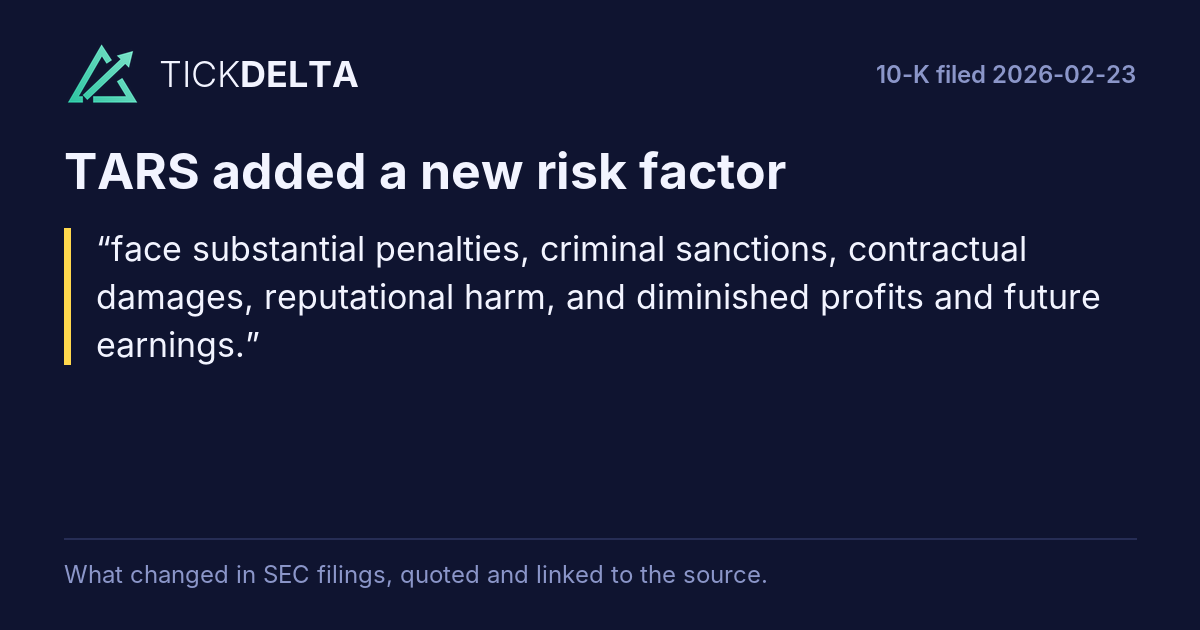
Regulatory expectations and enforcement priorities are evolving and may continue to evolve in the future. If our interpretation of applicable requirements differs from the FDA’s, or if guidance changes, we may incur additional review cycles, production costs, and operational burden (e.g., corrective messaging), and our commercialization plans and revenues could be adversely affected.
face substantial penalties, criminal sanctions, contractual damages, reputational harm, and diminished profits and future earnings.
New in the latest 10-Q
80 paragraphs in the 10-Q filed Nov 3, 2026 with nothing like them in the 10-Q filed Aug 6, 2026 (at least half the words must differ; new numbers alone do not count). Quoted exactly, grouped by the item heading above them. This is text that changed, not a judgement of how serious it is.
efforts, as we expect XDEMVY and each of our product candidates will continue to rely on single-source suppliers for the foreseeable future.
Read in the 10-Q
• We recently completed the acquisitions of iRenix and Alkeus and may pursue additional acquisitions or strategic partnerships in the future. We many not successfully integrate the acquired businesses and programs or realize their anticipated benefits, and these transactions have resulted in, and future transactions could result in, substantial contingent milestone and royalty payment obligations, dilution to our stockholders from shares issued as consideration or to satisfy milestone payments, reduced financial resources, the incurrence of debt or assumption of liabilities, and the diversion of management’s attention, any of which could disrupt our business and adversely affect our results of operations.
Read in the 10-Q
See accompanying notes to these unaudited condensed consolidated financial statements.
Read in the 10-Q
See accompanying notes to these unaudited condensed consolidated financial statements.
Read in the 10-Q
See accompanying notes to these unaudited condensed consolidated financial statements.
Read in the 10-Q
See accompanying notes to these unaudited condensed consolidated financial statements.
Read in the 10-Q
The accompanying Condensed Consolidated Financial Statements include the accounts of Tarsus Pharmaceuticals, Inc. and its wholly owned subsidiaries, consisting of iRenix and Alkeus. On July 6, 2026, a wholly owned subsidiary of the Company merged with and into iRenix, with iRenix surviving as a wholly owned subsidiary of the Company. iRenix is consolidated under the voting interest model, as it was determined not to be a variable interest entity (“VIE”) because it had sufficient equity at risk to finance its intended purpose/designed activities without additional subordinated financial support. On September 4, 2026, a wholly owned subsidiary of the Company merged with and into Alkeus, with Alkeus surviving as a wholly owned subsidiary of the Company. Alkeus is a VIE for which the Company is the primary beneficiary under ASC 810, Consolidation (“ASC 810”), because the Company has both the power to direct the activities that most significantly affect Alkeus’ economic performance and the obligation to absorb losses of, or the right to receive benefits from Alkeus that could
Read in the 10-Q
potentially be significant (see Note 8). The results of operations of iRenix and Alkeus are included from their respective acquisition dates. All significant intercompany transactions and balances have been eliminated. The Company operates its business in one operating segment consisting of one reporting unit.
Read in the 10-Q
the balance sheet date, are classified as current assets on the accompanying Condensed Consolidated Balance Sheets due to their highly liquid nature and availability for use in current operations.
Read in the 10-Q
The Company periodically evaluates whether a credit loss allowance should be recorded for available-for-sale debt securities in an unrealized loss position, which occurs when the fair value of a debt security declines below its amortized cost. The Company’s credit loss evaluation is based on objective evidence, including the underlying credit quality and credit ratings of the issuers, as well as subjective factors, including knowledge of recent events and assumptions of future events. If the Company intends to sell, or it is more likely than not that the Company will be required to sell, a debt security before recovery of its amortized cost basis, the amortized cost basis of the individual security is written down to fair value through earnings. Otherwise, declines in fair value attributable to credit losses are recorded through an allowance for credit losses, limited to the amount by which fair value is below amortized cost, with a corresponding charge to other income (expense), and declines attributable to non-credit-related factors are recorded in other comprehensive income (loss).
Read in the 10-Q
Revenues from product sales are recorded at the net sales price, or the transaction price, which may include fixed or variable consideration for (i) invoice discounts for prompt payment and distribution service fees, (ii) commercial and government rebates, chargebacks, discounts and fees, (iii) product returns and (iv) costs of co-pay assistance programs for
Read in the 10-Q
estimates, the Company may need to adjust accruals, which would affect product sales, net in the period of adjustment. An accrued liability is recorded for unpaid rebates related to product for which control has transferred to the customer.
Read in the 10-Q
Research and development costs are expensed as incurred or as certain upfront or milestone payments become contractually due to licensors upon the achievement of clinical or regulatory events. Research and development expenses
Read in the 10-Q
The Company evaluates acquisitions to determine whether they should be accounted for as business combinations or asset acquisitions, first applying the screen test to determine whether substantially all of the fair value of the gross assets acquired is concentrated in a single identifiable asset or group of similar identifiable assets then assessing the definition of a business under ASC 805, Business Combinations (“ASC 805”). When the acquired asset is not a business, the Company further evaluates whether the acquired entity is a VIE. For asset acquisitions of entities that are not VIEs, the cost of the acquisition, including direct transaction costs, is allocated to the assets acquired on a relative fair value basis, and contingent consideration is generally recognized when it is paid or becomes payable, unless it is a derivative or within the scope of ASC 480. For the initial consolidation of a VIE that is not a business, in accordance with ASC 810, Consolidation (“ASC 810”), the Company recognizes and measures the identifiable assets acquired and liabilities assumed at fair value using the measurement principles of ASC 805, does not recognize goodwill, measures the consideration transferred (including contingent consideration) at fair value, and recognizes a gain or loss for any difference between the net assets acquired and the consideration transferred as a loss on initial consolidation of a VIE within other income (expense), net, in the Condensed Consolidated Statements of Operations and Comprehensive Loss. Acquisition-related costs incurred by the Company in connection with the initial consolidation of a VIE are expensed as incurred. In either model, acquired IPR&D, and any acquired materials or inventory, that have no alternative future use are expensed upon acquisition as acquired in process research and development expense and research and development expense, respectively, in the Condensed Consolidated Statements of Operations and Comprehensive Loss.
Read in the 10-Q
In connection with an asset acquisition, the Company may be obligated to make future payments to the seller upon the achievement of specified development, regulatory or commercial milestones. The Company evaluates the terms of each such arrangement to determine the appropriate accounting model. Where the Company may settle the contingent consideration in cash or in a variable number of shares of its common stock at the Company’s election, the Company accounts for the arrangement as a liability in accordance with ASC 480.
Read in the 10-Q
Contingent consideration arising from the initial consolidation of a VIE that is not a business is recognized at its acquisition-date fair value as part of the consideration transferred and therefore is a component of the gain or loss on initial consolidation of the VIE. Contingent consideration classified as a liability within the scope of ASC 480 is remeasured to fair value at each reporting date, with changes recorded to change in fair value of contingent consideration in the Condensed Consolidated Statements of Operations and Comprehensive Loss. Contingent consideration that is payable solely in cash is classified as a liability but is not within the scope of ASC 480 or ASC 815, Derivatives and Hedging, and is not remeasured each reporting period. For milestone-based arrangements classified as contingent consideration, the liability is carried at its initially recognized amount until the milestone becomes payable, at which time the recognized liability is released and any amount payable in excess of the recognized liability is capitalized to the related intangible asset and amortized over its remaining useful life. For sales-based royalty arrangements, as royalties become due the recognized liability is released and royalty payments in excess of the recognized liability are recognized in cost of sales on the Condensed Consolidated Statements of Operations and Comprehensive Loss.
Read in the 10-Q
The fair value of the contingent consideration liability, including the valuation technique and the significant unobservable inputs used in its measurement, is described further in Note 3, Fair Value Measurements.
Read in the 10-Q
Stock awards that are classified as liabilities are initially measured at fair value and remeasured at fair value at each reporting date until settlement. For liability-classified awards subject to a performance condition that affects vesting, compensation cost is recognized when achievement of the performance condition is probable, based on the then-current fair value of the award and the requisite service rendered. Changes in fair value are recognized as compensation cost over the
Read in the 10-Q
requisite service period and, after the requisite service period has been completed, are recognized in the period of change until settlement. Compensation cost is attributed using the graded-vesting attribution method, as applicable.
Read in the 10-Q
The Company’s income tax returns are based on calculations and assumptions that are subject to examination by the Internal Revenue Service and other tax authorities. In addition, the calculation of the Company’s tax liabilities involves dealing with uncertainties in the application of complex tax regulations. The Company recognizes liabilities for uncertain tax
Read in the 10-Q
In September 2025, the FASB issued ASU No. 2025-07, Derivatives and Hedging (Topic 815) and Revenue from Contracts with Customers (Topic 606): Derivatives Scope Refinements and Scope Clarification for Share-Based Noncash
Read in the 10-Q
Consideration from a Customer in a Revenue Contract (“ASU 2025-07”). ASU 2025-07 expands the scope exception in Topic 815 to exclude from derivative accounting contracts, and embedded features within contracts, that are not traded on an exchange and that contain underlyings based on operations or activities specific to one of the parties to the contract. The standard also clarifies that share-based noncash consideration received from a customer in exchange for the transfer of goods or services is accounted for under Topic 606 until the Company’s right to receive or retain that consideration becomes unconditional, at which point the consideration is accounted for under other applicable guidance, including Topic 815 or Topic 321. ASU 2025-07 is effective for annual periods beginning after December 15, 2026, and interim periods within, with early adoption permitted prospectively or on a modified retrospective basis. The Company is currently assessing the impact this standard will have on its financial statements.
Read in the 10-Q
In connection with the Alkeus Acquisition (see Note 8), the Company recorded contingent consideration liabilities for future regulatory/commercial milestone payments and royalty payments. The contingent consideration liability related to the regulatory approval milestone is measured at fair value on a recurring basis and is classified within Level 3 of the fair value
Read in the 10-Q
hierarchy because its measurement relies on significant unobservable inputs, including the probability of achieving the regulatory milestone, the estimated timing of the related payment and the discount rate. The fair value is estimated with a probability-weighted model. The Company remeasures this liability at fair value as of each reporting period and records changes in fair value within change in fair value of contingent consideration in the Condensed Consolidated Statement of Operations and Comprehensive Loss.
Read in the 10-Q
Balance as of acquisition date (September 4, 2026) $49,280 Change in fair value (1,620) Balance as of September 30, 2026 $47,660
Read in the 10-Q
Quantitative information about the significant unobservable inputs used in the fair value measurement of the contingent consideration liability related to the regulatory approval milestone is presented in the following table as of September 30, 2026:
Read in the 10-Q
Probability-Weighted Discounted Cash Flow Discount rate 13.0% Estimated period to payment 4.7 years
Read in the 10-Q
The assumptions used to calculate the fair value of the regulatory approval milestones are subject to a significant amount of judgment. Fair value measurements are highly sensitive to changes in our probability assessment of regulatory approval and significant changes could result in a significantly higher or lower fair value and resulting expense or gain.
Read in the 10-Q
The acquisition-date fair values of the contingent consideration liabilities related to the first commercial sale milestone and the sales royalty earnout were $19.5 million and $18.5 million, respectively. The fair values were estimated using probability-weighted valuation models incorporating significant unobservable inputs. The valuation of the first commercial sale milestone incorporated the estimated probability and timing of the first commercial sale and a risk-adjusted discount rate. The valuation of the sales royalty earnout incorporated projected net sales, the probability of commercial success and a risk-adjusted discount rate. Because these liabilities are not remeasured after the acquisition date, they are excluded from the recurring fair value measurement disclosures above.
Read in the 10-Q
In September 2026, the Company capitalized a $ 10.0 million milestone achieved under the Eye and Derm Elanco Agreement based on annual net sales of XDEMVY (see Note 9).
Read in the 10-Q
In connection with the acquisition of Alkeus, the Company issued consideration in the form of cash and/or shares of the Company’s common stock to Alkeus employees in exchange for their partially vested equity awards issued for prior completed service. As these awards were not fully vested and did not contain a change in control provision requiring their settlement, the exchange was treated as compensatory awards separate from the acquisition. The awards consist of (i) an aggregate of $ 28.5 million, payable in cash and/or shares of the Company’s common stock, contingent upon the achievement of regulatory approval for gildeuretinol, (ii) an aggregate amount of cash equal to $ 11.4 million contingent upon the achievement of the first commercial sale, and (iii) cash payments based on a low-to-mid single digit tiered royalty payable based on the net sales of gildeuretinol subsequent to the first commercial sale. Because the awards are cash settleable, they are considered a liability under ASC 718, Compensation - Stock Compensation (“ASC 718”). The Company will recognize these liabilities for cash settleable awards at fair value when achievement of the regulatory milestone and first commercial sale become probable. Compensation expense, including changes in fair value, is attributed using the graded-vesting attribution method and is post-combination expense because the performance conditions were not probable as of the closing date of the acquisition.
Read in the 10-Q
The Company assesses the probability of vesting in the above performance awards each reporting period. As of September 30, 2026, the Company assessed all performance targets as not probable of being met as they are all subject to regulatory approval which has not occurred as of this date.
Read in the 10-Q
(1) Weighted-average shares outstanding includes pre-funded warrants issued on March 5, 2024 and August 7, 2026; it excludes shares contingently issuable upon achievement of the $ 250.0 million regulatory milestone (see Note 8).
Read in the 10-Q
(1) Other reconciling items primarily includes interest income, interest expense, gain on exchange of long-term investments, loss on initial consolidation of variable interest entity, and provision for income taxes.
Read in the 10-Q
The transaction was accounted for as an asset acquisition rather than a business combination, as substantially all of the value of the acquired assets was in the IPR&D asset, IRX-101. iRenix was not considered a variable interest entity as it had sufficient equity to finance the activities of the company’s purpose and design without additional subordinated financial support. Accordingly, the total acquisition cost of $ 78.2 million, including direct transaction costs, was allocated to the $ 81.3 million assets acquired and $ 3.1 million liabilities assumed based on their relative fair values. The IPR&D asset had no alternative future use and $ 81.0 million was expensed at closing to acquired in-process research and development expense and was recorded in the Condensed Consolidated Statements of Operations and Comprehensive Loss for the three and nine months ended September 30, 2026. Contingent milestone payments will be accounted for when they become payable. Milestones paid
Read in the 10-Q
after regulatory approval will be capitalized and amortized over the useful life of IRX-101. Royalties paid will be expensed to cost of sales.
Read in the 10-Q
On September 4, 2026, upon completion of the Alkeus Acquisition, the Company became the primary beneficiary of Alkeus and consolidated it as a VIE. Alkeus is a clinical-stage biopharmaceutical company whose purpose and design are principally to develop gildeuretinol (ALK-001), an investigational once-daily oral therapy for the potential treatment of Stargardt disease. Alkeus historically financed its activities through equity financings and following consolidation, Alkeus is financed through funding provided by the Company. Alkeus was determined to be a VIE due to its equity investment at risk not being sufficient to finance the activities for which it was designed without additional subordinated financial support.
Read in the 10-Q
The Company determined that it is the primary beneficiary of Alkeus because it has both (i) the power to direct the activities that most significantly affect Alkeus’ economic performance and (ii) the obligation to absorb losses of, and the right to receive benefits from, Alkeus that could potentially be significant. The activities that most significantly affect Alkeus’ economic performance include clinical-development strategy and execution, regulatory strategy, manufacturing and clinical-supply decisions, and funding and budget decisions. The Company has substantive rights to direct those activities through its governance rights. No other party has substantive kick-out, participating, or other rights that would prevent the Company from directing those activities. The Company’s ownership interest and exposure to Alkeus’ operating results and ALK-001 economics provide the obligation to absorb losses and the right to receive benefits that could potentially be significant.
Read in the 10-Q
The Company recognized the identifiable assets and liabilities of Alkeus using the recognition and measurement provisions specified by ASC 810, did not recognize goodwill, and recognized a $ 3.3 million loss on initial consolidation of a variable interest entity in the accompanying Condensed Consolidated Statement of Operations and Comprehensive Loss for the three and nine months ended September 30, 2026. The following table summarizes the fair value of consideration transferred for the Alkeus Acquisition:
Read in the 10-Q
Amounts Shares of common stock issued as consideration(1) 2,769,696 Price per share of common stock(2) $ 83.21 Fair value of stock consideration(3) $ 230,466 Cash consideration paid to selling shareholders(3) 238,202 Seller transaction costs paid by the Company 1,438 Deferred consideration — adjustment escrow(4) 5,000 Deferred consideration — option holder settlements(5) 14,853 Contingent consideration — regulatory approval milestone(6) 49,280 Contingent consideration — first commercial sales milestone(6) 19,529 Contingent consideration — sales royalty earnouts(6) 18,501 Total consideration transferred $ 577,269
Read in the 10-Q
(1) Represents the 2,908,692 shares of the Company’s common stock issued, less the 138,996 attributable to options accelerated in connection with the merger agreement for the Alkeus Acquisition that were recognized as compensation expense within research and development expense and selling, general and administrative expense in the accompanying Condensed Consolidated Statement of Operations and Comprehensive Loss, immediately following the closing.
Read in the 10-Q
(2) Represents the closing price per share of the Company’s common stock on September 3, 2026.
Read in the 10-Q
(3) The share consideration and cash consideration are presented net of approximately $ 11.5 million and $ 9.2 million, respectively, attributable to options accelerated in connection with the merger agreement for the Alkeus Acquisition that were recognized as compensation expense immediately following the closing.
Read in the 10-Q
(4) Represents a $ 5.0 million adjustment escrow funded upon closing with a third-party escrow agent to secure potential post-closing adjustments to the merger consideration.
Read in the 10-Q
(5) Represents amounts due to former option holders of Alkeus and settled subsequent to the closing.
Read in the 10-Q
(6) Contingent consideration is shown net of the 11.4 % of the total contingent consideration value that is allocable to the partially vested option holders who received a right to contingent consideration that is treated as a performance-based ASC 718 award in the post-combination period (see Note 3 and Note 5).
Read in the 10-Q
The following table summarizes the fair value of the assets acquired and liabilities assumed as of the closing on September 4, 2026 and the related loss on initial consolidation of the VIE:
Read in the 10-Q
Assets: Cash and cash equivalents $ 28,894 Prepaid expenses and other assets 2,190 Property and equipment, net 246 Operating lease right-of-use assets 612 Restricted cash, non-current 381 Acquired IPR&D 551,151 Acquired clinical inventory 3,045 Total assets acquired $ 586,519 Liabilities: Accounts payable $ 2,798 Accrued payroll and benefits 4,323 Other accrued liabilities 4,281 Other long-term liabilities 1,129 Total liabilities assumed 12,531 Net assets acquired 573,988 (Less): Consideration transferred (577,269) Loss on initial consolidation of VIE $ (3,281)
Read in the 10-Q
As the acquired ALK-001 IPR&D asset and acquired inventory have no alternative future use, their aggregate acquisition-date fair value of $ 554.2 million, consists of $ 551.2 million which was expensed to acquired IPR&D in the accompanying Condensed Consolidated Statements of Operations and Comprehensive Loss and $ 3.0 million of acquired clinical inventory which was expensed at closing.
Read in the 10-Q
The Company recognized approximately $ 87.3 million of contingent consideration liabilities at their estimated acquisition-date fair values, consisting of the regulatory approval milestone, first commercial sale milestone and sales royalty earnout arrangements. The potential payment of $ 250.0 million upon achievement of the regulatory approval milestone may be settled in cash and/or shares of the Company’s common stock in such proportions as the Company may determine in its sole discretion. Of the potential $ 250 million regulatory approval milestone payment, $ 221.5 million relates to contingent consideration associated with the initial consolidation of the VIE and is accounted for as a liability under ASC 480. The remaining $ 28.5 million is subject to the share-based compensation guidance under ASC 718 (see Note 5). The portion accounted for under ASC 480 had an acquisition-date fair value of $ 49.3 million and is subsequently measured at fair value at each reporting date, with changes recognized in the Condensed Consolidated Statements of Operations and Comprehensive Loss. The potential payment of $ 100.0 million upon achievement of the first commercial sale milestone is payable in cash and the sales royalty earnout milestones are payable in cash based on low-to-mid single digit tiered descending royalties on worldwide product sales, net during the royalty term. Consistent with the Company’s accounting policy for cash-settled contingent consideration, the liability is carried at its initially recognized amount and is not remeasured until the milestone becomes payable. Of the potential $ 100.0 million first commercial sale milestone payment, $ 88.6 million relates to contingent consideration associated with the initial consolidation of the VIE. Upon achievement of the first commercial sale milestone, payments in excess of the initial fair value as of the acquisition date to settle the contingent consideration will be capitalized as an intangible asset. The intangible asset will be amortized over its remaining useful life with amortization expense recognized within cost of sales in the Condensed Consolidated Statements of Operations and Comprehensive Loss, and tested for impairment under ASC 360, Long-lived Assets, as part of its asset group when impairment triggers exist. The remaining $ 11.4 million is subject to the share-based compensation guidance under ASC 718.
Read in the 10-Q
In connection with the Alkeus Acquisition, certain unvested Alkeus equity awards were accelerated. The portion of the cash and share consideration attributable to these accelerated awards totaled $ 20.7 million and was recognized as compensation expense immediately following the closing. The portion of contingent consideration attributable to these awards is accounted for as a performance-condition award under ASC 718, and will be recognized as compensation expense when the related performance conditions are considered probable (see Note 5). In addition, retention bonuses of $ 1.8 million payable to Alkeus employees will be recognized as compensation expense in the post-combination period.
Read in the 10-Q
Concurrent with the Alkeus Acquisition, in September 2026, the Company assumed the lease obligations for office and laboratory suites in Cambridge, Massachusetts (the “Cambridge Lease”). The Company will pay the landlord $ 0.6 million in base rent over the remaining lease term which ends on October 31, 2027.
Read in the 10-Q
We have also expanded our pipeline to include non-lotilaner-based product candidates, including IRX-101 for the potential use as an ocular antiseptic and ALK-001 for the potential treatment of Stargardt disease. IRX-101 and ALK-001 were acquired through the acquisitions of iRenix in July 2026 (the “iRenix Acquisition”) and Alkeus in September 2026 (the “Alkeus Acquisition”), respectively, as part of our expansion into retina.
Read in the 10-Q
In connection with the Alkeus Acquisition we acquired ALK-001, an investigational once-daily oral medicine with a differentiated approach designed to reduce toxic Vitamin A dimer formation in the retina, targeting the underlying biology of Stargardt disease. Stargardt disease is an inherited retinal disease affecting more than 36,000 diagnosed patients and an estimated 86,000 total patients in the U.S., which can lead to blindness. The Alkeus Acquisition added an ongoing Phase 3 clinical program (the “Northstar Trial”), evaluating ALK-001 for the potential treatment of Stargardt disease with enrollment continuing to progress and topline results expected in 2029.
Read in the 10-Q
In October 2026 we appointed Neera Clase, formerly Interim Chief Commercial Officer, as Chief Commercial Officer. Ms. Clase has been instrumental in creating a new market for XDEMVY, building our commercial team, and securing
Read in the 10-Q
broad coverage for patients. Her extensive knowledge of the business and established leadership across the organization position her well to lead commercial execution.
Read in the 10-Q
◦ Launch-to-date, more than one million bottles of XDEMVY have been dispensed and cumulative net product sales have surpassed $1.0 billion, as the first and only FDA-approved treatment for Demodex blepharitis reaches more patients.
Read in the 10-Q
◦ The average number of Eye Care Professionals (“ECPs”) prescribing XDEMVY at least daily increased approximately 20% from the beginning to the end of the third quarter of 2026, amidst a seasonally softer quarter in prescription eye care.
Read in the 10-Q
◦ Direct-to-consumer (“DTC”) initiatives drove a 75% increase in high-value actions and we saw a higher prescription conversion than last year.
Read in the 10-Q
◦ Retreatment continued to become a more established part of care, with refills accounting for approximately 20% of XDEMVY prescriptions in the third quarter of 2026.
Read in the 10-Q
• Presented eleven scientific abstracts at the American Academy of Optometry, adding to the real-world evidence for XDEMVY and understanding of Demodex blepharitis. Key findings included:
Read in the 10-Q
◦ Retreatment experience: Among ECPs with retreatment experience, 98% were satisfied with XDEMVY’s efficacy and tolerability.
Read in the 10-Q
◦ Disease recognition: Demodex blepharitis was found in 65% of patients presenting with chalazia or hordeola, rising to 91% among those with recurrent cases, reinforcing the importance of checking for Demodex blepharitis in routine eye care.
Read in the 10-Q
◦ Longer-term outcomes: In an ongoing real-world observational study, 73% of XDEMVY-treated patients reported improvement in itchy eyelids, a key symptom of Demodex blepharitis, at nine months, compared with 29% of patients receiving non-lotilaner options.
Read in the 10-Q
During the third quarter of 2026, we decided to defer regulatory filings for TP-03 for the treatment of Demodex blepharitis in Europe and Japan in light of the current implications of the most-favored-nation regulations.
Read in the 10-Q
materially breach such agreement, including by making insufficient onshoring progress, the U.S. Department of Commerce may terminate the agreement and any tariff rate reductions we have been granted.
Read in the 10-Q
Acquired in-process research and development expense (“IPR&D”) was $632.2 million for the three months ended September 30, 2026, consisting of $81.0 million related to the iRenix Acquisition and $551.2 million representing the acquisition-date fair value of the gildeuretinol IPR&D acquired in the Alkeus Acquisition, which was expensed because it has no alternative future use. There was no acquired IPR&D expense in the prior-year periods.
Read in the 10-Q
The $1.6 million decrease in fair value of the contingent consideration related to the Alkeus regulatory milestone was primarily driven by a one percentage point increase in the discount rate between the closing date and September 30, 2026.
Read in the 10-Q
Acquired IPR&D was $632.2 million for the nine months ended September 30, 2026, consisting of $81.0 million related to the iRenix Acquisition and $551.2 million representing the acquisition-date fair value of the gildeuretinol IPR&D
Read in the 10-Q
acquired in the Alkeus Acquisition, which was expensed because it has no alternative future use. There was no acquired IPR&D expense in the prior-year periods.
Read in the 10-Q
Selling, general and administrative expenses increased by $158.5 million for the nine months ended September 30, 2026, as compared to the prior year period. Of this increase, $29.8 million was attributable to the Alkeus Acquisition, consisting of $6.1 million of payroll and personnel-related costs (including $5.7 million of stock-based compensation expenses related to the accelerated vesting of acquired Alkeus equity awards), $23.5 million of transaction-related and integration costs, and $0.2 million of professional services.
Read in the 10-Q
The $1.6 million decrease in fair value of the contingent consideration related to the Alkeus regulatory milestone was primarily driven by a one percentage point increase in the discount rate between the closing date and September 30, 2026.
Read in the 10-Q
may be required to raise additional capital earlier than we currently expect based on our cash requirements and market dynamics.
Read in the 10-Q
policy changes on our business operations and financial performance and these or other trade policy changes could significantly increase our cost of goods, disrupt supply chains, or adversely affect our gross margins.
Read in the 10-Q
substantial expenses as a result of the limited nature of our disaster recovery and business continuity plans, which, particularly when taken together with our lack of earthquake insurance, could have a material adverse effect on our business.
Read in the 10-Q
In addition, we have incurred, and may in the future incur, substantial contingent payment obligations in connection with acquisitions. In connection with the iRenix Acquisition and the Alkeus Acquisition, we agreed to make significant milestone payments upon the achievement of specified regulatory and commercial milestones, as well as tiered royalties on net sales of the acquired product candidates, as further described in Note 8 to our accompanying Condensed Consolidated Financial Statements. If these milestones are achieved, the related payments would require substantial cash, which would reduce our financial resources and could require us to raise additional capital or incur debt.
Read in the 10-Q
In addition, we have licensed certain intellectual property rights for the development and potential commercialization of our other product candidates, including IRX-101 and ALK-001, from other third parties. If we materially breach or fail to perform any provision under these license agreements, including failure to make payments to a licensor when due for royalties or milestones and/or fail to use commercially reasonable efforts to develop and commercialize the licensed product candidates, such licensors may have the right to terminate our license agreement. If, for any reason, one or more of our agreements with such third parties is terminated or we otherwise loses those rights, it could harm our business.
Read in the 10-Q
Pursuant to Item 601(b)(2) of Regulation S-K, certain confidential portions of this exhibit have been omitted by means of marking such portions with asterisks as the identified confidential portions (i) are not material and (ii) is information of the type that the Company treats as private or confidential.
Read in the 10-Q
Pursuant to Item 601(a)(5) of Regulation S-K, certain exhibits and schedules have been omitted. The Company hereby undertakes to furnish supplementally a copy of any omitted exhibit or schedule upon request by the SEC.
Read in the 10-Q
Pursuant to Item 601(b)(10) of Regulation S-K, certain confidential portions of this exhibit have been omitted by means of marking such portions with asterisks as the identified confidential portions (i) are not material and (ii) is information of the type that the Company treats as private or confidential.
Read in the 10-Q
Item 1A of the 10-Q filed Nov 3, 2026 against Item 1A of the 10-K filed Feb 23, 2026.
A 10-Q repeats only the risks that changed, so a 10-K paragraph that is missing from it is not counted as removed.
Added is a paragraph with nothing like it in the 10-K, Reworded a sentence that is in both with several words changed,
Quiet changes a sentence in both where one to four words changed and one is a hedge or a modal
(cut words struck through, new words highlighted).
Text on the page, not a score; each links to the filing at sec.gov.
The first 26 of 77 are shown (at most 12 of each type).
Two-word phrases in Risk Factors of the 10-K filed Feb 23, 2026 that are in none of the 1 earlier 10-Ks stored, back to Feb 25, 2025
Used at least twice, small words left out. Counted, not picked: a phrase can be new because the company renamed something.
8 paragraphs of last year's Risk Factors with nothing like them now. The longest are quoted.
Item 1A of each 10-K and 10-Q on EDGAR, quoted exactly. Each paragraph links to the filing at sec.gov.
10-K change: what was reworded or cut, section by section.
Excel workbook · CSV. Google Sheet that stays up to date: paste =IMPORTDATA("https://tickdelta.com/company/TARS/export.csv") into a cell.