Screener / SEC EDGAR /CIK 0001819790 /10-K filed Feb 23, 2026, compared with Feb 25, 2025 /Numbers from the XBRL of the 10-Ks
Nasdaq Health care · Biotechnology

Tarsus Pharmaceuticals, Inc. TARS

Compare with peers Embed
SEC comment letters, last 20 years

2 reviews of TARS's filings by SEC staff

UPLOAD and CORRESP
Reviews 2 latest letter Mar 30, 2023
Questions asked 44 each answered in the company's own letter
No closing letter 1 reviews without a letter saying the staff completed it

When the SEC's staff reviews a filing, it writes to the company with numbered questions, and the company answers each one in a letter. SEC publishes the exchange once the review is over, at least 20 business days later. A question is not an accusation; most reviews end with the company adding detail to its next filing.

How the reviews went

Every review on EDGAR, from the first staff letter to the letter that closes it

  1. 1. Staff letters 4 UPLOAD
  2. 2. Questions in them 44 numbered comments
  3. 3. Company replies 6 CORRESP
  4. 4. Reviews closed 1 of 2 closing letter

Half the closed reviews took 19 days or less from the first letter to the closing letter.

Form 10-K for the Fiscal Year Ended December 31, 2022

2023-03-30 to 2023-04-18 · 2 questions · 1 letter from the SEC, 1 from the company
Review closed 2023-04-18
Results discussion (MD&A)RevenueChina
Components of our Results of Operations · Research and Development Expenses, page 93
SEC asked (1)
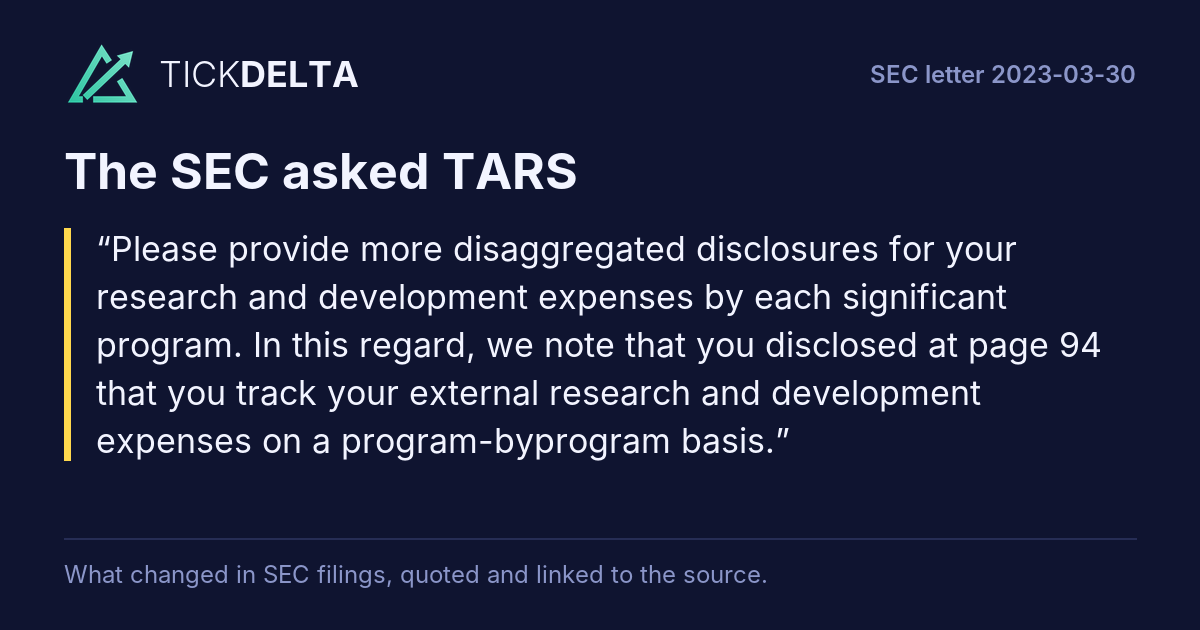
Please provide more disaggregated disclosures for your research and development expenses by each significant program. In this regard, we note that you disclosed at page 94 that you track your external research and development expenses on a program-byprogram basis.
TARS answered
The

Company respectfully acknowledges the Staff’s comment and confirms that it will provide disaggregated disclosure for significant external research and development costs by program in its future annual and quarter filings under the Securities

Exchange Act of 1934, as amended, beginning with the Company’s upcoming filing on Form 10-Q for the quarter ended March 31, 2023.
Read in the reply
In its next report

First report after the company's reply of Apr 13, 2023: 10-Q filed May 9, 2023 ↗, against the 10-Q filed Nov 9, 2022 ↗.

Tickdelta does not hold the text of both reports, so they are not compared here.
Financial Statements · Note 9. Out-License Agreement, page 126
SEC asked (2)
Please address the following comments with regard to your accounting and disclosures for your Out-License of TP-03 Commercial Rights in Greater China with LianBio Ophthalmology Limited. • Describe all material terms of the agreement, including the material rights and obligations of each party.
Rest of the question

• Provide us an analysis of your revenue recognition under ASC 606, including your determination of the performance obligations, the transaction price, the amount allocated to each performance obligation, and your revenue recognition method (i.e. over time or point in time) for each performance obligation. • Tell us who is responsible for the achievement of additional TP-03 events discussed on page 22 which may result in additional consideration and clarify that the additional consideration is not included in the transaction price, if such is the case. Confirm that you have no further performance obligations including any clinical work with respect to either TP-03 for the treatment of Demodex blepharitis or MGD. • Tell us if the license was determined to be distinct and your basis for it. • Clarify how you are accounting for the drug supply agreement discussed on page 93 and provide references within ASC 606 to support your accounting treatment. • Lastly, clarify what is included in the line item "collaboration revenue" in your statement of operations. Please provide us your proposed future disclosures, as necessary.

TARS answered
•

Describe all material terms of the agreement, including the material rights and obligations of each party.

On March 26, 2021, the Company entered into a development and license agreement (the “LianBio

Agreement”) with LianBio Ophthalmology Limited (“LianBio”), pursuant to which, the Company licensed the product rights for the development and commercialization of TP-03 (lotilaner ophthalmic solution, 0.25%) in the People’s Republic of China, Hong Kong, Macau, and Taiwan (the “Territory”) for the treatment of Demodex blepharitis and Meibomian Gland Disease (“MGD”).
Rest of the answer

Under the terms of the LianBio

Agreement, the Company is entitled to (i) aggregate upfront payments of $25.0 million by June 2021, (ii) development and commercial milestone payments of up to an aggregate of $75.0 million and $100.0 million, respectively,

(iii) tiered low-to-high teen royalties on the sale of TP-03 in the Territory; and an equity warrant exercisable for the purchase of LianBio ordinary shares, the receipt of which are discussed below, as applicable.

The LianBio Agreement established a

Joint Steering Committee with an equal number of representatives from the Company and LianBio to serve as a forum for communication with regards to (a) the overall state of the alliance; (b) progress of the Company and LianBio’s development and commercialization activities; (c) the Territory-specific development plan; and (d) clinical trials for Demodex blepharitis or MGD that support development or regulatory approval of any compound or licensed product inside or outside the Territory (this excludes Saturn-1 and Saturn-2 trials, as described further below).

CONFIDENTIAL TREATMENT

REQUESTED

BY TARSUS PHARMACEUTICALS, INC.

Pursuant to the terms of the LianBio Agreement, LianBio may extend the Phase 3 Milestone by an additional 12 months by paying the Company $[***] creditable against the amount payable for a specified development milestone payment, if such development milestone payment becomes due. LianBio may also extend the regulatory approval milestone by an additional 12 months by paying the Company $[***], creditable against the amount payable for a specified development milestone payment, if such development milestone payment becomes due.

The Company’s responsibility pursuant to the LianBio Agreement included completion of clinical study data for TP-03 Phase 2b/3 (Saturn-1) and Phase 3 (Saturn-2) trials. At any point during the clinical trial activity through completion, LianBio is able to request and access the clinical trial data. Pursuant to the LianBio Agreement, LianBio is contractually responsible for all clinical development and commercialization activities and costs incurred within the Territory.

Under the terms of the LianBio Agreement, the specific development and commercial milestone events and related payments are as follows:

Milestone Event

Payment

Amount

(000’s)

Development Milestones:

(i)

[***]

$

[***

]

(ii)

(iii)

(iv)

(v)

(vi)

Total Development Milestones

75,000

Commercial Milestones:

Total Commercial Milestones

100,000

Total Milestones

175,000

The warrant to purchase ordinary shares of LianBio represents a minority interest in LianBio upon issuance, which vests upon the achievement of certain development and regulatory milestones. The warrant will be exercisable at the fair market value at the time of issuance. The warrant shall vest and be exercisable upon achievement of the following milestones: [***].

The LianBio Agreement includes conditions for supply agreements (collectively, the “Drug Supply

Agreement”) to be negotiated in good faith and executed between the Company and LianBio. The Company will supply Licensed Product, as defined in the LianBio Agreement, (the “Licensed Product”), to LianBio for development and commercialization purposes in the Territory, in accordance with separate written agreements, one for supply in clinical trials (“Clinical Supply Agreement”) and another for commercialization (“Commercial Supply Agreement”).

In December 2021, the Company and LianBio entered into a binding term sheet outlining the principal terms and conditions and basis to negotiate the Drug Supply Agreement. The binding term sheet specified that the Company would be paid one-time payments of $[***] upon execution of the respective

Clinical Supply Agreement and Commercial Supply Agreement aggregating to a total of up to $[***].

Provide us an analysis of your revenue recognition under ASC 606, including your determination of the performance obligations, the transaction price, the amount allocated to each performance obligation, and your revenue recognition method (i.e. over time or point in time) for each performance obligation.

The Company evaluated and concluded that the arrangement reflected a transaction with a customer. The Company is receiving consideration in exchange for delivering an out-license, in addition to access to clinical trial research and development activities and results. These activities fall within the scope and accounting of ASC 606 contracts with customers. The following summarized the Company’s analysis of revenue recognition under ASC 606:

Determination of the performance obligations

In accordance with

ASC 606-10-25-14 the Company identified the following performance obligations in the arrangement at contract inception:

(1) an exclusive license to research, develop, manufacture, commercialize, make, offer for sale, sell and import the licensed products in the Territory; and (2) research and development services in the form of completed clinical study materials for the respective Saturn-1 and Saturn-2 trials. The promises to provide research and development services for Saturn-1 and Saturn-2 clinical trials were evaluated and determined to be distinct promises in the contract and each of the two clinical trials are separate performance obligations apart from the promise to provide the license.

The Company also considered whether the Joint Steering Committee represented a distinct performance obligation and determined that it was formed only as a governance activity to provide the Company protectionary rights that was not meant to be a separate service that would provide benefit to the customer. The Company further evaluated that the Joint Steering Committee is not material to the overall promises in the agreement.

Transaction Price

The transaction price includes nonrefundable upfront payments, development milestones, commercialization milestones, equity warrants, and royalties.

Under ASC 606-10-32-8, the Company used the most likely amount method to determine the transaction price for development milestones. The Company evaluated at contract inception whether the achievement of the development milestones were within the control of the Company. Based on this evaluation, the Company included the $10.0 million milestone amount in the transaction price related to milestones within the control of the Company. Given the high degree of inherent uncertainty around the occurrence of the remaining contingent development milestones, the Company determined these milestone amounts were outside of the control of the Company and milestone receipts were at-risk at contract inception. Therefore, the Company constrained the consideration associated with these milestones until resolution of the uncertainty associated with these payments. As the variability around the development milestones are resolved, the Company allocated the consideration to each of the performance obligations, as discussed further below. Subsequent to execution of the LianBio Agreement, the Company met certain development milestone performance obligations and at that time adjusted the transaction price and amount allocated to each of the performance obligations in accordance with ASC 606-10-32-43 at each reporting period.

The Company applied the accounting in ASC 606-10-55-65 to account for the commercial milestones and royalties. The Company evaluated that the license is the predominant promise in the contract as it is the provision that allows LianBio to generate future revenues. Therefore, under the sales-or-usage-based royalty exception, the Company recognizes revenue based on the contractual percentage of LianBio’s sale of products to its customers at the later of (i) the occurrence of the related product sales or (ii) the date upon which the performance obligation to which some or all of the royalty has been allocated has been satisfied or partially satisfied. There have been no TP-03 product sales in the Territory and therefore, the commercial milestone and royalty amounts were not included in the transaction price at contract inception.

The warrant to purchase ordinary shares of LianBio represented noncash consideration under ASC 606. In accordance with ASC 606-10-32-21 through 32-24, the

Company included the estimated fair value of the warrants in the transaction price at contract inception.

Allocation of the

Transaction Price to each Performance Obligation

In accordance with ASC 606-10-32-29, to meet the allocation objective, an entity shall allocate the transaction price to each performance obligation identified in the contract on a relative standalone selling price basis in accordance with paragraphs 606-10-32-31 through

32-35, except as specified in paragraphs 606-10-32-36 through 32-38 (for allocating discounts) and paragraphs 606-10-32-39 through 32-41 (for allocating consideration that includes variable amounts).

In order to estimate the standalone selling price for license performance obligation, the Company considered ASC 606-10-32-34 and utilized an adjusted market assessment approach. The Company determined the standalone selling price by using a discounted projected sales model that included estimated product sales attributable to the license and discounted the sales using a present value factor. The Company believes this approach approximates the standalone selling price of the license as it represents the present value of all expected benefit for LianBio, its customer.

In order to estimate the standalone selling price for the respective research and development service performance obligations for Saturn-1 and Saturn-2, the Company considered ASC

606-10-32-34 and utilized the adjusted market assessment approach. The Company analyzed costs expected to be incurred for each of the clinical trials through completion to estimate the price that a customer would be willing to pay for these services in order to benefit from the clinical trials.

Based on the Company’s application of ASC 606, the Company determined that the amount of the transaction price allocated to each performance obligation is as follows:

Performance Obligation

Allocated

(i) License for exclusive development and commercialization of TP-03 in the Territory for the treatment of Demodex blepharitis and MGD

$[***

(ii) Research and development services related to Saturn-1, including delivery of the clinical trial results

(iii) Research and development services related to Saturn-2, including delivery of the clinical trial results

Total

36,233

Revenue Recognition Method

In accordance with ASC

606-10-55-62 through 55-63, the Company determined that the license provides the right to use intellectual property as it exists at the point in time at which the license is granted as the license was sufficiently developed for LianBio to benefit from it. Therefore, the amount initially allocated to the license performance obligation was recognized as revenue at contract inception, upon delivery of the license.

In accordance with ASC 606-10-25-27, the Company determined that LianBio simultaneously benefits from the research and development services that are satisfied over time, as they are able to request and access the clinical trial data at any point through the trial completion. Therefore, the Company recognized the amounts allocated to the respective research and development performance obligations for

Saturn-1 and Saturn-2 over the expected period of time that each clinical trial is ongoing, based on an input method as the related costs are incurred. The Company monitored the expected completion dates for each clinical trial and updated its estimated time to completion at each reporting period, as necessary.

Tell us who is responsible for the achievement of additional TP-03 events discussed on page 22 which may result in additional consideration and clarify that the additional consideration is not included in the transaction price, if such is the case.Confirm that you have no further performance obligations including any clinical work with respect to either TP-03 for the treatment of Demodex blepharitis or MGD.

The Company disclosed in its Form 10-K on page 22 that “We will be eligible to receive further consideration from LianBio upon the achievement of additional TP-03 events, including: (i) additional development milestone payments of up to an aggregate of $25.0 million (includes $2.5 million for a milestone triggered in February 2023), (ii) China-based TP-03 sales threshold milestone payments of up to an aggregate of $100.0 million,

(iii) tiered low-to-high-teen royalties for the Territory TP-03 product sales, and (iv) vesting of a LianBio equity warrant upon certain regulatory milestones.”

LianBio is responsible for the achievement of remaining development milestones, as well as the commercial milestones, Territory TP-03 product sale thresholds, and regulatory milestones. The additional consideration for these milestone events is not included in the transaction price at contract inception.

Apart from the promises in separately executed Clinical Supply Agreement in February 2023 and the Commercial Supply Agreement that is to be executed, as discussed below, the Company has no further performance obligations pursuant to the LianBio Agreement, including any clinical work with respect to TP-03 for the treatment of Demodex blepharitis. The Company is in control of the initiation and completion of any MGD clinical trial activities, and therefore, assessed that this is not a performance obligation in the LianBio Agreement. The Company will, however, deliver clinical data to LianBio if it completes a pivotal trial for MGD.

Pursuant to the LianBio Agreement, the Company and LianBio shall negotiate in good faith and enter into a Commercial Supply Agreement by which LianBio will source from the Company, and the Company will supply LianBio, the Licensed Product. The Company and LianBio are responsible for executing the mutually satisfactory

Commercial Supply Agreement. The additional consideration for this achievement is not included in the transaction price at contract inception.

Tell us if the license was determined to be distinct and your basis for it.

The Company determined that the license is distinct from other promises in the arrangement. The Company assessed the LianBio Agreement in accordance with ASC 606-10-25-14 and ASC 606-10-25-19 and identified the following to be considered: (1) an exclusive license to research, develop, manufacture, commercialize, make, offer for sale, sell and import the licensed products in the Territory; and (2) research and development services in the form of completed clinical study materials for the respective Saturn-1 and Saturn-2 trials.

The Saturn-1 and

Saturn-2 trials were initiated to evaluate the safety and efficacy of the Licensed Product. The Company believes the nature of the research and development services, explicitly promised in the arrangement, indicate that the license is distinct within the context of the contract. In assessing that the license is capable of being distinct from other promises, the Company considered that LianBio has the research and development capabilities to benefit from the functional intellectual property given their robust pipeline of product candidates in therapeutic areas and the availability of the associated expertise in the general marketplace. In addition, the Company considered whether LianBio can benefit from a promise for its intended purpose without the receipt of the remaining promise, whether the value of the promise is dependent on the unsatisfied promise, whether there are other vendors that could provide the remaining promise, and whether it is separately identifiable from the remaining promise.

Clarify how you are accounting for the drug supply agreement discussed on page 93 and provide references within ASC 606 to support your accounting treatment.

The Drug Supply Agreement on page 93 refers to the binding term sheet entered into in December 2021, as referred to above in the description of the material terms of the LianBio Agreement. The binding term sheet provides the basis to negotiate definitive agreements in good faith. As of December 31,

2022, no Clinical Supply Agreement or Commercial Supply Agreement had been executed. In accordance with ASC 606-10-25-2, the binding term sheet did not create an enforceable right beyond negotiating specific terms in definitive agreements.

In accordance with ASC 606-10-32-8, the Company utilized the most likely amount method to estimate the amount of consideration to which it will be entitled.

Given the high degree of uncertainty around the occurrence of these events, the Company determined the amounts to be constrained at contract inception and until the uncertainty associated with these payments is resolved. [***].

Lastly, clarify what is included in the line item “collaboration revenue” in your statement of operations.

Collaboration revenue in the statement of operations and comprehensive loss consists of the revenue recognized for research and development services performed pursuant to the LianBio Agreement. Specifically, this line item includes the proportion of allocated transaction price recognized over time, as the

TP-03 Saturn-1 and Saturn-2 clinical trials are completed, and the associated clinical data and reports are delivered to LianBio.

License revenue recognized from the LianBio Agreement was disclosed in the license fees line in the statement of operations and comprehensive loss.

The Company respectfully acknowledges the Staff’s comment and in response, advises the Staff that it will supplement its existing disclosures included in the notes to the financial statements to provide additional detail regarding its revenue recognition and related accounting policies for out-license arrangements. For the convenience of the Staff, we attach the relevant paragraphs from our footnotes as Appendix A.

Read in the reply
In its next report

First report after the company's reply of Apr 13, 2023: 10-Q filed May 9, 2023 ↗, against the 10-Q filed Nov 9, 2022 ↗.

Tickdelta does not hold the text of both reports, so they are not compared here.

Also in this review: closing letter, 2023-04-18
Form S-1

2020-09-03 to 2020-10-13 · 42 questions · 3 letters from the SEC, 5 from the company
No closing letter
Risk factorsCritical estimates
Draft Registration Statement on Form S-1, submitted August 7, 2020 · Cover Page
SEC asked (1)
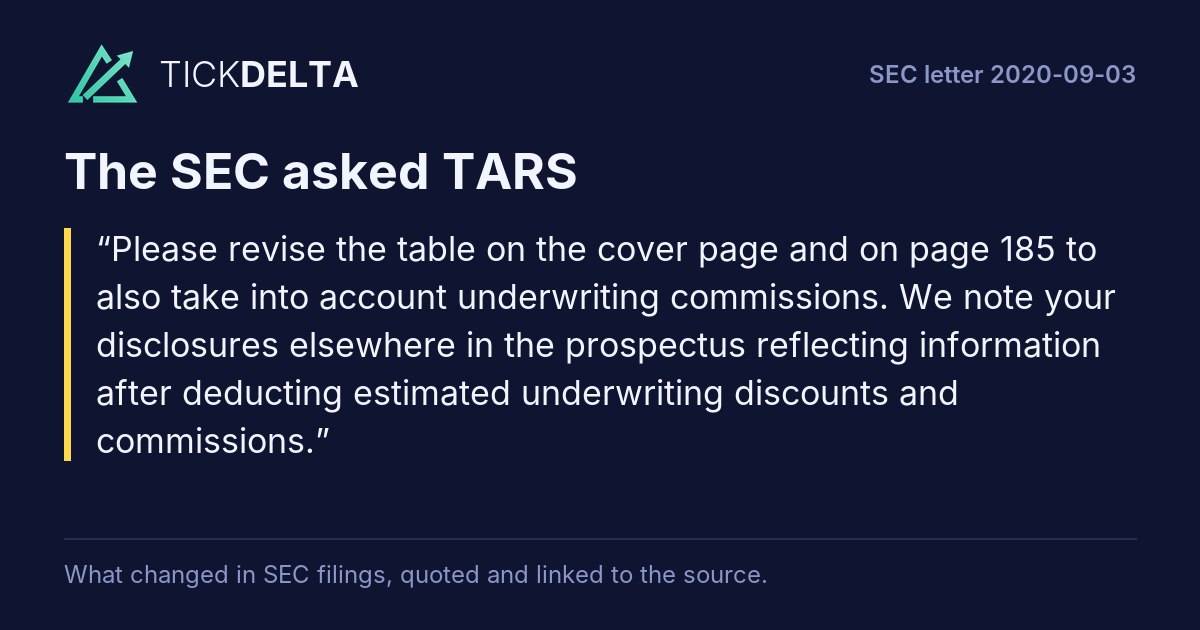
Please revise the table on the cover page and on page 185 to also take into account underwriting commissions. We note your disclosures elsewhere in the prospectus reflecting information after deducting estimated underwriting discounts and commissions.
TARS answered

No numbered answer found in the reply. Read the reply ↗

Prospectus Summary · Overview, page 1
SEC asked (2)
We note your references to your product candidates as "first-in-class" on page 1 and throughout the registration statement. This term suggests that the product candidates are effective and likely to be approved. Please delete these references throughout your registration statement.
Rest of the question

If your use of these terms was intended to convey your belief that the products are based on a novel technology or approach and/or is further along in the development process, you may discuss how your technology differs from technology used by competitors and, if applicable, that you are not aware of competing products that are further along in the development process. Statements such as these should be accompanied by cautionary language that the statements are not intended to give any indication that the product candidates have been proven effective or that they will receive regulatory approval. Additionally, with respect to TP-03, there are existing FDA approved treatments for rosacea.

TARS answered

No numbered answer found in the reply. Read the reply ↗

Prospectus Summary · Overview, page 1
SEC asked (3)
We note your statement that you estimate that the number of Demodex blepharitis cases may be as high as approximately 25 million based on your internal studies, and your other references to your research and surveys in the Summary.
Rest of the question

Please remove discussions of your surveys from the Summary, and in the Business section, provide additional details regarding the surveys so that an investor may understand their significance, including which types of ECPs were included in the survey, how the surveyed ECPs and patients in eye care clinics were selected, whether there was any ECP education that took place between May 2019 and May 2020 that may have led to a rise in the number of diagnoses, and what information regarding the indication and product candidates were provided to those surveyed. Please also revise to provide balancing disclosure regarding the small number of ECPs and patients surveyed. Also explain the basis for why you believe there may be 25 million Demodex blepharitis patients when you state on page 2 that your research also indicates 58% of patients presenting to ECP offices have collarettes indicative of Demodex blepharitis and that there are 20 million patients who suffer from blepharitis.

TARS answered

No numbered answer found in the reply. Read the reply ↗

Prospectus Summary · Overview, page 1
SEC asked (4)
Please revise the pipeline table on page 2, which also appears on page 108, so that it reflects the current status of your product candidates. As such, please remove the grayed out portion of the arrow for TP-04, and also shorten the length of the arrows for the preclinical studies that are not yet completed. For example, we note your disclosure on page 133 that you are conducting pre-clinical studies for TP-04.
Rest of the question

Please also expand your disclosure on page 133 to state that you will need to obtain an IND for TP-04 prior to commencing trials in the U.S., which you explain on page 19.

TARS answered

No numbered answer found in the reply. Read the reply ↗

Blepharitis: A Significant, Underserved & Underdiagnosed Market , page 2
SEC asked (5)
Please include a statement citing the number of people with collarettes that do not have Demodex blepharitis.
TARS answered

No numbered answer found in the reply. Read the reply ↗

Blepharitis: A Significant, Underserved & Underdiagnosed Market , page 2
SEC asked (6)
Please remove the comparisons of the blepharitis market to the dry eye market and your TP-03 product to Allergen's Restasis in your Summary section. Additionally, tell us why you believe it is appropriate to make such comparisons when there are numerous differences, including but not limited to the intended indication, regulatory approval status and company operating history.
TARS answered

No numbered answer found in the reply. Read the reply ↗

Our Approach: TP-03 , page 3
SEC asked (7)
We note your statements on page 4 and elsewhere that your results are “highly statistically significant.” Please limit your discussions of trial results in the Summary section to statements regarding the primary endpoints and whether they were met, or that the trials and endpoints were exploratory, as applicable.
Rest of the question

The discussion of specific p-values and whether they are statistically significant should be in the Business section, where you should also explain how statistical significance relates to FDA approval and what you mean by "highly" statistically significant.

TARS answered

No numbered answer found in the reply. Read the reply ↗

Our Approach: TP-03 , page 3
SEC asked (8)
We note your statement on page 4 regarding the “robust and consistent clinical efficacy” of TP-03 that you observed in your Phase 2 clinical trials, as well as "meaningful and consistent clinical efficacy and safety results" from your Phase 2 program.
Rest of the question

You also refer on page 6 to "[c]ompelling efficacy and safety data" from your Phase 2 program, on page 7 that you observed in Phase 2 trials that TP-03 "results in collarette cure and mite eradication," and your Figure 15 advertises a key advantage of TP-03 as its "Efficacy and Efficiency." Please revise these and all similar statements throughout your prospectus that state or imply that your product candidates are safe or effective as these determinations are solely within the authority of the FDA and comparable regulatory bodies.

TARS answered

No numbered answer found in the reply. Read the reply ↗

Our Approach: TP-03 , page 3
SEC asked (9)
Please explain the basis for the amounts set forth in the following statement on page 5: "In the United States, MGD prevalence has been found to be approximately two-thirds of that of the estimated 34 million dry eye patient population." We note that on page 3, you state the diagnosed population for dry eye was over 6 million in 2015 and similar levels have been maintained since.
TARS answered

No numbered answer found in the reply. Read the reply ↗

Our Approach: TP-03 , page 3
SEC asked (10)
The footnotes to the graphic on page 5 indicate the Saturn trials are pending FDA feedback. Please disclose this in your discussions of the Saturn trials and describe this process and expected timeline. Please also increase the font size of the footnotes to the graphic to make them more legible.
TARS answered

No numbered answer found in the reply. Read the reply ↗

Our Approach: TP-03 , page 3
SEC asked (11)
Please describe how the formulation of TP-03 that is expected to support your NDA submission for Demodex blepharitis is different than the formulation of TP-03 used in certain of your prior trials.
TARS answered

No numbered answer found in the reply. Read the reply ↗

Our Strengths and Differentiation, page 6
SEC asked (12)
Please balance your first bullet to explain that based on FDA feedback, your Phase 3 trials will be using primary endpoints that are more stringent than the ones used in your Mars and Jupiter trials and involve longer durations.
Rest of the question

Also explain that you expect to enroll 700 patients in your two Phase 3 trials as compared to your largest trial to date with 54 patients, that all your other trials were conducted outside of the U.S., and that the FDA has not yet approved your trial designs.

TARS answered

No numbered answer found in the reply. Read the reply ↗

Our Strategy, page 7
SEC asked (13)
Please revise the last bullet on page 7 regarding the rights you retained, and similar references elsewhere, to explain that you are dependent on intellectual property licensed from Elanco Tiergesundheit AG for both TP-03 and TP-04.
TARS answered

No numbered answer found in the reply. Read the reply ↗

Risks Related to our Business, page 7
SEC asked (14)
Please revise your risk factor discussion so that they are of the same prominence as the discussion of your strategies. Please add bullets to discuss the risks associated with the significant concentration of share ownership by your principal shareholders, officers and directors, as referenced on pages 77-78, and that you are dependent on a license agreement for the intellectual property underlying your lead product
Rest of the question

candidate.

TARS answered

No numbered answer found in the reply. Read the reply ↗

Implications of Being an Emerging Growth Company, page 9
SEC asked (15)
Please supplementally provide us with copies of all written communications, as defined in Rule 405 under the Securities Act, that you, or anyone authorized to do so on your behalf, present to potential investors in reliance on Section 5(d) of the Securities Act, whether or not they retain copies of the communications.
TARS answered

No numbered answer found in the reply. Read the reply ↗

Risks Related to Intellectual Property, page 48
SEC asked (16)
In the first risk factor on page 48 please include your obligation to grant Elanco a license to your patents and know-how if Elanco terminates the agreement for failure to meet a development milestone, which is mentioned on page 137.
TARS answered

No numbered answer found in the reply. Read the reply ↗

Market, Industry and Other Data, page 85
SEC asked (17)
It is not appropriate to directly or indirectly disclaim liability for statements in your registration statement. Accordingly, please delete the statements that the sources of the data cannot guarantee the accuracy or completeness of the information, and that your internal assumptions have not been verified by any independent source. Alternatively, specifically state that you take liability for these statements.
Rest of the question

We also note you state that you have conducted or sponsored surveys and studies set forth in this prospectus. Please expand your Business discussion to clarify which surveys were conducted by a third party, identify the party, and whether you commissioned the study for use in the registration statement. Please also tell us what consideration you gave with respect to filing a consent for such third party pursuant to Securities Act Rule 436. Use of Proceeds, page 86

TARS answered

No numbered answer found in the reply. Read the reply ↗

Market, Industry and Other Data, page 85
SEC asked (18)
Please revise to disclose how far you expect to proceed in your Phase 3 trials of TP-03 for the treatment Demodex blepharitis and in the development of your other product candidates. Also, to the extent material amounts of other funds are necessary to accomplish your specified purposes, state the amounts of such other funds and the sources thereof.
TARS answered

No numbered answer found in the reply. Read the reply ↗

Critical Accounting Policies, Significant Judgments and Use of Estimates · Fair Value of Common Stock, page 105
SEC asked (19)
Once you have an estimated offering price or range, please explain to us how you determined the fair value of the common stock underlying your equity issuances and the reasons for any differences between the recent valuations of your common stock leading up to the IPO and the estimated offering price.
Rest of the question

This information will help facilitate our review of your accounting for equity issuances including stock compensation and beneficial conversion features.

TARS answered
The Company respectfully submits the below additional information to assist the Staff in its review of the Company’s determination of the fair value of its common stock (“Common Stock”) underlying its outstanding equity awards and the reasons for the changes in the valuation of its common stock from October 1, 2019 to September 30, 2020.

Preliminary IPO Price Range

The Company advises the Staff that the Company currently expects a price range of $[*] to $[*] per share (the Preliminary Price

Range”) with a midpoint of the anticipated Preliminary Price Range of approximately $[*] per share
Rest of the answer

for the initial public offering (“IPO”) of the Company’s common stock, par value $0.0001 per share (the

“Common Stock). The Company also advises the Staff that it expects to reflect a reverse stock split on a [*]:1.00 basis that the Company plans to effect prior to the commencement of the “road show” for the proposed offering (the

“Reverse Stock Split”) in a pre-effective amendment to the Registration Statement that includes the estimated Preliminary Price Range; however, all dollar amounts and per share amounts in this letter are pre-Stock Split, and therefore, consistent with the Registration Statement.

The Preliminary Price Range is based in part upon the Company’s financial information, history and prospects, prospects for the biopharmaceutical industry, an assessment of the Company’s management, its past and present operations, and the prospects for, and timing of, its future revenues, the present state of the Company’s development, the general condition of the securities markets and the recent market prices of, and the demand for, publicly traded shares and valuation multiples of generally comparable companies in the biopharmaceutical industry, as well as input received in testing-the-waters meetings with investors and from BofA Securities, Inc., Jefferies LLC, and Raymond James & Associates, Inc. (the

“Representatives”), the representatives of the several underwriters for the Company’s IPO. The Company notes that, as is typical in IPOs, the Preliminary Price Range for the Company’s IPO was not derived using a formal determination of fair value, but was determined by discussions between the Company and the Representatives based on the assessment of the foregoing factors.

However, the parameters of the actual bona fide price range will be subject to then-current market conditions, continuing discussions with the

Representatives and any material developments impacting the Company. Also, due to the volatility in the capital markets, in particular the volatility experienced in the market by recent IPO issuers, there is a possibility that the actual bona fide price range for the IPO may fall outside of the Preliminary Price Range (after giving effect to the reverse stock split). In any event, the Company confirms to the Staff that the bona fide price range will comply with Item 501(b)(3) of Regulation S-K and C&DI 134.04. The Company’s final post-split bona fide price range remains under discussion between the Company and the Representatives, and a bona fide price range will be included in an amendment to the Registration Statement prior to any distribution of the preliminary prospectus in connection with the Company’s road show.

As further discussed below, with respect to option grants issued in July and September 2020, the Company believes that a contemporaneous fair value measure of its Common Stock is its $40 million Series C preferred stock financing for $1.88 per share. This round was led by a new investor, RTW Investments.

Stock Option Grants Since October 1, 2019

The Company has periodically granted equity awards, exclusively in the form of stock options, to certain of its employees, directors, and consultants. The Company accounts for equity-based compensation in accordance with ASC 718 Compensation—Stock Compensation (“ASC 718”). In accordance with ASC 718, the Company estimates the fair value of stock options as of the date of grant, using the Black-Scholes option pricing model (“Black-Scholes”). The Black-Scholes assumptions include the fair value of common shares, expected term of the option, the expected volatility of the stock price, and the risk-free interest rate during the expected term of the option.

The Company recognizes this estimated value of granted stock option as compensation expense over the contractual vesting period, during which substantive services are provided in exchange for the award. From October 1, 2019 through September 30, 2020, the Company granted stock options, as follows:

Stock Option Grant Date

Number of

Options

Granted

Exercise

Price

Fair Value per share of

Common Stock on Grant Date under

409A Valuation Report# used in

Black-Scholes model ##

April 3, 2020

4,650,201

$

0.27

May 14, 2020

2,806,205

July 13, 2020

2,383,003

1.88

*

September 25, 2020

3,095,094

1.48

**

As preliminarily adjusted from $0.27, as discussed within Q3 2020 Valuation and Stock Option Grants section below

As adjusted from $1.48, as discussed within Q3 2020 Valuation and Stock Option Grants section below

#

The grants did not have a contemporaneous 409A valuation.

##

Illustrated for purposes of stock-based compensation for financial reporting.

Historical Fair Value Determination and Methodology

As there has been no public market for the Common Stock to date, the estimated fair value of Common Stock for purposes of granting equity awards has been determined by the Company’s board of directors (the “Board”), and the Board has estimated the fair value of the Common Stock at various grant dates, with input from management, considering the

Company’s (i) sales of its Series B preferred stock and Series C preferred stock, par value $0.0001 per share (collectively with the Company’s Series A preferred stock, the “Preferred Stock”), (ii) the most recent third-party valuation of its Common Stock, as well as the Board’s assessment of additional objective and subjective factors that the Board believed were relevant and which may have changed from the date of the most recent third-party valuation through the date of the grant, to the estimated fair value. The Company’s most recent third-party valuations of its Common Stock were as follows:

Measurement Date of Third-Party Valuation

Date of Board approval

Per Share Fair

Value of

Common stock *

March 19, 2020

September 15, 2020

Fair value determined by Board on date of Board approval.

The third-party valuations of the Common Stock that the Board considered in making its determinations were prepared in accordance with the

American Institute of Certified Public Accountants Guide, Accounting and Valuation Guide, Valuation of Privately-Held-Company Equity Securities Issued as Compensation (the “Practice Aid”). The Practice Aid identifies various available methods for allocating enterprise value across classes and series of capital stock to determine the estimated fair value of common stock at each valuation date. As described in further detail in the section of the Registration

Statement entitled “Management’s Discussion and Analysis of Financial Condition and Results of Operations—Critical Accounting Policies, Significant Judgements and Use of Estimates—Fair Value of Common Stock”, the third-party valuation reports were prepared by determining the Company’s total equity value using appropriate valuation methodologies and then allocating the value across the Company’s various outstanding securities at the time of valuation. In accordance with the Practice Aid, the Company considered the following methods for allocating the enterprise value across its classes and series of capital stock to determine the estimated fair value of the Common Stock at each valuation date:

•

Hybrid Option Pricing Method. The hybrid option pricing method (“HOPM”) is a hybrid between the PWERM (as defined below) and the option pricing model, estimating the probability-weighted value across multiple scenarios but using the option pricing model to estimate the allocation of value within one or more of those scenarios. Under the HOPM, shares are valued by taking into account the preferred stockholders’ liquidation preferences, participation rights, dividend policy, and conversion rights to determine how proceeds from a liquidity event shall be distributed among the various ownership classes at a future date and also applies the PWERM (as defined below). The HOPM considers the current value of equity and then allocates that equity value to the various interests considering their rights and preferences. The HOPM treats common stock and preferred stock as call options on the portfolio company’s equity value, with exercise prices based on the liquidation preferences of the preferred stock. Under this method, the common stock has value only if the funds available for distribution to shareholders exceed the value of the liquidation preferences at the time of a liquidity event (for example, a merger or sale), assuming the portfolio company has funds available to make a liquidation preference meaningful and collectible by the shareholders. The common stock is modeled as a call option that gives its owner the right, but not the obligation, to buy the underlying equity value at a predetermined or exercise price. In the model, the exercise price is based on a comparison with the equity value rather than, as in the case of a “regular” call option, a comparison with a per-share stock price. Thus, common stock is considered to be a call option with a claim on the equity at an exercise price equal to the remaining value immediately after the preferred stock is liquidated. The option pricing model has commonly used the Black-Scholes model to price the call option.

Probability-Weighted Expected Return Method. The probability-weighted expected return method

(“PWERM”), is a scenario-based analysis that estimates value per share based on the probability-weighted present value of expected future investment returns, considering each of the possible outcomes available to us, as well as the economic and control rights of each share class.

The Board also considered that the Common Stock represented a non-marketable equity interest in a private enterprise and Company’s stockholders could not freely trade its Common Stock in the public markets. Accordingly, the Board applied discounts to the preliminary value estimates to account for the lack of liquidity that a stockholder experiences of the Common Stock based on the weighted-average expected time to liquidity. This adjustment is commonly referred to as a discount for lack of marketability

(“DLOM”).

At each grant date, the Board also evaluated any recent events and their potential impact on the estimated fair value per share of the Common Stock. For grants of stock awards made on dates for which there was no contemporaneous independent third-party valuation, the Board determined the estimated fair value of the Common Stock on the date of grant taking into consideration the immediately preceding valuation report as well as other pertinent information available to it at the time of the grant. The Board considered various objective and subjective factors to determine the estimated fair value of the Common Stock as of each grant date, including:

the issuance price of the Company’s Series A Preferred Stock, Series B Preferred Stock, and Series C

Preferred Stock sold to investors in arm’s length transactions and the rights, preferences and privileges of such Preferred Stock as compared to Common Stock, including the liquidation preferences of such Preferred Stock;

the Company’s results of operations, financial position and the status of research and development and clinical development efforts and achievement of enterprise milestones;

the composition of, and changes to, the Company’s management team and Board;

the lack of liquidity of Common Stock as a private company;

the Company’s stage of development, business strategy and the material risks related to the Company’s business and industry;

the valuation of publicly-traded companies in the life sciences and biotechnology sectors, as well as recently completed mergers and acquisitions of peer companies;

external market conditions affecting the life sciences and biotechnology industry sectors;

the likelihood of achieving a liquidity event for the holders of Common Stock, such as an IPO, or a sale of the

Company, given prevailing market conditions; and the state of the IPO market for similarly situated privately held biotechnology companies.

The Company began to evaluate the possibility of an IPO and its necessary preparation in early June 2020, though did not formally engage banks and decide to proceed with IPO planning until mid-July 2020. By the time of the September 15, 2020 valuation, the Company had better visibility into the timing of a potential IPO. The equity value for the

IPO scenario utilized in the September 2020 valuation was weighted based on the adjusted probability of an IPO, the then-pending Series C Preferred Stock issuance, and that all outstanding shares of the Preferred Stock would automatically convert into shares of Common Stock at the time of an IPO, under the terms of the Company’s Amended and Restated Certificate of Incorporation. Set forth below in this letter is a discussion of each valuation the Company has performed to date and stock option grants since October 1, 2019.

Discussion of Common Stock Valuations and Stock Option Grants

Q1 2020 Valuation and Q1 and Q2 Stock Option Grants

March 19, 2020 Valuation

The

March 19, 2020 independent third-party 409A valuation (“March 2020 Valuation”) utilized the HOPM methodology, as described in the Registration Statement, specifically using the backsolve method with an equity adjustment.

The backsolve method considers the economic rights of recently issued securities in relation to the rights of other equity securities within the capital structure. To determine the value of the Common Stock, the valuation referenced the then-recently closed Series B Preferred Stock financing for aggregate proceeds of $60 million at $1.21 per preferred share in December 2019, led by Vivo Capital and which included several other new and existing investors. The conversion rate on the Series B Preferred Stock is 1:1 with the Common Stock. The total equity value implied by this transaction was then applied in the context of an option pricing model to determine the value of the Common Stock. Subsequently, a negative equity adjustment was applied to reflect the changes in the market from when the Series B preferred stock round closed and the valuation date.

The option pricing method can be based on either a binomial or Black-Scholes option pricing model. The option pricing method assumes a liquidity event involving some type of transaction, whether it would be a sale, transfer, merger, IPO, or dissolution, of the Company. Under any option pricing theory, various inputs are needed to derive value, including the value of the underlying asset, the exercise price, the underlying asset’s estimated volatility, the term, and an appropriate risk-free interest rate. The valuation utilized two option pricing models with separate assumptions for the distribution of potential future equity values. In determining the total implied equity value under the backsolve method, the valuation estimated a volatility of 50% for an earlier liquidation event and a volatility of 85% for a later liquidation event based on an analysis of guideline public companies. A weighted average estimated time to liquidity 2.0 years was used in the valuation, based on management’s best estimate of a liquidity event at such time, and a DLOM of 45% was applied. The valuation also applied a -20% equity adjustment between the backsolve date of December 2019 and the valuation date (March 2020), given the macroeconomic impact of COVID-19, beginning particularly in

March 2020. The valuation set the fair value of Common Stock at $0.27 per share as of March 19, 2020.

Other factors considered by the Board in the valuation of the Common Stock as of

March 19, 2020 included that the Company’s execution an in-license in January 2019 for the exclusive rights for the active pharmaceutical ingredient used in its

TP-03 product candidate for use in eye care and dermatology and other disease and conditions; and in January 2019, the Company began its TP-03 Demodex blepharitis Phase

2 studies at a single ex-U.S. site. Accordingly, on April 3, 2020, the Board determined the estimated fair value of Common Stock as of March 19, 2020 to be $0.27 per share.

April 3, 2020 Stock Option Grant

For the period from the date of March 19, 2020 through April 3, 2020, the Board determined there were no internal or external developments since the March 2020 Valuation that warranted a change in the estimated fair value of Common Stock, based, in part, upon a lack of significant new development milestones achieved. Management’s forecasted operating results remained substantially unchanged from the March 2020 Valuation date through April 2020. Given the fact that no additional capital raising transactions had occurred and the lack of certainty of any future financing event, in the judgment of the Board, there were no meaningful developments in the Company’s business or external factors that indicated the fair value of Common Stock had changed from the March 2020 Valuation to the grant made on April 3, 2020. As a result, the Board determined that the fair market value of Common Stock remained $0.27 per share as of April 3, 2020.

May 14, 2020 Stock Option Grant

For the period from the date of March 19, 2020 through May 14, 2020, the Board determined there were no requisite internal or external developments since the March 2020 Valuation that warranted a change in the estimated fair value of the Common Stock. The Company completed its 54 patient Phase 2b Europa Study in early May 2020 as contemplated by the March 19, 2020 valuation and hired its first CFO on April 20, 2020. Nonetheless, these events were not determined to collectively represent milestones for which the Company believed a valuation increase could be ascribed. Further, management’s forecasted operating results remained substantially unchanged from the March 2020 Valuation date through May 2020. Since no additional capital raising transactions had occurred and a lack of certainty of any future financing event, in the judgment of the

Board, the fair value of Common Stock had not changed from the March 2020 Valuation to the grant made on May 14, 2020. As such, the Board determined that the fair market value of Common Stock remained $0.27 per share as of May 14, 2020.

Q3 2020 Valuation and Stock Option Grants

September 15, 2020 Valuation

The September 15, 2020 independent third-party 409A valuation (“September 2020 Valuation”) utilized the Hybrid method, specifically using the backsolve method. The backsolve method considers the economic rights of recently issued securities in relation to the rights of other equity securities within the capital structure. To determine the value of the Common

Stock, the valuation assumed the closing of the $40 million Series C Preferred Stock financing at a sale price of $1.88 per share. The conversion rate on the Series C Preferred Stock is 1:1 to the Common Stock. The Series C Preferred Stock financing closed on September 24, 2020 (the date prior to the September 2020 option grants), and was led by a new investor, RTW Investments, along with several other new and existing investors. Of the $40 million in aggregate proceeds, $33 million was purchased by new investors. The total equity value implied by this transaction was then applied in the context of HOPM, incorporating both a Stay Private scenario allocating value in an option pricing model, and an IPO scenario allocating value in a PWERM to determine the value of each class of the Company’s capital stock.

The option pricing method can be based on either a binomial or Black-Scholes option pricing model. The option pricing method assumes a liquidity event involving some type of transaction, whether it would be a sale, transfer, merger, IPO, or dissolution, of the Company. To calculate the fair market value of Common Stock, the Black-Scholes Option Pricing Model was used. The

Black-Scholes implementation of the Option Pricing Method treats the rights of holders of various classes of securities (preferred stock, common stock, warrants, and options) as call options on any value of the Company above a series of breakpoints.

Under any option pricing theory, various inputs are needed to derive value, including the value of the underlying asset, the exercise price, the underlying asset’s estimated volatility, the term, and the risk-free interest rate during the expected term of the option. In determining the total implied equity value under the backsolve method, the valuation estimated a volatility of 85% based on an analysis of guideline public companies. A weighted average estimated time to liquidity 2.0 years was used in the valuation, based on management’s best estimate of a liquidity event at such time. After applying a DLOM of 20% under a stay private scenario and a DLOM of 10% under an IPO scenario. The IPO scenario under PWERM applied a

70% weighting due to its increased likelihood and the remaining 30% weighting was applied for the option pricing model valuation approach. The valuation set the fair value of Common Stock at $1.48 per share as of September 15, 2020.

Accordingly, the Board determined estimated fair value of Common Stock as of September 15, 2020 to be $1.48 per share (the “September 2020 Valuation Date”).

Between the March 2020 Valuation and September 2020 Valuation, several significant events took place (in addition to the Series C Preferred

Stock financing). These value-creating events for the Company particularly began in July 2020. The Board approved the decision to pursue public financing through an IPO on July 13, 2020 and held its IPO organization meeting on July 17,

2020. It then began to enact its corporate development and hiring strategies to be ready for a potential IPO. The Company concurrently hired its first Chief Operating Officer in July 2020 and its first Chief Commercial Officer in August 2020. In

September 2020, the Company commenced its Phase 2b/3 Saturn-1 trial for TP-03 Demodex blepharitis and executed an expanded in-license with its licensor to include human uses beyond the skin and eye, allowing for the clinical and commercial development of its TP-05 product candidate.

The Company is targeting an IPO date of October 16, 2020 (date of first trade) and its estimated likelihood of proceeding with the IPO was 70% as of the September 2020 Valuation Date. Based on the determined fair value per share in the September 2020 Valuation, the Company considered whether the fair market value per share at the date of the April 3, 2020 or May 14, 2020 stock option grants should be retroactively increased to reflect the most recent valuation. However, as discussed above, the Company’s accretive value events collectively occurred between July 2020 to September 2020.

As of May 2020, the Company did not have a Series C Preferred Stock term sheet or any offer; had not engaged investment bankers for a potential IPO; key executive leadership roles to drive operational and marketing efforts were vacant; its Phase 2b/3 Saturn-1 trial had not yet commenced; and it had not yet executed an in-license that would provide for TP-05 development and commercialization rights. Accordingly, the Common Stock the fair market value of $0.27 per share used in the April and

May 2020 stock option grants is deemed appropriate.

July 13, 2020 and September 25, 2020 Stock Option Grant

The July 13, 2020 stock options were granted at an exercise price of $0.27 per share and the September 25, 2020 stock options were granted at an exercise price of $1.48 per share.

However, in connection with the Company’s likelihood of an IPO, the Company’s

September 2020 Valuation of Common Stock by an independent third-party, and closing of Series C Preferred Stock financing, the Company reassessed the Common Stock fair value for these two award dates. The Company believes that the Common Stock value used within Black Scholes model should retroactively be increased for the options granted in July 2020 and September 2020.

The Company believes the price per share of $1.88 for the Series C Preferred Stock issued on September 24, 2020 most closely reflects the fair market value per share for the July 2020 and September 2020 stock option grants, and therefore used it to calculate the Black-Scholes estimated fair value of the aggregate 5.4 million options granted. The Company expects to record approximately $[*] million of aggregate compensation costs related to unvested stock options granted on July 13, 2020 and September

25, 2020 over a weighted-average period of four years, or approximately $[*] million per quarter. This will be reported as stock-based compensation expense within the Company’s statements of operations and comprehensive loss. The Company believes its quarterly stock-based compensation will be immaterial to its financial statements taken as whole for the interim period ended September 30, 2020 and taken as a whole. The impact of these stock-based compensation costs (giving effect to the reassessed grant date estimated fair value per share) will first be recorded for the three and nine months ending September 30, 2020. The Company intends to provide disclosure substantially similar to the second sentence of this paragraph in the section titled Management’s Discussion and Analysis of Financial Condition and Results of Operations in the next amendment to the Registration Statement.

Since the Common Stock valuation differs from the Black-Scholes inputs for those stock options granted after June 30, 2020, any incremental stock-based compensation recorded by the Company has no impact on the financial statement periods disclosed in the Registration Statement.

Explanation of Difference Between the Estimated Fair Value of Common Stock Using the September 2020 Valuation and the Midpoint of the Preliminary Price

Range

The Company believes that any difference in value reflected between the estimated fair value of its Common Stock using the

September 2020 Valuation and the Preliminary Price Range is the result of the following key factors, among others:

The Company made additional progress in its planned IPO, including holding testing the waters meetings with potential investors in reliance on Section 5(d) of the Securities Act of 1933, as amended (the “Act”) and/or Rule 163B and the filing of the Registration Statement with the Commission on September 25, 2020.

The mid-point of the Preliminary Price Range assumes a successful IPO in the near term with no weighting attributed to any other outcome for the Company’s business, such as remaining a privately-held company, being sold in a sale transaction or a liquidation of its assets in a dissolution scenario.

The mid-point of the Preliminary Price Range represents a future price for the shares of Common Stock that, if issued in the Company’s IPO, would be immediately freely tradable in a public market, whereas the estimated fair value of the Common Stock based on the September 2020 Valuation represents an estimate of the fair value of the shares that were then illiquid, might never become liquid, might be for shares that are never publicly traded and, even if an IPO were to be successfully completed, would remain illiquid at least until the expiration of the 180-day lockup period following the IPO. Additionally, the Preliminary Price Range reflects that, upon a successful IPO, the shares of Preferred Stock will convert into Common Stock and will no longer have the liquidation preferences and preferential rights attributable to the Preferred Stock as compared to the Common Stock prior to the IPO (which results in a higher valuation of the Common Stock in the Preliminary Price Range, and also drives a lower

Common Stock value in the stay private scenario).

Recent market conditions used in the determination of the Preliminary Price Range after discussions with the

Representatives, based on the current market environment and the supply and demand for such investment opportunities in the marketplace.

The successful completion of the IPO would strengthen the Company’s balance sheet, provide access to public equity and provide enhanced operational flexibility, increasing the value of the Common Stock compared to that of a private company.

Return of This Unredacted Letter Pursuant to Rule 418 Under the Securities Act of 1933, as amended

The Company hereby further requests, pursuant to Rule 418(b) under the Securities Act of 1933, as amended, the return of the unredacted version of this letter, or if impractical, that the unredacted version of this letter is destroyed. The Company believes that the return or destruction of the supplemental information contained in this letter will protect the interests of investors and is consistent with the provisions of the Freedom of Information Act by maintaining in confidence the potential valuation of the Company that may, if disseminated, negatively impact the trading in the Common Stock following the IPO. Please either destroy this letter or return this letter to the Company, in care of the undersigned, a responsible representative of the Company, at 15440 Laguna Canyon Road, Suite 200, Irvine, CA, 92618.

Conclusion

In light of the above, the Company respectfully submits that the per share grant date estimated fair values, as set forth in the table above under “Discussion Common Stock Valuations and Stock Option Grants,” which have been used as the basis for determining the stock-based compensation in connection with its historical stock option grants between October 1, 2019 to June 30, 2020, were reasonable and appropriate for the reasons described herein and in the Registration Statement. Additionally, the

Company believes the Series C Preferred Stock price per share of $1.88 that closed on September 24, 2020 most closely reflects the fair market value per share for the July 2020 and September 2020 stock option grants.

Read in the reply
Business · Blepharitis Overview, page 113
SEC asked (20)
On page 116, please clarify which of your clinical studies is referenced, or otherwise disclose information regarding the trial, including the number of participants and the results. In particular, you state “only 7% of patients without collarettes had Demodex” and you also state “[e]ven for those subjects without collarettes, but who were performing daily lid scrubs with shampoo for a full year, 50% had Demodex
Rest of the question

infestation….” Please clarify how the 50% relates to the 7% in the description and Figure 7.

TARS answered

No numbered answer found in the reply. Read the reply ↗

Market Opportunity in Blepharitis, page 116
SEC asked (21)
On page 117, please revise the disclosure to state why a comparison to dry eye is being presented in a study that you state was conducted to determine ECP awareness of the connection between collarettes and Demodex infestation. With respect to the graphic, please revise as necessary to clarify if any of these patients had overlapping diagnoses, in particular with respect to MGD and dry eye.
TARS answered

No numbered answer found in the reply. Read the reply ↗

Market Opportunity in Blepharitis, page 116
SEC asked (22)
On page 120 please explicitly state the basis for your comparison to dry eye and why that comparison is meaningful. Please note whether there was any overlap between patients that had both collarettes and were on a prescription therapeutic for dry eye disease and explain how the survey results relate to your stated belief that there is a significant population for Demodex blepharitis.
TARS answered

No numbered answer found in the reply. Read the reply ↗

Our Approach: Treating Demodex Mites, a Root Cause of Disease, page 121
SEC asked (23)
In the graphic on page 121 please clarify what you mean by "near complete resolution on mean reduction of collarettes and mites" and either here or on page 114 include a statement describing the basis for which you feel TP-03 may meaningfully improve patient satisfaction with cataract and refractive surgery.
TARS answered

No numbered answer found in the reply. Read the reply ↗

Clinical Development Program, page 122
SEC asked (24)
On page 124 you state your study treated 15 people through day 28 and three did not continue after day 28. The results on pages 125 and 126 show a total of 13 subjects on days 7 and 14, and 14 subjects on day 28. A similar disconnect appears in connection with the Io phase 2a trial discussion on page 127 with respect to Day 14. Please reconcile.
Rest of the question

Our Additional Product Candidates - TP-04 Topical Formulation for the Treatment of Rosacea,

TARS answered

No numbered answer found in the reply. Read the reply ↗

Clinical Development Program, page 122
SEC asked (25)
We note you indicate that TP-04 is in a preclinical stage. Please explain why you expect to move TP-04 directly to a Phase 2a trial.
TARS answered

No numbered answer found in the reply. Read the reply ↗

Clinical Development Program, page 122
SEC asked (26)
On page 133, please describe in more detail how you feel your TP-04 treatment for rosacea would address the unmet medical need in the rosacea market and be more effective than existing treatments that also target Demodex. For example, please expand upon the following parenthetical "(longer half-life, more lipophilic, greater therapeutic window)."
TARS answered

No numbered answer found in the reply. Read the reply ↗

Intellectual Property, page 135
SEC asked (27)
Please revise your discussion to clarify which patents (and their corresponding jurisdictions and expiration dates) are licensed, and which ones are owned by you, and whether your treatment and composition of matter claims are covered by issued patents or pending patent applications.
TARS answered

No numbered answer found in the reply. Read the reply ↗

License Agreements, page 136
SEC asked (28)
Please state the duration of the Elanco license agreement and the term of the royalty due thereunder. Please also provide the time period for the diligence and dermatology milestones or a range. We note that the earliest milestones were within a number of months after the agreement date per Exhibit 10.10.
Rest of the question

If you have missed any deadlines thus far please so state, and also note whether they were COVID-19 related or not.

TARS answered

No numbered answer found in the reply. Read the reply ↗

Prospectus Summary · Overview, page 1
SEC asked (1)
We note your response to our prior comment number 4. Please revise the "Anticipated Future Milestones" column for TP-04 to state that you expect to file an IND in 2021, as you state on page 5. Also revise the footnotes to state whether you have discussed with the FDA your planned approach to rely on TP-03 studies for TP-04 and provide balancing disclosure that the FDA may reject your intended approach, as you
Rest of the question

further explain on page 28.

TARS answered
The Company acknowledges the Staff’s comment and advises the Staff that the Company does not intend to file an IND in 2021 for TP-04 and has revised the disclosure on page 6 to delete and clarify this reference. The Company has also revised the footnotes to the pipeline chart to disclose that the Company has not discussed with the FDA the approach of relying on TP-03 preclinical studies for TP-04 and TP-05, which may increase timelines and costs if the FDA does not approve this approach.
Rest of the answer

The Company has also revised pages 143, 144 and 145 to provide additional disclosure about relying on preclinical data from TP-03 for TP-04 and TP-05.

Read in the reply
Prospectus Summary · Overview, page 1
SEC asked (2)
We note that your revised pipeline table now includes a new product candidate, TP-05, and you have arrows for both the Lyme disease and malaria indications showing that preclinical trials are completed because you intend to rely on preclinical data for TP-03 for demodex belpharitis.
Rest of the question

A footnote to the pipeline table states that you “intend to leverage data from [y]our TP-03 preclinical studies for Demodex blepharitis as well as third-party preclinical studies for Lyme disease or malaria, respectively (and will not conduct [y]our own preclinical studies for Lyme disease and malaria)….” As TP-03 is applied as an eye drop and TP-05 is meant to be orally ingested, please revise to explain the basis for your intended approach. Also revise your prospectus as appropriate to further explain your intention to rely on third party studies, including identifying them, explaining how your intended formulation would be different than the ones used in such other studies, and disclosing your rights to use such studies. Also state whether you have had any discussions with the FDA regarding your intended approach.

TARS answered
The Company acknowledges the Staff’s comment and has revised the pipeline chart to include further disclosure in the footnotes and has included additional disclosure on page 143, 144 and 145 to state the basis for relying on third party studies, explain how the intended formulation would be different and disclose the Company’s rights to use such studies. The Company advises the Staff, however, that it does not have consent to publicly disclose the identity of such third parties that conducted the studies.
Rest of the answer

Further, the Company has revised page 144 to state that for TP-05 it is relying on oral systemic preclinical data from TP-03. The Company has also included additional disclosure in the Registration Statement that it has not had discussions with the FDA regarding this approach.

Read in the reply
Prospectus Summary · Overview, page 1
SEC asked (3)
We note your revised disclosures in response to prior comment 6. We also note our statements on page 102, which appear to indicate you believe that the market size for blepharitis may be similar to the dry eye market size because of the results of your ECP Survey.
Rest of the question

If true, please balance your disclosure here to explain that your belief that the markets are comparable are based on your own internal research with a small sample size. Our Approach: TP-03, page 3

TARS answered
The Company acknowledges the Staff’s comment and has revised page 3 to provide balancing disclosure.
Read in the reply
Prospectus Summary · Overview, page 1
SEC asked (4)
We note your revised disclosures in the pipeline table and elsewhere that you intend for your new product candidate TP-05 to target malaria. Based on your disclosures in the Business section, including on page 119, it appears that you intend for the product candidate to be administered widely in communities in an effort to achieve herd protection.
Rest of the question

Please revise your references to TP-05 in the Summary section with respect to this indication to clearly explain the intended method of use of this product candidate, and provide appropriate balancing disclosures regarding this approach.

TARS answered
The Company acknowledges the Staff’s comment and has revised page 6 to explain the intended method of use of this product candidate, and provide balancing disclosures regarding this approach.
Read in the reply
Risk Factors · Risks Related to Development and Commercialization of Our Product Candidates , page 24
SEC asked (5)
On page 25 you state that the FDA recommended carcinogenicity testing for TP-03. Please explain whether this recommended testing is already reflected in your other disclosures, such as with respect to your intended use of proceeds, or your anticipated timelines. Please also revise the disclosure to expressly state any other FDA recommendations concerning your product indications and studies.
TARS answered
The Company acknowledges the Staff’s comment and advises the Staff that the recommended testing is already reflected in other disclosures, including intended use of proceeds and anticipated timelines. The Company has also revised page 141 to provide an explanation about carcinogenicity testing for TP-03 and that it is factored into the

Company’s expected timelines and expenses.
Rest of the answer

The Company has also included disclosure on page 37 and 141 to disclose that the FDA has also recommended embryofetal development studies in a second species for

TP-03 prior to submitting an NDA, which is likewise factored into the Company’s expected timelines and expenses.

Read in the reply
Use of Proceeds, page 72
SEC asked (6)
We note your revised disclosures in response to prior comment 18, including that you expect the proceeds will fund further clinical development of TP-03, as well as your TP04 and TP-05 programs. Please further revise to specify the stage of development you expect to achieve for your TP-03 program other than for Demodex blepharitis, and your TP-04 and TP-05 programs.
TARS answered
The Company acknowledges the Staff’s comment and has revised pages 89 and 90 to further specify the stage of development the Company expects to achieve with the net proceeds of the offering for its TP-03 program, other than for Demodex blepharitis, and the Company’s TP-04 and TP-05 programs.
Read in the reply
Business · Blepharitis Overview, page 98
SEC asked (7)
We note your references on page 101 and elsewhere to a study conducted by Gao. Referring investors to sources outside your registration statement for material information is not sufficient to meet your disclosure obligation.
Rest of the question

If you retain your discussion of the study, please revise your disclosure to include all material information in your prospectus, such that you do not need to refer investors to external sources for additional information. For example, provide additional information regarding the participants and how they were selected.

TARS answered
The Company acknowledges the Staff’s comment and has revised page 124 to provide additional information regarding the study conducted by

Gao. The Company advises the Staff that Gao did not provide information as to how the participants were selected.

Market Opportunity in Blepharitis,
Read in the reply
Market Opportunity in Blepharitis, page 102
SEC asked (8)
We note your response to our prior comment number 21. On page 102, you state “ECPs were chosen based on a random sample of ophthalmologists and optometrists that had sufficient exposure to blepharitis patients to provide a representative sample of ECPs who have prescribed TP-03 to blepharitis patients.” Please revise to clarify whether the sample of ECPs were limited to a specific geographical area or were selected
Rest of the question

nation-wide, and explain whether the selected patients were limited to patients of the selected ECPs. Also state the number of patients included in the survey and why you believe the survey "was representative of the number of Demodex patients." In addition, revise this disclosure to clarify how TP-03 is able to be prescribed given it is still in clinical trials.

TARS answered
The Company acknowledges the Staff’s comment and has revised page 125 to clarify that the ECPs were selected nation-wide based on their potential exposure to blepharitis patients. The Company advises the Staff that ECP Survey did not sample patients explicitly but asked questions of the ECPs regarding the size of their patient bases and the Company has revised the disclosure to provide such clarifying disclosure. The Company has also revised page 125 to clarify that the survey introduced the TP-03 product profile to ECPs.
Read in the reply
Market Opportunity in Blepharitis, page 102
SEC asked (9)
We note your response to our prior comment number 22. On page 104, please explain how the statement "[t]he Patient Survey did not measure overlap between patients with collarettes and those on prescription therapeutic for dry eye disease” reconciles with the statement that "13% of the 1,121 patients presented with collarettes and were also on a prescription therapeutic for dry eye at the same time," which appears
Rest of the question

earlier in the same paragraph and is shown in Figure 13.

TARS answered
The Company acknowledges the Staff’s comment and has revised page 128 to delete the reference that the Patient Survey did not measure overlap.
Read in the reply
Our Additional Product Candidates, page 117
SEC asked (10)
We note your revised disclosures in response to our prior comment number 8. However, on page 95, you continue to refer to the "observed efficacy in Io and Europa" trials, and on page 119, you state that preclinical studies performed by third parties show "a favorable safety profile." Please revise this statement as safety determinations are solely within the authority of the FDA and comparable regulatory bodies.
TARS answered
TO

COMMENT 10:

The Company acknowledges the Staff’s comment and has revised pages 4 and 117 to refer to the achievement of endpoints in place of referring to observed efficacy in the Io and Europa clinical trials. The Company deleted the reference to a favorable safety profile.
Read in the reply
Malaria, page 119
SEC asked (11)
We refer to your revised disclosures referring to a preclinical study being "highly potent" and demonstrating a mosquito death rate exceeding 99%. Please revise to provide additional information regarding such study, including its duration and the number of subjects involved.
TARS answered
The Company acknowledges the Staff’s comment and advises the Staff that although the study did not address duration and did not treat human subjects, the Company has provided additional disclosure on page 145 regarding the material elements of the study.
Read in the reply
Intellectual Property , page 121
SEC asked (12)
We note your response to our prior comment number 27. Please revise your disclosure on page 121 to specify whether the composition of matter claims relate to issued or pending patents. We also note you state that your owned pending patent applications relate to composition of matter claims. Please clarify whether such composition of matter claims relate to your TP-03 product with respect to your lead indication.
TARS answered
The Company acknowledges the Staff’s comment and has revised the disclosure on page 147 and 148 to provide additional information about whether the composition of matters claims relate to issued or pending patents. The Company has also revised the disclosures on page 147 and 148 to clarify that the composition of matters claims relate to

TP-03.
Read in the reply
Intellectual Property , page 121
SEC asked (13)
Please re-insert the amount of the upfront payment to Elanco under the Eye and Derm Elanco Agreement on page 122 or advise.
TARS answered
The Company acknowledges the Staff’s comment and has revised pages 148 and F-30 to disclose the amount of the upfront payment.
Read in the reply
Prospectus Summary · Our Approach: TP-03, page 3
SEC asked
We note your response to our prior comment number 4. Please revise the disclosure on page 6 to further clarify the intended mechanism of TP-05. Additionally, provide balancing disclosure to this approach, including that a minimum amount of people would need to take TP-05 to achieve herd protection.
TARS answered
The Company acknowledges the Staff’s comment and has provided additional disclosure on page 6 to further clarify the intended mechanism of TP-05. The Company has also provided additional balancing disclosure.
Read in the reply

Also in this review: company letter, Oct 13, 2020, company letter, Oct 13, 2020

Letters without questions

Other letters

UPLOAD and CORRESP
4 other letters: notices that a filing will not be reviewed, requests to declare a registration effective, and the like

From the SEC's correspondence on EDGAR: staff letters (form UPLOAD) and company letters (form CORRESP), 15 letters filed since 2020-09-04. Questions and answers are matched by their numbers; topics come from words in each question. The reports are compared word for word (same form, before the first SEC letter against the first report after the company's reply). No AI.

Sources

The SEC's correspondence on EDGAR: staff letters (form UPLOAD) and company letters (form CORRESP), matched question by question. No AI.

Also

Filings: the letters in the filing list.

Work with it

Excel workbook · CSV. Google Sheet that stays up to date: paste =IMPORTDATA("https://tickdelta.com/company/TARS/export.csv") into a cell.

Next in Owners and insiders:Insider trades
Esc

Type a ticker such as AAPL, a name, an investor such as Buffett, or a topic such as tariffs. ↑ ↓ to move, Enter to open.