Added10-Q Nov 5, 2026 vs 10-K Feb 25, 2026
The following table sets forth information regarding the Company’s repurchases of its common stock during the quarter ended September 30, 2026:
Each branch is a paragraph in Risk Factors with nothing like it in the 10-K filed Mar 3, 2025. A box jumps to the paragraph as filed, below.
82 paragraphs in Risk Factors of the 10-K filed Feb 25, 2026 with nothing like them in the 10-K filed Mar 3, 2025. Quoted exactly. Paragraphs that were only edited are under 10-K change.
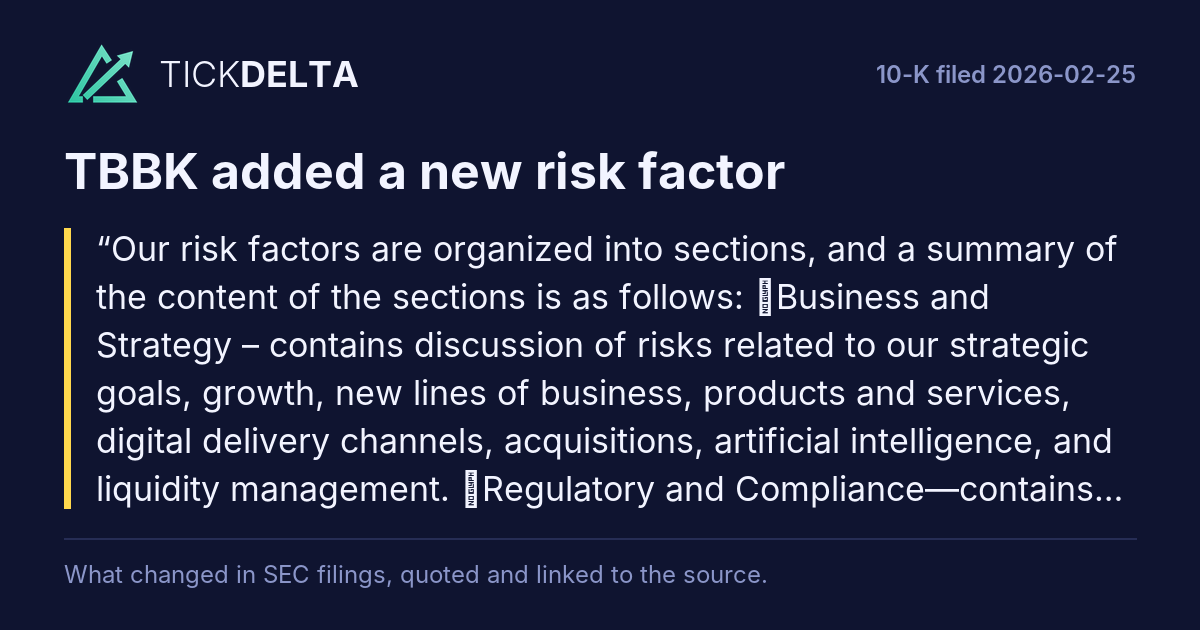
Our risk factors are organized into sections, and a summary of the content of the sections is as follows:
Business and Strategy – contains discussion of risks related to our strategic goals, growth, new lines of business, products and services, digital delivery channels, acquisitions, artificial intelligence, and liquidity management.
Regulatory and Compliance—contains discussion of risks related to the impact of government regulation or changes in regulation, personal data protection and privacy law compliance, our enterprise risk-management framework, processes and strategies, and the consequences if our balance sheet grows above $10 billion as of December 31 of any calendar year.
Economic—contains discussion of the impact on our business of periods of negative economic conditions, U.S. federal government shutdown, and changes in interest rates.
Fintech Solutions Business—contains discussion of concentration of partner relationships, regulatory and legal requirements specific to the industry, the impact of changes in rules or standards or rates of the payment networks, fraud risk, the risk of no longer being classified as non-brokered, fund transfer and payment related risks, risk related to partner agreements, and compliance risk related to unclaimed funds.
Credit Solutions Business—contains discussion of lending risks, model risk, credit fraud and regulatory risks related to partner agreements for marketing and servicing loans, risks specific to real estate bridge lending, and SBA lending program risks.
Operations—contains discussion of risks of interruptions or failures in technology, cybersecurity risk, third-party outsourcing risk, and key employee risk.
Taxes and Accounting—contains discussion of accounting estimates risk, change in accounting policy or standard risk, and internal control risk.
Ownership of Our Common Stock—contains discussion of risk related to the Bank’s ability to dividend to the holding company and impact on our ability to return capital, share repurchase program risks, the impact of anti-takeover provisions, and the required judicial forum for disputes.
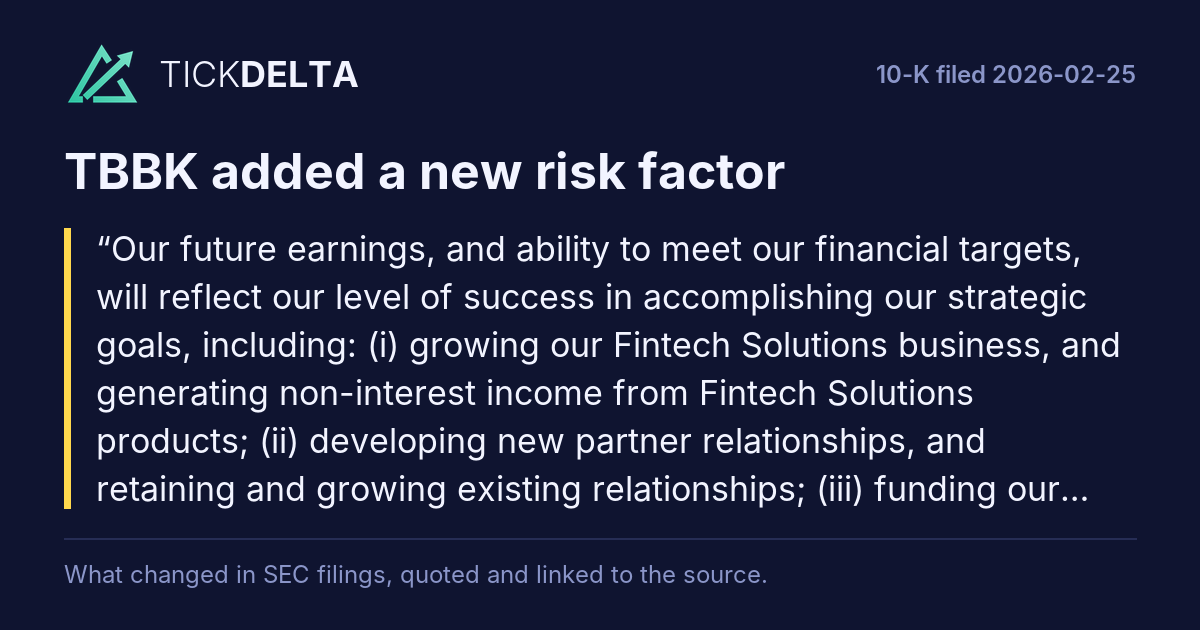
Our future earnings, and ability to meet our financial targets, will reflect our level of success in accomplishing our strategic goals, including: (i) growing our Fintech Solutions business, and generating non-interest income from Fintech Solutions products; (ii) developing new partner relationships, and retaining and growing existing relationships; (iii) funding our loan and investment portfolio with low-cost, stable deposits and optimizing our balance sheet allocation; and (iv) using our robust infrastructure as a platform for growth, and developing AI tools to increase efficiency in our expense base.
We may be unable to achieve these strategic goals, in whole or in part, or achieve the goals within our intended timelines, and the achievement of these goals may not have the intended benefit to our financial results, due to many factors including, but not limited to:
any failures to grow our product offerings, expand our platform or grow our program sponsorship balances;
our ability to attract new partnerships, or retain or grow existing relationships;
our decisions around balancing our loan and investment portfolio to optimize earnings while supporting the growth of our business may not yield our anticipated net margin;
our decisions around investments in our infrastructure, redeployment of, or reduction in resources, and use of AI may not have the beneficial impact that we intended to our processes, efficiency, and results.
In addition, many external factors may also impair our ability to accomplish our strategic goals, including but not limited to changes in market or economic conditions, changes to regulations impacting our business, and competition, among other factors.
We are dependent upon digital delivery channels for our banking and fintech services, and are subject to the risks associated with those channels.
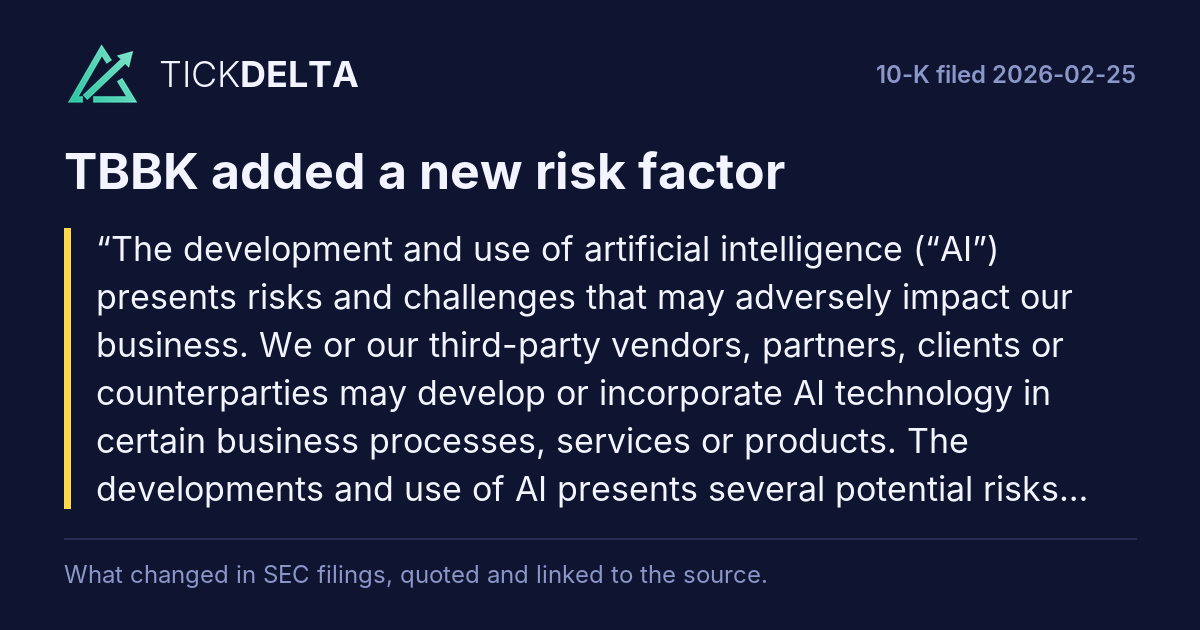
The development and use of artificial intelligence (“AI”) presents risks and challenges that may adversely impact our business.
We or our third-party vendors, partners, clients or counterparties may develop or incorporate AI technology in certain business processes, services or products. The developments and use of AI presents several potential risks and challenges to our business. The legal and regulatory environment relating to AI is uncertain and rapidly evolving in the U.S. and internationally, and includes regulatory schemes targeted specifically at AI as well as provisions in intellectual property, privacy, consumer protection, employment and other laws applicable to the use of AI. These evolving laws and regulations could require changes in our implementation of AI technology and increase our compliance costs and the risk of non-compliance. AI models, particularly generative AI models, may product output or take action that is incorrect, that reflects biases included in the data on which they are trained, that results in the release of private, confidential or proprietary information, that infringes on the intellectual property rights of others, or that is otherwise harmful. In addition, the complexity of many AI models makes it difficult to understand why they are generating particular outputs. This limited transparency increases the challenges associated with assessing the proper operation of AI models, understanding and monitoring the capabilities of the AI models, reducing erroneous output, eliminating bias, and complying with regulations that require documentation or explanation of the basis on which decisions are made. Further, we may rely on AI models developed by third-parties, and, to that extent, would be dependent in part on the manner in which those third-parties develop and train their models, including risks arising from the inclusion of any unauthorized material in the training data for their models and the effectiveness of the steps these third-parties have taken to limit the risks associated with the output of their models, matters over which we may have limited visibility. Any of these risks could expose
us to liability or adverse legal or regulatory consequences and harm our reputation and the public perception of our business or the effectiveness of our security measures.
Ineffective liquidity management could adversely affect our financial condition and results of operation.
Liquidity is essential to our business. We rely on different sources of funding to meet our potential liquidity demands. Our primary sources of funds are deposits, derived principally through our Fintech Solutions business, borrowings, principal and interest payments on loans and leases and mortgage-backed securities, and maturing investment securities. We also utilize wholesale deposit sources to provide temporary funding when necessary or when favorable terms are available. Our access to deposits may be negatively impacted by, among other factors, periods of low interest rates or higher interest rates which could promote increased competition for deposits, borrowings, and the sale of loans and other sources which could have a substantial negative effect on our liquidity. Our access to funding sources in amounts adequate to finance our activities or on terms which are acceptable to us could be impaired by factors that affect us specifically, or the financial services industry or economy generally. Additionally, negative news about us or the banking industry in general could negatively impact market or customer perceptions of our company, which could lead to a loss of depositor confidence and an increase in deposit withdraws, particularly among those with uninsured deposits. Any decline in available funding in amounts adequate to finance our activities or on terms which are acceptable could adversely impact our ability to originate loans, invest in securities, meet our expenses or fulfill our obligations, such as repaying our borrowings or meeting deposit withdrawal demands, any of which could, in turn, have a material adverse effect on our business, financial condition and results of operations. See “Item 7. Management’s Discussion and Analysis of Financial Condition and Results of Operation - Liquidity and Capital Resources” of this Form 10-K.
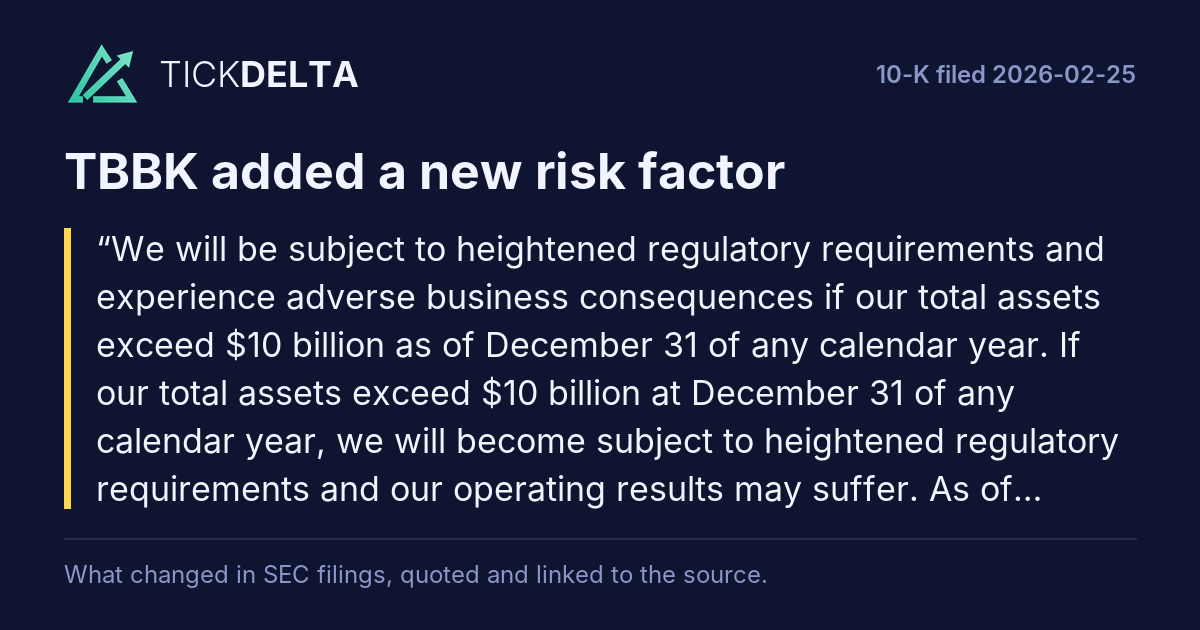
We will be subject to heightened regulatory requirements and experience adverse business consequences if our total assets exceed $10 billion as of December 31 of any calendar year.
If our total assets exceed $10 billion at December 31 of any calendar year, we will become subject to heightened regulatory requirements and our operating results may suffer. As of December 31, 2025, our total assets were $9.35 billion. Although we intend to manage our balance sheet to remain below $10 billion in total assets, growth in deposits and associated asset growth could cause us to exceed that threshold as of a calendar-year end. If we have total consolidated assets of $10 billion or more at calendar year-end, the exemption for small issuers ceases to apply as of July 1 of the following calendar year, although the exemption can be regained if our consolidated assets fall below the $10 billion threshold at calendar year-end in the future.
Banks with $10 billion or more in total assets are subject to additional regulatory requirements and supervisory oversight. Among other things, such institutions are examined directly by the Consumer Financial Protection Bureau with respect to federal consumer financial laws; are subject to reduced dividends on the Bank’s holdings of FRB common stock; are subject to limits on interchange fees pursuant to the Durbin Amendment to the Dodd-Frank Act; are subject to certain enhanced prudential standards; are no longer treated as a “small institution” for FDIC deposit insurance assessment purposes; and are not eligible to elect the Community Bank Leverage ratio. Further, loss of the small issuers exemption could result in the termination of certain beneficial fee-sharing prepaid card programs that are available to us while we remain below $10 billion in total assets.
Compliance with these additional requirements would increase our regulatory obligations and may require additional personnel, enhanced internal controls, and other significant expenditures, which could have a material adverse effect on our business, financial condition and results of operations.
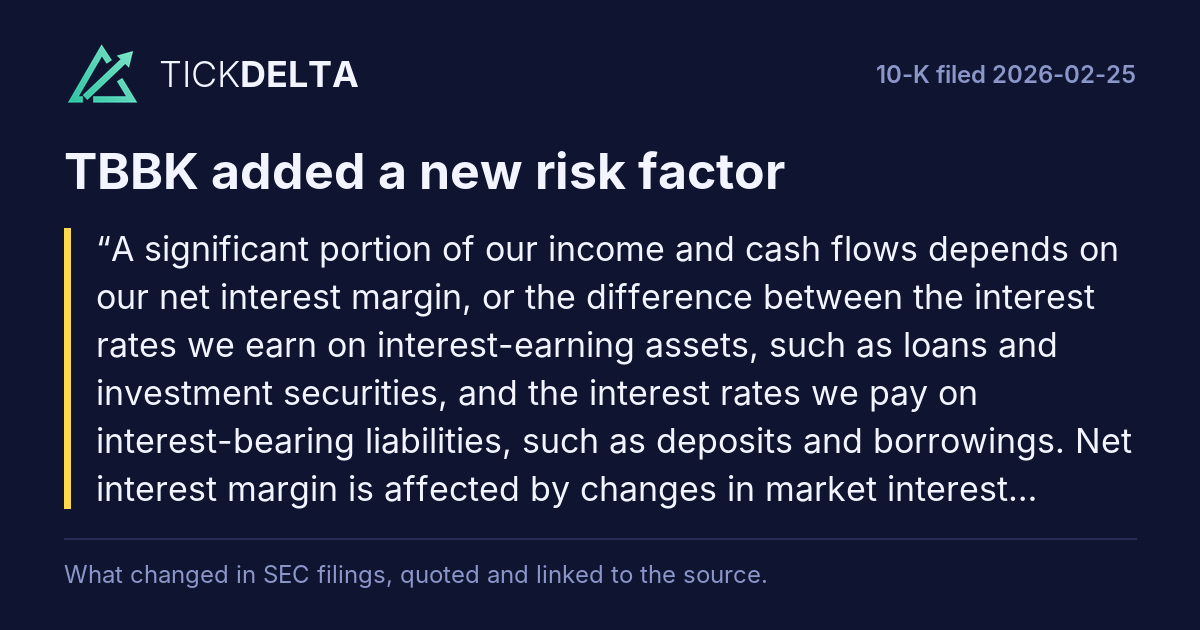
A significant portion of our income and cash flows depends on our net interest margin, or the difference between the interest rates we earn on interest-earning assets, such as loans and investment securities, and the interest rates we pay on interest-bearing liabilities, such as deposits and borrowings. Net interest margin is affected by changes in market interest rates, because different types of assets and liabilities may react differently, and at different times, to market interest rate changes. When interest-bearing liabilities mature or reprice more quickly than interest-earning assets in a period, an increase in market rates of interest could reduce net interest income. Similarly, when interest-earning assets mature or reprice more quickly than interest-bearing liabilities, falling interest rates could reduce net interest income. These rates are highly sensitive to many factors beyond our control, including competition, general economic conditions and monetary and fiscal policies of various governmental regulatory agencies, including the Federal Reserve and the target Federal Funds rate.
We seek to manage our risk from changes in market interest rates by adjusting the rates, maturity, repricing, and balances of our different types of interest-earning assets and interest-bearing liabilities, but these interest rate risk management techniques are not capable of fully eliminating such risks and they may not be as effective as we intend. In particular, rapid increases or decreases in interest rates could have unusually adverse effects on our net interest margin, net interest income and results of operations, to the extent our interest rate risk management techniques are insufficient to mitigate these risks in a timely manner.
The impact of interest rates on our investment portfolio and consolidated financial results, including AOCI, can also affect our ability to maintain our capital ratios within our target ranges as well as the amount and timing of our future share repurchases.
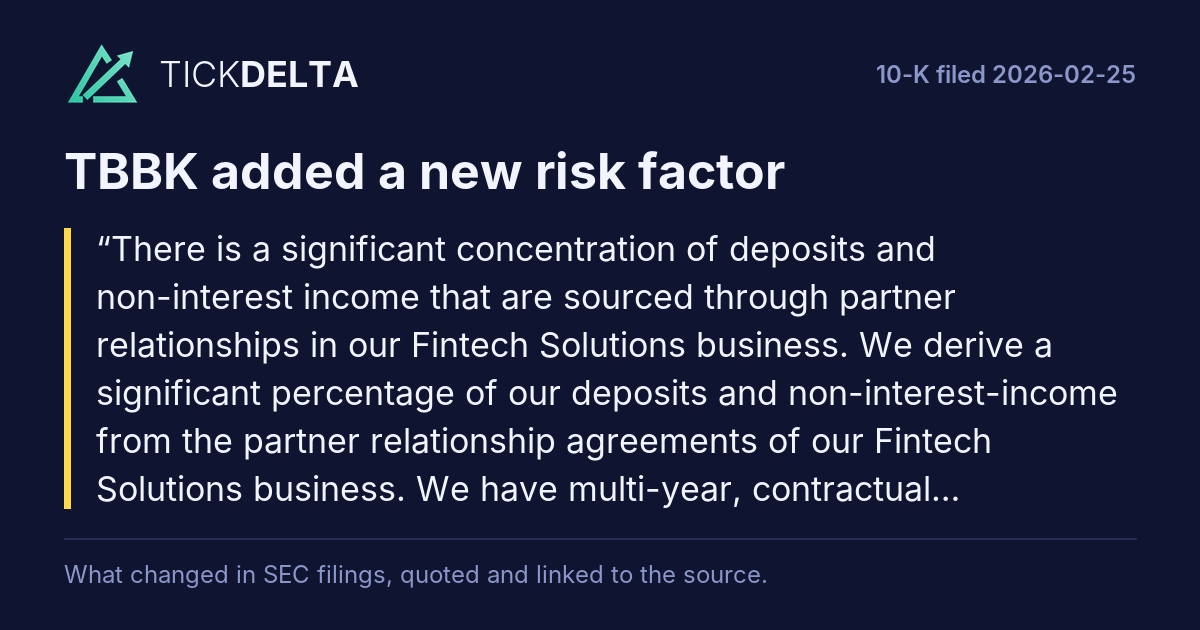
There is a significant concentration of deposits and non-interest income that are sourced through partner relationships in our Fintech Solutions business.
We derive a significant percentage of our deposits and non-interest-income from the partner relationship agreements of our Fintech Solutions business. We have multi-year, contractual relationships with partners through which we provide program sponsorship or the issuance of debit, credit and prepaid cards, we deliver payment services processing, and we originate fintech loans. We recognize non-interest income from these fintech services, primarily total fintech fees and fintech loan credit enhancement income. Also, from these fintech services we source our deposits, which are comprised primarily of millions of small transaction-based consumer balances, the vast majority of which are FDIC-insured.
There is a significant concentration of deposits and non-interest income that are sourced through these partner relationships.
Concentration based on Deposit Balances: Of our total deposits at year-end 2025, the top three partner relationships accounted for $3.83 billion (47%) and the next three largest accounted for $1.35 billion (17%). Those same partners, based on largest deposit concentration, also contributed to our noninterest income for the year ended December 31, 2025, with the top three accounting for total fintech fees of $61.6 million (44%) and all fintech credit enhancement income $169.3 million. The next three partners contributed $27.9 million (20%) to total fintech fees.
Concentration based on Income: Of our total non-interest income for the year ended December 31, 2025, the top three partner relationships accounted for total fintech fees of $83.5 million (59%) and all fintech credit enhancement income, or $169.3 million. The next three largest partners accounted for $14.1 million (10%) of total fintech fees. Those same partners, based on largest income concentration, also contribute to deposits at year end, with the top three accounting for $2.02 billion (25%) of deposits and the next three contributing $1.85 billion (23%) of deposits.
We may terminate relationships for various reasons, such as a partner’s failure to implement or maintain sufficient compliance and operational controls, increased financial or regulatory risk, or material changes in applicable law or our business.
Also, a partner could elect to reduce their volumes under our agreement, or terminate or not renew their agreements with us for reasons including the availability of more favorable terms from another provider or dissatisfaction with the level or quality of our services. Further, certain of our partners have been, and in the future may be, acquired by other entities, which could result in the transfer of their business to the acquiror or other institutions upon expiration of their current contractual agreements. In addition, our partner’s products, business strategies, and bank partnership strategies could shift, and, as such, could impact the volumes under our agreement.
If one of these significant relationships were to be terminated or there is a significant decrease in deposits or transactions associated with any of these business relationships, it could materially reduce our deposits and revenues and have a negative impact on our ability to fund our business.
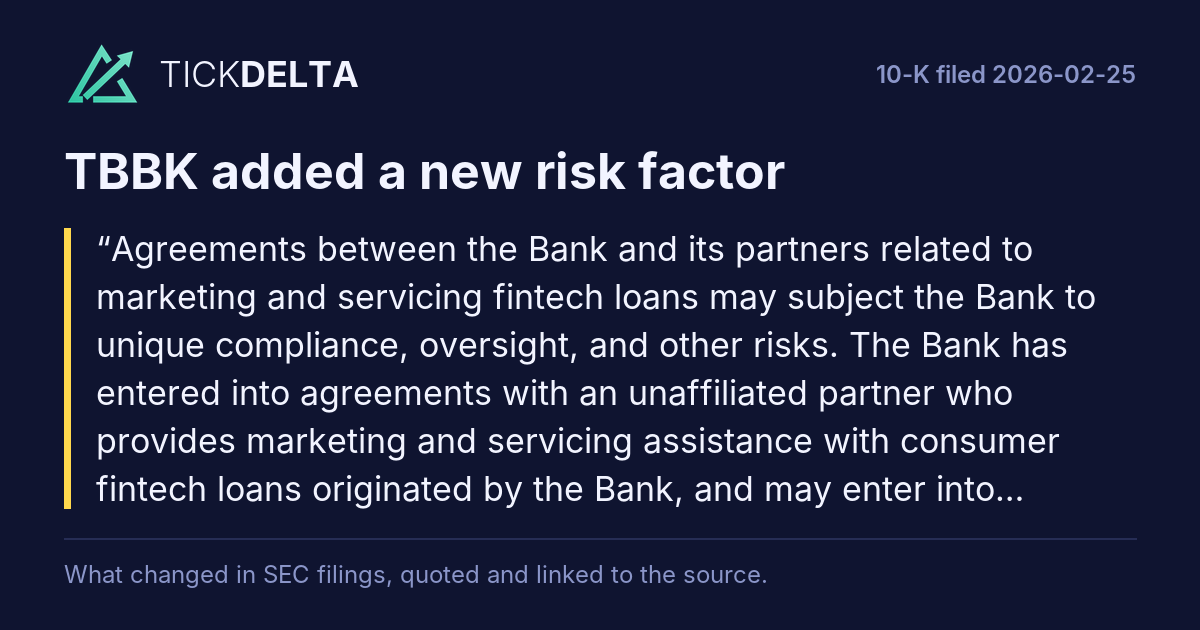
Agreements between the Bank and its partners related to marketing and servicing fintech loans may subject the Bank to unique compliance, oversight, and other risks.
The Bank has entered into agreements with an unaffiliated partner who provides marketing and servicing assistance with consumer fintech loans originated by the Bank, and may enter into agreements with additional unaffiliated partners in the future related to fintech loans. While we retain responsibility for compliance with applicable laws and regulations and maintain policies, procedures and monitoring designed to oversee these relationships, reliance on third parties exposes us to heightened compliance, oversight, operational, credit and reputational risks.
These programs are subject to extensive and evolving federal and state laws, regulations and supervisory expectations, including those relating to consumer protection, unfair, deceptive or abusive acts or practices, fair lending, privacy and data protection, anti-money laundering, debt collection and other compliance requirements. Regulatory agencies have increased their scrutiny of bank–fintech partnerships and third-party risk management practices. If a third-party fails to comply with applicable laws, regulations or regulatory guidance, or if regulators determine that our oversight, governance or control framework is inadequate, we could be subject to supervisory findings, enforcement actions, civil money penalties, consumer protection litigation, or other adverse consequences.
Certain program structures may also be subject to legal challenge or regulatory scrutiny, including with respect to licensing, rate exportation, “true lender” theories or other matters, which could result in litigation, reputational harm, monetary liabilities or the need to modify, suspend or terminate programs. In addition, these arrangements create risks related to model performance, credit quality, data integrity, information security, business continuity and the financial condition of our partners.
Although our agreements typically include contractual protections, including indemnification and credit enhancement provisions, such protections may be limited in scope, subject to dispute, or insufficient to fully protect us from losses or liabilities. The termination of, or disruption in, one or more significant partner relationships, whether due to regulatory developments, performance issues or other factors, could adversely affect loan originations, servicing operations, fee income and overall financial performance. Any of these risks could have a material adverse effect on our business, financial condition and results of operations.
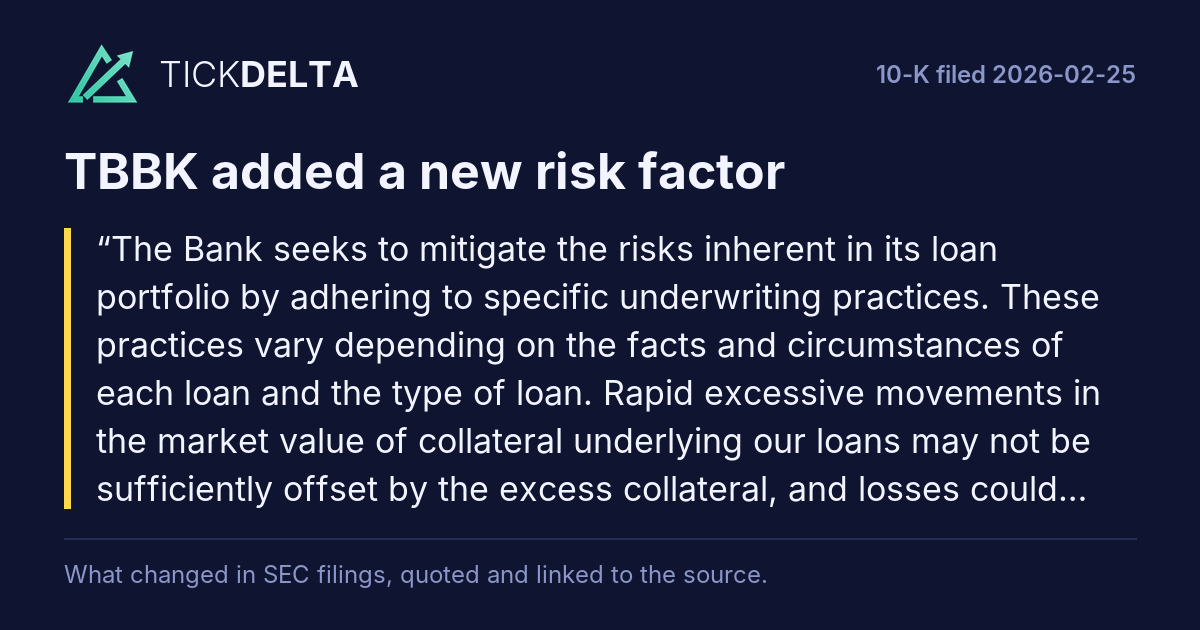
The Bank seeks to mitigate the risks inherent in its loan portfolio by adhering to specific underwriting practices. These practices vary depending on the facts and circumstances of each loan and the type of loan.
Rapid excessive movements in the market value of collateral underlying our loans may not be sufficiently offset by the excess collateral, and losses could result.
Although the Bank believes that its underwriting criteria are appropriate for the various kinds of loans it makes, the Bank may incur losses on loans that meet its underwriting criteria, and these losses may exceed the amounts set aside as reserves in the Bank’s allowance for credit losses.
Should cash flow and available cash reserves prove inadequate to cover debt service on these loans, repayment will primarily depend upon the sponsor’s ability to service the debt, or the value of the property in disposition. Low occupancy or rental rates may negatively impact loan repayment.
The quantitative models we use to manage certain accounting and risk management functions may not be effective, which may cause adverse effects on our results of operations and financial condition.
We use quantitative models to help manage certain aspects of our business and to assist with certain business decisions, including estimating probable loan losses, measuring the fair value of financial instruments when reliable market prices are unavailable and estimating the effects of changing interest rates and other market measures on our financial condition and results of operations. Our modeling methodologies rely on many assumptions, historical analyses and correlations. These assumptions may be incorrect, particularly in times of market distress, and the historical correlations on which we rely may no longer be relevant. Additionally, as businesses and markets evolve, our measurements may not accurately reflect this evolution. Even if the underlying assumptions and historical correlations used in our models are adequate, our models may be deficient due to errors in computer code, bad data, misuse of data, fraud or the use of a model for a purpose outside the scope of the model’s design. We rely on models in a number of critical areas, including liquidity stress testing, interest rate sensitivity analysis, allowance for credit losses estimation and compliance
monitoring, and regulators increasingly expect the use of robust model governance in these areas. In addition to technical flaws, misunderstanding or misuse of model outputs could result in suboptimal decision-making, regulatory scrutiny or financial loss.
As a result, our models may not capture or fully express the risks we face, may suggest that we have sufficient capitalization when we do not, or may lead us to misjudge the business and economic environment in which we will operate. If our models fail to produce reliable results on an ongoing basis, we may not make appropriate risk management or other business or financial decisions. Furthermore, strategies that we employ to manage and govern the risks associated with our use of models may not be effective or fully reliable, and as a result, we may realize losses or other lapses.
Banking regulators continue to focus on the models used by banks and bank holding companies in their businesses. The failure or inadequacy of a model may result in increased regulatory scrutiny on us or may result in an enforcement action or proceeding against us by one of our regulators.
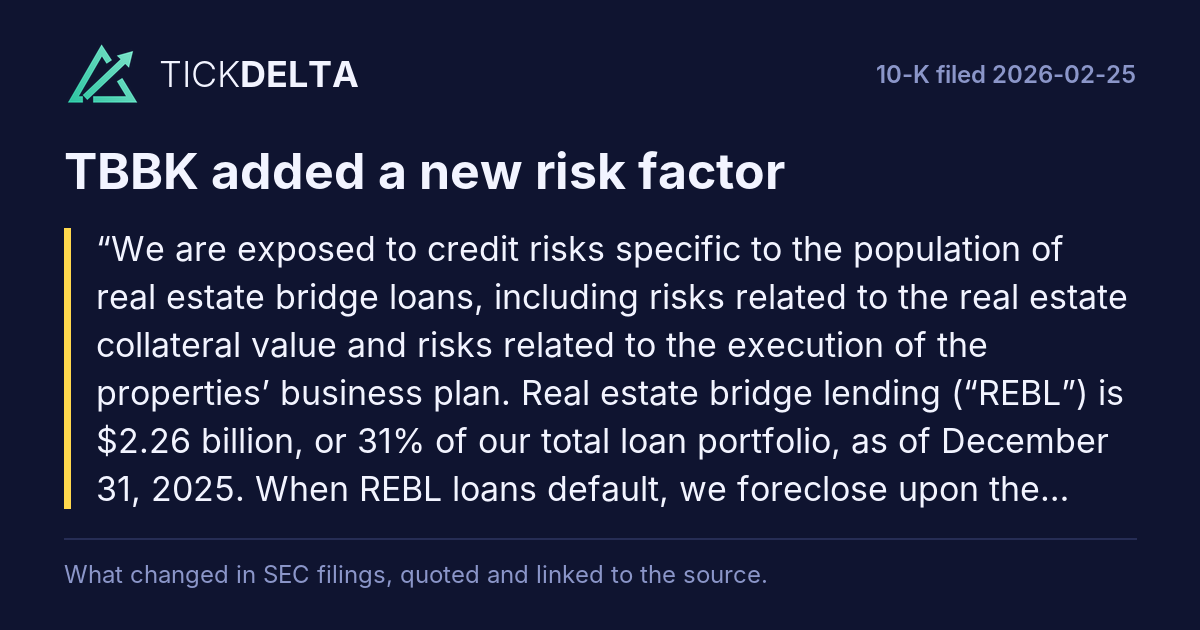
We are exposed to credit risks specific to the population of real estate bridge loans, including risks related to the real estate collateral value and risks related to the execution of the properties’ business plan.
Real estate bridge lending (“REBL”) is $2.26 billion, or 31% of our total loan portfolio, as of December 31, 2025. When REBL loans default, we foreclose upon the real estate collateral, recognize the estimated fair value of the property in Other real estate owned (“OREO”) on our Consolidated Balance Sheets, which was $60.7 million as of December 31, 2025. REBL are transitional commercial mortgage loans, made to improve and rehabilitate existing properties, primarily multi-family apartment buildings, and there are unique risks related to this loan population resulting from several factors, including the larger size of loan balances, the dependence on the success of the property owners’ business plan, the property owners’ ability to obtain subsequent funding at the end of their loan term, risks related to the market values of the collateral real estate properties, and risks related to other real estate owned.
REBL are dependent upon the successful operation of the borrower’s business. If the operating company suffers difficulties, including reduction in occupancy and/or profitability, the borrower’s ability to repay the loan may be impaired. Loans secured by properties where repayment is dependent upon payment of rent by third-party tenants or the sale of the property may be impacted by loss of tenants, lower lease rates needed to attract new tenants or the inability to sell a completed project in a timely fashion and at a profit. A number of factors may affect a borrower’s ability to make or refinance a balloon payment at the end of the loan term, including the financial condition of the borrower, the prevailing local economic conditions, and the prevailing interest rate environment. If the borrower is delinquent or unable to repay or refinance the loan, we may record increases to our allowance based on any difference between the current market value of the property (net of costs to sell) and our carrying amount of the loan.
We are exposed to potential losses based on changes in the real estate property values underlying the REBL portfolio. While we underwrite these loans based on our required loan-to-value levels, if real estate property values decline and the estimated property value is below our current carrying amount of the loan (net of allowance), our net income could be negatively impacted from increases our allowance or impairment losses on real estate owned. While we historically have not realized charge-offs or realized losses on foreclosed properties related to REBL, there can be no assurances that we will not have significant losses in the future.
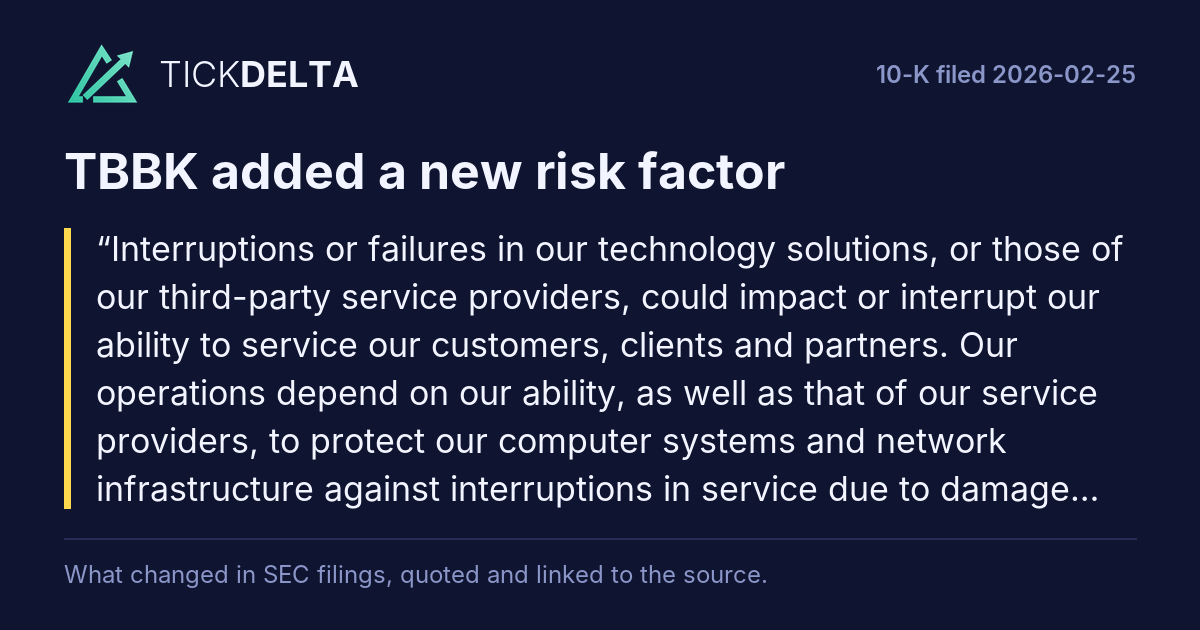
Interruptions or failures in our technology solutions, or those of our third-party service providers, could impact or interrupt our ability to service our customers, clients and partners.
Our operations depend on our ability, as well as that of our service providers, to protect our computer systems and network infrastructure against interruptions in service due to damage from fire, power loss, telecommunications failure, software or hardware defects, physical attacks, computer hacking or similar events.
Our operations are dependent upon our ability to ensure secure transmission of confidential information over public networks and other mediums, and protect the computer systems, software and networks utilized by us, and our third-party service providers, against cyber-attacks, cybersecurity breaches and other disruptive problems. We devote significant resources and management focus to ensuring the integrity of our systems through information security and business continuity programs. However, our measures, including encryption, authentication technology, firewalls, and penetration testing may not be effective and may not prevent or detect future potential losses or liabilities from system failures or breaches or cyber-attacks, cybersecurity breaches, or other disruptions.
Our computer systems, software and networks, and those of our third-party service providers may be targeted in cyberattacks, such as external or internal security breaches, hacking, acts of vandalism, computer viruses or malware, ransomware intrusion, denial-of-service attacks, data corruption attempts, or other similar events.
We seek to continuously monitor for and nimbly react to any and all such malicious cyber activity, and we develop our systems to protect our technology infrastructure and data from misuse, misappropriation or corruption.
Failures in, or breaches of, our computer systems, software and networks, or those of our third-party vendors or other service providers could disrupt our business or operations or those of our partners and clients, could result serious negative consequences including, but not limited to:
misappropriation or exposure of our intellectual property, funds and those of our partners and clients;
litigation exposure, regulatory fines, penalties, or regulatory enforcement action; and
We obtain essential technological, marketing and customer services support for our systems from third-party providers. For example, we outsource our check processing, check imaging, transaction processing, electronic bill payment, statement rendering, and other services to third-party vendors.
Our financial statements are based in part on assumptions and estimates made by our management. Our earnings may decrease if amounts realized vary significantly from our estimates, or from updates to assumptions.
Pursuant to accounting principles generally accepted in the United States, we utilize certain assumptions and estimates in preparing our financial statements, including but not limited to, when estimating the allowance for credit losses, determining the fair values of certain assets and liabilities, and when recording accruals, reserves and other estimated realizable amounts for assets. If the assumptions or estimates underlying our financial statements are incorrect, we may experience significant losses from updates to the assumptions, or if the ultimate realization of value is materially different than the amounts reflected in our balance sheets as of any particular date.
Allowance for credit loss. We maintain an allowance for credit losses to provide for current and future expected losses inherent in our loan portfolio. Significant judgment is required to determine the appropriate level of the allowance, and our estimate is based upon currently available information. The allowance is determined by management after analyzing many factors including historical loan losses, current trends in delinquencies and charge-offs, our assessment of collection risks, plans for problem loan resolution, and the estimated value of the real estate and other assets serving as collateral. Our estimate includes relevant information from internal and external sources, including reasonable forecasts for economic conditions.
If our assumptions are incorrect or if there is a significant deterioration in economic conditions, our allowance for credit losses may not be sufficient to cover expected credit losses in our loan and lease portfolio, resulting in unanticipated losses and additions to our allowance for credit losses. Material additions to our allowance for credit losses could materially decrease our net income.
Fair value. A substantial portion of our assets are recorded at fair value or include nonrecurring fair value measurements in measuring the carrying value of assets for impairment. Assets that are measured at fair value include commercial loans at fair value, and Investment securities available for sale. Assets that include fair value measurements in determining impairment or proper carrying value include estimates related to real estate owned property, estimates of the values of collateral used in measuring the allowance for collateral-dependent receivables, and the residual value of leased vehicles and equipment.
The fair value measurements are based upon significant estimates and assumptions made by our management, based on market information where available, and based on the best information available as of the measurement date. The use of different estimates or assumptions in connection with the valuation of these assets could produce materially different fair values, or our fair value estimates may not be realized in an actual sale or settlement, either of which could have a material adverse effect on our consolidated financial position, results of operations or cash flows.
Other Estimates. Our financial statements include other estimates, including accruals for legal and regulatory contingencies, estimates related to tax positions, and our estimate of the recoverable amount of our receivable for the credit enhancement related to our fintech agreements. If the assumptions or estimates are subsequently proven incorrect or inaccurate, there could be a material adverse effect on our business, financial position, results of operations or cashflows.
For additional information on the key areas for which assumptions and estimates are used in preparing our financial statements, see “Part II—Item 7. Management’s Discussion and Analysis of Financial Condition and Results of Operations—Critical Accounting Policies and Estimates” in this Form 10-K.
Changes in accounting policies or accounting standards, or changes in how accounting standards are interpreted or applied, could materially affect how we report our financial results and condition.
Our accounting policies are fundamental to determining and understanding our financial results and condition. From time to time, the Financial Accounting Standards Board (the "FASB") and the SEC change the financial accounting and reporting standards that govern the preparation of our financial statements. In addition, those that set accounting standards and those that interpret the accounting standards (such as the FASB, the SEC, banking regulators, and our outside auditors) may change or even reverse their previous interpretations or positions on how these standards should be applied. Changes in financial accounting and reporting standards and changes in current interpretations may be beyond our control, are difficult to predict, and could materially affect how we report our financial results and condition. We may be required to apply a new or revised standard retroactively or apply an existing standard differently and retroactively, which may result in us being required to restate prior period financial statements, which restatements may reflect material changes. Such changes could also require us to incur additional personnel and technology costs and affect our business and cost of operations.
If we fail to maintain effective internal control over financial reporting, our ability to accurately and timely report our financial results may be impacted, which could result in a loss of investor confidence and adversely impact our stock price and our business.
We are required to maintain an effective system of internal controls to provide reasonable assurance that transactions and activities are conducted in accordance with established policies and procedures and are completely and accurately reported in our financial statements. These internal control systems are subject to various inherent limitations, including cost, judgments used in decision-making, assumptions about the likelihood of future events, the soundness of our systems, the possibility of human error, and the risk of fraud. Moreover, controls may become inadequate because of changes in conditions or processes and the risk that the degree of compliance with policies or procedures may deteriorate over time. Because of these limitations, any system of internal operating controls may not be successful in preventing all errors or fraud or in making all material information known in a timely manner to the appropriate levels of management. From time-to-time, control deficiencies and losses from operational malfunctions or fraud have occurred and may occur in the future.
For example, in connection with the preparation of our Form 10-K for the year ended December 31, 2024, as amended, we identified control deficiencies related to: (i) the completion of all closing procedures prior to the filing of a required periodic report with the SEC; and (ii) the evaluation of the accounting and financial reporting associated with the credit enhancement contained within a third-party agreement and the impact on the allowance for credit losses for consumer fintech loans. As of December 31, 2024, management concluded that these control deficiencies constituted material weaknesses in our disclosure controls and procedures and internal control over financial reporting. As discussed in Part II, Item 9A. Controls and Procedures, our management has since remediated the material weakness and concluded that our internal control over financial reporting was effective as of December 31, 2025.
Control deficiencies or material weaknesses in our internal controls over financial reporting may be discovered in the future and could result in material weaknesses, cause us to fail to meet our periodic reporting obligations or result in material misstatements in our financial statements. Any such failure could also adversely affect our liquidity, our access to capital markets, the perceptions of our creditworthiness, and we may be unable to maintain compliance with applicable securities laws and the rules and listing standards of the NASDAQ. In addition, we may be subject to litigation or investigations requiring management resources and payment of legal and other expenses which may negatively impact results of operations and financial condition, could negatively affect investor confidence in the accuracy and completeness of our financial statements, and could adversely impact our stock price.
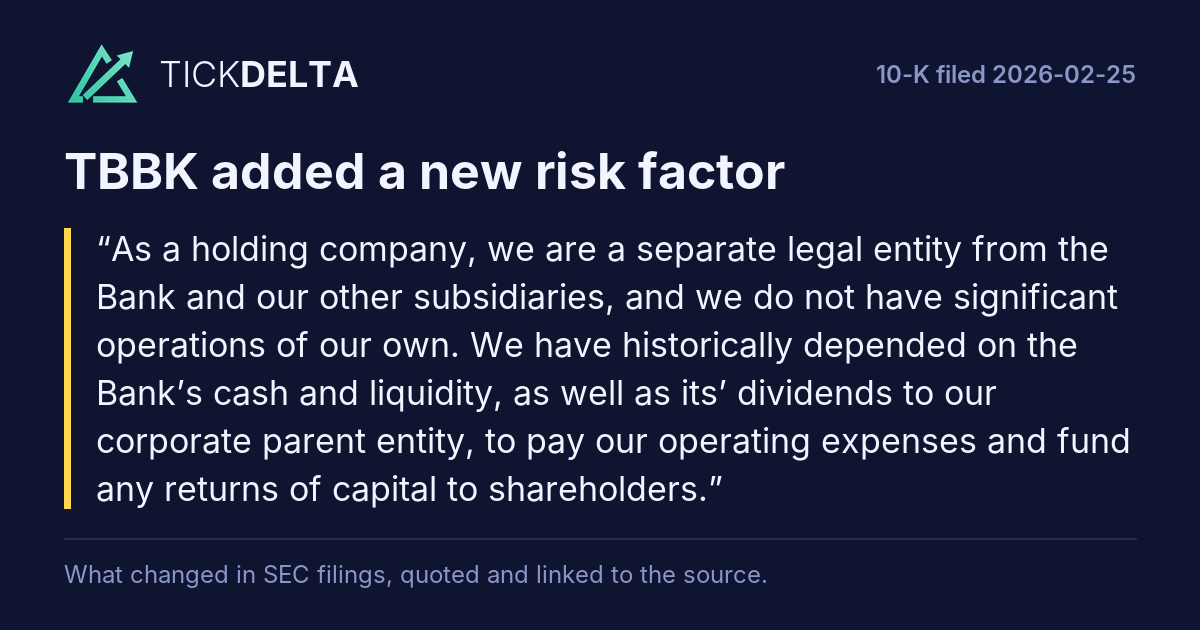
As a holding company, we are a separate legal entity from the Bank and our other subsidiaries, and we do not have significant operations of our own. We have historically depended on the Bank’s cash and liquidity, as well as its’ dividends to our corporate parent entity, to pay our operating expenses and fund any returns of capital to shareholders.
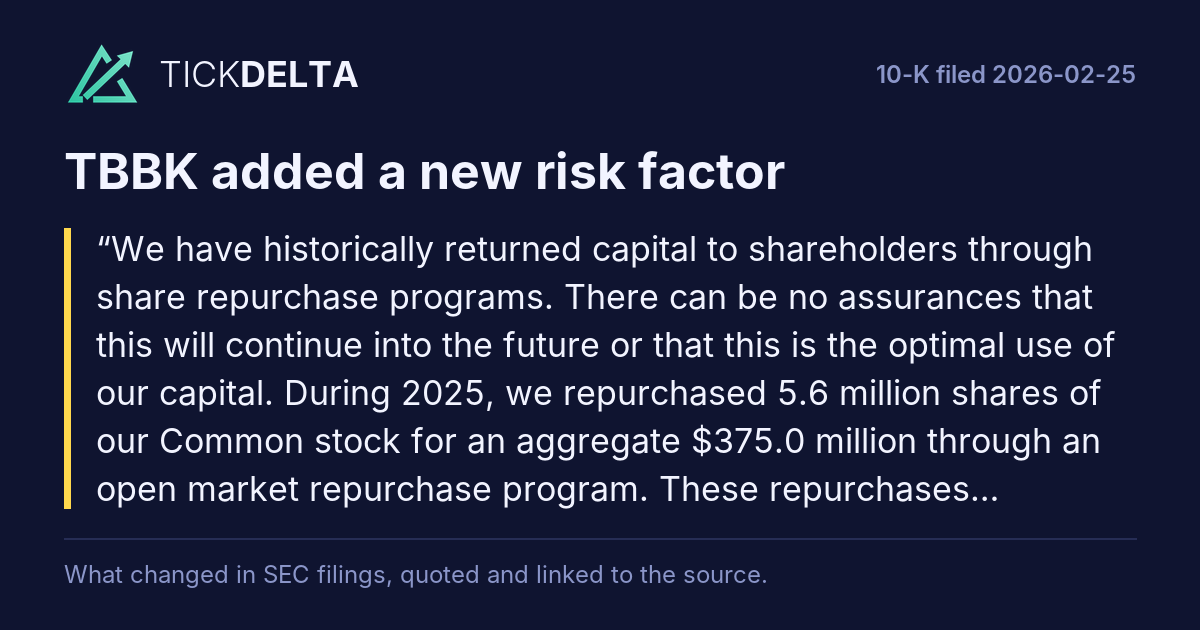
We have historically returned capital to shareholders through share repurchase programs. There can be no assurances that this will continue into the future or that this is the optimal use of our capital.
During 2025, we repurchased 5.6 million shares of our Common stock for an aggregate $375.0 million through an open market repurchase program. These repurchases reduced our market capitalization and public float, which is the number of shares of our Common stock that are owned by non-affiliated stockholders and available for trading in the securities markets, which may reduce the volume of trading in our shares and result in reduced liquidity and volatility in our stock price. The market price of our Common stock has been and may continue to be volatile which may affect your ability to sell our Common stock at an advantageous price. For example, the closing market price of our Common stock on the NASDAQ Global Select Market Exchange fluctuated between $40.93 per share and $80.34 per share during 2025 and may continue to fluctuate. Market price fluctuations in our Common stock may be due to factors both within and outside of our control, including our strategic actions, industry and regulatory matters or other material public announcements, as well as a variety of additional factors including, without limitation, those set forth under these “Risk Factors” and "Cautionary Note Regarding Forward-Looking Statements."
For 2026, our Board of Directors provided a new authorization for up to $200.0 million of share repurchases. We have no obligation to repurchase shares under this authorization, and any share repurchase program may be extended, modified, suspended or discontinued at any time. Any repurchases would utilize cash that we will not be able to use in other ways, or to meet other potential demands, and may not prove to be the best use of our capital. There can be no assurance that we will repurchase any, or the full amount authorized under any share repurchase program, or that any past or future repurchases will have a positive impact on our stock price.
New in the latest 10-Q
16 paragraphs in the 10-Q filed Nov 5, 2026 with nothing like them in the 10-Q filed Aug 6, 2026 (at least half the words must differ; new numbers alone do not count). Quoted exactly, grouped by the item heading above them. This is text that changed, not a judgement of how serious it is.
CONDENSED CONSOLIDATED STATEMENTS OF CHANGES IN SHAREHOLDERS' EQUITY (UNAUDITED)
Read in the 10-Q
CONDENSED CONSOLIDATED STATEMENTS OF CHANGES IN SHAREHOLDERS' EQUITY (UNAUDITED)
Read in the 10-Q
Adjustments to reconcile net income to net cash provided by operating activities
Read in the 10-Q
Proceeds from redemptions and prepayments of securities available-for-sale 91,286 271,981
Read in the 10-Q
Transfers (from) to other real estate owned from commercial loans, at fair value, and loans, net $ 10,586 $ 2,401
Read in the 10-Q
(1)During the nine months ended September 30, 2026, the Company paid $74.8 million to acquire transferable tax credits from third parties. There were no transferable tax credits purchased in 2025.
Read in the 10-Q
During the three months ended September 30, 2026, the Company purchased transferable tax credits to reduce its cash tax obligation for 2026 and certain eligible prior years. The amount of tax credits recognized is included in the determination of Company's effective tax rates for both the three and nine months ended September 30, 2026. Income tax expense on the Condensed Consolidated Statements of Operations includes a benefit of $ 10.3 million for both the three and nine months ended September 30, 2026 from purchased tax credits, of which $ 3.0 million relates to the 2026 tax year and $ 7.3 million relates to the carryback of credits to prior periods.
Read in the 10-Q
The planned amounts of repurchases are generally determined by assessing the impact of budgetary earnings projections on regulatory capital requirements. The excess of projected earnings over amounts required to maintain capital requirements is the maximum available for capital return to shareholders, barring any need to retain capital for other purposes. The Board of Directors' authorization represents the maximum amount shares that may be repurchased under the applicable program and does not obligate the Company to repurchase any shares. The Company may suspend, modify or discontinue the repurchase program at any time.
Read in the 10-Q
• our ability to obtain the anticipated benefits and cost savings of our organizational restructuring activities;
Read in the 10-Q
Our total loan portfolio also includes the Fintech loans generated by the Fintech Solutions business. The loans in our non-fintech portfolio are secured by collateral, and the fintech loans are backed by credit enhancement agreements from our partners.
Read in the 10-Q
As part of our long-term strategic plan, in September 2026, we announced that as part of our organizational restructuring, we intend to discontinue the origination of retail and wholesale SBL loans by the end of 2026. In addition, staffing adjustments were made across several other areas of the organization in connection with our efforts to refine workflows, expand automation and artificial intelligence, optimize costs and invest in our highest-value strategic priorities. We recognized restructuring costs of $4.3 million in the third quarter of 2026 in connection with those actions.
Read in the 10-Q
• Income tax expense decreased $9.3 million to $8.9 million in the third quarter of 2026 from $18.2 million in the third quarter of 2025. The third quarter of 2026 was favorably impacted by $10.3 million of total benefits related to purchased transferable tax credits, of which $3.0 million relates to 2026 taxes and $7.3 million relates to the carryback of credits to prior periods.
Read in the 10-Q
In third quarter of 2026, as part of our tax strategy, we purchased transferable tax credits to reduce our cash tax obligation for 2026 and certain eligible prior years. Income tax expense for the third quarter of 2026 includes $10.3 million of total benefits related to transferable investment tax credits, of which $3.0 million relates to 2026 taxes and $7.3 million relates to carryback of credits to prior periods. We expect to continue to invest in tax credits in future periods, resulting in an estimated annual future effective tax rate of approximately 23.9%, compared to the full year 2025 effective tax rate of 24.7%.
Read in the 10-Q
In third quarter of 2026, as part of our tax strategy, we invested in transferable tax credits to reduce our cash tax obligation for 2026 and certain eligible prior years. Income tax expense for the nine months ended September 30, 2026 includes $10.3 million of total benefits related to transferable investment tax credits, of which $3.0 million relates to 2026 taxes and $7.3 million relates to carryback of credits to prior periods. We expect to continue to invest in tax credits in future periods, resulting in an estimated annual future effective tax rate of approximately 23.9%, compared to the full year 2025 effective tax rate of 24.7%.
Read in the 10-Q
Total assets at September 30, 2026 were $9.43 billion, relatively consistent with $9.35 billion at December 31, 2025.
Read in the 10-Q
At September 30, 2026, the Bank was “well capitalized” under banking regulations.
Read in the 10-Q
Item 1A of the 10-Q filed Nov 5, 2026 against Item 1A of the 10-K filed Feb 25, 2026.
A 10-Q repeats only the risks that changed, so a 10-K paragraph that is missing from it is not counted as removed.
Added is a paragraph with nothing like it in the 10-K, Reworded a sentence that is in both with several words changed,
Quiet changes a sentence in both where one to four words changed and one is a hedge or a modal
(cut words struck through, new words highlighted).
Text on the page, not a score; each links to the filing at sec.gov.
What the 10-Q itself says about its risk factors:There have been no material changes or additions to the risk factors disclosed in Part I, Item 1A. “Risk Factors” in our Annual Report on Form 10-K for the year ended December 31, 2025.
Read in the 10-Q
Two-word phrases in Risk Factors of the 10-K filed Feb 25, 2026 that are in none of the 1 earlier 10-Ks stored, back to Mar 3, 2025
Used at least twice, small words left out. Counted, not picked: a phrase can be new because the company renamed something.
98 paragraphs of last year's Risk Factors with nothing like them now. The longest are quoted.
Item 1A of each 10-K and 10-Q on EDGAR, quoted exactly. Each paragraph links to the filing at sec.gov.
10-K change: what was reworded or cut, section by section.
Excel workbook · CSV. Google Sheet that stays up to date: paste =IMPORTDATA("https://tickdelta.com/company/TBBK/export.csv") into a cell.