Screener / SEC EDGAR /CIK 0000816761 /10-K filed Feb 27, 2026, compared with Feb 21, 2025 /Numbers from the XBRL of the 10-Ks
NYSE Technology · Software

Teradata Corp TDC

Compare with peers Embed
The 10-K against last year's

113 changes: 20 added, 18 removed, 72 reworded, 3 quiet changes

10-K Feb 27, 2026 vs Feb 21, 2025

10-K 0001628280-26-012671 (Feb 27, 2026) vs 10-K 0000816761-25-000027 (Feb 21, 2025)

Every paragraph, and how much of it changed

One bar per paragraph, in the order of the 10-K. Height and colour show the share of its words not in the closest paragraph a year earlier; the tallest bars are new paragraphs.

Risk Factors

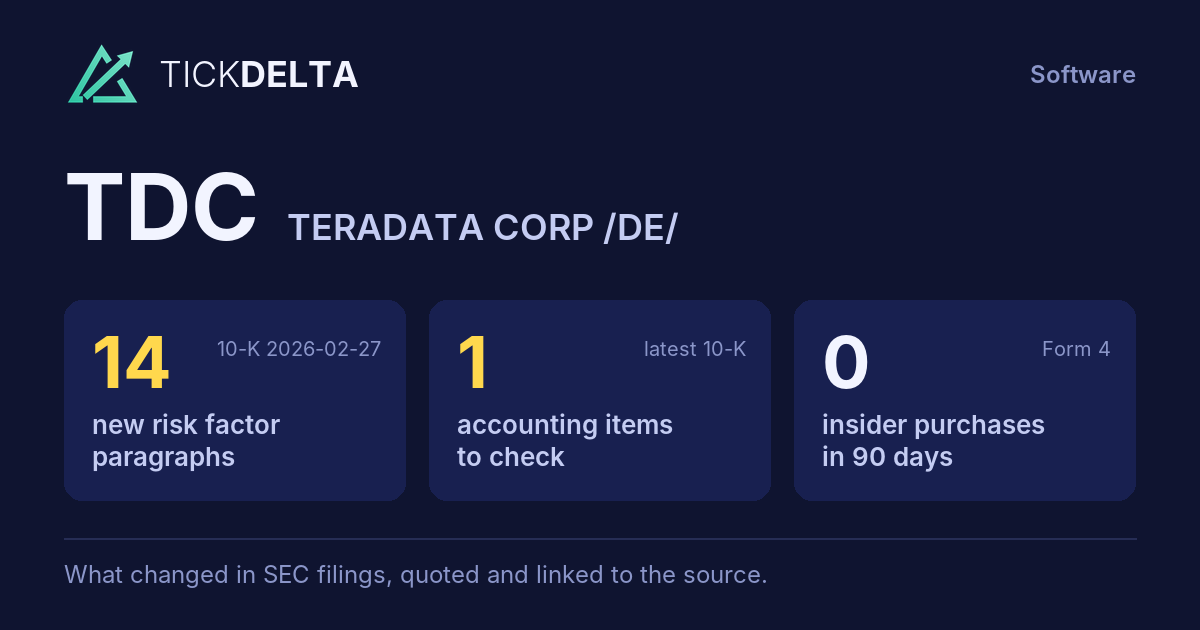
126 paragraphs · 14 new · 43 reworded · 10 gone · 10-K Feb 27, 2026 against Feb 21, 2025
New paragraph Reworded (5% of its words or more) Same or nearly
Paragraph 34 · 49% changed Every version of it
Teradata’s platform offerings have been expanded to include a variety of subscription options, which impact the timing of when revenues are recognized and related cash flows are collected. The IT industry generally has been experiencing increasing pricing pressure from customers when purchasing or renewing support agreements. As our on-premises customers migrate all or a portion of their data analytics solutions to a cloud-based environment, some customers have selected a cloud-based offering of one of our competitors and existing customers may do so in the future. As a result, such customers have cancelled all or a portion of their arrangements with us and may continue to do so in the future. While customer cancellations we have had to date have not been material to our business, they could become material in the future. Mergers and acquisitions in certain industries that we serve could result in a reduction of the software and hardware being supported and put pressure on our subscription and support terms with customers who have merged. Given these factors, there can be no assurance that our current customers will migrate from on-premises to the cloud with Teradata, renew their subscription and/or support agreements, or agree to the same terms when they renew, which could result in our reducing or losing subscription and/or support fees which could adversely impact operating results.
Paragraph 42 · 49% changed Every version of it
In 2023, Teradata introduced a new has evolved its brand identity, and messaging, including our messaging around trusted its emphasis on autonomous AI and knowledge-based data and trusted AI. With this brand we strive analytics offerings, to be modern, innovative, reflect changes in customer needs and reflective of our vision for the future. Our updated brand is designed to highlight Teradata’s role as a leader in AI market conditions. Recognition and hybrid cloud data and analytics. We believe that recognition and the reputation of our brand is key are important to our success, including our ability to retain existing customers as well as customers, attract new customers and partners. partners, and achieve our growth expectations in the data management and analytics market. While we leverage our decades of experience in data analytics and database management services, we believe we have evolved continue to provide the modern evolve our offerings customers need. These include the cloud-native architecture of Teradata VantageCloud Lake, the end-to-end pipeline of AI/ML capabilities in ClearScape Analytics, our on-demand AI/ML engine in the cloud that delivers a completely self-service experience with Teradata AI Unlimited, to address customer needs across cloud, hybrid, and our commitment to providing a platform compatible with OTFs to provide an open and connected ecosystem offering to our customers. The failure for AI-enabled environments. If the market to does not recognize our brand attributes or for if there to be are misperceptions in the market regarding our autonomous AI, cloud, hybrid, AI, or other capabilities could negatively impact capabilities, our ability to upgrade existing on-premises customers to our hybrid cloud-based solutions, customers, drive expansion/consumption expansion or consumption growth, and/or or acquire new customers for our on-premises and hybrid cloud businesses. could be adversely affected. In addition, damage to the reputation of our brand could result in, among other things, customer cancellations or non-renewals, lower employee retention challenges in attracting and productivity, retaining employees, vendor relationship issues, and investor increased scrutiny from investors and other stakeholder scrutiny, stakeholders, any of which could materially affect our revenue and profitability.
Paragraph 31 · 48% changed Every version of it
Our cloud- and hybrid-based platforms generally require us to deploy or operate solutions for our customers, directly or through the use of third-party services providers, either on-premises at customer-selected data center facilities, or at third-party-hosted data center facilities. As a result, more responsibility for data security has been transferred to us and our third-party service providers due to the data security responsibilities allocated among us, our customers, and third-party providers that are inherent in cloud- and hybrid-based platforms. For example, gaps in security responsibilities can materialize if roles among us, our customers, or third-party providers are not clearly defined or effectively managed and can lead to additional security risks (such as compromised credentials, hijacked accounts, data breaches due to misconfigured cloud storage, inadequate security practices by third-party providers, and vulnerabilities in shared technology). The distributed and multi-tenant nature of our cloud- and hybrid-based platforms can also complicate data governance and compliance. While customers handle application development and deployment within our platform, vulnerabilities stemming from various actions, including unsecure coding practices, data leakage, performance issues, or mismanagement of configurations, can impact the broader platform's integrity and security. Further, we are required to maintain and obtain various global security certifications for our platforms, such as the International Organization for Standardization 27001 ("ISO 27001"), Payment Card Industry Data Security Standard ("PCI"), Federal Risk and Authorization Management Program ("FedRAMP®"), and any delays or failure in maintaining or obtaining such certifications may hinder our competitiveness, particularly in regulated industries, and impact customer confidence.
Paragraph 97 · 45% changed Every version of it
Our employees and access to specialized talent are critical to our success. Our future success depends depends, in part, on our ability to attract, retain, develop, and motivate the services of senior management and other key personnel personnel, including in all areas of our Company, including product engineering and development, marketing go-to-market functions, information security and sales professionals, other roles requiring expertise in AI/ML and consultants. cloud-based technologies. Competition for highly skilled personnel and acquired talent in the current environment, specifically the IT industry is intense. We have experienced, and may continue has intensified as companies seek to experience, voluntary workforce attrition, including the loss of senior management and key personnel, in part due to the highly competitive job market in our industry. Furthermore, we are required to attract and retain talent with expertise in cloud-based technologies and AI/ML capabilities, particularly with respect to our engineering, development and services teams. No assurance accelerate AI adoption. As a result, there can be made no assurance that key personnel will remain with us, and it may be difficult and costly to replace such employees and/or obtain personnel or hire qualified talent who are not employees. We While we have implemented a policies, including remote working policy and hybrid work arrangements to expand broaden our talent pool for key personnel and pool, these measures may not fully mitigate competitive pressures. If we cannot predict the longer-term workforce implications. Our failure are unable to execute on key initiatives or successfully hire, retain, and replace key personnel, our key culture initiatives, hire, retain or replace our key personnel competitiveness, innovation capabilities, and business operations could have a material adverse impact on our business operations. be materially and adversely affected.
Paragraph 101 · 41% changed Every version of it
In addition, we are subject to diverse and complex laws and regulations, including those relating to technology, including AI/ML, corporate governance, ESG reporting, environmental protection, data privacy, public disclosure, and reporting, which are rapidly changing and subject to possible changes in the future. From time to time, we may conduct internal investigations to ensure compliance with such laws and regulations, the costs or results of which could impact our financial results. In addition, we may be subject to unexpected costs in connection with new public disclosure or other accounting or regulatory requirements that are issued from time to time. Laws and regulations impacting our customers, such as those relating to privacy, data protection and digital marketing, could also impact our future business. Because we do business in the government sector, we are generally subject to audits and investigations which could result in various civil or criminal fines, penalties or administrative sanctions, including debarment from future government business, which could negatively impact the Company’s results of operations or financial condition.
Paragraph 79 · 41% changed Every version of it
The AI/ML regulatory environment is rapidly evolving, and it is difficult to predict the impact the evolving regulatory landscape such changes may have on our business, results of operations and financial condition. Teradata’s platforms and ClearScape Analytics are designed Evolving AI-related regulations could require changes to deliver harmonized data, AI/ML, and faster innovation to facilitate better decision-making. AI/ML technologies are rapidly changing, and with the evolving regulatory environment, our AI-enabled features or platforms, or limit customer use of our offerings, potentially delaying development, increasing costs, or reducing demand. In addition, we may be subject to increased regulatory requirements, as well as other risks such as requirements and related risks, including data privacy concerns, intellectual property disputes, and exposure to litigation.
Paragraph 71 · 40% changed Every version of it
There is active enforcement and ongoing focus by the Securities and Exchange Commission (the "SEC") and other governmental authorities on the United States Foreign Corrupt Practices Act, the U.K. Bribery Act of 2010 and similar anti-bribery, anti-corruption laws in other countries. Given the breadth and scope of our international operations, we may not in all cases be able to detect improper or unlawful conduct by our partners, distributors, resellers, customers, and employees, despite our high ethics, governance and compliance standards, which could put the Company at risk regarding possible violations of such laws and could result in various civil or criminal fines, penalties or administrative sanctions, and related costs, which could negatively impact the Company's business, brand, results of operations or financial condition.
Paragraph 93 · 39% changed Every version of it
Federal, state and foreign governments continue to adopt new, or modify existing, laws and regulations addressing data privacy and the collection, processing, storage, transfer and use of data. Some of these impose new obligations directly on the Company as both a data controller and a data processor, as well as on many of our customers. New laws also require us to evaluate any required changes to our solutions and services on an ongoing basis to enable Teradata and/or our customers to comply with the new legal requirements and may also increase our potential liability through higher potential penalties for non-compliance. Further, laws such as the European Union’s proposed e-Privacy Regulation are increasingly aimed at the use of personal information for marketing purposes, and the tracking of individuals’ online activities. These new or proposed laws and regulations are also subject to differing interpretations which may be inconsistent among jurisdictions. These and other requirements could reduce demand for our solutions and services, require us to take on more onerous obligations in our contracts, restrict our ability to store, transfer and process data or, in some cases, impact our ability to offer our solutions and services in certain locations or our customers' ability to deploy our solutions globally. For example, existing and developing laws regarding how companies transfer personal data across borders can be unpredictable and subject to legal challenge and could result in further limitations on the ability to transfer data across borders, particularly if governments are unable or unwilling to create new, or maintain existing, mechanisms that support cross-border data transfers. Additionally, certain countries have passed or are considering passing laws requiring local data residency. The costs of compliance with, and other burdens imposed by, privacy laws, regulations and standards may limit the use and adoption of our solutions and services, reduce overall demand for our solutions and services, make it more difficult to meet expectations from or commitments to customers, lead to significant fines, penalties or liabilities for noncompliance, or slow the pace at which we close sales transactions, any of which could harm our business.

MD&A

87 paragraphs · 6 new · 36 reworded · 8 gone · 10-K Feb 27, 2026 against Feb 21, 2025
New paragraph Reworded (5% of its words or more) Same or nearly
Paragraph 7 · 43% changed
•Public Cloud ARR (included within Total ARR) - annual contract value for all active and contractually binding term-based contracts at the end of the period that are operated in a point in time of all contracts related to public cloud implementations of Teradata VantageCloud and does not include ARR related to private or managed cloud implementations. environment.
Paragraph 43 · 42% changed
Other expense, net in 2024 and 2023, is comprised primarily of interest expense on long-term debt and finance leases, foreign currency transactions, as well as benefit costs for our pension and postemployment plans, partially offset by interest income earned on our cash and cash equivalents. Other expense is lower in 2024, primarily due to $30 million less in losses resulting from foreign currency transactions compared to the prior year, and $9 million less in losses with respect to Argentina Blue Chip Swaps (a foreign exchange mechanism which effectively results in a parallel U.S. dollar exchange rate) in order to remit cash from our Argentine operations.
Paragraph 82 · 39% changed
On January 1, 2020, we transferred certain of our intellectual property among our wholly-owned subsidiaries, which resulted in the recognition of deferred tax assets of $157 million. The recognition of deferred tax assets from intra-entity transfers of intellectual property required us to make significant estimates and assumptions to determine the fair value of such intellectual property. Significant assumptions in valuing the intellectual property include, but are not limited to, internal revenue and expense forecasts, and the discount rate. The sustainability of our future tax benefits is dependent upon the acceptance of these valuation estimates and assumptions by the taxing authorities.
Paragraph 60 · 39% changed
Our total cash and cash equivalents held outside the United States in various foreign subsidiaries was $462 million as of December 31, 2025 and $350 million as of December 31, 2024 and $428 million as of December 31, 2023. 2024. The remaining balance held in the United States ("U.S.") was $70 million as of December 31, 2024 and $58 million as of December 31, 2023. The Company expects that a majority of its foreign earnings will be repatriated to the U.S. Effective January 1, 2018, the U.S. moved to a territorial system of international taxation, and as such will generally not subject future foreign earnings to U.S. taxation upon repatriation in future years.
Paragraph 45 · 34% changed
The 2024 2025 effective tax rate included a net $3 $2 million of discrete tax expense, benefit, of which $9 million of tax benefit resulted from the reversal of unrecognized tax benefits, a majority of which related was due to the settlement of the Company's 2020 federal income tax audit in the first quarter. This benefit was largely offset by $7 million of additional tax expense from stock-based compensation vesting.
Paragraph 24 · 33% changed
Total ARR decreased 6% increased 3% versus the prior year, with declines in Subscription, and Maintenance and Software upgrade rights ARR off-set in part by growth in Public Cloud ARR. Foreign currency exchange rate fluctuations had a negative positive 2% impact on total ARR. Our overall Total ARR decline was primarily driven by on-premises erosions, elongated deal closing cycles and lower on-premises expansion activity, and was partially offset by growth increase reflects meaningful improvement in Public Cloud ARR. customer retention as compared to the prior year.
Paragraph 69 · 32% changed
Transition tax is the remaining current payable balance recorded on our balance sheet as of December 31, 2024, of the one-time tax on accumulated foreign earnings resulting from the 2017 Tax Act. The payments associated with this deemed repatriation are being paid over seven years ending in 2025. Purchase obligations are committed purchase orders and other contractual commitments for goods and services and include non-cancelable contractual payments for fixed or minimum amounts to be purchased in relation to service agreements with various vendors for ongoing telecommunications, information technology, hosting and other services.
Paragraph 16 · 32% changed
•Operating expenses in 2024 2025 decreased by 9% 8% as compared to 2023, 2024, primarily driven by our cost discipline initiatives initiatives, primarily within selling, general and a favorable impact from foreign currency fluctuations. administrative ("SG&A") expenses.

A paragraph is matched with the one last year that shares the most of its words; under half in common makes it new. The paragraphs shown are the 8 reworded the most in each section.

The paragraph that changed most in each section

The redline

Marked against last year's 10-K: cut words struck through, new words highlighted.

Risk Factors236 words changed in this paragraph; it is 47% similar to last year's version.
In 2023, Teradata introduced a new has evolved its brand identity, and messaging, including our messaging around trusted its emphasis on autonomous AI and knowledge-based data and trusted AI. With this brand we strive analytics offerings, to be modern, innovative, reflect changes in customer needs and reflective of our vision for the future. Our updated brand is designed to highlight Teradata’s role as a leader in AI market conditions. Recognition and hybrid cloud data and analytics. We believe that recognition and the reputation of our brand is key are important to our success, including our ability to retain existing customers as well as customers, attract new customers and partners. partners, and achieve our growth expectations in the data management and analytics market. While we leverage our decades of experience in data analytics and database management services, we believe we have evolved continue to provide the modern evolve our offerings customers need. These include the cloud-native architecture of Teradata VantageCloud Lake, the end-to-end pipeline of AI/ML capabilities in ClearScape Analytics, our on-demand AI/ML engine in the cloud that delivers a completely self-service experience with Teradata AI Unlimited, to address customer needs across cloud, hybrid, and our commitment to providing a platform compatible with OTFs to provide an open and connected ecosystem offering to our customers. The failure for AI-enabled environments. If the market to does not recognize our brand attributes or for if there to be are misperceptions in the market regarding our autonomous AI, cloud, hybrid, AI, or other capabilities could negatively impact capabilities, our ability to upgrade existing on-premises customers to our hybrid cloud-based solutions, customers, drive expansion/consumption expansion or consumption growth, and/or or acquire new customers for our on-premises and hybrid cloud businesses. could be adversely affected. In addition, damage to the reputation of our brand could result in, among other things, customer cancellations or non-renewals, lower employee retention challenges in attracting and productivity, retaining employees, vendor relationship issues, and investor increased scrutiny from investors and other stakeholder scrutiny, stakeholders, any of which could materially affect our revenue and profitability.

Source: Item 1A, 10-K 0001628280-26-012671 vs Item 1A, 10-K 0000816761-25-000027

MD&A173 words changed in this paragraph; it is 39% similar to last year's version.
•Our open market share repurchase program provides for the repurchase of Teradata stock periodically on an ongoing basis in open market transactions, through 10b5-1 programs, through accelerated share repurchase programs, in privately negotiated transactions, or through the use of derivative instruments, in accordance with applicable securities rules regarding issuer repurchases. The On November 1, 2021, our Board of Directors authorized an additional $1 billion for share repurchases under the open market share repurchase program. There was a total authority of $222 million remaining under the open market share repurchase program as of December 31, 2025. On November 17, 2025, the Board approved the Repurchase Program authorizing the Company to repurchase up to $500 million of its common stock. The Repurchase Program became effective on January 1, 2026, does not have an expiration date, and will continue until otherwise modified, suspended, or terminated. The purchases under the Repurchase Program may be made from time to time in the open market, in privately negotiated transactions, or by other means, including through Rule 10b5-1 trading plans, in accordance with applicable securities law and other regulatory requirements. The Repurchase Program does not obligate the Company to repurchase any shares under the authorization and the timing and amount of any repurchases will depend on a variety of factors, including the price of the Company’s common stock, general business and market conditions, and other investment considerations.

Source: Item 7, 10-K 0001628280-26-012671 vs Item 7, 10-K 0000816761-25-000027

Legal Proceedings113 words changed in this paragraph; it is 78% similar to last year's version.
claims in the TD-SAP 1 suit. In December 2021, the Company appealed that decision to the U.S. Court of Appeals for the Federal Circuit in Washington, D.C. That Court ruled the appeal should be decided by the Ninth Circuit Court of Appeals and transferred the appeal to the Ninth Circuit, where a three-judge panel heard oral arguments on February 12, 2024. Soon after, the Company and SAP entered into a partial settlement agreement that resulted in full dismissal of all claims and counterclaims in the TD-SAP 2 suit in California and the TD-SAP 3 suit in Germany, as well as a stay of all claims and counterclaims remaining in the TD-SAP 1 suit pending resolution of the Company’s appeal. On December 19, 2024, the Ninth Circuit panel ruled in the Company’s favor, overturning the district court’s summary judgment decision with respect both to the antitrust claims and the trade secret claims, and remanding to the district court for further proceedings. On January 23, 2025, SAP petitioned the Ninth Circuit for rehearing en banc. Currently, The Ninth Circuit denied SAP’s rehearing petition on March 4, 2025, and issued its mandate returning the case to the district court on April 1, 2025. On June 2, 2025, SAP petitioned for a writ of certiorari ("cert") to the Supreme Court challenging the Ninth Circuit’s reasoning on applicability of the per se rule to the Company’s antitrust claim. The Supreme Court denied SAP’s cert petition on October 6, 2025. Trial is set to begin with jury selection on March 30, 2026, in the U.S. District Court for the Northern District of California. As of December 31, 2025, it is was not possible to determine the likelihood of a loss or a reasonably estimated range of loss, if any, pertaining to any of SAP’s remaining patent counterclaims in the TD-SAP 1 lawsuit. Please refer to Note 17 for an update to these legal proceedings.

Source: Item 3, via Note 10 – Commitments and Contingencies, 10-K 0001628280-26-012671 vs Item 3, via Note 10 – Commitments and Contingencies, 10-K 0000816761-25-000027

Accounting Policies59 words changed in this paragraph; it is 63% similar to last year's version.
Beginning with our 2024 2025 annual reporting, we adopted Accounting Standards Update (ASU) No. 2023-07, Segment Reporting 2023-09, "Income Taxes (Topic 280): 740): Improvements to Reportable Segment Disclosures (ASU 2023-07) Income Tax Disclosures" that was issued by the Financial Accounting Standards Board (FASB). This standard requires disclosure of significant segment expenses enhances disclosures related to income taxes, including the rate reconciliation and other segment items by reportable segment information on an annual and interim basis. income taxes paid. Upon adoption, the guidance was applied retrospectively prospectively to all prior periods the current period presented in the financial statements. For additional information, see Note 14 6 — Segment, Other Supplemental Information and Concentrations. Income Taxes.

Source: Item 8, Note 1 – Description of Business, Basis of Presentation and Significant Accounting Policies, 10-K 0001628280-26-012671 vs Item 8, Note 1 – Description of Business, Basis of Presentation and Significant Accounting Policies, 10-K 0000816761-25-000027

Sentences and paragraphs added, removed or reworded

Every change, by type

Sentences and paragraphs of TDC's Risk Factors and MD&A, 10-K Feb 27, 2026 against 10-K Feb 21, 2025. Each links to the text at sec.gov.

Quiet changes are sentences kept from last year with one to four words changed, at least one of them a hedge, a modal or a qualifier (may, could, will, not, significant, material…). A year or date rolling forward is not counted.

The full word list

adverse, adversely, all, although, anticipate, anticipates, any, approximately, believe, believes, can, cannot, certain, could, expect, expects, generally, however, if, intend, intends, largely, likely, many, material, materially, may, might, most, must, never, no, not, possible, primarily, probable, should, significant, significantly, some, substantial, substantially, unlikely, will, would

AddedRisk Factors
Failure to successfully execute our strategy and realize the anticipated benefits of our business transformation, including R&D investments, could have a material adverse effect on our business.
Read it in 10-K Feb 27, 2026 at sec.gov
AddedRisk Factors
Our strategy and ongoing business transformation, including with regard to our cloud, hybrid, on-premises, AI/ML and related offerings, involve significant execution risk. We may not successfully develop, launch, scale, or operate our offerings as planned, including enabling our platform and offerings to operate effectively across cloud, hybrid, on-premises environments, or within the environments of our cloud service provider partners. The execution of our strategy and transformation initiatives presents organizational, operational, and technological challenges, including those related to organizational alignment, technology integration, skilled personnel availability, resource allocation, cost management and internal controls. We may not be able to implement or execute all aspects of our strategy as planned, or realize the anticipated benefits within expected timeframes. Even if certain benefits are achieved, there may be unforeseen consequences, including operational disruptions, which could occur. Any such outcomes could have a material adverse effect on our business, brand and reputation, competitive position, financial condition, results of operations, growth prospects and cash flows.
Read it in 10-K Feb 27, 2026 at sec.gov
AddedRisk Factors
Shortened product life cycles driven by rapid technological change, competitive pressures, and evolving customer expectations require us to continuously innovate to keep pace with emerging customer use cases and technology trends. We must innovate both internally and in coordination with third-party technology providers whose components are included in our offerings. Bringing new offerings or enhancements to market can be costly and time consuming and may increase our exposure to significant technical, legal, regulatory or other risks. Furthermore, as
Read it in 10-K Feb 27, 2026 at sec.gov
AddedRisk Factors
we migrate our customers from on-premises environments to the cloud and hybrid deployments, expand our customers’ workloads or introduce new consumption or deployment models, we may incur unexpected, delays, or operational complexity.
Read it in 10-K Feb 27, 2026 at sec.gov
AddedRisk Factors
Our ability to successfully scale and operate our platform, including AI-enabled capabilities, depends on our ability to develop appropriate business models, infrastructure, systems, and operational processes, and to attract, retain, and develop skilled personnel in a competitive labor market. Market acceptance of our new offerings depends on our ability to include functionality and usability that address customer expectations, and to optimally price our offerings and services to meet customer demand across platforms and cover our costs. There can be no assurance that our go-to-market approach will successfully address these evolving preferences. In addition, evolving regulatory requirements applicable to AI-enabled technologies may require changes to product design, development processes, or permitted customer uses, which could delay deployments, increase costs, or reduce customer demand.
Read it in 10-K Feb 27, 2026 at sec.gov
AddedRisk Factors
If we are unable to successfully execute our strategy, respond to market and technological change, develop, deliver and scale our offerings on a timely and cost-effective basis, maintain our differentiated hybrid capabilities, or achieve competitive margins and growth, our business, brand and reputation, competitive position, financial condition, results of operations, growth prospects, and cash flows could be materially adversely affected.
Read it in 10-K Feb 27, 2026 at sec.gov
AddedRisk Factors
Our business has substantially shifted from a traditional, perpetual pricing and revenue model to a subscription-based model in which less revenue is recognized upfront at the time the customer enters into a transaction. The pace
Read it in 10-K Feb 27, 2026 at sec.gov
AddedRisk Factors
or obtaining future returns on these investments, or if we are otherwise unable to maintain adequate relationships with any of these cloud service providers, our financial results may be adversely impacted.
Read it in 10-K Feb 27, 2026 at sec.gov
Show the other 55
AddedRisk Factors
Additionally, we may face reduced availability of component parts due to global shortages, extended lead times, or other supply chain constraints. Demand for semiconductors, flash memory, GPUs, and other components used in AI, data analytics, and cloud infrastructure may exceed supply, which could increase prices, delay deliveries or compress margins. Such shortages or cost increases could adversely affect our ability to meet customer demand, and we may not be able to fully mitigate these impacts through pricing actions, alternative sourcing, or design adjustments.
Read it in 10-K Feb 27, 2026 at sec.gov
AddedRisk Factors
Historically, we have mitigated certain cost increases by raising product prices, collaborating with suppliers, pursuing alternative sourcing options, and engaging in cost reduction efforts, all as appropriate. However, these
Read it in 10-K Feb 27, 2026 at sec.gov
AddedRisk Factors
actions may not be sufficient and if our customers resist price adjustments or market conditions limit our ability to offset cost pressures, our sales, margins, earnings, and market share could be adversely affected.
Read it in 10-K Feb 27, 2026 at sec.gov
AddedRisk Factors
We have undertaken a multi-year initiative to design, implement, and modernize our ERP system, with deployment completed in 2025. Stabilization and optimization efforts remain ongoing and require continued management attention, including financial and personnel resources. Challenges related to system integration, process alignment, or user adoption during this stabilization phase could result in operational disruption, increased costs, or impacts to financial reporting, which could adversely affect our business, financial condition, or results of operations.
Read it in 10-K Feb 27, 2026 at sec.gov
RemovedRisk Factors
Our failure to successfully execute our strategy and achieve the anticipated benefits of our business transformation, which includes successfully developing, launching, and scaling cloud- and on-premises-based products and product enhancements and/or enabling our data platform to operate effectively in various environments, including cloud, hybrid, and on-premises, or those of our cloud service provider partners, and/or for various uses, including artificial intelligence ("AI") and machine learning ("ML"), could have a material adverse effect on our business, brand and reputation, competitive position, financial condition, results of operations, and cash flows.
Read it in 10-K Feb 21, 2025 at sec.gov
RemovedRisk Factors
The successful implementation of our strategy to be the hybrid cloud platform for trusted AI at scale, coupled with the continued execution of our business transformation can present organizational and infrastructure challenges. We may not be able to implement, execute, and realize some or all of the anticipated benefits from our strategy or our business transformation plan on a timely basis. Even if the anticipated benefits and savings are substantially realized, there may be unforeseen consequences, internal control issues, or business impacts.
Read it in 10-K Feb 21, 2025 at sec.gov
RemovedRisk Factors
A core component of our business strategy is to expand and enhance our product offerings, particularly for analytic solutions in cloud and hybrid environments, to include newer market-relevant features, functionality, and cloud-native options, including AI/ML, and to keep pace with price-to-performance gains. In this regard, please see Item 1. Business, for a description of our product offerings and innovations. We expect that we will continue to enhance our cloud, hybrid, on-premises, and AI/ML offerings in the future. Shortened product life cycles due to customer demands and competitive pressures impact the pace at which we must develop, introduce, and implement new technology as part of our product offerings. This requires high-level anticipation of customer needs and technology trends, as well as innovation by both our software developers and the suppliers of the third-party software components included in our solutions. Bringing new offerings to the market entails a costly and, at times, lengthy process, that may increase our risk of liability and cause us to incur significant technical, legal, or other costs. Furthermore, as we migrate our customers from on-premises environments to the cloud, upgrade customers’ VantageCloud environments, and expand our customers’ workloads in cloud, hybrid, and on-premises deployments, we may incur unexpected costs or delays. New cloud offerings, migrations, expansions, upgrades, and deployment models that we rollout may not be successful, and we may not be able to develop the necessary business models, infrastructure, and systems to support and scale the business as our business evolves. This includes acquiring, retaining and developing the right people to execute our business strategy in a competitive job market. In addition, market acceptance of new product and service offerings will be dependent in part on our ability to include functionality and usability that address customer requirements, and to optimally price our offerings and services to meet customer demand and cover our costs. Our go-to-market strategies, including for AI/ML, cloud, and hybrid also must adjust to customers’ changing buying preferences, and there can be no assurance that our go-to-market approach will adequately and completely address such preferences.
Read it in 10-K Feb 21, 2025 at sec.gov
RemovedRisk Factors
We may not successfully execute our strategy because of challenges we may face, including with regard to product planning and timing, technical hurdles that we fail to overcome in a timely fashion, cloud service provider costs or other requirements, or a lack of appropriate resources. If we are unable to: successfully execute on our strategy and/or continue to respond to market demands; develop leading technologies; timely deliver offerings to the market; timely scale of our cloud business to achieve gross margins comparable or better than our on-premises business; continue successful migrations, expansions, and upgrades for our customers; maintain our industry leading hybrid-environment capabilities; and maintain our leadership in analytic data solutions’ performance and scalability; then our competitive position, business, brand and reputation, talent acquisition, financial condition, guidance, and forecasts, results of operations, future Total Annual Recurring Revenue ("ARR") growth potential, and cash flows may be adversely affected.
Read it in 10-K Feb 21, 2025 at sec.gov
RemovedRisk Factors
Our cloud offerings are dependent on cloud service providers and require significant investments to ensure that our solutions are optimized in these cloud environments. In addition, our profit margins are currently adversely impacted by the price we pay for cloud services and will continue to do so until we effectively scale our cloud business.
Read it in 10-K Feb 21, 2025 at sec.gov
RemovedRisk Factors
We commenced a multi-year initiative to transform and modernize our ERP system, and expect to complete the final go-live phase in the first quarter of 2025. The 1st phase of the system's implementation has been used to support the preparation of our Annual Report on Form 10-K for 2024. The ERP system is designed to accurately maintain the Company’s financial records, enhance operational functionality, and provide timely information to the Company’s management team related to the operation of the business. The implementation of the new ERP system requires an investment in financial and personnel resources, including substantial expenditures for outside consultants and system expenses in connection with the transformation of our financial and operating processes. While the ERP system is intended to improve and enhance our information management systems, the ongoing implementation and initial use of this new ERP system exposes us to integration complexities and challenges with
Read it in 10-K Feb 21, 2025 at sec.gov
RemovedRisk Factors
our existing systems and processes, including the possible disruption of our financial reporting. If we failed to properly design our ERP system or are unable to successfully implement and use the new ERP system as planned, we may experience increased expenditure and the diversion of personnel resources which could adversely affect our internal control over financial reporting, business operations and financial condition.
Read it in 10-K Feb 21, 2025 at sec.gov
RemovedRisk Factors
difficult to meet expectations from or commitments to customers, lead to significant fines, penalties or liabilities for noncompliance, or slow the pace at which we close sales transactions, any of which could harm our business.
Read it in 10-K Feb 21, 2025 at sec.gov
RewordedRisk Factors
The failure for If the market to does not recognize our brand attributes or for if there to be are misperceptions in the market regarding our autonomous AI, cloud, hybrid, AI, or other capabilities could negatively impact capabilities, our ability to upgrade existing on-premises customers to our hybrid cloud-based solutions, customers, drive expansion/consumption expansion or consumption growth, and/or or acquire new customers for our on-premises and hybrid cloud businesses. could be adversely affected.
Read it in 10-K Feb 27, 2026 at sec.gov
RewordedRisk Factors
These types of activities will recur and persist, one or more of them may be successful in the future, and one or more of them may have been or will be successful but not detected, prevented, remediated or mitigated by us, and the costs to us to eliminate, detect, prevent, remediate, mitigate or alleviate cyber security or security vulnerabilities could be significant, and our efforts to address these problems may not be successful and could adversely impact our future results of operations.
Read it in 10-K Feb 27, 2026 at sec.gov
RewordedRisk Factors
The costs of compliance with, and other burdens imposed by, privacy laws, regulations and standards may limit the use and adoption of our solutions and services, reduce overall demand for our solutions and services, make it more difficult to meet expectations from or commitments to customers, lead to significant fines, penalties or liabilities for noncompliance, or slow the pace at which we close sales transactions, any of which could harm our business.
Read it in 10-K Feb 27, 2026 at sec.gov
RewordedRisk Factors
Our future success depends depends, in part, on our ability to attract, retain, develop, and motivate the services of senior management and other key personnel personnel, including in all areas of our Company, including product engineering and development, marketing go-to-market functions, information security and sales professionals, other roles requiring expertise in AI/ML and consultants. cloud-based technologies.
Read it in 10-K Feb 27, 2026 at sec.gov
RewordedRisk Factors
Our competitors include established companies within our industry, including Amazon, Google, IBM, Oracle, Microsoft, AWS, Databricks, Google Cloud, Microsoft Azure, Snowflake, and SAP, others, many of which are well-capitalized companies with widespread distribution, brand recognition and penetration of our product platforms and service offerings. a strong presence in the markets we serve.
Read it in 10-K Feb 27, 2026 at sec.gov
RewordedRisk Factors
We believe that recognition Recognition and the reputation of our brand is key are important to our success, including our ability to retain existing customers as well as customers, attract new customers and partners. partners, and achieve our growth expectations in the data management and analytics market.
Read it in 10-K Feb 27, 2026 at sec.gov
RewordedRisk Factors
Reorganization activities activities, including workforce reductions, leadership and management transitions, and changes to organizational structures, involve risks as they and may divert management's attention from our core businesses, increase expenses on a short‑term basis basis, reduce revenues, or reduce revenues. disrupt execution of our strategy.
Read it in 10-K Feb 27, 2026 at sec.gov
RewordedRisk Factors
AI/ML technologies are rapidly changing, and with the evolving regulatory environment, In addition, we may be subject to increased regulatory requirements, as well as other risks such as requirements and related risks, including data privacy concerns, intellectual property disputes, and exposure to litigation.
Read it in 10-K Feb 27, 2026 at sec.gov
RewordedRisk Factors
In addition, we are subject to diverse and complex laws and regulations, including those regulations relating to technology, including AI/ML, technology (including AI/ML), corporate governance, ESG reporting, environmental protection, privacy and data privacy, protection, taxation, public disclosure, and reporting, which are rapidly changing evolving and subject to possible changes in the future. change.
Read it in 10-K Feb 27, 2026 at sec.gov
RewordedRisk Factors
Despite robust data security measures and skilled computer programmers, nation state nation-state sponsored cyber attackers (including from countries such as Iran, China, Russia and certain Eastern European nations) and hackers deploying and advanced and persistent threats may be able to penetrate our network security or that of our third-party providers and misappropriate or compromise our intellectual property or other confidential information or that of our customers, create system disruptions or cause shutdowns.
Read it in 10-K Feb 27, 2026 at sec.gov
RewordedRisk Factors
While we leverage our decades of experience in data analytics and database management services, we believe we have evolved continue to provide the modern evolve our offerings customers need. to address customer needs across cloud, hybrid, and AI-enabled environments.
Read it in 10-K Feb 27, 2026 at sec.gov
RewordedRisk Factors
Disruptions could occur as a result of supply chain challenges; decreases in work force availability; availability of natural resources availability; resources; natural disasters; disasters, including inclement weather, including as which can be exacerbated by global climate change; man-made disasters; or other external events, such as terrorist acts or acts of war, pandemics and/or epidemics, boycotts and sanctions, widespread criminal activities, or protests and/or social unrest, or other events, at at, or in proximity to to, any of our facilities or those of our customers, vendors, data warehouses, distribution channels, and public cloud service providers.
Read it in 10-K Feb 27, 2026 at sec.gov
Quiet changesRisk Factors
As part of our strategy, our relationships with public cloud service providers, Amazon Web Services ("AWS"), Google Cloud, and Microsoft Azure, can could impact our business.
Read it in 10-K Feb 27, 2026 at sec.gov
AddedMD&A
At Teradata Corporation ("we," "us," "Teradata," or the "Company"), we are focused on helping organizations activate the intelligence in their enterprise and turn the insights from across their organization into outcomes. We believe that we have architected our platform for autonomous AI operations and organizations’ toughest data and analytics challenges, particularly as enterprises are evaluating how to cost effectively deploy agentic AI. We’ve also seen a resurgence of hybrid environments that reflected a growing understanding of how enterprises can best leverage both on-premises and cloud deployment options to meet their diverse business needs. With our AI and knowledge platform, underpinned by our extensive patented workload management optimization technology, we believe we are well positioned to help enterprises become more autonomous, while enabling our customers to focus on managing, securing, and providing trustworthy data for AI and analytics across hybrid and multi-cloud environments.
Read it in 10-K Feb 27, 2026 at sec.gov
AddedMD&A
•Total Annual Recurring Revenue ("Total ARR") - annual contract value for all active and contractually binding term-based contracts at the end of the period, including cloud, recurring AI services, subscriptions, hardware rental, maintenance and software upgrade rights.
Read it in 10-K Feb 27, 2026 at sec.gov
AddedMD&A
Consulting Services revenue decreased 19%, with no significant impact from foreign currency exchange rate fluctuations. The Consulting Services revenue decrease is an expected result of the lower order booking activity in the second half of 2024 and into 2025.
Read it in 10-K Feb 27, 2026 at sec.gov
AddedMD&A
2025 compared to 2024 - The decrease in SG&A expense was primarily driven by continued cost discipline, and the impact of cost actions initiated in late 2024 that continued in 2025 (as discussed in "Note 16-Reorganization and Business Transformation" in the Notes to Consolidated Financial Statements in this Annual Report).
Read it in 10-K Feb 27, 2026 at sec.gov
AddedMD&A
•Our open market share repurchase program provides for the repurchase of Teradata stock periodically on an ongoing basis in open market transactions, through 10b5-1 programs, through accelerated share repurchase programs, in privately negotiated transactions, or through the use of derivative instruments, in accordance with applicable securities rules regarding issuer repurchases. On November 1, 2021, our Board of Directors authorized an additional $1 billion for share repurchases under the open market share repurchase program. There was a total authority of $222 million remaining under the open market share repurchase program as of December 31, 2025. On November 17, 2025, the Board approved the Repurchase Program authorizing the Company to repurchase up to $500 million of its common stock. The Repurchase Program became effective on January 1, 2026, does not have an expiration date, and will continue until otherwise modified, suspended, or terminated. The purchases under the Repurchase Program may be made from time to time in the open market, in privately negotiated transactions, or by other means, including through Rule 10b5-1 trading plans, in accordance with applicable securities law and other regulatory requirements. The Repurchase Program does not obligate the Company to repurchase any shares under the authorization and the timing and amount of any repurchases will depend on a variety of factors, including the price of the Company’s common stock, general business and market conditions, and other investment considerations.
Read it in 10-K Feb 27, 2026 at sec.gov
AddedMD&A
Legal Settlement. As disclosed in "Note 10 - Commitments and Contingencies", and "Note 17 - Subsequent Events" of Notes to Consolidated Financial Statements in this Annual Report, Teradata has been involved in several litigation proceedings (collectively, the "Litigation") against SAP SE, SAP America, Inc., and SAP Labs, LLC (collectively, "SAP" and with "Teradata" the "Parties"). On February 19, 2026 (the "Effective Date"), Teradata entered into a Settlement Agreement (the "Settlement Agreement") with SAP. As a result of the Settlement Agreement, Teradata will receive a gross payment of $480 million (the "Settlement Amount") no later than 60 days after the Effective Date. Teradata believes that the net cash benefit of the Settlement Amount after associated fees and expenses, including a customary contingent fee arrangement and other outstanding legal fees incurred in connection with the Litigation, will be in the range of approximately $355–$362 million before taxes (the "Net Proceeds"). Teradata is currently evaluating the appropriate use of the Net Proceeds and will provide an update on its 2026 first quarter earnings call.
Read it in 10-K Feb 27, 2026 at sec.gov
RemovedMD&A
At Teradata Corporation ("we," "us," "Teradata," or the "Company"), we believe that people thrive when empowered with trusted information. We are focused on helping organizations improve business performance,
Read it in 10-K Feb 21, 2025 at sec.gov
RemovedMD&A
enrich customer experiences, and integrate data across the enterprise. As such, we strive to innovate and deliver trusted solutions for their toughest data and analytics challenges. That is why we built our open and connected hybrid cloud analytics and data platform for AI. With our Teradata Vantage platform, underpinned by our extensive patented workload management optimization technology, we are well positioned to help enterprises deliver business breakthroughs and solve business problems with our capabilities to provide harmonized data, trusted AI, and faster innovation, at scale. As companies embrace AI, they need data at scale. Data at scale is the foundation of generative AI applications, and data at scale is what Teradata provides. As a result, we believe that we empower our customers to make better, more confident decisions, engage in faster innovation, and drive positive impact within the enterprise.
Read it in 10-K Feb 21, 2025 at sec.gov
RemovedMD&A
•Total Annual Recurring Revenue ("Total ARR") - annual value at a point in time of all recurring contracts, including subscription, cloud, software upgrade rights, and maintenance. ARR does not include managed services and third-party software.
Read it in 10-K Feb 21, 2025 at sec.gov
RemovedMD&A
Consulting services revenue decreased 16%, including a 3% adverse impact from foreign currency exchange rate fluctuations, as we continue to realign and focus our consulting resources on higher-margin engagements. In this regard, we are focused on both direct engagement with customers and joint engagement with partners that drive increased software consumption within our targeted customer base.
Read it in 10-K Feb 21, 2025 at sec.gov
RemovedMD&A
We expect a decline in gross profit primarily due to negative foreign currency exchange rates and cloud mix, partially offset by cloud rate improvements. We also expect to continue our disciplined approach to managing our financial plan, investing in extending our technology strengths and promoting Teradata as a leader in data analytics, trusted AI, and hybrid cloud technology, while prudently managing costs.
Read it in 10-K Feb 21, 2025 at sec.gov
RemovedMD&A
The 2023 effective tax rate included a net $18 million of discrete tax expense, of which $15 million of tax expense related to the foreign currency translation impact on deferred and payable balances for our Argentina operations due to hyperinflation in Argentina and $10 million of tax expense related to a valuation allowance recorded against deferred tax assets for our operations in Argentina and other reorganization and transformation activities. These expenses were offset by $4 million of tax benefit related to the reversal of a FIN 48 tax reserve due to the expiration of statute of limitations and $3 million of incremental tax benefit related to stock-based compensation.
Read it in 10-K Feb 21, 2025 at sec.gov
RemovedMD&A
•Our open market share repurchase program provides for the repurchase of Teradata stock periodically on an ongoing basis in open market transactions, through 10b5-1 programs, through accelerated share repurchase programs, in privately negotiated transactions, or through the use of derivative instruments, in accordance with applicable securities rules regarding issuer repurchases. The open market share repurchase program
Read it in 10-K Feb 21, 2025 at sec.gov
RemovedMD&A
will expire on December 31, 2025. On November 1, 2021, our Board of Directors authorized an additional $1 billion for share repurchases under the open market share repurchase program. There is a total authority of $352 million remaining under the open market share repurchase program as of December 31, 2024.
Read it in 10-K Feb 21, 2025 at sec.gov
RewordedMD&A
Effective on January 1, 2022, the U.S. tax law changed to require that R&D expenses be capitalized and amortized for tax purposes under Internal Revenue Code Section 174; as a result of this law change, we We recognized approximately $2 million of tax expense related to global intangible low-taxed income ("GILTI") in our marginal effective tax rate for 2024 2025 and approximately $2 million for 2023. 2024.
Read it in 10-K Feb 27, 2026 at sec.gov
RewordedMD&A
Other expense is lower in 2024, 2025, primarily due to $30 $10 million less in losses resulting from foreign currency transactions compared to the prior year, and $9 $3 million less in losses with respect to Argentina Blue Chip Swaps (a foreign exchange mechanism which effectively results in a parallel U.S. dollar exchange rate) in order to remit cash from our Argentine operations.
Read it in 10-K Feb 27, 2026 at sec.gov
RewordedMD&A
Gross profit for the following years ended December 31 was as follows:% of % of In millions 2025 Revenue 2024 Revenue 2023 Revenue Gross profit Recurring $ 983 68.0% $ 1,038 70.2% $ 1,074 72.0% Perpetual software licenses, hardware and other 4 23.5% — —% 7 15.6% Consulting services — —% 20 8.1% 34 11.5% Total gross profit $ 987 59.4% $ 1,058 60.5% $ 1,115 60.8%
Read it in 10-K Feb 27, 2026 at sec.gov
RewordedMD&A
Refer to Notes 1 "Note 1-Description of Business, Basis of Presentation and 3 Significant Accounting Policies" and "Note 3-Revenue from Contract with Customers" in the Notes to Consolidated Financial Statements included in this Annual Report on Form 10-K for discussion of our revenue recognition policies.
Read it in 10-K Feb 27, 2026 at sec.gov
RewordedMD&A
Public Cloud ARR increased 15% versus the prior year primarily due to on-premises customers migrating to Teradata VantageCloud along with a net expansion rate of 117%. 108%, as well as on-premises customers migrating to Teradata's cloud platform.
Read it in 10-K Feb 27, 2026 at sec.gov
RewordedMD&A
Other financing activities, including net share settlement for the payroll tax liability of section 16 officers (as discussed in Item 5 of this Annual Report on Form 10-K), offset by proceeds from the ESPP and the exercise of stock options, net of tax, was a net inflow of $1 million for 2025 and a net outflow of $1 million for 2024 and a net inflow of $7 million for 2023. 2024.
Read it in 10-K Feb 27, 2026 at sec.gov
RewordedMD&A
Our total cash and cash equivalents held outside the United States in various foreign subsidiaries was $462 million as of December 31, 2025 and $350 million as of December 31, 2024 and $428 million as of December 31, 2023. 2024.
Read it in 10-K Feb 27, 2026 at sec.gov
RewordedMD&A
Our segment information is presented in Note 14 "Note 14-Segment, Other Supplemental Information and Concentrations" of Notes to Condensed Consolidated Financial Statements. Statements in this Annual Report.
Read it in 10-K Feb 27, 2026 at sec.gov
RewordedMD&A
Within recurring revenue, a decline in revenue from on-premises solutions was partially offset by growth in Public Cloud revenue as we continued to migrate customers to the cloud. revenue, consistent with prior-year trends.
Read it in 10-K Feb 27, 2026 at sec.gov
RewordedMD&A
Teradata used approximately $37 $35 million of cash in 2024 2025 for reorganization activities, including the re-alignment of our go-to-market function and other activities to optimize our workforce, as compared to $43 $37 million used in 2023 2024 for similar purposes.
Read it in 10-K Feb 27, 2026 at sec.gov
RewordedMD&A
In addition, as disclosed in Note 9 "Note 9-Derivative Instruments and Hedging Activities" of Notes to Consolidated Financial Statements, Statements in this Annual Report, Teradata entered into an interest rate swap to hedge approximately 90% of the floating interest rate of the total $500 million Term Loan and a cross currency swap to hedge a portion of Euro currency exposure of its net investment in certain foreign subsidiaries.
Read it in 10-K Feb 27, 2026 at sec.gov
RewordedMD&A
We have recorded $110 million in 2025 and $101 million in 2024 and $90 million in 2023 for valuation allowances, $65 $69 million of which offset our California R&D tax credit carryfoward, and $19 $24 million of which relates to our US Foreign Tax Credit Carryforward, as the Company expects to continue to generate excess California R&D & Foreign tax credits into the foreseeable future.
Read it in 10-K Feb 27, 2026 at sec.gov
Quiet changesMD&A
Public Cloud ARR growth and the Cloud Net Expansion rate were primarily driven by customer demand for our differentiated offerings, resulting in new workloads for both migrations and expansions.
Read it in 10-K Feb 27, 2026 at sec.gov

Sources

The two latest 10-Ks on EDGAR, section by section. Each change links to the text at sec.gov.

Also

New risk factors: paragraphs with nothing like them last year, quoted in full.

Work with it

Excel workbook · CSV. Google Sheet that stays up to date: paste =IMPORTDATA("https://tickdelta.com/company/TDC/export.csv") into a cell.

Next:Related parties
Esc

Type a ticker such as AAPL, a name, an investor such as Buffett, or a topic such as tariffs. ↑ ↓ to move, Enter to open.