Form 10-K for the Fiscal Year Ended June 30, 2017
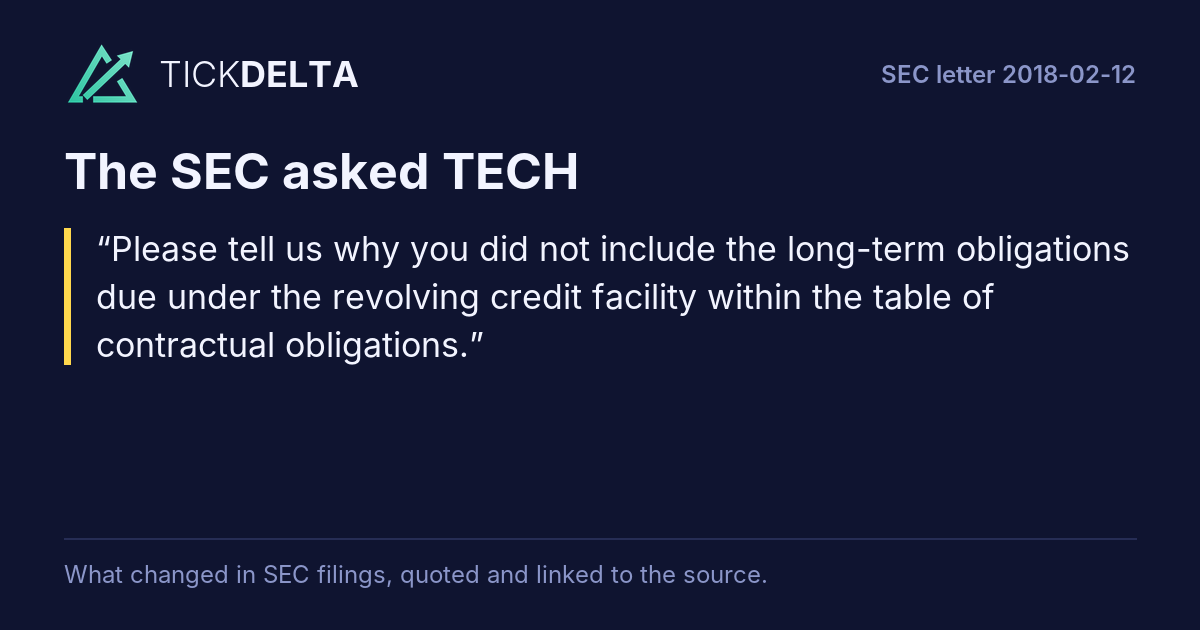
Please tell us why you did not include the long-term obligations due under the revolving credit facility within the table of contractual obligations.
Historically, we have not included our revolving credit facility within the table of contractual obligations. The terms of our facility do not require any minimum annual payments in advance of the maturity date of July 28, 2021. Both the maturity date and amount outstanding of our credit facility are disclosed in our Form 10-K. However, after review of the guidance, we have determined that we should include the revolving credit facility in the table of contractual obligations.Read in the reply ↗Rest of the answer
In future Form 10-K filings, we will ensure that our credit facility is included in the table of contractual obligations.
First report after the company's reply of 2018-02-23: 10-Q filed 2018-05-09 ↗, against the 10-Q filed 2018-02-08 ↗.
Tickdelta does not hold the text of both reports, so they are not compared here.
Please tell us the amount of net sales for each of your five product lines within the Biotechnology segment for the year ended June 30, 2017 and for the six months ended December 31, 2017. Also tell us what factors determine that a group of products constitute a product line and your consideration for providing disclosures for each of these product lines pursuant to ASC 280-10-50-40.
The products within the Biotechnology reporting segment represent a similar group of products in that they are variations of protein reagents and tools to further validate the encoding of proteins. More specifically, all of our products in this segment are consumables used by both industry and academic scientists for conducting laboratory experiments. ASC 280-10-50-40 requires that a public entity report the revenues from external customers for each product and service or each group of similar products unless it is impracticable to do so.Read in the reply ↗Rest of the answer
Because the Bio-technology segment represents a similar group of products, we believe our current disclosures at the segment level are in accordance with ASC 280-10-50-40.
We attempt to group our products into product lines for managing our business as this information is useful to management to provide directional information about our customer’s preferences including which brands are doing well and the market penetration of recent acquisitions. However, given the number of acquisitions and the frequent addition of new products at our existing operations, the gathering of this data is a manual process. As a result, there are inconsistencies with how products are grouped between regions and between our subsidiaries. Therefore, we are unable to provide the amount of net sales for each of our five product lines within the Biotechnology segment for the year ended June 30, 2017 and for the six months ended December 31, 2017.
***
We acknowledge that we are responsible for the adequacy and accuracy of the disclosure in the filing, that Staff comments or changes to disclosure in response to Staff comments do not foreclose the Commission from taking any action with respect to the filing, and that we may not assert Staff comments as a defense in any proceeding initiated by the Commission or any person under the federal securities laws of the United States.
On behalf of the company, I thank you for your consideration of our responses. Should the Staff have further questions or comments or need any further information or clarification, please do not hesitate to contact me.
First report after the company's reply of 2018-02-23: 10-Q filed 2018-05-09 ↗, against the 10-Q filed 2018-02-08 ↗.
Tickdelta does not hold the text of both reports, so they are not compared here.
Refer to your response to comment two. Please explain how the Advanced Cell Diagnostics product line is similar in nature to the proteins, antibodies, immunoassays and small molecules products. It appears that the primary product portfolio in the ACD business, genomic in situ hybridization, is not similar to your core biotechnology business.Rest of the question
For example, it appears the opportunities for growth in the ACD product line are greater than for the other product lines. You disclose on page 17 of the Form 10-Q for the quarterly period ended December 31, 2017, that the ACD product category contributed substantially, with over 40% growth for the quarter and six months ended December 31, 2017 that was driven by the rapid research market adoption of your RNA-ISH technology. In addition, please address the disclosure on page 22 of the 10-K that in fiscal 2017, the biggest impact to gross margin as compared to fiscal 2016, was the change in product mix associated with the acquisition of ACD. Please confirm whether the product lines in the Biotechnology segment have similar gross margins. Finally, while you state that you are unable to provide the net sales for each of your five product lines within the biotechnology segment, it appears based on your disclosure of the impact of the ACD product categories that you are able to make some reasonable estimates. In this regard, provide us your estimate of the ACD product categories as a percentage of your consolidated net sales for the six months ended December 31, 2017.
The acquisition of Advanced Cell Diagnostics (ACD) brought the in situ genomic hybridization to our portfolio of products. Therefore, we needed to assess if the ACD product line was similar to our existing core biotechnology business which we previously determined could be aggregated. The terms of our purchase of ACD included contingent consideration payments based on future performance which extended in to fiscal year 2018.Read in the reply ↗Rest of the answer
Therefore, as of June 30, 2107 the ACD business had not been fully integrated in to the core bio-technology business processes and financial information remained stand alone in the general ledger systems we acquired such that specific revenue and gross margin information was available for this product line and was used are part of our assessment.
All of our products offered by ACD and the legacy biotechnology business are consumables used for conducting laboratory experiments by both industry and academic scientists within the biotechnology and biomedical life science fields. Specifically, our customers are focused on understanding the biological processes for a variety of diseases and pathological conditions such as cancer, autoimmunity, diabetes, hypertension, obesity, inflammation, neurological disorders, and kidney failure. A critical piece of their research is understanding the underlying cell behavior at both the protein and genetic levels within the cell. Our protein, antibodies, immunoassays, and small molecules products in the legacy biotechnology business are tools to help our customers analyze the protein component of cells, and the ACD technology allows our customers to analyze the genetic changes within cells. When used together, our customers have a more complete set of tools to study normal and abnormal cell behavior. Further the production of ACD products requires skilled labor including trained chemists and biologists like our legacy bio-technology business and uses the same or similar raw materials, and has similar degrees of labor intensiveness.
On page 22 of our Form 10-K, we disclose that management uses adjusted results to monitor and evaluate performance of the Company’s three business segments. Therefore, our assessment also focused on a comparison of adjusted gross margins. Adjusted gross margins exclude reversal of acquired inventory fair value step-up and the amortization of acquired technology. For the year ended June 30, 2017 the adjusted gross margin of our legacy bio-technology business was 80.7% compared to the adjusted gross margin on the Advanced Cell Diagnostics (ACD) business of 79.1% and we expect these margins will continue to be similar. We believe these similar gross margins further support the aggregation of these products for disclosure.
As noted by the staff, on page 22 of our Form 10-K, we disclosed that in fiscal 2017 the biggest impact to gross margin as compared to fiscal 2016, was the change in product mix associated with the acquisition of ACD. We acknowledge that this disclosure was not as clear as it could have been. Our reference to product mix means that the amount of reversal of the acquired inventory fair value step-up and amortization of acquired technology included in cost of goods sold was higher in fiscal 2017 due to the addition of the ACD business. Thus the acquisition of ACD had a negative impact on our consolidated gross margin. The table on page 22 reconciling consolidated gross margin percentage to adjustment gross margin percentages summarizes the impact of these acquisition related costs for our investors.
In addition to margins, we also considered revenue growth opportunities. As ACD was an early stage company when it was acquired, significant growth was expected. There has been significant growth since the time of the acquisition, and we anticipate that we will continue see higher growth rates compared to our core biotechnology business in the near term. However, as of June 30, 2017, we concluded that over the long-term, the revenue growth rates for the current ACD products will be similar to the legacy biotechnology business within five to ten years. We continually reassess this conclusion as we look at strategic opportunities to better support our businesses and facilitate global growth.
Finally, we considered if there were any regulatory differences with the ACD products. Like our legacy biotechnology products, ACD products are initially classified as research use only (RUO) and in order to be used in a clinical diagnostics application certain Food and Drug Administration (FDA) approvals must be obtained.
For the six-month period ended December 31, 2017, the ACD business represented 8% of our consolidated revenue and predominately relates to the sales of consumables described above. A portion of the ACD revenue for this period relates to services performed by ACD. ACD recognizes service revenue when we perform tests using our products for the customer rather than the customer performing the tests themselves, or when we develop custom products for the customer. However, the ACD services revenue is less 2% of consolidated revenue and is considered immaterial for separate disclosure at this time.
Based on consideration of the factors described above, we believe that the products and services within the Bio-technology segment are appropriately combined for purposes of the disclosure requirements prescribed by ASC 280-10-50-40. To further clarify this determination for our investors we intend to include an additional disclosure within segment footnote of our future Form 10-K filings. Specifically, we will state that the revenues from external customers within each of our segments represent a similar group of products.
***
We acknowledge that we are responsible for the adequacy and accuracy of the disclosure in the filing, that Staff comments or changes to disclosure in response to Staff comments do not foreclose the Commission from taking any action with respect to the filing, and that we may not assert Staff comments as a defense in any proceeding initiated by the Commission or any person under the federal securities laws of the United States.
On behalf of the company, I thank you for your consideration of our responses. Should the Staff have further questions or comments or need any further information or clarification, please do not hesitate to contact me.
First report after the company's reply of 2018-04-05: 10-Q filed 2018-05-09 ↗, against the 10-Q filed 2018-02-08 ↗.
Tickdelta does not hold the text of both reports, so they are not compared here.
Also in this review: closing letter, 2018-05-01