Paragraph 4 · 46% changed
Every version of it
Screener
/
SEC EDGAR
/CIK 0001660280
/10-K filed Feb 27, 2026, compared with Feb 24, 2025
/Numbers from the XBRL of the 10-Ks
Nasdaq
Technology · Software
Tenable Holdings, Inc. TENB
The 10-K against last year's
140 changes: 16 added, 41 removed, 77 reworded, 6 quiet changes
10-K Feb 27, 2026 vs Feb 24, 2025
Risk Factors
17.9%
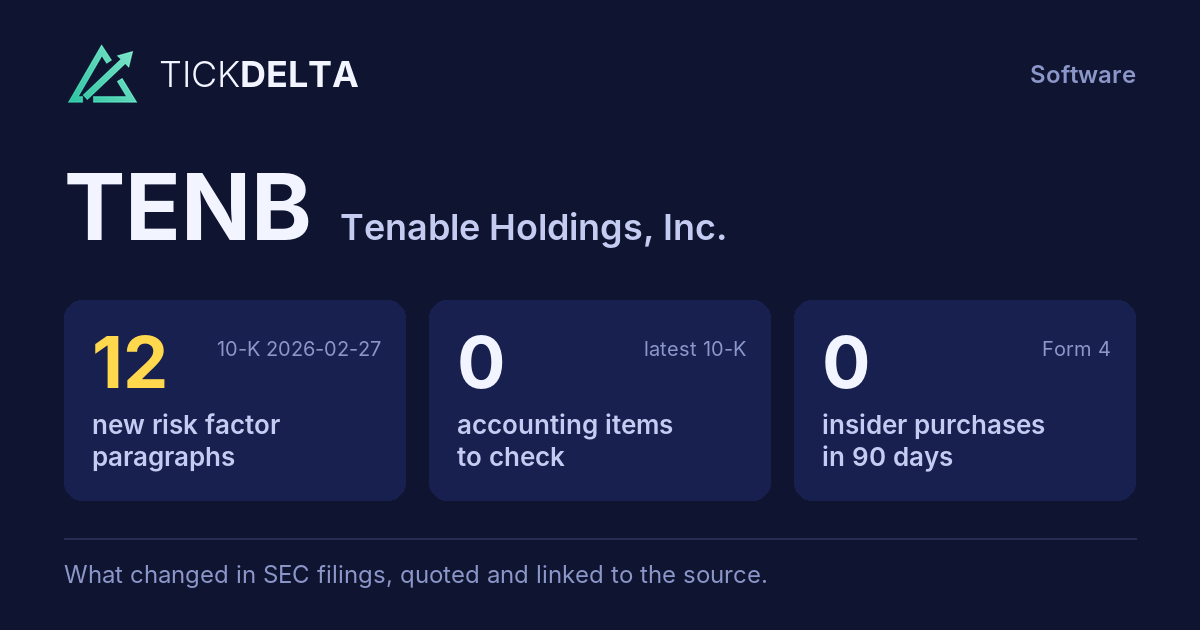
of the text changed · 25,555 words now · 12 new paragraphs, 11 gone
MD&A
22.5%
of the text changed · 5,933 words now · 4 new paragraphs, 30 gone
Legal Proceedings
2.8%
of the text changed · 182 words now
Accounting Policies
8.8%
of the text changed · 3,717 words now
10-K 0001660280-26-000005 (Feb 27, 2026) vs 10-K 0001660280-25-000034 (Feb 24, 2025)
Every paragraph, and how much of it changed
One bar per paragraph, in the order of the 10-K. Height and colour show the share of its words not in the closest paragraph a year earlier; the tallest bars are new paragraphs.
Risk Factors
297 paragraphs · 12 new · 82 reworded · 11 gone · 10-K Feb 27, 2026 against Feb 24, 2025
New paragraph
Reworded (5% of its words or more)
Same or nearly
Paragraph 120 · 46% changed
Every version of it
Paragraph 208 · 44% changed
Every version of it
A number of sustainability disclosure regulations have been enacted, including the State of California's climate disclosure statutes. Failure or perceived failure to comply with these disclosure requirements sustainability regulations or other perceived shortcomings in regulatory or voluntary sustainability disclosures could lead to regulatory investigations, litigation, reputational harm, and other adverse business consequences.
Paragraph 280 · 44% changed
Every version of it
We are subject to the anti-bribery laws of the jurisdictions in which we operate. These include the FCPA, the U.S. domestic bribery statute contained in 18 U.S.C. § 201, the U.S. Travel Act, the U.K. Bribery Act 2010, and other anti-corruption laws in countries in which we conduct activities. Anti-corruption laws are interpreted broadly and prohibit our company from authorizing, offering, or providing, directly or indirectly, improper payments or benefits in order to gain or maintain business, including payments to recipients in the public or private sector. We use third-party law firms, accountants, and other representatives for regulatory compliance, sales, and other purposes in several countries. We sell directly and indirectly, via third-party representatives, to both private and government sectors in the United States and in other jurisdictions. Our employees and third-party representatives interact with these customers, which may include government officials. We can be held liable for the corrupt or other illegal activities of these third-party representatives, our employees, contractors, and other agents, even if we do not explicitly authorize such activities. Noncompliance with these laws could subject us to whistleblower complaints, investigations, sanctions, settlements, prosecution, other enforcement actions, disgorgement of profits, significant fines, damages, other civil and criminal penalties or injunctions, suspension and/or debarment from contracting with certain persons, the loss of export privileges, reputational harm, adverse media coverage, and other collateral consequences. If any subpoenas or investigations are launched, or governmental or other sanctions are imposed, or if we do not prevail in any possible civil or criminal litigation, our reputation, business, results of operations and financial condition could be materially harmed. In addition, responding to any action will likely result in a materially significant diversion of management’s attention and resources and significant defense costs and other professional fees. Enforcement actions and sanctions could further harm our business, results of operations, and financial condition. Moreover, as an issuer of securities, we also are subject to the accounting and internal controls provisions of the FCPA. These provisions require us to maintain accurate books and records and a system of internal controls sufficient to detect and prevent corrupt conduct. Failure to abide by these provisions may have an adverse effect on our business, operations or financial condition.
Paragraph 21 · 42% changed
Every version of it
Paragraph 68 · 41% changed
Every version of it
Our AI technology features may also generate output that is misleading, insecure, inaccurate, harmful or otherwise flawed. Agentic AI solutions may compound those risks by taking or implementing actions or outputs, which themselves may be based on flawed outputs, that further increase the risk of misleading, insecure, inaccurate, harmful or otherwise flawed outcomes. This risk extends to our enterprise operations, as employee use of unvetted third-party agentic AI solutions, such as browser plug-ins or other automated applications, could result in actions being taken without adequate human review or monitoring. Such unauthorized automated actions could, for example, lead to the inadvertent disclosure or modification of corporate data or other sensitive information, flawed communications to customers or partners, or the creation of unintended legal or financial obligations on behalf of the company. Our customers or others may rely on or use such misleading, insecure, harmful or otherwise flawed content to their detriment, which may harm our brand, reputation, business or customers, cause competitive harm or expose us to legal liability. For example, AI algorithms use machine learning and predictive analytics which may be insufficient or of poor quality and reflect inherent biases and could lead to flawed, biased, and inaccurate results. Deficient or inaccurate recommendations, forecasts, or analyses that generative AI applications assist in producing could lead to customer rejection or skepticism of our products, affect our reputation or brand, and negatively affect our financial results. Further, unauthorized use or misuse of AI by our employees or others may result in disclosure of confidential company and customer data, reputational harm, privacy law violations and legal liability. Our use of generative AI may also lead to novel and urgent cybersecurity risks, including those related to personal data, which may adversely affect our operations and reputation. reputation, and these risks likely are compounded by our use of agentic AI.
Paragraph 51 · 40% changed
Every version of it
Paragraph 223 · 39% changed
Every version of it
Certain U.S. government contracts may require our employees to maintain various levels of security clearances, and may require us to maintain a facility security clearance, to comply with Department the requirements of Defense, or DoD, requirements. The DoD has certain government agencies, which have strict security clearance requirements for personnel who perform work in support of classified programs. Obtaining and maintaining a facility clearance and security clearances for employees can be a difficult, sometimes lengthy process. If we do not have employees with the appropriate security clearances, then a customer requiring classified work could terminate an existing contract or decide not to renew the contract upon its expiration. To the extent we are not able to obtain or maintain a facility security clearance, we may not be able to bid on or win new classified contracts, and existing contracts requiring a facility security clearance could be terminated.
Paragraph 4 · 46% changed
Every version of it
10-K Feb 24, 2025the following risks or others not specified below materialize, our business, financial condition and results of operations could be materially and adversely affected.
10-K Feb 27, 2026
•Our business, financial condition and results of operations could be materially adversely affected by global economic, political and geopolitical tensions.
Paragraph 120 · 46% changed
Every version of it
10-K Feb 24, 2025A portion of our revenue is generated from subscriptions and perpetual licenses sold to governmental entities in the United States. Additionally, many of our current and prospective customers, such as those in the financial services, energy, insurance and healthcare industries, are highly regulated and may be required to comply with more stringent regulations in connection with subscribing to and implementing our enterprise platform. Selling licenses to these entities can be highly competitive, expensive and time-consuming, often requiring significant upfront time and expense without any assurance that we will successfully complete a sale. Governmental demand and payment for our enterprise platform may also be impacted by public sector budgetary cycles and funding authorizations, with funding reductions or delays adversely affecting public sector demand for our enterprise platform. In addition, governmental entities have the authority to terminate contracts at any time for the convenience of the government, which creates risk regarding revenue anticipated under our existing government contracts.
10-K Feb 27, 2026
any assurance that we will successfully complete a sale. Governmental demand and payment for our enterprise platform may also be impacted by public sector budgetary cycles and funding authorizations, the operational stability of federal agencies, and the prioritization of cybersecurity and digital infrastructure initiatives. Funding reductions or delays, including those resulting from a U.S. government shutdown, reductions or eliminations of agency operating budgets or deprioritization of cybersecurity digital infrastructure related initiatives would adversely affect public sector demand for our enterprise platform. For example, the U.S. presidential administration's priorities and actions to reduce government spending, including, but not limited to, those previously driven by the Department of Government Efficiency, may impact the availability of funding for U.S. government customers as a result of the elimination of departments and personnel. These actions may lead to elongated sales cycles and procurement decisions and could result in fewer contract opportunities or reduced funding for existing initiatives, all of which would adversely affect our business and financial performance. In addition, governmental entities have the authority to terminate contracts at any time for the convenience of the government, which creates risk regarding revenue anticipated under our existing government contracts.
Paragraph 208 · 44% changed
Every version of it
10-K Feb 24, 2025
with these disclosure requirements could lead to regulatory investigations, litigation, reputational harm, and other adverse business consequences.
10-K Feb 27, 2026
A number of sustainability disclosure regulations have been enacted, including the State of California's climate disclosure statutes. Failure or perceived failure to comply with sustainability regulations or other perceived shortcomings in regulatory or voluntary sustainability disclosures could lead to regulatory investigations, litigation, reputational harm, and other adverse business consequences.
Paragraph 280 · 44% changed
Every version of it
10-K Feb 24, 2025
We are subject to the anti-bribery laws of the jurisdictions in which we operate. These include the FCPA, the U.S. domestic bribery statute contained in 18 U.S.C. § 201, the U.S. Travel Act, the U.K. Bribery Act 2010, and other anti-corruption laws in countries in which we conduct activities. Anti-corruption laws are interpreted broadly and prohibit our company from authorizing, offering, or providing, directly or indirectly, improper payments or benefits in order to gain or maintain business, including payments to recipients in the public or private sector. We use third-party law firms, accountants, and other representatives for regulatory compliance, sales, and other purposes in several countries. We sell directly and indirectly, via third-party representatives, to both private and government sectors in the United States and in other jurisdictions. Our employees and third-party representatives interact with these customers, which may include government officials. We can be held liable for the corrupt or other illegal activities of these third-party representatives, our employees, contractors, and other agents, even if we do not explicitly authorize such activities. Noncompliance with these laws could subject us to whistleblower complaints, investigations, sanctions, settlements, prosecution, other enforcement actions, disgorgement of profits, significant fines, damages, other civil and criminal penalties or injunctions, suspension and/or debarment from contracting with certain persons, the loss of export privileges, reputational harm, adverse media coverage, and other collateral consequences. If any subpoenas or investigations are launched, or governmental or other sanctions are imposed, or if we do not prevail in any possible civil or criminal litigation, our reputation, business, results of operations and financial condition could be materially harmed. In addition, responding to any action will likely result in a materially significant diversion of management’s attention and resources and significant defense costs and other professional fees. Enforcement actions and sanctions could further harm our business, results of operations, and financial condition. Moreover, as an issuer of securities, we also are subject to the accounting and internal controls provisions of the FCPA. These provisions require us to maintain accurate books and records and a system of internal controls sufficient to detect and prevent corrupt conduct. Failure to abide by these provisions may have an adverse effect on our business, operations or financial condition.
10-K Feb 27, 2026
We are subject to the anti-bribery laws of the jurisdictions in which we operate. These include the FCPA, the U.S. domestic bribery statute contained in 18 U.S.C. § 201, the U.S. Travel Act, the U.K. Bribery Act 2010, and other anti-corruption laws in countries in which we conduct activities. Anti-corruption laws are interpreted broadly and prohibit our company from authorizing, offering, or providing, directly or indirectly, improper payments or benefits in order to gain or maintain business, including payments to recipients in the public or private sector. We use third-party law firms, accountants, and other representatives for regulatory compliance, sales, and other purposes in several countries. We sell directly and indirectly, via third-party representatives, to both private and government sectors in the United States and in
Paragraph 21 · 42% changed
Every version of it
10-K Feb 24, 2025the following risks or others not specified below materialize, our business, financial condition and results of operations could be materially and adversely affected.
10-K Feb 27, 2026
Our business, financial condition and results of operations could be materially adversely affected by global economic, political and geopolitical tensions.
Paragraph 68 · 41% changed
Every version of it
10-K Feb 24, 2025
poor quality and reflect inherent biases and could lead to flawed, biased, and inaccurate results. Deficient or inaccurate recommendations, forecasts, or analyses that generative AI applications assist in producing could lead to customer rejection or skepticism of our products, affect our reputation or brand, and negatively affect our financial results. Further, unauthorized use or misuse of AI by our employees or others may result in disclosure of confidential company and customer data, reputational harm, privacy law violations and legal liability. Our use of generative AI may also lead to novel and urgent cybersecurity risks, including related to personal data, which may adversely affect our operations and reputation.
10-K Feb 27, 2026
Our AI technology features may also generate output that is misleading, insecure, inaccurate, harmful or otherwise flawed. Agentic AI solutions may compound those risks by taking or implementing actions or outputs, which themselves may be based on flawed outputs, that further increase the risk of misleading, insecure, inaccurate, harmful or otherwise flawed outcomes. This risk extends to our enterprise operations, as employee use of unvetted third-party agentic AI solutions, such as browser plug-ins or other automated applications, could result in actions being taken without adequate human review or monitoring. Such unauthorized automated actions could, for example, lead to the inadvertent disclosure or modification of corporate data or other sensitive information, flawed communications to customers or partners, or the creation of unintended legal or financial obligations on behalf of the company. Our customers or others may rely on or use such misleading, insecure, harmful or otherwise flawed content to their detriment, which may harm our brand, reputation, business or customers, cause competitive harm or expose us to legal liability. For example, AI algorithms use machine learning and predictive analytics which may be insufficient or of poor quality and reflect inherent biases and could lead to flawed, biased, and inaccurate results. Deficient or inaccurate recommendations, forecasts, or analyses that generative AI applications assist in producing could lead to customer rejection or skepticism of our products, affect our reputation or brand, and negatively affect our financial results. Further, unauthorized use or misuse of AI by our employees or others may result in disclosure of confidential company and customer data, reputational harm, privacy law violations and legal liability. Our use of generative AI may also lead to novel and urgent cybersecurity risks, including those related to personal data, which may adversely affect our operations and reputation, and these risks likely are compounded by our use of agentic AI.
Paragraph 51 · 40% changed
Every version of it
10-K Feb 24, 2025We rely on third-party service providers and technologies to operate critical business systems, including processing confidential and sensitive information, including, without limitation, cloud-based infrastructure, data center facilities, encryption and authentication technology, employee email and other functions. We also rely on third-party service providers to provide other products, services, or otherwise, to operate our business and elements of our infrastructure, including endpoints. Our ability to monitor these third parties' information security practices is limited, and these third parties may not have adequate information security measures in place. Additionally, software errors or vulnerabilities in these third-party technologies could result in significant disruptions to our information technology systems, leading to downtime, data loss, or compromised data integrity.
10-K Feb 27, 2026
parties may not have adequate information security measures in place. Additionally, software errors or vulnerabilities in these third-party technologies could result in significant disruptions to our information technology systems, leading to downtime, data loss, or compromised data integrity.
Paragraph 223 · 39% changed
Every version of it
10-K Feb 24, 2025
Certain U.S. government contracts may require our employees to maintain various levels of security clearances, and may require us to maintain a facility security clearance, to comply with Department of Defense, or DoD, requirements. The DoD has strict security clearance requirements for personnel who perform work in support of classified programs. Obtaining and maintaining a facility clearance and security clearances for employees can be a difficult, sometimes lengthy process. If we do not have employees with the appropriate security clearances, then a customer requiring classified work could terminate an existing contract or decide not to renew the contract upon its expiration. To the extent we are not able to obtain or maintain a facility security clearance, we may not be able to bid on or win new classified contracts, and existing contracts requiring a facility security clearance could be terminated.
10-K Feb 27, 2026
Certain U.S. government contracts may require our employees to maintain various levels of security clearances, and may require us to maintain a facility security clearance, to comply with the requirements of certain government agencies, which have strict security clearance requirements for personnel who perform work in support of classified programs.
MD&A
103 paragraphs · 4 new · 38 reworded · 30 gone · 10-K Feb 27, 2026 against Feb 24, 2025
New paragraph
Reworded (5% of its words or more)
Same or nearly
Paragraph 11 · 46% changed
Paragraph 4 · 45% changed
Tenable One is an One, our AI-powered exposure management platform that platform, gives enterprises a single, unified view of risk across all types of assets and attack pathways. The platform combines broad, industry-leading vulnerability coverage, spanning IT assets, cloud resources, containers, web apps apps, identity systems, third-party connectors and identity systems. Tenable One builds on the speed AI-related assets and breadth of vulnerability coverage from our research team of cybersecurity and data science experts, or Tenable Research, and adds aggregated exposure view analytics, guidance on mitigating attack pathways and a centralized asset inventory. It leverages AI, and machine learning, or ML, rapidly analyzing and interpreting vast data sets to pinpoint priority weaknesses and high-risk attack paths, deliver recommendations and automate routine tasks. workloads.
Paragraph 88 · 42% changed
Paragraph 5 · 36% changed
Our platform offerings solutions are primarily sold on a subscription basis with a one-year term. term, but are increasingly being sold with longer contractual durations. Our subscription terms are generally not longer than three years. These offerings subscriptions are typically prepaid invoiced in advance. advance at the beginning of the term, however multi-year subscriptions are increasingly being invoiced annually in installments.
Paragraph 96 · 32% changed
We account for business combinations by recognizing the fair value of acquired assets and liabilities. The excess purchase consideration over the fair value of acquired assets and liabilities is recorded as goodwill. When determining the fair value of assets acquired and liabilities assumed, a non-recurring Level 3 fair value measurement, we make estimates and assumptions, especially with respect to intangible assets such as identified acquired technology and trade names. We generally determine the fair value of acquired technology using the multi-period excess earnings method, a form of the income approach. However, in certain situations we may use the cost approach. Estimates in valuing identifiable intangible assets include, but are not limited to, projected revenue growth rates, obsolescence projections and an appropriate discount rate. Our estimate of fair value is based upon assumptions we believe to be reasonable, but which are inherently uncertain and, as a result, actual results may differ from estimates. During the measurement period, we may make adjustments to the fair value of assets acquired and liabilities assumed, with offsetting adjustments to goodwill.
Paragraph 97 · 25% changed
Paragraph 81 · 24% changed
At December 31, 2024, 2025, we had other non-cancellable purchase obligations of $24.5 $25.8 million due in the next twelve months and $10.5 $7.9 million due thereafter. Additionally, we had $8.5 million of unrecognized tax benefits and $1.4 million of asset retirement obligations, the timing of payments for which is uncertain.
Paragraph 40 · 24% changed
Restructuring expenses consist of non-ordinary course severance, employee related benefits and other charges to reorganize business operations. In the three months ended December 31, 2025, we recorded $3.1 million of restructuring
Paragraph 11 · 46% changed
10-K Feb 24, 2025We use the non-GAAP measure of calculated current billings, which we believe is a key metric to measure our periodic performance. Given that most of our customers pay in advance, we typically recognize a majority of the related revenue ratably over time. We use calculated current billings to measure and monitor our ability to provide our business with the working capital generated by upfront payments from our customers.
10-K Feb 27, 2026
Historically we have used calculated current billings as a key metric to measure our periodic performance and to measure and monitor our ability to provide our business with the working capital generated by upfront payments from our customers. Recently, however, the shift to annual installment billing for larger multi-year transactions is reducing our overall billing duration. We believe this shift creates a negative distortion in calculated current billings that fails to accurately represent the growth of our business and as such we have transitioned away from relying on calculated current billings to monitor performance of our business. We have included calculated current billings for comparative purposes.
Paragraph 4 · 45% changed
10-K Feb 24, 2025
Tenable One is an AI-powered exposure management platform that gives enterprises a single, unified view of risk across all types of assets and attack pathways. The platform combines broad, industry-leading vulnerability coverage, spanning IT assets, cloud resources, containers, web apps and identity systems. Tenable One builds on the speed and breadth of vulnerability coverage from our research team of cybersecurity and data science experts, or Tenable Research, and adds aggregated exposure view analytics, guidance on mitigating attack pathways and a centralized asset inventory. It leverages AI, and machine learning, or ML, rapidly analyzing and interpreting vast data sets to pinpoint priority weaknesses and high-risk attack paths, deliver recommendations and automate routine tasks.
10-K Feb 27, 2026
Tenable One, our AI-powered exposure management platform, gives enterprises a single, unified view of risk across all types of assets and attack pathways. The platform combines broad, industry-leading vulnerability coverage, spanning IT assets, cloud resources, containers, web apps, identity systems, third-party connectors and AI-related assets and workloads.
Paragraph 88 · 42% changed
10-K Feb 24, 2025Our subscription arrangements generally have annual or multi-year contractual terms to use our software or cloud-based solutions, including ongoing software updates during the contractual period. For software subscriptions that are dependent on ongoing software updates and the ability to identify the latest cybersecurity vulnerabilities, revenue is recognized ratably over the subscription term given the critical utility provided by the ongoing updates that are released through the contract period. When the critical utility of our software does not depend on ongoing updates, we recognize revenue attributable to the license at the time of delivery and the revenue attributable to the maintenance and support ratably over the contract period.
10-K Feb 27, 2026
software does not depend on ongoing updates, we recognize revenue attributable to the license at the time of delivery and the revenue attributable to the maintenance and support ratably over the contract period.
Paragraph 5 · 36% changed
10-K Feb 24, 2025
Our platform offerings are primarily sold on a subscription basis with a one-year term. Our subscription terms are generally not longer than three years. These offerings are typically prepaid in advance.
10-K Feb 27, 2026
Our solutions are primarily sold on a subscription basis with a one-year term, but are increasingly being sold with longer contractual durations. Our subscription terms are generally not longer than three years. These subscriptions are typically invoiced in advance at the beginning of the term, however multi-year subscriptions are increasingly being invoiced annually in installments.
Paragraph 96 · 32% changed
10-K Feb 24, 2025
We account for business combinations by recognizing the fair value of acquired assets and liabilities. The excess purchase consideration over the fair value of acquired assets and liabilities is recorded as goodwill. When determining the fair value of assets acquired and liabilities assumed, a non-recurring Level 3 fair value measurement, we make estimates and assumptions, especially with respect to intangible assets such as identified acquired technology and trade names. We generally determine the fair value of acquired technology using the multi-period excess earnings method, a form of the income approach. However, in certain situations we may use the cost approach. Estimates in valuing identifiable intangible assets include, but are not limited to, projected revenue growth rates, obsolescence projections and an appropriate discount rate. Our estimate of fair value is based upon assumptions we believe to be reasonable, but which are inherently uncertain and, as a result, actual results may differ from estimates. During the measurement period, we may make adjustments to the fair value of assets acquired and liabilities assumed, with offsetting adjustments to goodwill.
10-K Feb 27, 2026
We account for business combinations by recognizing the fair value of acquired assets and liabilities. The excess purchase consideration over the fair value of acquired assets and liabilities is recorded as goodwill. When determining the fair value of assets acquired and liabilities assumed, a non-recurring Level 3 fair value measurement, we make estimates and assumptions, especially with respect to intangible assets such as identified acquired technology and trade names. We generally determine the fair value of acquired technology using the multi-period excess earnings method, a form of the
Paragraph 97 · 25% changed
10-K Feb 24, 2025We account for business combinations by recognizing the fair value of acquired assets and liabilities. The excess purchase consideration over the fair value of acquired assets and liabilities is recorded as goodwill. When determining the fair value of assets acquired and liabilities assumed, a non-recurring Level 3 fair value measurement, we make estimates and assumptions, especially with respect to intangible assets such as identified acquired technology and trade names. We generally determine the fair value of acquired technology using the multi-period excess earnings method, a form of the income approach. However, in certain situations we may use the cost approach. Estimates in valuing identifiable intangible assets include, but are not limited to, projected revenue growth rates, obsolescence projections and an appropriate discount rate. Our estimate of fair value is based upon assumptions we believe to be reasonable, but which are inherently uncertain and, as a result, actual results may differ from estimates. During the measurement period, we may make adjustments to the fair value of assets acquired and liabilities assumed, with offsetting adjustments to goodwill.
10-K Feb 27, 2026
income approach. However, in certain situations we may use the cost approach. Estimates in valuing identifiable intangible assets include, but are not limited to, projected revenue growth rates, obsolescence projections and an appropriate discount rate. Our estimate of fair value is based upon assumptions we believe to be reasonable, but which are inherently uncertain and, as a result, actual results may differ from estimates. During the measurement period, we may make adjustments to the fair value of assets acquired and liabilities assumed, with offsetting adjustments to goodwill. Any adjustments made after the measurement period will be reflected in the consolidated statements of operations. Acquisition-related costs are expensed as incurred.
Paragraph 81 · 24% changed
10-K Feb 24, 2025
At December 31, 2024, we had other non-cancellable purchase obligations of $24.5 million due in the next twelve months and $10.5 million due thereafter. Additionally, we had $8.5 million of unrecognized tax benefits and $1.4 million of asset retirement obligations, the timing of payments for which is uncertain.
10-K Feb 27, 2026
At December 31, 2025, we had other non-cancellable purchase obligations of $25.8 million due in the next twelve months and $7.9 million due thereafter.
Paragraph 40 · 24% changed
10-K Feb 24, 2025
Restructuring expenses consist of non-ordinary course severance, employee related benefits and other charges to reorganize business operations.
10-K Feb 27, 2026
Restructuring expenses consist of non-ordinary course severance, employee related benefits and other charges to reorganize business operations. In the three months ended December 31, 2025, we recorded $3.1 million of restructuring
A paragraph is matched with the one last year that shares the most of its words; under half in common makes it new. The paragraphs shown are the 8 reworded the most in each section.
The paragraph that changed most in each section
The redline
Marked against last year's 10-K: cut words struck through, new words highlighted.
Risk Factors264 words changed in this paragraph; it is 58% similar to last year's version.
Our success is dependent in part upon establishing and maintaining relationships with a variety of channel partners that we utilize to extend our geographic reach and market penetration. We typically use a two-tiered, channel model whereby we sell our products and services to our distributors, who in turn sell to our resellers, who then sell to our end users, who we call customers. We anticipate that we will continue to rely on this two-tiered sales model in order to help facilitate sales of our offerings as part of larger purchases in the United States and to grow our business internationally. In 2024, 2023 2025, 2024 and 2022, 2023, we derived 94%, 93% 94% and 92%, 93%, respectively, of our revenue from sales through channel partners, and the percentage of revenue derived from channel partners may continue to increase in future periods. Ingram Micro, Inc., a distributor, one of our distributors, accounted for 34%, 32%, 34% and 36% and 38% of our revenue in 2024, 2023 2025, 2024 and 2022, 2023, respectively, and 29% 27% of our accounts receivable at December 31, 2024 2025 and 32% 29% at December 31, 2023. 2024. Our agreements with reliance on these channel partners also means that any significant interruption to their systems could harm our channel partners, including our agreement with business. For example, a major distributor experiencing a significant operational failure or cybersecurity incident, such as the recent ransomware attack that impacted Ingram Micro, are non-exclusive could disrupt their ability to take orders and do not prohibit them from working with our competitors or offering competing solutions, and some of our channel partners may have more established relationships with our competitors. Similarly, our channel partners have no obligations to renew their agreements with us on commercially reasonable terms or at all, and certain of the agreements governing these relationships may be terminated by either party at any time, with no or limited notice. For example, our agreement with Ingram Micro allows Ingram Micro to terminate the agreement in their discretion upon 30 days’ written notice to us. If our channel partners choose to place greater emphasis on products of their own or those offered by our competitors or as a result of an acquisition, competitive factors or other reasons do not continue to market and sell our solutions in an effective manner or at all, distribute products. Any such interruption could negatively affect our ability to grow sell and distribute our business products through that partner, which could materially and sell adversely impact our solutions, particularly in key international markets, may be adversely affected. In addition, our failure to recruit additional channel partners, or any reduction or delay in their sales business, financial position, and results of our solutions and professional services, including as operations.
Source: Item 1A, 10-K 0001660280-26-000005 vs Item 1A, 10-K 0001660280-25-000034
Accounting Policies134 words changed in this paragraph; it is 45% similar to last year's version.
In December 2023, the Financial Accounting Standards Board (“FASB”) ("FASB") issued ASU 2023-09 - Income Taxes (Topic 740): Improvements to Income Tax Disclosures, which requires public entities to provide greater disaggregation within their the annual rate reconciliation, including new requirements to present reconciling items on a gross basis in specified categories, disclose both percentages and dollar amounts, and disaggregate individual reconciling items by jurisdiction and nature when the effect of the items meet a quantitative threshold. reconciliation. The guidance also requires disaggregating the annual disclosure of income taxes paid, net of refunds received, by federal (national), state, received. We have adopted ASU 2023-09 for the year ended December 31, 2025, and foreign taxes, with separate presentation of individual jurisdictions that meet a quantitative threshold. The guidance is effective for our have applied the new disclosure requirements prospectively to the current annual periods beginning January 1, 2025 on a prospective basis, with a retrospective option, and early adoption is permitted. Adopting this guidance will result in additional annual tax period. Prior period disclosures but will have not impact our provision for income taxes, deferred tax assets or deferred tax liabilities. been adjusted.
Source: Item 8, Note 1 – Business and Summary of Significant Accounting Policies, 10-K 0001660280-26-000005 vs Item 8, Note 1 – Business and Summary of Significant Accounting Policies, 10-K 0001660280-25-000034
MD&A112 words changed in this paragraph; it is 36% similar to last year's version.
Source: Item 7, 10-K 0001660280-26-000005 vs Item 7, 10-K 0001660280-25-000034
Legal Proceedings10 words changed in this paragraph; it is 92% similar to last year's version.
In July 2024, we entered into a new contract with AWS for cloud services, in which we committed to spend $59.7 million, $77.6 million and $93.0 million in contract years one, two and three, respectively, for a total commitment of $230.3 million from August 2024 to July 2027. As of December 31, 2024, 2025, we have met our first year commitment and we have spent $28.1 $31.3 million of our first second year commitment.
Source: Item 3, via Note 9 – Commitments and Contingencies, 10-K 0001660280-26-000005 vs Item 3, via Note 9 – Commitments and Contingencies, 10-K 0001660280-25-000034
Sentences and paragraphs added, removed or reworded
Every change, by type
Sentences and paragraphs of TENB's Risk Factors and MD&A, 10-K Feb 27, 2026 against 10-K Feb 24, 2025. Each links to the text at sec.gov.
Quiet changes are sentences kept from last year with one to four words changed, at least one of them a hedge, a modal or a qualifier (may, could, will, not, significant, material…). A year or date rolling forward is not counted.
The full word list
adverse, adversely, all, although, anticipate, anticipates, any, approximately, believe, believes, can, cannot, certain, could, expect, expects, generally, however, if, intend, intends, largely, likely, many, material, materially, may, might, most, must, never, no, not, possible, primarily, probable, should, significant, significantly, some, substantial, substantially, unlikely, will, would
AddedRisk Factors
We serve customers in many countries around the world and receive a significant portion of our revenue from outside the United States. Accordingly, our operations and execution are subject to the effects of global economic trends, geopolitical risks and disruptions to global markets, cross-border operations, supply chains or workforce availability resulting from events such as war or international conflict, a major terrorist attack, natural disasters or actual or threatened public health pandemics or other emergencies. Political developments or policy shifts in areas such as tariffs, export controls, including trade barriers, sanctions, technical or local content regulations, currency controls, global tax laws or other laws and policies, have been and may continue to be disruptive and costly to our business. These can interfere with our global operating model, customer relationships and competitive position. Escalation of tariffs or any other specific trade tensions, including potential decoupling between the United States and the European Union, or in global trade conflict more broadly could be harmful to global economic growth or to our business in or with the European Union or other countries. Deterioration of economic conditions or outlooks, such as lower rates of investment, lower economic growth, recession or fears of recession in the United States, Europe or other key markets, may adversely affect the demand for or profitability of our offerings, and the impact from developments outside the United States on our business performance can be significant given the extent of our global activities. Increased geopolitical tensions and outbreaks of armed conflict, as well as sanctions or other measures imposed in response, have in the past and in the future may cause disruption and instability in global markets, particular regions or countries, supply chains or commercial activity that adversely impact our business, financial condition, results of operations and cash flows and pose reputational risks. In addition, market uncertainty and volatility in various geographies may be magnified as a result of shifts in trade, economic and other policies. We also do business in emerging market jurisdictions where economic political and legal risks are heightened and the operating environments are complex.
Read it in 10-K Feb 27, 2026 at sec.gov
AddedRisk Factors
Some defects may cause our solutions to be vulnerable to attacks, cause them to fail to detect vulnerabilities, or temporarily interrupt customers’ networking traffic or operational technology environments, any of which may damage our customers’ business and could hurt our reputation.
Read it in 10-K Feb 27, 2026 at sec.gov
AddedRisk Factors
Datasets used in AI training, development, and operations may be insufficient, of poor quality, not fit for purpose, contain sensitive information, or reflect unwanted bias. If we do not have adequate rights to utilize the data or other materials and content that our AI technologies depend on, we may face legal consequences for violating applicable laws, third-party intellectual property, privacy or other rights, or contracts to which we are a party. The use of certain types or sources of data for AI training or development may require consent from data subjects, customers, or other data owners or custodians. We may not have insight into, or control over, the provenance of certain data that our AI technologies ingest. As laws evolve, we may be obligated to obtain certain consents for AI development that we had not previously sought and seeking any type of consent may be costly, impractical, and hinder competitive development or deployment of AI technologies. Customers are increasingly concerned about how their data may interact with AI technologies and may require us to make stronger assurances or contractual commitments to refrain or limit the use of customer data with AI technologies. This may adversely impact our ability to develop or improve AI technologies, which rely on a large volume of diverse and relevant data, including customer data, to produce more accurate, reliable, and predictable outputs.
Read it in 10-K Feb 27, 2026 at sec.gov
AddedRisk Factors
While AI features are presently increasing in popularity, we have no assurance that our AI technologies will continue to be accepted and sought by customers. The development of generative and agentic AI technologies is complex, and there are technical challenges associated with achieving the desired level of accuracy, efficiency, and reliability. The algorithms and models utilized in generative or agentic AI systems may have limitations, including biases, errors, or inability to handle certain data types or scenarios. Furthermore, there is a risk of system failures, disruptions, or vulnerabilities that could compromise the integrity, security or privacy of the generated content. These limitations or failures could result in reputational damage, legal liabilities, or loss of customer confidence, which, in turn, could result in lower than anticipated demand from customers to adapt our AI features. We have, and will continue, to dedicate significant resources to developing and deploying generative, agentic, or other AI features in our products and services, without assurances that we will, or will continue to, see customer demand and market conditions to support those investments.
Read it in 10-K Feb 27, 2026 at sec.gov
AddedRisk Factors
We rely, and likely will continue to rely, on third parties to support our use of AI in our products and services. Our ability to offer AI-powered products and services may be adversely impacted if any of our third-party AI providers, or other AI-related third-party vendors, develops or deploys AI tools that are unlawful, unreliable, unsecure, or unavailable. If we cannot use third-party AI, or that use is restricted, our business may be less efficient or we may be at a competitive disadvantage, which could adversely affect our business, financial condition, customer loyalty, and reputation.
Read it in 10-K Feb 27, 2026 at sec.gov
AddedRisk Factors
our operating results in the future and may reduce our ability to predict cash flow and optimize the timing of our operating expenses.
Read it in 10-K Feb 27, 2026 at sec.gov
AddedRisk Factors
we are subject to an increased risk of investigations, criminal prosecution, civil fraud claims, whistleblower lawsuits and other legal actions and liabilities as compared to solely private sector commercial companies.
Read it in 10-K Feb 27, 2026 at sec.gov
AddedRisk Factors
•global economic trends, competition and geopolitical risks, including evolving impacts from tariffs, sanctions or other trade tensions between the United States and other countries, or disruptions to global markets, cross-border operations, supply chains or workforce availability resulting from events such as a major terrorist attack, war, natural disasters or actual or threatened public health pandemics or other emergencies;
Read it in 10-K Feb 27, 2026 at sec.gov
Show the other 61
AddedRisk Factors
In addition, recent tariff actions and escalating trade tensions have contributed to heightened market uncertainty and increased operating costs for certain customers, which may cause private-sector customers to defer or reprioritize purchasing decisions as they assess potential impacts from ongoing trade negotiations and regulatory developments, which could extend enterprise procurement cycles and would adversely impact our business.
Read it in 10-K Feb 27, 2026 at sec.gov
AddedRisk Factors
Additionally, retaliatory trade policies or anti-U.S. sentiment in certain regions whether driven by trade tensions, political disagreements, or regulatory concerns may make customers more hesitant to adopt solutions offered by U.S.-based providers. This may lead to increased preference for local competitors, changes to government procurement policies, heightened regulatory scrutiny, decreased intellectual property protections, delays in regulatory approvals or other retaliatory regulatory non-tariff policies, the introduction of trade barriers applicable to digital services, which may result in heightened international legal and operational risks and difficulties in attracting and retaining non-U.S. customers, suppliers, employees, partners and investors.
Read it in 10-K Feb 27, 2026 at sec.gov
AddedRisk Factors
Trade disputes, trade restrictions, tariffs, and other political tensions between the United States and other countries may also exacerbate unfavorable macroeconomic conditions including inflationary pressures, foreign exchange volatility, financial market instability, and economic recessions or downturns, which may also negatively impact customer demand for our services, delay renewals or limit expansion opportunities with existing customers, limit our access to capital, or otherwise negatively impact our business and operations. Ongoing tariff and macroeconomic uncertainty has and may continue to contribute to volatility in the price of our common stock. Furthermore, if the equity and credit markets deteriorate, including as a result of political unrest or war, it may make any necessary debt or equity financing more difficult to obtain in a timely manner or on favorable terms, more costly or more dilutive.
Read it in 10-K Feb 27, 2026 at sec.gov
AddedRisk Factors
While we continue to monitor trade developments, the ultimate impact of these risks remains uncertain and any prolonged economic downturn, escalation in trade tensions, or deterioration in international perception of U.S.-based companies could materially and adversely affect our business, results of operations, financial condition and prospects. In addition, tariffs and other trade developments have and may continue to heighten the risks related to the other risk factors described elsewhere in this report.
Read it in 10-K Feb 27, 2026 at sec.gov
RemovedRisk Factors
RemovedRisk Factors
RemovedRisk Factors
RemovedRisk Factors
RemovedRisk Factors
RemovedRisk Factors
RemovedRisk Factors
RemovedRisk Factors
RemovedRisk Factors
RemovedRisk Factors
RemovedRisk Factors
RewordedRisk Factors
We have acquired products, technologies and businesses from other parties, such as recent acquisitions discussed in Note 6 of our acquisition of Vulcan Cyber Ltd., or Vulcan Cyber, which we announced in January 2025, our June 2024 acquisition of Eureka Security, Inc., or Eureka, and our October 2023 acquisition of Ermetic, Ltd., or Ermetic, consolidated financial statements, and we expect to expand our current business by acquiring additional businesses or technologies in the future.
Read it in 10-K Feb 27, 2026 at sec.gov
RewordedRisk Factors
For example, the European Union authorities recently adopted a legal framework on EU AI regulation, the Artificial Intelligence Act, which applies beyond the European Union’s borders and establishes obligations for AI providers and those deploying AI systems. systems, sets out a risk-based framework that subjects certain AI technologies to numerous compliance obligations, such as transparency, conformity and risk assessment, monitoring and human oversight requirements.
Read it in 10-K Feb 27, 2026 at sec.gov
RewordedRisk Factors
In addition, our failure to recruit additional channel partners, or any reduction or delay in their sales of our solutions and professional services, including as a result of economic uncertainty, legal or regulatory actions, such as government investigations or law enforcement activities, impacting their business, or conflicts between channel sales and our direct sales and marketing activities may harm our results of operations.
Read it in 10-K Feb 27, 2026 at sec.gov
RewordedRisk Factors
If we are unable to conclude that our internal control over financial reporting is effective, or if our independent registered public accounting firm determines we have a material weakness or significant deficiency in our internal control over financial reporting, we could lose investor confidence in the accuracy and completeness of our financial reports, the market price of our common stock could decline, and we could be subject to sanctions or investigations by the Nasdaq, the SEC or other regulatory authorities.
Read it in 10-K Feb 27, 2026 at sec.gov
RewordedRisk Factors
If we fail to maintain compatibility of our cloud platform and our other solutions with our customers’ network and security infrastructures, including for remote devices, our customers may not be able to fully utilize our solutions, and we may, among other consequences, lose or fail to increase our market share and experience reduced demand for our services, which would materially harm our business, operating results and financial condition.
Read it in 10-K Feb 27, 2026 at sec.gov
RewordedRisk Factors
Many U.S. and international governmental bodies and regulators have proposed, enacted or are in the process of developing, new regulations related to the use of AI and machine learning technologies. technologies, including the EU AI Act, Colorado AI Act, California Bot Disclosure Law, and Utah AI Policy Act, as well as regulations on certain high-risk automated decisions, such as those in the employment context.
Read it in 10-K Feb 27, 2026 at sec.gov
RewordedRisk Factors
Governmental demand and payment for our enterprise platform may also be impacted by public sector budgetary cycles and funding authorizations, with funding reductions or delays adversely affecting public sector demand for our enterprise platform. the operational stability of federal agencies, and the prioritization of cybersecurity and digital infrastructure initiatives.
Read it in 10-K Feb 27, 2026 at sec.gov
RewordedRisk Factors
Ingram Micro, Inc., a distributor, one of our distributors, accounted for 34%, 32%, 34% and 36% and 38% of our revenue in 2024, 2023 2025, 2024 and 2022, 2023, respectively, and 29% 27% of our accounts receivable at December 31, 2024 2025 and 32% 29% at December 31, 2023. 2024.
Read it in 10-K Feb 27, 2026 at sec.gov
RewordedRisk Factors
Certain U.S. government contracts may require our employees to maintain various levels of security clearances, and may require us to maintain a facility security clearance, to comply with Department the requirements of Defense, or DoD, requirements. certain government agencies, which have strict security clearance requirements for personnel who perform work in support of classified programs.
Read it in 10-K Feb 27, 2026 at sec.gov
RewordedRisk Factors
Nation-state actors and nation-state-supported actors may engage in such attacks for geopolitical reasons and in conjunction with military conflicts and defense activities, including around the ongoing conflict between Ukraine and Russia, the ongoing conflict in the Middle East, and rising tensions between China and Taiwan. world.
Read it in 10-K Feb 27, 2026 at sec.gov
RewordedRisk Factors
While the Federal Reserve decreased interest rates in 2024, 2025, interest rates remain high and the Federal Reserve is not expected elevated relative to significantly decrease interest rates in the immediate future. recent historical lows.
Read it in 10-K Feb 27, 2026 at sec.gov
RewordedRisk Factors
Moreover, as a U.S. government contractor, we maintain plans to ensure compliance with nondiscrimination applicable legal and regulatory contractual requirements for qualified employees on the basis of gender, race, disability and veteran status. related to nondiscrimination.
Read it in 10-K Feb 27, 2026 at sec.gov
Quiet changesRisk Factors
Quiet changesRisk Factors
If we fail to successfully promote and maintain our brand, or if we incur substantial expenses, we may fail to attract or retain customers necessary to realize a sufficient return on our brand-building efforts, or to achieve the widespread brand awareness that is critical for broad customer adoption of our solutions.
Read it in 10-K Feb 27, 2026 at sec.gov
Quiet changesRisk Factors
If we do not succeed in attracting well-qualified employees, retaining and motivating existing employees or maintaining our corporate culture in a hybrid or remote work environment, our business would will be adversely affected.
Read it in 10-K Feb 27, 2026 at sec.gov
Quiet changesRisk Factors
If we or the third parties upon which we rely fail, or are perceived to have failed, to address or comply with applicable data privacy and security obligations, we could face significant consequences.
Read it in 10-K Feb 27, 2026 at sec.gov
Quiet changesRisk Factors
For example, during periods with a relatively strong U.S. dollar, our products are more expensive for existing and prospective international customers, which has impacted, and could in the future could impact, the budgets and purchasing decisions of certain of our existing and prospective international customers.
Read it in 10-K Feb 27, 2026 at sec.gov
Quiet changesRisk Factors
In addition, higher inflation could also could increase our customers’ operating costs, which could result in reduced budgets for our customers, longer sales cycles and potentially less demand for our products.
Read it in 10-K Feb 27, 2026 at sec.gov
AddedMD&A
expense for non-ordinary course severance and employee-related benefits. We expect to record approximately $5.0 million in restructuring expense in the year ended December 31, 2026.
Read it in 10-K Feb 27, 2026 at sec.gov
AddedMD&A
(2) Stock-based compensation expense in 2025 includes $14.6 million of expense related to the accelerated vesting of equity awards for our former Chairman and Chief Executive Officer.
Read it in 10-K Feb 27, 2026 at sec.gov
AddedMD&A
•a $17.0 million increase in personnel costs, including $15.5 million in termination benefits including cash compensation and accelerated equity award vesting related to the passing of our former Chairman and Chief Executive Officer; and
Read it in 10-K Feb 27, 2026 at sec.gov
AddedMD&A
We have generated significant operating losses prior to and during 2025 as reflected by our accumulated deficit of $897.5 million at December 31, 2025.
Read it in 10-K Feb 27, 2026 at sec.gov
RemovedMD&A
RemovedMD&A
RemovedMD&A
RemovedMD&A
RemovedMD&A
RemovedMD&A
RemovedMD&A
RemovedMD&A
RemovedMD&A
RemovedMD&A
RemovedMD&A
RemovedMD&A
RewordedMD&A
From 2022 2024 to 2023, 2025, net cash used in investing activities increased by $84.6 $133.1 million, primarily due to an increase in cash paid for acquisitions of $176.5 million, partially offset by $167.0 million and a $71.6 $7.9 million net increase in sales of short-term investments, $10.0 million in cash paid for other investments in 2022, a $7.7 million decrease in purchases of property and equipment and equipment, partially offset by a $2.7 $41.2 million net decrease in capitalized software development costs. purchases of short-term investments.
Read it in 10-K Feb 27, 2026 at sec.gov
RewordedMD&A
From 2023 to 2024, net cash used in investing activities decreased by $171.2 million, primarily due to a decrease in cash paid for acquisitions of $214.1 million, a $3.5 million increase in proceeds from our investments in private companies and a $0.6 million decrease in capitalized software development costs, partially offset by a $43.3 million net decrease in sales of short-term investments, a $2.5 million increase in purchases of property and equipment, and a $1.3 million increase in cash paid for other investments.
Read it in 10-K Feb 27, 2026 at sec.gov
RewordedMD&A
From 2023 2024 to 2024, 2025, net cash used in financing activities increased by $80.7 $154.7 million, primarily due to an $85.0 a $147.5 million increase in the repurchase of common stock under our stock share repurchase program partially offset by a $4.6 million increase in proceeds from the exercise of stock options. program.
Read it in 10-K Feb 27, 2026 at sec.gov
RewordedMD&A
Exposure management is the evolution of an increasingly critical category that extends foundational vulnerability management, advancing management capabilities to advance risk assessment and prioritization across the entire attack surface – from IT infrastructure to and cloud environments to critical infrastructure. infrastructure and AI.
Read it in 10-K Feb 27, 2026 at sec.gov
RewordedMD&A
RewordedMD&A
RewordedMD&A
Year Ended December 31, (in thousands) 2025 2024 2023 2022 Net cash provided by operating activities $ 266,750 $ 217,476 $ 149,855 $ 131,151 Net cash used in investing activities (174,578) (41,431) (212,615) (128,039) Net cash (used in) provided by financing activities (234,095) (79,401) 1,251 23,318 Effect of exchange rate changes on cash and cash equivalents and restricted cash 1,038 (5,129) (2,225) (3,835) Net (decrease) increase (decrease) in cash and cash equivalents and restricted cash $ (140,885) $ 91,515 $ (63,734) $ 22,595
Read it in 10-K Feb 27, 2026 at sec.gov
RewordedMD&A
RewordedMD&A
The $1.4 $7.3 million decrease in interest income was primarily due to a decrease in cash and cash equivalents and short-term investments as well as lower interest rates on our cash and cash equivalents and short-term investments.
Read it in 10-K Feb 27, 2026 at sec.gov
RewordedMD&A
Our platform offerings solutions are primarily sold on a subscription basis with a one-year term. term, but are increasingly being sold with longer contractual durations.
Read it in 10-K Feb 27, 2026 at sec.gov
RewordedMD&A
RewordedMD&A
In October 2024, July 2025 and January 2026, our Board of Directors increased the repurchase authorization by $200 million. million, $250 million and $150 million, respectively.
Read it in 10-K Feb 27, 2026 at sec.gov
Sources
The two latest 10-Ks on EDGAR, section by section. Each change links to the text at sec.gov.
Also
New risk factors: paragraphs with nothing like them last year, quoted in full.
Work with it
Excel workbook · CSV. Google Sheet that stays up to date: paste =IMPORTDATA("https://tickdelta.com/company/TENB/export.csv") into a cell.