Added10-Q Oct 29, 2026 vs 10-K Feb 13, 2026
The following table provides information about our purchases during the quarter ended September 30, 2026 of our common stock that is registered by us pursuant to the Exchange Act.
Each branch is a paragraph in Risk Factors with nothing like it in the 10-K filed Feb 7, 2025. A box jumps to the paragraph as filed, below.
24 paragraphs in Risk Factors of the 10-K filed Feb 13, 2026 with nothing like them in the 10-K filed Feb 7, 2025. Quoted exactly. Paragraphs that were only edited are under 10-K change.
and realize the expected benefits of such transactions. While we believe that strategic acquisitions can improve our competitiveness and profitability, these activities could have a material adverse effect on our business, financial condition and operating results. We have consummated mergers and acquisitions in the past and anticipate making additional acquisitions in the future. On February 2, 2026, we closed on the REV Transaction. Our ability to realize the anticipated benefits of the REV Transaction, including the expected combination benefits, will depend, to a large extent, on the ability of management of the new combined company to integrate the businesses.
Our results after the completion of the REV Transaction may be adversely impacted if we do not effectively manage our expanded operations following the completion of the REV Transaction.
Following the recent REV Transaction, the size of our business is now significantly larger. Our ability to successfully manage this expanded business will depend, in part, upon management’s ability to design and implement strategic initiatives that address not only the integration of two independent stand-alone companies, but also the increased scale and scope of the combined business with its associated increased costs and complexity. There can be no assurances that we will be successful or that we will realize the expected operating efficiencies, cost savings and other benefits anticipated from the REV Transaction.
Potential divestitures, and any retained liabilities from such sold businesses, could negatively impact our business and financial results.
As part of our portfolio management process, we review our operations for businesses which may no longer be aligned with our strategic initiatives and long-term objectives. Concurrently with the public announcement of the execution of the REV Transaction, we announced that we would initiate a strategic review process regarding our Aerials business, including a possible divestiture of our Aerials business. We may not be able to complete a transaction providing for a disposition of our Aerials business on favorable terms or on our anticipated timeline, if at all. We also continue to review our portfolio and may pursue additional divestitures. Any such potential transaction involves risks, including, but not limited to, disruption to operations, loss of synergies, significant transaction costs, potential impairment charges, disputes with buyers and potential adverse impacts on relationships with customers, suppliers, and employees. If any such transaction is delayed, not completed, or completed on terms less favorable than anticipated, we may not realize the expected benefits of such divestiture transaction, and our business, financial condition, and results of operations could be materially adversely affected.
Certain of our businesses depend on the performance of dealers and disruptions within our dealer network could have a negative effect on our business.
Certain of our businesses rely on their independent dealer networks to sell our products to end customers. Such businesses are therefore affected by our ability to establish new relationships and maintain relationships with existing dealers. The geographic coverage of our dealers and their individual business conditions can affect the ability of our dealers to sell our products to customers. In a number of markets, there is a lack of exclusivity with dealers, which may decrease our bargaining leverage. In addition, recent consolidation of dealers in certain businesses, as well as the growth of larger, multi-location dealers, may result in increased bargaining power on the part of dealers, which could have a material adverse effect on our business.
While our dealer agreements are often for a multi-year term, we cannot provide assurance that we will be able to renew our dealer agreements on favorable terms, or at all, at their respective scheduled expiration dates. If one or more of our significant dealers chooses not to renew a contract with us or to re-negotiate an agreement under advantageous terms, our sales and results of operations could be adversely affected. Some of our dealer agreements include guarantees, which could have a negative impact on our financial performance if we are required to fulfill them. In addition, laws in many of the locations in which we operate make it difficult for us to terminate or not renew dealer agreements, which may make it difficult for us to optimize our dealer network.
Demand for our products is affected by the general strength of the economies in which we sell our products, customers’ perceptions concerning the timing of economic cycles, customers’ replacement or repair cycles, prevailing interest rates,
Certain of our businesses depend upon continued federal, state, and local government expenditures, which have not always remained constant over time. Current government spending levels on programs our businesses support may not be sustainable as a result of changes in government leadership, policies or priorities. Certain of our sales are subject to risks specific to doing business with the U.S. government and municipalities, including, but not limited to budgetary constraints or fluctuations, changes in government programs or requirements, realignment of funds to other government priorities, government shutdowns and other potential delays in government appropriations processes, delays in the payment of our invoices by government authorities, and adoption of new laws or regulations and our ability to meet specified performance thresholds. These or other factors could cause government agencies and departments to delay or reduce their purchases or deliveries under contracts, exercise their right to terminate contracts, or not exercise options to renew contracts, any of which could cause us to lose sales. A significant decline in overall government spending or a shift in expenditures away from agencies or programs that we support could cause a material decline in our sales and harm our financial results.
Some of our customers also depend substantially on government funding of highway construction, maintenance and other infrastructure projects. Policies of governments attempting to address local deficit or structural economic issues could have a material impact on our customers and markets. Any decrease or delay in government funding of highway construction and maintenance, other infrastructure projects and overall government spending could cause our revenues and profits to decrease.
Cancellations, reductions or delays in customer orders, customer breaches of purchase agreements, reduction in expected backlog, reductions in profitability of backlog due to fluctuations in product costs, or our inability to meet customer delivery schedules may adversely affect our results of operations.
Certain of our businesses may have a backlog due to the nature of our production and sales process, and our financial results are affected if any backlog order is deferred or canceled. Our estimates of backlog for some of our contracts could be affected by variables beyond our control and may not be entirely realized, if at all. In addition, given the nature of our customers and our markets, there is a risk that a portion of our backlog may not be fully realized in the future. Failure to realize sales from our existing or future backlog could negatively impact our financial results.
In addition, certain of our businesses, as a result of firm purchase orders from our customers, enter into agreements to produce and sell products at a specified price based upon our estimation of the cost to produce and the timing of delivery. Due to the nature of these product cost estimates and the fluctuations in input costs and availability, we may underestimate the costs of production and therefore overestimate the profitability in our backlog. As a result, the actual profitability on those sales in the future may differ materially from our initial estimates when we recorded the firm purchase order in backlog.
Our ability to meet customer delivery schedules is dependent on a number of factors including, but not limited to, access to components and raw materials, an adequate and capable workforce, assembling/engineering expertise for certain projects and sufficient manufacturing capacity. The availability of these factors may in some cases be subject to conditions outside of our control. A failure to deliver in accordance with our performance obligations may result in damage to existing customer relationships, damage to our reputation and a loss of future bidding opportunities, which could cause the loss of future business and could negatively impact our financial performance.
The market price of our common stock may be affected by factors different from those that affected the price of our common stock before the REV Transaction and may decline as a result of the REV Transaction.
Our results of operations and the price of our common stock may begin to be affected by factors different from those factors that affected our common stock before the REV Transaction. We may now face additional risks and uncertainties to which we may not have been exposed to prior to the REV Transaction.
The market price of our common stock may decline as a result of the REV Transaction, and stockholders may lose the value of their investment in our common stock if, among other things, we are unable to achieve the expected growth in earnings, or if the anticipated benefits, including synergies, cost savings, innovation and operational efficiencies, from the REV Transaction are not realized, or if the transaction costs related to the REV Transaction are greater than expected. The market price of our common stock also may decline if we do not achieve the perceived benefits and expected synergies of the transaction as rapidly or to the extent anticipated by financial or industry analysts or if the effect of the REV Transaction on our financial position, results of operations or cash flows is not consistent with the expectations of financial or industry analysts. The issuance of shares of our common stock in the REV Transaction could on its own have the effect of depressing the market price of our common stock. In addition, many prior REV stockholders may decide not to hold the shares of our common stock that they receive as a result of the REV Transaction. Other prior REV stockholders, such as funds with limitations on their permitted holdings of stock in individual issuers, may be required to sell the shares of our common stock they receive as a result of the REV Transaction. Any such sales of our common stock could have the effect of depressing the market price of our common stock. Moreover, general fluctuations in stock markets could have a material adverse effect on the market for, or liquidity of, our common stock, regardless of our operating performance.
A failure of a key information technology system or a breach of our information security from increased cybersecurity threats and more sophisticated computer crime could adversely impact our ability to conduct business and our operating results.
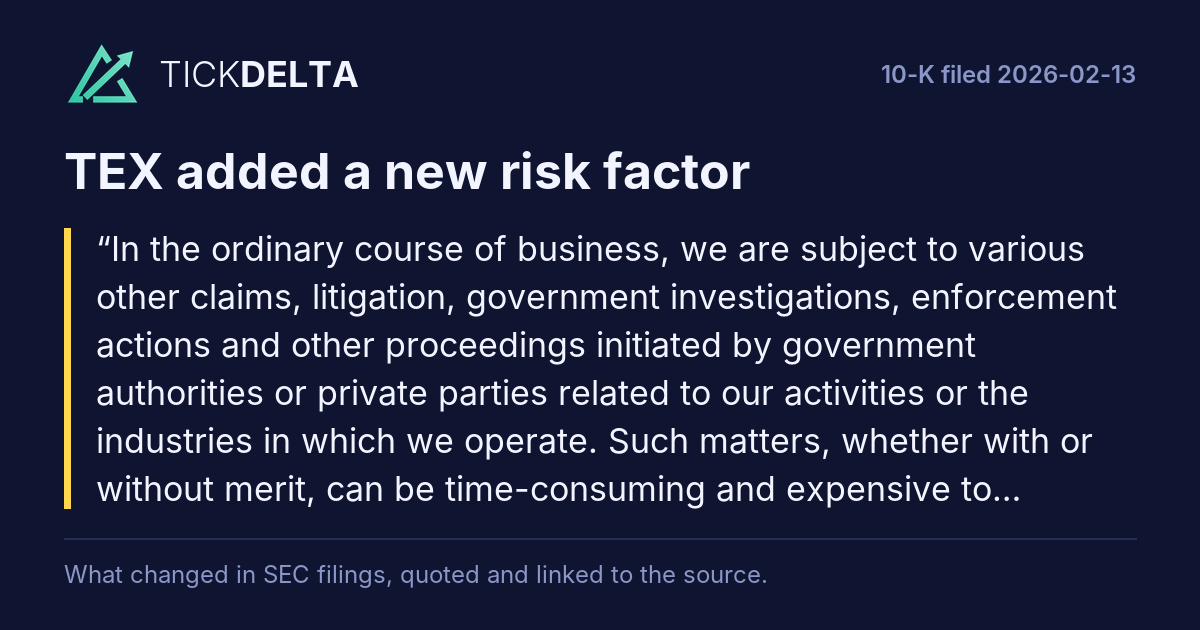
In the ordinary course of business, we are subject to various other claims, litigation, government investigations, enforcement actions and other proceedings initiated by government authorities or private parties related to our activities or the industries in which we operate. Such matters, whether with or without merit, can be time-consuming and expensive to defend, divert management’s attention and resources, result in reputational damage to the Company, result in significant damages or other costs, and otherwise have a material adverse effect on our business, financial condition and results of operations. In addition, we are in the early stages of industry anti-trust class action lawsuits in which we have been named a defendant. We believe these anti-trust class actions are without merit and will continue to vigorously oppose them, no assurance can be given as to the final resolution of such litigation or that we will not ultimately be required to pay damages or other costs related to such actions.
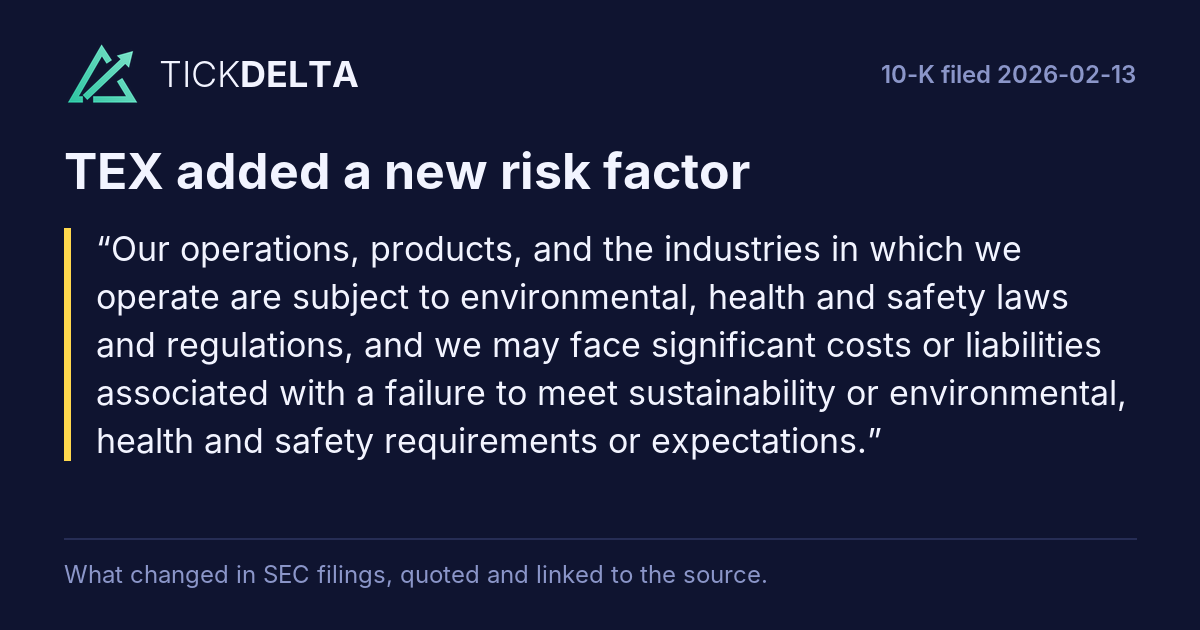
Our operations, products, and the industries in which we operate are subject to environmental, health and safety laws and regulations, and we may face significant costs or liabilities associated with a failure to meet sustainability or environmental, health and safety requirements or expectations.
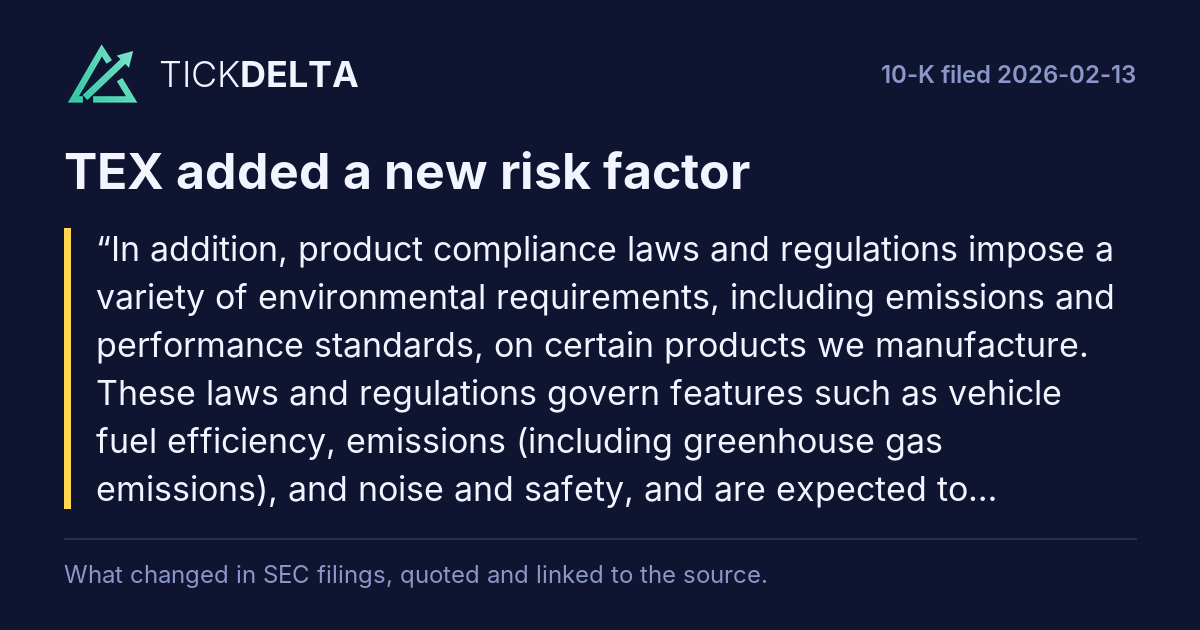
In addition, product compliance laws and regulations impose a variety of environmental requirements, including emissions and performance standards, on certain products we manufacture. These laws and regulations govern features such as vehicle fuel efficiency, emissions (including greenhouse gas emissions), and noise and safety, and are expected to continue to add to the cost of certain of our products and increase the engineering and product development programs of certain businesses. These standards, as well as other federal and state emissions and other standards applicable to certain products we manufacture, have
increased and will continue to increase costs of development for engines and products and administrative costs arising from implementation of the standards, and have impacted in recent years and may continue to impact the cost or availability of certain items, such as chassis, used in our products. In addition, regulatory proposals under consideration or those that are proposed in the future may set standards that are difficult to achieve or adversely affect our results of operations due to increased research, development, or warranty costs or otherwise.
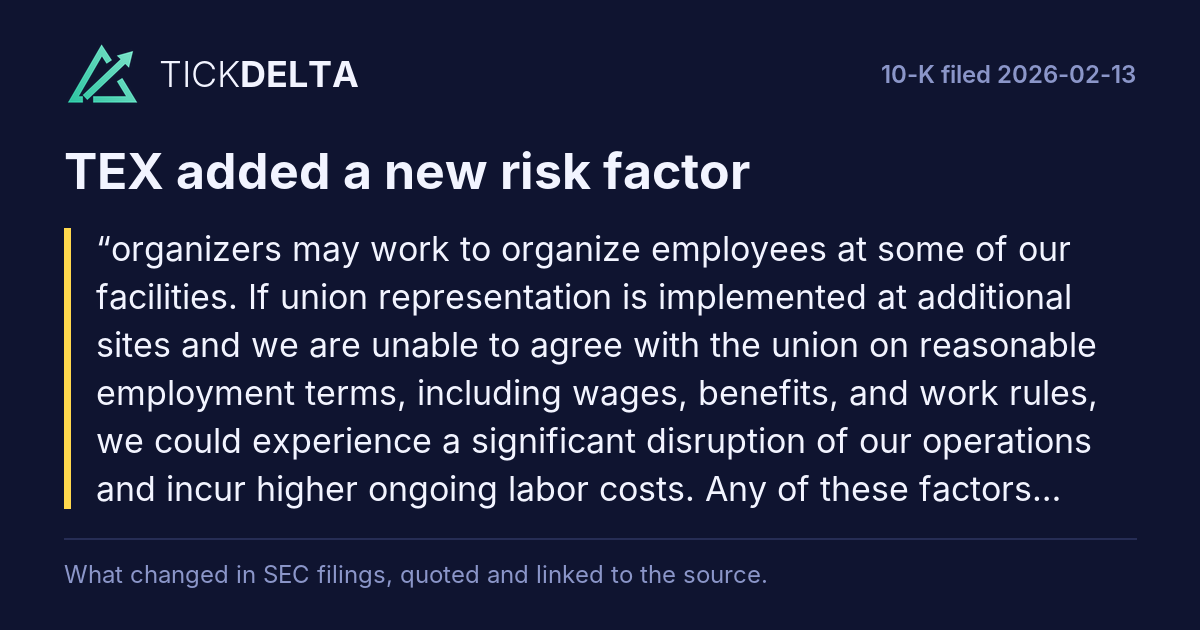
organizers may work to organize employees at some of our facilities. If union representation is implemented at additional sites and we are unable to agree with the union on reasonable employment terms, including wages, benefits, and work rules, we could experience a significant disruption of our operations and incur higher ongoing labor costs. Any of these factors may have an adverse effect on us or may limit our flexibility in managing our workforce.
New in the latest 10-Q
9 paragraphs in the 10-Q filed Oct 29, 2026 with nothing like them in the 10-Q filed Jul 30, 2026 (at least half the words must differ; new numbers alone do not count). Quoted exactly, grouped by the item heading above them. This is text that changed, not a judgement of how serious it is.
In connection with a strategic review of the product portfolio, the Company was pursuing the sale of certain assets and liabilities of Capacity of Texas, Inc. (“Capacity”) and Mobile Products, Inc. (“LayMor”), two businesses within the Specialty Vehicles segment. The assets and liabilities to be divested in connection with this transaction met the held for sale criteria as of September 30, 2026. The carrying value of the assets and liabilities held for sale was greater than the estimated sales proceeds, less expected costs to sell, resulting in a non-cash loss of $ 17 million. As part of contract negotiations the Company also agreed to indemnify the buyer for certain items which increased the total loss by $ 3 million. The total loss of $ 20 million is included in Selling, general and administrative expenses in the Unaudited Condensed Consolidated Statements of Income and Comprehensive Income for the three months ended September 30, 2026.
Read in the 10-Q
As of September 30, 2026, assets and liabilities held for sale were included in Prepaid and other current assets and Other current liabilities, respectively, in the Unaudited Condensed Consolidated Balance Sheet. Assets and liabilities held for sale consisted of the following balances:
Read in the 10-Q
The Company completed the sale of Capacity and LayMor on October 23, 2026. Refer to Note L, Subsequent Events, for further details.
Read in the 10-Q
On October 23, 2026, the Company completed the sale of the Capacity and LayMor businesses to Right Lane Industries for total consideration of approximately $ 33 million, pursuant to the terms of the related purchase agreement. Capacity and LayMor were previously reported within the SV segment. During the three and nine months ended September 30, 2026, the Company recognized a non-cash loss of $ 20 million to adjust the carrying value of the assets and liabilities of these businesses that were classified as held for sale as of September 30, 2026 to their fair value. The Company will recognize any adjustments to this non-cash loss in the fourth quarter 2026.
Read in the 10-Q
Three Months Ended September 30, 2026 Compared with Three Months Ended September 30, 2025
Read in the 10-Q
Nine Months Ended September 30, 2026 Compared with Nine Months Ended September 30, 2025
Read in the 10-Q
The following notes apply to both the Adjusted operating profit and Adjusted EBITDA reconciliations above, as applicable:
Read in the 10-Q
d.Primarily relates to losses on held for sale businesses in the MP and SV segments.
Read in the 10-Q
The following notes apply to both the Adjusted operating profit and Adjusted EBITDA reconciliations above, as applicable:
Read in the 10-Q
Item 1A of the 10-Q filed Oct 29, 2026 against Item 1A of the 10-K filed Feb 13, 2026.
A 10-Q repeats only the risks that changed, so a 10-K paragraph that is missing from it is not counted as removed.
Added is a paragraph with nothing like it in the 10-K, Reworded a sentence that is in both with several words changed,
Quiet changes a sentence in both where one to four words changed and one is a hedge or a modal
(cut words struck through, new words highlighted).
Text on the page, not a score; each links to the filing at sec.gov.
What the 10-Q itself says about its risk factors:There have been no material changes in our risk factors previously disclosed in Part I, Item 1A. - “Risk Factors” of our Annual Report on Form 10-K for the year ended December 31, 2025.
Read in the 10-Q
Two-word phrases in Risk Factors of the 10-K filed Feb 13, 2026 that are in none of the 1 earlier 10-Ks stored, back to Feb 7, 2025
Used at least twice, small words left out. Counted, not picked: a phrase can be new because the company renamed something.
8 paragraphs of last year's Risk Factors with nothing like them now. The longest are quoted.
Item 1A of each 10-K and 10-Q on EDGAR, quoted exactly. Each paragraph links to the filing at sec.gov.
10-K change: what was reworded or cut, section by section.
Excel workbook · CSV. Google Sheet that stays up to date: paste =IMPORTDATA("https://tickdelta.com/company/TEX/export.csv") into a cell.