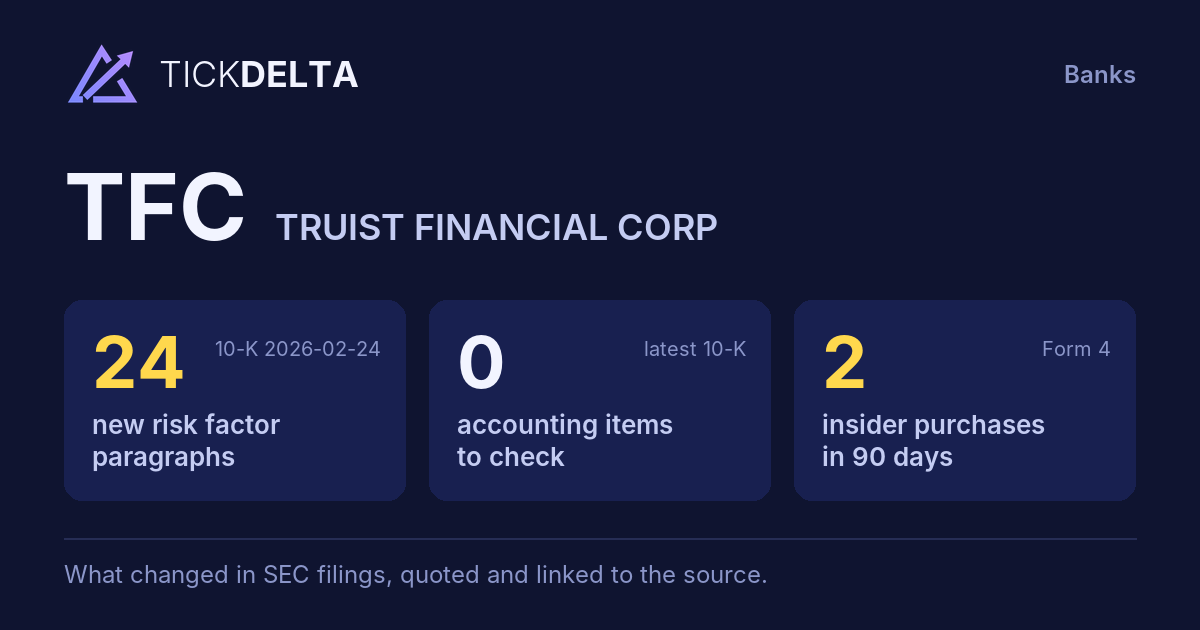
10-K 0000092230-26-000030 (2026-02-24) vs 10-K 0000092230-25-000020 (2025-02-25)
| Section | Compared text | Words now | Changed |
|---|
| Risk Factors | Item 1A | 19,308 |
25.0% |
| MD&A | Item 7 | 19,295 |
27.9% |
| Legal Proceedings | Item 3, via Note 16 – Commitments and Contingencies | 2,914 |
13.5% |
| Accounting Policies | Item 8, Note 1 – Basis of Presentation | 11,010 |
14.4% |
The redline: what was cut and what was added
In each section, the paragraph that changed most, marked against last year's 10-K:
cut words struck through, new words highlighted and underlined.
Risk Factors 259 words changed in this paragraph; it is 33% similar to last year's version.
Truist has elected to be treated as an FHC, which permits us to engage in a number of financial and related activities beyond banking, including securities, advisory, banking such as securities underwriting and merchant banking activities. Truist banking. FHCs and Truist Bank their IDI subsidiaries are subject to ongoing requirements for Truist to continue to qualify as an FHC. If a BHC an FHC or any of its insured depository institutions IDIs were found not to be well capitalized well-capitalized or well managed, managed as defined under by applicable law, the BHC can be restricted from engaging in FRB may impose corrective capital and managerial requirements on the broader range of financial FHC, which could impact resources and related activities permitted for FHCs, including limit amounts otherwise available to creditors and shareholders. In such a situation, the ability to acquire companies engaged in those activities, and can be required to discontinue these activities or even divest any of its insured depository institutions. In addition, if an insured-depository-institution subsidiary of a BHC were to fail to achieve a satisfactory or better rating under the CRA, FRB may also place limitations on the ability of the BHC FHC to expand conduct certain business activities that FHCs are generally permitted to conduct as well as the FHC’s ability to make certain acquisitions. If the failure to meet these standards persists, the FHC may be required to divest its IDI subsidiaries or cease all activities other than those activities that may be conducted by BHCs that are not FHCs. Furthermore, if an IDI subsidiary of an FHC has not maintained a satisfactory CRA rating, the FHC would not be able to commence any new financial and related activities or acquire a company that engages in such activities, although the FHC would still be allowed to engage in activities closely related to banking and make acquisitions could be restricted. investments in the ordinary course of conducting banking activities.
Source: Item 1A, 10-K 0000092230-26-000030 vs Item 1A, 10-K 0000092230-25-000020
MD&A 210 words changed in this paragraph; it is 34% similar to last year's version.
Operational risk is the risk of loss associated with external events or inadequate or failed internal processes, people, systems, or from external events. systems. It includes legal risk, which is the risk of loss arising from defective transactions, litigation or claims made, litigation, claims, or the failure to adequately protect company-owned Company-owned assets. An operational loss occurs when an event results in a loss or reserve originating from operational risk. The Company executes business activities in diverse markets and relies on the ability of its teammates and systems to process a high number of transactions. Operational risk is inherent in all business activities, and the management of this risk is important to the achievement of the Company’s objectives. Business units and enterprise functions have primary responsibility and accountability for identifying, mitigating, and monitoring operational risks embedded in their business activities, including additional or increased risks created by economic and financial disruptions. Business continuity and disaster recovery planning are critical to effectively managing operational risks. Each business unit and enterprise function is required to develop, maintain, and test these plans at least annually to identify recovery activities that, if needed, can support mission critical functions, including technology, networks and data centers supporting client applications and business operations. While the Company strives to design processes to minimize operational risks, there is no absolute assurance that business disruptions or operational losses will not occur as a result of an external event or internal control breakdown. On an ongoing basis, management makes process changes and investments to enhance Truist’s systems of internal controls and business continuity and disaster recovery plans.
Source: Item 7, 10-K 0000092230-26-000030 vs Item 7, 10-K 0000092230-25-000020
Legal Proceedings 131 words changed in this paragraph; it is 77% similar to last year's version.
This class action case was filed in Fulton County State Court on July 12, 2010, and an amended complaint was filed on August 9, 2010. Plaintiff alleges that all overdraft fees charged to his account which related to debit card and ATM transactions are actually interest charges and therefore subject to the usury laws of Georgia. The amended complaint asserts claims for violations of civil and criminal usury laws, conversion, and money had and received, and seeks damages on a class-wide basis, including refunds of challenged overdraft fees and pre-judgment interest. On October 6, 2017, the trial court granted plaintiff’s motion for class certification and defined the class as “Every Georgia citizen who had or has one or more accounts with SunTrust Bank and who, from July 12, 2006, to October 6, 2017 (i) had at least one overdraft of $500.00 or less resulting from an ATM or debit card transaction (the “Transaction”); (ii) paid any Overdraft Fees as a result of the Transaction; and (iii) did not receive a refund of those Fees,” and the granting of a certified class was affirmed on appeal. The class seeks sought a return of up to $ 452 million in paid overdraft fees from the 2006 to 2017 period above, plus prejudgment interest which, interest, which based on the this amount of claimed fees, was fees would have been estimated to be at approximately $ 431 463 million as of December 31, 2024. A court-ordered mediation was held on February 28, 2024, but no resolution was reached. On March 4, 2024, the trial court issued an order granting in part and denying in part Truist’s motions to amend the class definition to narrow the scope of the class, to compel arbitration against certain class members, and for summary judgment. Truist and the class separately appealed the trial court’s order to the Georgia Court of Appeals. On February 20, 2025, the Georgia Court of Appeals ruled on the appeals and affirmed in part and reversed in part the trial court’s March 4, 2024 order. Truist continues to assess the court’s rulings. 2025.
Source: Item 3, via Note 16 – Commitments and Contingencies, 10-K 0000092230-26-000030 vs Item 3, via Note 16 – Commitments and Contingencies, 10-K 0000092230-25-000020
Accounting Policies 110 words changed in this paragraph; it is 32% similar to last year's version.
December 31, 2024 Standards Not Yet Adopted Improvements 2027 Expense Disaggregation Disclosures / Introduces new requirements to Income Tax Disclosures Improves the transparency disclose more detailed information about certain types of income tax disclosures by requiring (1) consistent categories and greater disaggregation of information expenses not already presented in separate expense captions in the rate reconciliation Consolidated Statements of Income, including employee compensation, depreciation, intangible asset amortization, and (2) income taxes paid disaggregated by jurisdiction. It also includes certain other amendments selling expenses. Banks that present a caption for salaries and benefits under SEC rules would be permitted to improve the effectiveness of income tax disclosures. retain their current definition. Permits either a prospective or retrospective transition approach. Truist is evaluating the impact of this standard on its disclosures. This standard relates to footnote disclosures only.
Source: Item 8, Note 1 – Basis of Presentation, 10-K 0000092230-26-000030 vs Item 8, Note 1 – Basis of Presentation, 10-K 0000092230-25-000020
Every change, by type
Sentences and paragraphs of TFC's Risk Factors and MD&A, 10-K 2026-02-24 against 10-K 2025-02-25.
Each links to the text at sec.gov.
Quiet changes are sentences kept from last year with one to four words changed, at least one of them a hedge, a modal or a qualifier
(may, could, will, not, significant, material…). A year or date rolling forward is not counted.
The full word list
adverse, adversely, all, although, anticipate, anticipates, any, approximately, believe, believes, can, cannot, certain, could, expect, expects, generally, however, if, intend, intends, largely, likely, many, material, materially, may, might, most, must, never, no, not, possible, primarily, probable, should, significant, significantly, some, substantial, substantially, unlikely, will, would
AddedRisk Factors
•The use of AI in our products and services, as well as our business and the industry more broadly, may negatively impact our business, operations, financial condition, results of operations, prospects, and reputation.
Read it in 10-K 2026-02-24 at sec.gov ↗
AddedRisk Factors
•The Company’s risk and control framework may fail to identify, assess, monitor, and mitigate the risks we face and cause us to suffer unexpected losses that could adversely affect our business, financial condition, results of operations, prospects, and reputation.
Read it in 10-K 2026-02-24 at sec.gov ↗
AddedRisk Factors
•Truist faces loan servicing risks that could adversely impact the Company’s business, operations, liquidity, and results of operations.
Read it in 10-K 2026-02-24 at sec.gov ↗
AddedRisk Factors
•Truist faces risks of non-compliance and may incur additional operational and compliance costs under laws relating to anti-money laundering, economic sanctions, embargo programs, anti-bribery, and anti-corruption.
Read it in 10-K 2026-02-24 at sec.gov ↗
AddedRisk Factors
•The Company is at risk of losses from fraud which could result in financial loss and reputational harm.
Read it in 10-K 2026-02-24 at sec.gov ↗
AddedRisk Factors
The Company has experienced, and may continue to experience, failures and disruptions affecting the stability, performance, security, and availability of its applications, operating systems, and infrastructure. These include degraded processing performance, data quality issues, loss of network connectivity, software malfunctions and misconfigurations, and interruptions in the availability and reliability of cloud-based and other third-party systems and services. The Company’s substantial and increasing reliance on cloud service providers and other external technology vendors heightens exposure to risks outside of its control, including system outages, downtime, cyber-attacks, and adverse financial and operating conditions at those providers and vendors. The Company’s expanding use of AI tools and related technologies introduces additional operational risks, including reliance on data integrity and model performance as well as third-party AI services that may fail, degrade, or produce inaccurate or unexpected outputs.
Read it in 10-K 2026-02-24 at sec.gov ↗
AddedRisk Factors
The Company regularly updates and modifies its applications, operating systems, and infrastructure to support business and operations, including growth initiatives and regulatory compliance requirements. These activities involve significant costs and create additional risks related to the implementation, integration, and effectiveness of new or modified applications, systems, and infrastructure. The introduction, updating, or retraining of AI models and other methods of automation may amplify these risks. Changes in model behavior or configuration may produce unintended outcomes, increase susceptibility to operational errors, or reduce the effectiveness of existing controls. Failures associated with upgrades, configuration changes, system conversions, AI model deployment, integration efforts, and related activities may result in operational interruptions, system failures, or reduced control effectiveness.
Read it in 10-K 2026-02-24 at sec.gov ↗
AddedRisk Factors
Failures to properly maintain, upgrade, or secure applications, operating systems, and infrastructure may increase the Company’s susceptibility to cybersecurity threats, including supply chain attacks, and may impair the Company’s ability to meet business continuity and resiliency objectives. AI-enabled technologies may further expand the cyber-attack surface and velocity, including exposure to adversarial manipulation, data poisoning, and vulnerabilities in third-party AI and other platforms. These events have resulted in adverse client impacts, including the inability to access account information or conduct transactions through ATM, online, or mobile channels, the exposure of confidential, proprietary, personal, and other sensitive information, the posting of duplicative or delayed transactions, and delays in obtaining assistance through call centers. The Company cannot assure that similar or more severe operational or technology failures and disruptions, including AI-related failures or third-party service interruptions, will not occur in the future or that their effects can be prevented, contained, or remediated in a timely manner.
Read it in 10-K 2026-02-24 at sec.gov ↗
AddedRisk Factors
The use of AI in our products and services, as well as our business and the industry more broadly, may negatively impact our business, operations, financial condition, results of operations, prospects, and reputation.
Read it in 10-K 2026-02-24 at sec.gov ↗
AddedRisk Factors
Our industry is subject to rapid and significant technological change. To compete effectively, the Company uses new and evolving technologies, including AI, to help improve our marketing, referrals, products, services, and client service, to increase productivity for internal code and software development and testing, and to automate certain business decisions and risk management practices, such as fraud identification. The Company's use of AI is subject to risks that models, prompts, algorithms, and datasets, as well as related decisions, predictions, analysis, and other output, are flawed, inaccurate, of poor quality, insufficient, biased, or otherwise erroneous or inadequate, any of which may not be easily detectable. In addition, the models and processes relating to AI are not always transparent, which could increase the risk of unintended deficiencies. Ineffective implementation of AI by us or our third-party providers could subject us to additional risks that we cannot adequately predict or mitigate. Further, inappropriate or controversial data practices by developers and end-users, or other factors adversely affecting public opinion of AI and machine learning, could impair the acceptance and use of AI. If any of these risks are realized, we could suffer business and operational disruptions, operational inefficiencies, competitive harm, legal liability, increased regulatory scrutiny, reputational harm, or other consequences that the Company cannot predict, any of which could negatively affect the Company's financial condition and results of operations.
Read it in 10-K 2026-02-24 at sec.gov ↗
AddedRisk Factors
Regulatory and other legal frameworks surrounding AI continue to evolve and remain uncertain. If we do not have sufficient rights to use models, prompts, algorithms, and datasets on which our AI technologies rely or the related decisions, predictions, analysis, or other output, we could incur significant damages, substantial fees, deprivation of access, or considerable expense through a violation of applicable law, third-party intellectual property, privacy, or other rights, or other violations. New or changing statutes, regulations, or industry standards and practices may increase costs, restrict use cases, or require significant changes to our deployment or our existing systems and controls. If we fail to appropriately respond to changes within the AI landscape, including changing public sentiment, we could face legal, regulatory, or brand and stakeholder risk that may negatively impact our business, operations, financial results, financial condition, or reputation. In addition, the use of AI by companies has resulted in, and may in the future result in, cybersecurity breaches, attacks, and other similar incidents as well as data privacy violations.
Read it in 10-K 2026-02-24 at sec.gov ↗
AddedRisk Factors
The Company’s risk and control framework may fail to identify, assess, monitor, and mitigate the risks we face and cause us to suffer unexpected losses that could adversely affect our business, financial condition, results of operations, prospects, and reputation.
Read it in 10-K 2026-02-24 at sec.gov ↗
RemovedRisk Factors
•The Company’s risk management framework may fail to identify and manage the risks that we face.
Read it in 10-K 2025-02-25 at sec.gov ↗
RemovedRisk Factors
•In deciding whether to extend credit or enter into other transactions with clients and counterparties, Truist depends on the accuracy and completeness of information about clients and counterparties, and Truist could be negatively impacted if the information is not accurate or complete.
Read it in 10-K 2025-02-25 at sec.gov ↗
RemovedRisk Factors
Truist is also subject to heightened requirements under the enhanced prudential standards and increased supervisory scrutiny, including, for example, single counterparty credit limits, heightened expectations with respect to governance, risk management and internal controls, and additional capital and liquidity requirements.
Read it in 10-K 2025-02-25 at sec.gov ↗
RemovedRisk Factors
Truist must comply with laws and regulations relating to AML, economic sanctions, embargo programs, and anti-corruption, which can increase its risks of non-compliance and costs associated with the implementation and maintenance of complex compliance programs. These laws and regulations are designed to protect the financial system, consumers, and financial institutions from bad actors and illicit activities by requiring financial institutions to develop and implement programs designed to deter and when possible detect and prevent the use of the financial system to facilitate the funding of criminal activities. Federal law grants substantial enforcement powers to federal financial institution regulators, OFAC, and the U.S. DOJ, among other government agencies, with respect to these laws and regulations. This enforcement authority includes, among other things, the ability to: assess significant civil or criminal monetary penalties, fines, or restitution; issue cease and desist or prohibition orders; and initiate injunctive actions against financial institutions and institution-affiliated parties, including individual teammates. These enforcement actions may be initiated for violations of laws and regulations or unsafe and unsound practices. Additionally, actual or alleged misconduct by teammates, including unethical, fraudulent, improper, or illegal conduct, or unfair, deceptive, abusive, or discriminatory practices, can result in litigation, or government investigations and enforcement actions, and cause significant reputational harm to Truist, even if allegations are ultimately unsubstantiated.
Read it in 10-K 2025-02-25 at sec.gov ↗
RemovedRisk Factors
Truist is subject to regulatory capital and liquidity requirements established by the FRB and the FDIC. These regulatory capital and liquidity requirements are typically developed at an international level by the BCBS and then applied, with adjustments, in each country by the appropriate domestic regulatory bodies. Domestic regulatory agencies have the ability to apply stricter capital and liquidity standards than those developed by the BCBS. In several instances, the U.S. banking agencies have done so with respect to U.S. banking organizations.
Read it in 10-K 2025-02-25 at sec.gov ↗
RemovedRisk Factors
Regulatory capital and liquidity requirements receive periodic review and revision by the BCBS and the U.S. banking agencies. Proposed changes to applicable capital and liquidity requirements, such as the Basel III proposal and the long-term debt proposal, could result in increased expenses or cost of funding, which could negatively affect our financial results or our ability to pay dividends and engage in share repurchases. For more information concerning our legal and regulatory obligations with respect to Basel III and long-term debt requirements, please see “Regulatory Considerations” in Item 1 “Business.”
Read it in 10-K 2025-02-25 at sec.gov ↗
RemovedRisk Factors
In addition to repurchase claims from GSEs, Truist could be subject to indemnification claims from non-GSE purchasers of the Company’s loans. Claims could be made if the loans sold fail to conform to statements about their quality, the manner in which the loans were originated and underwritten, or their compliance with state and federal law.
Read it in 10-K 2025-02-25 at sec.gov ↗
RemovedRisk Factors
The Company’s risk management framework may fail to identify and manage the risks that we face.
Read it in 10-K 2025-02-25 at sec.gov ↗
RemovedRisk Factors
In deciding whether to extend credit or enter into other transactions with clients and counterparties, Truist depends on the accuracy and completeness of information about clients and counterparties, and Truist could be negatively impacted if the information is not accurate or complete.
Read it in 10-K 2025-02-25 at sec.gov ↗
RewordedRisk Factors
Negative public opinion could result from the Company’s actual or alleged conduct in any number of or activities, including lending, sales, training, quality assurance, client complaint resolution, and other operating practices, incentive compensation design and governance, corporate governance, acquisitions, a data breach the disclosure, collection, use, sharing, storage, and other processing of client or teammate information, or the failure of client expectations regarding any product or service sold provided by the Company, and the Company’s ability to meet clients’ expectations comply with applicable statutes or applicable regulatory requirements. requirements or related to new or changed business activities.
Read it in 10-K 2026-02-24 at sec.gov ↗
RewordedRisk Factors
Increased Such an impact can be exacerbated by the continued adoption of consumer banking technology can result in reduced deposit demand due that enables deposits to the be transferred with relative ease with which depositors may transfer deposits to a different depository institution in the event that the or other competitor if Truist Bank’s products and services are less competitive or confidence is lost in the Truist Bank.
Read it in 10-K 2026-02-24 at sec.gov ↗
RewordedRisk Factors
A successful penetration or circumvention of system the security for our applications, operating systems, or network security infrastructure or those of third parties could cause serious negative consequences, including loss of clients and business opportunities; costs associated with maintaining client and business relationships after a cyberattack cyber-attack or security breach; a loss of investor confidence; significant disruption to the Company’s operations and business; misappropriation, exposure exposure, or destruction of the Company’s confidential, proprietary, and other sensitive information, including personal information, and the funds and those of the Company’s Company and its clients; damage to the Company’s or the Company’s clients’ or third parties’ third-parties’ computers, systems, or networks; and a violation of applicable laws statutes and regulations, including those related to data privacy, data protection, and cybersecurity.
Read it in 10-K 2026-02-24 at sec.gov ↗
RewordedRisk Factors
Additional Other factors affecting the extent to which we influencing such a decision may securitize loans and receivables in the future include the overall credit quality of our its loans and receivables, the costs of selling or securitizing our its loans and receivables, the demand for consumer bulk sales and asset-backed securities securities, and the legal, regulatory, accounting accounting, or tax rules affecting securitization transactions and asset-backed securities, generally. these transactions.
Read it in 10-K 2026-02-24 at sec.gov ↗
RewordedRisk Factors
Regulatory The Company is regularly subject to regulatory investigations, examinations or examinations, and other initiatives by governmental authorities that, if adversely determined against the Company, may subject the Company us to litigation, settlements, fines, penalties penalties, or other sanctions, sanctions and may require the Company us to engage in remediation, provide restitution to customers or to clients, restructure its our operations and activities activities, or to cease offering certain products or services.
Read it in 10-K 2026-02-24 at sec.gov ↗
RewordedRisk Factors
For example, in 2024, 2025, maintaining and growing client deposits continued to be challenging with as the FRB continuing to reduce Federal Reserve System reduced the size of its balance sheet through quantitative tightening and sustained increased interest rates giving clients an incentive to move deposits to money market funds and other higher-yielding alternatives. tightening.
Read it in 10-K 2026-02-24 at sec.gov ↗
RewordedRisk Factors
Cybersecurity risks for financial institutions have significantly increased in recent years and will likely continue to increase, in part because of the proliferation of new technologies to facilitate and conduct financial transactions. transactions and the increased sophistication and activities of organized crime affiliates, terrorist organizations, hostile foreign governments, state-sponsored actors, disgruntled teammates or vendors, hackers, activists, and other third parties, including those involved in corporate espionage.
Read it in 10-K 2026-02-24 at sec.gov ↗
RewordedRisk Factors
Federal and state law grants substantial enforcement and supervisory powers to federal and state banking regulators and law enforcement agencies if the they determine that regulated entities fail have failed to comply with applicable laws law, comport with safe and sound practices, or to maintain a risk and control environment that meets the standards and expectations of the regulators. meet supervisory expectations.
Read it in 10-K 2026-02-24 at sec.gov ↗
RewordedRisk Factors
Notwithstanding such Our risk management and control framework, however, we cannot guarantee that we will adequately or effectively identify identify, assess, monitor, and manage the risks in our business and operations currently, mitigate current business, operational, or other risks, or that we will adequately or effectively identify identify, assess, monitor, and manage mitigate such risks in the future.
Read it in 10-K 2026-02-24 at sec.gov ↗
RewordedRisk Factors
When loans are sold or securitized, including to GSEs, it is customary to make representations and warranties to the purchaser about the loans, including loans—including their quality, the manner in which they were originated, originated and underwritten, and compliance with applicable law—and to agree to repurchase the loans or indemnify the buyer purchaser in the event of a breach of the sale agreement, including a breach of these representations or warranties. warranties or other provisions of the sale agreement.
Read it in 10-K 2026-02-24 at sec.gov ↗
RewordedRisk Factors
In addition, For example, models based on historical data may degrade over time can be ineffective due to erroneous or inadequate data, flawed formulas or algorithms, limited or inapt historical patterns, changes in correlations, extreme or unanticipated market movements, or unexpected client behavior and liquidity, or illiquidity, especially during severe market downturns or stress events (e.g., geopolitical or pandemic events).
Read it in 10-K 2026-02-24 at sec.gov ↗
RewordedRisk Factors
Truist may be impacted by the actual or perceived soundness of other financial institutions, including as a result of the financial or operational failure of a major financial institution, institution or concerns about the creditworthiness of such a financial institution or its ability to fulfill its obligations, which can cause substantial and cascading disruption within the financial markets and increased expenses, including FDIC insurance premiums or special assessments, and could affect our ability to attract and retain depositors and to borrow or raise capital. markets.
Read it in 10-K 2026-02-24 at sec.gov ↗
Quiet changesRisk Factors
Additionally, a downgrade to Truist’s credit ratings might also may adversely impact the Company’s ability to conduct derivatives business with certain clients and counterparties and could trigger obligations to make cash or collateral payments to certain clients and counterparties.
Read it in 10-K 2026-02-24 at sec.gov ↗
Quiet changesRisk Factors
These actions could also can negatively impact the products and services that we offer and our ability to engage in business opportunities.
Read it in 10-K 2026-02-24 at sec.gov ↗
Quiet changesRisk Factors
Truist operates in a highly competitive industry that could is expected to become even more competitive with growth in areas such as digital financial service providers and other nonbank platforms.
Read it in 10-K 2026-02-24 at sec.gov ↗
Quiet changesRisk Factors
Increased competition could arise also arises from technological advancements, legislative and regulatory changes, as well as competition from other financial services companies, some of which may be subject to less extensive regulation than Truist.
Read it in 10-K 2026-02-24 at sec.gov ↗
AddedMD&A
During 2025, we focused on delivering strong, purpose-driven performance by deepening client relationships, enhancing operational efficiency, investing in talented teammates and innovative technology, and increasing capital return to shareholders. Through disciplined risk management and sound governance, we believe we strengthened our foundation and positioned Truist for sustainable growth.
Read it in 10-K 2026-02-24 at sec.gov ↗
AddedMD&A
• Execute strategic growth and profitability initiatives in both WB and CSBB including:
Read it in 10-K 2026-02-24 at sec.gov ↗
AddedMD&A
◦ In CSBB, grow deposits with a focus on Premier clients, increase client acquisition, deepen client relationships, and drive digital acquisition and client engagement.
Read it in 10-K 2026-02-24 at sec.gov ↗
AddedMD&A
• Drive positive operating leverage through revenue growth and expense discipline.
Read it in 10-K 2026-02-24 at sec.gov ↗
AddedMD&A
Looking ahead, our strategic priorities remain unchanged. By successfully executing on them, we seek to accelerate revenue growth, drive greater positive operating leverage, and return more capital to shareholders, all while maintaining our risk discipline. These outcomes are central to driving improved profitability.
Read it in 10-K 2026-02-24 at sec.gov ↗
AddedMD&A
(1) Represents a non-GAAP measure. A reconciliation of each non-GAAP measure to the most directly comparable GAAP measure is included within the table above or in the “Non-GAAP Financial Measures” section in this report.
Read it in 10-K 2026-02-24 at sec.gov ↗
AddedMD&A
(1) Effective December 31, 2025, Truist reclassified treasury management fees to ‘Card and treasury management fees’ from ‘Other deposit revenue.’ Prior period balances have been conformed to current period presentation.
Read it in 10-K 2026-02-24 at sec.gov ↗
AddedMD&A
(4) Effective December 31, 2025, Truist reclassified operating lease income into ‘Other income.’ Prior period balances have been conformed to current period presentation.
Read it in 10-K 2026-02-24 at sec.gov ↗
AddedMD&A
(1) Effective December 31, 2025, Truist reclassified the underlying activities of restructuring charges, which were previously reported in a separate financial statement caption, to their natural expense categories of ‘Personnel,’ ‘Net occupancy,’ ‘Professional fees and outside processing,’ and ‘Other expense.’ Prior period balances have been conformed to current period presentation.
Read it in 10-K 2026-02-24 at sec.gov ↗
AddedMD&A
(2) Effective December 31, 2025, Truist reclassified operating lease depreciation into ‘Other expense.’ Prior period balances have been conformed to current period presentation.
Read it in 10-K 2026-02-24 at sec.gov ↗
AddedMD&A
• Personnel expense increased due to higher investments in talent in revenue producing businesses as well as the technology and risk infrastructure organizations, incentives, insurance costs, and severance charges, partially offset by lower expenses for other employee benefits.
Read it in 10-K 2026-02-24 at sec.gov ↗
AddedMD&A
• Software expense increased primarily due to higher spending on certain projects.
Read it in 10-K 2026-02-24 at sec.gov ↗
RemovedMD&A
2024 was an important year for Truist. We added new clients and deepened existing relationships, invested in our core banking business, made enhancements to our technology and risk infrastructure, and maintained our credit and expense discipline.
Read it in 10-K 2025-02-25 at sec.gov ↗
RemovedMD&A
We executed on several important strategic initiatives, including the sale of TIH and the repositioning of our balance sheet. On May 6, 2024, we completed the divestiture of TIH. Refer to “Note 2. Discontinued Operations” for additional information. Following the sale of TIH, Truist executed a strategic balance sheet repositioning of a portion of its AFS investment securities portfolio by selling lower-yielding investment securities, resulting in an after-tax loss of $5.1 billion in 2024, allowing Truist to reinvest a portion of the proceeds in higher yielding securities.
Read it in 10-K 2025-02-25 at sec.gov ↗
RemovedMD&A
In July 2024, we successfully completed the sale of Sterling Capital Management LLC, an asset management business. Cash proceeds and the gain recognized on the sale were not material.
Read it in 10-K 2025-02-25 at sec.gov ↗
RemovedMD&A
Clarke R. Starnes III retired from his position as CRO and Vice Chair. Brad Bender, a 20-year Truist veteran who previously served as Truist’s Head of Enterprise Operational Services and interim Chief Information Officer, succeeded Starnes as CRO.
Read it in 10-K 2025-02-25 at sec.gov ↗
RemovedMD&A
Hugh S. “Beau” Cummins III, Vice Chair and Chief Operating Officer of Truist, resigned from his position, effective January 13, 2025. Following Mr. Cummins’ departure, management of the enterprise payments business transitioned to Kristin Lesher, Senior Executive Vice President and Chief Wholesale Banking Officer. Mr. Cummins’ remaining responsibilities, including leading teams responsible for enterprise operational services, enterprise corporate services, the strategy, transformation, and performance office, and the governance and controls organization, transitioned to Michael B. Maguire, Senior Executive Vice President and CFO.
Read it in 10-K 2025-02-25 at sec.gov ↗
RemovedMD&A
We launched Truist Cares for Western North Carolina, a three-year, $725 million commitment to support and sustain hurricane recovery and resiliency through dedicated capital to support rebuilding and resiliency, loans or investments in Community Development Financial Institutions, philanthropic grants to local and national nonprofit organizations, and community service hours.
Read it in 10-K 2025-02-25 at sec.gov ↗
RemovedMD&A
Our strategic direction is to build the top super regional bank that grows with our clients with care. Our 2025 strategic objectives are to:
Read it in 10-K 2025-02-25 at sec.gov ↗
RemovedMD&A
• Leverage our capital position by growing and capturing additional share within our high growth markets and existing client base in key focus areas in WB and CSBB and in areas, markets, and client solutions where we have invested significantly and have momentum.
Read it in 10-K 2025-02-25 at sec.gov ↗
RemovedMD&A
• In CSBB, grow core deposits, deepen existing relationships with Premier clients, enhance the client digital experience, and drive additional fee and loan growth through our differentiated consumer lending solutions.
Read it in 10-K 2025-02-25 at sec.gov ↗
RemovedMD&A
• Continue to invest in important areas like new and existing talent, technology, risk, and cybersecurity, while maintaining our expense discipline with a goal of driving positive operating leverage.
Read it in 10-K 2025-02-25 at sec.gov ↗
RemovedMD&A
Truist’s TE revenue for 2024 was $13.5 billion. Excluding securities losses, TE revenue was $20.1 billion, representing a decrease of $101 million compared to 2023. Net interest income on a TE basis was $14.3 billion, down $441 million, or 3.0%, from the prior year primarily as a result of having a smaller more efficient balance sheet after the repositioning improving NIM by five basis points.
Read it in 10-K 2025-02-25 at sec.gov ↗
RemovedMD&A
• The decrease in the current year provision expense primarily reflects a lower allowance build.
Read it in 10-K 2025-02-25 at sec.gov ↗
RewordedMD&A
Other Assets as of Period End (Dollars in millions) Dec 31, 2024 2025 Dec 31, 2023 2024 Tax credit and other private equity investments $ 9,882 $ 9,303 $ 7,898 Bank-owned life insurance 8,515 7,801 7,716 Prepaid pension assets Pension assets, net 7,920 7,238 6,563 Accrued income 2,028 2,069 2,085 DTAs, net 1,945 3,037 Accounts receivable 1,624 1,904 997 FHLB stock 1,521 965 DTA 1,507 1,945 Leased assets and related assets 1,359 1,352 1,647 Derivative assets 1,343 966 Prepaid expenses 1,075 1,061 1,083 ROU assets 1,045 1,015 1,057 Derivative assets 966 951 FHLB stock 965 1,198 Other 1,151 1,513 765 Total other assets $ 38,970 $ 37,132 $ 34,997
Read it in 10-K 2026-02-24 at sec.gov ↗
RewordedMD&A
Consumer loans and credit cards increased $632 million $6.6 billion during 2024 2025 primarily due to a $748 million $2.8 billion increase in other consumer primarily due to portfolio driven by growth of higher-return point-of-sale lending or online portfolios (Service Finance and Sheffield), and LightStream), a $362 million $2.6 billion increase in indirect auto portfolio primarily due to higher production, partially offset by and a $411 million decrease $1.2 billion increase in home equity. residential mortgage portfolio due to additional purchases and correspondent production.
Read it in 10-K 2026-02-24 at sec.gov ↗
RewordedMD&A
Total liabilities at December 31, 2024 2025, were $467.5 $482.3 billion, a decrease an increase of $8.6 $14.9 billion, or 1.8%, from the prior year, 3.2%, compared to December 31, 2024, reflecting a decrease an increase of $5.3 $9.9 billion, or 1.3%, 2.5%, in deposits and a decrease an increase of $4.0 $7.0 billion, or 10.2%, 20%, in long-term debt, partially offset by an increase a decrease of $4.4 $1.4 billion, or 17.6%, 4.7%, in short-term borrowings.
Read it in 10-K 2026-02-24 at sec.gov ↗
RewordedMD&A
Noninterest income was down $6.3 up $6.7 billion for the year ended December 31, 2024 2025, compared to the year ended December 31, 2023 2024, primarily due to $6.7 billion of securities losses resulting from the balance sheet repositioning, lower lending related fees, operating lease income, repositioning in 2024, as well as higher other income and card and payment related treasury management fees, partially offset by higher lower investment banking and trading income, wealth management income, service charges on deposits, and other income.
Read it in 10-K 2026-02-24 at sec.gov ↗
RewordedMD&A
Noninterest income was down $6.3 up $6.7 billion for the year ended December 31, 2024 2025, compared to the year ended December 31, 2023 2024, primarily due to $6.7 billion of securities losses resulting from the balance sheet repositioning, lower lending related fees, operating lease income, repositioning in 2024 as well as higher other income and card and payment related treasury management fees, partially offset by higher lower investment banking and trading income, wealth management income, service charges on deposits, and other income.
Read it in 10-K 2026-02-24 at sec.gov ↗
RewordedMD&A
Truist’s total assets at December 31, 2024 2025, were $531.2 $547.5 billion, a decrease an increase of $4.2 $16.4 billion, or 0.8%, 3.1%, compared to December 31, 2023 2024, as loans and leases, net of ALLL, decreased $5.7 increased $22.0 billion, or 1.9%, total securities decreased $3.4 billion, or 2.8%, 7.3%, partially offset by an increase a decrease of $8.7 $5.9 billion, or 35%, 5.0%, in interest-bearing deposits with banks. total securities.
Read it in 10-K 2026-02-24 at sec.gov ↗
RewordedMD&A
Net charge-offs during 2024 2025 totaled $1.8 $1.7 billion, or 0.59% 0.54% as a percentage of average loans, and were up nine down five basis points compared to the prior year, primarily driven by higher lower net charge-offs and growth in the CRE, other consumer, credit card, average loans and indirect auto portfolios, partially offset by the sale of the student loan portfolio in the prior year. leases.
Read it in 10-K 2026-02-24 at sec.gov ↗
RewordedMD&A
WB CSBB average loans and leases held for investment decreased $7.5 increased $6.3 billion, or 4.0%, 5.0%, for the year ended December 31, 2024 2025 compared to the prior year year, primarily due to higher indirect lending in the prime auto and Service Finance portfolios, and increased real estate lending driven by decreases in the commercial and industrial mortgage portfolio.
Read it in 10-K 2026-02-24 at sec.gov ↗
RewordedMD&A
Loans 30-89 days past due and still accruing totaled $1.9 $2.0 billion at December 31, 2024, down $22 2025, up $31 million compared to the prior year due to increases in the indirect auto, other consumer, and commercial construction portfolios, partially offset by declines in the commercial and industrial, indirect auto, CRE, and other consumer portfolios, partially offset by increases in the residential mortgage and CRE portfolios.
Read it in 10-K 2026-02-24 at sec.gov ↗
RewordedMD&A
CSBB average total deposits decreased $7.3 increased $1.7 billion, or 3.3%, 0.8%, for the year ended December 31, 2024 2025 compared to the prior year year, primarily due to decreases in higher average interest-bearing checking, noninterest-bearing deposits, and money market and savings, savings and noninterest-bearing deposits, partially offset by an increase in time lower average interest-bearing checking deposits.
Read it in 10-K 2026-02-24 at sec.gov ↗
RewordedMD&A
WB average total deposits decreased $6.4 increased $3.8 billion, or 4.3%, 2.7%, for the year ended December 31, 2024 2025 compared to the prior year year, primarily due to decreases in higher average interest-bearing checking balances, partially offset by lower average noninterest-bearing deposits and money market and savings, partially offset by an increase in interest-bearing checking savings balances.
Read it in 10-K 2026-02-24 at sec.gov ↗
RewordedMD&A
Nonperforming assets totaled $1.5 $1.6 billion at December 31, 2024, down $11 2025, up $156 million compared to December 31, 2023 2024 due to a decline in the LHFS portfolio, partially offset by an increase in the commercial and industrial and residential mortgage portfolios, partially offset by a decline in the CRE portfolio.
Read it in 10-K 2026-02-24 at sec.gov ↗
Quiet changesMD&A
The MRO will also present presents model risk topics to the BRC as necessary.
Read it in 10-K 2026-02-24 at sec.gov ↗