Screener / SEC EDGAR /CIK 0000096943 /10-K filed Feb 27, 2026, compared with Feb 28, 2025 /Numbers from the XBRL of the 10-Ks
NYSE Health care · Medical Instruments

Teleflex Inc TFX

Compare with peers Embed
SEC comment letters, last 20 years

4 reviews of TFX's filings by SEC staff

UPLOAD and CORRESP
Reviews 4 latest letter Aug 30, 2018
Questions asked 8 each answered in the company's own letter
No closing letter 0 reviews without a letter saying the staff completed it

When the SEC's staff reviews a filing, it writes to the company with numbered questions, and the company answers each one in a letter. SEC publishes the exchange once the review is over, at least 20 business days later. A question is not an accusation; most reviews end with the company adding detail to its next filing.

How the reviews went

Every review on EDGAR, from the first staff letter to the letter that closes it

  1. 1. Staff letters 4 UPLOAD
  2. 2. Questions in them 8 numbered comments
  3. 3. Company replies 4 CORRESP
  4. 4. Reviews closed 4 of 4 closing letter

Half the closed reviews took 32 days or less from the first letter to the closing letter.

Form 10-K for the Fiscal Year Ended December 31, 2017

2018-08-30 to 2018-09-14 · 1 question · 1 letter from the SEC, 1 from the company
Review closed 2018-09-14
Russia and Ukraine
General
SEC asked
It appears from your website that your products are available in North Korea, Sudan and Syria. North Korea, Sudan and Syria are designated by the State Department as state sponsors of terrorism and are subject to U.S. economic sanctions and/or export controls. You do not include disclosure in the Form 10-K about contacts with those countries.
Rest of the question

Please describe to us the nature and extent of any past, current and anticipated contacts with North Korea, Sudan and Syria, whether through subsidiaries, distributors or other direct or indirect arrangements. You should describe any products, technology or services you have provided to North Korea, Sudan and Syria directly or indirectly, and any agreements, commercial arrangements or other contacts with the governments of those countries or entities they control.

TFX answered
Teleflex has no known past, current or anticipated future contacts with North Korea, Sudan or Syria, whether through subsidiaries, distributors or other direct or indirect arrangements. In this regard, to its knowledge, Teleflex has not directly or indirectly provided any products, technology or services to North Korea, Syria or Sudan and has not had any agreements, commercial arrangements, or other contacts with the governments of those countries or entities controlled by such governments.
Rest of the answer

Teleflex also has no offices, other assets or employees in any of those countries.

Teleflex conducts its business in compliance with all applicable U.S. sanctions and export control laws and regulations, including those relating to sanctioned countries designated by the U.S. State Department as state sponsors of terrorism. In addition, Teleflex maintains policies and procedures designed to facilitate compliance.

After receiving the Commission’s comment, we conducted a review of the Company’s website and discovered that references to North Korea, Syria and Sudan had been erroneously included in regional menus providing access to one of the product catalogs included on our website. Similarly, erroneous references to North Korea, Syria and Sudan were discovered in generic pull-down country menus included on certain pages of the Company’s website relating to requests for product and other information. As noted above, Teleflex does not directly or indirectly provide any products, technologies or services to North Korea, Sudan or Syria. As such, our website has been corrected to remove those references to North Korea, Syria and Sudan, and we are not aware of any other such erroneous references to those countries on our website. Moreover, we have implemented certain process improvements that are designed to prevent similar errors from occurring in the future.
Read in the reply

Also in this review: closing letter, 2018-09-14
Form 10-K for the Fiscal Year Ended December 31, 2016

2017-11-08 to 2017-12-01 · 3 questions · 1 letter from the SEC, 1 from the company
Review closed 2017-12-01
Results discussion (MD&A)Income taxesReserves and insuranceAcquisitions
Operations · Taxes on income from continuing operations, page 42
SEC asked (1)
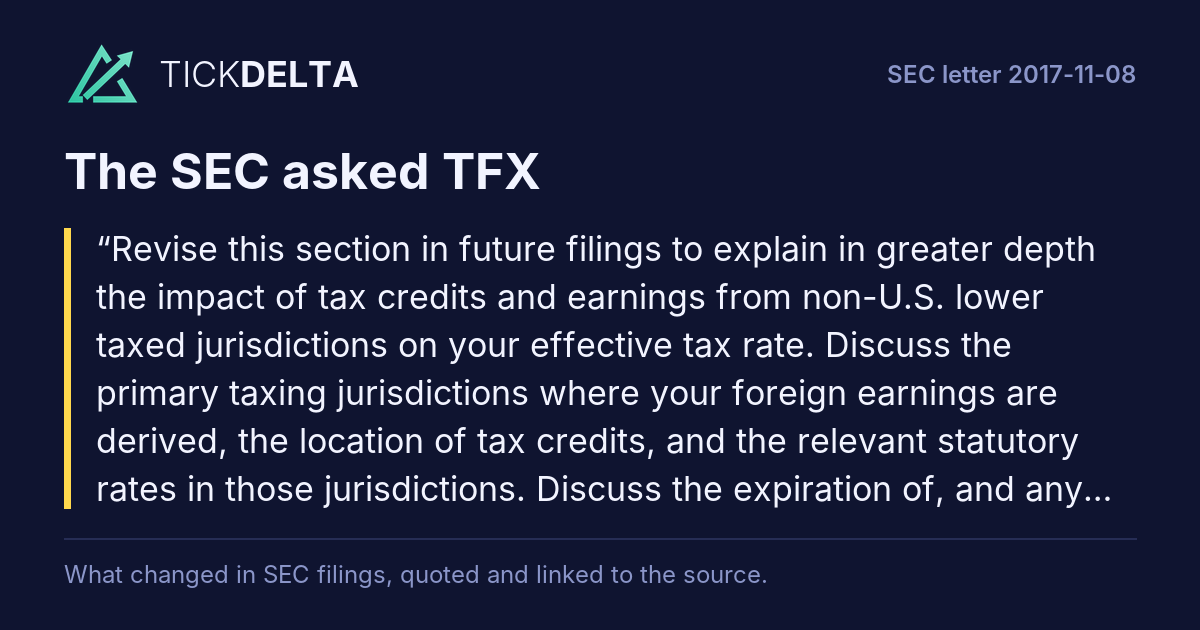
Revise this section in future filings to explain in greater depth the impact of tax credits and earnings from non-U.S. lower taxed jurisdictions on your effective tax rate. Discuss the primary taxing jurisdictions where your foreign earnings are derived, the location of tax credits, and the relevant statutory rates in those jurisdictions.
Rest of the question

Discuss the expiration of, and any uncertainties relating to, the income tax rates or benefits you currently receive in those jurisdictions. Refer to Item 303(a)(3) of Regulation S-K.

TFX answered
In future filings we will provide additional disclosure in Management’s Discussion and Analysis of Financial Condition and Results of Operations to discuss the effect that the statutory tax rates of the international jurisdictions in which we file tax returns has on our effective tax rate. Although the actual text of the disclosures to be included in future filings will be subject to existing facts and circumstances at the time of the relevant filing, the following illustrates the type of disclosure we contemplate will be included in future filings, beginning with the Company’s Form 10-K for
Rest of the answer

the fiscal year ended December 31, 2017:

“We generate substantial earnings from our international operations. Most of the international jurisdictions in which we file tax returns have statutory tax rates that are lower than the United States statutory tax rate; as a result, our consolidated effective income tax rate is substantially below the United States statutory tax rate. The principal international jurisdictions in which the statutory tax rate is lower than the United States statutory tax rate and from which we derive substantial earnings include Ireland, Bermuda, Germany, Italy and China.

We anticipate that, absent changes to either the currently enacted United States tax rates or international statutory tax rates, lower statutory tax rates with respect to our operations in international jurisdictions will continue to significantly reduce our consolidated effective income tax rate below the United States statutory tax rate.”

The Company supplementally advises the staff that we are not the beneficiary of significant tax holidays, tax credits or incentives that contribute to our effective tax rate being lower than the United States statutory tax rate.

Read in the reply
In its next report

First report after the company's reply of Nov 21, 2017: 10-K filed Feb 22, 2018 ↗, against the 10-K filed Feb 23, 2017 ↗.

Tickdelta does not hold the text of both reports, so they are not compared here.

Note 13 – Income taxes, page F-36
SEC asked (2)
In your rate reconciliation table, you disclose that international items impacted your tax rate by (27.5%) in the fiscal year ended December 31, 2016. Please quantify and detail for us the nature of the significant components of this item. Describe for us in greater detail the audit resolution related to German tax reserves and clarify if this item is included in the international line item.
Rest of the question

Refer to ASC 740-10-50-12.

TFX answered
Substantially all of the (27.5%) impact of the international items included in our rate reconciliation table for the fiscal year ended December 31, 2016 is attributable to lower statutory tax rates applicable to our earnings derived from international jurisdictions.

As noted in our response above, because most of the international jurisdictions in which we file tax returns have statutory tax rates that are lower than the United States statutory tax rate, our consolidated effective income tax rate was substantially less than the United States statutory tax rate.
Rest of the answer

In 2016, the lower statutory tax rates accounted for 27.4% of the 27.5% benefit included in the rate reconciliation table within the “Tax effect of international items” line item.

The reduction of Germany tax reserves for the year ended December 31, 2016 resulted from a final audit determination by the German tax authorities that the amount of our tax liability for the tax years 2007 through 2010 was $2.9 million. This was less than the $7.6 million reserve we established with respect to those tax years pursuant to ASC 740-10-25. As a result, we released $4.7 million of the reserve as a reduction to income tax expense.

The reduction to income tax expense related to the conclusion of the German tax audit was not included within the “Tax effect of international items” line item in our rate reconciliation table. Rather, the benefit was included within the “Uncertain tax contingencies” line item, as it represented a reduction in the reserve for uncertain tax contingencies.

Read in the reply
In its next report

First report after the company's reply of Nov 21, 2017: 10-K filed Feb 22, 2018 ↗, against the 10-K filed Feb 23, 2017 ↗.

Tickdelta does not hold the text of both reports, so they are not compared here.

Note 3 – Acquisitions · Vascular Solutions, page 10
SEC asked (3)
We note that you allocated approximately $259 million and $248 million of the purchase price to customer lists and intellectual property, respectively. Please address the following:  Tell us how you determined the fair value of these intangible assets, including the significant assumptions utilized.  Explain to us how you determined that a useful life of 25 years was appropriate for the customer lists.
Rest of the question

 Tell us why customer lists are not separately disclosed within your intangible asset table on page 17.

TFX answered
We were assisted in our identification of the intangible assets acquired and calculation of the fair value of the acquired intellectual property and customer relationships (customer lists), as well as in the calculation of the useful life of the customer relationships, by a third party valuation firm.

We preliminarily determined the fair value of the customer relationships, pursuant to ASC 805-20-30, using the excess earnings method, a form of the income approach under which the fair value is estimated as the present value of the benefits anticipated from ownership of the assets in excess of
Rest of the answer

the returns required from investment in contributory assets necessary to realize those benefits. The significant assumptions utilized to value the customer relationships included the projected revenues attributable to Vascular Solutions’ existing customers; the annual customer attrition rate, which was based on Vascular Solutions’ historical customer retention experience; the discount rate, which reflects consideration of the risk of the expected future cash flows, industry rates of return, and a premium for the risk of the customer relationship intangible asset relative to the tangible and other intangible assets; and the tax rates, which were determined based on the acquiring entity’s jurisdiction, the United States. The tax rates were utilized to calculate the after-tax discounted cash flows associated with the benefit anticipated from ownership of the assets as well as the hypothetical tax benefit associated with the amortization of the customer relationship intangible asset.

We preliminarily determined the fair value of the intellectual property, pursuant to ASC 805-20-30, using a relief from royalty method, a form of the income approach under which the fair value is based on the after-tax cost savings resulting from owning the intellectual property rather than paying a licensing royalty. The significant assumptions utilized to value the intellectual property included the projected revenues of each product line utilizing the intellectual property; the hypothetical royalty rates for the intellectual property, which were estimated based on an assessment of the uniqueness of the product, market share, the competitive environment and, to the extent feasible, publicly available royalty rates for technologies deemed to be similar to the intellectual property, as well as an assessment of the importance of the technology relative to other contributory intangible assets; the discount rate, which reflects consideration of the risk of the expected future cash flows, industry rates of return, and a premium for the risk of the intellectual property intangible asset relative to the tangible and other intangible assets; and the tax rates, which were determined based on the acquiring entity’s jurisdiction, the United States. The tax rates were utilized to calculate the after-tax discounted cash flows associated with the savings resulting from owning the intellectual property as well as the hypothetical tax benefit associated with the amortization of the intellectual property intangible asset.

We preliminarily determined the 25 year useful life of the customer relationships based on our consideration of the pertinent factors outlined in ASC 350-30-35-3 including consideration of the historical annual attrition rates experienced by Vascular Solutions.

The customer lists are disclosed within our intangible asset table on page 17 under the line item entitled “customer relationships.” In future filings, we will consistently apply the term “customer relationships” throughout our financial disclosures, including those that currently use the term “customer lists.”

Read in the reply
In its next report

First report after the company's reply of Nov 21, 2017: 10-K filed Feb 22, 2018 ↗, against the 10-K filed Feb 23, 2017 ↗.

Tickdelta does not hold the text of both reports, so they are not compared here.

Also in this review: closing letter, 2017-12-01

Form 10-K for the year ended December 31, 2012

2013-12-05 to 2014-01-06 · 2 questions · 1 letter from the SEC, 1 from the company
Review closed 2014-01-06
Non-GAAP measuresRevenue
Exhibit 99.1
SEC asked (1)
We note that you present certain forward looking non-GAAP measures, such as constant currency revenue growth, adjusted gross margin and adjusted operating margin, on page 18 of the presentation. Regulation G requires you to provide a reconciliation of the forward looking non-GAAP measure to the appropriate forward-looking GAAP measure.
Rest of the question

If the forward-looking GAAP measure is not accessible, you are required to disclose that fact and provide reconciling information that is available without an unreasonable effort. Further, you must identify the information that is unavailable and disclose its probable significance. Please revise future filings to provide the information required by Regulation G. Please note this comment also applies to your presentation of constant currency revenue growth projections included in the Form 8-K dated October 29, 2013.

TFX answered
In future filings and furnishings, we will provide a reconciliation of each forward-looking non-GAAP measure to the appropriate forward-looking GAAP measure. Specifically, we will provide such reconciliation with respect to constant currency revenue growth, adjusted gross margin, adjusted operating margin and any other forward-looking non-GAAP measure included in such future filings or furnishings, subject to the following sentence.
Rest of the answer

If the forward-looking GAAP measure is not accessible, we will disclose that fact, provide reconciling information that is available without an unreasonable effort, identify the information that is unavailable and disclose its probable significance.

Read in the reply
In its next report

First report after the company's reply of Dec 23, 2013: 10-K filed Feb 24, 2014 ↗, against the 10-K filed Feb 22, 2013 ↗.

Tickdelta does not hold the text of both reports, so they are not compared here.

Exhibit 99.1
SEC asked (2)
Appendix D on page 24 presents a non-GAAP income statement. Please remove this from any future filings. Refer to Item 10(e) of Regulation S-K and Non-GAAP Financial Information Compliance and Disclosure Interpretation Question 102.10 available on our website at http://www.sec.gov/divisions/corpfin/guidance/nongaapinterp.htm.
TFX answered
In future filings and furnishings, we will not include the Appendix D presentation or similar presentations.

As requested by the staff, Teleflex Incorporated (the “Company”) acknowledges the following with regard to its annual report on Form 10-K for the fiscal year ended December 31, 2012, and its current report on Form 8-K dated October 30, 2013 (the “Filings”):

• the Company is responsible for the adequacy and accuracy of the disclosure in the Filings;

staff comments or changes to disclosure in response to staff comments do not foreclose the Commission from taking any action with
Rest of the answer

respect to the Filings; and the Company may not assert staff comments as a defense in any proceeding initiated by the Commission or any person under the federal securities laws of the United States.

Read in the reply
In its next report

First report after the company's reply of Dec 23, 2013: 10-K filed Feb 24, 2014 ↗, against the 10-K filed Feb 22, 2013 ↗.

Tickdelta does not hold the text of both reports, so they are not compared here.

Also in this review: closing letter, 2014-01-06

Form 10-K for the year ended December 31, 2011

2012-10-05 to 2012-11-06 · 2 questions · 1 letter from the SEC, 1 from the company
Review closed 2012-11-06
Critical estimatesSegmentsResults discussion (MD&A)Liquidity and cashGoodwill and impairment
Critical Accounting Estimates, page 46 · Accounting for Allowance for Doubtful Accounts, page 46
SEC asked (1)
We note that as a result of providing extended or delayed payment plans in Europe, your receivables to customers in those countries increased during the ended December 31, 2011. Additionally, we note your disclosure that you are engaging in a more robust risk assessment for these customers.
Rest of the question

Please revise future filings to summarize the additional procedures you are undertaking to evaluate the risks and collectability of these receivables.

TFX answered
As noted in the referenced discussion, “our customers, particularly in the European region, have extended or delayed payments for products and services.” In addition, please note that our enhanced risk assessment efforts were not limited to European customers.

As requested by the staff, we will expand our disclosure in future filings to address our enhanced customer risk assessment efforts.
Rest of the answer

While our actual disclosures in future filings will be based on facts and circumstances then existing, we intend to include in our discussion of accounting for the allowance for doubtful accounts under “Management’s Discussion and Analysis of Financial Condition and Results of Operations – Critical

Accounting Estimates,” the following form of disclosure:

In light of the disruptions in global economic markets that began in the fourth quarter of 2008 and have continued through 2012, we have instituted enhanced measures to facilitate customer-by-customer risk assessment when estimating the allowance for doubtful accounts. Such measures include, among others, monthly credit control committee meetings, at which customer credit risks are identified after review of, among other things, accounts that exceed specified credit limits, payment delinquencies and other customer problems. In addition, for some of our non-government customers, we have instituted measures designed to reduce our risk exposures, including issuing dunning letters, reducing credit limits, requiring that payments accompany orders and instituting legal action with respect to delinquent accounts. With respect to government customers, we evaluate receivables for potential collection risks associated with the availability of government funding and reimbursement practices.

Some of our customers, particularly in Europe, have extended or delayed payments for products and services already provided.

Collectability concerns regarding our accounts receivable from these customers, for the most part in Greece, Italy, Spain and Portugal, is the primary cause for the increase in the allowance. If the financial condition of these customers or the healthcare systems in these countries continue to deteriorate such that the ability of an increasing number of customers to make payments is uncertain, additional allowances may be required in future periods.

Read in the reply
In its next report

First report after the company's reply of Oct 19, 2012: 10-Q filed Oct 31, 2012 ↗, against the 10-Q filed Jul 31, 2012 ↗.

Tickdelta does not hold the text of both reports, so they are not compared here.

Operations, page 35 · Change in Reporting Segments and Business Unit Structure, page 36
SEC asked (2)
We note that a result of the change in your North American reporting units you recognized a goodwill impairment charge of $332 million during the first quarter of 2012. Please revise future filings to expand your MD&A to discuss whether your reorganization and related impairment charges affected your expectations regarding your future operating results and liquidity.
Rest of the question

Please also discuss the primary underlying factors that resulted in the goodwill impairment charges.

TFX answered
We recognize that in many situations a goodwill impairment charge is an indication that there were underlying factors that would imply a possible reduction in future operating results and liquidity. However, with respect to the impairment charge of $332 million that we recorded in the first quarter of 2012, there is no reduction in our expectation of future operating results or liquidity.
Rest of the answer

Rather, as explained below, the impairment charge was a result of the mechanical application of accounting guidance contained in Financial Accounting Standards Board Accounting Standards Codification (“ASC”) Section 350-20-35 to each of the five new reporting units created out of the North American reporting unit.

As disclosed in “Management’s

Discussion and Analysis of Financial Conditions and Results of Operation – Critical Accounting Estimates – Goodwill,” in our Form 10-K for the year ended December 31, 2011, the fair value of the North American Medical Reporting Unit exceeded its carrying value only to a limited extent. In applying the Step 1 test under ASC Section 350-20-35 to each of the reporting units, we allocated goodwill among the five reporting units based on their relative fair values, as required under

ASC Paragraph 350-20-35-45. The allocation of the historical carrying values of the net assets other than goodwill to the five reporting units was based on specific identification and their respective operating activities. The resulting relative allocation of the carrying amounts was different from the allocation of the relative fair value.

Accordingly, while there was very little change in the total fair value and carrying value of the sum of the five reporting units compared to the North American reporting unit, the relative values were different for each of the five new reporting units. For some reporting units the fair value exceeded the carrying value, while in other situations the carrying value exceeded fair value, which led to the application of the Step 2 test.

We emphasize that the results of the Step 1 test did not reflect any change in management’s assessment of the North American segment’s profitability or liquidity.

Indeed, in performing its analysis, management used projections in the first quarter of 2012 which indicated substantially the same performance as compared to the performance reflected in the projections used in connection with our fourth quarter 2011 impairment test. Moreover, the magnitude of the goodwill impairment charge was principally due to the fact that, in applying the Step 2 impairment test under ASC Section 350-20-35, the implied fair values assigned to net assets other than goodwill substantially exceeded their book values, which caused a concomitant reduction in the implied fair value of goodwill. The goodwill impairment charge was primarily attributable to the reduction in the implied fair value of goodwill resulting from the increase in the implied fair value of the other net assets of the three affected reporting units.

For the periods in which the charge of $332 million for the impairment of goodwill is included in our income statement, we intend to add the following form of disclosure to the end of the referenced paragraph:

The impairment charge does not reflect any significant business change or any change in our expectations regarding the future operating results or liquidity of the North American segment. Rather, it is attributable to the creation of five new reporting units out of the North American reporting unit. In the fourth quarter of 2011 we determined the fair value of the North American reporting unit exceeded the carrying value, and thus there was no further analysis to determine if there was an impairment of goodwill. In the first quarter of 2012, we determined the relative fair values of each reporting unit and allocated the goodwill assigned to the North American reporting unit to each of the new reporting units based on relative fair value. We subsequently allocated other net assets to the reporting unit based on specific identification and their respective operating activities. The resulting allocation of the carrying amounts was different from the allocation of the relative fair value. Accordingly, while there was very little change in the total fair value and carrying value of the sum of the five reporting units compared to the North American reporting unit, the relative values were different for each of the five new reporting units. For some reporting units the fair value exceeded the carrying value, and in other situations the carrying value exceeded fair value of the reporting unit, which resulted in further analysis to determine the implied fair value of the goodwill and the resulting impairment charge. This charge was primarily attributable to the fact that the fair value of other assets increased which results in a decrease in the assumed fair value of goodwill.

As requested by the staff, Teleflex

Incorporated (the “Company”) acknowledges the following with regard to its annual report on Form 10-K for the fiscal year ended December 31, 2011, and its quarterly report on Form 10-Q for the quarter ended July 1, 2012 (the

“Filings”)

• the Company is responsible for the adequacy and accuracy of the disclosure in the Filings;

staff comments or changes to disclosure in response to staff comments do not foreclose the Commission from taking any action with respect to the

Filings; and the Company may not assert staff comments as a defense in any proceeding initiated by the Commission or any person under the federal securities laws of the United States.

Read in the reply
In its next report

First report after the company's reply of Oct 19, 2012: 10-Q filed Oct 31, 2012 ↗, against the 10-Q filed Jul 31, 2012 ↗.

Tickdelta does not hold the text of both reports, so they are not compared here.

Also in this review: closing letter, 2012-11-06

From the SEC's correspondence on EDGAR: staff letters (form UPLOAD) and company letters (form CORRESP), 12 letters filed since 2012-10-05. Questions and answers are matched by their numbers; topics come from words in each question. The reports are compared word for word (same form, before the first SEC letter against the first report after the company's reply). No AI.

Sources

The SEC's correspondence on EDGAR: staff letters (form UPLOAD) and company letters (form CORRESP), matched question by question. No AI.

Also

Filings: the letters in the filing list.

Work with it

Excel workbook · CSV. Google Sheet that stays up to date: paste =IMPORTDATA("https://tickdelta.com/company/TFX/export.csv") into a cell.

Next in Owners and insiders:Insider trades
Esc

Type a ticker such as AAPL, a name, an investor such as Buffett, or a topic such as tariffs. ↑ ↓ to move, Enter to open.