TGTTarget Corporation
Target Corporation was incorporated in Minnesota in 1902. 10-K, Item 1
- Headquarters
- Minneapolis, MN
- CEO
- Brian C. Cornell
- Next results
- around Nov 18, 2026
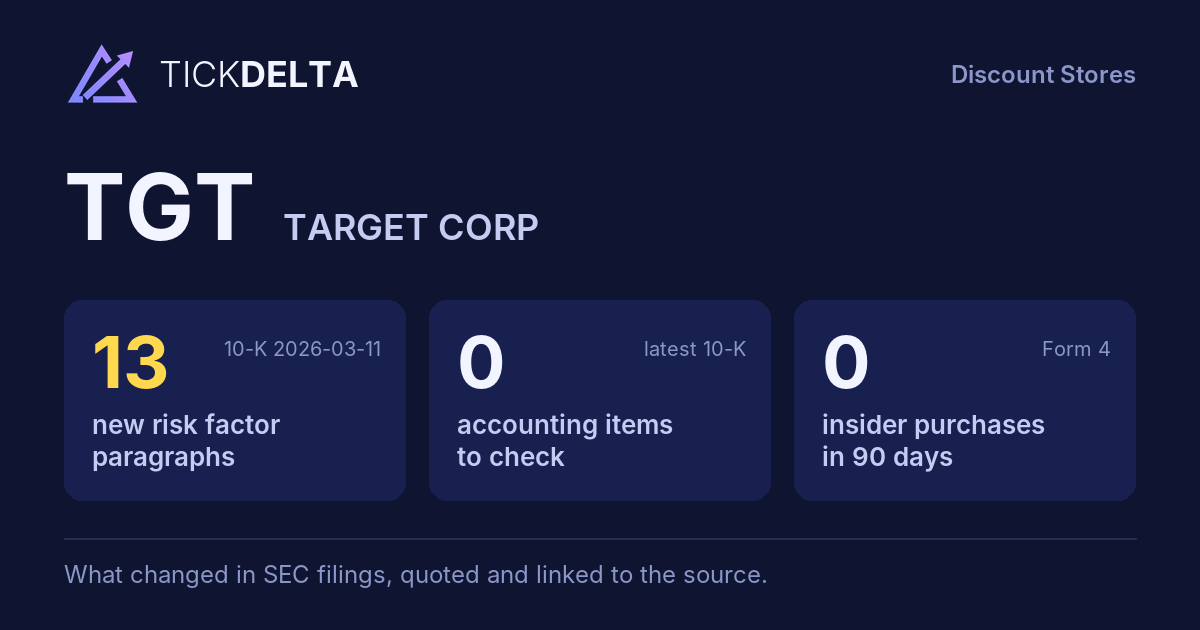
What the 10-K filed 2026-03-11 says about risks that are not on the face of the balance sheet, from the notes to the financial statements, Legal Proceedings and the MD&A (and, for big customers and key suppliers, Business and Risk Factors). Tickdelta picks sentences with specifics (amounts, accruals, covenant ratios) and quotes them as filed. New marks a sentence with nothing like it in the 10-K filed 2025-03-12.
Big customers
Customers the company names as a large share of revenue or receivables (it must name any worth 10% of revenue).
No specific sentence about this in the 10-K.
Key suppliers
Parts or manufacturing that depend on one or a few suppliers.
No specific sentence about this in the 10-K.
Lawsuits and legal claims
2 newPending cases, settlements and what the company has set aside for them.
“On January 31, 2025, and February 20, 2025, Target Corporation and members of its Board of Directors were named as defendants in two purported federal securities law class actions filed in the United States District Court for the Middle District of Florida.”
Read it in the 10-K ↗
“Both plaintiffs have marked the class actions as related to a previously filed individual federal securities action in which the court denied a motion to dismiss.”
Read it in the 10-K ↗
“The plaintiffs seek damages and other relief, including attorneys’ fees, based on allegations that the defendants misled investors, including about the risks associated with Target’s environmental, social, and governance initiatives (including with respect to diversity, equity, and inclusion) and its 2023 Pride Month merchandise collection, and oversight of those risks.”
Read it in the 10-K ↗
New “We recognized $593 million of net gains related to settlements of credit card interchange fee litigation matters.”
Read it in the 10-K ↗
New “(b)For 2025, includes $250 million related to business transformation costs described in Note 7 and $593 million of pretax net gains related to settlements of credit card interchange fee litigation matters described in Note 6.”
Read it in the 10-K ↗
Guarantees and indemnities
Promises to pay someone else's debts or losses if they cannot.
“Standby letters of credit and surety bonds, primarily related to insurance and regulatory requirements, totaled $667 million as of January 31, 2026.”
Read it in the 10-K ↗
Debt covenants
Conditions in loan agreements that, if broken, can make debt due early.
“We are, and expect to remain, in compliance with these covenants.”
Read it in the 10-K ↗
“We are, and expect to remain, in compliance with these covenants, which have no practical effect on our ability to pay dividends.”
Read it in the 10-K ↗
Commitments off the balance sheet
Contracts the company must pay for later: purchase obligations, take-or-pay deals.
“Purchase obligations, which include all legally binding contracts such as merchandise royalties, equipment purchases, marketing-related contracts, software acquisition/license commitments, firm minimum commitments for inventory purchases, and service contracts, were $1.2 billion as of January 31, 2026.”
Read it in the 10-K ↗
Sentences are chosen by their words, not read by AI, so some can be off topic. Always check the filing. Open the 10-K ↗
Work on TGT in a spreadsheet:
Excel workbook (a sheet per section, ten years by column, charts, links to the filings) ·
CSV.
For a Google Sheet that stays up to date, paste =IMPORTDATA("https://tickdelta.com/company/TGT/export.csv") into a cell.