Form 10-K
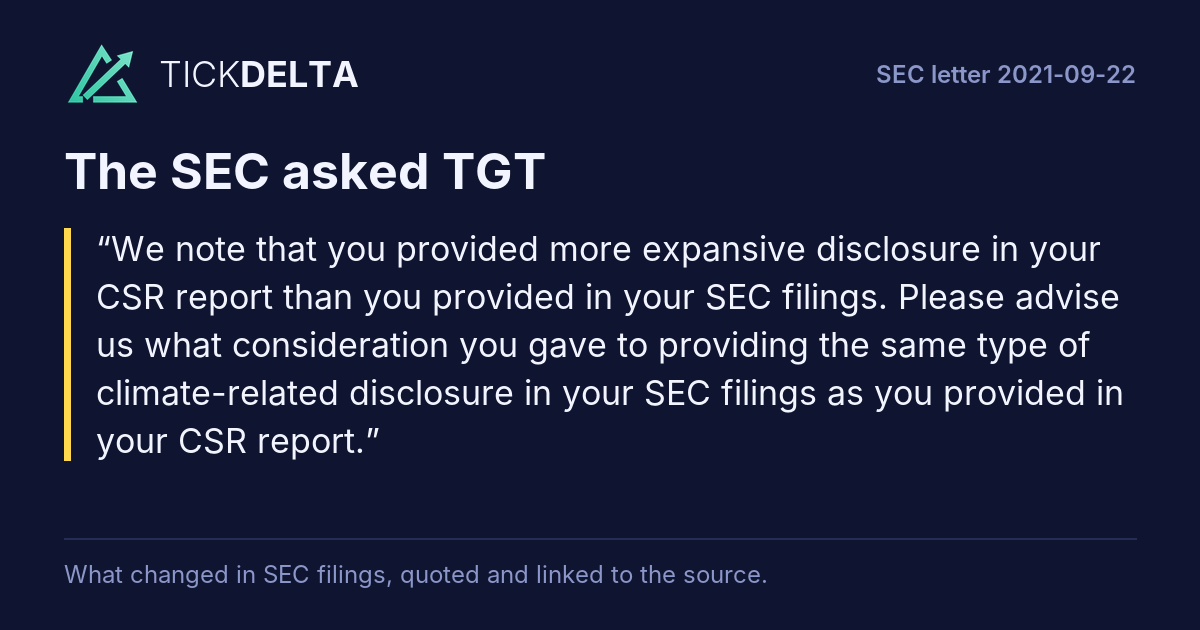
We note that you provided more expansive disclosure in your CSR report than you provided in your SEC filings. Please advise us what consideration you gave to providing the same type of climate-related disclosure in your SEC filings as you provided in your CSR report.
Target’s Response to Comment 1
As a general merchandise retailer with over 1,900 stores located across the United States, we have stakeholders on a variety of matters. These stakeholders include our employees (whom we refer to as “team members”), customers (whom we refer to as “guests”), suppliers, investors, nonprofits, and others.
We provide disclosure in our Securities and Exchange Commission (“SEC”) filings primarily to satisfy our obligations under the securities laws and provide “material” information to our shareholders and the investing public.Read in the reply ↗Rest of the answer
Additionally, we provide information on our website and in various other public disclosures, including our 2021 Target Corporate Responsibility Report (“CR Report”) which you referenced, that may be useful or of interest to our different stakeholders for a variety of reasons. For example, we have a legacy of corporate responsibility, community support, and sustainability efforts. Consistent with that legacy, and one of many factors we view as important to our reputation and relevance with our stakeholders, we disclose information in our CR Report and elsewhere about our programs and commitments related to global environmental, social and governance topics, including climate, to address evolving stakeholder expectations, even where those issues may not have a material effect on our business.
For purposes of this question and the other questions below, we note in particular the statement on page 4 of our CR Report that it reports on topics material to stakeholders across our value chain, as identified during our 2018-2019 materiality assessment and 2020 stakeholder engagement. It also clarifies that, for purposes of the CR Report, we use the Global Reporting Initiative’s definition of materiality, which differs from the definition used for SEC filings. As a result, issues deemed material for purposes of the CR Report may not be considered material for SEC reporting purposes. Where topics in our CR Report meet the general standards of “materiality” under the securities laws and such disclosure is required, we include the material information about those topics in our SEC filings.
We acknowledge and follow the SEC’s Guidance Regarding Disclosure Related to Climate Change, Interpretive Release No. 33-9106 (February 8, 2010) (“Release No. 33-9106”), as well as the principles-based disclosure rules in Regulation S-K. Even though the specific effects of climate change are not currently material to Target under the SEC’s applicable disclosure standards, we acknowledge the general effects of climate change and also the public interest in the topic, which is one of the reasons we disclose information about climate change and other sustainability topics on our website, in our CR Report, and in other public disclosures.
Finally, as it pertains to this question and the other questions below, we acknowledge our obligation to continuously review these matters as part of our ongoing disclosure controls and disclose climate-change related matters in our SEC filings to the extent we determine it is required. At the same time, we appreciate the interest many of our stakeholders have in information about climate change, and we expect to continue providing information about climate change and other environmental, social, and governance topics through various public disclosures, including our website and CR Report.
Disclose the material effects of transition risks related to climate change that may affect your business, financial condition, and results of operations, such as policy and regulatory changes that could impose operational and compliance burdens, market trends that may alter business opportunities, credit risks, or technological changes.
Target’s Response to Comment 2
We reviewed the applicable disclosure standards while preparing our Form 10-K and concluded that transition risks related to climate change are not expected to materially affect our business, financial condition, and results of operations. As materiality is assessed in connection with each filing, we will disclose transition risks related to climate change that may affect our business, financial condition, or results of operations if they become material to Target and such disclosure is required or we otherwise determine such disclosure to be appropriate. Read in the reply ↗
First report after the company's reply of 2021-10-18: 10-Q filed 2021-11-24 ↗, against the 10-Q filed 2021-08-27 ↗.
Tickdelta does not hold the text of both reports, so they are not compared here.
Disclose any material litigation risks related to climate change and the potential impact to the company.
Target’s Response to Comment 3
We reviewed the applicable disclosure standards while preparing our Form 10-K and concluded that we do not have any material litigation risks related to climate change. As materiality is assessed in connection with each filing, we will disclose litigation risks related to climate change and the potential impact to the company if they become material to Target and such disclosure is required or we otherwise determine such disclosure to be appropriate. Read in the reply ↗
First report after the company's reply of 2021-10-18: 10-Q filed 2021-11-24 ↗, against the 10-Q filed 2021-08-27 ↗.
Tickdelta does not hold the text of both reports, so they are not compared here.
We note your discussion of past and/or future investments in climate-related projects in your CSR report. If material, please quantify these expenditures in your SEC filings.
Target’s Response to Comment 4
We reviewed the applicable disclosure standards while preparing our Form 10-K and concluded that our investments in climate-related projects have not and are not expected to materially affect our business, financial condition, or results of operations. As materiality is assessed in connection with each filing, we will disclose climate-related investments if they become material to Target and such disclosure is required or we otherwise determine such disclosure to be appropriate. Read in the reply ↗
First report after the company's reply of 2021-10-18: 10-Q filed 2021-11-24 ↗, against the 10-Q filed 2021-08-27 ↗.
Tickdelta does not hold the text of both reports, so they are not compared here.
To the extent material, discuss the indirect consequences of climate-related regulation or business trends, such as the following: • decreased demand for goods or services that produce significant greenhouse gas emissions or are related to carbon-based energy sources; • increased demand for goods that result in lower emissions than competing products; • increased competition to develop innovative new products thatRest of the question
result in lower emissions; and • any anticipated reputational risks resulting from operations or products that produce material greenhouse gas emissions.
Target’s Response to Comment 5
We reviewed the applicable disclosure standards while preparing our Form 10-K and concluded that indirect consequences of climate-related regulation or business trends have not and are not expected to materially affect our business, financial condition, or results of operations. As materiality is assessed in connection with each filing, we will disclose indirect consequences of climate-related regulation or business trends if they become material to Target and such disclosure is required or we otherwise determine such disclosure to be appropriate. Read in the reply ↗
First report after the company's reply of 2021-10-18: 10-Q filed 2021-11-24 ↗, against the 10-Q filed 2021-08-27 ↗.
Tickdelta does not hold the text of both reports, so they are not compared here.
If material, discuss the significant physical effects of climate change on your operations and results. This disclosure may include the following: • quantification of material weather-related damages to your property or operations; • potential for indirect weather-related impacts that have affected or may affect your major customers or suppliers; • any impacts to your supply chain resulting from decreasedRest of the question
agricultural production capacity in areas affected by drought or other weather-related changes; and • any weather-related impacts on the cost or availability of insurance.
Target’s Response to Comment 6
We reviewed the applicable disclosure standards while preparing our Form 10-K and concluded that significant physical effects of climate change on our operations and results have not and are not expected to materially affect our business, financial condition, or results of operations. As materiality is assessed in connection with each filing, we will disclose significant physical effects of climate change on our operations and results if they become material to Target and such disclosure is required or we otherwise determine such disclosure to be appropriate. Read in the reply ↗
First report after the company's reply of 2021-10-18: 10-Q filed 2021-11-24 ↗, against the 10-Q filed 2021-08-27 ↗.
Tickdelta does not hold the text of both reports, so they are not compared here.
Quantify any material increased compliance costs related to climate change.
Target’s Response to Comment 7
We reviewed the applicable disclosure standards while preparing our Form 10-K and concluded that compliance costs related to climate change have not and are not expected to materially affect our business, capital expenditures, competitive position, financial condition, or results of operations. As materiality is assessed in connection with each filing, we will disclose any increased compliance costs related to climate change if they become material to Target and such disclosure is required or we otherwise determine such disclosure to be appropriate. Read in the reply ↗
First report after the company's reply of 2021-10-18: 10-Q filed 2021-11-24 ↗, against the 10-Q filed 2021-08-27 ↗.
Tickdelta does not hold the text of both reports, so they are not compared here.
If material, provide disclosure about your purchase or sale of carbon credits or offsets and any material effects on your business, financial condition, and results of operations.
Target’s Response to Comment 8
We reviewed the applicable disclosure standards while preparing our Form 10-K and concluded that our purchases of carbon credits or offsets have not and are not expected to materially affect our business, financial condition, or results of operations. As materiality is assessed in connection with each filing, we will disclose our purchases of carbon credits or offsets if they become material to Target and such disclosure is required or we otherwise determine such disclosure to be appropriate.
****
On behalf of Target Corporation, I thank you for yourRead in the reply ↗Rest of the answer
consideration of our response.
First report after the company's reply of 2021-10-18: 10-Q filed 2021-11-24 ↗, against the 10-Q filed 2021-08-27 ↗.
Tickdelta does not hold the text of both reports, so they are not compared here.
We note your response to comment 2. Please explain, in detail, how you determined that transition risks related to climate change are not expected to materially affect your business, financial condition, and results of operations. In your response, tell us about the specific transition risks you considered, including those noted in our prior comment.
Target’s Response to Comment 1
Our standard procedures for preparing our annual report on Form 10-K and quarterly reports on Form 10-Q include a process to identify and consider risks that may affect our business, financial condition, and results of operations. This process includes reviewing risks identified through our enterprise risk management program, reviewing information provided by our business functions, and a discussion and analysis of the foregoing among the group responsible for the accuracy and completeness of our filings.Read in the reply ↗Rest of the answer
This process is designed to identify our significant risks, which are then evaluated for possible disclosure in light of their materiality and the applicable disclosure requirements, including the SEC's Guidance Regarding Disclosure Related to Climate Change, Interpretive Release No. 33-9106 (February 8, 2010). To date, transition risks related to climate change have not been among our material risks.
More specifically, we engaged a third party consultant in 2019 to assist our evaluation of transition risks related to climate change. This evaluation included a scenario analysis, based on the Recommendations of the Task Force on Climate-related Financial Disclosures (TCFD), which provides a framework for evaluating the impacts of climate change on an organization under alternate futures (or scenarios).
In our scenario analysis, we evaluated transition risks in the following areas:
Current and Emerging Regulation
We considered the impact of current and emerging climate change regulations on our business. For example, current regulation includes California’s Zero-Emission Vehicle regulation (several additional states have adopted similar versions), which requires a minimum percentage of electric vehicle sales. Third-party logistics providers own and operate the vast majority of vehicles used to support our business. As a result of this regulation, these third-party logistics partners, who primarily operate diesel-powered trucks, may face increased operating costs and may attempt to pass on those costs to Target. The scenario analysis also evaluated the current and evolving regulatory framework for electricity pricing, which includes various measures to encourage renewable energy participation in the capacity marketplace. As a consumer of energy, these types of measures could increase the price we pay for electricity.
Although the scenario analysis identified several areas where regulatory developments could result in increased operating costs, we did not view any of these possible increased costs as potentially material to Target, given the likelihood that regulatory changes would impact our competitors in a similar manner, and the potential for us to adopt merchandising, sourcing, or other strategies to manage any increased operating costs, which is our customary approach for any type of increased cost.
Technology
We also considered technology advances motivated by climate change considerations and how these advances might affect our business. While technology advances could affect our merchandise assortment, we do not view this issue as presenting a material risk to Target because we are able to adjust our merchandise assortment to respond to changing guest demand. Technology advances also present new opportunities to satisfy guest demand. For example, we now offer an assortment of some of the latest energy efficient consumer products available in the market, such as smart thermostats and efficient lighting, and we expect guest demand for such products to continue to grow in the future. However, given the significant breadth and depth of Target's entire merchandise assortment, even with continued growth in demand for these products, we do not expect such demand to have a material effect on our overall sales.
Market
We evaluated how climate change transitions may affect overall market risk. For example, oil price fluctuations could drive higher material costs for products that use petrochemicals—such as feedstocks, plastics, detergents, solvents, nylon, and polyester. Our suppliers could subsequently pass on their cost increases to Target. While we understand the possibility of product cost increases, this would likely impact our competitors in a similar fashion, and we see potential for us to adopt merchandising, sourcing, or other strategies to manage any cost increase. For these reasons, we did not view the possibility of product cost increases as material to Target at this time.
Reputation
We also considered the reputational risks to Target if we are not perceived as assisting the global effort to transition to a low-carbon economy. We do not view this reputational risk as an independent material risk given our voluntary reporting in our Corporate Responsibility (CR) report and other channels, as well as the goals we have established for reduction of greenhouse gas (GHG) emissions. We also note that our Risk Factors contain an overall reputation risk that is intended to address a wide array of potential reputational issues faced by a large consumer-facing business. We have concluded that transition risks related to climate change are not material risks that would require disclosure.
Finally, we recognize that this is an evolving area and, as a result, we regularly update our risk analysis. We also intend to periodically update our scenario analysis.
First report after the company's reply of 2021-12-08: 10-K filed 2022-03-09 ↗, against the 10-K filed 2021-03-10 ↗.
Tickdelta does not hold the text of both reports, so they are not compared here.
We note your response to comment 3. Please explain, in detail, how you determined that you do not have any material litigation risks related to climate change. In your response, please tell us how you considered providing disclosure addressing the possibility of litigation related to climate change and its potential impact.
Target’s Response to Comment 2
We regularly review pending and threatened litigation and government proceedings in connection with our SEC filings. Additionally, we regularly monitor trends and material risks to our business, including potential litigation risks. As part of our regular review, we have concluded that the risk of climate change-related litigation is not currently a material risk that warrants disclosure in the Risk Factors section of our periodic reports.
To date, we have not experienced any threatened or actual climate change-related litigation, and we have no indicationRead in the reply ↗Rest of the answer
that our industry is susceptible to significant litigation related to climate change.
To the extent that climate change-related litigation includes claims and actions related to environmentally-focused labeling or marketing of products, we have occasionally experienced these types of claims. However, none of these claims have resulted in material liability to date.
First report after the company's reply of 2021-12-08: 10-K filed 2022-03-09 ↗, against the 10-K filed 2021-03-10 ↗.
Tickdelta does not hold the text of both reports, so they are not compared here.
We note your response to comment 4. Please explain, in detail, how you determined that your investments in climate-related projects have not and are not expected to materially affect your business, financial condition, or results of operations. In your response, include information about your specific investments and quantify the associated costs.
Target’s Response to Comment 3
In order to determine whether our investments in climate-related projects have had, or are expected to have, a material effect on our business, financial condition, or results of operations, we reviewed and analyzed the size, scope, and costs of current and anticipated projects, including investments in climate-related projects.Read in the reply ↗Rest of the answer
We then compared these amounts to our overall capital expenditures or our Selling, General and Administrative (SG&A) expenses, as applicable.
While we are increasingly making investments in climate-related projects and technology, our analysis led us to conclude that our climate-related investments have not and are not expected to materially affect our business, financial condition, or results of operations. We analyzed our investments in this area relative to our total annual capital expenditures, which averaged approximately $3 billion in 2018 through 2020 and we estimate will increase to $4 billion or more in the foreseeable future.
Specifically, as discussed in our Form 10-K, we invest in opportunities to profitably grow our business, create sustainable long-term value, and maintain our current operations and assets. Among the investments we consider in this regard are investments to increase energy efficiency, such as the installation of LED lighting, efficient refrigeration units, and rooftop solar panels. As noted in our 2021 Corporate Responsibility (CR) report, over the past seven years, collectively, we have invested approximately $300 million in energy efficient projects. More specifically, these investments approximated $100 million or less annually in each of fiscal years 2020, 2019, and 2018, and represented less than three percent (3%) of total annual capital expenditures. While these projects reduce our energy use and help us to achieve our sustainability goals, they also provide an acceptable economic return.
These investments do not significantly differ from, nor are they incremental to, other investments we make in our business. For example, we regularly replace lights and refrigeration units due to normal wear and tear, and when doing so, we evaluate the cost/benefit of replacing existing assets with modern, more energy efficient equipment. While we expect to increase our investments in projects in support of our climate goals, including energy efficiency, for many years into the future, at this time we do not expect that they will be material, and are not expected to exceed five percent (5%) of our total annual capital expenditures in the foreseeable future.
In addition to capital expenditures, we also enter into arrangements to source our electricity needs from renewable sources, namely wind and solar energy, as part of the goals we have established for reduction of GHG emissions. We do this by contracting directly with utility companies that serve our facilities and indirectly through power purchase agreements with renewable energy facilities. These arrangements require no upfront investment. The renewable electricity that we purchase is not incremental to our overall energy needs or annual SG&A expenses.
First report after the company's reply of 2021-12-08: 10-K filed 2022-03-09 ↗, against the 10-K filed 2021-03-10 ↗.
Tickdelta does not hold the text of both reports, so they are not compared here.
We note your response to comment 5. Please explain, in detail, how you determined that the indirect consequences of climate-related regulation or business trends have not and are not expected to materially affect your business, financial condition, or results of operations.Rest of the question
In your response, tell us how you expect climate change to affect demand for products and services or your ability to provide products and services. Also, address any anticipated reputational risks resulting from operations or products that produce greenhouse gas emissions.
to Question 1 provides our discussion of reputational risks. Read in the reply ↗
First report after the company's reply of 2021-12-08: 10-K filed 2022-03-09 ↗, against the 10-K filed 2021-03-10 ↗.
Tickdelta does not hold the text of both reports, so they are not compared here.
We note your response to comment 6. Your response appears to be conclusory without addressing the individual items from our prior comment. Please explain, in detail, how you determined that significant physical effects of climate change on your operations and results have not and are not expected to materially affect your business, financial condition, or results of operations.Rest of the question
In your response, specifically address each of the items from our prior comment.
Target’s Response to Comment 5
We determined that the physical effects of climate change have not and are not expected to materially affect our business, financial condition, and results of operations by (i) assessing our historical and foreseeable expenses related to our physical operations, including weather-related damage; (ii) investigating whether we have data and information indicating that weather-related events have significantly impacted our major vendors and suppliers, or may significantly impact our major vendors and suppliers in the foreseeable future; (iii) examining historicalRead in the reply ↗Rest of the answer
weather-related impacts to our agricultural supply chain and the availability of associated products; and (iv) reviewing our historical and current insurance premiums to determine whether they have been materially impacted by weather-related factors. Although we have experienced some weather-related impacts to our business in each of these categories, due to the significant size and scope of our operations, and the geographic diversity of our operations, suppliers, and vendors, we are able to mitigate these impacts so that they have not been and are not expected to be material to our business, financial condition, or results of operations. Below, we specifically address each of the items addressed in your initial letter on this matter:
•Weather-related damages to our property and business represented 0.1% or less of our total Selling, General and Administrative expenses (SG&A) in each of fiscal years 2020, 2019, and 2018. Due to these historical trends and the geographically dispersed composition of our business, we do not expect an increase in weather-related property losses to a degree that is material to Target.
•We have more than 1,900 stores located across all fifty states and a significant digital sales channel, and our guest base is broad and geographically dispersed. For these reasons, weather-related impacts on our guests have not and are not expected to materially impact our operating results.
•Our business is dependent on our ability to effectively manage our inventory in a broad range of merchandise categories, including products that are dependent on agriculture production like certain textiles, paper products, and grocery items. We source products from suppliers and vendors from a global network of facilities in nearly fifty countries. Our geographically diverse supply chain and extensive product assortment reduces the risk of droughts or other weather-related events materially affecting our business operations or the availability of our product offerings.
From time-to-time, weather events have negatively affected the supply or increased the cost of certain products. The most significant recent example that demonstrates our ability to mitigate weather-related events affecting major vendors involved back-to-back Category 4 and Category 5 hurricanes in November 2020, which severely crippled banana supplies from Honduras and other parts of Central America, a major source of supply for our vendors. Bananas are among our highest volume items, and to date, since November 2020, we have not seen a significant impact on our sales, as our vendors were able to supplement their supply from other growing regions. Although bananas are one of our largest items by sales dollars, they represent 0.1% or less of our total sales and gross profits. Because our sales are generated from a broad, multi-category assortment, the availability and/or cost of individual products have not and are not expected to have a material impact on our operating results.
•We have not experienced any material impacts to our insurance costs or to the availability of insurance due to weather-related factors. Specifically, our total property insurance premiums represented less than 0.1% of our total SG&A expenses in each of fiscal years 2020, 2019, and 2018. Based on our understanding of the property insurance market, and our expectations for future premiums relative to our total SG&A expenses, we do not expect weather-related factors to affect our ability to obtain property insurance coverage or to increase the cost of property insurance coverage to a degree that is material to Target.
First report after the company's reply of 2021-12-08: 10-K filed 2022-03-09 ↗, against the 10-K filed 2021-03-10 ↗.
Tickdelta does not hold the text of both reports, so they are not compared here.
We note your response to comment 7. Please explain, in detail, how you determined that compliance costs related to climate change have not and are not expected to materially affect your business, capital expenditures, competitive position, financial condition, or results of operations. In your response, please describe the nature of the compliance costs you incurred and quantify the related amounts.
Target’s Response to Comment 6
The climate change-related compliance costs applicable to our business relate principally to inspection and reporting requirements pertaining to commercial refrigeration systems used in our operations. We consider the ongoing maintenance and repair of these systems as a cost of maintaining our operations that would be incurred irrespective of the inspection and reporting compliance obligations.Read in the reply ↗Rest of the answer
In addition, we are subject to state level permitting and reporting requirements related to mobile back-up generators used in our stores and distribution centers, and a California mandatory commuter subsidy program that requires employers to provide subsidies for the use of public transit by employees. To date, these compliance costs have been less than 0.1% of our total SG&A expenses and we expect them to remain in that range.
First report after the company's reply of 2021-12-08: 10-K filed 2022-03-09 ↗, against the 10-K filed 2021-03-10 ↗.
Tickdelta does not hold the text of both reports, so they are not compared here.
We note your response to comment 8. Provide us with support for your statement that purchases of carbon credits or offsets have not and are not expected to materially affect your business and quantify the amounts relating to these transactions. Please contact Cara Wirth at (202) 551-7127 or Lilyanna Peyser at (202) 551-3222 with any questions.
Target’s Response to Comment 7
To date, we have purchased approximately $100,000 of carbon offsets. In fiscal years 2020 and 2019, we purchased offsets from the Arbor Day Foundation for 3,304 and 8,105 metric tons of carbon dioxide emissions, respectively, through the protection and restoration of trees in the Mississippi Alluvial Valley, the McCloud River in California, and Cordillera Azul National Park in Peru.
While we are evaluating the use of carbon credits and offsets to meet our climate goals, we do not expect that future purchases of carbon credits or offsets will materially affectRead in the reply ↗Rest of the answer
our business, financial condition or results of operations on an annual basis.
****
On behalf of Target Corporation, I thank you for your consideration of our response.
First report after the company's reply of 2021-12-08: 10-K filed 2022-03-09 ↗, against the 10-K filed 2021-03-10 ↗.
Tickdelta does not hold the text of both reports, so they are not compared here.
Also in this review: closing letter, 2022-01-26