Paragraph 67 · 41% changed
Every version of it
Screener
/
SEC EDGAR
/CIK 0000944695
/10-K filed Feb 20, 2026, compared with Feb 24, 2025
/Numbers from the XBRL of the 10-Ks
NYSE
Financials · Property & Casualty Insurance
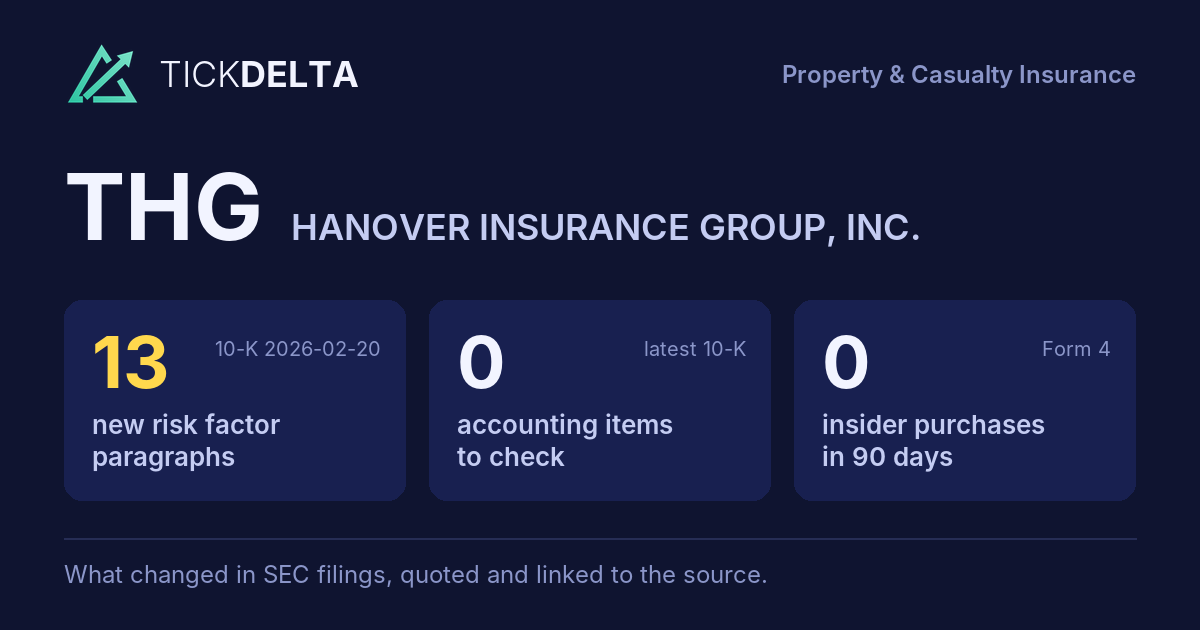
Hanover Insurance Group, Inc. THG
The 10-K against last year's
183 changes: 17 added, 17 removed, 148 reworded, 1 quiet changes
10-K Feb 20, 2026 vs Feb 24, 2025
Risk Factors
12.3%
of the text changed · 13,173 words now · 13 new paragraphs, 10 gone
MD&A
11.8%
of the text changed · 19,578 words now · 4 new paragraphs, 7 gone
Legal Proceedings
0.0%
of the text changed · 188 words now
Accounting Policies
8.7%
of the text changed · 3,631 words now
10-K 0001193125-26-060983 (Feb 20, 2026) vs 10-K 0000950170-25-025093 (Feb 24, 2025)
Every paragraph, and how much of it changed
One bar per paragraph, in the order of the 10-K. Height and colour show the share of its words not in the closest paragraph a year earlier; the tallest bars are new paragraphs.
Risk Factors
147 paragraphs · 13 new · 42 reworded · 10 gone · 10-K Feb 20, 2026 against Feb 24, 2025
New paragraph
Reworded (5% of its words or more)
Same or nearly
Paragraph 97 · 32% changed
Every version of it
Paragraph 125 · 31% changed
Every version of it
Deterioration in the global financial markets may adversely affect our investment portfolio and have a related impact on our other comprehensive income, shareholders’ equity and overall investment performance. In response to growing inflation, monetary policies in developed economies tightened in recent years, though easing has begun in the U.S. Despite the easing, financial conditions continue to be tight and remain a challenge to the U.S. economy. Tighter financial conditions pose a challenge to the economy and may increase the likelihood of defaults on our fixed income investments, particularly with respect to non-investment grade debt securities. Also, the effects of geo-political developments and conditions in global financial markets could change rapidly in ways that we cannot anticipate, resulting in additional realized and unrealized losses.
Paragraph 56 · 28% changed
Every version of it
In response to concerns about the overall cost and affordability of automobile insurance insurance, in Michigan, the state June 2019, Michigan enacted legislation in June 2019 (which became effective July 2, 2020) that significantly changed no-fault and PIP systems. The legislation, which was effective July 2, 2020, legislation eliminated the requirement that all insureds purchase unlimited PIP coverage and instead substituted instead tiered limits, ranging from zero (for those with certain health benefits meeting specified criteria) to unlimited benefits. In contrast, the minimum amounts of bodily injury coverage drivers are were required to purchase increased, increased. The legislation included underwriting and we anticipate an increase other restrictions and mandates, in tort liability addition to subjecting rates, forms and related litigation rules to prior approval from these changes. The the Michigan Department of Insurance and Financial Services (“Michigan Insurance Department”) before implementation.
Paragraph 45 · 21% changed
Every version of it
Our insurance businesses are subject to supervision and regulation by the state insurance authority in each state where we transact business. This system of supervision and regulation relates to numerous aspects of an insurance company’s business and financial condition, including including: limitations on the authorization of lines of business, business; underwriting limitations, limitations; the ability to utilize credit-based insurance scores, scores; pricing models, models; use artificial intelligence (“AI”), (“AI”); use of gender, geographic location, information publicly available information (such as on social media), education, occupation, income income, or other factors in underwriting, underwriting; the setting of premium rates, rates; the requirement to write certain classes of business that we might otherwise avoid avoid, or charge different premium rates, rates; restrictions on the ability to withdraw from certain lines of business or terminate policies policies, or classes of policyholders and the approval of policy forms, forms; the establishment of standards of solvency, solvency; the licensing of insurers and agents, agents; the ability to terminate agents, agents; supervisory and liability responsibilities for agents, agents; compensation of and contractual arrangements with independent agents, agents; concentration of investments, investments; levels of reserves, reserves; the payment of dividends, dividends; transactions with affiliates, affiliates; changes of control, control; and, information security, protection of private information of our agents, policyholders, claimants and others (which may include highly sensitive financial or medical information or other private information such as social security numbers, driving records or driver’s license numbers). From time to time, various states and Congress have
Paragraph 46 · 19% changed
Every version of it
medical information or other private information such as social security numbers, driving records or driver’s license numbers). From time to time, various states and Congress have proposed to prohibit or otherwise restrict the use of credit-based insurance scores or other risk-based pricing factors in underwriting or rating our Personal Lines business. The elimination of the use of risk-based pricing factors could cause significant disruption to our business and our confidence in our pricing and underwriting. Most insurance regulations are designed to protect the interests of policyholders rather than stockholders and other investors.
Paragraph 66 · 18% changed
Every version of it
All fifty U.S. states and the District of Columbia have insurance guaranty fund laws requiring property and casualty insurance companies doing business within the state to participate in guaranty associations. These associations are organized to pay contractual obligations under insurance policies issued by impaired or insolvent insurance companies. The associations levy assessments, up to prescribed limits, on all member insurers in a particular state based on the proportionate share of the premiums written by member insurers in the lines of business that the impaired or insolvent insurer is engaged in. Although mandatory assessments by state guaranty funds that are used to cover losses to policyholders of insolvent or rehabilitated companies can be substantially recovered over time through policyholder surcharges or a reduction in future premium taxes in many states (provided the collecting insurer continues to write business in such state), there can be no assurance that all funds will be recoupable in the future. During 2024, we had a total assessment of $2.8 million levied against us. As of December 31, 2024, we had $2.3 million of reserves related to guaranty fund assessments. In the future, these assessments may increase above levels experienced in prior years. Future increases in these assessments depend upon the rate of insolvencies of insurance companies.
Paragraph 59 · 17% changed
Every version of it
Many medical and other providers who receive reimbursement under the PIP system strenuously objected to the fee schedules, cost controls and utilization restrictions imposed by the new legislation. Since the reform legislation was adopted, legislation, and since its adoption, we have experienced (and may continue to experience) an increase in litigation from medical and other these providers demanding higher reimbursements under the current system, and that reimbursements. This litigation could increase depending on the outcome of these and other ongoing legal challenges.
Paragraph 67 · 41% changed
Every version of it
10-K Feb 24, 2025All fifty U.S. states and the District of Columbia have insurance guaranty fund laws requiring property and casualty insurance companies doing business within the state to participate in guaranty associations. These associations are organized to pay contractual obligations under insurance policies issued by impaired or insolvent insurance companies. The associations levy assessments, up to prescribed limits, on all member insurers in a particular state based on the proportionate share of the premiums written by member insurers in the lines of business that the impaired or insolvent insurer is engaged in. Although mandatory assessments by state guaranty funds that are used to cover losses to policyholders of insolvent or rehabilitated companies can be substantially recovered over time through policyholder surcharges or a reduction in future premium taxes in many states (provided the collecting insurer continues to write business in such state), there can be no assurance that all funds will be recoupable in the future. During 2024, we had a total assessment of $2.8 million levied against us. As of December 31, 2024, we had $2.3 million of reserves related to guaranty fund assessments. In the future, these assessments may increase above levels experienced in prior years. Future increases in these assessments depend upon the rate of insolvencies of insurance companies.
10-K Feb 20, 2026
write business in such state), there can be no assurance that all funds will be recoupable in the future. During 2025, we had net assessments totaling $2.0 million levied against us. As of December 31, 2025, we had $1.7 million of reserves related to guaranty fund assessments. In the future, these assessments may increase above levels experienced in prior years. Future increases in these assessments depend upon the rate of insolvencies of insurance companies.
Paragraph 97 · 32% changed
Every version of it
10-K Feb 24, 2025In addition, we may increase our reliance upon third-party vendors to access data or to provide or support technology, data storage and business process functions in the future. If we do not effectively develop, implement and monitor our outsourcing and third-party risk management strategies, third-party providers do not perform as anticipated, or we or they experience technological or other problems with a migration or in operations, we may not realize productivity improvements or cost efficiencies and may experience operational difficulties, liabilities for breaches of confidential information, increased costs and a loss of business. Our outsourcing of certain technology, information management and business process functions to third parties may expose us to enhanced risk related to information systems, data security and privacy, which could result in monetary and reputational damages. In addition, our ability to receive services from third-party providers outside of the United States might be impacted by global differences in social and cultural expectations, political instability, or substantially different, conflicting or onerous regulatory requirements or policies, which could impact our operational effectiveness. As a result, our ability to conduct our business might be adversely affected.
10-K Feb 20, 2026
We rely upon, and in the future may increase our reliance upon, third-party vendors for certain of our technology, data storage and business process functions. If we do not effectively manage these vendors, they do not perform as anticipated, if the costs associated with using such suppliers increase or if they experience technological, data security or other problems, we may not realize productivity improvements or cost efficiencies, and we may experience operational difficulties, increased costs, liabilities for breaches of confidential or personal information, loss of business, and reputational damage. Moreover, if our use of third-party providers outside of the United States were to be impacted by global differences in social and cultural expectations, political instability, or substantially different, conflicting or onerous regulatory requirements or policies, it could also impact our operational effectiveness.
Paragraph 125 · 31% changed
Every version of it
10-K Feb 24, 2025
Deterioration in the global financial markets may adversely affect our investment portfolio and have a related impact on our other comprehensive income, shareholders’ equity and overall investment performance. In response to growing inflation, monetary policies in developed economies tightened in recent years, though easing has begun in the U.S. Despite the easing, financial conditions continue to be tight and remain a challenge to the U.S. economy. Tighter financial conditions pose a challenge to the economy and may increase the likelihood of defaults on our fixed income investments, particularly with respect to non-investment grade debt securities. Also, the effects of geo-political developments and conditions in global financial markets could change rapidly in ways that we cannot anticipate, resulting in additional realized and unrealized losses.
10-K Feb 20, 2026
Deterioration in the global financial markets may adversely affect our investment portfolio and have a related impact on our other comprehensive income, shareholders’ equity and overall investment performance. Also, the effects of geo-political developments and conditions in global financial markets could change rapidly in ways that we cannot anticipate, resulting in additional realized and unrealized losses.
Paragraph 56 · 28% changed
Every version of it
10-K Feb 24, 2025
In response to concerns about the overall cost and affordability of automobile insurance in Michigan, the state enacted legislation in June 2019 that significantly changed no-fault and PIP systems. The legislation, which was effective July 2, 2020, eliminated the requirement that all insureds purchase unlimited PIP coverage and substituted instead tiered limits, ranging from zero (for those with certain health benefits meeting specified criteria) to unlimited benefits. In contrast, the minimum amounts of bodily injury coverage drivers are required to purchase increased, and we anticipate an increase in tort liability and related litigation from these changes. The
10-K Feb 20, 2026
In response to concerns about the overall cost and affordability of automobile insurance, in June 2019, Michigan enacted legislation (which became effective July 2, 2020) that significantly changed no-fault and PIP systems. The legislation eliminated the requirement that all insureds purchase unlimited PIP coverage and instead substituted tiered limits, ranging from zero (for those with certain health benefits meeting specified criteria) to unlimited benefits. In contrast, the minimum amounts of bodily injury coverage drivers were required to purchase increased. The legislation included underwriting and other restrictions and mandates, in addition to subjecting rates, forms and rules to prior approval from the Michigan Department of Insurance and Financial Services (“Michigan Insurance Department”) before implementation.
Paragraph 45 · 21% changed
Every version of it
10-K Feb 24, 2025
Our insurance businesses are subject to supervision and regulation by the state insurance authority in each state where we transact business. This system of supervision and regulation relates to numerous aspects of an insurance company’s business and financial condition, including limitations on the authorization of lines of business, underwriting limitations, the ability to utilize credit-based insurance scores, pricing models, artificial intelligence (“AI”), gender, geographic location, information publicly available (such as on social media), education, occupation, income or other factors in underwriting, the setting of premium rates, the requirement to write certain classes of business that we might otherwise avoid or charge different premium rates, restrictions on the ability to withdraw from certain lines of business or terminate policies or classes of policyholders and the approval of policy forms, the establishment of standards of solvency, the licensing of insurers and agents, the ability to terminate agents, supervisory and liability responsibilities for agents, compensation of and contractual arrangements with independent agents, concentration of investments, levels of reserves, the payment of dividends, transactions with affiliates, changes of control, information security, protection of private information of our agents, policyholders, claimants and others (which may include highly sensitive financial or medical information or other private information such as social security numbers, driving records or driver’s license numbers). From time to time, various states and Congress have
10-K Feb 20, 2026
Our insurance businesses are subject to supervision and regulation by the state insurance authority in each state where we transact business. This system of supervision and regulation relates to numerous aspects of an insurance company’s business and financial condition, including: limitations on the authorization of lines of business; underwriting limitations; the ability to utilize credit-based insurance scores; pricing models; use artificial intelligence (“AI”); use of gender, geographic location, publicly available information (such as on social media), education, occupation, income, or other factors in underwriting; the setting of premium rates; the requirement to write certain classes of business that we might otherwise avoid, or charge different premium rates; restrictions on the ability to withdraw from certain lines of business or terminate policies, or classes of policyholders and the approval of policy forms; the establishment of standards of solvency; the licensing of insurers and agents; the ability to terminate agents; supervisory and liability responsibilities for agents; compensation of and contractual arrangements with independent agents; concentration of investments; levels of reserves; the payment of dividends; transactions with affiliates; changes of control; and, information security, protection of private information of our agents, policyholders, claimants and others (which may include highly sensitive financial or
Paragraph 46 · 19% changed
Every version of it
10-K Feb 24, 2025
proposed to prohibit or otherwise restrict the use of credit-based insurance scores or other risk-based pricing factors in underwriting or rating our Personal Lines business. The elimination of the use of risk-based pricing factors could cause significant disruption to our business and our confidence in our pricing and underwriting. Most insurance regulations are designed to protect the interests of policyholders rather than stockholders and other investors.
10-K Feb 20, 2026
medical information or other private information such as social security numbers, driving records or driver’s license numbers). From time to time, various states and Congress have proposed to prohibit or otherwise restrict the use of credit-based insurance scores or other risk-based pricing factors in underwriting or rating our Personal Lines business. The elimination of the use of risk-based pricing factors could cause significant disruption to our business and our confidence in our pricing and underwriting. Most insurance regulations are designed to protect the interests of policyholders rather than stockholders and other investors.
Paragraph 66 · 18% changed
Every version of it
10-K Feb 24, 2025
All fifty U.S. states and the District of Columbia have insurance guaranty fund laws requiring property and casualty insurance companies doing business within the state to participate in guaranty associations. These associations are organized to pay contractual obligations under insurance policies issued by impaired or insolvent insurance companies. The associations levy assessments, up to prescribed limits, on all member insurers in a particular state based on the proportionate share of the premiums written by member insurers in the lines of business that the impaired or insolvent insurer is engaged in. Although mandatory assessments by state guaranty funds that are used to cover losses to policyholders of insolvent or rehabilitated companies can be substantially recovered over time through policyholder surcharges or a reduction in future premium taxes in many states (provided the collecting insurer continues to write business in such state), there can be no assurance that all funds will be recoupable in the future. During 2024, we had a total assessment of $2.8 million levied against us. As of December 31, 2024, we had $2.3 million of reserves related to guaranty fund assessments. In the future, these assessments may increase above levels experienced in prior years. Future increases in these assessments depend upon the rate of insolvencies of insurance companies.
10-K Feb 20, 2026
All fifty U.S. states and the District of Columbia have insurance guaranty fund laws requiring property and casualty insurance companies doing business within the state to participate in guaranty associations. These associations are organized to pay contractual obligations under insurance policies issued by impaired or insolvent insurance companies. The associations levy assessments, up to prescribed limits, on all member insurers in a particular state based on the proportionate share of the premiums written by member insurers in the lines of business that the impaired or insolvent insurer is engaged in. Although mandatory assessments by state guaranty funds that are used to cover losses to policyholders of insolvent or rehabilitated companies can be substantially recovered over time through policyholder surcharges or a reduction in future premium taxes in many states (provided the collecting insurer continues to
Paragraph 59 · 17% changed
Every version of it
10-K Feb 24, 2025
Many medical and other providers who receive reimbursement under the PIP system strenuously objected to the fee schedules, cost controls and utilization restrictions imposed by the new legislation. Since the reform legislation was adopted, we have experienced an increase in litigation from medical and other providers demanding higher reimbursements under the current system, and that litigation could increase depending on the outcome of these and other ongoing legal challenges.
10-K Feb 20, 2026
Many medical and other providers who receive reimbursement under the PIP system strenuously objected to the fee schedules, cost controls and utilization restrictions imposed by the new legislation, and since its adoption, we have experienced (and may continue to experience) an increase in litigation from these providers demanding higher reimbursements. This litigation could increase depending on the outcome of these and other ongoing legal challenges.
MD&A
236 paragraphs · 4 new · 73 reworded · 7 gone · 10-K Feb 20, 2026 against Feb 24, 2025
New paragraph
Reworded (5% of its words or more)
Same or nearly
Paragraph 162 · 50% changed
We evaluate our fixed maturity securities and mortgage loan participations for expected credit losses on a quarterly basis, and more frequently when necessary, and we monitor the sufficiency of our credit loss allowance using both quantitative and qualitative considerations which are subject to risks and uncertainties, as follows. uncertainties. We apply consistent standards of credit analysis to our fixed maturity securities including, among others, evaluation of rating downgrades, unexpected price variances, industry-specific concerns, the financial condition of issuers or underlying borrowers, collateral default rates, and estimates of projected cash flows. For mortgage loan participations, we also consider risk ratings based on property characteristics including geographical markets, loan-to-value and debt service coverage ratios, and risk factors associated with property type.
Paragraph 156 · 45% changed
To determine the expected long-term return on plan assets, we generally consider historical mean returns by asset class for passive indexed strategies, as well as current and expected asset allocations, and adjust for certain factors that we believe will have an impact on future returns. Actual returns on plan assets in any given year seldom result in the achievement of the expected rate of return on assets. Actual returns on plan assets in excess of these expected returns will generally reduce our net actuarial losses (or increase actuarial gains) that are reflected in the accumulated other comprehensive income (loss) balance in shareholders’ equity, whereas actual returns on plan assets that are less than expected returns will generally increase our net actuarial losses (or decrease actuarial gains) that are reflected in accumulated other comprehensive income (loss). These gains or losses are amortized into expense in future years. The qualified benefit plan held assets consisting of approximately 90% fixed maturities and 10% equity securities at December 31, 2024.
Paragraph 146 · 42% changed
Net realized and unrealized investment losses were $46.0 million in 2025 compared to $75.8 million in 2024 compared to $32.5 million in 2023. 2024. Net realized and unrealized investment losses in 2024 2025 were primarily due to $84.2 $61.7 million of net realized losses from sales of investments, primarily fixed maturities, and, to a lesser extent, from impairment losses on investments, including $3.6 million of credit-related impairments and $2.2 million of losses related to intent to sell securities. These investment losses were partially offset by changes in the fair value of equity securities of $14.2 million. Net realized and unrealized investment losses in 2023 were primarily due to $18.0 million of impairment losses and, to a lesser extent, net realized investment losses from sales of fixed maturities and net depreciation in the fair value of equity securities.
Paragraph 10 · 41% changed
Paragraph 53 · 39% changed
We have been taking actions to improve financial results and reduce volatility within our Personal Lines segment. These actions include increasing pricing, changing certain policy terms and conditions, and being more selective on new business quoting, where permissible, around certain geographies, driver and vehicle history, and building and roof condition type. We were able to obtain obtained pricing increases of approximately 19% 14% in our homeowners line and approximately 16% 9% in our personal automobile line during 2024 2025 and believe that our ability to obtain pricing increases, while although moderating, will continue. Consistent with our expectations, PIF declined in 2024, 2025, driven by lower renewal business. We expect our sequential PIF counts policies available to continue to shrink in 2025, primarily driven by our targeted renew year over year from prior margin recapture actions in the Midwest. taken. Additionally, our Personal Lines net premiums written may be affected by price competition and the regulatory and overall macroeconomic environment. These factors, along with the aforementioned actions, factors may also affect our ability to maintain and improve underwriting results.
Paragraph 111 · 38% changed
Paragraph 47 · 38% changed
Paragraph 114 · 34% changed
The increase in net investment income in 2024 2025 was primarily due to the impact of reinvesting at higher interest rates in the fixed maturity portfolio and the continued investment of operational cashflows, partially offset by lower partnership income. Income from partnerships can vary significantly from year to year based on the performance in the underlying portfolios. cashflows.
Paragraph 162 · 50% changed
10-K Feb 24, 2025
We evaluate our fixed maturity securities and mortgage loan participations for expected credit losses and we monitor the sufficiency of our credit loss allowance using both quantitative and qualitative considerations which are subject to risks and uncertainties, as follows.
10-K Feb 20, 2026
We evaluate our fixed maturity securities and mortgage loan participations for expected credit losses on a quarterly basis, and more frequently when necessary, and we monitor the sufficiency of our credit loss allowance using both quantitative and qualitative considerations which are subject to risks and uncertainties. We apply consistent standards of credit analysis to our fixed maturity securities including, among others, evaluation of rating downgrades, unexpected price variances, industry-specific concerns, the financial condition of issuers or underlying borrowers, collateral default rates, and estimates of projected cash flows. For mortgage loan participations, we also consider risk ratings based on property characteristics including geographical markets, loan-to-value and debt service coverage ratios, and risk factors associated with property type.
Paragraph 156 · 45% changed
10-K Feb 24, 2025
To determine the expected long-term return on plan assets, we generally consider historical mean returns by asset class for passive indexed strategies, as well as current and expected asset allocations, and adjust for certain factors that we believe will have an impact on future returns. Actual returns on plan assets in any given year seldom result in the achievement of the expected rate of return on assets. Actual returns on plan assets in excess of these expected returns will generally reduce our net actuarial losses (or increase actuarial gains) that are reflected in the accumulated other comprehensive income (loss) balance in shareholders’ equity, whereas actual returns on plan assets that are less than expected returns will generally increase our net actuarial losses (or decrease actuarial gains) that are reflected in accumulated other comprehensive income (loss). These gains or losses are amortized into expense in future years. The qualified benefit plan held assets consisting of approximately 90% fixed maturities and 10% equity securities at December 31, 2024.
10-K Feb 20, 2026
To determine the expected long-term return on plan assets, we generally consider historical mean returns by asset class for passive indexed strategies, as well as current and expected asset allocations, and adjust for certain factors that we believe will have an impact
Paragraph 146 · 42% changed
10-K Feb 24, 2025
Net realized and unrealized investment losses were $75.8 million in 2024 compared to $32.5 million in 2023. Net realized and unrealized investment losses in 2024 were primarily due to $84.2 million of net realized losses from sales of investments, primarily fixed maturities, and, to a lesser extent, from impairment losses on investments, including $3.6 million of credit-related impairments and $2.2 million of losses related to intent to sell securities. These investment losses were partially offset by changes in the fair value of equity securities of $14.2 million. Net realized and unrealized investment losses in 2023 were primarily due to $18.0 million of impairment losses and, to a lesser extent, net realized investment losses from sales of fixed maturities and net depreciation in the fair value of equity securities.
10-K Feb 20, 2026
Net realized and unrealized investment losses were $46.0 million in 2025 compared to $75.8 million in 2024. Net realized and unrealized investment losses in 2025 were primarily due to $61.7 million of net realized losses from sales of investments, primarily
Paragraph 10 · 41% changed
10-K Feb 24, 2025Operating income before interest expense and income taxes was $650.1 million for the year ended December 31, 2024, compared to $105.6 million for the year ended December 31, 2023, an improvement of $544.5 million. This increase was primarily due to lower catastrophe losses, improvements in current accident year underwriting results, primarily in our Personal Lines segment, and, to a lesser extent, higher net favorable development on prior years’ loss reserves, and higher net investment income. Pre-tax catastrophe losses were $375.9 million for the year ended December 31, 2024, compared to $690.1 million for the year ended December 31, 2023, a decrease of $314.2 million. The catastrophe losses in 2024 were primarily due to several convective storms across multiple states, with wind and hail damage representing the majority of reported losses, primarily in the Midwest, and, to a lesser extent, the impacts of hurricanes Helene and Beryl. The catastrophe losses in 2023 were primarily due to several convective storms across multiple states, particularly in the Midwest, with hail and wind damage representing the majority of reported losses, primarily impacting our Personal Lines business. The lower Personal Lines current accident year losses were primarily due to the benefit of earned pricing outpacing loss trends in both personal automobile and homeowners lines, and moderated loss trends, particularly in automobile collision coverages.
10-K Feb 20, 2026
Pre-tax catastrophe losses were $276.3 million in 2025, compared to $375.9 million in 2024, a decrease of $99.6 million. The catastrophe losses in 2025 were due to severe convective storms across multiple states, and, to a lesser extent, the California Palisades and Eaton wildfires. The higher catastrophe losses in 2024 were primarily due to several convective storms across multiple states, with wind and hail damage representing the majority of reported losses, primarily in the Midwest, and, to a lesser extent, the impacts of hurricanes Helene and Beryl.
Paragraph 53 · 39% changed
10-K Feb 24, 2025
We have been taking actions to improve financial results and reduce volatility within our Personal Lines segment. These actions include increasing pricing, changing certain policy terms and conditions, and being more selective on new business quoting, where permissible, around certain geographies, driver and vehicle history, and building and roof condition type. We were able to obtain pricing increases of approximately 19% in our homeowners line and approximately 16% in our personal automobile line during 2024 and believe that our ability to obtain pricing increases, while moderating, will continue. Consistent with our expectations, PIF declined in 2024, driven by lower renewal business. We expect our sequential PIF counts to continue to shrink in 2025, primarily driven by our targeted actions in the Midwest. Additionally, our Personal Lines net premiums written may be affected by price competition and the regulatory environment. These factors, along with the aforementioned actions, may also affect our ability to maintain and improve underwriting results.
10-K Feb 20, 2026
We obtained pricing increases of approximately 14% in our homeowners line and 9% in our personal automobile line during 2025 and believe that our ability to obtain pricing increases, although moderating, will continue. Consistent with our expectations, PIF declined in 2025, driven by lower policies available to renew year over year from prior margin recapture actions taken. Additionally, our Personal Lines net premiums written may be affected by price competition and the regulatory and overall macroeconomic environment. These factors may also affect our ability to maintain and improve underwriting results.
Paragraph 111 · 38% changed
10-K Feb 24, 2025In addition to reserves we carry to cover exposure in our direct business, we have established gross and net loss and LAE reserves for assumed reinsurance pool business with asbestos and environmental damage liability. As of December 31, 2024, we had $29.9 million of gross reserves and $2.2 million of net reserves for assumed reinsurance pool business. This compares to $30.3 million of gross reserves and $2.1 million of net reserves at December 31, 2023. These reserves relate to pools in which we have terminated our participation; however, we continue to be subject to claims related to years in which we were a participant. Results of operations from these pools are included in our Other segment. A significant part of our gross pool reserves relates to our participation in the ECRA voluntary pool. In 1982, the pool was dissolved and since that time, the business has been in run-off. During 2021, we entered into an agreement to transfer our ECRA pool participations to a third-party reinsurer. This transfer was executed through a 100% reinsurance arrangement for our ECRA claim liability participations written during the period 1950 to 1982. This transaction had no significant impact on our 2021 results of operations. In 2024, we novated the prior agreement to another third-party reinsurer with no material change in terms. This reinsurance arrangement does not relieve us from our obligations to policyholders and a failure of the reinsurer to honor their obligations could result in losses to us. The reinsurer is pursuing a novation for our ECRA claim liability participations which, if achieved, would relieve us from our obligations to policyholders. If the reinsurer is unable to achieve this novation then we have the option to cancel this reinsurance arrangement.
10-K Feb 20, 2026
As of December 31, 2025, we had gross loss and LAE reserves for our assumed reinsurance pool business of $2.2 million compared to $29.9 million in December 31, 2024. These assumed reinsurance pool reserves relate to pools in which we have terminated our participation, however, we continue to be subject to claims related to years in which we were a participant. Results of operations from these pools are included in our Other segment. A significant part of our gross pool reserves at December 31, 2024 was related to our participation in the Excess and Casualty Reinsurance Association (“ECRA”) voluntary pool for our ECRA claim liability participations. During 2025, we completed an insurance business transfer of our ECRA liabilities to a third-party, which novation has fully relieved us of our obligations to ECRA policyholders. This transaction had no significant impact on our results of operations for the year ended December 31, 2025.
Paragraph 47 · 38% changed
10-K Feb 24, 2025Net premiums written increased $273.4 million for the year ended December 31, 2024, compared to the year ended December 31, 2023. The increase in net premiums written was primarily due to renewal price increases.
10-K Feb 20, 2026
Specialty current accident year underwriting profit, excluding catastrophes, was $174.6 million for the year ended December 31, 2025, compared to $166.5 million for the year ended December 31, 2024. The $8.1 million increase in underwriting results was primarily due to earned premium growth.
Paragraph 114 · 34% changed
10-K Feb 24, 2025
The increase in net investment income in 2024 was primarily due to the impact of reinvesting at higher interest rates and the continued investment of operational cashflows, partially offset by lower partnership income. Income from partnerships can vary significantly from year to year based on the performance in the underlying portfolios.
10-K Feb 20, 2026
The increase in net investment income in 2025 was primarily due to the impact of reinvesting at higher interest rates in the fixed maturity portfolio and the continued investment of operational cashflows.
A paragraph is matched with the one last year that shares the most of its words; under half in common makes it new. The paragraphs shown are the 8 reworded the most in each section.
The paragraph that changed most in each section
The redline
Marked against last year's 10-K: cut words struck through, new words highlighted.
MD&A250 words changed in this paragraph; it is 43% similar to last year's version.
Source: Item 7, 10-K 0001193125-26-060983 vs Item 7, 10-K 0000950170-25-025093
Accounting Policies242 words changed in this paragraph; it is 34% similar to last year's version.
In November 2024, September 2025, the FASB issued ASC Update No. 2024-03, Income Statement 2025-06, Intangibles - Reporting Comprehensive Income Goodwill and Other - Expense Disaggregation Disclosures Internal-Use Software (Subtopic 220-40). 350-40): Targeted Improvements to the Accounting for Internal-Use Software. This Update eliminates the traditional three-stage sequential software development model (preliminary, application development, and post-implementation) and instead requires entities capitalization to disclose, at begin once management has authorized and commits funding to each interim software project, and annual reporting period, specified information about certain costs and expenses in the notes to financial statements. Entities must disclose the amounts, in a tabular format, of relevant expense captions presented on the face completion of the income statement within continuing operations software for its intended use is probable. The guidance states that contain expenses associated the “probable-to-complete” recognition threshold is not met until significant development uncertainty has been resolved. Additionally, disclosure requirements for internal-use software have been updated to align with employee compensation, depreciation, those for property, plant, and equipment under ASC 360-10, Property, Plant and Equipment - Overall, regardless of whether the software is classified as intangible asset amortization. Additionally, the Update requires qualitative disclosure of amounts remaining in relevant expense captions that are not separately disaggregated quantitatively, and the disclosure of total of selling expenses, among other items. or tangible. This Update is effective for interim and annual reporting periods beginning after December 15, 2026, and interim reporting periods within annual reporting periods, as clarified in ASC Update No. 2025-01, beginning after December 15, 2027, with early adoption permitted. This guidance may be implemented either on a prospective prospective, modified, or retrospective basis. The Company does not expect implementation is currently assessing the impact of this guidance to have a material effect on its financial position or and results of operations, as the Update is disclosure related. operations.
Source: Item 8, Note 1 – SUMMARY OF SIGNIFICANT ACCOUNTING POLICIES, 10-K 0001193125-26-060983 vs Item 8, Note 1 – SUMMARY OF SIGNIFICANT ACCOUNTING POLICIES, 10-K 0000950170-25-025093
Risk Factors146 words changed in this paragraph; it is 54% similar to last year's version.
Source: Item 1A, 10-K 0001193125-26-060983 vs Item 1A, 10-K 0000950170-25-025093
Sentences and paragraphs added, removed or reworded
Every change, by type
Sentences and paragraphs of THG's Risk Factors and MD&A, 10-K Feb 20, 2026 against 10-K Feb 24, 2025. Each links to the text at sec.gov.
Quiet changes are sentences kept from last year with one to four words changed, at least one of them a hedge, a modal or a qualifier (may, could, will, not, significant, material…). A year or date rolling forward is not counted.
The full word list
adverse, adversely, all, although, anticipate, anticipates, any, approximately, believe, believes, can, cannot, certain, could, expect, expects, generally, however, if, intend, intends, largely, likely, many, material, materially, may, might, most, must, never, no, not, possible, primarily, probable, should, significant, significantly, some, substantial, substantially, unlikely, will, would
AddedRisk Factors
Risks Related to Technology, Information Security, Privacy and Third-Party Suppliers
Read it in 10-K Feb 20, 2026 at sec.gov
AddedRisk Factors
If we or our suppliers experience unforeseen interruptions or difficulties in the operation of the information technology systems that support our business, our operations, reputation, and financial results could be negatively affected.
Read it in 10-K Feb 20, 2026 at sec.gov
AddedRisk Factors
We and certain third-party partners rely on the continuous availability and proper functioning of our information technology systems and those of our third-party vendors to process, store, retrieve, evaluate, and use internal and external data and to perform necessary insurance functions. These functions include providing insurance quotations, processing premium payments, servicing, and modifying existing policies, filing and paying claims, supporting agents, brokers, and policyholders, and managing our investment portfolios. Our systems, and those of our suppliers, may be subject to interruptions, failures, or degradation due to technological or human errors, software or hardware defects, vulnerabilities, system capacity limitations, computer or communications failures, power outages, disruptions during system upgrades or replacements, adverse weather, or natural disasters, cyberattacks, or other unexpected events.
Read it in 10-K Feb 20, 2026 at sec.gov
AddedRisk Factors
If these systems are disrupted or become inaccessible to our employees, agents, brokers, or policyholders for an extended period, and if our disaster recovery or business continuity plans or those of our suppliers are inadequate or do not function as intended, our ability to conduct business could be impaired. Prolonged or severe disruptions could result in the loss of critical data, harm to policyholder, agent, and partner relationships, increased claims or operating costs, reputational damage, and adverse impacts on our operations and financial results.
Read it in 10-K Feb 20, 2026 at sec.gov
AddedRisk Factors
Our inability to adapt to or implement new technologies, including artificial intelligence, could adversely affect our business and results of operations, and the use of new technologies may create unforeseen exposure or coverage issues.
Read it in 10-K Feb 20, 2026 at sec.gov
AddedRisk Factors
We rely on a broad range of advanced technologies, including AI, to support our operations. As these technologies continue to rapidly evolve, our business could be adversely affected if we are unable to effectively adopt, update, integrate, or scale new capabilities in a timely or cost-effective manner. Competitors with greater technology investments or faster innovation cycles may introduce enhanced AI enabled tools, digital experiences, or analytic capabilities that improve efficiency, the customer or agent experience, and business outcomes. If we fail to keep pace with such developments, we may face disadvantages in attracting and retaining policyholders, supporting our distribution partners, or achieving operational efficiency, which could adversely affect our business and results of operations. New or evolving technologies, including AI, may also create unforeseen exposures or coverage issues under the policies we write or introduce new forms of claims fraud or cybercrime. In addition, regulatory standards relating to the use of AI in the states where we do business are also evolving and may increase the complexity of our compliance and reporting obligations, as well as the regulatory risks associated with our use of this technology.
Read it in 10-K Feb 20, 2026 at sec.gov
AddedRisk Factors
Our operations, financial performance and reputation could be adversely affected, and we could be subject to legal liability or regulatory enforcement actions, if we, or our suppliers, are unable to protect against, or effectively respond to, cyberattacks or other cyber incidents.
Read it in 10-K Feb 20, 2026 at sec.gov
AddedRisk Factors
We rely extensively on the security, integrity, and availability of our information technology systems and those of our agents, brokers, third-party administrators, claims vendors, catastrophe response partners, and other service providers to underwrite policies, price risk, service policyholders, adjust and pay claims, manage reinsurance arrangements, and store and process large volumes of sensitive personal and commercial information. These systems are exposed to continuously evolving cybersecurity threats, including unauthorized access, malware, ransomware, distributed denial of service attacks, phishing and other social engineering schemes,
Read it in 10-K Feb 20, 2026 at sec.gov
Show the other 50
AddedRisk Factors
insider threats, software vulnerabilities, and operational or system failures. A cybersecurity attack or other security incident affecting us or a third-party service provider could disrupt our ability to quote, bind, issue, or service policies, impede claims intake, investigation, or settlement, compromise or misappropriate confidential agent, policyholder, claimant, or commercial customer information, affect our catastrophe response capabilities, or interfere with the operation of telematics, Internet of Things devices, or other data collection tools used in underwriting or claims processing. Such events could also expose us to regulatory investigations or enforcement actions by state insurance departments, litigation, contractual liabilities to distribution partners, remediation costs, operational delays, reputational harm, and adverse impacts on our financial condition or results of operations. Although we maintain a cybersecurity program designed to prevent, detect, and respond to security threats and continually enhance our defenses, no control environment can eliminate all risk. Like many companies in the property and casualty insurance industry, we and our third-party service providers have experienced, and are likely to continue to experience, cybersecurity events and attempts to compromise systems. To date, these events have not had a material adverse effect on our business, but there is no assurance that future incidents will not be material. Cybersecurity threats continue to grow in frequency and complexity, including due to the rapid advancement and use of AI by threat actors. As a result, we may be required to devote additional financial, technological, and personnel resources to monitor, detect, investigate, contain, mitigate, remediate, or defend against such threats. These efforts may increase costs and divert resources from other operational or strategic priorities.
Read it in 10-K Feb 20, 2026 at sec.gov
AddedRisk Factors
We also rely on numerous third parties, including agents, brokers, claims adjusters, contractors, independent appraisers, managed repair networks, cloud providers, and other vendors, all of whom face similar cybersecurity risks. A cybersecurity incident affecting one of these third parties could compromise our data or systems, disrupt our business processes, or increase our exposure to regulatory, operational, or financial risks through the interconnected nature of our business relationships. While we employ oversight and protective measures intended to reduce these risks, we cannot guarantee that our controls or those of our third parties will prevent all cybersecurity incidents.
Read it in 10-K Feb 20, 2026 at sec.gov
AddedRisk Factors
For more information on how we handle cybersecurity, see Item 1C. Cybersecurity.
Read it in 10-K Feb 20, 2026 at sec.gov
AddedRisk Factors
If we fail to effectively manage our third-party suppliers, or if their ability to perform were negatively impacted, our business, financial performance and reputation could be adversely affected.
Read it in 10-K Feb 20, 2026 at sec.gov
RemovedRisk Factors
RemovedRisk Factors
RemovedRisk Factors
RemovedRisk Factors
RemovedRisk Factors
RemovedRisk Factors
RemovedRisk Factors
RemovedRisk Factors
RemovedRisk Factors
RemovedRisk Factors
RewordedRisk Factors
This system of supervision and regulation relates to numerous aspects of an insurance company’s business and financial condition, including including: limitations on the authorization of lines of business, business; underwriting limitations, limitations; the ability to utilize credit-based insurance scores, scores; pricing models, models; use artificial intelligence (“AI”), (“AI”); use of gender, geographic location, information publicly available information (such as on social media), education, occupation, income income, or other factors in underwriting, underwriting; the setting of premium rates, rates; the requirement to write certain classes of business that we might otherwise avoid avoid, or charge different premium rates, rates; restrictions on the ability to withdraw from certain lines of business or terminate policies policies, or classes of policyholders and the approval of policy forms, forms; the establishment of standards of solvency, solvency; the licensing of insurers and agents, agents; the ability to terminate agents, agents; supervisory and liability responsibilities for agents, agents; compensation of and contractual arrangements with independent agents, agents; concentration of investments, investments; levels of reserves, reserves; the payment of dividends, dividends; transactions with affiliates, affiliates; changes of control, control; and, information security, protection of private information of our agents, policyholders, claimants and others (which may include highly sensitive financial or medical information or other private information such as social security numbers, driving records or driver’s license numbers).
Read it in 10-K Feb 20, 2026 at sec.gov
RewordedRisk Factors
If we do not effectively develop, implement and monitor our outsourcing and third-party risk management strategies, third-party providers manage these vendors, they do not perform as anticipated, if the costs associated with using such suppliers increase or we or if they experience technological technological, data security or other problems with a migration or in operations, problems, we may not realize productivity improvements or cost efficiencies efficiencies, and we may experience operational difficulties, increased costs, liabilities for breaches of confidential or personal information, increased costs and a loss of business. business, and reputational damage.
Read it in 10-K Feb 20, 2026 at sec.gov
RewordedRisk Factors
RewordedRisk Factors
RewordedRisk Factors
Many medical and other providers who receive reimbursement under the PIP system strenuously objected to the fee schedules, cost controls and utilization restrictions imposed by the new legislation. legislation, and since its adoption, we have experienced (and may continue to experience) an increase in litigation from these providers demanding higher reimbursements.
Read it in 10-K Feb 20, 2026 at sec.gov
RewordedRisk Factors
Additionally, the availability, scope of coverage, cost, and cost of reinsurance, as well as the creditworthiness of reinsurance reinsurers could continue to be adversely affected by new or more frequent catastrophes, terrorist attacks, cyber risks, and the perceived risks associated with future terrorist activities, global conflicts, including the threat of nuclear conflict, and the changing legal and regulatory environment environments (including changes that could create new insured risks). risks) and currency risk.
Read it in 10-K Feb 20, 2026 at sec.gov
RewordedRisk Factors
Although the federal terrorism risk insurance program coverage is in effect through December 31, 2027, if this program is modified unfavorably by the government in the future, government, then private reinsurance for events of terrorism may not be available to us or available at reasonable or acceptable rates. rates given the stabilizing effect this federal terrorism program provides the reinsurance market.
Read it in 10-K Feb 20, 2026 at sec.gov
RewordedRisk Factors
Although mandatory assessments by state guaranty funds that are used to cover losses to policyholders of insolvent or rehabilitated companies can be substantially recovered over time through policyholder surcharges or a reduction in future premium taxes in many states (provided the collecting insurer continues to write business in such state), there can be no assurance that all funds will be recoupable in the future.
Read it in 10-K Feb 20, 2026 at sec.gov
RewordedRisk Factors
RewordedRisk Factors
In contrast, the minimum amounts of bodily injury coverage drivers are were required to purchase increased, and we anticipate an increase in tort liability and related litigation from these changes. increased.
Read it in 10-K Feb 20, 2026 at sec.gov
RewordedRisk Factors
In response to concerns about the overall cost and affordability of automobile insurance insurance, in Michigan, the state June 2019, Michigan enacted legislation in June 2019 (which became effective July 2, 2020) that significantly changed no-fault and PIP systems.
Read it in 10-K Feb 20, 2026 at sec.gov
RewordedRisk Factors
Quiet changesRisk Factors
Further, as we continue to expand our business into new regions, either organically or through acquisition, acquisitions, we may become subject to the regulations and different regulatory bodies governing such business in those locales.
Read it in 10-K Feb 20, 2026 at sec.gov
AddedMD&A
catastrophe reserves and, unless otherwise indicated, such development is excluded from discussions of prior year loss and loss adjustment expenses (“LAE”) reserve development.
Read it in 10-K Feb 20, 2026 at sec.gov
AddedMD&A
As of December 31, 2025, we had $10.5 million of net asbestos and environmental reserves, comprised of $8.3 million of direct reserves and $2.2 million of assumed reinsurance pool reserves. This compares to net reserves of $10.9 million at December 31, 2024, comprised of $8.7 million of direct reserves and $2.2 million of assumed reinsurance pool reserves.
Read it in 10-K Feb 20, 2026 at sec.gov
AddedMD&A
The improvement in net unrealized losses on fixed maturities was primarily driven by lower interest rates.
Read it in 10-K Feb 20, 2026 at sec.gov
AddedMD&A
losses and affects in excess of one hundred policyholders. For the international business across our Core Commercial and Specialty businesses, management utilizes a “catastrophe loss” definition that is substantially consistent with the ISO definition framework.
Read it in 10-K Feb 20, 2026 at sec.gov
RemovedMD&A
RemovedMD&A
RemovedMD&A
RemovedMD&A
RemovedMD&A
RemovedMD&A
RemovedMD&A
RewordedMD&A
YEAR ENDED DECEMBER 31, 2024 2025 (in millions) Core Specialty Personal Other Total Commercial Lines Underwriting profit, excluding prior year reserve $ 174.3 158.5 $ 166.5 174.6 $ 252.2 365.3 $ — $ 593.0 698.4 development and catastrophes Prior year favorable (unfavorable) loss and LAE reserve 17.7 46.2 4.9 (1.4) 67.4 7.1 56.8 7.2 (0.7) 70.4 development on non-catastrophe losses Prior year favorable (unfavorable) catastrophe development 32.3 14.7 (5.0) 11.0 4.0 11.0 — 42.0 26.0 Current year catastrophe losses (109.5) (52.2) (256.2) (124.4) (38.1) (139.8) — (417.9) (302.3) Underwriting profit (loss) 114.8 175.2 (4.1) (1.4) 284.5 52.2 197.3 243.7 (0.7) 492.5 Net investment income 170.4 84.5 106.7 11.0 372.6 202.5 102.6 128.5 20.8 454.4 Fees and other income 5.0 5.9 15.7 1.4 28.0 5.2 4.8 14.7 0.2 24.9 Other operating expenses (9.0) (8.6) (7.9) (7.0) (11.5) (35.0) (7.1) (14.1) (38.8) Operating income (loss) before interest expense and income taxes $ 281.6 250.9 $ 257.7 296.1 $ 111.3 379.8 $ (0.5) 6.2 $ 650.1 933.0
Read it in 10-K Feb 20, 2026 at sec.gov
RewordedMD&A
YEARS ENDED DECEMBER 31 (in millions) 2024 2025 Core Commercial Specialty Personal Other Discontinued Total Lines Operations Net realized and unrealized investment losses $ (20.8) $ (10.5) $ (13.4) $ (1.3) $ — $ (46.0) Discontinued Chaucer business, net of taxes — — — — 0.3 0.3 Discontinued life businesses, net of taxes — — — — 1.5 1.5 Net realized and unrealized investment losses $ (33.4) $ (16.6) $ (21.0) $ (4.8) $ — $ (75.8) 2024 Other non-operating items — — — (2.4) — (2.4) Discontinued Chaucer business, net of taxes — — — — 0.7 0.7 2023 Net realized and unrealized investment gains (losses) $ (15.6) $ (7.3) $ (9.7) $ 0.1 $ — $ (32.5) Other non-operating items — — 0.2 1.9 — 2.1 Discontinued Chaucer business, net of taxes — — — — 1.2 1.2 Discontinued life businesses, net of taxes — — — — 0.6 0.6 2022 Net realized and unrealized investment gains (losses) $ (50.7) $ (23.1) $ (33.2) $ 0.5 $ — $ (106.5) Other non-operating items — — — (0.5) — (0.5) Discontinued life businesses, net of taxes — — — — (0.8) (0.8)
Read it in 10-K Feb 20, 2026 at sec.gov
RewordedMD&A
Our Other segment had an operating profit of $6.2 million for the year ended December 31, 2025, compared to an operating loss of $0.5 million for the year ended December 31, 2024, compared to $0.8 million for the year ended December 31, 2023, an improvement of $0.3 million. $6.7 million, due primarily to an increase in net investment income.
Read it in 10-K Feb 20, 2026 at sec.gov
RewordedMD&A
Core Commercial favorable loss and LAE development was $17.7 $7.1 million, with favorability lower than expected losses in each of the main product lines: workers’ compensation, general liability, and commercial multiple peril, peril product lines, which was partially offset by higher than expected losses in our commercial automobile, workers’ compensation automobile and other core commercial lines.
Read it in 10-K Feb 20, 2026 at sec.gov
RewordedMD&A
The $18.3 $15.8 million decrease in underwriting results was primarily due to higher expenses, and higher current accident year losses, relative to earned premiums, in our umbrella product within other core commercial lines, partially offset by lower losses, relative to expenses and earned premiums, in our commercial automobile line of business. premium growth.
Read it in 10-K Feb 20, 2026 at sec.gov
RewordedMD&A
The catastrophe losses in 2024 2025 were primarily due to several severe convective storms across multiple states, with wind and hail damage representing the majority of reported losses, primarily in the Midwest, and, to a lesser extent, the impacts of hurricanes Helene California Palisades and Beryl. Eaton wildfires.
Read it in 10-K Feb 20, 2026 at sec.gov
RewordedMD&A
The catastrophe losses in 2024 2025 were primarily due to several severe convective storms across multiple states, with wind and hail damage representing the majority of reported losses, primarily in the Midwest, and, to a lesser extent, the impacts of hurricanes Helene California Palisades and Beryl. Eaton wildfires.
Read it in 10-K Feb 20, 2026 at sec.gov
RewordedMD&A
Total cash and investments increased $616.1 $1,660.1 million, or 6.7%, 16.9%, for the year ended December 31, 2024 2025 as compared to December 31, 2023, primarily due to continued investment of cashflows from operations, partially offset by the funding of financing activities, including our dividend payments. 2024.
Read it in 10-K Feb 20, 2026 at sec.gov
RewordedMD&A
In addition, we hold senior subordinated debentures of $375.0 $50.1 million due in 2026, 2027, which pay annual interest at a rate of 4.50%, and 8.207%, senior debentures of $300.0 million due in 2030, which pay annual interest at a rate of 2.50%. 2.50%, and senior debentures of $500.0 million due in 2035, which pay interest at an annual rate of 5.50%.
Read it in 10-K Feb 20, 2026 at sec.gov
RewordedMD&A
Operating income before interest expense and income taxes increased decreased in 2024, 2025, primarily due to lower higher catastrophe losses and higher current accident year losses, relative to earned premiums, higher net investment income, and earned premium growth, partially offset by higher expenses. net investment income.
Read it in 10-K Feb 20, 2026 at sec.gov
RewordedMD&A
This increase was primarily due to lower catastrophe losses, improvements in current accident year underwriting results, primarily results in our Personal Lines segment and, to a lesser extent, higher net favorable development on prior years’ loss reserves and segment, higher net investment income. income, and earned premium growth.
Read it in 10-K Feb 20, 2026 at sec.gov
RewordedMD&A
As of December 31, 2024, 2025, we had $29.9 million of gross reserves loss and $2.2 million of net LAE reserves for our assumed reinsurance pool business. business of $2.2 million compared to $29.9 million in December 31, 2024.
Read it in 10-K Feb 20, 2026 at sec.gov
Sources
The two latest 10-Ks on EDGAR, section by section. Each change links to the text at sec.gov.
Also
New risk factors: paragraphs with nothing like them last year, quoted in full.
Work with it
Excel workbook · CSV. Google Sheet that stays up to date: paste =IMPORTDATA("https://tickdelta.com/company/THG/export.csv") into a cell.