Screener / SEC EDGAR /CIK 0000903129 /10-K filed Feb 19, 2026, compared with Feb 19, 2025 /Numbers from the XBRL of the 10-Ks
Nasdaq Consumer discretionary · Auto Parts

Gentherm Inc THRM

Compare with peers Embed
SEC comment letters, last 20 years

5 reviews of THRM's filings by SEC staff

UPLOAD and CORRESP
Reviews 5 latest letter Apr 13, 2022
Questions asked 13 each answered in the company's own letter
No closing letter 0 reviews without a letter saying the staff completed it

When the SEC's staff reviews a filing, it writes to the company with numbered questions, and the company answers each one in a letter. SEC publishes the exchange once the review is over, at least 20 business days later. A question is not an accusation; most reviews end with the company adding detail to its next filing.

How the reviews went

Every review on EDGAR, from the first staff letter to the letter that closes it

  1. 1. Staff letters 5 UPLOAD
  2. 2. Questions in them 13 numbered comments
  3. 3. Company replies 6 CORRESP
  4. 4. Reviews closed 5 of 5 closing letter

Half the closed reviews took 23 days or less from the first letter to the closing letter.

Form 10-K for the Fiscal Year Ended December 31, 2021

2022-04-13 to 2022-05-06 · 1 question · 1 letter from the SEC, 2 from the company
Review closed 2022-05-06
SegmentsResults discussion (MD&A)Goodwill and impairmentCritical estimates
Critical Accounting Estimates · Impairments of Goodwill, page 42
SEC asked
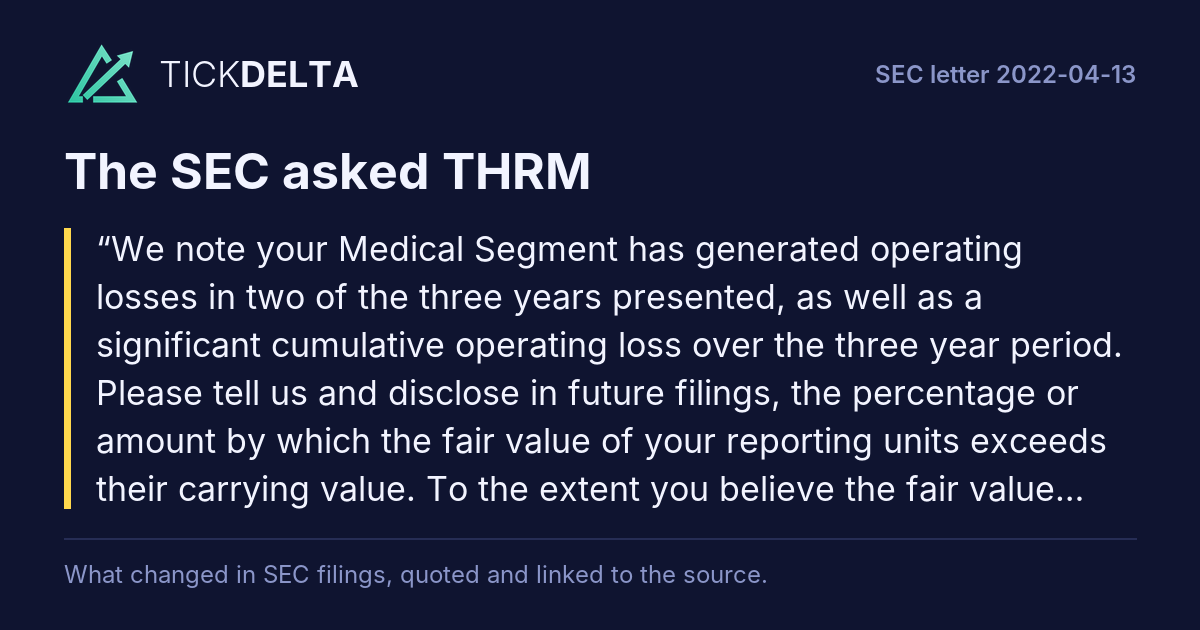
We note your Medical Segment has generated operating losses in two of the three years presented, as well as a significant cumulative operating loss over the three year period. Please tell us and disclose in future filings, the percentage or amount by which the fair value of your reporting units exceeds their carrying value.
Rest of the question

To the extent you believe the fair value "substantially exceeds" the carrying values of your reporting units, please add disclosure stating such. For any reporting units that have fair values which are not substantially in excess of carrying values, provide information for investors to assess the probability of future goodwill impairment charges, including the following: • the percentage by which fair value exceeded carrying value at the date of the most recent test; • the specific critical assumptions used in your fair value determinations; • a discussion of the degree of uncertainty associated with the assumptions; and • a description of potential events and/or changes in circumstances that could reasonably be expected to negatively affect the key assumptions. Please refer to Item 303(b)(3) of Regulation S-K.

THRM answered
In your letter dated April 13, 2022 (the “Staff Comment Letter”), you requested that we respond to your comments regarding our Form 10-K for the Fiscal Year ended December 31, 2021 within ten business days or advise you when we would provide a response.

During our telephone conversation with Andi Carpenter on April 15, 2022, we advised her that, due to the timing of our quarterly financial reporting and time constraints on our finance and legal personnel, we were requesting an extension of time to provide a response. As a result, and as agreed with Ms.
Rest of the answer

Carpenter during our telephone conversation, we will submit our response to the Staff Comment Letter by May 4, 2022.

Read in the reply
In its next report

First report after the company's reply of Apr 21, 2022: 10-Q filed May 4, 2022 ↗, against the 10-Q filed Oct 29, 2021 ↗.

Tickdelta does not hold the text of both reports, so they are not compared here.
Also in this review: company letter, May 2, 2022, closing letter, 2022-05-06
Form 10-K

2018-12-11 to 2019-02-04 · 4 questions · 1 letter from the SEC, 1 from the company
Review closed 2019-02-04
RevenueSegmentsResults discussion (MD&A)Goodwill and impairment
After reviewing your response to these comments, we may have additional comments. MD&A · Results of Operations, page 34
SEC asked (1)
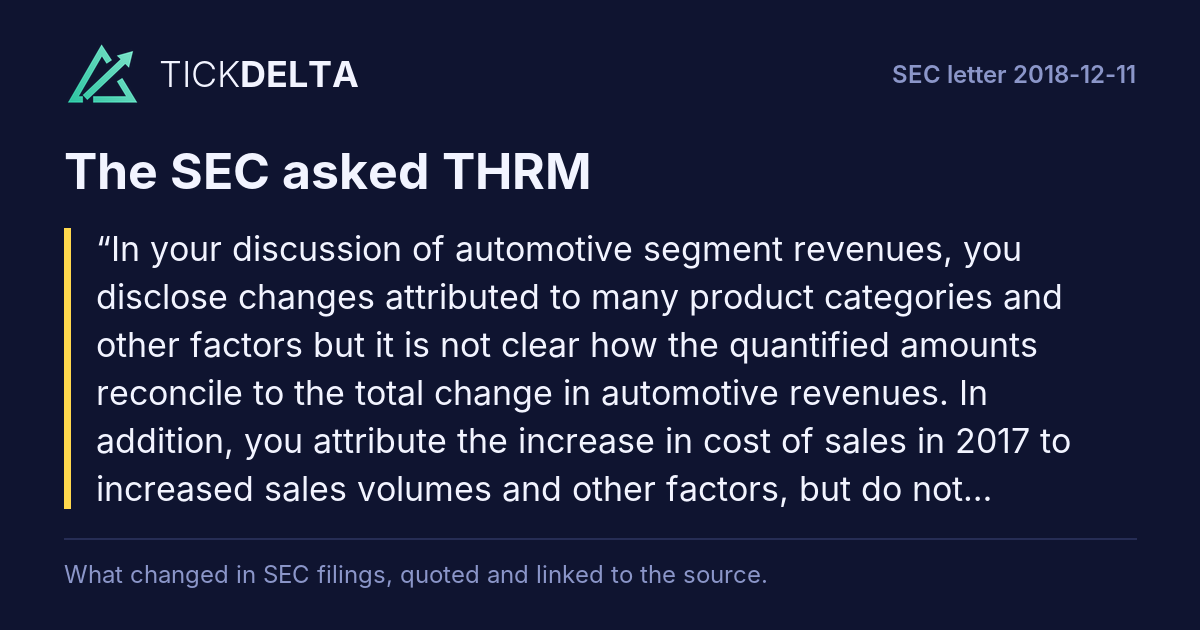
In your discussion of automotive segment revenues, you disclose changes attributed to many product categories and other factors but it is not clear how the quantified amounts reconcile to the total change in automotive revenues. In addition, you attribute the increase in cost of sales in 2017 to increased sales volumes and other factors, but do not quantify the change attributed to increased sales volumes.
Rest of the question

As such, please consider expanding this section by: • increasing the use of tables to present dollar and percentage changes in accounts, rather than including such information in narrative text form; • using tables to list, quantify, and sum all of the material individual factors to which changes in accounts are attributable; • refocusing the narrative text portion of the disclosure on analysis of the underlying business reasons for the individual factors in the tables above; • ensuring that all material factors are quantified and analyzed; and • quantifying the effects of changes in both price and volume on revenues and expense categories, where appropriate.

THRM answered
We have considered how we can expand our analysis, as the comment suggests. First, we will, in future filings add a table illustrating the amounts of product revenue by individual product category and by segment (see example Revenue by Product Category table below) on a comparative basis.

GENTHERM INCORPORATED

REVENUE BY PRODUCT CATEGORY

(in thousands)

Year Ended

December 31,

2017

2016

$

Diff.

%

Climate Controlled Seat (CCS)

387,961

405,795

(17,834

)

-4.4

Seat Heaters

307,309

288,939

18,370

6.4

Steering Wheel Heaters

62,125

49,516

12,609

25.5

Automotive
Rest of the answer

Cables

92,093

85,283

6,810

8.0

Battery Thermal Management (BTM)

10,043

6,546

3,497

53.4

Etratech

8,398

—

Other Automotive

11,528

11,349

179

1.6

Subtotal Automotive

879,457

847,428

32,029

3.8

Remote Power Generation (GPT)

31,891

18,628

13,263

71.2

Cincinnati Sub-Zero Products (CSZ)

74,335

51,544

22,791

44.2

Subtotal Industrial

106,226

70,172

36,054

51.4

Total Company

985,683

917,600

68,083

7.4

Furthermore, we will enhance the content to include quantitative measures to explain the factors impacting revenues by providing specific values or estimates when reasonably possible. Some of the factors impacting our product revenues can be easily measured while others are more difficult. In the automotive segment, for example, we produce and ship individual components that are designed to be combined by our customers to form a complete system. Some customers buy certain required components from us on certain vehicles and from other companies for other vehicles. Additionally, we sell products specifically designed for hundreds of different vehicles each having a unique design. These circumstances make it difficult to accurately calculate some of the factors that impact revenue. Our products typically represent optional features that are not installed on every vehicle produced by our customers. This fact makes it difficult to measure how market based factors, such as industry vehicle production volumes, influence our product shipments. Nevertheless, we believe that we can provide additional quantitative information to enhance the quality of the narrative disclosure in some cases, even if the values represent estimates or ranges of values for those factors that cannot be precisely measured.

Read in the reply
In its next report

First report after the company's reply of Jan 15, 2019: 10-K filed Feb 26, 2019 ↗, against the 10-K filed Feb 23, 2018 ↗.

Tickdelta does not hold the text of both reports, so they are not compared here.

Note 2 - Summary of Significant Accounting Policies · Accrued Warranty Costs, page F-13
SEC asked (2)
We note your reconciliation of the changes in the warranty liability includes reconciling items "warranty claims paid or retired" and "expense." Please revise your tabular reconciliation to include the reconciling items specified by ASC 460-10-50-8c.
THRM answered
Gentherm produces very high-quality products and, as such, enjoys a very low cost of warranty. For example, during 2017, payments to our customers for warranty claims was only $979 thousand, representing less than 0.01% of product revenues. We will, in future filings, update the table to include captions specified by ASC 460-10-50-8c.
Rest of the answer

The table below illustrates the updated table.

As Revised:

As Reported:

Balance at beginning of year

5,443

4,558

Warranty claims paid

(979

(1,096

Warranty claims paid or retired

Warranty expense for products shipped during the current period

3,162

3,357

Adjustments to warranty estimates from prior periods

(2,655

(1,304

Expense

507

2,053

Adjustment due to currency translation

411

(72

Read in the reply
In its next report

First report after the company's reply of Jan 15, 2019: 10-K filed Feb 26, 2019 ↗, against the 10-K filed Feb 23, 2018 ↗.

Tickdelta does not hold the text of both reports, so they are not compared here.

Note 11 - Segment Reporting, page F-32
SEC asked (3)
We note your disclosure in MD&A of changes in sales for certain product categories. Please revise note 11 to disclose revenues from external customers for each product and service or each group of similar products and services. Refer to ASC 280-10-50-40.
THRM answered
In future filings we will add an additional table detailing the amounts of product revenue by product category for each reported segment similar to the table illustrated above in our response to your comment number one.
Read in the reply
In its next report

First report after the company's reply of Jan 15, 2019: 10-K filed Feb 26, 2019 ↗, against the 10-K filed Feb 23, 2018 ↗.

Tickdelta does not hold the text of both reports, so they are not compared here.

Consolidated Condensed Statements of Income, page 4
SEC asked (4)
We note from page 29 that the $11.5 million impairment charge taken is comprised of $2.2 million in impairment loss recognized on held for sale assets, $6.2 million in impairment loss on goodwill, and $3.1 million in impairment loss recognized on other intangible assets, and that this relates to your classification of GPT and CSZ-IC as held for sale.
Rest of the question

We also note from your disclosure on page 28 that these entities, while meeting the qualifications to be considered held for sale, did not meet the qualifications to be considered as discontinued operations. Please tell us why you have classified these impairment charges as non-operating income in your statement of income. Refer to the guidance in Rule 5-03 of Regulation S-X.

THRM answered
We considered, when preparing our financial statements for the third quarter of 2018, whether this charge was best reflected as an operating or non-operating charge. We ultimately concluded that classification as a non-operating charge was the better presentation based on several factors:

During the first half of 2018 Gentherm conducted a review of all its existing business activities. That review resulted in a new strategic plan that, among many other new activities and initiatives, resulted in a decision to divest both GPT and CSZ-IC.
Rest of the answer

The disposals of each of these businesses marked a strategic shift in the company’s business plans because their products and end markets are significantly different than our continuing businesses. While the dispositions do not qualify for discontinued operations treatment because they will not have a “major effect” on the company’s financial results, the Company will no longer, after the disposition of these businesses, operate in the market segments in which those businesses operate.

The impairment losses arose from changes in the financial outlook for these businesses which were a direct result of the decision to divest. The decisions led to changes in certain planned investments and other activities, including cutting back on development of new products, and due to the loss of synergies between the businesses being sold and the rest of the Company.

ASC 360-10-45-5, which addresses gains and losses recognized on disposals that do not qualify as discontinued operations does state that such gains and losses should be presented within operating income. However, Section 8.2 of the Deloitte publication entitled “A Roadmap to Reporting Discontinued Operations”, which provides further interpretation of ASC 360-10-45-5 for situations similar to our divestiture of GPT and CSZ-IC. points out that ASU 2014-08, “seemed to have eliminated diversity in practice [for the classification of gains or losses on the disposal of long-lived assets not accounted for as discontinued operations]”, but that, in informal conversations, “the SEC staff has indicated that it would not object if an entity presents the gain or loss from a sale of a business that is not a discontinued operation in nonoperating income”. While not considered at the time we originally reported the impairment loss, we note that PWC includes similar guidance in its “Financial statement presentation” guide, as follows:

Some reporting entities present gains or losses resulting from sales of businesses (that do not qualify as discontinued operations) within operating income in a “two-step” income statement. However, others report such items as non-operating gains or losses. The SEC has accepted both approaches.

We have observed that shareholders and analysts of Gentherm typically disregard or add back infrequent non-cash charges to earnings when commenting on the Company in their notes and reports. We believe this indicates that the users of financial statements consider these types of charges to be unrelated to operations. Our classification facilitates the presentation of financial performance in line with these financial statement users.

After careful consideration of these points, we concluded that the classification of the impairment charges for GPT and CSZ-IC below the Operating Income subtotal in the Consolidated Condensed Statement of Income would be better than including the charges in that sub-total. We note that, with regards to restructuring expenses related to operations that we will continue to own, we concluded the presentation within Operating Income was appropriate. Furthermore, the disclosures in Note 2 provide financial statement readers with the ability to fully understand the nature of the impairment charges and thus the information needed to evaluate the Company’s business is readily available.

Read in the reply
In its next report

First report after the company's reply of Jan 15, 2019: 10-K filed Feb 26, 2019 ↗, against the 10-K filed Feb 23, 2018 ↗.

Tickdelta does not hold the text of both reports, so they are not compared here.

Also in this review: request for more time, Dec 18, 2018, closing letter, 2019-02-04

Form 10-K

2017-12-20 to 2018-01-25 · 5 questions · 1 letter from the SEC, 1 from the company
Review closed 2018-01-25
Results discussion (MD&A)Income taxesSegmentsRevenueLiquidity and cash
Item 7. Management’s Discussion and Analysis of Financial Condition and Results of · Operations, page 29
SEC asked (1)
We note from the “Segment Reporting” note that the Industrial segment has reported an operating loss in each year presented, as well as for the three and nine months ended September 2017 and 2016. However, it is not clear from your disclosure within MD&A the reason for these losses.
Rest of the question

Please include an analysis that explains these losses and address any known trends, demands and uncertainties that have had or that you reasonably expect will have a material impact on this segment’s results. Refer to Item 303(a)(3)(ii) of Regulation S-K and section III.F.1 of Release No. 33-6835 for guidance. Please provide us with a copy of your intended disclosure.

THRM answered
The Industrial segment is made up of three of Gentherm’s business units. The businesses include Global Power Technologies, serving the energy markets, Cincinnati Sub-Zero, serving the medical and product testing services markets, and our advanced technology research and development activities. The financial results, as well as trends, demands and uncertainties that have had or that the Company reasonably expects will have a material impact, of all three of these business units are discussed throughout Management’s Discussion and Analysis of Financial Condition and Results of Operations
Rest of the answer

(“MD&A”). However, the MD&A – Results of Operations only discusses the foregoing matters in the context of the Company’s consolidated results on a line item basis and not in a separate discussion for each reportable segment. In future filings, we will add a separate discussion at the end of MD&A - Results of Operations summarizing the material factors by reportable segment to improve our shareholders’ understanding of our business. By way of supplementary information, the following paragraph is an example of this discussion for the Industrial segment for the three month period ended September 30, 2017.

Industrial Segment Operating Loss. The Industrial segment, comprised of Cincinnati Sub-Zero (“CSZ”), Global Power Technologies (“GPT”) and our advanced research and development activities, reported an operating loss totaling $5,507,000 for the Third Quarter 2017. This loss was $708,000, or 14%, higher than the operating loss of the Industrial segment during Third Quarter 2016. We incurred these losses for three reasons. First, the advanced research and development activities, the total cost for which were $3,604,000 and $3,862,000, during Third Quarter 2017 and 2016, respectively, are focused on products and technologies that are currently not generating product revenues. We expect that many of the individual projects included in the business unit will generate profitable revenue in future periods. Second, GPT’s lower revenue for the Third Quarter 2017, which related to the timing of a large program shipment, did not cover the related fixed costs. GPT would have reported approximately $3,000,000 in higher operating income if the large program would have shipped during the Third Quarter 2017. Finally, CSZ’s approximately $1,000,000 in higher expenses in the Third Quarter 2017 associated with the new direct sales force was not yet offset by a corresponding increase in the amount of revenue and related operating income. We continue to believe that the direct sales force will lead to higher CSZ product revenue in future periods that will generate operating profits in excess of the cost for the direct sales persons.

Read in the reply
In its next report

First report after the company's reply of Jan 15, 2018: 10-K filed Feb 23, 2018 ↗, against the 10-K filed Feb 23, 2017 ↗.

Tickdelta does not hold the text of both reports, so they are not compared here.

Note 1 – The Company · North American Reorganization, page F-9
SEC asked (2)
You recorded an offsetting deferred charge for approximately the same amount as the one-time income tax payment of approximately $32.6 million accrued during 2016 because the payment will result in tax deductions against income taxes in future periods. Please explain to us the tax deductions that will result and the basis for recording a deferred charge for them.
Rest of the question

Note 2 – Summary of Significant Accounting Policies and Basis of Presentation,

THRM answered
The one-time income tax payment arose from an intercompany reorganization (the “North American Reorganization”) in which some of the business activities previously performed by existing North American operations were consolidated into European and other North American facilities. This reorganization included an intercompany transaction which generated income tax expense, resulting in an offsetting deferred charge pursuant to Accounting Standards Codification (ASC) 740-1-25-3(e).

ASC 740-1-25-3(e) prohibits the recognition of current and deferred income taxes for intercompany asset transfers
Rest of the answer

until the asset has been sold to an outside party or as the assets are amortized. Therefore, the income tax expense associated with profits from an intercompany sale or transfer of assets is disregarded. Instead, the income tax expense is deferred, recorded on the balance sheet as a deferred charge, and taken as a deduction against earnings either when the assets leave the consolidated group or as the assets are amortized. Similarly, the related entity that purchased the assets is prohibited from recognizing a deferred tax asset for the increase in the tax basis due to the intercompany sale or transfer, with such tax asset realized only when the assets leave the consolidated group or as the assets are amortized and tax deductions are taken.

As part of the North American Reorganization, intangible assets owned by Gentherm Canada ULC having no book value were sold to a related entity, Gentherm GmbH, at fair value. The resulting intercompany gain on the sale of the intangible assets resulted in a one-time tax liability for Gentherm Canada ULC. The related tax expense arising from this gain was eliminated from earnings and recorded as a deferred charge as outlined above pursuant to ASC 740-1-25-3(e). Additionally, no deferred tax asset was recorded for the basis difference which normally arises out of the elimination of the fair market value step-up recorded by Gentherm GmbH. The deferred charge was partially amortized during 2016 and 2017 as the transferred assets are being amortized for book purposes. The amortization of such assets results in the tax deduction referenced in your question.

It should be noted that Accounting Standards Update (ASU) 2016-16, Intra-Entity Transfers of Assets Other Than Inventory, will affect the above-described treatment of the deferred charge at Gentherm Canada ULC and the absence of a deferred tax asset at Gentherm GmbH. Under ASU 2016-16, an entity is required to recognize the income tax consequences of an intercompany transfer of an asset other than inventory when the transfer occurs. We intend to adopt ASU 2016-16 during the first quarter of 2018 and, consistent with the provisions of ASU 2016-16, a cumulative catch-up adjustment will be recorded in the first quarter of 2018 to reflect the reversal of the deferred charge and the recording of the related deferred tax asset. Appropriate disclosure and explanation of this cumulative change will be included in the related financial statement notes.

Read in the reply
In its next report

First report after the company's reply of Jan 15, 2018: 10-K filed Feb 23, 2018 ↗, against the 10-K filed Feb 23, 2017 ↗.

Tickdelta does not hold the text of both reports, so they are not compared here.

Consolidation, page F-11
SEC asked (3)
You reclassified “long-term supply contract price downs” from accounts receivable to accrued liabilities to conform to the current year’s presentation. Please tell us the nature of this item and its amount at December 31, 2016 and 2015.
THRM answered
We routinely grant customers price decreases on our products through supplier contracts in various forms. Once a price decrease is agreed to, our customer will then issue a revised Purchase Order (“PO”) with the new price. It is the PO that initiates changes in both our invoicing software as well as the customer’s Enterprise Resource Planning (ERP) system. Unfortunately, the PO is often issued well after the effective date of the price change and this lag period can span several months.
Rest of the answer

During this lag period, our invoicing system and the customer’s payment system will continue processing sales at the old price. Once the PO is finally issued, our customer will then issue us a debit memo for the cumulated difference between the old price and the new price for all parts shipped during the lag period. We account for this difference by recording an offsetting revenue accrual as parts are shipped. Prior to 2016, one of our locations classified the liability balance as a contra receivable whereas others included it as an accrued liability. We reviewed this classification during 2016 and concluded that, since the majority of the balance was related to invoices that had already been paid by the customer; the more appropriate classification was to include the amount in accrued liabilities. After reclassification, the amount of this accrual was $13,259,000 and $10,248,000 at December 31, 2016 and 2015, respectively. The amount of the reclassification from accounts receivable to accrued liabilities to the December 31, 2015 balance sheet totaled $1,884,000, which was deemed to be immaterial to the financial statements.

Read in the reply
In its next report

First report after the company's reply of Jan 15, 2018: 10-K filed Feb 23, 2018 ↗, against the 10-K filed Feb 23, 2017 ↗.

Tickdelta does not hold the text of both reports, so they are not compared here.

Management’s Discussion and Analysis · Results of Operations Third Quarter 2017 Compared with Third Quarter 2016, page 21
SEC asked (4)
You disclose during the three months ended March 31, 2017 you revised your revenue by product analysis to better reflect pricing adjustments and other differences. Please explain to us what this represents and why this was not previously reflected in the analysis of revenue.
THRM answered
We compile and disclose revenue by product in several sections of our annual and quarterly reports and other press releases, including MD&A. Due to historical system limitations, price accruals, which were more specifically described in our response to your question number 3, were not incorporated into the product revenue analysis prior to Third Quarter 2016. During 2016, we made system enhancements which allowed us to properly analyze the accruals and classify them by product. We reviewed the historical data and made changes to allow for proper comparability.
Rest of the answer

By way of supplemental information, the following table illustrates the adjustment that was made for the Third Quarter 2016:

As previously

Reported

Reclassification of Price

Accruals

Adjusted

(000’s)

Climate Controlled Seats

$

101,028

(1,258

)

99,770

Seat Heaters

75,442

(936

74,506

Steering Wheel Heaters

12,914

(25

12,889

Automotive Cables

21,768

(503

21,265

Other Automotive

1,217

2,722

3,939

Global Power Technologies

5,112

-

Read in the reply
In its next report

First report after the company's reply of Jan 15, 2018: 10-K filed Feb 23, 2018 ↗, against the 10-K filed Feb 23, 2017 ↗.

Tickdelta does not hold the text of both reports, so they are not compared here.

Liquidity and Capital Resources, page 24
SEC asked (5)
You cite non-cash expenses and changes in accrual based net income (which includes the non-cash expenses) in partial explanation of the decrease in cash provided by operating activities. You also cite a change in working capital due to a decrease in accrued liabilities resulting from the payment of income taxes related to the reorganization as a factor in the decrease, but you already cited the payment of income
Rest of the question

taxes related to the reorganization as a factor. Please note that citing noncash items as well as net income, accrued liabilities and other working capital items may not provide a sufficient basis to understand how actual operating cash was impacted between comparative periods. Refer to section IV.B.1 of SEC Release No. 33-8350 for guidance. Quantify any variance factors cited, pursuant to section 501.04 of the staff’s Codification of Financial Reporting. Please provide us with a copy of your intended revised disclosure.

THRM answered
We agree that the narrative discussion related to our operating cash flow may be difficult to follow. This is due to the significance of the non-cash adjustments to net income which are necessary to explain in order to illustrate the impact that changes in net income have on the operating cash flows. However, the important business factors driving the variance during the nine month period ended September 30, 2017 as compared to September 30, 2016, which include the change in net income and the reorganization tax payment, are mentioned in accordance with the SEC’s published guidance.
Rest of the answer

After considering your comment, we believe that the clarity and intuitive nature of the discussion would be significantly improved through the inclusion of a comparative table of operating cash flow and a bridge schedule highlighting the important differences between periods, which we will include in future filings. By way of supplementary information, the following are examples of the above-described tables which we will include in future filings:

Nine Months Ended

September 30,

2017

2016

Change

Amounts in Thousands

Net income

40,469

50,562

(10,093

Non-cash adjustment to reconcile net income to cash provided by operating activities:

Depreciation and amortization

32,663

27,724

4,939

Deferred income taxes

(9,059

(1,933

(7,126

Stock compensation

8,559

6,856

1,703

Defined benefit plan expense

151

(55

Provision of doubtful accounts

(353

385

(738

Loss on sale of property and equipment

868

291

577

Net income before non-cash adjustments

73,243

84,036

(10,793

Changes in operating assets and liabilities:

Accounts receivable

(5,581

(22,835

17,254

Inventory

(4,407

(5,647

1,240

Prepaid expenses and other assets

(555

2,826

(3,381

Accounts payable

(7,433

6,508

(13,941

Accrued liabilities

(39,896

6,123

(46,019

Total changes in operating assets and liabilities

(57,872

(13,025

(44,847

Net cash provided by operating activities

15,371

71,011

(55,640

Net cash provided by operating activities during 2016 period

Decrease due to lower net income

Decrease due to income taxes paid related to the Reorganization

(35,100

Other differences in working capital, net

(9,747

Read in the reply
In its next report

First report after the company's reply of Jan 15, 2018: 10-K filed Feb 23, 2018 ↗, against the 10-K filed Feb 23, 2017 ↗.

Tickdelta does not hold the text of both reports, so they are not compared here.

Also in this review: request for more time, Dec 21, 2017, closing letter, 2018-01-25

Form 10-K

2016-12-15 to 2017-01-03 · 2 questions · 1 letter from the SEC, 1 from the company
Review closed 2017-01-03
Results discussion (MD&A)Liquidity and cashIncome taxes
Liquidity and Capital Resources · Cash and Cash Flows, page 31
SEC asked (1)
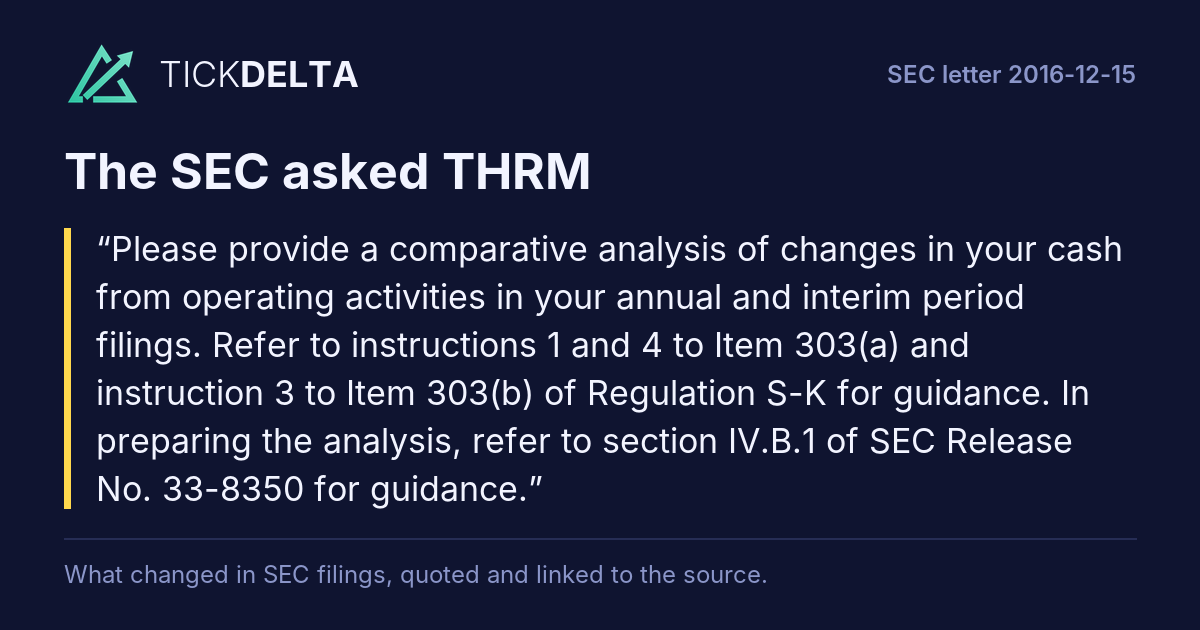
Please provide a comparative analysis of changes in your cash from operating activities in your annual and interim period filings. Refer to instructions 1 and 4 to Item 303(a) and instruction 3 to Item 303(b) of Regulation S-K for guidance. In preparing the analysis, refer to section IV.B.1 of SEC Release No. 33-8350 for guidance.
THRM answered
The Company acknowledges that it considers the provisions cited by the Staff in connection with each periodic filing regarding the appropriate comparative analysis of the Company’s cash from operating activities. The changes in the Company’s cash from operating activities from period to period has historically been very closely correlated to changes in net income, and the Company generally has determined variances of each other factor to be immaterial.
Rest of the answer

In particular, cash from operating activities for the year ended December 31, 2015 was $24.4 million greater than cash from operating activities for the year ended

December 31, 2014. Net income for the same periods increased by $25.3 million. The Company determined that each other variance was immaterial to the period comparison. In future periodic filings on Form 10-K and Form 10-Q, the Company will expand its disclosures in Liquidity and Capital Resources to describe this correlation, or any material variance of any other relevant factor not otherwise addressed in the Company’s disclosures regarding the changes in net income.

Read in the reply
In its next report

First report after the company's reply of Dec 19, 2016: 10-K filed Feb 23, 2017 ↗, against the 10-K filed Feb 25, 2016 ↗.

Tickdelta does not hold the text of both reports, so they are not compared here.

Notes to the Consolidated Financial Statements · Note 4 – Income Taxes, page F-16
SEC asked (2)
You disclose on page F-18 that you received a tax holiday related to your new operating facility in Macedonia. To the extent material, please disclose the aggregate dollar and per share effects. Refer to Staff Accounting Bulletin Topic 11.C for guidance.
THRM answered
During 2015, to entice the Company to construct a new facility in

Macedonia, the government of Macedonia granted the Company a tax holiday that released the Company from the obligation to pay corporate income taxes for a ten year period, subject to certain limitations. The amount of corporate income tax savings actually realized by the Company as a result of this tax holiday during 2015 was zero as a result of operating losses generated during the period.
Rest of the answer

The aggregate income statement dollar effect (less than $0.2 million income tax expense) and per share effect (less than one half of $0.01 per share) of the corporate income tax holiday during 2015 was immaterial. Total future benefits to the Company resulting from this tax holiday will be based on the amount of income earned by the entity in Macedonia during the ten year tax holiday period. At this time, the Company does not expect the aggregate amount of such benefit to be material to any individual financial reporting period; however, should this determination change and the effects of the tax holiday become material, the Company will disclose the aggregate dollar and per share effects.

Read in the reply
In its next report

First report after the company's reply of Dec 19, 2016: 10-K filed Feb 23, 2017 ↗, against the 10-K filed Feb 25, 2016 ↗.

Tickdelta does not hold the text of both reports, so they are not compared here.

Also in this review: closing letter, 2017-01-03

Form 10-K for the Fiscal Year Ended December 31, 2014

2015-12-16 to 2015-12-29 · 1 question · 1 letter from the SEC, 1 from the company
Review closed 2015-12-29
ClimateRussia and Ukraine
General
SEC asked
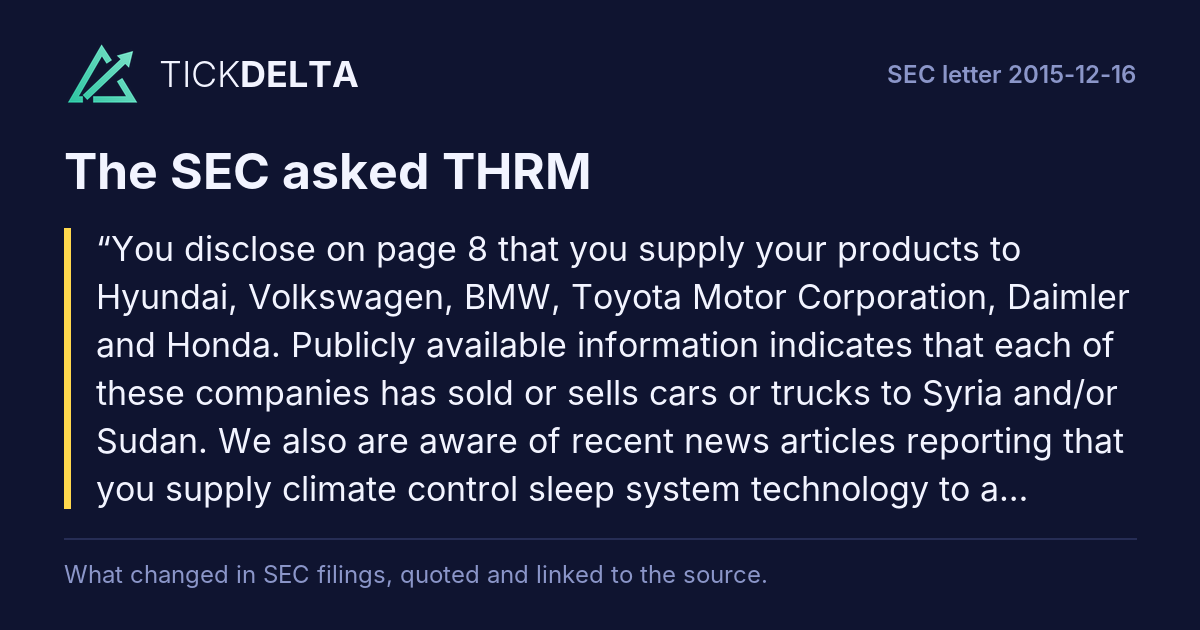
You disclose on page 8 that you supply your products to Hyundai, Volkswagen, BMW, Toyota Motor Corporation, Daimler and Honda. Publicly available information indicates that each of these companies has sold or sells cars or trucks to Syria and/or Sudan.
Rest of the question

We also are aware of recent news articles reporting that you supply climate control sleep system technology to a company in Dubai which sells its products in the Middle East. Syria, located in the Middle East, and Sudan, which can be understood to be included in references to the Middle East, are designated by the State Department as state sponsors of terrorism, and are subject to U.S. economic sanctions and export controls. Please describe to us the nature and extent of any past, current, and anticipated contacts with Syria and Sudan, whether through subsidiaries, affiliates, distributors or other direct or indirect arrangements, including whether the referenced companies incorporate your products or technology into products they sell in Syria or Sudan. You should describe any products, components, technology or services you have provided, directly or indirectly to those countries, and any agreements, commercial arrangements or other contacts with the governments of those countries or entities they control.

THRM answered
The following represents the response of Gentherm Incorporated (the “Company”) to your letter dated December 16, 2015, with respect to the Company’s Form 10-K for the Fiscal Year Ended December 31, 2014. For ease of reference, your comment is repeated in italics followed by the Company’s response:

You disclose on page 8 that you supply your products to Hyundai, Volkswagen, BMW, Toyota

Motor Corporation, Daimler and Honda. Publicly available information indicates that each of these companies has sold or sells cars or trucks to Syria and/or Sudan.
Rest of the answer

We also are aware of recent news articles reporting that you supply climate control sleep system technology to a company in Dubai which sells its products in the Middle East. Syria, located in the Middle East, and Sudan, which can be understood to be included in references to the Middle East, are designated by the State Department as state sponsors of terrorism, and are subject to U.S. economic sanctions and export controls. Please describe to us the nature and extent of any past, current, and anticipated contacts with Syria and Sudan, whether through subsidiaries, affiliates, distributors or other direct or indirect arrangements, including whether the referenced companies incorporate your products or technology into products they sell in Syria or Sudan. You should describe any products, components, technology or services you have provided, directly or indirectly to those countries, and any agreements, commercial arrangements or other contacts with the governments of those countries or entities they control.

The Company designs, manufactures and sells thermal management and power generation products, primarily to the automotive industry. The largest portion of the

Company’s revenue comes from heated, heated and ventilated and heated and cooled automobile seat components that are sold to the world’s largest automobile manufacturers and their seat suppliers. A much smaller portion of our revenue comes from the sale of components used to create a heat and cool system in a mattress called the Climate Controlled Sleep System (“CCSS”). While we mainly sell CCSS products to one customer in the United States, we have also sold a very small number of units to a company named Intercoil, operating in the United Arab Emirates. The Company is not aware of any past, current or anticipated contacts with Syria and Sudan (the “Identified Countries”), whether through its subsidiaries, affiliates, distributors or other direct or indirect arrangements. The Company has no way of monitoring where Hyundai, Volkswagen, BMW, Toyota Motor Corporation, Daimler and Honda

(the “Identified Companies”) sell their cars and trucks or where Intercoil sells its mattresses containing the Company’s products, and thus has no way of determining whether any products sold to the Identified Companies or Intercoil have been incorporated into cars, trucks, or mattresses sold in the Identified Countries. The Company has not directly or, to its knowledge, indirectly provided any products, components, technology or services to the Identified Countries nor has the

Company made any agreements, commercial arrangements or other contracts with the governments of the Identified Countries or entities they control.

The Company acknowledges that: the Company is responsible for the adequacy and accuracy of the disclosure in the filing; staff comments or changes to disclosure in response to staff comments do not foreclose the Commission from taking any action with respect to the filing; and the Company may not assert staff comments as a defense in any proceeding initiated by the Commission or any person under the federal securities laws of the United States.

Read in the reply

Also in this review: closing letter, 2015-12-29

From the SEC's correspondence on EDGAR: staff letters (form UPLOAD) and company letters (form CORRESP), 18 letters filed since 2015-12-17. Questions and answers are matched by their numbers; topics come from words in each question. The reports are compared word for word (same form, before the first SEC letter against the first report after the company's reply). No AI.

Sources

The SEC's correspondence on EDGAR: staff letters (form UPLOAD) and company letters (form CORRESP), matched question by question. No AI.

Also

Filings: the letters in the filing list.

Work with it

Excel workbook · CSV. Google Sheet that stays up to date: paste =IMPORTDATA("https://tickdelta.com/company/THRM/export.csv") into a cell.

Next in Owners and insiders:Insider trades
Esc

Type a ticker such as AAPL, a name, an investor such as Buffett, or a topic such as tariffs. ↑ ↓ to move, Enter to open.