Form 10-K for the Fiscal Year Ended February 1, 2014
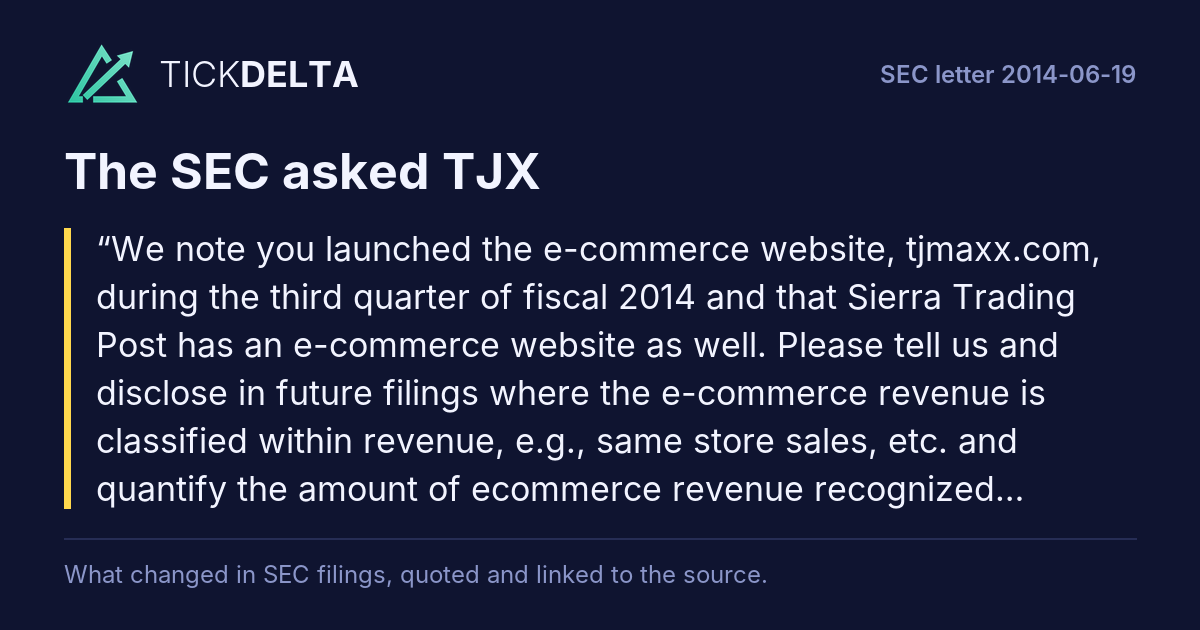
We note you launched the e-commerce website, tjmaxx.com, during the third quarter of fiscal 2014 and that Sierra Trading Post has an e-commerce website as well. Please tell us and disclose in future filings where the e-commerce revenue is classified within revenue, e.g., same store sales, etc.Rest of the question
and quantify the amount of ecommerce revenue recognized during the year or other reporting period or the amount of year-to-year change (as applicable) in e-commerce revenues. Provide us with a draft of the proposed disclosures to be included in future filings.
The Company treats its e-commerce sites tkmaxx.com (which supports the T.K. Maxx stores in Europe) and tjmaxx.com (which supports our T.J. Maxx stores in the United
States) as on-line stores, and it plans to follow the same classification criteria defined in its disclosures about same store sales. Accordingly, as of the fiscal year ended February 1,
2014, the sales of tkmaxx.com were included in the same store sales of our TJX Europe segment, as it has been in operation for more than two consecutive fiscal years, and sales of tjmaxx.com were classified as new store sales of the MarmaxxRead in the reply ↗Rest of the answer
segment as it just began operations in fiscal 2014. Revenue from our Sierra Trading Post business is not included in same store sales.
The Company plans to revise its definition of same store sales in future filings to clarify the treatment of its e-commerce sites as marked below.
We define same store sales to be sales of those stores that have been in operation for all or a portion of two consecutive fiscal years, or in other words, stores that are starting their third fiscal year of operation. Tjmaxx.com and tkmaxx.com are treated as stores of the related divisions that they support. Revenue from our Sierra Trading Post business is not included in same store sales. We classify a store as a new store until it meets the same store sales criteria. We determine which stores are included in the same store sales calculation at the beginning of a fiscal year and the classification remains constant throughout that year, unless a store is closed. We calculate same store sales results by comparing the current and prior year weekly periods that are most closely aligned. Relocated stores and stores that have increased in size are generally classified in the same way as the original store, and we believe that the impact of these stores on the consolidated same store percentage is immaterial. Same store sales of our foreign segments are calculated on a constant currency basis, meaning we translate the current year’s same store sales of our foreign segments at the same exchange rates used in the prior year. This removes the effect of changes in currency exchange rates, which we believe is a more accurate measure of segment operating performance. We define customer traffic to be the number of transactions in stores included in the same store sales calculation and define average ticket to be the average retail price of the units sold. We define average transaction to be the average dollar value of transactions included in the same store sales calculation.
The Company respectfully advises the Staff that as revenue from tkmaxx.com, tjmaxx.com and its Sierra Trading Post business was immaterial to its total revenue for the fiscal year ended February 1, 2014 and fiscal quarter ended May 3, 2014, the Company does not believe that information regarding changes in revenue from these e-commerce sites and the Sierra Trading Post business to be necessary to an understanding of its financial condition, changes in financial condition and results of operations and, therefore, not required. The Company notes that it did disclose the impact on Fiscal 2014 net sales of a full fiscal year of Sierra Trading Post sales compared to five weeks of Sierra Trading Post sales in Fiscal 2013. To the extent in the future the Company believes information regarding such revenue or changes in such revenue is necessary to an understanding of its financial condition, changes in financial condition and results of operations, the Company plans to include relevant disclosure.
First report after the company's reply of 2014-07-11: 10-Q filed 2014-08-29 ↗, against the 10-Q filed 2014-05-30 ↗.
Tickdelta does not hold the text of both reports, so they are not compared here.
Please confirm you will revise the final paragraph under the “financing activities” heading in future filings to clarify whether you plan to repatriate any of the cash balances held overseas and if so, that there are tax implications associated with repatriation.
The Company has provided further disclosure on this topic in “Note L. Income Taxes” of the consolidated financial statements.
Adjusting those disclosures to be responsive to the SEC’s comment, the Company plans to add the following disclosure, to the extent it remains accurate, to the end of the final paragraph under the heading “Liquidity and Capital
Resources—Financing activities” in future Annual Reports on Form 10-K as provided below:
We have provided for deferred U.S.
taxes on all undistributed earnings through [fiscal year end] from our subsidiaries in Canada, Puerto Rico, Italy,Read in the reply ↗Rest of the answer
India, Hong Kong, and Australia. If we repatriate cash from such subsidiaries, we should not incur additional tax expense, but our cash balances would be reduced by the amount of taxes paid. For all other foreign subsidiaries, no income taxes have been provided on undistributed earnings because such earnings are considered to be indefinitely reinvested in the business. We have no current plans to repatriate cash balances held by such other foreign subsidiaries.
First report after the company's reply of 2014-07-11: 10-Q filed 2014-08-29 ↗, against the 10-Q filed 2014-05-30 ↗.
Tickdelta does not hold the text of both reports, so they are not compared here.
You disclose you estimate inventory shrinkage each quarter and perform a full physical inventory prior to year-end. You disclose that actual and estimated amounts of shrinkage may differ in interim periods but the difference is not a factor in annual results of operations.Rest of the question
Since you report on a quarterly basis, tell us how you conclude that the difference between actual and estimated shrinkage is not material to interim period results. Also you do not appear to have any inventory valuation reserves, please confirm.
The Company respectfully advises the Staff that the disclosure in its Annual Report on Form 10-K for the fiscal year ended February 1,
2014 states that estimated and actual amounts of shrinkage may differ in quarterly results and that the difference is not typically a significant factor in full year results, but does not state that the difference between actual and estimated shrinkage is not material to interim period results. The Company estimates inventory shrinkage rates for annual periods as a percentage of net sales and applies that rate to each quarterly period.Read in the reply ↗Rest of the answer
The Company does not have actual inventory results at interim periods to determine whether there is a material difference from the estimates at interim periods, as it only performs physical inventory observations near its fiscal year end. However, the Company has no reason to believe that the actual shrinkage rate for interim periods would vary materially from the actual shrinkage rate for the fiscal year. Historically, the variance between estimated shrinkage and actual shrinkage has not been material to our annual financial results. The Company has an inventory valuation reserve, which involves management estimates, as disclosed in the discussion of the Company’s critical accounting policies on page 35 of its Annual Report on
Form 10-K for the fiscal year ended February 1, 2014. The inventory valuation reserve at fiscal year-end was immaterial.
* *
*
As requested, TJX hereby acknowledges that: (i) TJX is responsible for the adequacy and accuracy of the disclosure in the filings; (ii) Staff comments or changes to disclosure in response to Staff comments do not foreclose the Commission from taking any action with respect to the filings; and (iii) TJX may not assert Staff comments as a defense in any proceeding initiated by the Commission or any person under the federal securities laws of the United States.
First report after the company's reply of 2014-07-11: 10-Q filed 2014-08-29 ↗, against the 10-Q filed 2014-05-30 ↗.
Tickdelta does not hold the text of both reports, so they are not compared here.
Also in this review: request for more time, 2014-06-23, closing letter, 2014-07-22