Paragraph 65 · 48% changed
Every version of it
Screener
/
SEC EDGAR
/CIK 0001798562
/10-K filed Mar 31, 2026, compared with Mar 27, 2025
/Numbers from the XBRL of the 10-Ks
Nasdaq
Materials · Mining
TMC the metals Co Inc. TMC
The 10-K against last year's
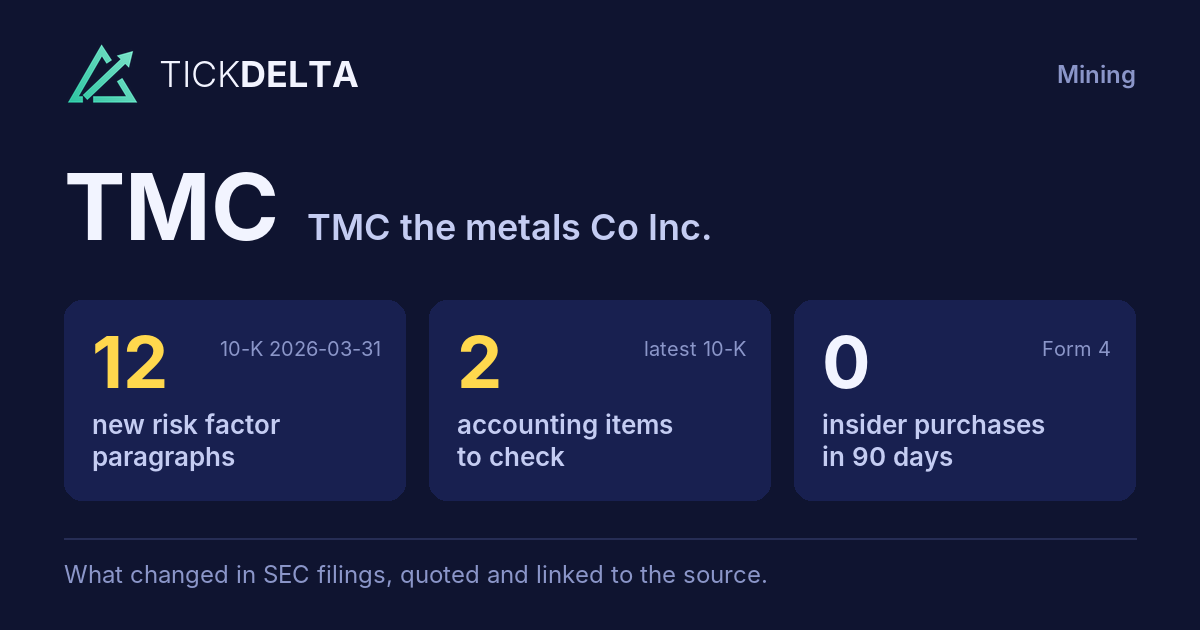
250 changes: 73 added, 60 removed, 115 reworded, 2 quiet changes
10-K Mar 31, 2026 vs Mar 27, 2025
Risk Factors
19.2%
of the text changed · 21,979 words now · 12 new paragraphs, 20 gone
MD&A
50.2%
of the text changed · 13,391 words now · 61 new paragraphs, 40 gone
Legal Proceedings
40.8%
of the text changed · 917 words now
Accounting Policies
7.7%
of the text changed · 2,854 words now
10-K 0001104659-26-037863 (Mar 31, 2026) vs 10-K 0001410578-25-000516 (Mar 27, 2025)
Every paragraph, and how much of it changed
One bar per paragraph, in the order of the 10-K. Height and colour show the share of its words not in the closest paragraph a year earlier; the tallest bars are new paragraphs.
Risk Factors
238 paragraphs · 12 new · 62 reworded · 20 gone · 10-K Mar 31, 2026 against Mar 27, 2025
New paragraph
Reworded (5% of its words or more)
Same or nearly
Paragraph 147 · 48% changed
Every version of it
Paragraph 64 · 47% changed
Every version of it
It is also currently not definitively known whether the risk of biodiversity loss in the CCZ could can be eliminated or sufficiently mitigated through setting aside large representative areas of CCZ under spatial protection (13 areas currently set aside by the ISA covering 43% of the CCZ) measures, operational controls or reduced through other mitigation strategies inside operating areas strategies, or how long it will take for disturbed seabed areas may take to recover naturally. Prior While prior research indicates suggests that the density, diversity and function of certain fauna representing most of resident biomass (including mobile, pelagic and microbial life) are expected to may recover naturally over years to decades. However, a high level of decades, significant uncertainty exists around recovery of fauna remains, particularly with respect to species that requires the depend on polymetallic nodules as hard substrate of nodules for critical life function. functions. The extent to which planned measures, effectiveness of mitigation measures such as leaving behind partial nodule cover retention, no-collection zones and setting aside no-take zones, would aid recruitment habitat connectivity corridors remains under active study and recovery of any potential nodule-dependent species in impacted areas will depend on factors like habitat connectivity, which is an area that is still under study. may vary materially by location and operating conditions.
Paragraph 81 · 42% changed
Every version of it
Estimates of mineral resources and mineral reserves from the contract areas of NORI and TOML described in our SEC filings and reported in the NORI-D PFS and the TOML and NORI IA technical reports prepared by AMC are only estimates and depend on geological interpretation and statistical inferences or assumptions drawn from survey data and recovery and sampling analysis, which might prove to be materially inaccurate. While these reports have been provided by experts, there is a degree of uncertainty attributable to the estimation of mineral resources. Mineral resources and mineral reserves. Except for the probable mineral reserves declared in the NORI-D PFS for the Initial Mining Area of NORI Area D as described in the NORI-D PFS, mineral reserves have not been defined for our other contract areas and will require completion of further studies. The NORI-D PFS is not a feasibility study and does not support a development decision, and the TOML and NORI IA is preliminary in nature, contains no mineral reserves, and is not sufficient to determine the economic viability of a mining project. Additionally, the NORI-D PFS does not include the conversion of all mineral resources included in NORI Area D to mineral reserves and does not include the conversion of any mineral resources to proven mineral reserves. You are cautioned not to assume that all or any part of measured or indicated mineral resources will ever be upgraded to mineral reserves or that probable mineral reserves will ever be upgraded to proven mineral reserves. Until mineral deposits are actually mined and processed, mineral resources and mineral reserves must be considered as estimates only. Until mineral resources and mineral reserves are actually collected and processed on a commercial scale, the quantity of metal and nodule abundance must be considered as estimates only only, and no assurance can be given that the indicated levels of metals will be produced. In making determinations about whether to advance any The estimation of our projects to further development, we must rely upon calculated estimates for the mineral reserves and mineral resources is an iterative process and is, at times, partially dependent upon the judgment of the persons preparing the estimates. The process relies on the quantity and quality of available data and is based on knowledge, experience, statistical analysis of data and industry practices. Valid estimates made at a given time may significantly change when new information becomes available. Estimated mineral reserves and mineral resources may have to be recalculated based on changes in metal prices, further exploration or development activity, actual production experience, or changes in operating or regulatory conditions. This could materially and adversely affect estimates of the volume or grade of mineralization, estimated recovery rates, or other important factors that influence mineral reserve and mineral resource estimates. The extent to which mineral resources may ultimately be reclassified as mineral reserves is dependent upon the demonstration of their profitable recovery. Any material changes in volume and grades of mineralization will affect the economic viability of placing a property into production and a property’s return on capital. We cannot provide assurance that polymetallic nodules can be collected or processed profitably. The mineral resource and mineral reserve estimates in our contract areas SEC filings have been determined and estimated equipment valued based on assumed future metal prices, cut-off grades, production rates, equipment availability and utilization and collection efficiency. operating costs that may prove to be inaccurate.
Paragraph 77 · 39% changed
Every version of it
On March 16, 2022, NORI and Allseas entered into a non-binding term sheet for the development and operation of a commercial nodule collection system and, in August 2023 entered into an exclusive use agreement with respect to the Project Zero Offshore Nodule Collection System. NORI vessel the Hidden Gem. We anticipate reaching agreements with Allseas in 2026 on definitive contract terms for both the development of collection system (including preparation of the Hidden Gem and Allseas intend to equally finance all costs related to developing the first nodule collection system), and getting Project Zero Offshore Nodule Collection System into for initial commercial nodule production currently. The parties intend to detail and revise these cost estimates in three definitive agreements for the engineering, build and operations phases which the parties expect to enter into before the submission extension of our exploitation application on June 27, 2025. exclusive use agreement with respect to the Hidden Gem. There can be no assurances, however, that we will enter into the binding Heads of Terms and definitive agreements with Allseas in a particular time period, or at all, or on terms similar to those set forth in the non-binding term sheet, sheet and the exclusive use agreement, or that if such definitive agreements are entered into by us that the proposed commercial systems and second additional production vessel vessel(s) will be successfully developed or operated in a particular time period, or at all and hence, we may be delayed in obtaining offshore collection equipment in the event we do not reach agreement with Allseas and have to develop such equipment on our own or through new third-party contractual relationships.
Paragraph 149 · 38% changed
Every version of it
We have a limited operating history, and there we expect that our losses will continue until we achieve profitable commercial production. Our subsidiaries currently intend to pursue exploration, evaluation, collection and potential commercial recovery activities across multiple project areas in the CCZ. There can be no assurance that we will obtain necessary approvals from NOAA or the ISA or that we will be able to commercially develop our these resource areas or achieve profitability project applications or that we will be able to generate profits in the future.
Paragraph 33 · 38% changed
Every version of it
Paragraph 63 · 36% changed
Every version of it
Nodule collection operations in the CCZ are certain expected to disturb wildlife in the operating area and may impact affect ecosystem function. The nature nature, extent and severity duration of these impacts on CCZ wildlife are expected to vary by species and are currently habitat and remain subject to significant scientific uncertainty. Our environmental campaigns to establish baseline wildlife and ecosystem function, conditions, pilot the nodule collection system systems and monitor potential impacts arising from the use of this system have been completed. Data completed, and data processing and analysis is in progress and, similar to studies conducted in respect of ongoing. As with land-based mining, these studies may not definitively establish the full impacts of activities operations on the biodiversity in the CCZ. biodiversity. Given the significant volume scale, depth and logistical challenges of deep water and the difficulty of sampling and retrieving biological specimens, deep-sea environment, a complete biological inventory might may never be established as is the case in terrestrial environments. Accordingly, established, and impacts on CCZ biodiversity and ecosystem services may never be, completely and be fully or definitively known.
Paragraph 65 · 48% changed
Every version of it
10-K Mar 27, 2025While we intend to collect seafloor polymetallic nodules in a way that mitigates and reduces potential damage to the seafloor, marine life and ecosystem function, we do not know whether the ISA or any other regulatory body will seek to impose onerous methods for the restoration of the disturbed area or rehabilitation obligations on our collecting process. Any such obligations, to the extent they are overly burdensome, could result in material changes to our business as currently contemplated.
10-K Mar 31, 2026
Although we intend to design and operate our collection systems to mitigate and reduce potential harm to the seafloor, marine life and ecosystem function, we do not know whether the ISA or regulatory authorities under national permitting regimes will impose additional or more onerous restoration, rehabilitation, offset or long-term monitoring obligations. Any such requirements, to the extent they are costly, operationally restrictive or open-ended, could result in material changes to our and our subsidiaries’ businesses, increased capital or operating expenditures, or delays or limitations on our ability to proceed with development as currently contemplated.
Paragraph 147 · 48% changed
Every version of it
10-K Mar 27, 2025For example, since 2021, we have continued to define our resource in the NORI area, with the goal to develop project economics to pre-feasibility level and are working towards a pre-feasibility study, which is nearing completion. As part of our ongoing refinement of our business plans and resource definition work, we are now pursuing a low-CAPEX approach to our development and commercialization of operations for our NORI Area D project where we reuse existing production assets opposed to the high-CAPEX approach where the majority of offshore and onshore production assets would be newly built by us as assumed in the 2021 economic analysis included in the NORI Technical Report Summary. As a result of these changes and the general passage of time since the valuation date of January 1, 2021, the 2021 point-in-time economic analysis included in Section 19 of the NORI Technical Report Summary and the estimated capital and operating costs set forth in Section 18 of the NORI Technical Report Summary, including any references thereto throughout the NORI Technical Report Summary, should no longer be relied upon or used by investors for any reason. In addition, as we continue our work towards the completion of a pre-feasibility study, any economic analysis resulting from this work as to the cash flows from or valuation of the potential extraction of nodules form NORI Area D or elsewhere may differ significantly from earlier or current estimates and any resulting analyses that are lower than earlier or current estimates or lower than those expected by investors or other stakeholders could have a material adverse effect on our share and warrant prices and results or operations. The same material adverse effects could occur if we are unable to complete the pre-feasibility study in a timely manner or at all.
10-K Mar 31, 2026
In addition, as we advance development activities beyond the pre-feasibility stage, including in connection with our U.S.-based project application areas referred to as TMC USA-A, TMC USA-A and TMC USA-B, any economic analysis resulting from this work as to the cash flows from or valuation of the potential extraction of nodules from NORI Area D, our U.S.-based project areas, or elsewhere may differ significantly from earlier or current estimates and any resulting analyses that are lower than earlier or current estimates or lower than those expected by investors or other stakeholders could have a material adverse effect on our share and warrant prices and results or operations.
Paragraph 64 · 47% changed
Every version of it
10-K Mar 27, 2025
It is also currently not definitively known whether the risk of biodiversity loss in the CCZ could be eliminated through setting aside large representative areas of CCZ under protection (13 areas currently set aside by the ISA covering 43% of the CCZ) or reduced through mitigation strategies inside operating areas or how long it will take for disturbed seabed areas to recover naturally. Prior research indicates that the density, diversity and function of fauna representing most of resident biomass (including mobile, pelagic and microbial life) are expected to recover naturally over years to decades. However, a high level of uncertainty exists around recovery of fauna that requires the hard substrate of nodules for critical life function. The extent to which planned measures, such as leaving behind partial nodule cover and setting aside no-take zones, would aid recruitment and recovery of any potential nodule-dependent species in impacted areas will depend on factors like habitat connectivity, which is an area that is still under study.
10-K Mar 31, 2026
It is also not definitively known whether the risk of biodiversity loss in the CCZ can be eliminated or sufficiently mitigated through spatial protection measures, operational controls or other mitigation strategies, or how long disturbed seabed areas may take to recover naturally. While prior research suggests that certain fauna may recover over years to decades, significant uncertainty remains, particularly with respect to species that depend on polymetallic nodules as hard substrate for critical life functions. The effectiveness of mitigation measures such as partial nodule retention, no-collection zones and habitat connectivity corridors remains under active study and may vary materially by location and operating conditions.
Paragraph 81 · 42% changed
Every version of it
10-K Mar 27, 2025
Estimates of mineral resources from the contract areas of NORI and TOML described in our SEC filings and reported in technical reports prepared by AMC are only estimates and depend on geological interpretation and statistical inferences or assumptions drawn from survey data and recovery and sampling analysis, which might prove to be materially inaccurate. While these reports have been provided by experts, there is a degree of uncertainty attributable to the estimation of mineral resources. Mineral reserves have not been defined and will require completion of further studies. Until mineral resources are actually collected and processed on a commercial scale, the quantity of metal and nodule abundance must be considered as estimates only and no assurance can be given that the indicated levels of metals will be produced. In making determinations about whether to advance any of our projects to further development, we must rely upon calculated estimates for the mineral resources and grades of mineralization in our contract areas and estimated equipment production rates, equipment availability and utilization and collection efficiency.
10-K Mar 31, 2026
Estimates of mineral resources and mineral reserves from the contract areas of NORI and TOML described in our SEC filings and reported in the NORI-D PFS and the TOML and NORI IA technical reports prepared by AMC depend on geological interpretation and statistical inferences or assumptions drawn from survey data and recovery and sampling analysis, which might prove to be materially inaccurate. While these reports have been provided by experts, there is a degree of uncertainty attributable to the estimation of mineral resources and mineral reserves. Except for the probable mineral reserves declared in the NORI-D PFS for the Initial Mining Area of NORI Area D as described in the NORI-D PFS, mineral reserves have not been defined for our other contract areas and will require completion of further studies. The NORI-D PFS is not a feasibility study and does not support a development decision, and the TOML and NORI IA is preliminary in nature, contains no mineral reserves, and is not sufficient to determine the economic viability of a mining project. Additionally, the NORI-D PFS does not include the conversion of all mineral resources included in NORI Area D to mineral reserves and does not include the conversion of any mineral resources to proven mineral reserves. You are cautioned not to assume that all or any part of measured or indicated mineral resources will ever be upgraded to mineral reserves or that probable mineral reserves will ever be upgraded to proven mineral reserves. Until mineral deposits are actually mined and processed, mineral resources and mineral reserves must be considered as estimates only. Until mineral resources and mineral reserves are actually collected and processed on a commercial scale, the quantity of metal and nodule abundance must be considered as estimates only, and no assurance can be given that the indicated levels of metals will be produced. The estimation of mineral reserves and mineral resources is an iterative process and is, at times, partially dependent upon the judgment of the persons preparing the estimates. The process relies on the quantity and quality of available data and is based on knowledge, experience, statistical analysis of data and industry practices. Valid estimates made at a given time may significantly change when new information becomes available. Estimated mineral reserves and mineral resources may have to be recalculated based on changes in metal prices, further exploration or development activity, actual production experience, or changes in operating or regulatory conditions. This could materially and adversely affect estimates of the volume or grade of mineralization, estimated recovery rates, or other important factors that influence mineral reserve and mineral resource estimates. The extent to which mineral resources may ultimately be reclassified as mineral reserves is dependent upon the demonstration of their profitable recovery. Any material changes in volume and grades of mineralization will affect the economic viability of placing a property into production and a property’s return on capital. We cannot provide assurance that polymetallic nodules can be collected or processed profitably. The mineral resource and mineral reserve estimates in our SEC filings have been determined and valued based on assumed future metal prices, cut-off grades, production rates, and operating costs that may prove to be inaccurate.
Paragraph 77 · 39% changed
Every version of it
10-K Mar 27, 2025
On March 16, 2022, NORI and Allseas entered into a non-binding term sheet for the development and operation of the Project Zero Offshore Nodule Collection System. NORI and Allseas intend to equally finance all costs related to developing and getting Project Zero Offshore Nodule Collection System into production currently. The parties intend to detail and revise these cost estimates in three definitive agreements for the engineering, build and operations phases which the parties expect to enter into before the submission of our exploitation application on June 27, 2025. There can be no assurances, however, that we will enter into the binding Heads of Terms and definitive agreements with Allseas in a particular time period, or at all, or on terms similar to those set forth in the non-binding term sheet, or that if such definitive agreements are entered into by us that the proposed commercial systems and second production vessel
10-K Mar 31, 2026
On March 16, 2022, NORI and Allseas entered into a non-binding term sheet for the development and operation of a commercial nodule collection system and, in August 2023 entered into an exclusive use agreement with respect to the vessel the Hidden Gem. We anticipate reaching agreements with Allseas in 2026 on definitive contract terms for both the development of collection system (including preparation of the Hidden Gem and the first nodule collection system), and for initial commercial nodule production and the extension of our exclusive use agreement with respect to the Hidden Gem. There can be no assurances, however, that we will enter into definitive agreements with Allseas in a particular time period, or at all, or on terms similar to those set forth in the non-binding term sheet and the exclusive use agreement, or that if such definitive agreements are entered into by us that the proposed commercial systems and additional production vessel(s) will be successfully developed or operated in a particular time period, or at all and hence, we may be delayed in obtaining offshore collection equipment in the event we do not reach agreement with Allseas and have to develop such equipment on our own or through new third-party contractual relationships.
Paragraph 149 · 38% changed
Every version of it
10-K Mar 27, 2025
We have a limited operating history, and there can be no assurance that we will be able to commercially develop our resource areas or achieve profitability in the future.
10-K Mar 31, 2026
We have a limited operating history, and we expect that our losses will continue until we achieve profitable commercial production. Our subsidiaries currently intend to pursue exploration, evaluation, collection and potential commercial recovery activities across multiple project areas in the CCZ. There can be no assurance that we will obtain necessary approvals from NOAA or the ISA or that we will be able to commercially develop these resource areas or project applications or that we will be able to generate profits in the future.
Paragraph 33 · 38% changed
Every version of it
10-K Mar 27, 2025To date, no commercial collection (also referred to as “mining,” “exploitation” or “harvesting”) of nodules has occurred on the seafloor in the area of the high seas beyond the limits of national jurisdiction (the “Area”), which includes the CCZ. Moreover, despite the release by the ISA of the Draft Regulations on Exploitation of Mineral Resources (the “Draft Regulations”), finalization of such regulations remains subject to approval and adoption by the ISA. Once adopted, these regulations will add to the legal and technical framework for exploitation of the polymetallic nodules in the NORI and TOML contract areas.
10-K Mar 31, 2026
Both the ISA regulatory regime under UNCLOS and the U.S. regulatory regime under DSHMRA have not yet been used for commercial production of seafloor polymetallic nodules and, to date, no commercial collection (also referred to as “mining,” “exploitation” or “harvesting”) of nodules has occurred on the seafloor in the area of the high seas beyond the limits of national jurisdiction (the “Area”), which includes the CCZ.
Paragraph 63 · 36% changed
Every version of it
10-K Mar 27, 2025
Nodule collection operations in the CCZ are certain to disturb wildlife in the operating area and may impact ecosystem function. The nature and severity of these impacts on CCZ wildlife are expected to vary by species and are currently subject to significant uncertainty. Our campaigns to baseline wildlife and ecosystem function, pilot the nodule collection system and monitor impacts arising from the use of this system have been completed. Data processing and analysis is in progress and, similar to studies conducted in respect of land-based mining, may not definitively establish the impacts of activities on the biodiversity in the CCZ. Given the significant volume of deep water and the difficulty of sampling and retrieving biological specimens, a complete biological inventory might never be established as is the case in terrestrial environments. Accordingly, impacts on CCZ biodiversity may never be, completely and
10-K Mar 31, 2026
Nodule collection operations in the CCZ are expected to disturb wildlife in the operating area and may affect ecosystem function. The nature, extent and duration of these impacts are expected to vary by species and habitat and remain subject to significant scientific uncertainty. Our environmental campaigns to establish baseline conditions, pilot collection systems and monitor potential impacts have been completed, and data processing and analysis is ongoing. As with land-based mining, these studies may not definitively establish the full impacts of operations on biodiversity. Given the scale, depth and logistical challenges of the deep-sea environment, a complete biological inventory may never be established, and impacts on CCZ biodiversity and ecosystem services may never be fully or definitively known.
MD&A
139 paragraphs · 61 new · 47 reworded · 40 gone · 10-K Mar 31, 2026 against Mar 27, 2025
New paragraph
Reworded (5% of its words or more)
Same or nearly
Paragraph 106 · 50% changed
Net cash used in generated by investing activities in 2025 was $0.4 million which included proceeds from the year ended December 31, 2024 was $0.5 million, representing return of capital from Investee offset by the purchase of equipment. equipment and software development. In the comparative year ended December 31, 2023, cash used in investing activities period of 2024, $0.5 million was $0.6 million for the purchase spent on acquisition of equipment. equipment and software development.
Paragraph 104 · 46% changed
For the year ended December 31, 2024, 2025, major operating activities over this period involved Campaign 8, as well as advanced work on engineering and pre-feasibility studies as we and work to advance towards our application to the ISA for a NORI exploitation contract and prepare for potential future commercial production. Net permit applications with NOAA resulting in net cash used in operating activities in the year ended December 31, 2024, amounted to $43.5 million, and of $42.9 million. This mainly consisted mainly of $14.7 $11.1 million on Campaign 8 and payroll costs, $8.1 million on various environmental work, $11.7 $7.5 million on personnel costs, $9.2 legal and consulting fees, $3.7 million on legal, advisory and consulting, $2.4 million for sponsorship, training and stakeholder engagement support, $1.9 million spent on engineering and pre-feasibility studies, $1.7 engagement, $3.7 million on communication interest and business development expenses, $0.9 underutilization fees paid on the 2024 Credit Facility and working capital loan, $3.3 million on business development, investor relations and additional payments of $1.8 communications, $1.4 million on mining technological and process development and $4.1 million for various expenses. expenses, partially offset by interest income receipts of $2.4 million.
Paragraph 53 · 44% changed
Paragraph 29 · 43% changed
Paragraph 116 · 43% changed
On March 8, 2008, Tonga and TOML entered into the TOML Sponsorship Agreement formalizing certain obligations of the parties in relation to TOML’s exploration and potential exploitation of a proposed application to the ISA (subsequently granted) known as the TOML Area. On September 23, 2021, Tonga TOML updated the TOML Sponsorship Agreement harmonizing the terms of its engagement with TOML with those held by NORI with Nauru. TOML expects to renegotiate the existing sponsorship agreement with Tonga prior to entering into operations in the TOML Area September 2021 and has committed to paying corporate income tax within Tonga, assuming our future operations are ultimately profitable. again on August 4, 2025.
Paragraph 12 · 41% changed
To reach our objective and initiate commercial production, we are: are working to: (i) defining further refine our resource and project economics, (ii) developing completed the development and commision a commercial offshore nodule collection system, (iii) assessing continue to assess the environmental environmental, social and social cultural impacts of offshore nodule collection, and (iv) developing secure existing foreign and/or develop new domestic U.S. onshore technology facilities to process collected polymetallic nodules into a manganese silicate product, and an intermediate nickel-copper-cobalt alloy or matte product and/or and end-products like nickel and of nickel, cobalt sulfates, and copper cathode. In addition, we are also in the initial stages of considering the possibility of a U.S.-based regulatory pathway with the U.S. National Oceanic and Atmospheric Administration (“NOAA”) and the U.S. Department of Commerce under the U.S. Deep Seabed Hard Mineral Resources Act (“DSHMRA”) for the commercial production of deep-sea polymetallic nodules in the CCZ. metal.
Paragraph 107 · 38% changed
Net cash provided by financing activities for the year ended December 31, 2024 2025 was $40.7 $156.6 million, which comprised of net cash proceeds received from the Korea Zinc investment of $85.2 million, net proceeds from the 2025 Registered Direct Offering announced in November 2024 of $14.7 $36.7 million, the remaining net proceeds of $8.8 million from the 2023 Offering, proceeds from short-term debt and credit facilities 2024 Registered Direct Offerings of $11.8 $4.5 million, proceeds from common shares issued from ATM sold under the Sales Agreement of $4.9 $14.8 million and proceeds from the exercise of stock options and employee stock plans warrants of $0.5 $27.2 million. The year ended December 31, 2023 represents This increase was partially offset by repayments totaling $11.8 million on our credit facilities and on the Allseas Working Capital loan.
Paragraph 99 · 32% changed
On November 14, 2024, May 12, 2025, we entered into a securities purchase agreement (the “2024 Purchase Agreement”) with certain new and existing institutional investors investors, including an existing strategic investor, for the sale of an aggregate of 17,500,000 12,333,333 common shares (the “Shares”) and accompanying Class B warrants (the “Class B Warrants”), C Warrants, in a registered direct offering. offering, for gross proceeds, exclusive of warrant exercises, of $37 million (net proceeds of $36.7 million, after offering expenses). The offering price was $1.00 $3.00 per Share, common share, with each Share common share including an accompanying Class B C Warrant to purchase 0.5 one common shares. share. The Class B C Warrants are exercisable immediately upon issuance at a price of $2.00 $4.50 per share and expire five three years from issuance. On November 26, 2024, we entered into the First Amendment to the 2024 Purchase Agreement, pursuant to which we agreed to sell and issue an additional 2,400,000 common shares and accompanying Class B Warrants to purchase 1,200,000 common shares to new investors on the same terms and conditions as initially offered. Including the First Amendment to the 2024 Purchase Agreement, we agreed to sell and issue in aggregate 19,900,000 common shares and Class B Warrants to purchase 9,950,000 common shares. Pursuant to the 2024 Purchase Agreement, we agreed not to issue any Common Shares or Common Share equivalents with an effective price of less than $1.00 per share until May 18, 2025. As at December 31, 2024, we received gross proceeds of $14.9 million (net proceeds of $14.2 million, after offering expenses), with the final $5 million of gross proceeds received on February 6, 2025.
Paragraph 106 · 50% changed
10-K Mar 27, 2025
Net cash used in investing activities in the year ended December 31, 2024 was $0.5 million, representing the purchase of equipment. In the comparative year ended December 31, 2023, cash used in investing activities was $0.6 million for the purchase of equipment.
10-K Mar 31, 2026
Net cash generated by investing activities 2025 was $0.4 million which included proceeds from the return of capital from Investee offset by the purchase of equipment and software development. In the comparative period of 2024, $0.5 million was spent on acquisition of equipment and software development.
Paragraph 104 · 46% changed
10-K Mar 27, 2025
For the year ended December 31, 2024, major operating activities over this period involved Campaign 8, as well as advanced work on engineering and pre-feasibility studies as we advance towards our application to the ISA for a NORI exploitation contract and prepare for potential future commercial production. Net cash used in operating activities in the year ended December 31, 2024, amounted to $43.5 million, and consisted mainly of $14.7 million on Campaign 8 and various environmental work, $11.7 million on personnel costs, $9.2 million on legal, advisory and consulting, $2.4 million for sponsorship, training and stakeholder engagement support, $1.9 million spent on engineering and pre-feasibility studies, $1.7 million on communication and business development expenses, $0.9 million on and additional payments of $1.8 million for various expenses.
10-K Mar 31, 2026
For the year ended December 31, 2025, major operating activities over this period involved advanced work on pre-feasibility studies and work to advance our permit applications with NOAA resulting in net cash used in operating activities of $42.9 million. This mainly consisted of $11.1 million on payroll costs, $8.1 million on various environmental work, $7.5 million on legal and consulting fees, $3.7 million on stakeholder engagement, $3.7 million on interest and underutilization fees paid on the 2024 Credit Facility and working capital loan, $3.3 million on business development, investor relations and communications, $1.4 million on mining technological and process development and $4.1 million for various expenses, partially offset by interest income receipts of $2.4 million.
Paragraph 53 · 44% changed
10-K Mar 27, 2025TOML. TOML our wholly-owned subsidiary which we acquired in March 2020, holds exploration rights to an area covering 74,713 square kilometers in the CCZ that were granted by the ISA in January 2012 (the “TOML Contract Area”). On March 8, 2008, Tonga and TOML entered into a sponsorship agreement formalizing certain obligations of the parties in relation to TOML’s exploration application to the ISA (subsequently granted) for the TOML Contract Area. The sponsorship agreement was updated on September 23, 2021. TOML commissioned a Technical Report Summary by AMC, dated March 2021, which is filed as Exhibit 96.2 to this Annual Report.
10-K Mar 31, 2026
NORI, our wholly-owned subsidiary, holds exploration rights to four blocks (NORI Area A, B, C, and D, the “NORI Contract Area”) covering 74,830 square kilometers in the CCZ that were granted by the ISA in July 2011. NORI is sponsored by Nauru pursuant to a certificate of sponsorship signed by the Government of Nauru on April 11, 2011. In September 2017, Nauru and NORI entered into a sponsorship agreement formalizing certain obligations of the parties in relation to NORI’s exploration and potential collection of nodules in the NORI Contract Area, which was revised in May 2025.
Paragraph 29 · 43% changed
10-K Mar 27, 2025In July 2024, Nature Geoscience published a paper claiming that seafloor nodules produce oxygen in the absence of sunlight. Since the paper’s publication, multiple rebuttals have been submitted to Nature warning of serious flaws with the paper’s methodology and claims, prompting calls for the paper to be retracted. Researchers at the University of Tokyo and University of Gothenburg are among the experts that have submitted pre-print rebuttals to the article’s author. Our own rebuttal, published September 19, 2024, notes selective reporting of data and omission of key evidence, including experiments that show oxygen levels increasing without nodules, directly contradicting the authors’ claims.
10-K Mar 31, 2026
On December 19, 2025, a peer-reviewed rebuttal was published in Frontiers in Marine Science refuting earlier claims in a paper published by Nature Geoscience that purported that seafloor nodules produce oxygen in the absence of sunlight. The rebuttal argues that the dark oxygen hypothesis is incompatible with decades of established evidence, and far better explained by the deliberate omission of contradictory data and improper equipment use. The peer-reviewed rebuttal follows the earlier submission of multiple rebuttals to Nature warning of serious flaws with the paper’s methodology and claims, including selective reporting of data and omission of key evidence which showed oxygen levels increasing without nodules, directly contradicting the authors’ claims.
Paragraph 116 · 43% changed
10-K Mar 27, 2025
On March 8, 2008, Tonga and TOML entered into the TOML Sponsorship Agreement formalizing certain obligations of the parties in relation to TOML’s exploration and potential exploitation of the TOML Area. On September 23, 2021, Tonga updated the TOML Sponsorship Agreement harmonizing the terms of its engagement with TOML with those held by NORI with Nauru. TOML expects to renegotiate the existing sponsorship agreement with Tonga prior to entering into operations in the TOML Area and has committed to paying corporate income tax within Tonga, assuming our future operations are ultimately profitable.
10-K Mar 31, 2026
On March 8, 2008, Tonga and TOML entered into the TOML Sponsorship Agreement formalizing certain obligations of the parties in relation to TOML’s exploration and potential exploitation of a proposed application to the ISA (subsequently granted) known as the TOML Area. TOML updated the sponsorship agreement with Tonga in September 2021 and again on August 4, 2025.
Paragraph 12 · 41% changed
10-K Mar 27, 2025
To reach our objective and initiate commercial production, we are: (i) defining our resource and project economics, (ii) developing a commercial offshore nodule collection system, (iii) assessing the environmental and social impacts of offshore nodule collection, and (iv) developing onshore technology to process collected polymetallic nodules into a manganese silicate product, and an intermediate nickel-copper-cobalt alloy or matte product and/or end-products like nickel and cobalt sulfates, and copper cathode. In addition, we are also in the initial stages of considering the possibility of a U.S.-based regulatory pathway with the U.S. National Oceanic and Atmospheric Administration (“NOAA”) and the U.S. Department of Commerce under the U.S. Deep Seabed Hard Mineral Resources Act (“DSHMRA”) for the commercial production of deep-sea polymetallic nodules in the CCZ.
10-K Mar 31, 2026
To reach our objective and initiate commercial production, we are working to: (i) further refine our project economics, (ii) completed the development and commision a commercial offshore nodule collection system, (iii) continue to assess the environmental, social and cultural impacts of offshore nodule collection, and (iv) secure existing foreign and/or develop new domestic U.S. onshore facilities to process collected polymetallic nodules into a manganese silicate product, an intermediate nickel-copper-cobalt matte product and end-products of nickel, cobalt and copper metal.
Paragraph 107 · 38% changed
10-K Mar 27, 2025
Net cash provided by financing activities for the year ended December 31, 2024 was $40.7 million, which comprised of net proceeds received from the Registered Direct Offering announced in November 2024 of $14.7 million, net proceeds of $8.8 million from the 2023 Offering, proceeds from short-term debt and credit facilities of $11.8 million, proceeds from shares issued from ATM of $4.9 million and proceeds from the exercise of stock options and employee stock plans of $0.5 million. The year ended December 31, 2023 represents
10-K Mar 31, 2026
Net cash provided by financing activities for 2025 was $156.6 million, which comprised of net cash proceeds received from the Korea Zinc investment of $85.2 million, net proceeds from the 2025 Registered Direct Offering of $36.7 million, the remaining net proceeds from the 2024 Registered Direct Offerings of $4.5 million, proceeds from common shares sold under the Sales Agreement of $14.8 million and proceeds from the exercise of stock options and warrants of $27.2 million. This increase was partially offset by repayments totaling $11.8 million on our credit facilities and on the Allseas Working Capital loan.
Paragraph 99 · 32% changed
10-K Mar 27, 2025
On November 14, 2024, we entered into a securities purchase agreement (the “2024 Purchase Agreement”) with certain new and existing institutional investors for the sale of an aggregate of 17,500,000 common shares (the “Shares”) and accompanying Class B warrants (the “Class B Warrants”), in a registered direct offering. The offering price was $1.00 per Share, with each Share including an accompanying Class B Warrant to purchase 0.5 common shares. The Class B Warrants are exercisable immediately upon issuance at a price of $2.00 per share and expire five years from issuance. On November 26, 2024, we entered into the First Amendment to the 2024 Purchase Agreement, pursuant to which we agreed to sell and issue an additional 2,400,000 common shares and accompanying Class B Warrants to purchase 1,200,000 common shares to new investors on the same terms and conditions as initially offered. Including the First Amendment to the 2024 Purchase Agreement, we agreed to sell and issue in aggregate 19,900,000 common shares and Class B Warrants to purchase 9,950,000 common shares. Pursuant to the 2024 Purchase Agreement, we agreed not to issue any Common Shares or Common Share equivalents with an effective price of less than $1.00 per share until May 18, 2025. As at December 31, 2024, we received gross proceeds of $14.9 million (net proceeds of $14.2 million, after offering expenses), with the final $5 million of gross proceeds received on February 6, 2025.
10-K Mar 31, 2026
On May 12, 2025, we entered into a securities purchase agreement with certain new and existing investors, including an existing strategic investor, for the sale of an aggregate of 12,333,333 common shares and accompanying Class C Warrants, in a registered direct offering, for gross proceeds, exclusive of warrant exercises, of $37 million (net proceeds of $36.7 million, after offering expenses). The offering price was $3.00 per common share, with each common share including an accompanying Class C Warrant to purchase one common share. The Class C Warrants are exercisable immediately upon issuance at a price of $4.50 per share and expire three years from issuance.
A paragraph is matched with the one last year that shares the most of its words; under half in common makes it new. The paragraphs shown are the 8 reworded the most in each section.
The paragraph that changed most in each section
The redline
Marked against last year's 10-K: cut words struck through, new words highlighted.
Risk Factors431 words changed in this paragraph; it is 38% similar to last year's version.
Estimates of mineral resources and mineral reserves from the contract areas of NORI and TOML described in our SEC filings and reported in the NORI-D PFS and the TOML and NORI IA technical reports prepared by AMC are only estimates and depend on geological interpretation and statistical inferences or assumptions drawn from survey data and recovery and sampling analysis, which might prove to be materially inaccurate. While these reports have been provided by experts, there is a degree of uncertainty attributable to the estimation of mineral resources. Mineral resources and mineral reserves. Except for the probable mineral reserves declared in the NORI-D PFS for the Initial Mining Area of NORI Area D as described in the NORI-D PFS, mineral reserves have not been defined for our other contract areas and will require completion of further studies. The NORI-D PFS is not a feasibility study and does not support a development decision, and the TOML and NORI IA is preliminary in nature, contains no mineral reserves, and is not sufficient to determine the economic viability of a mining project. Additionally, the NORI-D PFS does not include the conversion of all mineral resources included in NORI Area D to mineral reserves and does not include the conversion of any mineral resources to proven mineral reserves. You are cautioned not to assume that all or any part of measured or indicated mineral resources will ever be upgraded to mineral reserves or that probable mineral reserves will ever be upgraded to proven mineral reserves. Until mineral deposits are actually mined and processed, mineral resources and mineral reserves must be considered as estimates only. Until mineral resources and mineral reserves are actually collected and processed on a commercial scale, the quantity of metal and nodule abundance must be considered as estimates only only, and no assurance can be given that the indicated levels of metals will be produced. In making determinations about whether to advance any The estimation of our projects to further development, we must rely upon calculated estimates for the mineral reserves and mineral resources is an iterative process and is, at times, partially dependent upon the judgment of the persons preparing the estimates. The process relies on the quantity and quality of available data and is based on knowledge, experience, statistical analysis of data and industry practices. Valid estimates made at a given time may significantly change when new information becomes available. Estimated mineral reserves and mineral resources may have to be recalculated based on changes in metal prices, further exploration or development activity, actual production experience, or changes in operating or regulatory conditions. This could materially and adversely affect estimates of the volume or grade of mineralization, estimated recovery rates, or other important factors that influence mineral reserve and mineral resource estimates. The extent to which mineral resources may ultimately be reclassified as mineral reserves is dependent upon the demonstration of their profitable recovery. Any material changes in volume and grades of mineralization will affect the economic viability of placing a property into production and a property’s return on capital. We cannot provide assurance that polymetallic nodules can be collected or processed profitably. The mineral resource and mineral reserve estimates in our contract areas SEC filings have been determined and estimated equipment valued based on assumed future metal prices, cut-off grades, production rates, equipment availability and utilization and collection efficiency. operating costs that may prove to be inaccurate.
Source: Item 1A, 10-K 0001104659-26-037863 vs Item 1A, 10-K 0001410578-25-000516
MD&A365 words changed in this paragraph; it is 41% similar to last year's version.
We have key strategic alliances partnerships with (i) Allseas, a leading global offshore engineering contractor, which developed and tested a pilot collection system, and is now working to modify modifying it into the first commercial production system system, (ii) Pacific Metals Co. Ltd. (“PAMCO”), an experienced Japanese ferronickel producer, which is responsible for pre-feasibility and (ii) feasibility studies on nodule processing at their smelting facilities in Hachinohe, Japan, (iii) Korea Zinc, a world leader in non-ferrous metal refining and precursor Cathode Active Material (“pCAM”) technology, partnering to advance development in the U.S. and (iv) Mariana Minerals, a software-first mineral developer and operator working as part of TMC USA’s owners’ team to accelerate the development of potential domestic onshore processing and refining facilities (“Mariana”) and (v) Glencore International AG (“Glencore”) which holds offtake rights to 50% of the NORI nickel and copper production if produced from a DGE-owned TMC-owned or controlled facility. In addition, we have worked are working with engineering firm Hatch Ltd. (“Hatch”) and consultants KPM Kingston Process Metallurgy Inc. (“KPM”) to develop develop, test and engineer a near-zero solid waste flowsheet. The primary processing stages of the flowsheet from nodule to NiCuCo matte intermediate were demonstrated as part of our pilot plant program at FLSmidth facilities in Pennsuylvania, USA and XPS’ facilities. (Glencore subsidiary) facilities in Ontario, Canada; and later at industrial scale at PAMCO’s facilities in Hachinohe, Japan. The matte refining stages are being have been tested at an SGS Lakefield. facility in Lakefield Canada with positive results. The near-zero solid waste flowsheet provides a design that is expected to serve as the basis for our onshore processing facilities. In November 2022, On March 19, 2026, we entered into signed a non-binding MoU Strategic Partnership Agreement with Pacific Metals Co Ltd (PAMCO) Mariana focusing on the potential development of Japan pursuant to which PAMCO completed prefeasibility work assessing a nodule processing and refining facility in the prospect Port of processing nodules using their existing facilities. In November 2023, we entered into a binding MoU with PAMCO whereby they committed to completing a feasibility study (expected to be completed by mid-2025) to toll treat 1.3 million tonnes Brownsville, Texas as part of wet polymetallic nodules per year at its Hachinohe, Japan smelting facility, provided we obtain an exploitation contract from the ISA. The toll treatment is intended to take place on a dedicated Rotary Kiln Electric Arc Furnace (“RKEF”) processing line and produce two products: nickel-copper-cobalt alloy, an intermediate product used as feedstock to produce lithium-ion battery cathodes, and a manganese silicate product used to make silico-manganese alloy, a critical input into steel manufacturing. We expect this partnership to progress to a definitive tolling agreement in 2025, subject to successful evaluation study outcomes and agreement to mutually acceptable commercial terms. There can be no assurance that we will enter into such definitive strategic alliance in a particular time period, or at all, or on terms similar to those set our owner’s team.
Source: Item 7, 10-K 0001104659-26-037863 vs Item 7, 10-K 0001410578-25-000516
Legal Proceedings170 words changed in this paragraph; it is 76% similar to last year's version.
On November 8, 2024, a shareholder filed a putative class action against us and certain executives in federal district court for the Central District of California, captioned Lin v. TMC The Metals Company Inc., Gerard Barron, and Craig Shesky. The complaint alleges that all defendants violated Section 10(b) of the Exchange Act and Rule 10b-5 promulgated thereunder, and Messrs. Barron and Shesky violated Section 20(a) of the Exchange Act, by making false and/or misleading statements and/or failing to disclose information regarding the classification of the non-financial asset received from our partnership with Low Carbon Royalties Inc. and the derecognition of the capitalized exploration contract related to NORI. The alleged misstatements and omissions pertain to our initial classification of this non-financial asset as a gain on disposition (being a sale of future revenue) and subsequent reclassification thereof as a royalty liability (and re-capitalization of the exploration contract) and the restatement of our previously issued financial statements as a result thereof for the three months ended March 31, 2023, the six months ended June 30, 2023 and the nine months ended September 30, 2023 in March 2024. The complaint purports to represent a class of shareholders who acquired our securities between May 12, 2023, and March 25, 2024, and seeks to recover compensable damages caused by the alleged wrongdoings. On February 6, 2025, the Court appointed a lead plaintiff. An amended complaint was filed on March 6, 2025. Pursuant to court-approved scheduling, we are expected to serve a filed our motion to dismiss by on April 10, 2025, the 2025. The lead plaintiff is expected to file filed an opposition by on May 15, 2025, and we are expected to filed our reply by on June 5, 2025. We intend On June 18, 2025, the Court granted our motion to defend against dismiss in full but granted plaintiffs leave to amend. The plaintiffs filed a Second Amended Complaint on July 2, 2025. Our motion to dismiss the lawsuit. There can be no assurance, however, that we will be successful Second Amended Complaint was filed on August 6, 2025, the plaintiff’s opposition was filed on September 9, 2025, and our reply was filed by September 23, 2025. On January 20, 2026, the Court granted our motion to dismiss with prejudice, and the case was dismissed in our defense, or that insurance will be available or adequate to fund any settlement or judgment or its entirety. No appeal was filed, and the litigation costs of this action. Due to the early stage of this litigation, such losses or range of possible losses cannot be reliably estimated. matter is now considered closed.
Source: Item 3, 10-K 0001104659-26-037863 vs Item 3, 10-K 0001410578-25-000516
Accounting Policies60 words changed in this paragraph; it is 49% similar to last year's version.
The Company’s financial instruments consist of cash and cash equivalents, receivables, cash, receivables (Note 6), short-term debt, accounts payable and payable, accrued liabilities (Note 13) which are recorded initially recognized and subsequently measured at cost as well as amortized cost, while royalty liability (Note 10), and warrants to acquire common shares of the Company which (Note 16) are initially recognized and subsequently measured at fair value. value with changes in fair value recognized in the consolidated statements of loss and comprehensive loss in the period in which they arise.
Source: Item 8, Note 3 – Significant Accounting Policies, 10-K 0001104659-26-037863 vs Item 8, Note 3 – Significant Accounting Policies, 10-K 0001410578-25-000516
Sentences and paragraphs added, removed or reworded
Every change, by type
Sentences and paragraphs of TMC's Risk Factors and MD&A, 10-K Mar 31, 2026 against 10-K Mar 27, 2025. Each links to the text at sec.gov.
Quiet changes are sentences kept from last year with one to four words changed, at least one of them a hedge, a modal or a qualifier (may, could, will, not, significant, material…). A year or date rolling forward is not counted.
The full word list
adverse, adversely, all, although, anticipate, anticipates, any, approximately, believe, believes, can, cannot, certain, could, expect, expects, generally, however, if, intend, intends, largely, likely, many, material, materially, may, might, most, must, never, no, not, possible, primarily, probable, should, significant, significantly, some, substantial, substantially, unlikely, will, would
AddedRisk Factors
To date, NOAA has not issued a commercial recovery permit, and the legal framework, while established, has not yet been applied to the full lifecycle of a seabed mining project. Despite our applications now under NOAA review, there can be no assurance that such review will lead to NOAA granting TMC USA any exploration licenses or a commercial recovery permit on a timely basis or at all, or on commercially viable terms and conditions, which would materially and negatively impact our business, financial condition, liquidity, results of operations and prospects. In addition, there is no assurance that we will be able to comply with, or obtain a waiver of, the requirement under DSHMRA that minerals be processed in the United States.
Read it in 10-K Mar 31, 2026 at sec.gov
AddedRisk Factors
In addition, permitting under DSHMRA subjects TMC USA to a complex regulatory system in the United States which we are in the initial stages of analyzing to determine applicability and how compliance will impact our development plans and potential commercial operations. We will need to be in full compliance with U.S. environmental laws, and NOAA may deny a commercial recovery permit if it determines that significant adverse environmental effects cannot be adequately mitigated. The review and approval process will also be subject to a full EIS process under NEPA, as well as public comments and potential legal challenge in U.S. courts by third parties who can show that they are adversely affected or aggrieved by NOAA’s actions. Although the Executive Order 14825 signed by President Trump on April 24, 2025 directs the Commerce Secretary to implement an expedited permitting process under DSHMRA, the timing of license or permit issuance remains uncertain while there are statutory guidelines as to timing, there are no mandatory deadlines under DSHMRA and actual review timelines will depend on the scope and outcome of NOAA’s assessment.
Read it in 10-K Mar 31, 2026 at sec.gov
AddedRisk Factors
Success under the U.S. regulatory pathway will also require continued policy support from the U.S. executive branch and agencies such as NOAA and the Department of Commerce. Shifts in U.S. political priorities, legal interpretations, or agency leadership could adversely affect our ability to obtain and maintain required approvals or to rely on DSHMRA as a viable permitting pathway.
Read it in 10-K Mar 31, 2026 at sec.gov
AddedRisk Factors
Although NOAA has determined that our applications for exploration licenses are in full compliance and our consolidated application is in substantial compliance with the applicable requirements under DSHMRA and its implementing regulations and provide us with priority rights in the application areas under DSHMRA, if such priority rights were to be terminated or successfully challenged by a third party, our business prospects and financial condition would be materially adversely affected.
Read it in 10-K Mar 31, 2026 at sec.gov
AddedRisk Factors
Our efforts to pursue deep-sea nodule exploration licenses and a commercial recovery permit under DSHMRA may subject us to conflicting regulatory regimes, uncertain legal interpretations, and operational risks that could adversely affect our business.
Read it in 10-K Mar 31, 2026 at sec.gov
AddedRisk Factors
As described above, we have initiated a U.S.-based regulatory pathway with the U.S. Department of Commerce and NOAA under DSHMRA for the commercial recovery of polymetallic nodules in the CCZ, while NORI and TOML are maintaining their rights under their exploration contracts issued by the ISA under UNCLOS. We are now prioritizing this U.S. pathway, while preserving our subsidiaries’ rights under their ISA exploration contracts. Although we believe this dual-path approach enhances optionality, it introduces additional risks and complexities, arising from the interaction of parallel international and national regulatory regimes. For example, a U.S.-issued permit would be a unilateral authorization by the United States not formally recognized by the ISA or by states that are parties to UNCLOS. We do not believe pursuing licenses and permits with NOAA under DSHMRA nullifies our subsidiaries’ ISA exploration contracts or their sponsorship contracts with the Republic of Nauru and the Kingdom of Tonga, and NORI and TOML are in compliance with each of their ISA exploration contracts and each of their sponsorship contracts. There can be no assurances, however, that the ISA may not attempt to suspend or terminate NORI and TOML’s existing exploration contracts or that it will renew our NORI exploration contract when it expires in July 2026 or our TOML’s exploration contract when it expires in January 2027. Nor can there be assurances that NORI and TOML’s sponsorship contracts will not be suspended or terminated. In addition, if we proceed under the DSHMRA regime and secure U.S. permits, NORI and TOML may need to relinquish or suspend overlapping rights held under their ISA exploration contracts, which could raise diplomatic concerns or be perceived as undermining the ISA’s authority and allow the ISA to grant rights to these overlapping areas to other parties. While we believe our dual-path strategy is legally sound and the Trump administration, the U.S. Department of Commerce and NOAA have stated that U.S. companies can apply for exploration licenses and commercial recovery permits for deep-sea mining in ocean areas beyond national jurisdiction under DSHMRA, the announcement or implementation of this strategy may cause additional regulatory and political tensions, delay ISA decision-making, or impair NORI and TOML’s ability to secure or maintain exploration contracts or an exploitation contract under the ISA framework and may result in our need to engage in costly and time-consuming litigation to enforce our and/or our subsidiaries’ rights. In addition, a commercial recovery permit issued to us under DSHMRA, if any, may not be recognized by states that are parties to UNCLOS or by the ISA and may be regarded by UNCLOS parties and the ISA as a violation of international law, including UNCLOS, which could affect international perceptions of the project, and could have implications for logistics, processing, and market access in UNCLOS parties for seabed minerals extracted under a U.S. license or permit and for downstream products containing them, or for partnerships involving foreign entities, and could also result in actions, pursuant to UNCLOS, against us under the national laws of UNCLOS state parties, any or all of which could have a material adverse effect on our business, financial condition, liquidity, results of operations and prospects.
Read it in 10-K Mar 31, 2026 at sec.gov
AddedRisk Factors
All phases of exploring for, collecting and processing polymetallic nodules are subject to environmental regulation in multiple jurisdictions, including under international frameworks administered by the ISA and under national laws and regulations administered by governmental authorities, including NOAA pursuant to DSHMRA. No seafloor polymetallic nodule deposit has been developed commercially to date, and the environmental parameters, data sets, methodologies and mitigation measures that regulators may require in connection with the authorization of commercial-scale deep-sea mineral activities have not been fully established under either regime.
Read it in 10-K Mar 31, 2026 at sec.gov
AddedRisk Factors
Under the ISA framework, the standards, guidelines and procedures applicable to exploitation activities continue to evolve, and a full environmental and social impact assessment for commercial deep-sea nodule collection has not yet been completed and approved. The required scope, content and assessment standards for an ESIA and associated EMMPs have not been finalized, and changes to those standards could require revisions to submissions made by our subsidiaries (NORI and TOML) in connection with any exploitation contract application. The timing, content and outcome of any ISA review process remains uncertain, and the adoption of additional environmental requirements, procedural safeguards or policy measures could materially affect NORI and TOML’s anticipated development timelines or the economic viability of their projects.
Read it in 10-K Mar 31, 2026 at sec.gov
Show the other 66
AddedRisk Factors
In parallel, under the United States regulatory framework, commercial recovery activities would require licenses and permits issued by NOAA, including approvals relating to environmental impact assessment, mitigation, monitoring and compliance with applicable federal environmental statutes. While the United States has an established permitting regime under the DSHMRA, the application of that framework to commercial-scale polymetallic nodule recovery has not been tested in practice. Regulatory interpretations, environmental review expectations, interagency coordination requirements and potential judicial review under U.S. law introduce additional uncertainty, and there can be no assurance that permits or licenses will be granted on acceptable terms, within anticipated timeframes, or at all.
Read it in 10-K Mar 31, 2026 at sec.gov
AddedRisk Factors
Environmental permitting processes under both international and national regimes are expected to involve multiple layers of technical review, public scrutiny and potential legal challenge. Under the ISA framework, reviews by the Secretariat, the Legal and Technical Commission and the Council introduce procedural and political risk, and proposed exploitation activities may be subject to opposition from member states or non-governmental organizations, including calls for moratoria or other restrictions on deep-sea mining activities. Under national permitting regimes, including in the United States, approvals may be subject to administrative appeals or judicial review, which could delay or prevent project development.
Read it in 10-K Mar 31, 2026 at sec.gov
AddedRisk Factors
In addition, sponsoring state approvals, governmental licenses and permits may be required in connection with our activities, and failure to obtain or maintain such approvals could curtail or prohibit planned operations. Failure to comply with applicable environmental laws, regulations or permit conditions may result in enforcement actions, including suspension or cessation of operations, monetary penalties, remedial obligations or civil or criminal liability. Parties engaged in collection operations may also be required to compensate third parties for loss or damage arising from such activities. Any of the foregoing could have a material adverse effect on our business, financial condition, results of operations or prospects.
Read it in 10-K Mar 31, 2026 at sec.gov
AddedRisk Factors
On January 16, 2026, American Metal Inc. and American Metal Resources LLC filed a civil claim against TMC The Metals Company Inc. and The Metals Company USA LLC in the Supreme Court of British Columbia, Vancouver Registry, captioned American Metal Inc. and American Metal Resources LLC v. TMC The Metals Company Inc. and The Metals Company USA LLC, No. S260335. The complaint alleges, among other things, breach of contract, breach of confidence and related claims arising from discussions between the parties regarding potential collaboration and the submission of applications for deep seabed mineral exploration licenses to the United States National Oceanic and Atmospheric Administration. On March 3, 2026, we filed a response denying the material allegations and asserting a counterclaim against Robert Heydon and the plaintiffs alleging, among other things, breach of contract, breach of confidence and breach of fiduciary duty in connection with the alleged misuse of the Company’s confidential information. The litigation is in its early stages and no trial date has been set. We intend to vigorously defend against the claims and pursue our counterclaim. At this time, we are unable to estimate the potential loss, if any, associated with this matter.
Read it in 10-K Mar 31, 2026 at sec.gov
RemovedRisk Factors
RemovedRisk Factors
RemovedRisk Factors
RemovedRisk Factors
RemovedRisk Factors
RemovedRisk Factors
RemovedRisk Factors
RemovedRisk Factors
RemovedRisk Factors
RemovedRisk Factors
RemovedRisk Factors
RemovedRisk Factors
RewordedRisk Factors
There can be no assurances, however, that we will enter into the binding Heads of Terms and definitive agreements with Allseas in a particular time period, or at all, or on terms similar to those set forth in the non-binding term sheet, sheet and the exclusive use agreement, or that if such definitive agreements are entered into by us that the proposed commercial systems and second additional production vessel vessel(s) will be successfully developed or operated in a particular time period, or at all and hence, we may be delayed in obtaining offshore collection equipment in the event we do not reach agreement with Allseas and have to develop such equipment on our own or through new third-party contractual relationships.
Read it in 10-K Mar 31, 2026 at sec.gov
RewordedRisk Factors
As at December 31, 2024, 2025, we had 340,708,460 Common Shares, 14,300,575 422,966,333 common shares, 10,237,693 Short-Term Incentive Plan (“STIP”) options, 9,644,875 options to purchase common shares, 8,949,632 Long-Term Incentive Plan (“LTIP”) options in each case issued under the 2018 Stock Option Plan (“2018 Plan”), 3,940,000 11,190,000 options to purchase common shares issued under the 2021 Incentive Equity Plan and 38,180,770 55,850,282 warrants to acquire Common Shares common shares issued and outstanding, which does not include the 5,000,000 Common Shares and 2,500,000 Class B warrants issued after December 31, 2024 as part of the financing we announced in November 2024. outstanding.
Read it in 10-K Mar 31, 2026 at sec.gov
RewordedRisk Factors
RewordedRisk Factors
In addition, as set forth above, a shareholder filed a putative class action lawsuit against us and certain of our executives following our announcement of this material weakness and the associated restatements to our previously issued financial statements for the three months ended March 31, 2023, the six months ended June 30, 2023 and the nine months ended September 30, 2023 contained in its Quarterly Reports on Form 10-Q for the quarter ended March 31, 2023, June 30, 2023 and September 30, 2023, respectively, filed with the SEC. statements.
Read it in 10-K Mar 31, 2026 at sec.gov
RewordedRisk Factors
It is also currently not definitively known whether the risk of biodiversity loss in the CCZ could can be eliminated or sufficiently mitigated through setting aside large representative areas of CCZ under spatial protection (13 areas currently set aside by the ISA covering 43% of the CCZ) measures, operational controls or reduced through other mitigation strategies inside operating areas strategies, or how long it will take for disturbed seabed areas may take to recover naturally.
Read it in 10-K Mar 31, 2026 at sec.gov
RewordedRisk Factors
In addition, 70,262,856 Common Shares 110,262,856 common shares are currently reserved for issuance under the 2021 Incentive Equity Plan, including 40,000,000 shares added to the plan pursuant to the shareholder’s approval obtained at the special meeting of the Company’s shareholders held on August 28, 2025 and 13,628,338 shares added to the plan in January 2025 pursuant to the plan’s evergreen provision, of which 51,090,231 11,690,432 common shares are available for future issuance, and 14,395,117 Common Shares common shares are reserved for issuance under our 2021 Employee Stock Purchase Plan (the “ESPP”), including 3,407,085 shares added to the plan in January 2025, pursuant to the plan’s evergreen provision, of which 14,055,707 14,016,582 common shares are available for future purchase, in each case, subject to adjustment in certain events.
Read it in 10-K Mar 31, 2026 at sec.gov
RewordedRisk Factors
As a result, even if we obtain the necessary licenses, permits or approvals to proceed under one or more regulatory pathways, including under the ISA timely reviews and approves our expected application for an exploitation contract, which will include a plan of work for exploitation, for NORI Area D, or NOAA, there are no assurances that we will have successfully completed all development and pre-production work necessary to start commercial production.
Read it in 10-K Mar 31, 2026 at sec.gov
RewordedRisk Factors
In addition, as we continue advance development activities beyond the pre-feasibility stage, including in connection with our work towards the completion of a pre-feasibility study, U.S.-based project application areas referred to as TMC USA-A, TMC USA-A and TMC USA-B, any economic analysis resulting from this work as to the cash flows from or valuation of the potential extraction of nodules form from NORI Area D D, our U.S.-based project areas, or elsewhere may differ significantly from earlier or current estimates and any resulting analyses that are lower than earlier or current estimates or lower than those expected by investors or other stakeholders could have a material adverse effect on our share and warrant prices and results or operations.
Read it in 10-K Mar 31, 2026 at sec.gov
RewordedRisk Factors
Allseas also provides us with exclusive access to the Hidden Gem to the earlier of the development of the Project Zero Offshore Nodule Collection System such collection system and December 31, 2026 to the Hidden Gem, the converted drillship expected to be converted into a production vessel by Allseas for our commercial use. 2026.
Read it in 10-K Mar 31, 2026 at sec.gov
RewordedRisk Factors
Therefore, as of December 31, 2024, 2025, if we assume that each outstanding whole warrant is exercised for cash (opposed to on a cashless exercise basis) and one common share is issued as a result of such exercise, with payment of the exercise price ranging from $2.00 to $11.50 per share, our fully-diluted share capital would increase by a total of 38,180,770 55,850,282 shares, with approximately $309.1 $432.5 million paid to us to exercise the warrants assuming the warrants are not cashless exercised. warrants.
Read it in 10-K Mar 31, 2026 at sec.gov
RewordedRisk Factors
RewordedRisk Factors
In addition to two contracts held by our subsidiaries and partners, 15 a number of other entities (ISA entities, including ISA Member States and private companies sponsored by ISA Member States) States, currently hold ISA Exploration Contracts exploration contracts for polymetallic nodules. nodules or are pursuing alternative national regulatory pathways for deep-sea mineral exploration and commercial recovery, including under DSHMRA.
Read it in 10-K Mar 31, 2026 at sec.gov
Quiet changesRisk Factors
Nodule collection operations in the CCZ are certain expected to disturb wildlife in the operating area and may impact affect ecosystem function.
Read it in 10-K Mar 31, 2026 at sec.gov
Quiet changesRisk Factors
See “U.S. “Material U.S.
Read it in 10-K Mar 31, 2026 at sec.gov
AddedMD&A
We are a deep seabed minerals developer focused on the collection, processing and refining of polymetallic nodules found on the seafloor in international waters of the Clarion Clipperton Zone (“CCZ”), with NORI Area D located about 1,500 miles (or 2,400 kilometers) south-west of San Diego, California. The CCZ is a geological submarine fracture zone of abyssal plains and other formations in the Eastern Pacific Ocean, with a length of around 7,240 kilometers (4,500 miles) that spans approximately 4,500,000 square kilometers (1,737,000 square miles). Polymetallic nodules are discrete rocks that sit unattached to the seafloor, occur in significant quantities in the CCZ and have high concentrations of nickel, copper, cobalt and manganese, alongside meaningful concentrations of rare earth elements (REEs) in a single rock.
Read it in 10-K Mar 31, 2026 at sec.gov
AddedMD&A
Our mission is to build a carefully managed shared stock of metal (a “metal commons”) that can be used, recovered and reused for generations to come. We believe significant quantities of newly mined metal are required because existing metal stocks are insufficient to meet rapidly rising demand.
Read it in 10-K Mar 31, 2026 at sec.gov
AddedMD&A
The four metals and REEs contained in the polymetallic nodules are on the U.S. Department of Interior’s “2025 List of Critical Minerals”, with end-uses in strategic sectors including semiconductors and AI data centers, steel manufacturing, the defense and marine industrial base. Nickel was included on the list of 13 minerals selected by the U.S. Department of War in March 2026 for targeted procurement efforts through the Defense Industrial Base Consortium. Our resource definition work to date shows that nodules in our contract areas represent the world’s largest estimated undeveloped resource of several of these critical metals. If we are able to collect polymetallic nodules from the seafloor on a commercial scale, we plan to use such nodules to initially produce nickel, cobalt and copper-bearing intermediate and metal cathode products as well as a manganese silicate product of approximately 40% manganese comparable to medium-grade manganese ore. Once in production, we may explore expanding into other product formats including silicomanganese alloy, battery-grade sulfates and precursor Cathode Active Materials (pCAM), as well as extracting REEs contained in nodules.
Read it in 10-K Mar 31, 2026 at sec.gov
AddedMD&A
We are now in the development stage following the release of the results of a pre-feasibility study on one of our development areas in a report titled S-K 1300 Prefeasibility Study for NORI Area D Technical Report Summary, dated August 4, 2025, prepared by AMC Consultants Pty Ltd. and other qualified persons (the “NORI-D PFS”), which declared the world’s first mineral reserves for a seafloor polymetallic nodule project demonstrating the project’s economic viability. We also recently released an initial assessment of certain of our other development areas in a report titled S-K 1300 Technical Report Summary—Initial Assessment of TOML and NORI Properties, Clarion-Clipperton Zone, dated August 4, 2025, prepared by AMC Consultants Pty Lt. and other qualified persons (the “TOML and NORI IA” together with the NORI-D PFS, the “Technical Reports”). We have yet to obtain a commercial recovery permit or other related offshore and onshore permits from the regulators. Additionally, we do not yet hold the environmental or other permits required to construct and operate commercial-scale polymetallic nodule processing and refining facilities on land.
Read it in 10-K Mar 31, 2026 at sec.gov
AddedMD&A
Two parallel regulatory regimes exist to regulate deep seabed exploration and extraction activities in the high seas. The United States adopted the Deep Seabed Hard Mineral Resources Act of 1980 (“DSHMRA”), a U.S. domestic statute administered by the U.S. Department of Commerce through the National Oceanic and Atmospheric Administration (“NOAA”) to regulate deep-sea mining activities of its citizens in the high seas. NOAA implemented regulations for exploration licenses in 1981 and for commercial recovery permits in 1989 and amended these regulations introducing a consolidated exploration license and commercial recovery permit application process in 2026. In parallel, the International Seabed Authority (“ISA”), comprised today of 171 countries and the European Union was established in 1994, pursuant to the United Nations Convention on the Law of the Sea (“UNCLOS”) to regulate deep seabed exploration and exploitation activities of the nationals of Member States. The ISA has adopted exploration regulations in 2000 (amended in 2013 and 2014) and issued 19 polymetallic nodule exploration contracts (17 of which are located in the CCZ) but has been unable to adopt the final exploitation regulations, standards and guidelines despite initiating work in 2014. Almost 30 countries, including the United States, have not ratified UNCLOS and are not Member States of the ISA. The United States has remained a persistent objector to UNCLOS ratification, primarily due to its Part XI seabed mining provisions.
Read it in 10-K Mar 31, 2026 at sec.gov
AddedMD&A
We continue focusing on advancing our commercial production strategy under the DSHMRA regime. In April 2025, our wholly owned subsidiary, The Metals Company USA, LLC (“ TMC USA”), submitted two exploration license applications (covering 187,017 square kilometers in the CCZ referred to as TMC USA-A and TMC USA-B) and one commercial recovery permit application (covering 25,160 square kilometers in the CCZ referred to as TMC USA-A) to NOAA. Following the introduction of the consolidated application process by NOAA in January 2026, TMC USA submitted a consolidated exploration license and commercial recovery permit application covering a subset of TMC USA-A area previously applied over in April 2025. The application areas in total are estimated to hold approximately 1.639 billion wet tonnes of measured, indicated and inferred mineral resources. Together, the mineral resources are estimated to contain approximately 15.5 million tonnes of nickel, 12.8 million tonnes of copper, 2.0 million tonnes of cobalt, and 345 million tonnes of manganese.
Read it in 10-K Mar 31, 2026 at sec.gov
AddedMD&A
We believe that DSHMRA provides a viable and robust regulatory path to commercial production, distinct from the ISA regime under UNCLOS, which despite expectations to the contrary, has repeatedly failed to adopt the Regulations and Standards and Guidelines on the Exploitation of Mineral Resources in the Area. On April 24, 2025, the Executive Order 14825, titled “Unleashing America’s Offshore Critical Minerals and Resources” directed the Commerce Secretary to implement an expedited permitting process under DSHMRA. In addition to directing the International Development Finance Corporation, Export-Import Bank and Trade and Development Agency to identify tools to support this new industry, the Executive Order instructed the Departments of War and Energy to assess the use of the National Defense Stockpile for nodule-derived minerals and of entering into offtake agreements for the procurement of these minerals. These departments were also directed to review and support domestic processing capabilities for seabed mineral resources.
Read it in 10-K Mar 31, 2026 at sec.gov
AddedMD&A
At the same time as we pursue the U.S. regulatory pathway, we continue to maintain our ISA contracts and comply with all of our contractual obligations under the ISA system. While the ISA does not have jurisdiction over activities conducted under the regulatory authority of the United States, we maintain two ISA exploration contracts in the CCZ, one held by our subsidiary Nauru Ocean Resources Inc. (“NORI”), sponsored by the Republic of Nauru (“Nauru”), and another held by Tonga Offshore Mining Limited (“TOML”), sponsored by the Kingdom of Tonga (“Tonga”). Operations of NORI and TOML in the CCZ are being conducted under our ISA exploration contracts and will be conducted under these contracts until TMC USA receives an exploration license or commercial recovery permit under DSHMRA from NOAA.
Read it in 10-K Mar 31, 2026 at sec.gov
AddedMD&A
We have key strategic partnerships with (i) Allseas, a leading global offshore engineering contractor, which developed and tested a pilot collection system, and is now modifying it into the first commercial production system, (ii) Pacific Metals Co. Ltd. (“PAMCO”), an experienced Japanese ferronickel producer, which is responsible for pre-feasibility and feasibility studies on nodule processing at their smelting facilities in Hachinohe, Japan, (iii) Korea Zinc, a world leader in non-ferrous metal refining and precursor Cathode Active Material (“pCAM”) technology, partnering to advance development in the U.S. and (iv) Mariana Minerals, a software-first mineral developer and operator working as part of TMC USA’s owners’ team to accelerate the development of potential domestic onshore processing and refining facilities (“Mariana”) and (v) Glencore International AG (“Glencore”) which holds offtake rights to 50% of the NORI nickel and copper production if produced from a TMC-owned or controlled facility. In addition, we are working with engineering firm Hatch Ltd. (“Hatch”) and consultants Kingston Process Metallurgy Inc. (“KPM”) to develop, test and engineer a near-zero solid waste flowsheet. The primary processing stages of the flowsheet from nodule to NiCuCo matte intermediate were demonstrated as part of our pilot plant program at FLSmidth facilities in Pennsuylvania, USA and XPS’ (Glencore subsidiary) facilities in Ontario, Canada; and later at industrial scale at PAMCO’s facilities in Hachinohe, Japan. The matte refining stages have been tested at an SGS facility in Lakefield Canada with positive results. The near-zero solid waste flowsheet provides a design that is expected to serve as the basis for our onshore processing facilities. On March 19, 2026, we signed a Strategic Partnership Agreement with Mariana focusing on the potential development of a nodule processing and refining facility in the Port of Brownsville, Texas as part of our owner’s team.
Read it in 10-K Mar 31, 2026 at sec.gov
AddedMD&A
On August 4, 2025, we released (i) the NORI-D PFS, which declared the world’s first mineral reserves for a seafloor polymetallic nodule project demonstrating the project’s economic viability, and the TOML and NORI IA, which provided a concept level valuation for the resources outside of NORI Area D. The NORI-D PFS covers a portion of the area that is included in NORI’s ISA exploration contract and in TMC USA’s consolidated application for exploration license and commercial recovery permit (TMC USA-A) under DSHMRA. The TOML and NORI IA covers the remaining areas held under NORI’s and TOML’s ISA exploration contracts and portions of the areas covered under TMC USA’s applications for exploration license and commercial recovery permits under DSHMRA.
Read it in 10-K Mar 31, 2026 at sec.gov
AddedMD&A
TMC USA Submits Applications for Commercial Recovery of Deep-Sea Minerals Under U.S. Seabed Mining Code
Read it in 10-K Mar 31, 2026 at sec.gov
AddedMD&A
On April 29, 2025, we announced that TMC USA had submitted the first-ever application for a commercial recovery permit and two exploration licenses under DSHMRA. The application area for the commercial recovery permit, TMC USA-A, covers a total combined area of 25,160 square kilometers in the CCZ which includes areas that contain the Company’s already indicated and measured resources. TMC USA also submitted two exploration license applications: TMC USA-A and TMC USA-B with a total combined area of 187,017 square kilometers. The Company believes the TMC USA-A and USA-B exploration areas contain 1.635 billion wet tonnes of polymetallic nodules, with an additional potential exploration upside. The resources are estimated to contain approximately 15.5 million tonnes of nickel, 12.8 million tonnes of copper, 2.0 million tonnes of cobalt, and 345 million tonnes of manganese.
Read it in 10-K Mar 31, 2026 at sec.gov
RemovedMD&A
RemovedMD&A
RemovedMD&A
RemovedMD&A
RemovedMD&A
RemovedMD&A
RemovedMD&A
RemovedMD&A
RemovedMD&A
RemovedMD&A
RemovedMD&A
RemovedMD&A
RewordedMD&A
Net cash provided by financing activities for the year ended December 31, 2024 2025 was $40.7 $156.6 million, which comprised of net cash proceeds received from the Korea Zinc investment of $85.2 million, net proceeds from the 2025 Registered Direct Offering announced in November 2024 of $14.7 $36.7 million, the remaining net proceeds of $8.8 million from the 2023 Offering, proceeds from short-term debt and credit facilities 2024 Registered Direct Offerings of $11.8 $4.5 million, proceeds from common shares issued from ATM sold under the Sales Agreement of $4.9 $14.8 million and proceeds from the exercise of stock options and employee stock plans warrants of $0.5 $27.2 million.
Read it in 10-K Mar 31, 2026 at sec.gov
RewordedMD&A
On November 14, 2024, May 12, 2025, we entered into a securities purchase agreement (the “2024 Purchase Agreement”) with certain new and existing institutional investors investors, including an existing strategic investor, for the sale of an aggregate of 17,500,000 12,333,333 common shares (the “Shares”) and accompanying Class B warrants (the “Class B Warrants”), C Warrants, in a registered direct offering. offering, for gross proceeds, exclusive of warrant exercises, of $37 million (net proceeds of $36.7 million, after offering expenses).
Read it in 10-K Mar 31, 2026 at sec.gov
RewordedMD&A
(i) defining further refine our resource and project economics, (ii) developing completed the development and commision a commercial offshore nodule collection system, (iii) assessing continue to assess the environmental environmental, social and social cultural impacts of offshore nodule collection, and (iv) developing secure existing foreign and/or develop new domestic U.S. onshore technology facilities to process collected polymetallic nodules into a manganese silicate product, and an intermediate nickel-copper-cobalt alloy or matte product and/or and end-products like nickel and of nickel, cobalt sulfates, and copper cathode. metal.
Read it in 10-K Mar 31, 2026 at sec.gov
RewordedMD&A
RewordedMD&A
RewordedMD&A
RewordedMD&A
On September 16, 2022, we filed a registration statement on Form S-3 with the SEC, which the SEC declared effective on October 14, 2022, to sell up to $100 million of securities, which includes the $30 million that may be sold under the At-the-Market Equity Distribution Agreement discussed below and the Common Shares and shares underlying the Class A Warrants issued in the Registered Direct Offering. securities.
Read it in 10-K Mar 31, 2026 at sec.gov
RewordedMD&A
In addition, the exercise price to purchase one Common Share common share under the outstanding Class A Warrants and Class B Warrants is $2.00 each, Class C Warrants is $4.5, warrants issued to Korea Zinc is $7.00, warrants issued to Republic of Nauru is $4.72 and warrants issued to Tonga is $5.87 (subject to customary adjustments) and there can be no assurance that such warrants will be exercised prior to their expiration, and as such, such warrants may expire expire, and we will not receive any proceeds from the excise exercise thereof.
Read it in 10-K Mar 31, 2026 at sec.gov
RewordedMD&A
RewordedMD&A
On November 14, 2024, May 12, 2025, we entered into a securities purchase agreement with certain new and existing institutional investors investors, including an existing strategic investor, for the sale of an aggregate of 17,500,000 12,333,333 common shares (the “Shares”) and accompanying Class B C warrants (the “Class B C Warrants”), in a registered direct offering (the “2024 Registered Direct Offering”). offering.
Read it in 10-K Mar 31, 2026 at sec.gov
RewordedMD&A
On March 22, 2024, we entered into an Unsecured the 2024 Credit Facility with Gerard Barron, our Chief Executive Officer and Chairman, and ERAS Capital LLC, the family fund of our director, Andrei Karkar, Karkar (the “2024 Credit Facility”), pursuant to which, we may borrow from the 2024 Lenders up to $25 million in the aggregate ($12.5 million from each of the 2024 Lenders), from time to time, time (was initially $20 million in the aggregate ($10 million from each of the 2024 Lenders), subject to certain conditions.
Read it in 10-K Mar 31, 2026 at sec.gov
RewordedMD&A
In furtherance of this agreement, on July 8, 2019, we entered into a Pilot Mining Test Agreement with Allseas (“PMTA”), which was amended on five occasions through February 2023, to develop and deploy a PMTS, successful completion of which is a prerequisite for our application for an exploitation contract with the ISA.
Read it in 10-K Mar 31, 2026 at sec.gov
Sources
The two latest 10-Ks on EDGAR, section by section. Each change links to the text at sec.gov.
Also
New risk factors: paragraphs with nothing like them last year, quoted in full.
Work with it
Excel workbook · CSV. Google Sheet that stays up to date: paste =IMPORTDATA("https://tickdelta.com/company/TMC/export.csv") into a cell.