Form 10-K for the fiscal year ended December 31, 2024
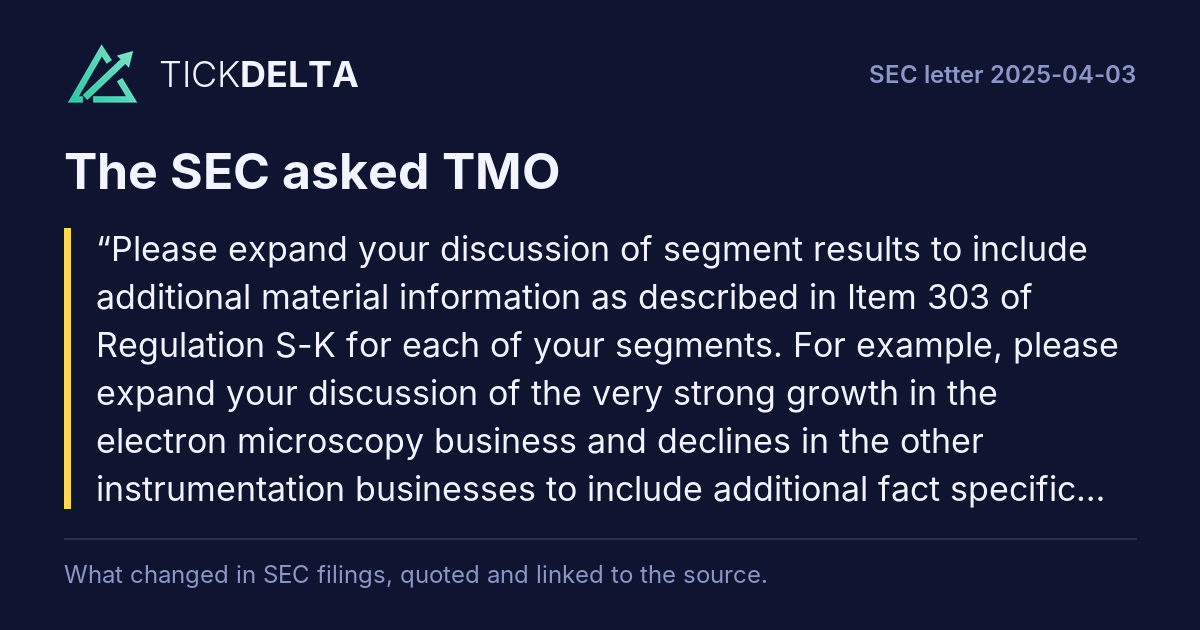
Please expand your discussion of segment results to include additional material information as described in Item 303 of Regulation S-K for each of your segments. For example, please expand your discussion of the very strong growth in the electron microscopy business and declines in the other instrumentation businesses to include additional fact specific insight describing the reasons for the growth and declines inRest of the question
the businesses, as well as related quantitative information. Please provide us any proposed disclosure for future filings.
1:
We acknowledge the Staff’s comment. While we believe the Company’s current discussion of segment results was appropriately developed after carefully considering the guidance in Item 303 of Regulation S-K, in future filings, we intend to enhance our disclosure as discussed below.
In historical filings, we used a “top-down” approach to provide management’s perspective about material developments and trends in the markets, geographies, and businesses in which we operate, keeping in mind the objective under Item 303(a) of Regulation S-K.Read in the reply ↗Rest of the answer
Because each of our reportable segments generates revenues from customers in four end markets and three major geographic regions, we provide framing comments that are applicable to the results in all reportable segments (page 20). In less common situations in which a trend or uncertainty is unique to more than one—but not all—reportable segments, we provide both the quantitative and qualitative context (for example, see discussion of the COVID-19 response on page 20).
After identifying how each reportable segment contributed to enterprise-wide revenue changes, we then provide analyses of segment-specific information. These analyses include, among other things, quantification of the components of changes in revenue (i.e., acquisitions/divestitures, currency translation, and organic growth (a non-GAAP measure)), as well as qualitative discussions that identify underlying businesses that materially contribute to organic growth. In situations in which a single factor contributed equally to all businesses within a reportable segment, we discuss such item qualitatively.
In future filings, we will enhance our descriptions of matters affecting businesses within our reportable segments pursuant to Item 303(b) of Regulation S-K that have had material impacts on the reportable segments in order to enhance a reader’s understanding of the magnitude and relative impacts. We note, however, that some of these factors, while describable qualitatively, may not be discernible with the level of precision necessary for quantitative disclosure. Our disclosure in future reports will be consistent with the example set forth in Appendix A (edits indicated by underlined text).
First report after the company's reply of 2025-04-10: 10-Q filed 2025-05-02 ↗, against the 10-Q filed 2024-11-01 ↗.
Tickdelta does not hold the text of both reports, so they are not compared here.
Please tell us how you applied the guidance in ASC 606-10-55-89 through 55-91 when selecting the categories to use to disaggregate revenues. As part of your response, please address how you considered disclosure of revenue attributable to the primary / key businesses identified on pages 3 and 4.Rest of the question
In this regard, we also note your use of pie charts to reflect the revenues attributable to these businesses in your 2024 Investor Day presentation. In addition, please tell us how you considered ASC 28010-50-40 as it relates to your segment disclosures.
2:
We acknowledge the Staff’s comment. While we believe the Company’s current disaggregated revenue disclosure was appropriately developed after carefully considering the guidance in ASC 606-10-50-5, as well as ASC 606-10-55-89 through 55-91, in future filings, we intend to enhance our disclosure as discussed below.
In historical filings, the Company considered and periodically evaluated the appropriate level of disaggregation into categories that depict how the nature, amount, timing, and uncertainty of revenue and cash flows are affected by economic factors.Read in the reply ↗Rest of the answer
As a result of this evaluation, we determined that more than one type of category disaggregation was needed.
When considering the disaggregated revenue disclosure, the Company evaluates both company-specific and macroeconomic factors. Sales of instruments can be capital-intensive for buyers and more subject to specifically allocated funds. By contrast, sales of consumables and the provision of services tend to reflect recurring needs for our customers that are generally funded by their operating budgets. As a result, providing revenue disaggregated by type (i.e., consumables, instruments, and services) appropriately articulates the level of potential risk to future revenue and cash flows. The level of disaggregation presented by revenue type is more disaggregated in Note 6 of the consolidated financial statements than provided in our 2024 Investor Day presentation.
Next, economic factors tend to vary on a geographically regional level such that providing revenue disaggregated by geographic region appropriately articulates the level of potential risk to future revenue and cash flows. Additionally, we disclose revenues to individually significant countries in Note 11 (page 64) of the consolidated financial statements, which further helps readers of our financial statements understand the concentration of revenues in individually material jurisdictions. This disclosure is consistent with information provided in our 2024 Investor Day presentation.
Although the mix varies among the reportable segments, as disclosed in Note 6 (page 54) of the consolidated financial statements, each reportable segment earns revenues from each type and in each region.
Separately, one pie chart in our 2024 Investor Day presentation (slide 9) provides percentages of revenues by four end markets. While we believe that the allocations included on that slide are reasonable, we exercise significant judgment in determining how to allocate certain transactions among the end markets. For example, some of our sales are made to distributors, who then sell our products to customers in end markets. Typically in these situations, we do not have knowledge of the identity of the end customer. Because many of our products can be used by customers in any end market, we estimate the market mix of end customers to whom the distributor will sell our products. In other situations, our larger, more sophisticated customers can use our products or services for one or more different end market-purposes. Again, in these situations, we estimate the ultimate end market for our products and services to these direct customers. Because of these reasons, we are unable to provide revenue by end market with the level of precision necessary to include quantitative disclosure in our periodic reports; however, we believe that our estimates of revenue by end market support qualitative discussions about material changes in the end markets that we include in Management’s Discussion and Analysis of Financial Condition and Results of Operations (page 20) because they are reasonable and helpful for readers.
The Company acknowledges the comment from the Staff regarding the use of pie charts to reflect revenues attributable to businesses that underlie our reportable segments in our 2024 Investor Day materials (slides 42, 50, 57, and 63) and after further consideration, in future filings, the Company will enhance its disclosures to provide revenues by businesses underlying our reportable segments in addition to revenue by type and revenue by geographic region. Our incremental disclosure in future reports will be consistent with the approach set forth in Appendix B.
Finally, ASC 280-10-50-40 does not define “similar” products and services. Therefore, the determination of whether two or more products are similar and can be combined for purposes of the entity-wide disclosures depends on the facts and circumstances of the particular entity. The Company’s interpretation is that an enterprise with a relatively narrow product line may not consider two products to be similar, while an enterprise with a broad product line, like Thermo Fisher, may consider those same two products to be similar. The types of products within each of the Company’s reportable segments are broadly defined yet similar and, in management’s judgment, the products within each of the Company’s segments are sufficiently similar such that their grouping within the Company’s segment disclosures satisfies the requirements of ASC 280-10-50-40. Nonetheless, based upon the plan discussed above to disclose revenues by businesses underlying our reportable segments, we note that the enhanced level of disaggregation will also appropriately satisfy the requirements of ASC 280-10-50-40.
First report after the company's reply of 2025-04-10: 10-Q filed 2025-05-02 ↗, against the 10-Q filed 2024-11-01 ↗.
Tickdelta does not hold the text of both reports, so they are not compared here.
Also in this review: closing letter, 2025-04-15