Form 10-K for the Fiscal Year Ended December 31, 2021
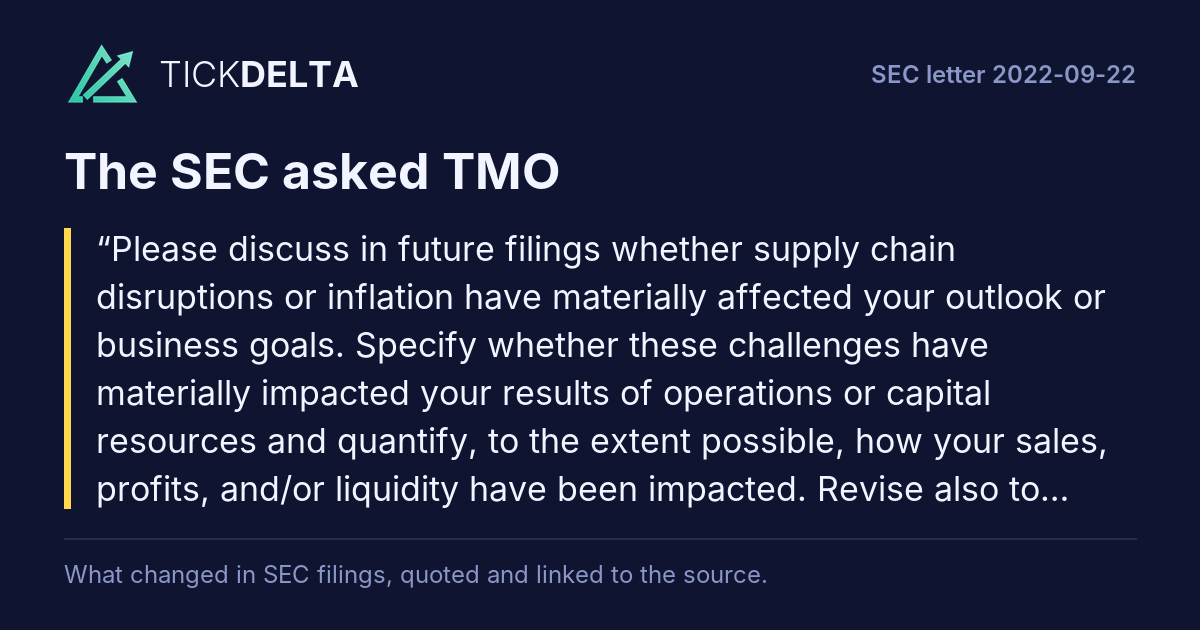
Please discuss in future filings whether supply chain disruptions or inflation have materially affected your outlook or business goals. Specify whether these challenges have materially impacted your results of operations or capital resources and quantify, to the extent possible, how your sales, profits, and/or liquidity have been impacted.Rest of the question
Revise also to discuss in future filings any known trends or uncertainties resulting from mitigation efforts undertaken, if any. Explain whether any mitigation efforts introduce new material risks, including those related to product quality, reliability, or regulatory approval of products.
1:
The Company acknowledges the Staff’s comment and notes that as of the date of the above-referenced reports, supply chain disruptions and inflation have not had a material impact on its outlook, business goals, results of operations, capital resources or business risks. The Company will continue to evaluate the impact of supply chain disruptions and inflation in connection with each of its periodic reports and will consider, and disclose if material, whether supply chain disruptions or inflation have materially affected our outlook or business goals.Read in the reply ↗Rest of the answer
The Company will also continue to consider and disclose, if material, whether such challenges have materially impacted results of operations or capital resources and whether any of the Company’s mitigation efforts in response to supply chain constraints have introduced new material risks.
First report after the company's reply of 2022-10-06: 10-Q filed 2022-11-04 ↗, against the 10-Q filed 2022-08-05 ↗.
Tickdelta does not hold the text of both reports, so they are not compared here.
We note that your discussion within Results of Operations focuses on individual segment operating performance. As required by Item 303(b) of Regulation S-X, please revise future filings to also describe the underlying reasons for material changes in quantitative and qualitative terms for the registrant as a whole.
2:
We acknowledge the Staff’s comment, and while we believe our disclosures, which quantified the changes in consolidated revenues due to currency translation, acquisitions, and COVID-19 testing as well as discussed trends in end markets and geographies and other qualitative changes in operating margins, were appropriate relative to Item 303(b) of Regulation S-K, in future filings the Company will enhance its discussion within Results of Operations to further describe the underlying reasons for material changes in quantitative and qualitative terms for the Company as a whole. Read in the reply ↗
First report after the company's reply of 2022-10-06: 10-Q filed 2022-11-04 ↗, against the 10-Q filed 2022-08-05 ↗.
Tickdelta does not hold the text of both reports, so they are not compared here.
We note that during the third quarter of 2021 certain businesses changed from the LIFO method to the FIFO method. Please explain to us why a preferability letter from your independent registered public accountants was not provided as an exhibit. Refer to ASC 250-10-S99-4 and Item 601(B)(18) of Regulation S-K.
3:
As noted in the Staff’s comment, we changed our accounting for inventory in the third quarter of 2021 from the last-in, first-out (LIFO) to the first-in, first-out (FIFO) method for the Company’s businesses that utilized the LIFO. As noted in ASC 250-10-S99-4, “Rule 10-01(b)(6) of Regulation S-X requires that a registrant who makes a material change in its method of accounting shall indicate the date of and the reason for the change.Read in the reply ↗Rest of the answer
The registrant also must include as an exhibit in the first Form 10-Q filed subsequent to the date of an accounting change, a letter from the registrant's independent accountants indicating whether or not the change is to an alternative principle which in [the independent accountant’s] judgment is preferable under the circumstances (emphasis added).”
As disclosed in our Quarterly Report on Form 10-Q for the period ended October 2, 2021, and our Annual Report on Form 10-K for the year ended December 31, 2021, the impact of the change in accounting was $33 million, which was less than 0.5% of income before income taxes for the year ended December 31, 2021, and less than 1% of inventories during 2021. This impact did not mask a change in earnings, hide a failure to meet analysts’ consensus expectations, or affect the achievement level of management’s incentive compensation. We concluded that the change in accounting principle was immaterial for all periods presented and, therefore, in accordance with the guidance in ASC 250-10-S99-4, concluded that a preferability letter from our independent registered public accounting firm, PricewaterhouseCoopers LLP (“PwC”), was not required.
As part of its interim review procedures for the third quarter of 2021, PwC evaluated our stated reasons and justifications for this change in accounting principle and concurred with our conclusion that the change from LIFO to FIFO represents, in the Company’s circumstances, a change to a preferable accounting principle in conforming with Accounting Standards Codification 250, Accounting Changes and Error Corrections.
First report after the company's reply of 2022-10-06: 10-Q filed 2022-11-04 ↗, against the 10-Q filed 2022-08-05 ↗.
Tickdelta does not hold the text of both reports, so they are not compared here.
Also in this review: closing letter, 2022-10-14