Form 10-K for the Year Ended December 31, 2022
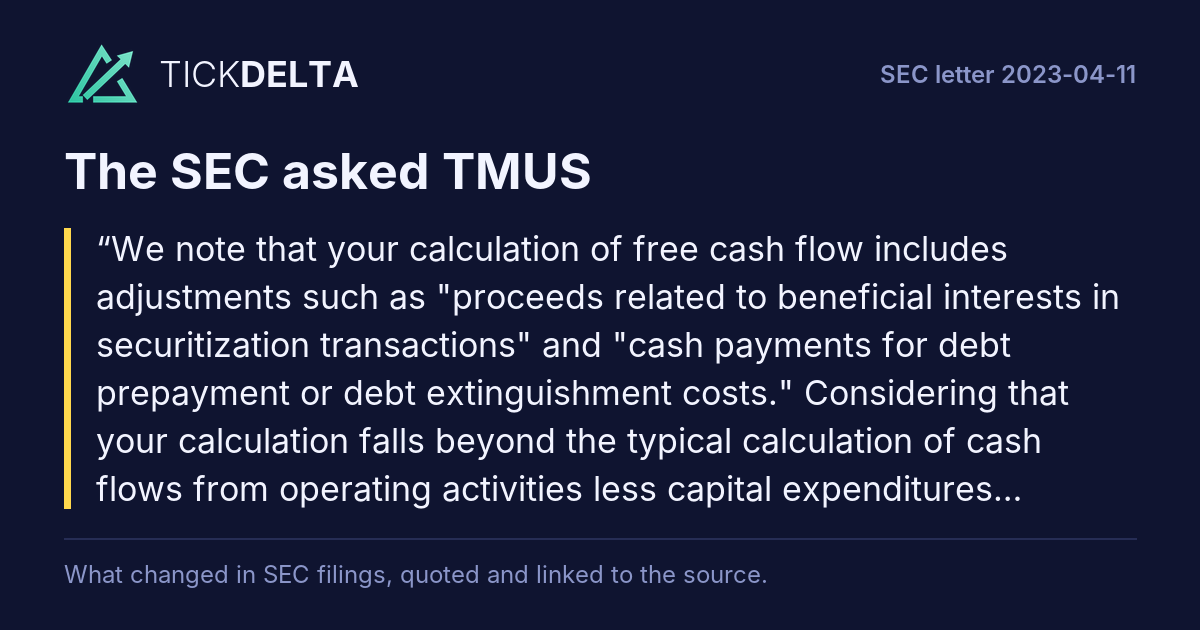
We note that your calculation of free cash flow includes adjustments such as "proceeds related to beneficial interests in securitization transactions" and "cash payments for debt prepayment or debt extinguishment costs." Considering that your calculation falls beyond the typical calculation of cash flows from operating activities less capital expenditures, please revise to relabel this measure or revise itsRest of the question
computation to more accurately reflect its definition. Please comply with this comment in future filings, including your Form 8- K. Refer to Q&A 102.07 of the C&DI on Non-GAAP Financial Measures.
The Company relabeled its non-GAAP financial measure “Free Cash Flow” to “Adjusted Free Cash Flow” beginning with the Company’s Quarterly Report on Form
10-Q for the quarterly period ended March 31, 2023, filed with the SEC on April 27, 2023, and earnings release dated April 27, 2023. Read in the reply ↗
First report after the company's reply of 2023-05-09: 10-Q filed 2023-07-27 ↗, against the 10-Q filed 2022-10-27 ↗.
Tickdelta does not hold the text of both reports, so they are not compared here.
Revise your contractual obligations table to include the payments required under the Cogent IP transit services agreement or advise us.
The Company will include the payments required under the Cogent IP Transit Services Agreement in the contractual obligations table in our annual report on Form 10-K for the year ending December 31, 2023. Read in the reply ↗
First report after the company's reply of 2023-05-09: 10-Q filed 2023-07-27 ↗, against the 10-Q filed 2022-10-27 ↗.
Tickdelta does not hold the text of both reports, so they are not compared here.
We note you recorded a liability for fees payable for IP transit services "as we have not currently identified any path to utilize such services in our continuing operations and have committed to execute the agreement as a closing condition for the Wireline Transaction." Please disclose and explain to us: • why you entered into the IP transit services agreement when you do not intend to utilize IP transit services;Rest of the question
• if entering into an IP transit services agreement was a condition required by Cogent in the purchase of the Wireline Business; • the business purpose of making the payments required in this agreement; • how the amounts to be paid under the agreement were determined; • if, in substance, the payments are for something other than services you will never receive; • the nature and amount of any unrecorded obligations, financial commitments, or contingent liabilities that will be assumed by Cogent as part of their purchase of the Wireline Business; and • the extent your continuing operations have utilized IP transit services similar to those covered under the IP transit services agreement during 2022 and 2021.
In connection with the merger between the Company and Sprint Corporation (“Sprint”) on April 1, 2020, the Company acquired
Sprint’s legacy CDMA and LTE wireless networks, which were supported by the legacy Sprint Wireline network that the Company also acquired through the same transaction. During the second quarter of 2022, we retired the legacy Sprint CDMA network and began the orderly shut-down of the LTE network, which was completed during the third quarter of 2022.
The Company began evaluating potential transactions involving the Wireline business in 2021 after the Company determinedRead in the reply ↗Rest of the answer
that the Wireline assets, which used to support legacy Sprint CDMA and LTE networks, would no longer support the Company’s wireless network and the associated customers after the network integration was completed and the legacy Sprint wireless networks were shut down. The Wireline business as a standalone business was not compatible with the Company’s focus of translating its 5G leadership into overall network leadership in the wireless and broadband markets, and the Wireline business generated approximately $666 million and $866 million of operating losses in 2021 and 2022, respectively. Following such evaluation, in the third quarter of 2022, the Company concluded that selling the Wireline business would be in the best interest of the Company, its stockholders and customers.
Through a competitive process for the sale of the Wireline business, Cogent was the bidder that provided the best economics along with a feasible path forward for the Wireline business. The IP Transit Services Agreement was required by Cogent as a closing condition for its purchase of the Wireline business (the “Wireline Transaction”). Although the Company had no identified use for the IP transit services at the time of signing, the terms with Cogent were more attractive to T-Mobile in comparison with the proposals from other potential buyers.
The Wireline Transaction, including the IP Transit Services Agreement, is beneficial to the Company because, as a result of the Wireline
Transaction, the Company will avoid ongoing operating losses related to the Wireline business and avoid the cost of shutting down the Wireline business. The Company forecast that shutting down the Wireline business would take multiple years in order to manage an orderly transition of Wireline customers to a new service provider, and therefore would require the Company to incur future operating losses and related costs significantly more than the $700 million the Company will pay under the
IP Transit Services Agreement. Additionally, pursuant to the IP Transit Services Agreement, Cogent commits to provide a certain amount of bandwidth to the Company upon demand and the Company is exploring whether it could generate additional business opportunities in connection with such bandwidth.
if entering into an IP transit services agreement was a condition required by Cogent in the purchase of the
Wireline Business;
Response:
Yes, entering into the IP Transit Services Agreement was a required closing condition for the Wireline Transaction.
the business purpose of making the payments required in this agreement;
Response:
The IP Transit
Services Agreement, and the payments thereunder, was a required closing condition for the Wireline Transaction, which is beneficial to the Company due to the avoidance of future operating losses related to the Wireline business and the prolonged process of shutting down the Wireline business, which the Company believes would take multiple years and require the incurrence of future operating losses and related costs significantly more than the $700 million the Company will pay under the
IP Transit Services Agreement. Additionally, pursuant to the IP Transit Services Agreement, Cogent commits to provide the Company with additional bandwidth upon demand and the Company is exploring whether it could generate additional business how the amounts to be paid under the agreement were determined;
Response:
The total payment amount was determined through an initial competitive bidding process followed by negotiations between the Company and Cogent.
if, in substance, the payments are for something other than services you will never receive;
Response:
Other than the fact that the payments were a negotiated required closing condition to the completion of the Wireline Transaction with Cogent, the payments are not, in substance, for something other than for services we don’t expect to receive. Although the Company has not currently identified a way to utilize these IP transit services in its continuing operations in a meaningful way, the Company will continue to assess ways to use these IP transit services over the term of the IP Transit Services Agreement.
the nature and amount of any unrecorded obligations, financial commitments, or contingent liabilities that will be assumed by Cogent as part of their purchase of the Wireline Business; and
Response:
The components of assets and liabilities of the Wireline business presented within Other current assets and Other current liabilities, respectively, on the Company’s Consolidated Balance Sheet as of December 31, 2022, were disclosed in the Company’s 2022 Form 10-K. As of December 31, 2022, the Wireline business had
$252 million in financial commitments, $12 million of recognized contingent liabilities and no material unrecorded obligations that will be assumed by Cogent as part of their purchase of the Wireline business.
the extent your continuing operations have utilized IP transit services similar to those covered under the
IP transit services agreement during 2022 and 2021.
Response:
The Company procured an insignificant amount of IP transit services similar to those covered under the IP Transit Services Agreement during
2022 and 2021 from third-party vendors unrelated to the Wireline Transaction. We currently do not believe the services covered under the IP Transit Services Agreement are compatible with our current network strategy and infrastructure.
First report after the company's reply of 2023-05-09: 10-Q filed 2023-07-27 ↗, against the 10-Q filed 2022-10-27 ↗.
Tickdelta does not hold the text of both reports, so they are not compared here.
We note your response to prior comment 3 regarding the liability for fees payable for the IP Transit Services Agreement. Please respond to the following: • In your response, you state that through a competitive process for the sale of the wireline business, Cogent was the bidder that provided the best economics along with a feasible path forward, and that the terms with Cogent were more attractive to you inRest of the question
comparison with the proposals from other potential buyers. Please discuss the nature and terms of the other competitive bids relative to the bid from Cogent and why you determined the bid from Cogent was most attractive. For example, Cogent paid $1 for the Wireline business, and then negotiated the IP Transit Services Agreement for which you are obligated to pay $700 million over its term even though you don’t expect to use the IP services. Explain whether the other bids received resulted in you receiving larger amounts for the Wireline business and/or resulted in you having to pay higher cash outflows related to any potential sale. • Please provide your accounting analysis, with cites to the authoritative accounting guidance you relied upon, as a basis for recording the obligation for the IP Transit Services Agreement during the third quarter of 2022 even though the agreement was not entered into until May 1, 2023. • Tell us why the IP Transit Services Agreement was entered into at closing of the Cogent transaction, instead of at the time of the September 6, 2022 Membership Interest Purchase Agreement. • In your response, you state that you have not currently identified a way to utilize the IP transit services in a meaningful way, but you will continue to assess ways to use the services over the term of the IP Transit Services Agreement. Tell us the accounting you would apply if you believe you were able to utilize the IP transit services in a meaningful way, given that you have already recorded a loss for the IP Transit Services Agreement. • Tell us whether you evaluated if you may assign your rights under the IP Transit Services Agreement to another party that may be able to use the services, and thus monetize value under the agreement. To the extent that you are, explain to us how you would account for the transaction. • We note you entered into a Customer Subscriber Agreement with Cogent on May 1, 2023. Please tell us the material terms of this agreement, including the term and the fees expected to be paid under this agreement, as well as whether you expect to use the services you are entitled to under the agreement. As part of your response, tell us how you are accounting for this agreement.
On behalf of our client, T-Mobile US, Inc. (the “Company”), this letter confirms my telephone conversation with Ms. Jacobson on June 9, 2023 regarding the Company’s request for an extension of time to respond to the comment letter dated June 8, 2023 from the Staff of the Division of Corporation Finance.
As discussed, the Company requires additional time to prepare its response and currently expects to respond on or about July 10, 2023. Read in the reply ↗
First report after the company's reply of 2023-06-09: 10-Q filed 2023-07-27 ↗, against the 10-Q filed 2022-10-27 ↗.
Tickdelta does not hold the text of both reports, so they are not compared here.
Also in this review: request for more time, 2023-04-12, company letter, 2023-07-10, company letter, 2023-07-14, company letter, 2023-08-07, closing letter, 2023-08-17