Screener / SEC EDGAR /CIK 0000794170 /10-K filed Dec 19, 2025, compared with Dec 20, 2024 /Numbers from the XBRL of the 10-Ks
NYSE Consumer discretionary · Homebuilders

Toll Brothers, Inc. TOL

Compare with peers Embed
SEC comment letters, last 20 years

3 reviews of TOL's filings by SEC staff

UPLOAD and CORRESP
Reviews 3 latest letter Apr 11, 2019
Questions asked 12 each answered in the company's own letter
No closing letter 0 reviews without a letter saying the staff completed it

When the SEC's staff reviews a filing, it writes to the company with numbered questions, and the company answers each one in a letter. SEC publishes the exchange once the review is over, at least 20 business days later. A question is not an accusation; most reviews end with the company adding detail to its next filing.

How the reviews went

Every review on EDGAR, from the first staff letter to the letter that closes it

  1. 1. Staff letters 4 UPLOAD
  2. 2. Questions in them 12 numbered comments
  3. 3. Company replies 4 CORRESP
  4. 4. Reviews closed 3 of 3 closing letter

Half the closed reviews took 29 days or less from the first letter to the closing letter.

Form 10-K for the period ended October 31, 2018

2019-04-11 to 2019-05-10 · 4 questions · 1 letter from the SEC, 1 from the company
Review closed 2019-05-10
RevenueResults discussion (MD&A)Income taxesLeases
Management's Discussion and Analysis of Financial Condition and Results of Operations · Results of Operations, page 32
SEC asked (1)
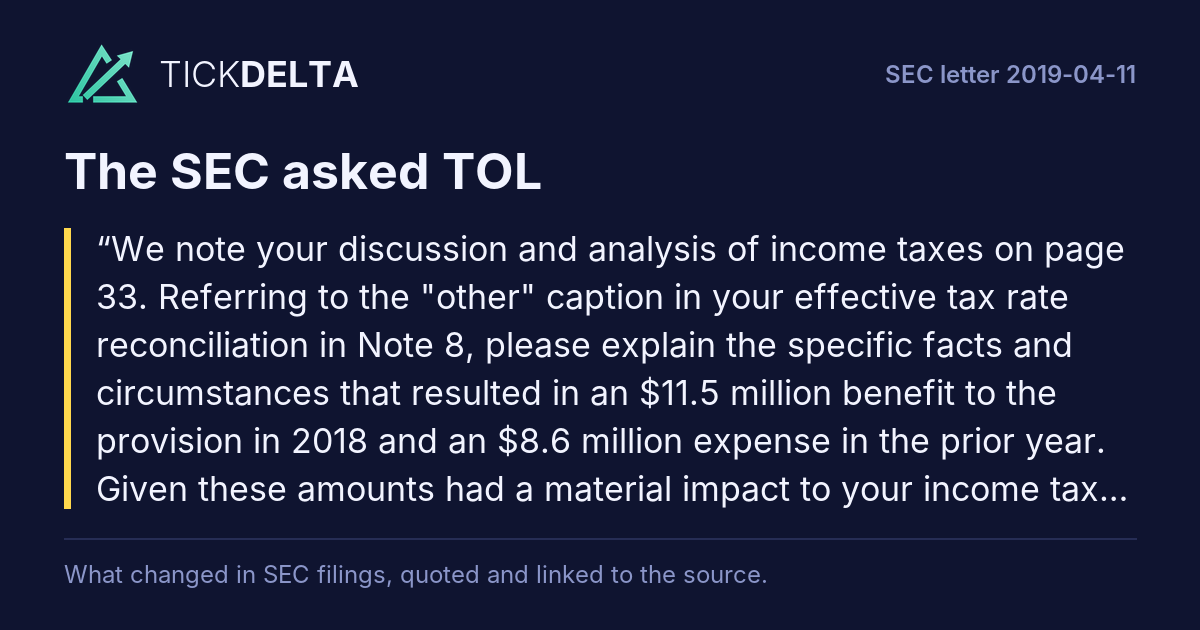
We note your discussion and analysis of income taxes on page 33. Referring to the "other" caption in your effective tax rate reconciliation in Note 8, please explain the specific facts and circumstances that resulted in an $11.5 million benefit to the provision in 2018 and an $8.6 million expense in the prior year.
Rest of the question

Given these amounts had a material impact to your income tax provision for the year, your discussion should describe the material factors within this line item that drove the change between the periods presented, whether they are recurring, and the potential impact on future operations. Please refer to Item 303(a)(3) of Regulation S-K and Section 501.12 of the Financial Reporting Codification for guidance.

TOL answered
The factors that comprised the approximate $11.5 million benefit to the Company’s income tax provision in fiscal 2018 and approximate $8.6 million expense in fiscal 2017 consisted of the following (amounts in thousands):

Item

Fiscal Year 2018

Fiscal Year 2017

Year-over-Year Change

Provision-to-return and other true-up adjustments

$

(3,077

)

9,941

(13,018

State deferred tax impact of basis step-up adjustments

(1,477

—

Transaction-related adjustments to state NOL carryforwards

(10,494

Adjustments due to changes in state tax rates and laws

2,533

(1,630

4,163

Other
Rest of the answer

adjustments

1,045

294

751

Total income tax expense/(benefit)

(11,470

8,605

(20,075

Provision-to-return and other true-up adjustments. The approximate $3.1 million benefit in fiscal 2018 consisted primarily of a true-up related to new energy efficient home tax credits under Section 45L of the U.S.

Internal Revenue Code of 1986, which on February 9, 2018 was retroactively extended through December 31, 2017. The approximate $9.9 million expense in fiscal 2017 consisted primarily of (i) true-ups of state tax provisions in the aggregate amount of approximately $4.6 million related to a reallocation of pre-tax earnings by legal entity and (ii) the write-off of certain deferred tax asset balances in the aggregate amount of approximately $5.7 million. These amounts were offset by various other true-up adjustments that resulted in an approximate $0.4 million benefit and that, individually and in the aggregate, were not material. The adjustments included in this category were based on events that the Company does not expect to recur or to have a material impact on future operations.

State deferred tax impact of basis step-up adjustments. The approximate $1.5 million benefit recognized in fiscal 2018 related to this category was the result of a transaction that resulted in a basis step-up in an entity that files separate state income tax returns (where the corresponding gain was recognized in an entity that files as part of a unitary group). This adjustment is not expected to recur or to have a material impact on future operations.

Transaction-related adjustments to state NOL carryforwards. The approximate $10.5 million benefit recognized in fiscal 2018 related to legal entity restructurings undertaken by the Company that resulted in changes to state tax apportionment percentages that increased the value of certain of the Company’s state net operating loss carryforwards. The adjustments in this category were the result of two separate discrete tax planning transactions taken by the Company that are not expected to recur or to have a material impact on future operations.

Adjustments due to changes in state tax rates and laws. Amounts included in this category reflect adjustments to state deferred tax assets and liabilities based on changes to state tax rates and regulations and as a result of other legal developments, including the adjudication of state tax court cases, as well as changes in the Company’s apportionment percentages as a result of operations. While these types of changes and developments may recur, the adjustments resulting from such changes and developments are typically not material to an understanding of the Company’s income tax provision. To the extent such a change or development is material, the Company intends to discuss the impact in its MD&A.

Other adjustments. Amounts included in this category reflect adjustments that, individually and in the aggregate, were not material.

In future filings the Company intends to identify any significant reconciling items that materially impact our effective tax rate during the period. In addition, to the extent material, we will continue to provide MD&A commentary on the fluctuations impacting our effective tax rate, including the recurring or non-recurring nature of the underlying items giving rise to such fluctuations and the potential impact on future operations.

Read in the reply
In its next report

First report after the company's reply of Apr 24, 2019: 10-Q filed Jun 6, 2019 ↗, against the 10-Q filed Mar 8, 2019 ↗.

Tickdelta does not hold the text of both reports, so they are not compared here.
Significant Accounting Policies · Revenue Recognition, page 6
SEC asked (2)
We note that in certain states you are not able to complete certain outdoor features prior to the closing of the home. To the extent these separate performance obligations are not complete prior to delivering the home, you defer a portion of the home sales revenues related to these separate performance obligations. Please tell us the nature of the outdoor features and describe your analysis under ASC 606-10-25-19.
TOL answered
The outdoor features that the Company treats as separate performance obligations under its sales agreements are landscaping services such as seeding of lawns, grading, and completion of driveways. In certain locations, these features cannot be completed prior to closing of the home sale due to unfavorable weather conditions. The Company’s sales agreements generally provide for this contingency and state that the home buyer is obligated to close on the home sale despite these features being incomplete, with the Company promising to fulfill its obligations when weather permits.
Rest of the answer

The following is an example of the provision we typically include in our sales agreements:

“Certain items of outside work (e.g. grading, seeding and driveway) may not be completed prior to closing. Seller agrees to complete such items after closing as soon as practical and weather permitting, and Buyer agrees that there will be no holdback or escrow of any part of the purchase price.”

As of January 31, 2019, deferred home sales revenue related to such features totaled approximately $3.1 million, with related costs of approximately $2.3 million, compared to approximately $1,319.3 million of home sales revenue and $1,042.20 million of home sales cost of revenues for the three months ended January 31, 2019. On a per home basis, the amount of deferred revenue was less than 1% of the Company’s average settled price of approximately $862,000 per home in the first quarter of fiscal 2019.

The Company evaluated, under ASC 606-10-25-19 through 25-22, whether the Company’s obligation to complete the outdoor features described above constitutes a separate performance obligation from its obligation to deliver the home or whether these obligations should be combined to form a single performance obligation. Based on this evaluation, as discussed in more detail below, we concluded that completion of the outdoor features is capable of being distinct and is distinct in the context of the contract from the obligation to deliver the home, and as such should be accounted for as a separate performance obligation. Our conclusion is supported by the following findings: (i) the obligation to complete the outdoor features is separately identifiable within the contract and is not highly interdependent or interrelated with the obligation to deliver the home; and (ii) our customers realize significant benefits from accepting delivery of a fully constructed and habitable home notwithstanding that certain outdoor features may be incomplete, as evidenced by their willingness to close on the home and make full payment of the purchase price at closing.

We considered the guidance outlined in ASC 606-10-25-19 through 25-21 in determining whether these were separate performance obligations. ASC 606-10-25-19 states the following:

“A good or service that is promised to a customer is distinct if both of the following criteria are met:

a

The customer can benefit from the good or service either on its own or together with other resources that are readily available to the customer (that is, the good or service is capable of being distinct).

b

The entity’s promise to transfer the good or service to the customer is separately identifiable from other promises in the contract (that is, the promise to transfer the good or service is distinct within the context of the contract).”

Both of these criteria must be met to conclude that the good or service is distinct. If these criteria are met, the individual good or service must be accounted for as a separate unit of accounting (i.e., a performance obligation).

Capable of being distinct

ASC 606-10-25-20 provides clarity on this first criterion:

“A customer can benefit from a good or service in accordance with paragraph 606-10-25-19(a) if the good or service could be used, consumed, sold for an amount that is greater than scrap value, or otherwise held in a way that generates economic benefits. For some goods or services, a customer may be able to benefit from a good or service on its own. For other goods or services, a customer may be able to benefit from the good or service only in conjunction with other readily available resources. A readily available resource is a good or service that is sold separately (by the entity or another entity) or a resource that the customer has already obtained from the entity (including goods or services that the entity will have already transferred to the customer under the contract) or from other transactions or events. Various factors may provide evidence that the customer can benefit from a good or service either on its own or in conjunction with other readily available resources. For example, the fact that the entity regularly sells a good or service separately would indicate that a customer can benefit from the good or service on its own or with other readily available resources.”

As part of our analysis under ASC 606-10-25-19(a), we considered that many of the goods and services that we are obligated to provide pursuant to our sales agreements (e.g., installation of flooring, countertops, appliances, and many other components in the delivered home) are capable of being distinct because the home buyer can benefit from each such good or service on its own, or with readily available resources. This is apparent from the vast number of independent contractors and suppliers who, on a daily basis, perform such installation services and product sales to home owners and new home buyers throughout the country. We assessed that the landscaping and similar services related to the outdoor features described above fall into this category and, therefore, concluded that the criterion under ASC 606-10-25-19(a) is met with respect to these features.

Distinct within the context of the contract

We also considered the three factors specified in ASC 606-10-25-21 to determine whether the nature of the Company’s promise to the home buyer is to transfer (i) individual goods or services or (ii) a combined item that comprises the individual promised goods or services in the contract. These factors revolve around whether there is a two-way dependency between the promised goods and services and whether the promised goods and services are integrated into a bundle of goods or services or significantly modify or customize each other.

In our analysis under ASC 606-10-25-19(b), we concluded that the goods and services provided to our home buyers, excluding the outside features, are not distinct in the context of our contracts because we are providing a significant service of integrating the goods and services to deliver a completed home to the home buyer in accordance with the sales agreement. Importantly, the language referenced above pertaining to the home buyer’s obligation to take delivery of the home despite it having incomplete outdoor features does not pertain to other components of the home. We therefore assessed that, except with respect to outdoor features, our sales agreements generally contain a single performance obligation.

With respect to outdoor features, we performed a separate analysis in light of the contract provision referenced above. We concluded that, with respect to ASC 606-10-25-19(b), although the outdoor features are not separately priced in the contract, they are distinct in the context of the contract because a home buyer accepting ownership of the home has full functionality of the home. Importantly, we made the following assessments with respect to the factors set forth in ASC 606-10-25-21:

(a)

We do not provide a significant service in integrating the outdoor features and the delivered home. Although we undertake significant efforts to ensure that the entire property that we deliver to a customer is aesthetically pleasing and functional, the components are separable.

(b)

The outdoor features and the home do not modify or customize each other. Although the specific configuration of a home can affect the types of outdoor features available to the home buyer, the outdoor features do not modify or customize the home itself.

(c)

The outside features are not highly interdependent or highly interrelated with the home because the home buyer could buy the home and use it for its intended purposes without such outside features.

Based on the above analysis, we concluded that each of the criteria under ASC 606-10-25-19 is met with respect to our separate performance obligation to perform post-closing landscaping and similar services. As a result, upon closing of a home, if these outdoor features are incomplete, we defer a portion of the home sales revenue and costs related to these obligations until such time as the obligations are completed.

Read in the reply
In its next report

First report after the company's reply of Apr 24, 2019: 10-Q filed Jun 6, 2019 ↗, against the 10-Q filed Mar 8, 2019 ↗.

Tickdelta does not hold the text of both reports, so they are not compared here.

Significant Accounting Policies · Revenue Recognition, page 6
SEC asked (3)
We note your disclosure that effective November 1, 2018, in land transactions that contain repurchase options, revenues and related costs are not recognized until the repurchase option expires. It does not appear that your policy addresses the accounting for the contract as either a lease or financing arrangement.
Rest of the question

Please tell us your consideration of ASC 606-10-55-66 through 78 in your accounting for these transactions.

TOL answered
With respect to our master planned communities, we may sell building lots to third-party home builders (the “Builders”) who then construct homes on the lots for sale to the ultimate home buyers. Because we typically build Toll Brothers branded houses in the remaining portion of the master planned community and otherwise retain a significant interest in the success of the community, we seek to ensure that such Builders construct high quality homes in a timely manner.
Rest of the answer

Therefore, our lot sale contracts with Builders generally include a repurchase option provision (a call option) that allows us to repurchase the lot from the Builder if a specified triggering event occurs (e.g., failure by the Builder to perform under the contract) or a proposed sale by the Builder to a third party. The repurchase price for a building lot is equal to 100% of the purchase price paid by the Builder for such lot and does not factor in the time value of money. In general, these repurchase options expire when the Builder installs a home foundation on a building lot (i.e., commences construction), and in our experience the expected life of these repurchase options has been less than one year. During the first quarter of fiscal 2019, these repurchase options were in place with respect to only two of our master planned communities, each located in Texas.

We evaluated these call options under ASC 606-10-55-66 through 55-78. ASC 606-10-55-68 states the following:

“If an entity has an obligation or a right to repurchase the asset (a forward or a call option), a customer does not obtain control of the asset because the customer is limited in its ability to direct the use of, and obtain substantially all of the remaining benefits from, the asset even though the customer may have physical possession of the asset. Consequently, the entity should account for the contract as either of the following:

A lease in accordance with Topic 840 on leases, if the entity can or must repurchase the asset for an amount that is less than the original selling price of the asset unless the contract is part of a sale-leaseback transaction. If the contract is part of a sale-leaseback transaction, the entity should account for the contract as a financing arrangement and not as a sale-leaseback in accordance with Subtopic 840-40.

A financing arrangement in accordance with paragraph 606-10-55-70, if the entity can or must repurchase the asset for an amount that is equal to or more than the original selling price of the asset.”

As noted above, the repurchase option gives us a right when there is a triggering event to repurchase the lot from the Builder for the original purchase price paid by the Builder. As outlined in ASC 606-10-55-69, “[w]hen comparing the repurchase price with the selling price, an entity should consider the time value of money.” Because the repurchase price of our option contracts does not factor in the time value of money, the repurchase price under the option is less than the original selling price. Accordingly, we concluded that we should account for these contracts as leases in accordance with ASC 840, “Leases.” In future filings, we will include disclosure that makes it clear that we account for these contracts as leases.

In accordance with ASC 840, we classified these leases as operating leases, continue to recognize them as an asset on our balance sheet, and recorded deferred revenue for the consideration received from the Builder. As of January 31, 2019, we recorded deferred revenue of approximately $11.3 million and deferred profit of approximately $3.5 million related to these repurchase options. Because the expected life of these repurchase options is generally less than one year, we have not recognized lease income related to these leases under ASC 840. We have determined that this lease income is immaterial to our consolidated financial statements and disclosures. In Note 1 to the Notes to Condensed Consolidated Financial Statements in our Form 10-Q, we disclosed that “[t]he revenue and related expense of such lots will be recognized in future periods when such repurchase options expires.” We will continue to monitor the level of activity and average life of these repurchase options and record income in accordance with ASC 840 if and when amounts become material.

Read in the reply
In its next report

First report after the company's reply of Apr 24, 2019: 10-Q filed Jun 6, 2019 ↗, against the 10-Q filed Mar 8, 2019 ↗.

Tickdelta does not hold the text of both reports, so they are not compared here.

Significant Accounting Policies · Revenue Recognition, page 6
SEC asked (4)
According to your disclosure, you treat incentives such as payment of a home buyer's closing costs as additional costs of sales when paid to a third party. Please tell us how you considered the guidance in ASC 606-10-32-25 through 27 in your determination that the costs paid to third parties, such as home buyer closing costs, should be reflected as expense rather than as a reduction of transaction price.
TOL answered
ASC 606-10-32-25 requires that consideration payable to a customer be treated as a reduction of revenue (subject to specified exceptions). ASC 606-10-32-25 states that “[c]onsideration payable to a customer includes cash amounts that an entity pays, or expects to pay, to the customer (or to other parties that purchase the entity’s goods or services from the customer).
Rest of the answer

Consideration payable to a customer also includes credit or other items (for example, a coupon or voucher) that can be applied against amounts owed to the entity (or to other parties that purchase the entity’s goods or services from the customer).”

In many cases, we provide an overall general credit to a home buyer as a sales incentive, which can be used by the home buyer to offset amounts owed to us and outside parties. The home buyer may use this general credit to, among other things, reduce the base house price, purchase additional house options from us, and/or reduce borrowing and closing costs. We generally do not track whether the home buyer is using the general credit we provide to offset distinct amounts owed to us or to outside parties. However, because the credit is ultimately being used to offset the amount that the home buyer is obligated to pay in respect of the home purchase, we reduce home sales revenue for any general credit we provide to a home buyer.

In certain cases, we agree to pay closing costs that are owed by the home buyer to a third party outside of the context of the general credit referred to above. These closing costs are in addition to closing costs that the Company is obligated to pay to a third party in respect of a home sale. In the first quarter of fiscal 2019, the total amount of closing costs that the Company paid, including amounts owed by the Company and the home buyer, was approximately $6.8 million, a majority of which related to amounts owed by the Company. Such costs represent less than 1% of the Company’s home sales revenue of approximately $1,319.3 million. Because we consider the closing costs that the Company pays in respect of home buyers to third parties to be immaterial, we do not separately account for these amounts as a reduction to home sales revenue.

Read in the reply
In its next report

First report after the company's reply of Apr 24, 2019: 10-Q filed Jun 6, 2019 ↗, against the 10-Q filed Mar 8, 2019 ↗.

Tickdelta does not hold the text of both reports, so they are not compared here.

Also in this review: closing letter, 2019-05-10
Form 10-K

2016-03-17 to 2016-05-26 · 7 questions · 2 letters from the SEC, 2 from the company
Review closed 2016-05-26
Legal and contingenciesResults discussion (MD&A)SegmentsGoodwill and impairmentInventoryLiquidity and cash
Fiscal 2015 Compared to Fiscal 2014, page 39 · Homebuilding – North and Mid-Atlantic, page 39
SEC asked (1)
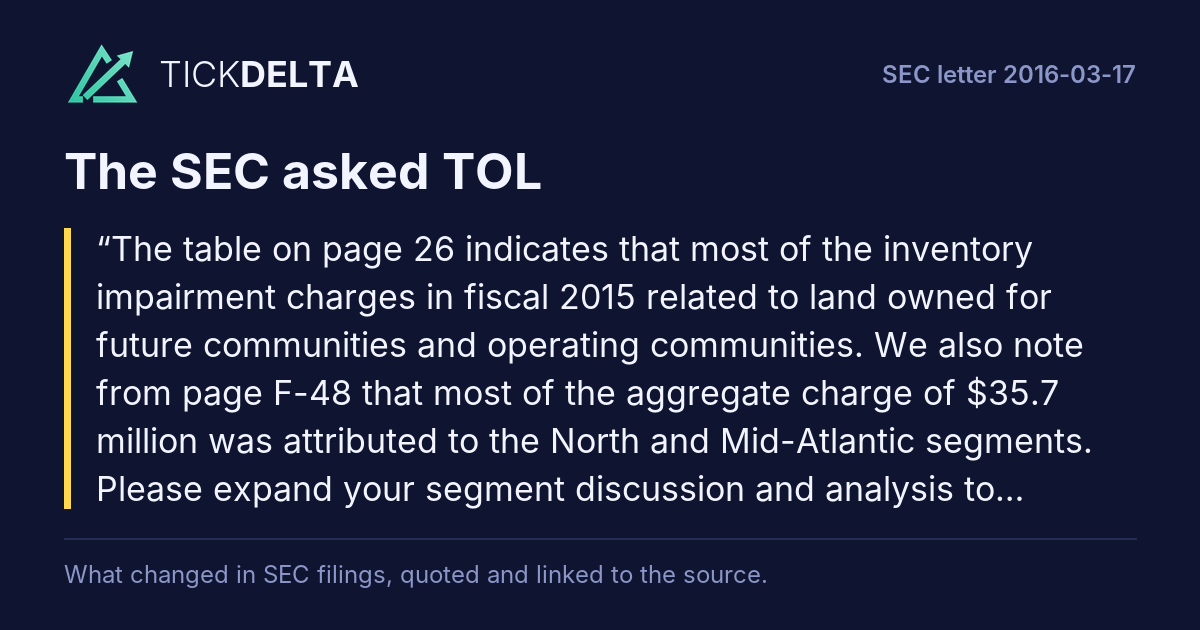
The table on page 26 indicates that most of the inventory impairment charges in fiscal 2015 related to land owned for future communities and operating communities. We also note from page F-48 that most of the aggregate charge of $35.7 million was attributed to the North and Mid-Atlantic segments.
Rest of the question

Please expand your segment discussion and analysis to adequately describe the relevant facts and circumstances surrounding each material component of the charge, including changes in your underlying assumptions. Refer to Sections 501.04 and 501.12.b.4 of the FRC.

TOL answered
Over 90% of the $35.7 million of inventory impairment charges in fiscal 2015 related to four operating communities located in our North and Mid-Atlantic segments and two parcels of land owned for future communities in our Mid-Atlantic segment. As disclosed in Note 1, “Significant

Accounting Policies - Inventory” in our Form 10-K (page F-9), we review operating communities for impairment when their profitability deteriorates, the sales pace declines significantly, or some other factor indicates a possible impairment in the recoverability of the asset.
Rest of the answer

During fiscal 2015, primarily due to a lack of improvement and/or a decrease in customer demand as a result of weaker than expected market conditions in certain housing markets in the suburbs of New York City and Philadelphia, we determined that the pricing assumptions used in our prior impairment reviews for four operating communities located in these markets needed to be reduced. As a result of these reductions in expected sales prices, we determined that these communities were impaired. Accordingly, the carrying values of these communities were written down to their estimated fair values resulting in charges to income before taxes of $13.9 million and $6.8 million in our North and Mid-Atlantic segments, respectively.

With respect to land owned for future communities, which is also discussed in Note 1 in our Form 10-K (page F-9), we evaluate all land held for future communities to determine whether we expect to proceed with the development of the land as originally contemplated. During fiscal 2015, due to the weakness in certain housing markets in Maryland and West Virginia, we decided to sell land at two future communities rather than develop them as previously intended. The carrying values of these communities were written down to their estimated fair values resulting in charges to income before taxes of $11.9 million in our Mid-Atlantic segment.

In future filings, we will discuss the relevant facts and circumstances in our segment discussion and analysis regarding significant impairment charges, including changes to underlying assumptions, consistent with the information provided above.

Read in the reply
In its next report

First report after the company's reply of Apr 6, 2016: 10-Q filed Jun 3, 2016 ↗, against the 10-Q filed Mar 3, 2016 ↗.

Tickdelta does not hold the text of both reports, so they are not compared here.

Note 7. Accrued Expenses, page F-29
SEC asked (2)
We note your disclosures regarding the stucco-related claims. With reference to the $54 million and $80.3 million estimate of your potential liability for known and unknown claims as of the end of fiscal years 2014 and 2015, respectively, please address the following comments:  Clarify whether or not your estimated charges are net of expected recoveries from your outside insurance carriers.
Rest of the question

In this regard, indicate whether you have recorded receivables for these expected recoveries and, if so, your basis for this recognition;  Support your use of previously recognized warranty and self-insurance accruals to cover your potential liabilities for these claims. In this regard, it appears that as of the end of fiscal year 2014, your $54 million of potential claims represented 62.3% of your accrual for expected warranty cost accrual at the end of fiscal year 2014 and 93.1% of your accrual at the end of fiscal year 2015. Tell us how your accrual for expected warranty costs are sufficient for all your expected warranty costs at the end of each fiscal year; and  You indicate that you do not believe that any resolution of your stucco-related and construction claims in excess of the amounts currently accrued would be material to your financial condition. Please tell us supplementally and expand your disclosure to assess materiality as it relates to your results of operations and liquidity.

TOL answered
The charges we recorded reflect our expected liability, net of expected recoveries and/or direct payments from our insurance carriers. We did not record a receivable from our insurance carriers for these expected recoveries. We will clarify this disclosure in future filings.

Support your use of previously recognized warranty and self-insurance accruals to cover your potential liabilities for these claims.
Rest of the answer

In this regard, it appears that as of the end of fiscal year 2014, your $54 million of potential claims represented 62.3% of your accrual for expected warranty cost accrual at the end of fiscal 2014 and 93.1% of your accrual at the end of fiscal year 2015. Tell us how your accrual for expected warranty costs are sufficient for all your expected warranty costs at the end of each fiscal year; and

Response:

As disclosed in Note 1, “Significant Accounting Policies - Warranty and Self-Insurance” in our Form 10-K (page F-12), we accrue for expected warranty costs at the time each home is closed and title and possession are transferred to the home buyer. Warranty costs are accrued based upon historical experience. Based on our evaluation of expected future warranty costs (excluding stuccorelated repairs discussed below), we had accruals of $48.9 million and $53.8 million at October 31,

2015 and 2014, respectively. These amounts are consistent with amounts accrued in prior years without stucco-related claims.

As disclosed in Note 7, “Accrued Expenses” in our Form 10-K (pages F-29 and F-30), after conducting a review of homes in certain completed communities in Pennsylvania and Delaware built during fiscal 2003 through fiscal 2009, we determined that we needed to establish a liability at October 31, 2014 for future stucco-related claims for homes built in these communities. As of October 31, 2014, we estimated that our expected gross exposure for stucco-related claims in these communities was approximately $54.0 million, of which approximately $32.5 million would be incurred by us and approximately $21.4 million would be covered by insurance policies in place at the time the homes were delivered to the home buyers. At October 31, 2014, we recorded a liability of $32.5 million to cover our expected uninsured future costs for stucco-related claims in these communities. This liability included the $7.6 million excess reserve for self-insurance discussed below.

As disclosed in Note 7, “Accrued Expenses” in our Form 10-K (pages F-29 and F-30), in the fourth quarter of fiscal 2015, during our review of the potential liability for stucco-related claims, we determined that the average cost of repairs increased based upon the actual costs of remediation of homes completed in the second half of fiscal 2015, and that stucco-related repairs would be needed in certain homes built in communities in Pennsylvania during fiscal 2010 through fiscal 2013. We also re-evaluated the amount we expected to be covered by our insurance policies with respect to stucco-related claims.

As of October 31, 2015, we estimated that our expected gross exposure for stucco-related claims was approximately $80.3 million, of which approximately $47.7 million would be incurred by us and approximately $32.6 million would be covered by insurance policies in place at the time the homes were delivered to the home buyers. In the fourth quarter of fiscal 2015, we recorded an additional charge for stucco-related repairs of approximately $14.7 million for the increase in our estimate of uninsured future costs for stucco-related claims. At October 31, 2015, our accrual for stucco-related repairs was approximately $44.2 million, consisting of the $32.5 million recorded in fiscal 2014, plus the additional $14.7 million for fiscal 2015, plus approximately $0.5 million of existing warranty accruals, less approximately $3.5 million expended during fiscal 2015 on remediation of claims.

During each fiscal year, we accrue for estimated construction defect claims based on claims experience. This review is performed with the assistance of our independent outside actuaries (“IOA”). At October 31, 2014, based on our review, as supplemented by our IOA, it was determined that we had $7.6 million in excess reserves for self-insurance. This excess was applied to the accrual for the expected costs of stucco repairs at October 31, 2014.

You indicate that you do not believe that any resolution of your stucco-related and construction claims in excess of the amounts currently accrued would be material to your financial condition. Please tell us supplementally and expand your disclosure to assess materiality as it relates to your results of operations and liquidity.

Response:

Based on our extensive review of the stucco-related claims previously made, the claims we expect to be made in the future, our estimate of costs to be incurred to complete the remediation of the claims, and the limited geographic area and time frame of the homes built with expected stucco-related claims, we believe that the amounts we have previously recognized in our financial statements are sufficient and we do not believe that we will incur any significant costs in excess of these amounts. If our estimates of potential stucco-related claims are insufficient to cover these costs, we do not believe that any shortfall will be material based on our 2015 results of operations, the size and strength of our balance sheet, and our liquidity.

At October 31, 2015, factors we considered in determining materiality included the $919.0 million of cash and cash equivalents on our balance sheet, over $565.0 million of available borrowing capacity on our revolving credit facility, $9.2 billion of total assets, $5.0 billion of total liabilities, $4.2 billion of total equity, and fiscal 2015 income before income taxes of $535.6 million.

In future filings, we will disclose that we believe that any resolution in excess of amounts accrued for stucco-related claims is not expected to have a material adverse effect on our results of operations, liquidity, or on our financial condition.

Read in the reply
In its next report

First report after the company's reply of Apr 6, 2016: 10-Q filed Jun 3, 2016 ↗, against the 10-Q filed Mar 3, 2016 ↗.

Tickdelta does not hold the text of both reports, so they are not compared here.

Form 10-K for the year ended October 31, 2015 · Note 7. Accrued Expenses, page F-29
SEC asked (1)
We have read your response to comment 2 of our letter dated March 17, 2016. The liabilities that you have recorded cover your expected uninsured future costs for stuccorelated claims. With reference to ASC 210-20-5-1 and 5-2 and ASC 210-20-45, please support your basis for recording your liabilities net of expected insurance recoveries.
Rest of the question

Specifically explain why your stucco-related contingency liabilities are not presented gross of any insurance receivables. With regard to expected insurance recoveries, we remind you that insurance receivables should only be recorded if they are probable.

TOL answered
We recorded our liability for stucco-related claims net of expected insurance recoveries of approximately $32 million and $22 million at October 31, 2015 and 2014, respectively. Based on ASC 450-30, we believe it is probable that the amounts incurred above our deductible will be reimbursed by our insurance company. This belief is based on numerous discussions with our insurer and their agreement that these costs are covered under our policies. Subsequent to October 31, 2015, we made two warranty requests for reimbursement from our insurance carrier, which included stucco related claims.
Rest of the answer

The insurance company has paid both claims in full.

We did not present the liability gross of our expected insurance recovery because the amount of the expected recovery was 0.35% of our total assets, 0.64% of our total liabilities, and 0.76% of our total equity at October 31, 2015 and was 0.26% of our total assets, 0.48% of our total liabilities, and 0.57% of our total equity at October 31, 2014; based on these metrics, we do not believe the amounts were material to our balance sheet. We also note that we disclose the gross amount of the estimated claims and the expected percentage of recovery from our insurance carrier in our footnote disclosure. We will continue to evaluate the materiality of any receivable in the future to determine if we should record the liability gross of that amount.

Read in the reply
In its next report

First report after the company's reply of May 17, 2016: 10-Q filed Jun 3, 2016 ↗, against the 10-Q filed Mar 3, 2016 ↗.

Tickdelta does not hold the text of both reports, so they are not compared here.

Form 10-K for the year ended October 31, 2015 · Note 7. Accrued Expenses, page F-29
SEC asked (2)
We note your assessment of materiality provided in the third bullet to comment 2. We caution you that a statement that the contingency is not expected to be material does not satisfy the requirements of ASC Topic 450 if there is at least a reasonable possibility that a loss exceeding amounts already recognized may have been incurred and the amount of that additional loss would be material to a decision to buy or
Rest of the question

sell your securities. In that case, you must either (a) disclose the estimated additional loss, or range of loss, that is reasonably possible, or (b) state that such an estimate cannot be made. Please advise.

TOL answered
We do not believe there is a reasonable possibility that additional charges incurred above the amounts already recognized would be material to an investor’s decision to buy or sell our securities. We will continue to monitor this for disclosure in future filings.
Read in the reply
In its next report

First report after the company's reply of May 17, 2016: 10-Q filed Jun 3, 2016 ↗, against the 10-Q filed Mar 3, 2016 ↗.

Tickdelta does not hold the text of both reports, so they are not compared here.

Form 10-K for the year ended October 31, 2015 · Note 7. Accrued Expenses, page F-29
SEC asked (3)
Please help us better understand how your accrual for stucco-related claims was developed. In this regard, please provide us with the following additional information:  Tell us the specific nature of the stucco-related claims and why those claims are limited to certain Delaware and Pennsylvania communities.
Rest of the question

Please address any commonalities among the types of homes built, the particular type of stucco used or any other industrial, operating or business factors that have led to these claims;  Tell us the number of communities involved as of October 31, 2014 and 2015 and January 31, 2016. Please also tell us if you identified any additional communities with stucco-related issues subsequent to January 31, 2016;  Tell us the number of completed communities you reviewed in connection with your estimate of your potential liability for known and unknown claims as of October 31, 2014 and 2015 and January 31, 2016. Tell us the specific nature of those reviews and clarify whether you extrapolated the findings of these reviews to other communities that may have potential stucco-related issues; Tell us the total number of homes you have identified that may potentially have stuccorelated issues as of October 31, 2014 and 2015 and January 31, 2016 and how you determined these numbers;  Tell us the number of estimated unknown claims you used in the determination of your stucco-related claims accrual as of October 31, 2014 and 2015 and January 31, 2016 and provide support for those numbers in light of the total number of homes that may potentially have stucco-related issues; and  Tell us how you determined during the fourth quarter of 2015 that additional stucco-related repairs will likely be needed in certain Pennsylvania communities built during fiscal 2010 through 2013. Please explain how you considered whether communities built in your mid-Atlantic region during these same time frames could have similar stucco-related issues; and  Please provide us a rollforward of your stucco-related claims activity, including (i) the number of claims received, (ii) the average dollar value of these claims, (iii) the number of claims settled or otherwise resolved and (iv) the average settlement amount per claim for each quarter beginning with your first quarter of fiscal year 2014 through your first quarter of 2016. Please provide us this information for the Pennsylvania and Delaware communities built during fiscal year 2003 through 2009 separately from the additional communities you identified in the fourth quarter of 2015 related to the Pennsylvania communities built during 2010 through 2013.

TOL answered
These claims involve water damage to homes clad with masonry-based cement stucco in the Pennsylvania and Delaware regions. The damage that we have seen in these claims primarily resulted from water intrusion at the intersection of dissimilar building components, including in particular rooflines, windows and other exterior building penetrations into the stucco cladding.

Installation of stucco cladding requires coordination by multiple trades and was subject to changing building code requirements during the relevant time period.
Rest of the answer

We attribute the geographic concentration of claims in Pennsylvania and Delaware to local construction practices employed by independent contractors in this area. Our divisions in Pennsylvania and Delaware were served by the same core group of contractors.

As a homebuilder, the Company is subject to construction defect and home warranty claims in the ordinary course of business, including stucco-related water damage claims similar to these claims, for which the Company has established warranty reserves. In the Fourth Quarter of fiscal 2014, however, we identified a trend of a higher than expected volume of claims involving stucco on homes delivered between 2002 and 2009 in communities in Pennsylvania and Delaware. We concluded that the magnitude, timing and geographic concentration of the claims indicated an exposure that would exceed the existing warranty reserves.

Accordingly, at the end of fiscal 2014, our legal, accounting and operations groups conducted a comprehensive analysis of known and potential claims to determine whether it was appropriate to establish an additional reserve for these claims. To determine the starting point for our analysis, we looked to our claims experience and our legal obligations. We provide a limited warranty for each home that includes, among other things, a limited structural warranty that runs for ten years from the closing of each home to the original buyer. Although the terms of our limited warranty terminate our warranty obligations after ten years, we applied a conservative approach and considered in our analysis known and potential claims on homes as old as 12 years old, which coincides with the statutory period of repose in Pennsylvania. Accordingly, we excluded from our 2014 analysis stucco homes delivered prior to November 2002. To determine an end date for our analysis, we looked to the end date of our higher than expected claims experience at that time, and we applied a December 31, 2009 cut off to our fiscal 2014 analysis in Pennsylvania and Delaware.

We used accounting records to identify stucco homes delivered in Pennsylvania and Delaware during this period. For each community that included a stucco home delivered in that period, we evaluated the following factors to determine whether a claim was likely to be received and the extent of likely exposure for any such claim:

(1) the closing dates of the stucco homes in each community;

(2) the number of known claims within each community;

(3) the estimated or actual repair costs of known claims in each community;

(4) the type and cost of repairs that have been performed in each community (i.e., area-targeted repairs, full wall re-clads);

(5) the number and amount of cash settlements with homeowners in each community;

(6) the size and models of homes, the type of construction (single family v. multi-family), and the number of stucco walls on each home;

(7) the identity of the contractors that were involved in the original construction of the homes;

(8) the number of claims by subsequent homeowners in each community; and

(9) other relevant knowledge and observations about each community gained from the field, particularly from our operations personnel who oversaw the original construction.

Based on our analysis, we projected at the end of fiscal 2014 that we would incur $54 million to repair or settle known and unknown stucco-related claims in homes delivered in Pennsylvania and Delaware between November 1, 2003 and December 31, 2009. That projection included extrapolations for communities without claims based on the application of the above-referenced factors.

We monitored the incidence of claims and repair costs incurred throughout 2015 and did not identify any trends or data that required an adjustment to our reserve until our fourth quarter. At the end of fiscal 2015, with the accumulated benefit of a full year of responding to and adjusting stucco-related claims and an increasing number of fully resolved repairs, our legal, accounting and operations groups conducted another comprehensive analysis of known and potential claims for purposes of evaluating the adequacy of the reserve. In this detailed analysis, we applied the same factors described above as part of our fiscal 2014 analysis. The total number of stucco-related claims increased as expected, but we determined that the projected average cost of stucco-related repairs had increased based on the actual or estimated cost of repairs or settlements in the second half of fiscal 2015.

In this fiscal fourth-quarter 2015 review of known and potential claims, we excluded homes without claims that were delivered prior to November 1, 2003 (instead of November 1, 2002) to account for the lapse of another year of the limited warranty period and the statutory period of repose. Our claims experience in fiscal 2015 also caused us to revisit our prior determination to reserve for potential claims involving only homes that delivered prior to December 31, 2009. The claims received in fiscal 2015 involved eight homes in four Pennsylvania communities that were delivered after December 2009. In light of that increase, we reviewed all Pennsylvania and Delaware communities that had stucco homes that closed after December 2009. Based on this review, we expanded our analysis of potential claims to include stucco homes that closed in Pennsylvania between January 1, 2010 and December 31, 2013.

In fiscal 2015, we added to the reserve analysis two urban multifamily communities in Pennsylvania after we became aware of stucco-related water intrusion issues. It should be noted that our analysis now includes all communities with stucco homes that were built in the relevant time period in Pennsylvania and Delaware.

We continue to monitor communities in other states in our Mid-Atlantic segment, but we have not expanded our reserve analysis because stucco-related claims in those states during the entire period emerged as expected in the ordinary course of business consistent with the basis used in accruing the Company’s normal warranty reserve.

We have not identified any additional communities with stucco-related issues subsequent to January 31, 2016 that would not be covered by our normal warranty reserve.

As a result of the above-noted increased cost per claim and increase in the projected number of claims due to the expansion of Pennsylvania homes through December 2013 and the identified issues in our multifamily communities in Pennsylvania, we revised our projected gross claims estimate to $80.3 million at the end of fiscal 2015 to repair or settle known and unknown stucco-related claims in Pennsylvania and Delaware. We continue to review our potential liability as new claims are submitted, and, at January 31, 2016, we concluded that our existing reserves were sufficient. For our quarter ended April 30, 2016, our review is ongoing.

Read in the reply
In its next report

First report after the company's reply of May 17, 2016: 10-Q filed Jun 3, 2016 ↗, against the 10-Q filed Mar 3, 2016 ↗.

Tickdelta does not hold the text of both reports, so they are not compared here.

Form 10-K for the year ended October 31, 2015 · Note 7. Accrued Expenses, page F-29
SEC asked (4)
Please provide us with the following insurance information related to your stucco-related claims:  Please tell us (i) the number and average dollar amounts of the claims you have submitted to your insurance carriers, (ii) the number and average dollar amount of claims processed by your insurance carriers, and (iii) the number and average dollar amount of claims denied by your insurance carriers for the years ended
Rest of the question

October 31, 2014 and 2015 and quarter ended January 31, 2016;  Please quantify the direct payments you received from your insurance carriers during fiscal years 2014 and 2015 and the quarter ended January 31, 2016 as well as your expected recoveries as of October 31, 2014 and 2015 and January 31, 2016; and  Please clarify whether there are any uncertainties regarding the legal sufficiency of your insurance claims or the solvency of your insurance carriers. Specifically tell us whether you have been in discussions with your insurance carriers regarding their processing of your claims and, if so, the nature of these discussions. Refer to ASC 450-20-S99.

TOL answered
The insurance policies that cover the potential stucco-related claims each carry a high per claim and aggregate deductible. Each insurance policy covers the period from September 1st to August 31st. We do not expect to exceed the per claim deductible for any individual claim. Our aggregate deductible includes all warranty claims, including the stucco-related claims. Non-litigated stucco-related repairs are being covered under the warranty coverage section of our policy.
Rest of the answer

Should any stucco-related claims result in litigation, these claims will be handled on an individual basis but still be subject to the aggregate deductible for the policy year that the home closed escrow.

The determination of the policy year which each individual warranty claim falls within is clearly determinable by the date that the home closed escrow with the home buyer. Warranty costs, including stucco related claims, for all homes closing escrow in a policy year are aggregated with all other construction defect claims related to homes closing escrow in that policy year and applied to the aggregate deductible.

Because of the high aggregate deductibles per policy year, we currently expect to exceed the aggregate deductibles only in policy years 9/1/2005 - 8/31/2006 (“policy year 2005”) and 9/1/2006 - 8/31/2007 (“policy year 2006”). The amounts we expect to recover from our insurance carrier for claims are based on the expected aggregate amount of claims in each policy year less the aggregate deductible for each policy year.

Before we are eligible for reimbursement from our insurance carrier, we must first absorb aggregate losses equal to the applicable full deductible. For policy year 2005, our payments made under the policy for all claims did not exceed the policy aggregate until August 2015. For policy year 2006, our payments have not yet exceeded the policy aggregate.

We have ongoing discussions with our insurance carrier regarding these claims. Our legal department has frequent discussions with claims adjusters to obtain pre-approval on specific home owner settlements and our risk management department is in regular discussions with our insurance carrier to review information submitted to them on our requests for reimbursement.

To date, we made two warranty requests for reimbursement on policy year 2005 from our insurance carrier, which included stucco-related claims. The insurance company has paid both claims in full. Based on our policies, our insurer’s actions consistent with the policies, and our ongoing cooperation with our insurer, we do not believe there are any uncertainties regarding the collectability of our future insurance claims or the solvency of our insurance carrier. Our insurance carrier is rated A+XV by A.M. Best.

Read in the reply
In its next report

First report after the company's reply of May 17, 2016: 10-Q filed Jun 3, 2016 ↗, against the 10-Q filed Mar 3, 2016 ↗.

Tickdelta does not hold the text of both reports, so they are not compared here.

Form 10-K for the year ended October 31, 2015 · Note 7. Accrued Expenses, page F-29
SEC asked (5)
Please tell us and disclose your policy related to the recognition of legal costs expected to be incurred. Refer to ASC 450-20-S99-2.
TOL answered
Transactional legal expenses for land acquisition and entitlement, and financing are capitalized and expensed over their appropriate life. We expense legal fees related to litigation, warranty and insurance claims when incurred.

We do not believe that the amount of legal costs incurred by us is material and therefore we do not believe that we need to disclose our accounting policy in this regard. We will continue to monitor this for disclosure in future filings.
Read in the reply
In its next report

First report after the company's reply of May 17, 2016: 10-Q filed Jun 3, 2016 ↗, against the 10-Q filed Mar 3, 2016 ↗.

Tickdelta does not hold the text of both reports, so they are not compared here.

Also in this review: closing letter, 2016-05-26

Form 10-K

2014-03-19 to 2014-04-08 · 1 question · 1 letter from the SEC, 1 from the company
Review closed 2014-04-08
RevenueExecutive pay
Form 10-K for the year ended October 31, 2013
SEC asked
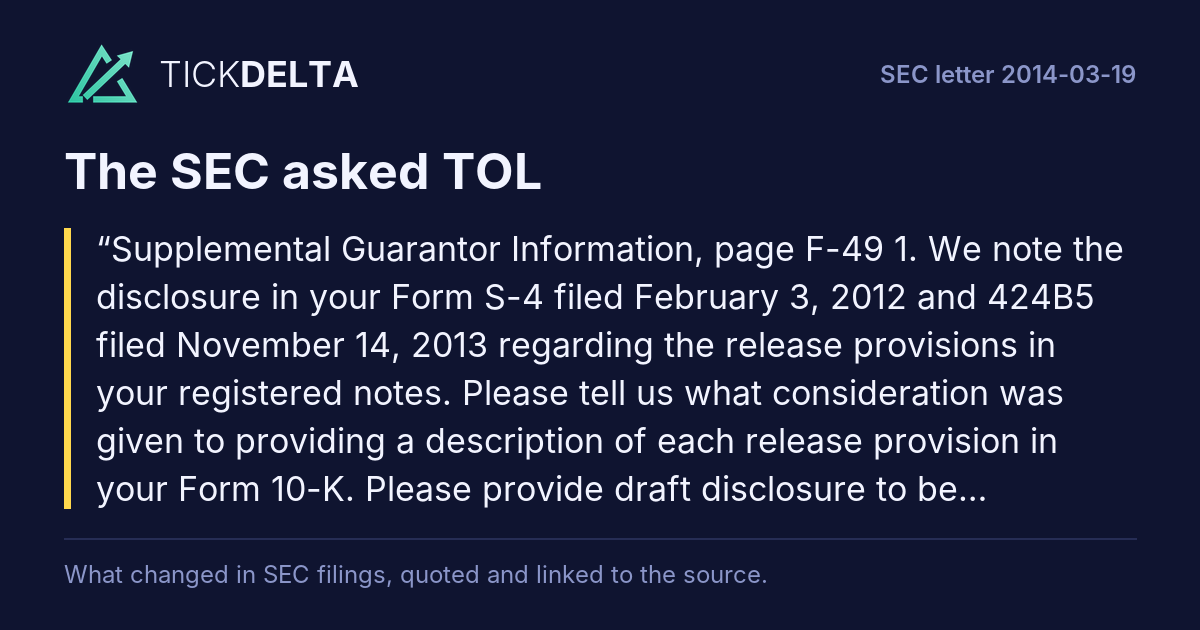
Supplemental Guarantor Information, page F-49 1. We note the disclosure in your Form S-4 filed February 3, 2012 and 424B5 filed November 14, 2013 regarding the release provisions in your registered notes. Please tell us what consideration was given to providing a description of each release provision in your Form 10-K.
Rest of the question

Please provide draft disclosure to be included in future filings that describes the nature of the release provisions each time that you disclose the guarantees are full and unconditional Definitive Proxy Statement on Schedule 14A Executive Compensation, page 30 Compensation Discussion and Analysis, page 30 Fiscal 2013 Bonus Performance Goals, page 38 2. We note your disclosure that the percentage of the maximum amount potentially available for each of the NEOs in 2013 was determined based on the achievement of specified levels of consolidated revenue and operating income performance goals. We also note your disclosure that “[i]n determining the actual amounts to be paid, the Compensation Committee then made a subjective evaluation regarding the overall individual performance of each of the NEOs and Company performance during fiscal 2013.” Based on your disclosure, it is unclear how the compensation committee used the pre-established performance goals and evaluated individual performance to determine the actual amount that was paid to the NEOs in 2013. Please supplementally explain how each of the annual incentive bonuses for fiscal 2013 were determined for each named executive officer and include similar disclosure in future filings. Please also clearly state if the compensation committee established any individual performance goals for the NEOs.

TOL answered
A description of each release provision had been included in the Form S-4 and 424B5 referenced above given its greater significance to potential purchasers of notes but, in response to the comment and so as to be fully responsive to the position outlined in Section 2510.5 of the Financial Reporting Manual issued by the Commission’s Division of Corporation Finance, in future Form 10-K and Form 10-Q filings the Company proposes to include the disclosure set forth below in the note to its financial statements relating to Supplemental Guarantor Information.

Proposed Future Disclosure

[Existing
Rest of the answer

Disclosure:] The obligations of the Subsidiary Issuer to pay principal, premiums, if any, and interest are guaranteed jointly and severally on a senior basis by the Company and substantially all of the Company’s 100% owned home building subsidiaries (the "Guarantor Subsidiaries"). The guarantees are full and unconditional. The Company’s non-home building subsidiaries and several of its home building subsidiaries (together, the "Non-Guarantor Subsidiaries") do not guarantee the debt. The Subsidiary Issuer generates no operating revenues and does not have any independent operations other than the financing of other subsidiaries of the Company by lending the proceeds from the above described debt issuances. [Additional New Disclosure:] The indentures under which the senior notes were issued provide that any subsidiary of the Company that provides a guarantee of the Credit Facility will guarantee the senior notes. The indentures further provide that any Guarantor Subsidiary may be released from its guarantee so long as (1) no default or event of default exists or would result from release of such guarantee, (2) the Guarantor Subsidiary being released has consolidated net worth of less than 5% of the Company’s consolidated net worth as of the end of the Company’s most recent fiscal quarter, (3) the Guarantor Subsidiaries released from their guarantees in any fiscal year comprise in the aggregate less than 10% (or 15% if and to the extent necessary to permit the cure of a default) of the Company’s consolidated net worth as of the end of the Company’s most recent fiscal quarter, (4) such release would not have a material adverse effect on the home building business of the Company and its subsidiaries, and (5) the Guarantor Subsidiary is released from its guaranty under the Credit Facility. If there are no guarantors under the Credit Facility, all Guarantor Subsidiaries under the indentures will be released from their guarantees.

Definitive Proxy Statement on Schedule 14A

Executive Compensation, page 30

Compensation Discussion and Analysis, page 30

Fiscal 2013 Bonus Performance Goals, page 38

2. We note your disclosure that the percentage of the maximum amount potentially available for each of the NEOs in 2013 was determined based on the achievement of specified levels of consolidated revenue and operating income performance goals. We also note your disclosure that "[i]n determining the actual amounts to be paid, the Compensation Committee then made a subjective evaluation regarding the overall individual performance of each of the NEOs and Company performance during fiscal 2013." Based on your disclosure, it is unclear how the compensation committee used the pre-established performance goals and evaluated individual performance to determine the actual amount that was paid to the NEOs in 2013. Please supplementally explain how each of the annual incentive bonuses for fiscal 2013 were determined for each named executive officer and include similar disclosure in future filings. Please also clearly state if the compensation committee established any individual performance goals for the NEOs.

Response: The Executive Compensation Committee ("Committee") determined in January 2013 that eligibility for up to the maximum amount available under the Senior Officer Bonus Plan for fiscal 2013 would be conditioned upon our achievement of consolidated revenues of at least $2.15 billion and operating income of at least $142.25 million. In recent years and for fiscal 2013 performance, the Committee has awarded annual incentive bonuses that were well below the maximum amounts allowable under the Senior Officer Bonus Plan. For a further discussion of this process, see "Fiscal 2013 Bonus Performance Goals" on page 38 of our 2014 proxy statement.

In exercising its discretion to set the actual cash incentive bonus amount to be paid to each NEO, the Committee considered that fiscal 2013 revenues of $2.67 billion and operating income of $206.74 million exceeded the threshold measures set forth above and significantly exceeded 2012 results. The Committee further considered actual results compared to performance metrics for operating income, home building margin, and units delivered, which were established by the Committee at the beginning of the fiscal year for the 2013 performance-based RSUs. The Committee reviewed fiscal 2013 results in each of these areas on an absolute basis and relative to the prior fiscal year and considered that operating income of $206.74 million exceeded the target of $177.85 million, home building margin of 24.60% exceeded the target of 24.00%, and units delivered of 4,184 exceeded the target of 4,000 units, and that 2013 performance exceeded 2012 results in all three areas. For a further discussion of these performance metrics and actual results, see "2013 Performance-Based RSUs" on page 41 of our 2014 proxy statement.

In its evaluation of individual performance, the Committee considered each NEO’s contribution to the financial and other business achievements highlighted above, as well as the Company’s fiscal 2013 results in the areas of contracts, backlog, and selling, general and administrative expenses (SG&A). The Committee further considered each NEO’s contribution to the Company’s $1.60 billion acquisition of Shapell Homes of California (and related acquisition financing), which will significantly expand our California presence. Additionally, the Committee recognized the NEOs’ efforts in management of growth in a recovering economy, diversification of revenue, and honors received. The Committee also considered the leadership of each NEO in the areas of Company strategy, brand management, and balance sheet management. For further discussion of these considerations, see "2013 Company Performance" on pages 30 to 32 of our 2014 proxy statement and "Review Individual Performance" on page 35 of our 2014 proxy statement. The Committee did not establish any individual performance goals for the NEOs at the commencement of fiscal 2013. In future filings, we will provide disclosure similar to the above.

* * *

We are grateful for your assistance in this matter. Please do not hesitate to call me at (215) 938-8045 with any questions or further comments you may have regarding this letter or if you wish to discuss our responses to the Comment Letter.

Yours truly,

Read in the reply

Also in this review: closing letter, 2014-04-08

From the SEC's correspondence on EDGAR: staff letters (form UPLOAD) and company letters (form CORRESP), 11 letters filed since 2014-03-19. Questions and answers are matched by their numbers; topics come from words in each question. The reports are compared word for word (same form, before the first SEC letter against the first report after the company's reply). No AI.

Sources

The SEC's correspondence on EDGAR: staff letters (form UPLOAD) and company letters (form CORRESP), matched question by question. No AI.

Also

Filings: the letters in the filing list.

Work with it

Excel workbook · CSV. Google Sheet that stays up to date: paste =IMPORTDATA("https://tickdelta.com/company/TOL/export.csv") into a cell.

Next in Owners and insiders:Insider trades
Esc

Type a ticker such as AAPL, a name, an investor such as Buffett, or a topic such as tariffs. ↑ ↓ to move, Enter to open.