Paragraph 79 · 42% changed
Every version of it
Screener
/
SEC EDGAR
/CIK 0001650164
/10-K filed Feb 18, 2026, compared with Feb 26, 2025
/Numbers from the XBRL of the 10-Ks
NYSE
Technology · Data Processing
Toast, Inc. TOST
The 10-K against last year's
74 changes: 8 added, 9 removed, 55 reworded, 2 quiet changes
10-K Feb 18, 2026 vs Feb 26, 2025
Risk Factors
3.5%
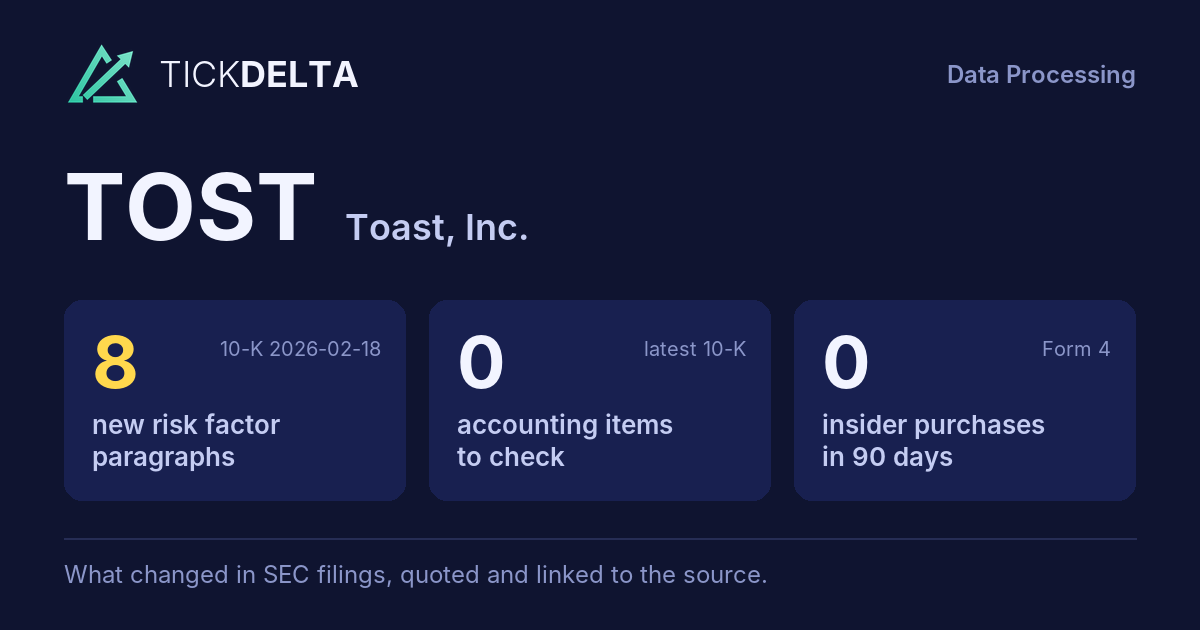
of the text changed · 30,063 words now · 8 new paragraphs, 3 gone
MD&A
10.8%
of the text changed · 5,226 words now · 0 new paragraphs, 6 gone
Legal Proceedings
0.0%
of the text changed · 154 words now
Accounting Policies
7.6%
of the text changed · 5,427 words now
10-K 0001650164-26-000057 (Feb 18, 2026) vs 10-K 0001650164-25-000072 (Feb 26, 2025)
Every paragraph, and how much of it changed
One bar per paragraph, in the order of the 10-K. Height and colour show the share of its words not in the closest paragraph a year earlier; the tallest bars are new paragraphs.
Risk Factors
282 paragraphs · 8 new · 52 reworded · 3 gone · 10-K Feb 18, 2026 against Feb 26, 2025
New paragraph
Reworded (5% of its words or more)
Same or nearly
Paragraph 45 · 37% changed
Every version of it
Paragraph 44 · 33% changed
Every version of it
Paragraph 77 · 27% changed
Every version of it
Paragraph 258 · 25% changed
Every version of it
Any common stock that we issue under our existing equity incentive plans or other equity incentive plans that we may adopt in the future would dilute the percentage ownership held by our other equity holders. We have, and may in the future, issue securities in connection with investments, acquisitions, or capital raising activities. In particular, the number of shares of our Class A common stock issued in connection with an investment or acquisition, or to raise additional equity capital, could constitute a material portion of our then-outstanding shares of our Class A common stock. Any such issuance of additional securities in the future may result in additional dilution to you or may adversely impact the price of our Class A common stock. While our board of directors have approved a shareholder repurchase program, which is intended to enhance long-term stockholder value, there is no assurance this program would do so because the market price of our Class A common stock may decline below the levels at which we repurchase shares and short-term stock price fluctuations could reduce the effectiveness of our repurchase programs. Furthermore, there is no guarantee that our stock repurchases in the past or in the future will be able to successfully mitigate our equity dilution.
Paragraph 220 · 24% changed
Every version of it
Additionally, we have registered, among other trademarks, the name “Toast” in the United States and other jurisdictions. As we expand internationally, we will apply for trademark protection for our name and certain product and service marks in foreign jurisdictions. However, trademark applications may not be approved in all jurisdictions, and in some countries, existing third-party rights or local laws may prevent us from registering or enforcing our marks. If we are unable to obtain trademark protection for our name or other key marks in foreign markets, or if our trademark rights are successfully challenged, we may be required to rebrand our products or services in those jurisdictions, which could result in significant costs, loss of brand recognition, and adverse effects on our business and operating results. Competitors have and may continue to adopt service names similar to ours, thereby harming our ability to build brand identity and possibly leading to user confusion. There could also be potential trade name or trademark infringement claims brought by owners of other trademarks that are similar to our trademarks. Litigation or proceedings before the U.S. Patent and Trademark Office or other governmental authorities and administrative bodies in the United States and abroad may be necessary in the future to enforce our intellectual property rights and to determine the validity and scope of the proprietary rights of others. Further, we may not timely or successfully register our trademarks or otherwise secure our intellectual property.
Paragraph 163 · 18% changed
Every version of it
We also rely on certain suppliers located internationally as part of our supply chain, and the supply risks described above may similarly apply to or be more pronounced in respect of those international suppliers. For example, we have several long-term contracts with companies based in China and other parts of Asia. Issues and claims relating to these contracts and business arrangements may require us to bring a claim in China or another a jurisdiction in Asia, which where it may be difficult and expensive to arbitrate, litigate, enforce, or otherwise resolve. In addition, there is uncertainty as to whether the courts in these international jurisdictions would recognize or enforce judgments of U.S. courts. Any litigation in international jurisdictions, including in China or other parts of Asia, may be protracted and result in substantial costs and diversion of resources and management attention.
Paragraph 150 · 12% changed
Every version of it
Paragraph 79 · 42% changed
Every version of it
10-K Feb 26, 2025Further, given the early stage of generative AI, factors that may impact this type of technology, such as new government regulations and market demand, are uncertain, and we may be unsuccessful in our product development efforts. For example, several US states have introduced or enacted legislation that is designed to govern the development or use of AI. Other states and countries have or are considering applicable legislation, and the EU Artificial Intelligence Act, which aims to introduce a common regulatory and legal framework for EU Member States, came into effect on August 1, 2024. Our ability to use and offer AI and machine learning solutions may be constrained by current or future laws, regulatory or self-regulatory requirements. The rapid evolution of AI, including potential additional government regulation of AI and its various uses, may require significant resources for us to implement compliant and ethical AI practices.
10-K Feb 18, 2026
Likewise, within the United States, the regulatory landscape is rapidly evolving as evidenced by several US states introducing or enacting legislation that is designed to govern the development or use of AI. Our ability to use and offer AI and machine learning solutions may be constrained by current or future laws, regulatory, or self-regulatory requirements. At the federal level, the Trump Administration has endorsed a federal moratorium on the enforcement of state AI laws, including through a December 11, 2025 executive order on “Ensuring a National Policy Framework for Artificial Intelligence.” Federal efforts have thus far have not been successful in curtailing state action on AI regulation, which has contributed to an increasingly complicated regulatory landscape. The rapid evolution of AI, including potential additional government regulation of AI and its various uses, may require significant resources for us to implement compliant and ethical AI practices. We may also be subject to significant enforcement actions or litigation in the event of any perceived or actual non-compliance.
Paragraph 45 · 37% changed
Every version of it
10-K Feb 26, 2025Under our agreement with our bank partner, on a monthly basis, we are obligated to purchase loans made in a particular quarter that have been (or are scheduled to be) charged off, are otherwise non-performing, or do not satisfy our bank partner’s credit policy, unless such purchase would cause the principal amount of such purchased loans to exceed 15% of the original principal amount of loans made in the applicable quarter. As a result of this potential purchase obligation, and our servicing fee and credit performance fee, we are subject to credit risk on the loans extended by our bank partner under this program. Accordingly, if we fail to accurately predict the likelihood of default or timely repayment of loans, our business may be materially and adversely affected. For example, if more of our customers cease operations, experience a decline in their revenue, or engage in fraudulent behavior and are not able to repay their loans, our business may be materially and adversely affected. A decline in macroeconomic conditions could increase the risk of non-payment or fraud and could also lead to a decrease in the number of customers eligible for loans or financing. In addition, although our bank partner acts as the lender with respect to these working capital loans, we are subject to numerous contractual and regulatory requirements in connection with our marketing and servicing activities in connection with these loans. If we were to fail to comply with these requirements, we could be subject to liability, regulatory sanctions, or claims by our customers or our bank partner, and our bank partner could terminate its relationship with us. We intend to continue to explore additional financial or other solutions to offer to our customers. Some of those solutions may require, or be deemed to require, additional procedures, partnerships, licenses, regulatory approvals and requirements, or capabilities. Should we fail to address these requirements, or should these new solutions, or new regulations or interpretations of existing regulations, impose requirements on us that are impractical or that we cannot satisfy, the future growth and success of our financial business may be materially and adversely affected.
10-K Feb 18, 2026
In addition, although our bank partners perform the regulated financial services for our customers, we are subject to numerous contractual and regulatory requirements in connection with our marketing and servicing activities in connection with these services. If we were to fail to comply with these requirements, we could be subject to liability, regulatory sanctions, or claims by our customers or our bank partners, and our bank partners could terminate their relationship with us. We intend to continue to explore additional financial or other solutions to offer to our customers. Some of those solutions may require, or be deemed to require, additional procedures, partnerships, licenses, regulatory approvals and requirements, or capabilities. Should we fail to address these requirements, or should these new solutions, or new regulations or interpretations of existing regulations, impose requirements on us that are impractical or that we cannot satisfy, the future growth and success of our financial business may be materially and adversely affected.
Paragraph 44 · 33% changed
Every version of it
10-K Feb 26, 2025Under our agreement with our bank partner, on a monthly basis, we are obligated to purchase loans made in a particular quarter that have been (or are scheduled to be) charged off, are otherwise non-performing, or do not satisfy our bank partner’s credit policy, unless such purchase would cause the principal amount of such purchased loans to exceed 15% of the original principal amount of loans made in the applicable quarter. As a result of this potential purchase obligation, and our servicing fee and credit performance fee, we are subject to credit risk on the loans extended by our bank partner under this program. Accordingly, if we fail to accurately predict the likelihood of default or timely repayment of loans, our business may be materially and adversely affected. For example, if more of our customers cease operations, experience a decline in their revenue, or engage in fraudulent behavior and are not able to repay their loans, our business may be materially and adversely affected. A decline in macroeconomic conditions could increase the risk of non-payment or fraud and could also lead to a decrease in the number of customers eligible for loans or financing. In addition, although our bank partner acts as the lender with respect to these working capital loans, we are subject to numerous contractual and regulatory requirements in connection with our marketing and servicing activities in connection with these loans. If we were to fail to comply with these requirements, we could be subject to liability, regulatory sanctions, or claims by our customers or our bank partner, and our bank partner could terminate its relationship with us. We intend to continue to explore additional financial or other solutions to offer to our customers. Some of those solutions may require, or be deemed to require, additional procedures, partnerships, licenses, regulatory approvals and requirements, or capabilities. Should we fail to address these requirements, or should these new solutions, or new regulations or interpretations of existing regulations, impose requirements on us that are impractical or that we cannot satisfy, the future growth and success of our financial business may be materially and adversely affected.
10-K Feb 18, 2026
Our agreement with our bank partner that originates loans requires us to, on a monthly basis, purchase loans made in a particular quarter that have been (or are scheduled to be) charged off, are otherwise non-performing, or do not satisfy our bank partner’s credit policy, unless such purchase would cause the principal amount of such purchased loans to exceed 15% of the original principal amount of loans made in the applicable quarter. As a result of our purchase obligations under this agreement, our servicing fees and credit performance fees, and any performing loans that we may otherwise elect to purchase from our bank partner on a forward flow basis, we are subject to credit risk on the loans extended by our bank partner under this program and potential loss of fees that we earn on loans in repayment. Accordingly, if our models fail to accurately predict the likelihood of default or timely repayment of loans, our business may be materially and adversely affected. For example, if our customers undergo labor disruption or shortage, experience revenue decline, engage in fraudulent behaviors, cease operations, or otherwise fail to repay their loans, our business may be materially and adversely affected. Macroeconomic declines could also increase the risk of non-payment or fraud and lead to a decrease in the number of customers eligible for loans or financing.
Paragraph 77 · 27% changed
Every version of it
10-K Feb 26, 2025We utilize artificial intelligence, or AI, solutions both for internal productivity purposes and in products and services available to our customers. We also work with partners who have incorporated or may incorporate AI solutions in their products and services. As with many innovations, AI presents risks and challenges that could affect its further development, adoption, and utilization, and therefore affect our business. For example, if the content, recommendation or analyses that AI applications assist in producing, or their training data are or are alleged to be deficient or inaccurate, we could be subject to competitive risks, potential legal liability, and reputational harm. Furthermore, the integration of third-party AI models, including Large Language Models, within our products and services may rely, in part, on certain safeguards implemented by the third-party developers of the underlying AI models, including those related to the accuracy, bias, and other variables of the data, and these safeguards may be insufficient. The use of AI applications may also result in cybersecurity incidents, which could adversely affect our business. In addition, AI may present evolving ethical issues. If our use of AI becomes controversial, we may experience reputational harm or legal liability.
10-K Feb 18, 2026
that AI applications assist in producing, are or are alleged to be deficient or inaccurate, or if the data used to train these applications are or are alleged to be deficient or inaccurate or legally impermissible to train on, we could be subject to competitive risks, potential legal liability, and reputational harm. Furthermore, the integration of third-party AI models, including Large Language Models, within our products and services may rely, in part, on certain safeguards implemented by the third-party developers of the underlying AI models, including those related to the accuracy, bias, and other variables of the data, and these safeguards may be insufficient. In addition, AI may present evolving ethical issues. If our use of AI becomes controversial, we may experience reputational harm or legal liability.
Paragraph 258 · 25% changed
Every version of it
10-K Feb 26, 2025
Any common stock that we issue under our existing equity incentive plans or other equity incentive plans that we may adopt in the future would dilute the percentage ownership held by our other equity holders. We have, and may in the future, issue securities in connection with investments, acquisitions, or capital raising activities. In particular, the number of shares of our Class A common stock issued in connection with an investment or acquisition, or to raise additional equity capital, could constitute a material portion of our then-outstanding shares of our Class A common stock. Any such issuance of additional securities in the future may result in additional dilution to you or may adversely impact the price of our Class A common stock.
10-K Feb 18, 2026
Any common stock that we issue under our existing equity incentive plans or other equity incentive plans that we may adopt in the future would dilute the percentage ownership held by our other equity holders. We have, and may in the future, issue securities in connection with investments, acquisitions, or capital raising activities. In particular, the number of shares of our Class A common stock issued in connection with an investment or acquisition, or to raise additional equity capital, could constitute a material portion of our then-outstanding shares of our Class A common stock. Any such issuance of additional securities in the future may result in additional dilution to you or may adversely impact the price of our Class A common stock. While our board of directors have approved a shareholder repurchase program, which is intended to enhance long-term stockholder value, there is no assurance this program would do so because the market price of our Class A common stock may decline below the levels at which we repurchase shares and short-term stock price fluctuations could reduce the effectiveness of our repurchase programs. Furthermore, there is no guarantee that our stock repurchases in the past or in the future will be able to successfully mitigate our equity dilution.
Paragraph 220 · 24% changed
Every version of it
10-K Feb 26, 2025
Additionally, we have registered, among other trademarks, the name “Toast” in the United States and other jurisdictions. Competitors have and may continue to adopt service names similar to ours, thereby harming our ability to build brand identity and possibly leading to user confusion. There could also be potential trade name or trademark infringement claims brought by owners of other trademarks that are similar to our trademarks. Litigation or proceedings before the U.S. Patent and Trademark Office or other governmental authorities and administrative bodies in the United States and abroad may be necessary in the future to enforce our intellectual property rights and to determine the validity and scope of the proprietary rights of others. Further, we may not timely or successfully register our trademarks or otherwise secure our intellectual property.
10-K Feb 18, 2026
Additionally, we have registered, among other trademarks, the name “Toast” in the United States and other jurisdictions. As we expand internationally, we will apply for trademark protection for our name and certain product and service marks in foreign jurisdictions. However, trademark applications may not be approved in all jurisdictions, and in some countries, existing third-party rights or local laws may prevent us from registering or enforcing our marks. If we are unable to obtain trademark protection for our name or other key marks in foreign markets, or if our trademark rights are successfully challenged, we may be required to rebrand our products or services in those jurisdictions, which could result in significant costs, loss of brand recognition, and adverse effects on our business and operating results. Competitors have and may continue to adopt service names similar to ours, thereby harming our ability to build brand identity and possibly leading to user confusion. There could also be potential trade name or trademark infringement claims brought by owners of other trademarks that are similar to our trademarks. Litigation or proceedings before the U.S. Patent and Trademark Office or other governmental authorities and administrative bodies in the United States and abroad may be necessary in the future to enforce our intellectual property rights and to determine the validity and scope of the proprietary rights of others. Further, we may not timely or successfully register our trademarks or otherwise secure our intellectual property.
Paragraph 163 · 18% changed
Every version of it
10-K Feb 26, 2025
We also rely on certain suppliers located internationally as part of our supply chain, and the supply risks described above may similarly apply to or be more pronounced in respect of those international suppliers. For example, we have several long-term contracts with companies based in China and other parts of Asia. Issues and claims relating to these contracts and business arrangements may require us to bring a claim in China or another jurisdiction in Asia, which may be difficult and expensive to arbitrate, litigate, enforce, or otherwise resolve. In addition, there is uncertainty as to whether the courts in these international jurisdictions would recognize or enforce judgments of U.S. courts. Any litigation in international jurisdictions, including in China or other parts of Asia, may be protracted and result in substantial costs and diversion of resources and management attention.
10-K Feb 18, 2026
We also rely on certain suppliers located internationally as part of our supply chain, and the supply risks described above may similarly apply to or be more pronounced in respect of those international suppliers. For example, we have several long-term contracts with companies based in Asia. Issues and claims relating to these contracts and business arrangements may require us to bring a claim in a jurisdiction where it may be difficult and expensive to arbitrate, litigate, enforce, or otherwise resolve. In addition, there is uncertainty as to
Paragraph 150 · 12% changed
Every version of it
10-K Feb 26, 2025Additionally, we periodically conduct audits and self-assessments to verify our compliance with Nacha Rules. If an audit or self-assessment under Nacha Rules identifies any deficiencies that we need to remediate, the remediation efforts may distract our management team and other staff and be expensive and time consuming. Nacha may update its operating rules and guidelines at any time, which could require us to take more costly compliance measures or to develop more complex monitoring systems. Our partner financial institutions could also change their interpretation of Nacha requirements, similarly requiring costly remediation efforts and potentially preventing us from continuing to provide services through such partner financial institutions until we have remediated such issues to their satisfaction.
10-K Feb 18, 2026
the remediation efforts may distract our management team and other staff and be expensive and time consuming. Nacha may update its operating rules and guidelines at any time, which could require us to take more costly compliance measures or to develop more complex monitoring systems. Our partner financial institutions could also change their interpretation of Nacha requirements, similarly requiring costly remediation efforts and potentially preventing us from continuing to provide services through such partner financial institutions until we have remediated such issues to their satisfaction.
MD&A
89 paragraphs · 0 new · 30 reworded · 6 gone · 10-K Feb 18, 2026 against Feb 26, 2025
New paragraph
Reworded (5% of its words or more)
Same or nearly
Paragraph 78 · 50% changed
Paragraph 44 · 45% changed
The gain recognized decrease in other income, net, for restructuring expenses during the fiscal year ended December 31, 2025 was driven by significant restructuring and restructuring-related expenses incurred during fiscal year ended December 31, 2024 was primarily attributable as part of the February 2024 Restructuring Plan. See Note 11, “Restructuring Plan” of the Notes to the Warrant Repurchase. See Note 3 to our consolidated financial statements Consolidated Financial Statements for further information.
Paragraph 50 · 32% changed
The gain recognized in other income, net, for the fiscal year ended December 31, 2024 was primarily attributable to the one-time extinguishment gain of the warrant liabilities in connection with the Warrant Repurchase. See Note 3 to our consolidated financial statements for further information. Repurchase in July 2024.
Paragraph 42 · 32% changed
The increase in sales general and marketing administrative expenses during the fiscal year ended December 31, 2024 2025 was primarily attributable to driven by an increase in employee-related costs. bad debt expense.
Paragraph 88 · 30% changed
Our contracts often include promises to transfer multiple products and services to a customer. Determining whether products and services are considered distinct performance obligations that should be accounted for separately as opposed to being combined may require judgment. We allocate total arrangement consideration at the inception of an arrangement to each performance obligation using the relative selling price allocation method based on each distinct performance obligation’s standalone selling price, or SSP. Determining the SSP for each distinct performance obligation requires judgement.
Paragraph 71 · 28% changed
The net increase in cash, cash equivalents and marketable securities was primarily due to increases from cash provided by operating activities from the fiscal year ended December 31, 2024 2025 compared to the previous year. During the fiscal year ended December 31, 2024, 2025, the increase in net cash provided by operating activities as compared to the fiscal year ended December 31, 2023, 2024, was primarily driven by net income of $19 $342 million during the fiscal year ended December 31, 2024 2025 as compared to a net loss income of $246 $19 million during the same period last year, an increase in non-cash adjustments, primarily attributable to the fair value remeasurement of our warrant liability and increased amortization of deferred contract acquisition costs. year. This increase was partially offset by cash severance charges paid in connection with the Restructuring Plan and a higher use of cash for working capital primarily driven by higher deferred contract acquisition costs and increases of accounts receivable, net, resulting, in part, from continued growth in Locations, partially offset by higher accrued expenses and other current liabilities due to higher financial technology solutions expenses related to our growth in GPV. the timing of payments.
Paragraph 35 · 27% changed
The decrease increase in general and administrative expenses subscription services costs during the fiscal year ended December 31, 2024 2025 was primarily driven by a decrease $22 million increase in amortization of capitalized software and a $15 million increase in employee-related costs of $30 million and a decrease in lease termination expenses of $9 million. costs.
Paragraph 38 · 22% changed
The decrease increase in general sales and administrative marketing expenses during the fiscal year ended December 31, 2024 2025 was primarily driven by a decrease $64 million increase in employee-related costs of $30 million and a decrease $24 million increase in lease termination expenses of $9 million. marketing expenses.
Paragraph 78 · 50% changed
10-K Feb 26, 2025Restructuring expenses included restructuring actions to adjust our cost structure and real estate footprint in 2024. See Note 12 to our consolidated financial statements for further information.
10-K Feb 18, 2026
For further information see Note 3, “Financial Instruments", Note 8, “Common Stock", and Note 9, “Stock-Based Compensation" of the Notes to the Consolidated Financial Statements for further information.
Paragraph 44 · 45% changed
10-K Feb 26, 2025
The gain recognized in other income, net, for the fiscal year ended December 31, 2024 was primarily attributable to the Warrant Repurchase. See Note 3 to our consolidated financial statements for further information.
10-K Feb 18, 2026
The decrease in restructuring expenses during the fiscal year ended December 31, 2025 was driven by significant restructuring and restructuring-related expenses incurred during fiscal year ended December 31, 2024 as part of the February 2024 Restructuring Plan. See Note 11, “Restructuring Plan” of the Notes to the Consolidated Financial Statements for further information.
Paragraph 50 · 32% changed
10-K Feb 26, 2025
The gain recognized in other income, net, for the fiscal year ended December 31, 2024 was primarily attributable to the Warrant Repurchase. See Note 3 to our consolidated financial statements for further information.
10-K Feb 18, 2026
The gain recognized in other income, net, for the fiscal year ended December 31, 2024 was primarily attributable to the one-time extinguishment gain of the warrant liabilities in connection with the Warrant Repurchase in July 2024.
Paragraph 42 · 32% changed
10-K Feb 26, 2025
The increase in sales and marketing expenses during the fiscal year ended December 31, 2024 was primarily attributable to an increase in employee-related costs.
10-K Feb 18, 2026
The increase in general and administrative expenses during the fiscal year ended December 31, 2025 was primarily driven by an increase in bad debt expense.
Paragraph 88 · 30% changed
10-K Feb 26, 2025
Our contracts often include promises to transfer multiple products and services to a customer. Determining whether products and services are considered distinct performance obligations that should be accounted for separately as opposed to being combined may require judgment. We allocate total arrangement consideration at the inception of an arrangement to each performance obligation using the relative selling price allocation method based on each distinct performance obligation’s standalone selling price, or SSP. Determining the SSP for each distinct performance obligation requires judgement.
10-K Feb 18, 2026
Our contracts often include promises to transfer multiple products and services to a customer. Determining whether products and services are considered distinct performance obligations that should be accounted for separately as opposed to being combined may require judgment.
Paragraph 71 · 28% changed
10-K Feb 26, 2025
The net increase in cash, cash equivalents and marketable securities was primarily due to increases from cash provided by operating activities from the fiscal year ended December 31, 2024 compared to the previous year. During the fiscal year ended December 31, 2024, the increase in net cash provided by operating activities as compared to the fiscal year ended December 31, 2023, was driven by net income of $19 million during the fiscal year ended December 31, 2024 as compared to a net loss of $246 million during the same period last year, an increase in non-cash adjustments, primarily attributable to the fair value remeasurement of our warrant liability and increased amortization of deferred contract acquisition costs. This increase was partially offset by cash severance charges paid in connection with the Restructuring Plan and a higher use of cash for working capital primarily driven by higher deferred contract acquisition costs and increases of accounts receivable, net, resulting, in part, from continued growth in Locations, partially offset by higher accrued expenses and other current liabilities due to higher financial technology solutions expenses related to our growth in GPV.
10-K Feb 18, 2026
The net increase in cash, cash equivalents and marketable securities was primarily due to increases from cash provided by operating activities from the fiscal year ended December 31, 2025 compared to the previous year. During the fiscal year ended December 31, 2025, the increase in net cash provided by operating activities as compared to the fiscal year ended December 31, 2024, was primarily driven by net income of $342 million during the fiscal year ended December 31, 2025 as compared to a net income of $19 million during the same period last year. This increase was partially offset by a higher use of cash for working capital primarily driven by increases in accrued expenses and other current liabilities due to the timing of payments.
Paragraph 35 · 27% changed
10-K Feb 26, 2025
The decrease in general and administrative expenses during the fiscal year ended December 31, 2024 was primarily driven by a decrease in employee-related costs of $30 million and a decrease in lease termination expenses of $9 million.
10-K Feb 18, 2026
The increase in subscription services costs during the fiscal year ended December 31, 2025 was primarily driven by a $22 million increase in amortization of capitalized software and a $15 million increase in employee-related costs.
Paragraph 38 · 22% changed
10-K Feb 26, 2025
The decrease in general and administrative expenses during the fiscal year ended December 31, 2024 was primarily driven by a decrease in employee-related costs of $30 million and a decrease in lease termination expenses of $9 million.
10-K Feb 18, 2026
The increase in sales and marketing expenses during the fiscal year ended December 31, 2025 was primarily driven by a $64 million increase in employee-related costs and a $24 million increase in marketing expenses.
A paragraph is matched with the one last year that shares the most of its words; under half in common makes it new. The paragraphs shown are the 8 reworded the most in each section.
The paragraph that changed most in each section
The redline
Marked against last year's 10-K: cut words struck through, new words highlighted.
Risk Factors259 words changed in this paragraph; it is 55% similar to last year's version.
Source: Item 1A, 10-K 0001650164-26-000057 vs Item 1A, 10-K 0001650164-25-000072
Accounting Policies91 words changed in this paragraph; it is 64% similar to last year's version.
Determining whether products and services are considered distinct performance obligations that should be accounted for separately as opposed to being combined requires judgment. We allocate total arrangement consideration at the inception of an arrangement to each performance obligation using the relative selling price allocation method based on each distinct performance obligation’s standalone selling price, or SSP. Judgment is required to determine the SSP for each distinct performance obligation. We determine SSP for hardware and professional services revenue using an adjusted market assessment approach which analyzes discounts provided to similar customers based on customer category, sales channel, and size. SSP for subscription services revenue is also established using the adjusted market approach considering relevant information, such as current and new customer pricing, renewal pricing, competitor information, market trends and market share for similar services. SSP for financial technology solutions revenue is determined using our own standalone sales data. We allocate variable fees earned from financial technology services revenue to those distinct performance obligations where pricing practices are consistent with the allocation objective.
Source: Item 8, Note 2 – Summary of Significant Accounting Policies, 10-K 0001650164-26-000057 vs Item 8, Note 2 – Summary of Significant Accounting Policies, 10-K 0001650164-25-000072
MD&A76 words changed in this paragraph; it is 76% similar to last year's version.
The net increase in cash, cash equivalents and marketable securities was primarily due to increases from cash provided by operating activities from the fiscal year ended December 31, 2024 2025 compared to the previous year. During the fiscal year ended December 31, 2024, 2025, the increase in net cash provided by operating activities as compared to the fiscal year ended December 31, 2023, 2024, was primarily driven by net income of $19 $342 million during the fiscal year ended December 31, 2024 2025 as compared to a net loss income of $246 $19 million during the same period last year, an increase in non-cash adjustments, primarily attributable to the fair value remeasurement of our warrant liability and increased amortization of deferred contract acquisition costs. year. This increase was partially offset by cash severance charges paid in connection with the Restructuring Plan and a higher use of cash for working capital primarily driven by higher deferred contract acquisition costs and increases of accounts receivable, net, resulting, in part, from continued growth in Locations, partially offset by higher accrued expenses and other current liabilities due to higher financial technology solutions expenses related to our growth in GPV. the timing of payments.
Source: Item 7, 10-K 0001650164-26-000057 vs Item 7, 10-K 0001650164-25-000072
Sentences and paragraphs added, removed or reworded
Every change, by type
Sentences and paragraphs of TOST's Risk Factors and MD&A, 10-K Feb 18, 2026 against 10-K Feb 26, 2025. Each links to the text at sec.gov.
Quiet changes are sentences kept from last year with one to four words changed, at least one of them a hedge, a modal or a qualifier (may, could, will, not, significant, material…). A year or date rolling forward is not counted.
The full word list
adverse, adversely, all, although, anticipate, anticipates, any, approximately, believe, believes, can, cannot, certain, could, expect, expects, generally, however, if, intend, intends, largely, likely, many, material, materially, may, might, most, must, never, no, not, possible, primarily, probable, should, significant, significantly, some, substantial, substantially, unlikely, will, would
AddedRisk Factors
opportunities, the impact of regulatory requirements, the maturation of our business, and macroeconomic conditions, among others.
Read it in 10-K Feb 18, 2026 at sec.gov
AddedRisk Factors
We use AI in our platform and product offerings, and our success is dependent upon our ability to leverage data, develop competitive products, and manage related risks.
Read it in 10-K Feb 18, 2026 at sec.gov
AddedRisk Factors
We utilize AI solutions both for internal productivity purposes and in products and services available to our customers. We also work with partners who have incorporated or may incorporate AI solutions in their products and services. While AI and machine learning present opportunities for enhanced productivity, AI also introduces cybersecurity, data privacy, IT, intellectual property, regulatory, legal, operational, competitive, reputational and other risks that could adversely impact our business. For example, if the content, recommendations or analyses
Read it in 10-K Feb 18, 2026 at sec.gov
AddedRisk Factors
Further, given the early stage of generative AI, the evolving regulatory landscape surrounding AI also poses a risk, as new laws and regulations could impose additional compliance burdens, resulting in increased operational costs to comply with U.S. and non-US laws concerning the use of AI. For example, the EU’s Artificial Intelligence Act, or AI Act, originally entered into force on August 1, 2024, and is expected to undergo amendments as introduced in the EU’s November 2025 Digital Omnibus. As enacted, the AI Act imposes significant obligations on providers and deployers of high-risk AI systems and encourages providers and deployers of AI systems to account for EU ethical principles in their development and use of these systems.
Read it in 10-K Feb 18, 2026 at sec.gov
AddedRisk Factors
Additionally, we periodically conduct audits and self-assessments to verify our compliance with Nacha Rules. If an audit or self-assessment under Nacha Rules identifies any deficiencies that we need to remediate,
Read it in 10-K Feb 18, 2026 at sec.gov
AddedRisk Factors
for their guests, order volume may decline, which we expect would adversely affect our financial condition and results of operations.
Read it in 10-K Feb 18, 2026 at sec.gov
AddedRisk Factors
whether the courts in these international jurisdictions would recognize or enforce judgments of U.S. courts. Any litigation in international jurisdictions may be protracted and result in substantial costs and diversion of resources and management attention.
Read it in 10-K Feb 18, 2026 at sec.gov
AddedRisk Factors
Toast and certain of its subsidiaries offer access to certain other financial technology products and services that are provided to our customers by bank partners. Our contracts with these bank partners, and our role in providing these services, requires us to comply with state and federal laws and regulations as well.
Read it in 10-K Feb 18, 2026 at sec.gov
Show the other 35
RemovedRisk Factors
RemovedRisk Factors
RemovedRisk Factors
RewordedRisk Factors
As a result of our purchase obligations under this potential purchase obligation, and agreement, our servicing fee fees and credit performance fee, fees, and any performing loans that we may otherwise elect to purchase from our bank partner on a forward flow basis, we are subject to credit risk on the loans extended by our bank partner under this program. program and potential loss of fees that we earn on loans in repayment.
Read it in 10-K Feb 18, 2026 at sec.gov
RewordedRisk Factors
For example, if more of our customers cease operations, undergo labor disruption or shortage, experience a decline in their revenue, or revenue decline, engage in fraudulent behavior and are not able behaviors, cease operations, or otherwise fail to repay their loans, our business may be materially and adversely affected.
Read it in 10-K Feb 18, 2026 at sec.gov
RewordedRisk Factors
In addition, although our bank partner acts as partners perform the lender with respect to these working capital loans, regulated financial services for our customers, we are subject to numerous contractual and regulatory requirements in connection with our marketing and servicing activities in connection with these loans. services.
Read it in 10-K Feb 18, 2026 at sec.gov
RewordedRisk Factors
RewordedRisk Factors
Additionally, if customers try to pass along increased operating costs by raising prices for their guests, order volume may decline, which we expect would adversely affect our financial condition and results of operations.
Read it in 10-K Feb 18, 2026 at sec.gov
RewordedRisk Factors
We may experience declines in our revenue growth rate as a result of a number of factors, including slowing demand for our platform, insufficient growth in the number of customers and their guests that utilize our platform, increasing competition, changing customer and guest behaviors, a decrease in the growth of our overall market, our failure to continue to capitalize on growth opportunities, the impact of regulatory requirements, the maturation of our business, and macroeconomic conditions, among others.
Read it in 10-K Feb 18, 2026 at sec.gov
RewordedRisk Factors
New laws and regulations relating to ESG matters, including climate change, human capital, and diversity, such as the European Union’s Corporate Sustainability Reporting Directive and its Corporate Sustainability Due Diligence Directive, have been implemented, or are being developed and formalized in the U.S. and elsewhere.
Read it in 10-K Feb 18, 2026 at sec.gov
RewordedRisk Factors
RewordedRisk Factors
As we continue to expand our business by selling subscriptions to our platform in retail and international markets and in other verticals such as in the retail market, future, we will also face competition from incumbents in these markets.
Read it in 10-K Feb 18, 2026 at sec.gov
RewordedRisk Factors
RewordedRisk Factors
If our bank partner were to terminate its relationship with us, we it would be unable difficult for us to make continue making working capital loans available to our customers, customers without disruption, at least in the short-term, until we are able to enter into a relationship with another financial institution to offer similar loans.
Read it in 10-K Feb 18, 2026 at sec.gov
RewordedRisk Factors
Quiet changesRisk Factors
Our business is primarily subscription-based, and contract terms for our SaaS products generally range from 12 to 36 months.
Read it in 10-K Feb 18, 2026 at sec.gov
Quiet changesRisk Factors
Further, because data security is a critical competitive factor in our industry, we may make statements in our privacy statements and notices and in our marketing materials describing the privacy and security of our platform, including but not limited to descriptions of certain security measures we employ or such features embedded within our products.
Read it in 10-K Feb 18, 2026 at sec.gov
RemovedMD&A
RemovedMD&A
RemovedMD&A
RemovedMD&A
RemovedMD&A
RemovedMD&A
RewordedMD&A
This increase was partially offset by cash severance charges paid in connection with the Restructuring Plan and a higher use of cash for working capital primarily driven by higher deferred contract acquisition costs and increases of accounts receivable, net, resulting, in part, from continued growth in Locations, partially offset by higher accrued expenses and other current liabilities due to higher financial technology solutions expenses related to our growth in GPV. the timing of payments.
Read it in 10-K Feb 18, 2026 at sec.gov
RewordedMD&A
The change in fair value of the warrant liability during the fiscal year ended December 31, 2024 2025 was attributable to an increase primarily driven by a decrease in our stock price and a reduction price, as the number of outstanding warrants primarily due to a warrant repurchase of 5 million shares of Class B common stock in July 2024, or remained unchanged during the Warrant Repurchase. period.
Read it in 10-K Feb 18, 2026 at sec.gov
RewordedMD&A
During the fiscal year ended December 31, 2024, 2025, the increase in net cash provided by operating activities as compared to the fiscal year ended December 31, 2023, 2024, was primarily driven by net income of $19 $342 million during the fiscal year ended December 31, 2024 2025 as compared to a net loss income of $246 $19 million during the same period last year, an increase in non-cash adjustments, primarily attributable to the fair value remeasurement of our warrant liability and increased amortization of deferred contract acquisition costs. year.
Read it in 10-K Feb 18, 2026 at sec.gov
RewordedMD&A
Year Ended December 31, (in millions) 2025 2024 2023 Net income (loss) $ 342 $ 19 $ (246) Stock-based compensation expense and related payroll tax 255 256 288 Depreciation and amortization 67 46 32 Interest income, net (51) (42) (37) Gain on warrant extinguishment — (14) — Change in fair value of warrant liability (3) 49 (3) Termination of leases 1 5 14 Stock-based charitable contribution expense 6 5 10 Restructuring and restructuring related expenses(1) 12 46 — Acquisition expenses — 1 Income tax expense 4 3 2 Adjusted EBITDA $ 633 $ 373 $ 61
Read it in 10-K Feb 18, 2026 at sec.gov
RewordedMD&A
Year Ended December 31, Change (dollars in millions) 2025 2024 2023 Amount % Subscription services $ 936 $ 706 $ 500 $ 206 41% 230 33% Financial technology solutions 5,037 4,053 3,189 864 27% 984 24% Hardware and professional services 180 201 176 25 14% (21) (10)% Total revenue $ 6,153 $ 4,960 $ 3,865 $ 1,095 28% 1,193 24%
Read it in 10-K Feb 18, 2026 at sec.gov
RewordedMD&A
The change in fair value of the warrant liability during the fiscal prior year ended December 31, 2024 was attributable to an increase in our stock price and balance included a reduction of outstanding warrants primarily due to a warrant repurchase of 5 million shares of Class B common stock in July 2024, or the Warrant Repurchase.
Read it in 10-K Feb 18, 2026 at sec.gov
RewordedMD&A
Year Ended December 31, (in millions) 2025 2024 2023 Net cash provided by operating activities $ 661 $ 360 $ 135 Net cash used in (used in) investing activities (172) (39) (86) Net cash provided by financing activities 7 18 63 Effect of exchange rate changes on cash and cash equivalents and restricted cash 2 (1) — Net increase in cash, cash equivalents equivalents, cash held on behalf of customers and restricted cash $ 498 $ 338 $ 112
Read it in 10-K Feb 18, 2026 at sec.gov
RewordedMD&A
The decrease increase in general sales and administrative marketing expenses during the fiscal year ended December 31, 2024 2025 was primarily driven by a decrease $64 million increase in employee-related costs of $30 million and a decrease $24 million increase in lease termination expenses of $9 million. marketing expenses.
Read it in 10-K Feb 18, 2026 at sec.gov
RewordedMD&A
Such activities are further described within Note 2, "Summary of Significant Accounting Policies" included in this Annual Report on Form 10-K in “Notes and Note 15, "Commitments and Contingencies" of the Notes to the Consolidated Financial Statements. Statements for further information.
Read it in 10-K Feb 18, 2026 at sec.gov
RewordedMD&A
The decrease increase in net cash used in investing activities during the fiscal year ended December 31, 2024, 2025, as compared to the fiscal year ended December 31, 2023, 2024, was primarily driven by net cash inflows outflows from marketable securities as compared to net cash outflows inflows from marketable securities during last year, partially offset by an increase in capital expenditures. year.
Read it in 10-K Feb 18, 2026 at sec.gov
RewordedMD&A
(1) Restructuring and restructuring-related expenses for the fiscal year years ended December 31, 2025 and 2024 include $9 million and $32 million of severance benefits, $3 million and $12 million of stock-based compensation expense, expense and $— million and $2 million of accelerated amortization related to facilities. facilities, respectively.
Read it in 10-K Feb 18, 2026 at sec.gov
RewordedMD&A
The decrease in net cash provided by financing activities during the fiscal year ended December 31, 2024, 2025, as compared to the same period last year, was primarily driven by cash outflows related to the Warrant Repurchase share repurchases and share repurchases, payments of debt issuance costs, partially offset by an increase in cash inflows from the proceeds from the issuance of common stock.
Read it in 10-K Feb 18, 2026 at sec.gov
Sources
The two latest 10-Ks on EDGAR, section by section. Each change links to the text at sec.gov.
Also
New risk factors: paragraphs with nothing like them last year, quoted in full.
Work with it
Excel workbook · CSV. Google Sheet that stays up to date: paste =IMPORTDATA("https://tickdelta.com/company/TOST/export.csv") into a cell.