tickdelta
Sign in

Tickdelta is free for now. Sign up and get Pro free

← Screener

TRGPTarga Resources

Energy · Pipelines · NYSE
Compare with peers → Embed
SEC comment letters, last 20 years

2 reviews of TRGP's filings by SEC staff

UPLOAD and CORRESP
ReviewsRead ↓
2
latest letter 2021-09-23
Questions asked
17
each answered in the company's own letter
No closing letter
0
reviews without a letter saying the staff completed it

When the SEC's staff reviews a filing, it writes to the company with numbered questions, and the company answers each one in a letter. SEC publishes the exchange once the review is over, at least 20 business days later. A question is not an accusation; most reviews end with the company adding detail to its next filing.

Form 10-K

2021-09-23 to 2022-01-03 · 9 questions · 4 letters from the SEC, 5 from the company
Review closed 2022-01-03
Non-GAAP measuresResults discussion (MD&A)SegmentsLiquidity and cashRevenue
Non-GAAP Measures · Our Non-GAAP Financial Measures, page 64
SEC asked (1)
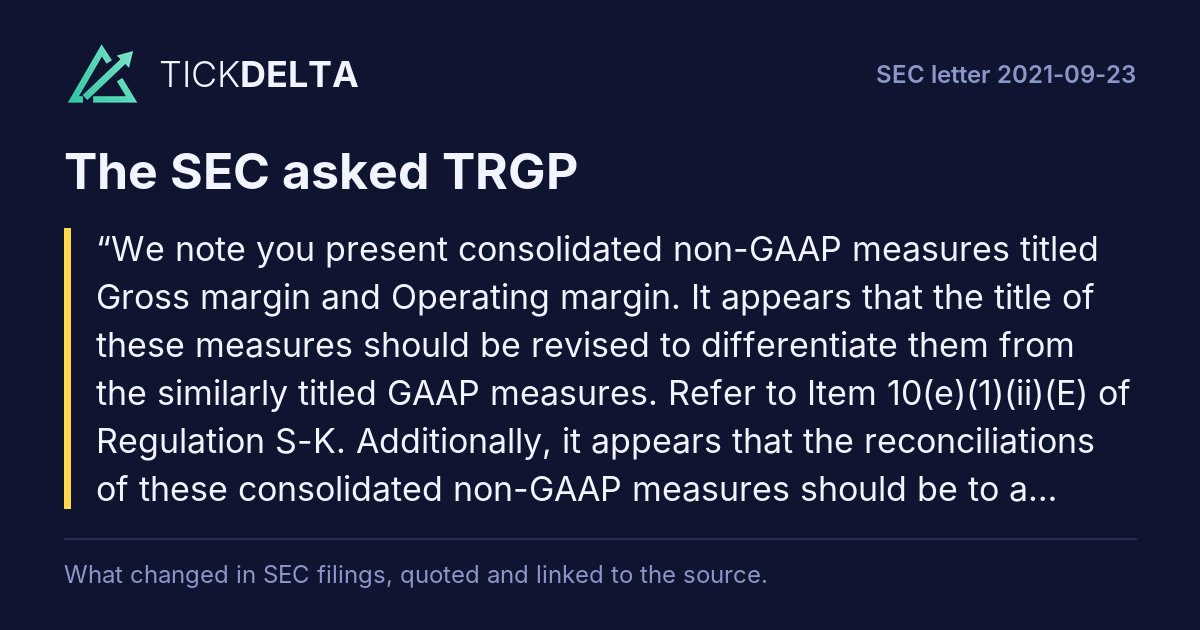
We note you present consolidated non-GAAP measures titled Gross margin and Operating margin. It appears that the title of these measures should be revised to differentiate them from the similarly titled GAAP measures. Refer to Item 10(e)(1)(ii)(E) of Regulation S-K.
Rest of the question

Additionally, it appears that the reconciliations of these consolidated non-GAAP measures should be to a fully burdened GAAP gross margin and GAAP Income (loss) from operations, respectively, as Item 10(e)(1)(i)(B) of Regulation S-K requires reconciliation to the most directly comparable GAAP measure.

TRGP answered
In response to the Staff’s comment, in future filings that include the non-GAAP measures Gross margin and Operating margin, the Company will (1) label such measures “Adjusted gross margin” and “Adjusted operating margin” and (2) revise its non-GAAP reconciliations to present a reconciliation of Income (loss) from operations to Adjusted operating margin and GAAP gross margin to Adjusted gross margin, beginning with the Company’s Form 10-Q for the quarter ended

September 30, 2021, expected to be filed with the Commission on November 4, 2021.

An illustrative presentation of the proposed
Rest of the answer

revisions (added information shown underlined below) and reconciliations described above is presented below. Such illustration is based on our June 30, 2021, Form 10-Q disclosures.

Adjusted Gross Margin

We define adjusted gross margin as revenues less product purchases and fuel. It is impacted by volumes and commodity prices as well as by our contract mix and commodity hedging program.

Gathering and Processing segment adjusted gross margin consists primarily of:

• service fees related to natural gas and crude oil gathering, treating and processing; and revenues from the sale of natural gas, condensate, crude oil and NGLs less producer payments, natural gas and crude oil purchases, and our equity volume hedge settlements.

Logistics and Transportation segment adjusted gross margin consists primarily of:

service fees (including the pass-through of energy costs included in fee rates);

system product gains and losses; and

NGL and natural gas sales, less NGL and natural gas purchases, fuel, third-party transportation costs and the net inventory change.

The adjusted gross margin impacts of mark-to-market hedge unrealized changes in fair value are reported in Other.

Adjusted Operating Margin

We define adjusted operating margin as adjusted gross margin less operating expenses. Adjusted operating margin is an important performance measure of the core profitability of our operations.

Adjusted gross margin and adjusted operating margin provide useful information to investors because they are used as supplemental financial measures by management and by external users of our financial statements, including investors and commercial banks, to assess:

the financial performance of our assets without regard to financing methods, capital structure or historical cost basis;

our operating performance and return on capital as compared to other companies in the midstream energy sector, without regard to financing or capital structure; and the viability of capital expenditure projects and acquisitions and the overall rates of return on alternative investment opportunities.

Management reviews business segment adjusted gross margin and operating margin monthly as a core internal management process. We believe that investors benefit from having access to the same financial measures that management uses in evaluating our operating results.

Three Months Ended June 30,

Six Months Ended June 30,

2021

2020

(In millions)

Reconciliation of Gross Margin to Adjusted Gross Margin

Gross margin

$

495.0

438.9

1,075.4

1,046.6

Depreciation and amortization expense

211.9

204.5

428.0

443.6

Adjusted gross margin

706.9

643.4

1,503.4

1,490.2

Reconciliation of Income (Loss) from Operations to

Income (loss) from operations

245.8

213.1

589.9

(1,864.4

)

General and administrative expense

63.7

61.5

125.1

121.9

Impairment of long-lived assets

—

2,442.8

(Gain) loss on sale or disposition of business and assets

(0.4

(0.7

(0.2

Read in the reply ↗
In its next report

First report after the company's reply of 2021-10-27: 10-Q filed 2021-11-04 ↗, against the 10-Q filed 2021-08-05 ↗.

Tickdelta does not hold the text of both reports, so they are not compared here.

Non-GAAP Measures · Our Non-GAAP Financial Measures, page 64
SEC asked (2)
Your computation of free cash flow appears to differ from the typical calculation of this measure (i.e., cash flows from operations less capital expenditures). Please revise the title of your non-GAAP measure to avoid potential confusion with free cash flow. Refer to Question 102.07 of the Non-GAAP Financial Measures Compliance and Disclosure Interpretations.
TRGP answered
In response to the Staff’s comment, we will amend the title of such non-GAAP measure used in all future filings to “adjusted free cash flow”, beginning with the Company’s Form 10-Q for the quarter ended September 30, 2021. An illustrative presentation of the revisions (added information shown underlined below) is as follows:

Distributable Cash Flow and Adjusted Free Cash Flow

We define distributable cash flow as adjusted EBITDA less distributions to TRP preferred limited partners, cash interest expense on debt obligations, cash tax

(expense) benefit and maintenance capital expenditures
Rest of the answer

(net of any reimbursements of project costs). The Preferred Units that were issued by the Partnership in October 2015 were redeemed in December 2020, and are no longer outstanding. We define adjusted free cash flow as distributable cash flow less growth capital expenditures, net of contributions from noncontrolling interest, and net contributions to investments in unconsolidated affiliates. Distributable cash flow and adjusted free cash flow are performance measures used by us and by external users of our financial statements, such as investors, commercial banks and research analysts, to assess our ability to generate cash earnings (after servicing our debt and funding capital expenditures) to be used for corporate purposes, such as payment of dividends, retirement of debt or redemption of other financing arrangements.

Read in the reply ↗
In its next report

First report after the company's reply of 2021-10-27: 10-Q filed 2021-11-04 ↗, against the 10-Q filed 2021-08-05 ↗.

Tickdelta does not hold the text of both reports, so they are not compared here.

Consolidated Results of Operations, page 66
SEC asked (3)
We note that your consolidated results of operations data presentation appears to closely resemble a full consolidated statement of operations. Therefore, non-GAAP measures should not be shown as part of this presentation. Refer to Item 10(e)(1)(ii)(C) of Regulation S-K.
TRGP answered
In response to the Staff’s comment, we advise the Staff that in future filings we will revise our disclosure to exclude non-GAAP measures in our consolidated statement of operations presentation, beginning with the Company’s Form 10-Q for the quarter ended September 30, 2021. Read in the reply ↗
In its next report

First report after the company's reply of 2021-10-27: 10-Q filed 2021-11-04 ↗, against the 10-Q filed 2021-08-05 ↗.

Tickdelta does not hold the text of both reports, so they are not compared here.

Results of Operations-By Reportable Segment · Gathering and Processing Segment, page 68
SEC asked (4)
We note your reconciliation of non-GAAP segment gross margin to segment operating margin here and on page 69 for the Logistics and Transportation segment. For purposes of equal or greater prominence, revise so that the reconciliation starts with the GAAP measure, which appears to be segment operating margin.
Rest of the question

Refer to Item 10(e)(1)(i)(A) of Regulation S-K and Question 102.10 of the Non-GAAP Financial Measures Compliance and Disclosure Interpretations.

TRGP answered
In response to the Staff’s comment, we advise the Staff that in future filings, we will revise our reconciliation to start with segment operating margin, beginning with the Company’s Form 10-Q for the quarter ended September 30, 2021.

An illustrative presentation of the revisions described above is presented below. Such illustration is based on our June 30, 2021, Form 10-Q disclosures. Read in the reply ↗
In its next report

First report after the company's reply of 2021-10-27: 10-Q filed 2021-11-04 ↗, against the 10-Q filed 2021-08-05 ↗.

Tickdelta does not hold the text of both reports, so they are not compared here.

Item 2.02 Form 8-K dated August 5, 2021 · Non-GAAP Financial Measures
SEC asked (5)
As applicable and in accordance with Regulation G and Item 10(e)(1)(i) of Regulation S- K, please address the comments above in your earnings releases furnished pursuant to Item 2.02 of Form 8-K.
TRGP answered
In response to the Staff’s comment, we will address the comments above in all future earnings releases furnished pursuant to Item 2.02 on Form 8-K, beginning with the Company’s earnings release on Form 8-K for the quarter ended September 30, 2021, expected to be filed with the Commission on November 4, 2021. Read in the reply ↗
In its next report

First report after the company's reply of 2021-10-27: 10-Q filed 2021-11-04 ↗, against the 10-Q filed 2021-08-05 ↗.

Tickdelta does not hold the text of both reports, so they are not compared here.

Non-GAAP Measures · Our Non-GAAP Financial Measures, page 64
SEC asked
We note your response to our prior comment 1. It appears that the Gross margin presented to reconcile to non-GAAP Adjusted gross margin is calculated without subtracting the Operating expenses line item. For the non-GAAP Adjusted gross margin measure you present, the most directly comparable GAAP-basis measure appears to be a fully burdened gross margin. Please revise your presentation accordingly.
TRGP answered
We respectively acknowledge the Staff’s comment. In future filings, the Company will not present Adjusted gross margin or Adjusted operating margin at the consolidated level, beginning with the Company’s Form 10-K for the year ended December 31, 2021. Read in the reply ↗
In its next report

First report after the company's reply of 2021-11-17: 10-K filed 2022-02-24 ↗, against the 10-K filed 2021-02-18 ↗.

Tickdelta does not hold the text of both reports, so they are not compared here.
Management's Discussion and Analysis of Financial Condition and Results of Operations · Non-GAAP Measures, page 62
SEC asked (1)
We note your response to prior comment 1. With regard to non-GAAP measures such as adjusted gross margin, the most directly comparable GAAP-basis measure under Item 10(e)(1)(i)(B) of Regulation S-K is generally a fully burdened gross margin.
Rest of the question

Please tell us why you believe your current description and presentation of non-GAAP segment adjusted gross margin in Management's Discussion and Analysis of Financial Condition and Results of Operations remains appropriate.

TRGP answered
In response to the Staff’s comment, we believe segment operating margin (a GAAP measure in accordance with ASC 280, Segment

Reporting), rather than a fully burdened GAAP segment gross margin, is the most directly comparable GAAP-basis measure to our non-GAAP segment adjusted gross margin. Additionally, we note the Staff’s prior comment 4 from the letter dated September 23, 2021, whereby the Staff advised us on such reconciliation to “revise so that the reconciliation starts with the GAAP measure, which appears to be segment operating margin.”

For clarification purposes, please refer to the
Rest of the answer

table below for a description of how each segment measure discussed in our response is calculated.

As illustrated in the table above, segment operating margin is more directly comparable to segment adjusted gross margin than a fully burdened segment gross margin, as there is an incremental reconciling item (depreciation and amortization expense) to reconcile adjusted gross margin to a fully burdened gross margin.

Read in the reply ↗
In its next report

First report after the company's reply of 2021-12-10: 10-K filed 2022-02-24 ↗, against the 10-K filed 2021-02-18 ↗.

Tickdelta does not hold the text of both reports, so they are not compared here.

Management's Discussion and Analysis of Financial Condition and Results of Operations · Non-GAAP Measures, page 62
SEC asked (2)
We note you define operating margin as "gross margin less operating expenses" on page 63. However, we note the addition of footnote (1) on page 25 in your Form 10-Q for the fiscal quarter ended September 30, 2021 that "Operating margin is calculated by subtracting Product purchases and fuel from Revenues." Please clarify for us how you calculate segment operating margin and revise your disclosure as necessary.
TRGP answered
Targa’s segment operating margin is calculated by subtracting product purchases and fuel and operating expenses from revenues. We will revise the footnote disclosure in our future filings to reflect this calculation. Read in the reply ↗
In its next report

First report after the company's reply of 2021-12-10: 10-K filed 2022-02-24 ↗, against the 10-K filed 2021-02-18 ↗.

Tickdelta does not hold the text of both reports, so they are not compared here.

Management's Discussion and Analysis of Financial Condition and Results of Operations · Non-GAAP Measures, page 62
SEC asked
We note your response to prior comment 1. Tell us how you concluded that the non- GAAP measure segment adjusted gross margin is appropriately named considering that you believe segment operating margin is the most directly comparable GAAP-basis measure.
TRGP answered
In response to the

Staff’s comment, we will change the caption for adjusted gross margin for our segments to “adjusted operating margin” in future filings, beginning with the Company’s Form 10-K for the year ended December 31, 2021. Read in the reply ↗
In its next report

First report after the company's reply of 2021-12-29: 10-K filed 2022-02-24 ↗, against the 10-K filed 2021-02-18 ↗.

Tickdelta does not hold the text of both reports, so they are not compared here.

Also in this review: company letter, 2021-10-14, closing letter, 2022-01-03
Form 10-K for the Year Ended December 31, 2015

2016-08-05 to 2016-08-24 · 8 questions · 1 letter from the SEC, 1 from the company
Review closed 2016-08-24
AcquisitionsResults discussion (MD&A)Liquidity and cashRisk factorsCritical estimatesSegmentsNon-GAAP measures
Management’s Discussion and Analysis of Financial Condition and Results of Operations · General Trends and Outlook, page 74
SEC asked (1)
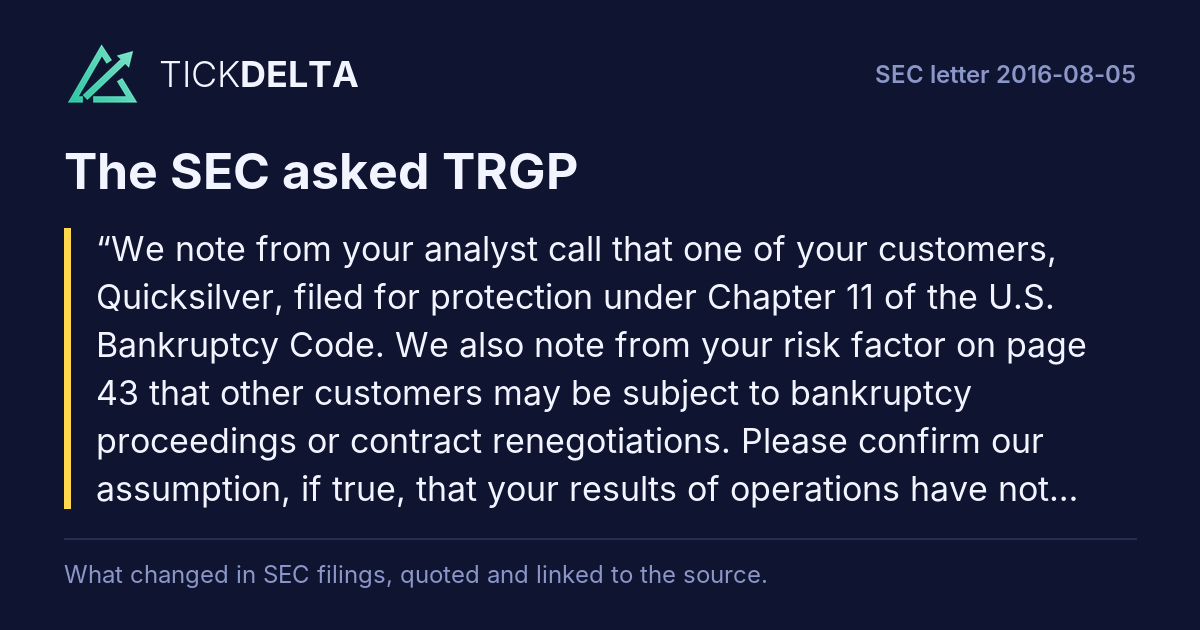
We note from your analyst call that one of your customers, Quicksilver, filed for protection under Chapter 11 of the U.S. Bankruptcy Code. We also note from your risk factor on page 43 that other customers may be subject to bankruptcy proceedings or contract renegotiations.
Rest of the question

Please confirm our assumption, if true, that your results of operations have not been materially impacted by any such customer bankruptcies or contract renegotiations. Additionally, please confirm our assumption, if true, that there are no known customer bankruptcies or contract renegotiations that are likely to have a material impact on your future results.

TRGP answered

No numbered answer found in the reply. Read the reply ↗

In its next report

First report after the company's reply of 2016-08-17: 10-Q filed 2016-11-04 ↗, against the 10-Q filed 2016-08-03 ↗.

Tickdelta does not hold the text of both reports, so they are not compared here.

Management’s Discussion and Analysis of Financial Condition and Results of Operations · General Trends and Outlook, page 74
SEC asked (2)
We note disclosures throughout your filing that the current depressed commodity price environment could have a negative impact on your customers’ creditworthiness and their performance under contractual arrangements.
Rest of the question

Please confirm our assumption, if true, that you have not seen a material increase in delinquency of your trade receivables or made any significant extensions to the payment terms offered to your customers. It appears that this could impact both your trade receivables asset and the number of accounts that qualify for your accounts receivable securitization facility and that any significant trends or uncertainties regarding collectability of your trade receivables could merit disclosure.

TRGP answered
We respectfully acknowledge the Staff’s comment. We confirm that the depressed commodity price environment has not resulted in a material increase in the delinquency of trade receivables or any significant extensions in payment terms offered to customers. We note that one segment of the energy industry whose creditworthiness has been significantly impacted by depressed commodity prices is oil and gas production.
Rest of the answer

However, our oil and gas producer customers typically are a source of supply to us, resulting in accounts payable rather than accounts receivable in our financial statements.

With respect to midstream and downstream energy customers that comprise the majority of our accounts receivables,

Item 7A of Form 10-K, Customer Credit Risk, discussed risk mitigation:

The Partnership extends credit to customers and other parties in the normal course of business. The Partnership has established various procedures to manage its credit exposure risk, including initial and subsequent credit risk analyses, credit limits and terms and credit enhancements when necessary.

The Partnership uses credit enhancements including (but not limited to) letters of credit, prepayments, parental guarantees and rights of offset to limit credit risk to ensure that our established credit criteria are followed and financial loss is mitigated or minimized. The Partnership has an active credit management process which is focused on controlling loss exposure to bankruptcies or other liquidity issues of counterparties.

When we determine that the credit worthiness of a customer has deteriorated, we actively pursue risk mitigation practices that are contractually and legally available to us in order to reduce the impact of uncollectible accounts receivable. In infrequent transitional situations, deliveries of product or rendering services may have been made to customers whose financial condition has substantially deteriorated or with whom significant contractual disputes have arisen that threaten the prospect of current payment. In these situations, we would not meet the requirements under GAAP for revenue recognition, as collectability of amounts owed would not be reasonably assured.1 As such, we would not record an account receivable; our contractual claim would be treated as a contingent asset and only recognized as revenue when payment is received. We did not have a material amount of such contingent customer contractual claims in the years included in our filings that are the subject of this SEC comment letter.

The accounts receivable securitization facility is secured by accounts receivable generated by our sales of natural gas, natural gas liquids and services provided for LPG export customers. These sales and services are predominately to customers that are rated investment grade or are backed by letters of credit from financial institutions and that have maintained their creditworthiness despite the depressed commodity price environment.

Read in the reply ↗
In its next report

First report after the company's reply of 2016-08-17: 10-Q filed 2016-11-04 ↗, against the 10-Q filed 2016-08-03 ↗.

Tickdelta does not hold the text of both reports, so they are not compared here.

Certain Relationships and Related Transactions, and Director Independence · Transactions with Related Persons, page 156
SEC asked (3)
In future filings, please name the executive managers and directors that own a controlling interest in Sajet Resources LLC. Additionally, please name the related persons associated with Tesla Resources LLC and Floridian Natural Gas Storage Company LLC. Refer to Item 404(a)(1) of Regulation S-K.
TRGP answered
We respectfully acknowledge the Staff’s comment, and in future filings we will name the related persons associated with Tesla Resources LLC and Floridian Natural Gas Storage Company LLC. We confirm that there are no Targa executive managers or directors that own a controlling interest in Sajet Resources LLC. Read in the reply ↗
In its next report

First report after the company's reply of 2016-08-17: 10-Q filed 2016-11-04 ↗, against the 10-Q filed 2016-08-03 ↗.

Tickdelta does not hold the text of both reports, so they are not compared here.

Financial Statements for the Year Ended December 31, 2015 · Note 4 – Business Acquisitions, page F-20
SEC asked (4)
We note your disclosure of the purchase price allocation for the Atlas mergers and your discussion of the revisions to that purchase price allocation that occurred during 2015, both due to measurement period adjustments and due to the errors described in Note 2.
Rest of the question

We have the following comments:  Please describe to us in more detail how you valued the acquired property, plant and equipment after correction of the errors, and also tell us why you had significant measurement period adjustments to these assets.  Please describe to us in more detail how you valued the acquired other intangible assets after correction of the errors, your basis for determining that these assets should be amortized over a 20 year life using the straight-line method, and why you had significant  Please consider revising your Critical Accounting Policies within MD&A to better explain the estimates and assumptions used in valuing these acquired assets given their materiality to your consolidated balance sheet.

TRGP answered
We respectfully acknowledge the Staff’s comment. We engaged a third-party valuation service to assist management in the valuation of the acquired assets and liabilities. Their analyses, opinions, and conclusions were developed in consultation with management and in conformity with the Uniform Standards of Professional

Appraisal Practice. The acquisition closed on February 27, 2015 and the initial draft valuation report was received in April 2015, prior to the filing of the Forms 10-Q of the Company and the Partnership for the three months ended

March 31, 2015.
Rest of the answer

Our procedures to validate the acquired asset listings, models and assumptions utilized by the third-party valuation service were completed over the course of the measurement period. Management has taken responsibility for the resulting valuation of the acquired assets and liabilities.

Personal Property comprised 87% of the fair value of acquired property, plant and equipment with Real Property comprising the remaining 13%. We have estimated a value in continued use for the Personal Property and have utilized the Cost Approach as the primary approach for valuing the majority of the Personal Property. The fair value of the Personal Property under the Cost Approach is limited by the cash flows that an asset or a business can be expected to generate over its remaining useful life. This limitation is referred to as economic obsolescence. The Income

Approach was used to quantify any economic obsolescence that may be present in the Personal Property. A Market Approach was used to value the acquired Real Property, which consists of pipeline rights of way and plant sites’ land.

The Cost Approach recognizes that a prudent investor would not ordinarily pay more for an asset than the cost to reproduce or replace it new.

Utilization of the Cost Approach results in a concept referred to as Depreciated Replacement Cost New (“DRCN”) where the term “depreciated” refers to a reduction of utility or value. DRCN is an indicator of Fair Value provided that all elements of depreciation and obsolescence are addressed. The first step in the Cost Approach is to estimate the reproduction / replacement cost (as if) new of an asset, using current prices and labor.

The Income Approach is a valuation technique that provides an estimation of the Fair Value of an asset or business based on the cash flows that an asset or a business can be expected to generate over its remaining useful life. The Discounted Cash Flow Method, a derivation of the Income Approach, begins with an estimation of the annual cash flows a market participant would expect the subject asset or business to generate over a discrete projection period. The estimated cash flows for each of the years in the discrete projection period are then converted to their present value equivalents using a rate of return appropriate for the risk of achieving the projected cash flows. The present value of the estimated cash flows is then added to the present value equivalent of the residual value of the asset (if any), or business, at the end of the discrete projection period to arrive at an estimate of Fair Value.

Economic obsolescence adjustments were made as part of the Personal Property analysis for certain locations (most notably the acquired gathering and processing assets in west Oklahoma), as there were insufficient cash flows to support the values established through the Cost Approach in those locations. The decrease in fair value of property, plant and equipment from the Company’s initial valuation reported at March 31, 2015 to the final valuation was primarily due to an increase in the required rate of return applied to the cash flows in the Discounted Cash Flow Method, which in turn decreased the fair value of property, plant and equipment in locations with economic obsolescence adjustments. Additionally, the validation of the completeness and accuracy of the acquired assets listings resulted in lesser adjustments throughout the measurement period.

Please describe to us in more detail how you valued the acquired other intangible assets after correction of the errors, your basis for determining that these assets should be amortized over a 20 year life using the straight-line method, and why you had significant measurement period adjustments to these assets.

RESPONSE: We respectfully acknowledge the Staff’s comment. We used the Excess Earnings Method, a derivation of the Income Approach, in the estimation of the fair value of the Customer Relationships. The Excess Earnings Method is an appropriate and commonly used technique to value customer-related assets for which measuring direct economic benefit is difficult, but which clearly have a value to a business. This method measures the value of an intangible asset by calculating the residual profit attributable to the asset after subtracting the appropriate returns for all other contributory assets that benefit the business

(“contributory asset charges”).

Excess Earnings from each customer base is calculated as Forecasted EBITDA less contributory asset charges. These amounts are discounted to present value using a required rate of return and summed to arrive at the indicated value of the customer base.

Forecasted EBITDA - Revenue and EBITDA are estimated for the contract/customer base being valued. The forecast period is a function of typical customer turnover, contractual lengths, and other business factors. Revenue is adjusted to reflect expected revenue from the existing customer relationships including an estimate of customer attrition and excludes potential revenue from future customers.

Contributory asset charges - Contributory asset charges represent the hypothetical payments required to lease other assets that support the generation of the forecasted EBITDA, and are derived from the valuation of the property, plant and equipment. Charges were taken on any material asset that is employed in the production of income from the relevant customer base. Additionally, other adjustments may be warranted to reflect specific characteristics of the subject asset.

Our estimate of the useful lives of the intangible assets was based on an evaluation of the pertinent factors described in ASC 350-30-35-3. For these intangible assets, management’s considerations for the use of a twenty-year useful life included:

The twenty-year useful life is based on Company-specific expectations regarding the use of the intangible assets, in contrast to the 37-year life utilized in the estimation of fair value under the guidance in ASC 820, which reflects a market participant perspective.

As an Income Approach was used to measure the fair value of the intangible assets, the determination of the useful life considered the period of expected cash flows used. The Excess Earnings present value model used estimated remaining useful lives of up to 37 years depending on the geographical location. However, the amortization period was limited to twenty years to be consistent with the Company-specific expectations regarding use, and to incorporate the effects of the factors described in ASC 350-30-35-3(e), “obsolescence, demand, competition, and other economic factors (such as the stability of the industry, known technological advances, legislative action that results in an uncertain or changing regulatory environment, and expected changes in distribution channels).” Over 65% of the present value of the customer relationship intangibles relates to expected cash flows generated in years one through twenty; therefore, the twenty-year life is consistent with the period over which the assets are expected to make a significant direct or indirect contribution to our future cash flows.

An intangible amortization period consistent with that of the longest-lived acquired tangible assets to which the intangible assets relate. In this acquisition, the most significant acquired tangible assets were the processing plants and gathering systems, for which a remaining useful life of twenty years was estimated. Therefore, an expected useful life of twenty years for the intangible assets aligns the amortization of the intangible assets to the life of the core assets within the group.

No legal, regulatory, or contractual provisions were identified that may limit the useful life.

An amortization period beyond contractual terms is supported by historical commercial experience in renewing or extending similar arrangements and the inherent advantage in many cases of having the sole connection to customer supplies in the regions due to gathering and processing infrastructure requirements. As a result, we would expect low levels of attrition and our estimates of the annual attrition of the customer relationships ranged from 2% to 5% depending on the geographical location. This is consistent with the intended use of the asset by the entity.

The method of amortization should reflect the pattern in which the economic benefits of the intangible asset are consumed. If that pattern cannot be reliably determined, a straight-line amortization method shall be used (ASC 350-30-35-6).

We performed an analysis of amortization methodologies consistent with the analysis performed for our Badlands acquisition in 2012. The

Badlands analysis resulted in the application of an amortization method that closely reflected the cash flow pattern underlying the Badlands intangible asset valuation. The acquired Badlands business was heavily fee-based, which provided for relatively predictable cash flows.

The acquired Atlas business had a significantly greater exposure to commodity prices than the

Badlands business due to the Atlas contractual mix, which results in less predictable cash flows. The fair value of the intangibles under the Excess Earnings method was calculated using a discount rate that reflected the higher level of risk and uncertainty associated with the cash flows from customer relationships. We considered utilizing a discounted economic value method similar to that used for the Badlands acquisition, as well as an undiscounted volume-based method and a discounted volume-based method.

Discounted economic value method - As the present value of Excess Earnings for certain locations was negative in the early years, but positive in total over their estimated useful lives, amortization on the basis of the discounted economic value method would result in back-loaded amortization expense with no amortization expense in the early years. We believe that the resulting amortization schedule derived from the discounted economic value method did not appropriately recognize the benefit from the customer relationships in the early years.

Undiscounted volume-based method – Utilizing the projected volumes underlying the Excess Earnings model on an undiscounted basis indicated lower amortization in the early years due to projected system growth than the straight-line method. We believe that the resulting amortization schedule derived from the undiscounted volumes did not appropriately recognize the benefit from items such as future negotiations and potential joint venture capital projects, for which we would expect value to be higher in the early years and decreasing over time.

Discounted volume-based method - Utilizing the projected volumes underlying the Excess Earnings model on a discounted basis indicated higher amortization in the early years than the straight-line method. We believe that the resulting amortization schedule derived from the discounted volumes overemphasized the impact of discounting, as both the volumes and the calculated fair value of intangible assets being amortized were on a discounted basis.

Ultimately, none of the three approaches was determined to provide a reliably determinable pattern of amortization, and therefore, we used the straight-line amortization method. Further, the straight-line amortization method is consistent with our expectation of low customer relationship attrition and high contract rate renewals resulting from the gathering and processing infrastructure requirements, in contrast with an accelerated amortization method that may be expected in other acquisitions without similar barriers to entry. Unlike other customer-related assets such as customer lists, which may dissipate in value more rapidly, our customer relationships remain strong over their useful lives due to our regular communication with our customers, who continue to depend on us for gathering and processing services, and opportunities to expand our business with those customers.

The increase in fair value of intangible assets from our initial valuation reported at

March 31, 2015 to the final valuation was primarily due to decreased contributory asset charges resulting from the lower Property, Plant and Equipment valuations noted above, and the calibration of commercial management’s estimated customer attrition rate percentages for consistency across all locations, partially offset by the impact of an increase in the required rate of return applied to the cash flows in the Excess Earnings Method.

Please consider revising your Critical Accounting Policies within MD&A to better explain the estimates and assumptions used in valuing these acquired assets given their materiality to your consolidated balance sheet.

RESPONSE: We respectfully acknowledge the Staff’s comment, and in future filings, we will revise the Company’s Critical Accounting Policies within MD&A to include additional explanations of estimates and assumptions regarding acquired assets.

Read in the reply ↗
In its next report

First report after the company's reply of 2016-08-17: 10-Q filed 2016-11-04 ↗, against the 10-Q filed 2016-08-03 ↗.

Tickdelta does not hold the text of both reports, so they are not compared here.

Financial Statements for the Period Ended March 31, 2016 · Note 20. Segment Information, page 37
SEC asked (5)
We note that you reevaluated your reportable segments in connection with your acquisitions of Atlas and the Partnership. Please tell us your operating segments as of March 31, 2016. Also tell us whether you have aggregated multiple operating segments into any of your reportable segments.
Rest of the question

If so, provide us with your analysis of why such aggregation is appropriate under ASC 280-10-50-11 and disclose this aggregation as required by ASC 280-10-50-21(a).

TRGP answered
We respectfully acknowledge the Staff’s comment. In accordance with ASC 280-10-50-1, we identified our operating segments as those components of our company that engage in business activities from which we earn revenues and incur expenses, for which operating results are regularly reviewed by our chief operating decision makers, and for which discrete financial information is available.
Rest of the answer

As a result, we identified a total of twenty-four operating segments, fifteen of which have been aggregated into our Gathering and Processing reportable segment and nine of which have been aggregated into our Logistics and Marketing reportable segment.

Per ASC 280-10-50-10(a), reportable segments are the operating segments that have been identified or that result from aggregating two or more of those segments in accordance with ASC 280-10-50-11. We applied the guidance in ASC 280-10-50-11, in which we evaluated if our operating segments have similar economic characteristics, similar nature of products and services, similar nature of processes, similar types of customers, similar methods used to provide services, and similar regulatory environments.

Based on our analysis, as summarized below, we determined that our fifteen Gathering and Process operating segments should be aggregated and our nine Logistics and Marketing operating segments should be aggregated, resulting in two reportable segments. Targa’s historic description of these two aggregations in prior filings as “divisions” is a reflection of the economic similarities of the underlying operating segments.

Gathering and Processing Operating Segment Aggregation

The Gathering and Processing operating segments are involved in the business of natural gas gathering and processing and crude oil gathering.

They earn operating margin through (1) the sale of residue natural gas, NGLs and condensate, which are a produced from the gathering and processing of raw natural gas and (2) charging a fee for natural gas gathered and processed and for crude oil gathered. The Gathering and Processing operating segments’ customers require the same services: gathering of crude oil, natural gas and condensate; compression, treating and processing of natural gas into processed products including residue gas and NGLs; distribution of crude oil and natural gas processed products to the next step of the value chain, which can include selling the processed products to a third party and settling the proceeds with the producers or other suppliers of the raw natural gas, selling the processed products to our Logistics and Marketing operating segments to perform additional value-added services such as fractionation, storage, terminaling, marketing and distribution, among other services, or returning the processed products to the producers in-kind, usually via delivery to a local central delivery point. The Gathering and Processing operating segments provide the same services and products to the same types of customers, delivered in the same manner. In addition, all of the Gathering and Processing operating segments are subject to substantially the same regulations.

The Gathering and Processing operating segments’ operating margin for a given period primarily depend on the volume of natural gas and crude oil produced by that operating segment’s producers, commodity prices of residue natural gas, underlying NGL products and crude oil, contract mix with the producers, and the profile of the hydrocarbons gathered in that operating segment’s area. The Gathering and Processing operating segments operate under a variety of contractual arrangements to accommodate customer preference and industry practices. Contract mixes have changed over time so that more of our operating margin is earned under fee-based arrangements, which are less commodity price exposed, and that trend is expected to continue into the future. Further, our focus is achieving certain levels of return, regardless of contract type – fee, POP or a combination of both, which is becoming more prevalent – and we use commodity hedges when appropriate as a component to achieve our return levels by mitigating our exposure to commodity price risk and its impact on returns. Based on the analysis of economic similarity and management’s judgment of the specific facts and circumstances surrounding the Gathering and Processing operating segments’ business, management has determined that the Gathering and Processing operating segments have similar economic characteristics.

Based on the analysis performed, as summarized above, management determined that Targa’s

Gathering and Processing operating segments are similar under the requirements of ASC 280-10-50-11, and thus, may be aggregated and disclosed as a single reportable segment.

Logistics and Marketing Operating Segment Aggregation

The Logistics and Marketing operating segments are involved in the business of providing certain value-added services such as the fractionation, storage, terminaling, transportation, exporting, distribution and marketing of NGLs; the storing and terminaling of refined petroleum products and crude oil; and certain natural gas supply and marketing activities in support of

Targa’s other businesses. These products are delivered to end-users through pipelines, barges, ships, trucks and rail cars. End-users of NGL products include petrochemical companies, refining companies, export markets for propane and butane, and propane markets for heating, cooking or crop drying applications.

The Logistics and Marketing operating segments are engaged primarily in the closely interrelated NGL services business and are derived directly from the existence of the fractionation business. Targa’s ability to function and compete as a fractionator depends on the existence of storage infrastructure and market connectivity necessary to conduct such operations. In addition to providing NGL fractionation services, Targa often provides a number of related services to customers, including storage, terminaling, transportation, exporting, refinery balancing, marketing and distribution of NGLs. Targa’s ability to engage in these business activities depends on its strategic position as a fractionator at Mont Belvieu. Targa’s ultimate customers for these operating segments are primarily petrochemical companies and refineries. Although FERC and CFTC rules apply differently among these operating segments, management does not believe the regulatory environment in which Targa operates these segments is different enough to warrant separate reporting. The operating margins generated by these Logistics and Marketing operating segments share similar economic drivers, including the NGL volumes and the needs of the end users of the NGL product stream. Further, the operating margins are dependent on the same asset base. For example, the operating margins captured through marketing NGL products are greatly impacted by Targa’s ability to leverage the fractionation, storage and terminaling assets. Certain operating margins, such as for export activities, cannot be attributed fully to a single operating segment and, therefore, are allocated arithmetically between the Logistics and Marketing operating segments. While information is tracked by operating segment for purposes of internal analysis, management considers the Logistics and Marketing operating segments together as a cohesive set of activities for decision making regarding allocation of resources. As such, management views the economic characteristics, nature of the products, services, production processes, type or class of customer, methods used for distribution and the regulatory environment to be similar.

The Logistics and Marketing operating segments also consist of similar services provided for other hydrocarbon products. The non-NGL-related

Petroleum Logistics and Gas Marketing operating segments have operations or activities similar to the NGL-related operating segments. Petroleum Logistics provides crude oil and petroleum products storage and terminaling services, which are similar in nature to the NGL-related storage and terminaling businesses, and markets petroleum products, which are, in many cases sold to the same type of refinery and petrochemical customers as the NGL Distribution and Marketing customers. Gas Marketing performs the same basic marketing functions as

NGL marketing, for natural gas. Petroleum Logistics and Gas Marketing comprised approximately 5% (4% and 1%, respectively) of Targa’s 2015 operating margin and, given the extensive overlap among the business activities and services performed with NGL-related activities and services, management determined that aggregation with the NGL-related operating segments is appropriate.

Based on the analysis performed, as summarized above, management determined that Targa’s Logistics and Marketing operating segments are similar under the requirements of ASC 280-10-50-11, and thus, may be aggregated and disclosed as a single reportable segment.

Operating Segments

A listing of Targa’s operating segments and their aggregation is provided below.

Gathering and Processing

North Texas

Permian Basin – Versado

Permian Basin – Non-Versado

SAOU

Badlands

WestTX

SouthTX

WestOK

SouthOK

Other Targa Pipeline

LOU

Southwest Louisiana

Southeast Louisiana

Vesco

T2 Joint Ventures

Logistics and Marketing

NGL-related:

Cedar Bayou Fractionator

Houston Area Assets

Louisiana Area Assets

Transportation

Wholesale Marketing and Distribution

NGL Distribution and Marketing

Gulf Coast Fractionator

Non-NGL-related:

Petroleum Logistics

Gas Marketing

In the Company’s and the Partnership’s future filings, pursuant to ASC 280-10-50-21(a), we will clarify that our reporting segments include operating segments that have been aggregated and the basis for aggregation.

Read in the reply ↗
In its next report

First report after the company's reply of 2016-08-17: 10-Q filed 2016-11-04 ↗, against the 10-Q filed 2016-08-03 ↗.

Tickdelta does not hold the text of both reports, so they are not compared here.

How We Evaluate Our Operations, page 44
SEC asked (6)
Please refer to your discussion of Distributable Cash Flow on page 46. Please tell us why you continue to present this non-GAAP measure in filings subsequent to your acquisition of the Partnership. In doing so, please tell us in detail why this particular calculation of cash generated by you continues to be useful and relevant to your investors and analysts given the flexibility in paying dividends resulting from
Rest of the question

your corporate structure. Please note that non-GAAP measures that focus on cash generated are typically presented for yield-generating master limited partnership where available cash is required to be distributed as opposed to a C-Corporation where dividends are solely at the election of the Board of Directors. Also explain to us in detail why this is a performance measure for a corporation rather than a liquidity measure for a corporation.

TRGP answered
We respectfully acknowledge the Staff’s comment. We believe that the non-GAAP measure Distributable Cash Flow continues to be useful for our investors and analysts because dividend yield remains a key valuation metric and performance measure for midstream companies, whether C-Corporations or master limited partnerships, in part because of the high concentration of publicly traded master limited partnership in our industry sector.
Rest of the answer

Though our investor base as a C-Corporation is continuing to evolve, that investor base continues to have many of the same investors who previously invested in the Partnership. These investors, and the research analysts who cover Targa, are focused on Distributable Cash Flow and dividend yield along with other valuation metrics, and evaluate Targa relative to other midstream energy peers, most of which are yield-generating master limited partnerships. While we recognize that our Distributable Cash Flow has attributes that resemble a liquidity measure in that it measures cash generated from operations, we believe that it continues to represent a performance measure to our investors and analysts, given that Distributable Cash Flow has a significant impact on dividend yield, and that dividend yield remains a key valuation metric in the mid-stream sector. We view Distributable Cash Flow as a performance measure as it measures management’s performance in executing our business strategy, in areas including the execution and operation of our contracts, construction and management of our asset base, and commodity price and credit risk management. Further, we do not use

Distributable Cash Flow to measure our liquidity as we use other metrics to assess our liquidity (e.g. cash on hand, available capacity under the TRC and TRP senior secured revolving credit facilities and the TRP accounts receivable securitization facility).

Read in the reply ↗
In its next report

First report after the company's reply of 2016-08-17: 10-Q filed 2016-11-04 ↗, against the 10-Q filed 2016-08-03 ↗.

Tickdelta does not hold the text of both reports, so they are not compared here.

Our Liquidity and Capital Resources, page 54
SEC asked (7)
We note that an important component of your liquidity is the dividends you pay to your stockholders. In this regard, you state that your primary business objective is to increase the cash available for dividends to your stockholders.
Rest of the question

Please revise your disclosure to more clearly explain how your acquisition of the Partnership will cause your future liquidity to differ from your historical liquidity and specifically your ability to pay dividends to your stockholders. In doing so, please clarify the extent to which the increased amount of distributions you receive from the Partnership following the acquisition of its limited partner interests will be offset by a larger amount of dividends you will pay to your stockholders resulting from the significant increase in the number of your stockholders. Please also clarify the extent to which statements made under Item 5 of your Form 10-K indicating that you expect to increase dividends to your stockholders as the distributions you receive from the Partnership increase will continue to be true.

TRGP answered
We respectfully acknowledge the Staff’s comment, and in future filings we will clarify our disclosure to more clearly explain how our acquisition of the Partnership will cause our future liquidity to differ from our historical liquidity and specifically our ability to pay dividends to our stockholders.
Rest of the answer

We will also clarify the extent to which the increased amount of distributions we receive from the Partnership following the acquisition of its limited partner interests will be offset by a larger amount of dividends we will pay to our stockholders resulting from the significant increase in the number of our stockholders. Finally, we will also clarify the extent to which statements made under Item 5 of our Form 10-K that indicated that we expect to increase dividends to our stockholders if the Partnership is successful in implementing its business strategy and increases distributions to its partners will continue to be true

Read in the reply ↗
In its next report

First report after the company's reply of 2016-08-17: 10-Q filed 2016-11-04 ↗, against the 10-Q filed 2016-08-03 ↗.

Tickdelta does not hold the text of both reports, so they are not compared here.

General
SEC asked (8)
Certain of our comments apply to both Targa Resources Corp. and Targa Resources Partners LP. In order to reduce the number of comments we issue, where a comment is applicable to both registrants, we have only issued the comment on Targa Resources Corp.; however, please ensure your response also addresses Targa Resources Partners LP where appropriate.
TRGP answered
We respectively acknowledge the Staff’s comment and will ensure that our responses address each registrant, where applicable.

We acknowledge that (i) we are responsible for the adequacy and accuracy of the disclosure in the filing, (ii) Staff comments or changes to disclosure in response to Staff comments do not foreclose the Commission from taking any action with respect to the filing and (iii) we may not assert Staff comments as a defense in any proceeding initiated by the Commission or any person under the federal securities laws of the United States. Read in the reply ↗

Also in this review: closing letter, 2016-08-24

From the SEC's correspondence on EDGAR: staff letters (form UPLOAD) and company letters (form CORRESP), 21 letters filed since 2016-08-05. Questions and answers are matched by their numbers; topics come from words in each question. The reports are compared word for word (same form, before the first SEC letter against the first report after the company's reply). No AI.

Next in Owners and insiders Insider trades →