Form 10-K
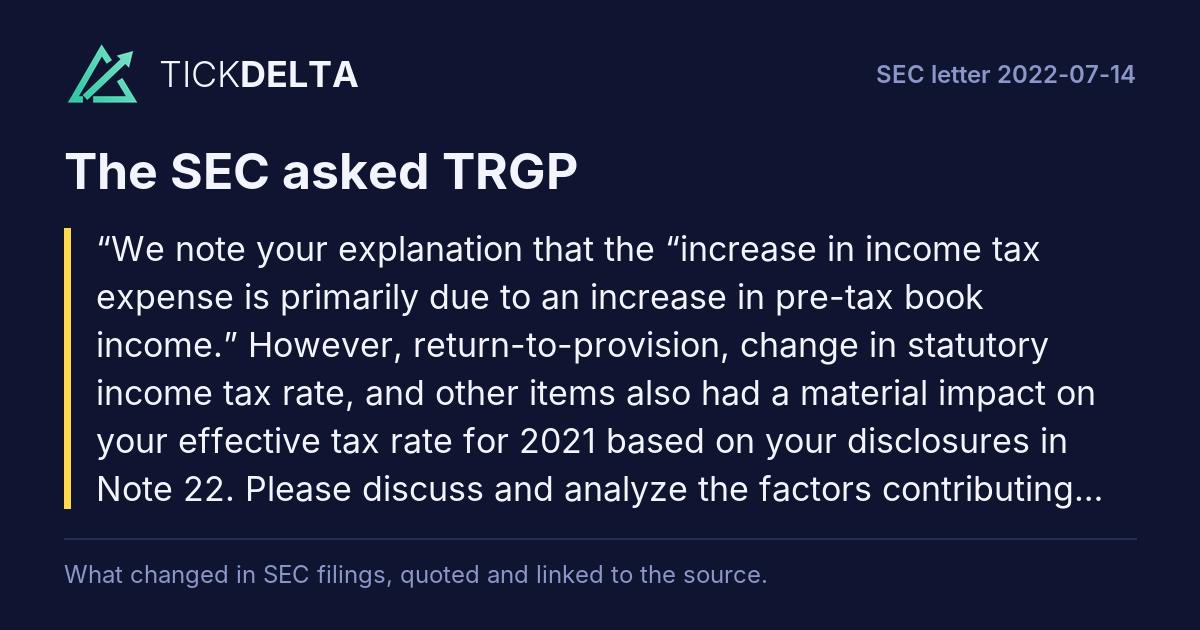
We note your explanation that the “increase in income tax expense is primarily due to an increase in pre-tax book income.” However, return-to-provision, change in statutory income tax rate, and other items also had a material impact on your effective tax rate for 2021 based on your disclosures in Note 22.Rest of the question
Please discuss and analyze the factors contributing to material changes to your income tax expense, including items that are not expected to recur. Refer to Item 303 of Regulation S-K.
We acknowledge the Staff’s comment that other items, in addition to an increase in pre-tax book income, had a material impact on our effective tax rate for 2021. The factors contributing to material changes in income taxes for the year ended December 31, 2021 compared with the year ended December 31, 2020 were:
i.
an increase in income tax expense primarily due to an increase in pre-tax book income, the income tax rate reductions enacted in Oklahoma and Louisiana and the correction of the state tax error in 2021 (which was previously presented as a component of the Return-to-provision, asRead in the reply ↗Rest of the answer
further discussed in the Company’s response to the Staff’s Comment 2.);
ii.
this increase was partially offset by a change in valuation allowance.
Prospectively, we will analyze our income tax expense in a similar fashion on a quarterly and annual basis for consideration of disclosure and discussion within Management’s Discussion and Analysis of Financial Condition and Results of Operations in subsequent Quarterly Reports on Form 10-Q and Annual Reports on Form 10-K.
First report after the company's reply of 2022-07-27: 10-Q filed 2022-08-04 ↗, against the 10-Q filed 2022-05-05 ↗.
Tickdelta does not hold the text of both reports, so they are not compared here.
We note from your disclosure that you recorded an additional $23.3 million of income tax expense and a corresponding increase to deferred tax liabilities in 2021 to correct identified errors related to your 2020 state tax provision. Please provide us with your SAB 99 analysis supporting your conclusion that the identified errors were not material to your financial statements.Rest of the question
As part of your response, tell us where this error correction is reflected in the income tax reconciliation. In addition, please provide an explanation for the Return-to-provision and Change in statutory income tax rate that are presented in your 2021 tax rate reconciliation. Refer to FASB ASC 740-10-50-12.
The Company conducted an analysis under Staff Accounting Bulletin No. 99 (“SAB 99”) when the state tax provision error was identified in the fourth quarter of 2021, which included the analysis of both quantitative and qualitative factors. The Company’s analysis resulted in the conclusion that the adjustment due to the state tax provision error was not material for either the year ended December 31, 2020 or 2021.Read in the reply ↗Rest of the answer
We are separately providing the SAB 99 analysis prepared in February 2022 to the Staff on a supplemental basis.
As noted, the Company’s 2020 financial statements included an error related to the apportionment of the Company’s income to Oklahoma. This error resulted in the Company utilizing an increased state tax rate for its deferred taxes that increased state tax deferred liabilities and overstated state tax assets related to state net operating losses. Additionally, the deferred state tax liabilities were utilized to support existing state deferred tax assets related to prior year state net operating losses in the Company’s assessment of its valuation allowance. The reversal of these three items resulted in the $23.3 million expense recorded in 2021.
The $23.3 million state tax provision error is comprised of the following three items (net of federal deduction):
a $59.3 million benefit from state tax adjustment on state deferred tax liabilities;
a $21.3 million expense from state tax adjustment on state net operating losses; and iii.
a $61.3 million expense to record additional state tax valuation allowance against the Company’s state net operating loss carryforwards.
The first two items above were included within the return-to-provision line on the income tax rate reconciliation in Note 22 to the Company’s historical financial statements in the Form
10-K (the “Income Tax Reconciliation”). The third item above, together with adjustments for current period activities, was included within the valuation allowance line on the Income Tax
Reconciliation. For reference, the Income Tax Reconciliation is copied below:
2020
2019
Income tax reconciliation:
Income (loss) before income taxes
$
436.9
(1,573.1
)
(46.7
Less: Net income attributable to noncontrolling interest
(350.9
(228.9
(250.4
Income attributable to TRC before income taxes
86.0
(1,802.0
(297.1
Federal statutory income tax rate
%
Provision for federal income taxes
18.1
(378.4
(62.4
Valuation allowance
14.1
194.2
—
State income taxes, net of federal tax benefit
(5.4
(51.2
(5.8
CARES Act NOL carryback
(16.9
Return-to-provision
(39.3
Change in statutory income tax rate
21.0
(14.4
Permanent adjustments
4.1
4.5
(6.3
Stock compensation shortfall
1.4
Other, net
0.8
(0.3
1.0
Income tax provision (benefit)
14.8
(248.1
(87.9
The change in statutory income tax rate line on the Income Tax Reconciliation is a result of adjusting the
Company’s state tax deferred balances and state net operating losses to reflect the lower enacted statutory income tax rates in Oklahoma and Louisiana.
In the Company’s future Form 10-K’s that include financial statements for the year ended December 31, 2021, the Company will provide the updated Income Tax Reconciliation schedule as depicted below which separately shows the correction of the state tax provision error:
(47.2
State tax provision error correction
23.3
(1.3
First report after the company's reply of 2022-07-27: 10-Q filed 2022-08-04 ↗, against the 10-Q filed 2022-05-05 ↗.
Tickdelta does not hold the text of both reports, so they are not compared here.
We note you have excluded Risk management activities from the reconciliation of estimated net income of the Company to estimated adjusted EBITDA for 2022 and that this appears to be a change in how you have historically presented this forward-looking non-GAAP measure.Rest of the question
Please tell us why you made this change and how you considered Question 100.02 of the Non-GAAP Financial Measures Compliance and Disclosure Interpretations. As part of your response, clarify for us the nature of the adjustments that comprise Risk management activities in the adjusted EBITDA measure. In closing, we remind you that the company and its management are responsible for the accuracy and adequacy of their disclosures, notwithstanding any review, comments, action or absence of action by the staff.
“Risk management activities” in the reconciliation of reported net income of the Company to reported Adjusted EBITDA is comprised of the unrealized mark-to-market gains or losses on the Company’s derivative instruments that do not qualify for hedge accounting or have not been designated as hedges. When reconciling estimated annual net income of the Company to estimated annual Adjusted EBITDA, the comparable reconciling item is labeled “Risk management activities and other” (presented only if not zero) and is comprised of actual unrealized mark-to-market gains or losses on derivativeRead in the reply ↗Rest of the answer
instruments, as well as other minor adjustments not segregated into individual line items.
The Company does not make projections regarding future unrealized mark-to-market gains or losses resulting from future commodity price movements when preparing estimated Adjusted EBITDA guidance on an annual basis. As the estimated annual net income of the Company does not include any estimated unrealized mark-to-market gains or losses, there is no need for a “Risk management activities and other” reconciling item to arrive at estimated Adjusted EBITDA in the annual guidance.
In interim periods in which we provide updated estimated Adjusted EBITDA guidance to reflect a significant change in expectations, estimated net income of the Company is updated for actual results, including unrealized mark-to-market gains or losses on derivative instruments as reported in the most recently published Quarterly Report on Form
10-Q. Therefore, actual results are incorporated into the reconciliation of updated estimated Adjusted EBITDA for the full year.
The reconciliation of estimated net income of the Company to estimated Adjusted EBITDA for 2022 included in the Form 8-K dated May 5, 2022 was presented on a consistent basis with the Company’s historical presentation, and therefore, in compliance with Question 100.02 of the
Non-GAAP Financial Measures Compliance and Disclosure Interpretations. The Company did not publish updated estimated Adjusted EBITDA guidance for 2022 with its first quarter 2022 results in the Form 8-K dated May 5, 2022, but rather repeated the annual guidance originally published in February 2022 (in the Form 8-K dated February 24, 2022) with unchanged estimated net income of the Company and unchanged estimated Adjusted EBITDA. As new guidance was not issued, there were no changes made to the estimated Adjusted EBITDA reconciliation.
On June 16, 2022, the Company issued a press release to announce a material acquisition that provided investors with updated stand-alone estimated Adjusted EBITDA guidance for 2022 to reflect the strength of commodity markets and producer activity levels. Consistent with past practice of the Company, the June 2022 updated estimated Adjusted EBITDA for 2022 incorporated the actual published results of the Company through March 31, 2022, and, therefore, a “Risk management activities and other” line item of $170.0 million is presented in the reconciliation provided in such press release, which is comprised primarily of the actual unrealized mark-to-market loss on derivative instruments of $178.2 million as reported in the Company’s Quarterly Report on Form 10-Q for the quarter ended March 31, 2022.
In order to provide additional clarity and consistency of formatting with our actual reconciliations of, as well as any updated interim reconciliations of, net income of the Company with Adjusted EBITDA, we will include a “Risk management activities and other” reconciling item with a balance of zero in future annual estimated guidance.
First report after the company's reply of 2022-07-27: 10-Q filed 2022-08-04 ↗, against the 10-Q filed 2022-05-05 ↗.
Tickdelta does not hold the text of both reports, so they are not compared here.
Also in this review: closing letter, 2022-08-25