TripAdvisor, Inc. TRIP
New risk paragraphs, branching off last year
Each branch is a paragraph in Risk Factors with nothing like it in the 10-K filed Feb 20, 2025. A box jumps to the paragraph as filed, below.
Paragraphs with nothing like them in last year's 10-K
21 paragraphs in Risk Factors of the 10-K filed Feb 13, 2026 with nothing like them in the 10-K filed Feb 20, 2025. Quoted exactly. Paragraphs that were only edited are under 10-K change.
•Liability risks in our experiences marketplace for safety incidents, quality failures, and judgment-proof suppliers;
•Risks related to the loss of our “controlled company” status following the Merger with LTRIP.
content and products that are perceived as useful, reliable and trustworthy, could adversely affect user experiences and their repeat behavior, reduce traffic to our platform and negatively impact our business and financial performance.
As we expand our experiences marketplace, we face increasing potential legal and financial liability for alleged safety incidents and service failures by third-party tour and activity operators, which could result in substantial costs, reputational harm, and regulatory penalties. Our experiences-led strategy relies on connecting travelers with thousands of third-party tour operators, activity providers, and experience hosts globally. Unlike our hotel metasearch business where we simply refer users to booking sites, our experiences marketplace brings us closer to transactions through payment processing, creating enhanced exposure, despite contracts for the supply of experiences being concluded directly between travelers and suppliers. Many of the third-party operators trading via our platform are small enterprises and may have limited resources and/or insurance coverage that ultimately proves to be inadequate.
As platform liability laws evolve, our insurance costs may increase or we may face uninsured exposure, reducing Experiences segment profitability or exiting certain markets or high-risk activity categories. Even where we successfully defend legal claims, safety incidents could harm our brand reputation or user trust, potentially driving travelers to competitors. If we cannot effectively manage platform liability risks through insurance, supplier vetting, or successfully defending claims, our experiences business growth may be constrained and our financial results materially adversely affected.
Weak economic conditions, including those that cause declines or disruptions in the travel industry or reduce consumer discretionary spending have, in the past, had a material adverse impact on the Company’s
Show the other 10
We may not realize the expected benefits of our November 2025 restructuring plan, and the restructuring may disrupt our business. In November 2025, we announced a restructuring plan designed to support the Company’s strategic priorities and initiatives. The plan includes a significant global workforce reduction and other targeted expense reductions. Many departing employees possess deep institutional knowledge of our complex technology systems, supplier relationships, and marketplace dynamics. The reduction in workforce could negatively impact our ability to respond to customer needs, maintain our internal controls, or execute on strategic initiatives. The public nature of the workforce reduction may impair our ability to recruit top talent, particularly in competitive markets for engineers and product managers. Competitors may target our remaining employees, leading to additional voluntary attrition beyond the planned reduction.
We may encounter unforeseen costs or operational disruptions. If the restructuring results in significant disruption to our operations or unforeseen costs, our business and financial results could be materially adversely affected. Finally, there can be no assurance that any restructuring activities that we have undertaken or will undertake in the future will be completed or, in the event that they are completed, will achieve the operating efficiencies or other benefits that we may initially expect.
•Difficulties encountered and/or expenses incurred in connection with the pursuit and execution of these transactions;
Our experiences marketplace business require payment institution licenses in the UK and EU, and failure to maintain compliance with PSD2 and payment regulations could force us to suspend operations in these critical markets. Our marketplace activities in the United Kingdom and European Union (“EU”), require us to obtain and maintain payment institution licenses under the Payment Services Directive Two (“PSD2”) and related national regulations. PSD2 governs entities performing defined 'payment services' in EU member states and, following Brexit, in the UK. To maintain our payment licenses, we must comply with extensive regulatory requirements including minimum capital requirements and financial resource calculations, safeguarding customer funds according to prescribed methodologies, governance structures and internal controls meeting regulatory standards, consumer disclosure and transparency obligations, transaction reporting and audit requirements, timing and settlement rules for payment processing, anti-money laundering (“AML”) and counter-terrorist financing (“CTF”) controls, cybersecurity and operational resilience standards, and cooperation with regulatory examinations and requests.
We have obtained payment institution licenses in both the UK and EU. However, maintaining compliance is complex, costly, and subject to evolving regulatory interpretation. If regulators determine that we have violated PSD2 requirements, we could face fines, restrictions on our business activities, suspension or revocation of our payment licenses, or even criminal liability for senior management. Loss of payment licenses would force us to immediately cease processing payments for experiences in the UK and EU, which would effectively shut down our marketplace operations in these markets. Payment regulations continue to evolve, with new requirements being imposed related to Strong Customer Authentication, open banking, digital wallets, and cryptocurrency. We may need to make costly system changes or operational adjustments to maintain compliance as regulations evolve. We may also be deemed to be engaged in money transmission or similar regulated activities in other jurisdictions beyond the UK and EU, including U.S. states. If we are found to be operating without required licenses in these jurisdictions, we could face significant fines, penalties, and operational restrictions. Any suspension of our payment processing capabilities or licensing status in these markets would have a severe material adverse effect on our business, financial condition, and results of operations.
Greenhouse gas emissions and climate change may have long-term impacts on the travel industry that could affect our business. The long-term effects of climate change on the global economy and our industry are unclear, but potential impacts include increased frequency and severity of extreme weather events, damage or reduced reliability of transportation and tourism infrastructure, and reduced visibility of certain destinations due to severe heat or cold, flooding, rising sea levels, or ocean acidification. These developments could alter travel demand patterns, increase operating costs for us and our partners, and negatively affect our revenue and profitability. Shifts in consumer preferences and governmental policy developments may further disrupt travel behavior and adversely affect our business. Additionally, growing concerns about climate change have led, and are likely to continue to lead, to increased legal and regulatory measures aimed at reducing environmental impacts, such as regulations on greenhouse gas emissions, alternative energy policies, and various sustainability initiatives. If these laws or regulations become more stringent than those currently in place, we may face greater compliance obligations and higher associated costs. For instance, under the EU’s Corporate Sustainability Reporting Directive (“CSRD”), we will be required to provide specific disclosures in 2026 regarding our environmental impacts, risks, and opportunities for the year 2025, which may necessitate changes to our current methods for collecting environmental-related data. Moreover, as environmental, social, and governance-related regulations continue to expand and become more complex at the global level, we may need to adjust our business operations and supply chain management practices to remain compliant, which could have a material adverse effect on our business, financial condition, or operating results.
satisfy all stakeholders and could expose us to reputational harm, private litigation, or stockholder actions, and could negatively affect our ability to attract or retain employees, customers, and investors.
address problems related to cyber or other security problems will be sufficient to prevent or limit the impact of any cyber intrusion or similar security incident or attack. Failure to adequately protect against incidents, attacks or intrusions, whether for our own systems or systems of vendors, could expose us to security breaches that could have an adverse impact on our financial performance. Our business policies and internal security controls may not keep pace as new threats and regulations emerge in jurisdictions worldwide.
We rely upon Amazon Web Services (“AWS”) to operate certain aspects of our business and any disruption, interruptions, delays in service or inability to increase capacity, including internationally, of the AWS operation could impair the use or functionality of our websites, harm our business and subject us to liability. AWS provides a distributed computing infrastructure platform for business operations, or what is commonly referred to as a “cloud” computing service. Our systems infrastructure for our branded websites is in a “hybrid-cloud” configuration, which is partially hosted by AWS. Any outage or failure of such data centers could negatively affect the branded websites connectivity and performance. Any damage to, or failure of, our systems infrastructure for the branded websites, or those of our third-party providers, could interrupt or hinder the use or functionality of our services. If the security of the AWS infrastructure is compromised or believed to have been compromised, our business, results of operations and financial condition could be adversely affected. It is possible that our customers and potential customers would hold us accountable for any breach of security affecting the AWS infrastructure and we may incur significant liability from those customers and from third parties with respect to any breach affecting AWS systems. Because our agreement with AWS limits AWS’ liability for damages, we may not be able to recover a material portion of our liabilities to our customers and third parties from AWS. Customers and potential customers may refuse to do business with us because of the perceived or actual failure of our cloud offering as hosted by AWS and our operating results could be harmed. Because we cannot easily transition our AWS operations to another cloud provider, any disruption, interruptions, delays in service or inability to increase capacity, including internationally, of the AWS operation could adversely affect our business and results of operations.
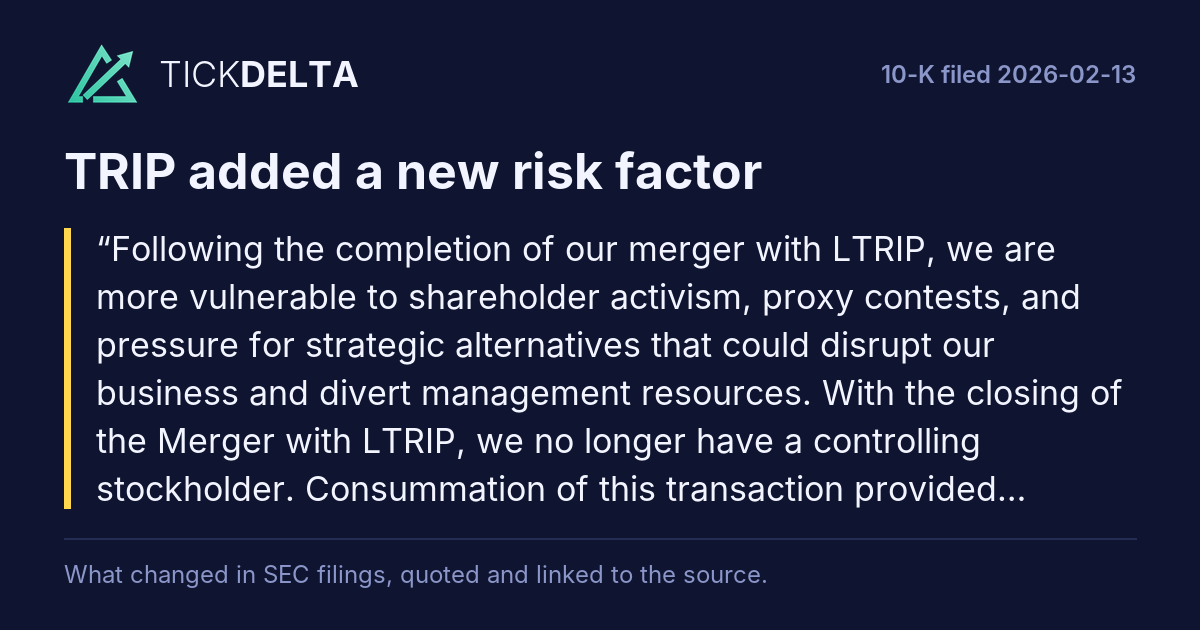
Following the completion of our merger with LTRIP, we are more vulnerable to shareholder activism, proxy contests, and pressure for strategic alternatives that could disrupt our business and divert management resources. With the closing of the Merger with LTRIP, we no longer have a controlling stockholder. Consummation of this transaction provided greater strategic flexibility, it also eliminated the voting control and strategic stability that our prior structure provided. We are now more vulnerable to activist shareholders who may seek to influence our strategic direction, board composition, capital allocation, or operations.
Responding to activist shareholders, including proxy contests, public campaigns, or other actions, could divert significant time and attention of our Board and management team from executing our business strategy, generate substantial legal, advisory, and public relations costs, create uncertainty among our employees, suppliers, and business partners, result in the departure of key executives or board members, force strategic decisions that prioritize short-term shareholder returns over long-term value creation, lead to unexpected changes in our business strategy, capital structure, or leadership, limit our ability to pursue acquisitions, investments, or other strategic initiatives, and result in significant stock price volatility. Furthermore, the perception that we are vulnerable to activist campaigns or a potential acquisition could make it more difficult to attract and retain key employees, negotiate favorable terms with suppliers and partners, or execute long-term strategic initiatives. Even if we successfully defend against activist proposals, the distraction and costs associated with these activities could materially adversely affect our business and financial performance.
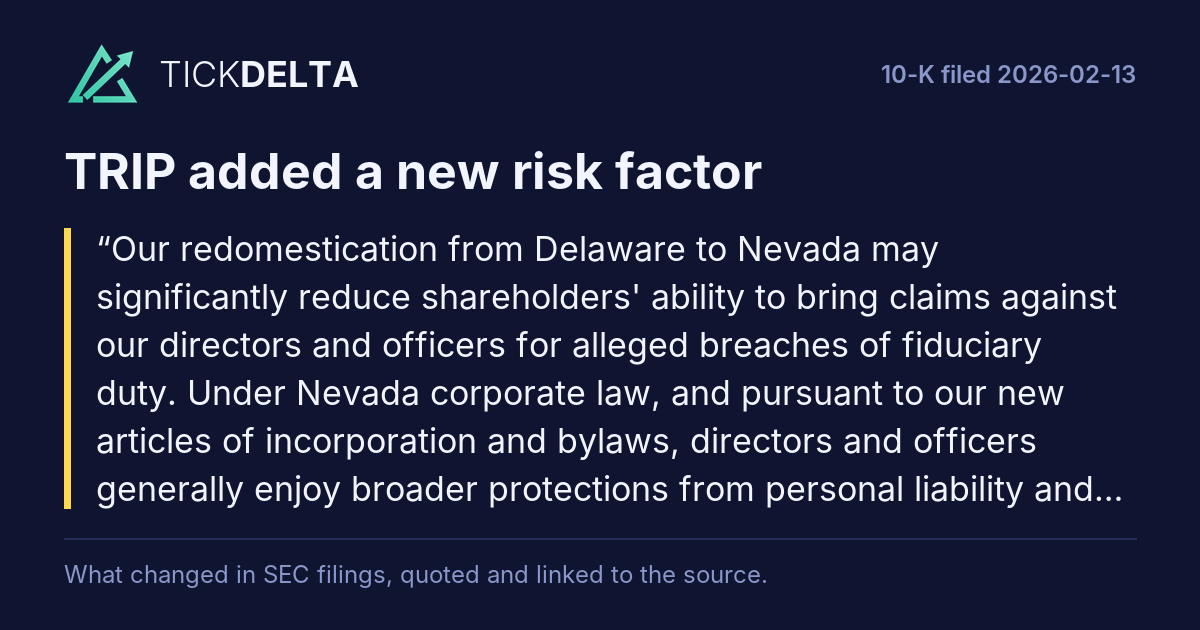
Our redomestication from Delaware to Nevada may significantly reduce shareholders' ability to bring claims against our directors and officers for alleged breaches of fiduciary duty. Under Nevada corporate law, and pursuant to our new articles of incorporation and bylaws, directors and officers generally enjoy broader protections from personal liability and a narrower scope of fiduciary duties than under Delaware law, which can make it more difficult for stockholders to initiate or successfully maintain derivative or other fiduciary duty litigation. As a result, shareholders may have fewer avenues to seek monetary damages or other remedies for alleged misconduct.
In addition, our articles of incorporation provide that the Eighth Judicial District Court of the State of Nevada shall be the exclusive forum for certain actions brought by our shareholders, which may limit shareholders' ability to obtain a judicial forum they consider more favorable for disputes with us or our directors, officers, or employees. This exclusive forum provision may discourage lawsuits against us and our directors, officers, employees and agents, and stockholders who do pursue claims in the Nevada Eighth Judicial District Court could incur additional costs, particularly if they reside outside Nevada. The Nevada Eighth Judicial District Court, or the federal district courts in the case of Securities Act claims, may also reach different judgments or results than other courts, including
courts in which stockholders might otherwise seek to bring actions, and such judgments or results may be more favorable to us than to our stockholders. If a court were to find our exclusive forum provision inapplicable or unenforceable, however, we could incur additional costs defending actions in multiple jurisdictions, which could adversely affect our business and financial condition.
These provisions or any prevention of a change of control transaction or changes in our Board of Directors could cause the market price of our common stock to decline.
Paragraphs in the 10-Q filed Nov 5, 2026 that were not in the one before
New in the latest 10-Q
14 paragraphs in the 10-Q filed Nov 5, 2026 with nothing like them in the 10-Q filed Aug 6, 2026 (at least half the words must differ; new numbers alone do not count). Quoted exactly, grouped by the item heading above them. This is text that changed, not a judgement of how serious it is.
Financial statements and notes
respectively, and is included in non-marketable investments on our unaudited condensed consolidated balance sheets. During the three and nine months ended September 30, 2026, we recognized $0.2 million and $0.9 million, respectively, representing our share of the investee’s net loss in other income (expenses), net within the unaudited condensed consolidated statements of operations. During the three and nine months ended September 30, 2025, we recognized $0.7 million and $1.6 million, respectively, representing our share of the investee’s net loss in other income (expenses), net within the unaudited condensed consolidated statements of operations. The Company evaluates this investment for impairment when factors indicate that a decline in the value of its investment has occurred and the carrying amount of its investment may not be recoverable. An impairment loss, based on the excess of the carrying value over the estimated fair value of the investment based on Level 3 inputs, is recognized in earnings when an impairment is deemed to be other than temporary. During the three and nine months ended September 30, 2026 and 2025, we did not record any impairment loss on this equity investment.
Read in the 10-Q
NOTE 6: GOODWILL The following table summarizes our goodwill activity by reportable segment for the periods presented: Experiences Hotels and Other Total (in millions) ───────────────────────────────────────────────────────────────────────────────────────────────────────────────────────────────────── Balance as of December 31, 2025 $ 309.6 $ 414.6 $ 724.2 Foreign currency translation adjustments 1.4 (0.8) 0.6 Impairment - (369.5) (369.5) Balance as of September 30, 2026 $ 311.0 $ 44.3 $ 355.3 Impairment We assess goodwill, which is not amortized, for impairment annually during the fourth quarter, or more frequently, if events and circumstances indicate that it is more likely than not that an impairment has occurred. Observing persistent and challenging business trends in 2026, during the third quarter of 2026, the Company updated its long range forecast for the Hotels and Other reporting unit to reflect the accelerated decline in recent financial performance, in addition to a decline in expected future profitability of the Hotels and Other reporting unit, as compared to the outyears forecast used in its previous impairment analysis. As a result, the Company determined that an impairment triggering event had occurred as of September 30, 2026. These trends are largely due to the sustained acceleration of traffic acquisition headwinds negatively impacting this business due to the changes in the search landscape. In addition, the Company experienced a significant decline in its stock price and market capitalization during the third quarter of 2026, with its stock price declining nearly 40% from June 30, 2026 to September 30, 2026. Therefore, the Company performed an interim impairment test of its Hotels and Other reporting unit as of the last day of the third quarter, or September 30, 2026. Based on these trends, noted above, and the resulting negative impact on this reporting unit, we concluded it was more likely than not that the estimated fair value of the Hotels and Other reporting unit was less than its respective carrying value. Therefore the Company chose to proceed directly to a quantitative analysis. As a result, the Company recognized a non-cash goodwill impairment of $369.5 million in its unaudited condensed consolidated statement of operations during the three months ended September 30, 2026 for the Hotels and Other reporting unit. The fair value of the Hotels and Other reporting unit using a quantitative analysis was determined with the assistance of a third party specialist using a discounted cash flow (“DCF”) analysis, or income approach calculation (Level 3). Fair value assessments of a reporting unit are considered a Level 3 measurement due to the significance of unobservable inputs used in their estimate. Determining fair value using a DCF analysis requires the exercise of significant judgment with respect to several items, including the amount and timing of expected future cash flows, discount rates, and the long-term growth rate used to estimate terminal value. The expected cash flows used in the DCF analysis for the Hotels and Other reporting unit were based on the Company’s most recent forecast, and for years beyond the periods covered by the forecast, the Company’s estimate of forecasted long-term growth rate. The discount rate used in the DCF analysis is intended to reflect the risks, which consider macroeconomic and industry specific factors inherent in the expected future cash flows of the reporting unit.
Read in the 10-Q
In conjunction with the quantitative analysis performed for the Hotels and Other reporting unit, as of September 30, 2026, the Company also performed a quantitative analysis' of its Experiences reporting unit. In addition, and separately, the Company performed a quantitative analysis for its indefinite-lived intangible assets, consisting of Tripadvisor trade name and trademarks, using the relief-from-royalty method. The Company concluded the estimated fair values of its Experiences reporting unit and indefinite-lived intangibles were substantially in excess of their carrying values. In addition, prior to performing the goodwill impairment analysis, the Company performed an impairment analysis of its reporting units' definite-lived long-lived assets (including capitalized website development) to determine if the carrying amount of its identified asset groups may not be fully recoverable, and concluded the carrying amounts were recoverable as of September 30, 2026, and no impairment was identified.
Read in the 10-Q
As of September 30, 2026, in order to corroborate its fair value conclusion, the Company combined the estimated fair values for its reporting units and performed a market capitalization reconciliation to validate the reasonableness of the implied control premium. The Company calculated the market capitalization using both the stock price as of September 30, 2026 as well as the average stock price over a reasonable period of time preceding September 30, 2026. Based on this reconciliation, the Company believes the implied control premium used to be reasonable.
Read in the 10-Q
As of September 30, 2026 and December 31, 2025, accumulated goodwill impairment losses totaled $372.6 million and $3.1 million, respectively; all related to the Hotels and Other segment.
Read in the 10-Q
Show the other 9
TheFork. On November 1, 2026, the Company consummated the sale of TheFork. Refer to “Note 1: Basis of Presentation”, under the section titled “Sale of TheFork”, for further information.
Read in the 10-Q
NOTE 11: STOCK-BASED AWARDS 2026 Stock Option Activity A summary of stock option activity, consisting of service-based non-qualified stock options, is presented below: Weighted Weighted Average Average Exercise Remaining Aggregate Options Price Per Contractual Intrinsic Outstanding Share Life Value (in thousands) (in years) (in millions) Options outstanding at December 31, 2025 2,001 $ 30.30 Canceled or expired (451) 33.11 Options outstanding at September 30, 2026 1,550 $ 29.49 4.2 $ Exercisable as of September 30, 2026 1,525 $ 29.63 4.2 $ Vested and expected to vest after September 30, 2026 1,550 $ 29.49 4.2 $
Read in the 10-Q
NOTE 15: SUBSEQUENT EVENTS On November 1, 2026, the Company consummated the sale of TheFork. Refer to Note 1: “Basis of Presentation”, under the section titled “Sale of TheFork” for further information. On November 4, 2026, the Company initiated a restructuring plan, designed to further simplify its Hotels and Other segment. This cost saving action primarily includes a reduction of workforce, with the substantial portion of the costs relating to severance payments and employee benefits. As a result, the Company expects to incur estimated pre-tax restructuring and other related reorganization costs of approximately $15 million to $20 million. This amount is expected to be expensed primarily in the fourth quarter of 2026, with any remaining amount expensed during 2027.
Read in the 10-Q
American Express pursuant to the Equity Purchase Agreement. The total net cash consideration received at closing was approximately $741.0 million, reflecting customary adjustments to the purchase price, including closing working capital, cash, and indebtedness, and net of transaction related expenses paid at closing. The Company anticipates recognizing an estimated gain on sale of approximately $487.0 million during the fourth quarter of 2026. However, the final net cash consideration and gain on sale amounts may differ materially, as these amounts remain subject to change based on final adjustments according to the terms of the Equity Purchase Agreement.
Read in the 10-Q
On November 4, 2026, the Company initiated a restructuring plan, designed to further simplify its Hotels and Other segment. This cost saving action primarily includes a reduction of workforce, with the substantial portion of the costs relating to severance payments and employee benefits. As a result, the Company expects to incur estimated pre-tax restructuring and other related reorganization costs of approximately $15 million to $20 million. This amount is expected to be expensed primarily in the fourth quarter of 2026, with any remaining amount expensed during 2027. Refer to “Note 15: Subsequent Events” in the notes to our unaudited condensed consolidated financial statements in Item 1 in this Quarterly Report.
Read in the 10-Q
As noted above, the Company recorded a $369.5 million non-cash goodwill impairment charge during the third quarter of 2026 in its Hotels and Other reporting unit. The valuation of goodwill is a critical accounting estimate because it requires significant judgments about future cash flows, discount rate, and long-term growth rate, all of which are inherently uncertain and sensitive to market conditions. Following the impairment, the carrying amount of the Hotels and Other reporting unit approximates its estimated fair value. Therefore, any adverse changes in these assumptions, if the reporting unit does not achieve its forecasted results, or if the Company's stock price and market capitalization decline further, the Company may be required to recognize additional goodwill impairment charges, which could be material. As of September 30, 2026, $44.3 million of goodwill remains allocated to this reporting unit. In order to evaluate the sensitivity of the estimated fair value calculation used for the goodwill impairment analysis, the Company applied a hypothetical 1% decrease in the long-term growth rate and a 1% increase in the discount rate, resulting in an additional impairment amount for the reporting unit of approximately $14.0 million. Refer to “Note 6: Goodwill” in the notes to our unaudited condensed consolidated financial statements in Item 1 in this Quarterly Report for further information regarding this impairment.
Read in the 10-Q
excluded from) the most directly comparable measure calculated and presented in accordance with GAAP in such company’s financial statements.
Read in the 10-Q
Refer to “Note 9: Income Taxes” and “Note 10: Commitments and Contingencies” in the notes to our unaudited condensed consolidated financial statements in Item 1 in this Quarterly Report for further information on other potential contingencies, including ongoing audits by the IRS and various other domestic and foreign tax authorities, and other tax and legal matters. The Organization for Economic Cooperation and Development (“OECD”) through its “Inclusive Framework” of G20 and other countries have issued proposals related to the taxation of the digital economy. Many jurisdictions, particularly in the EU, have implemented or are considering the adoption of a digital services tax (“DST”) or similar tax that imposes a tax on revenues earned from digital advertisements or the use of online platforms, even when there is no physical presence in the jurisdiction. Future developments related to such proposals, in particular any unilateral actions outside of the OECD's Inclusive Framework such as the imposition of DST rules, could have an adverse impact on our business by increasing our future tax obligations. During the three and nine months ended September 30, 2026, we recorded $3.4 million and $4.6 million, respectively, of digital service taxes to cost of sales on our unaudited condensed consolidated statements of operations, which includes a realized refund of $2.0 million during the second quarter of 2026, resulting from the repeal of enacted tax legislation in Canada during March 2026 related to digital service taxes. During the three and nine months ended September 30, 2025, we recorded $4.5 million and $10.2 million, respectively, of digital service taxes to cost of sales on our unaudited condensed consolidated statements of operations.
Read in the 10-Q
Market risk
Our exposure to potentially volatile movements in foreign currency exchange rates will increase as we increase our operations in international markets. The economic impact of foreign currency exchange rate movement is linked to variability in the
Read in the 10-Q
The 10-Q's risk factors against the 10-K
Item 1A of the 10-Q filed Nov 5, 2026 against Item 1A of the 10-K filed Feb 13, 2026.
A 10-Q repeats only the risks that changed, so a 10-K paragraph that is missing from it is not counted as removed.
Added is a paragraph with nothing like it in the 10-K, Reworded a sentence that is in both with several words changed,
Quiet changes a sentence in both where one to four words changed and one is a hedge or a modal
(cut words struck through, new words highlighted).
Text on the page, not a score; each links to the filing at sec.gov.
1 paragraph in the 10-Q's Item 1A, and none of them adds, rewords or quietly edits a paragraph of the 10-K's.
Phrases used for the first time
Two-word phrases in Risk Factors of the 10-K filed Feb 13, 2026 that are in none of the 1 earlier 10-Ks stored, back to Feb 20, 2025
Where each one is used
- experiences marketplace: •Liability risks in our experiences marketplace for safety incidents, quality failures, and judgment-proof suppliers;
- contingent workers: The composition of our work force, in terms of geographic location, in person or remote and full-time employees or contingent workers, creates challenges and risks and failure to properly manage those risks could have a negative impact on our business. In response to the COVID-19 pandemic, much of our work force...
- safety incidents: •Liability risks in our experiences marketplace for safety incidents, quality failures, and judgment-proof suppliers;
- strategic priorities: If our strategic initiatives are unsuccessful and/or do not achieve their expected benefits, there could be negative impacts to our business, financial condition and results of operations. As described in “Our Business Strategy,” and elsewhere in this Report, we have a number of strategic priorities and initiatives...
- strategic alternatives: If our strategic initiatives are unsuccessful and/or do not achieve their expected benefits, there could be negative impacts to our business, financial condition and results of operations. As described in “Our Business Strategy,” and elsewhere in this Report, we have a number of strategic priorities and initiatives...
- insurance coverage: As we expand our experiences marketplace, we face increasing potential legal and financial liability for alleged safety incidents and service failures by third-party tour and activity operators, which could result in substantial costs, reputational harm, and regulatory penalties. Our experiences-led strategy relies...
- platform liability: As platform liability laws evolve, our insurance costs may increase or we may face uninsured exposure, reducing Experiences segment profitability or exiting certain markets or high-risk activity categories. Even where we successfully defend legal claims, safety incidents could harm our brand reputation or user...
- value creation: Our growth and the execution of our strategic priorities may depend on mergers, acquisitions, dispositions, investments, and significant commercial arrangements, which could present new challenges and risks and disrupt our ongoing business. We have acquired, invested in and/or entered into significant commercial...
Used at least twice, small words left out. Counted, not picked: a phrase can be new because the company renamed something.
What was taken out
22 paragraphs of last year's Risk Factors with nothing like them now. The longest are quoted.
Sources
Item 1A of each 10-K and 10-Q on EDGAR, quoted exactly. Each paragraph links to the filing at sec.gov.
Also
10-K change: what was reworded or cut, section by section.
Work with it
Excel workbook · CSV. Google Sheet that stays up to date: paste =IMPORTDATA("https://tickdelta.com/company/TRIP/export.csv") into a cell.