Screener / SEC EDGAR /CIK 0001526520 /10-K filed Feb 13, 2026, compared with Feb 20, 2025 /Numbers from the XBRL of the 10-Ks
Nasdaq Technology · Internet & Software Services

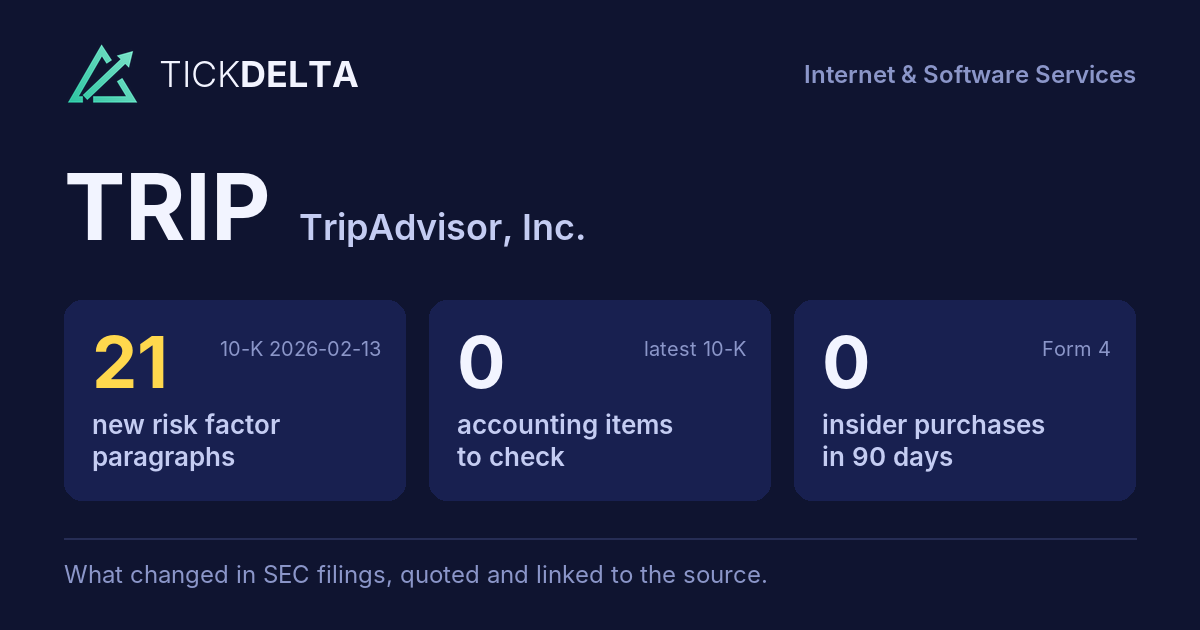
TripAdvisor, Inc. TRIP

Compare with peers Embed
SEC comment letters, last 20 years

5 reviews of TRIP's filings by SEC staff

UPLOAD and CORRESP
Reviews 5 latest letter Jul 7, 2020
Questions asked 18 each answered in the company's own letter
No closing letter 0 reviews without a letter saying the staff completed it

When the SEC's staff reviews a filing, it writes to the company with numbered questions, and the company answers each one in a letter. SEC publishes the exchange once the review is over, at least 20 business days later. A question is not an accusation; most reviews end with the company adding detail to its next filing.

How the reviews went

Every review on EDGAR, from the first staff letter to the letter that closes it

  1. 1. Staff letters 7 UPLOAD
  2. 2. Questions in them 18 numbered comments
  3. 3. Company replies 9 CORRESP
  4. 4. Reviews closed 5 of 5 closing letter

Half the closed reviews took 29 days or less from the first letter to the closing letter.

Form 10-K for the Year Ended December 31, 2019

2020-07-07 to 2020-07-21 · 4 questions · 1 letter from the SEC, 1 from the company
Review closed 2020-07-21
RevenueResults discussion (MD&A)Liquidity and cashSegmentsNon-GAAP measures
Overview · Financial Summary and Business Trends , page 37
SEC asked (1)
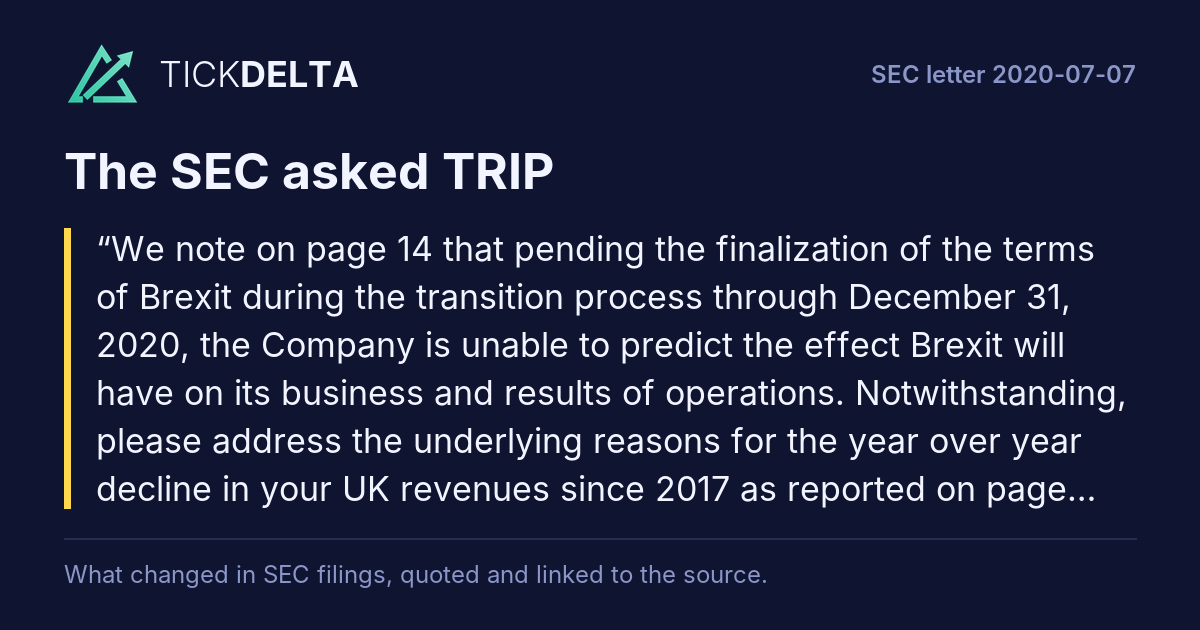
We note on page 14 that pending the finalization of the terms of Brexit during the transition process through December 31, 2020, the Company is unable to predict the effect Brexit will have on its business and results of operations.
Rest of the question

Notwithstanding, please address the underlying reasons for the year over year decline in your UK revenues since 2017 as reported on page 115 and whether you expect such trend to continue. Refer to Item 303(a)(3)of Regulation S-K.

TRIP answered
The Company does not internally report or forecast revenue by country or geography. However, the

Company does provide geographic information as required under ASC 280 on page 115 in its 2019 Form 10-K grouped at the legal entity level by country. The majority of the Company’s revenue in the United Kingdom (or “U.K.”) consists of click-based advertising revenue generated in its hotel metasearch auction (or “hotel auction revenue”).
Rest of the answer

As disclosed on page 41 of the MD&A in the Company’s 2019 Form 10-K, the primary drivers of the decrease in hotel auction revenue during this time period included, among others, increased competition from search engines (primarily Google) in our SEO marketing channel (or “free traffic”), a reduction by the Company in SEM and other online paid traffic acquisition spend (or “paid traffic”) in order to optimize profits, and travel partners bidding lower in our hotel metasearch auction. As the Company disclosed on page 37, revenue headwinds are expected to continue in our SEO marketing channel, as a result of increased competition from search engines (primarily Google), which are increasing the prominence of their own hotel products in search results, which would generally be expected to impact all of the Company’s geographies. The decrease in U.K. hotel auction revenue over this time period generally reflects similar trends experienced by the Company in most of its geographies for its hotel auction revenue, given similar drivers, customers, and contract terms for this revenue stream. During 2020 we expect this trend to continue, although we believe the impacts of the COVID pandemic will be a more significant driver throughout our business.

The Company does not believe that Brexit has had a meaningful impact on the revenue decline in the U.K., although the Company is still unable to predict the effect that Brexit will have on the Company’s business and results of operations.

Read in the reply
In its next report

First report after the company's reply of Jul 20, 2020: 10-Q filed Aug 6, 2020 ↗, against the 10-Q filed May 8, 2020 ↗.

Tickdelta does not hold the text of both reports, so they are not compared here.
Note 4. Revenue Recognition · Disaggregation of Revenue, page 90
SEC asked (2)
Please tell us how your current presentation of disaggregated revenues depicts the nature, amount, timing and uncertainty of revenues and cash flows as affected by economic factors. In this regard, we note in your earnings call and on pages 88-89, that you referred to discrete revenue streams including but not limited to hotel metasearch auction revenues, hotel B2B revenues, media revenues, booking commissions,
Rest of the question

transaction fees (seated diner fees), subscription-based advertising, and display advertising. Refer to ASC 606-10-5589 and 90.

TRIP answered
The objective of the Company’s disaggregated revenue disclosure is to provide the most useful information to users of its financial statements based on categories that are meaningful to the Company while at the same time depicting the nature, amount, timing and uncertainty of revenues and cash flows as affected by economic factors in accordance with the requirements of ASC 606-10-55-89.
Rest of the answer

Achieving this objective requires judgment, depends on various entity-specific and industry-specific factors and is not subject to a single prescribed factor as the basis for disaggregation.

ASC 606-10-55-90 discusses factors an entity should consider when selecting the type of information an entity should use to disaggregate revenue, including each of the following:

(a)

Disclosures presented outside the financial statements (for example, in earnings releases, annual reports, or investor presentations);

(b)

Information regularly reviewed by the chief operating decision maker (“CODM”) for evaluating the financial performance of operating segments; and

(c)

Other information that is like the types of information identified in (a) and (b) and that is used by the entity or users of the entity’s financial statements to evaluate the entity’s financial performance or make resource allocation decisions.

In applying the disaggregation framework, the Company also looked to ASC 606-10-55-91 and considered certain categories that the standard indicates may be appropriate for disaggregation purposes, including (a) the type of good or service, (b) geographic region, (c) market or customer type, (d) type of contract, (e) contract duration, (f) timing of transfer of goods or services, and (g) sales channels.

The Company acknowledges the references of discrete revenue streams on the Company’s earnings call and on pages 88-89 in its 2019 Form 10-K, including but not limited to hotel metasearch auction revenues, hotel B2B revenues, media revenues, booking commissions, transaction fees (seated diner fees), subscription-based advertising, and display advertising. For clarity, any references to “hotel metasearch auction revenues” or “hotel auction revenue”, refers to click-based advertising revenue within Tripadvisor-branded hotel revenue. “Media revenues”, “media advertising revenue”, or “display-based advertising revenue”, refer to Tripadvisor-branded display-based and platform revenue. “Hotel B2B revenue” refers to hotel sponsored placement revenue (or “hotel sponsored ads” revenue) and subscription-based advertising revenue within Tripadvisor-branded hotel revenue. References to “booking commissions” refers to revenue generally derived from our Experiences business, and transaction fees (or seated diner fees) is revenue derived from our Dining business. The Company advises the Staff it will ensure nomenclatures are consistently used across its future public filings and earnings calls.

The Company may also provide limited information regarding performance of certain revenue streams within each product category to provide investors with some context regarding the Company’s financial performance and/or underlying trends. In such instances, we generally do not specifically quantify percentage or dollar amounts and instead provide general information or other qualitative information.

Based on the foregoing discussion, we disaggregate our revenue by (1) reportable segments, (i) Hotels, Media & Platform, and (ii) Experiences & Dining, and (2) product offerings within these reportable segments, as follows; (i) Tripadvisor-branded hotel, (ii) Tripadvisor-branded display and platform, (iii) Experiences & Dining, and (iv) Other.

Disaggregation by reportable segment

The Company believes the nature, amount, timing and uncertainty of revenues and cash flows for its Hotels, Media & Platform reportable segment are affected by economic factors differently from our Experiences & Dining reportable segment based on customer group. The Hotels, Media & Platform reportable segment earns revenue by offering hotel and other travel-related advertising to largely online travel agents (“OTAs”) and hotels primarily on its Tripadvisor-branded websites. The Experiences & Dining reportable segment consists of transaction-based offerings (not advertising), both of which primarily earn commissions (for each attraction/tour facilitated) and transaction fees (per seated diner fees). The Experiences & Dining reportable segment is comprised of businesses that provide access on our websites during the trip planning process, to travel-related, recreational, and leisure activities to consumers while on their trip from a large supplier base of experience providers and restaurants.

Disaggregation by product offering

The Company notes that there is not a significant level of disparity in the nature, amount, timing, and uncertainty of revenues and cash flows between different revenue streams within each product offering, as described below. Accordingly, the Company believes that the disaggregation of its revenue on the basis of product offering is appropriate.

The Company disaggregates its Hotel, Media & Platform reportable segment into two product categories: (1) Tripadvisor-branded hotel revenue, and (2) Tripadvisor-branded display and platform revenue. Tripadvisor-branded hotel revenue is primarily monetized on a cost-per-click basis (or “CPC” rate), while Tripadvisor-branded display and platform revenue is primarily monetized on a cost-per-thousand impressions basis (or “CPM” rate).

Tripadvisor-branded hotel revenue. The Tripadvisor-branded hotel revenue is primarily monetized through click-based advertising on the hotel pages on our Tripadvisor-branded websites. The nature of this revenue is driven by the Company’s customers’ intent to drive traffic to their websites. Tripadvisor-branded hotels revenue primarily consists of hotel auction advertising revenue, where CPC rates are determined in a dynamic, competitive auction process (or “hotel auction revenue”), and to a lesser extent hotel advertising revenue from our hotel sponsored ads, hotel instant booking, and short-term subscription-based advertising.

The Company believes the nature of hotel advertising revenue from the various revenue streams within its Tripadvisor-branded hotels product category is similar in that all revenue streams enable the Company’s customers, primarily OTAs and hotels, to advertise information regarding hotels on the hotel pages of the Tripadvisor-branded websites, all of such advertising enabling consumers to find the right hotel at the right price. The Company monetizes within this product category primarily on a CPC basis from its hotel auction revenue and hotel sponsored ads revenue, and to a lesser extent through short-term subscription-based advertising, which also drives clicks and traffic to our hotel customers. The Company regards this as one single product category from an economic perspective as the product category is impacted by macro factors in the travel industry, regardless of the payment type by the customer. The Company is indifferent as to which revenue stream within the Tripadvisor-branded hotels product category it earns revenue, and the effectiveness of all such offerings is ultimately measured based on clicks. In addition, the Company is marketing to a similar customer group in this product category (primarily OTAs and hotels). The Company also notes that any further disaggregation of this product category is not used by the Company’s CODM for evaluating the financial performance of the Company’s operating segments.

Tripadvisor-branded display and platform revenue. The Tripadvisor-branded display and platform revenue (or “display-based revenue”) is sold predominantly on a CPM basis for advertisements displayed across our all our websites and not exclusively hotel pages. The advertising revenue earned through display-based revenue, enables our customers to promote their businesses in prominent areas directly on the Company’s website pages and to provide a more graphically appealing method of advertising. The Tripadvisor-branded display and platform customers are not only hotels and OTAs, but also airlines, cruise operators, destination marketing organizations, other travel-related businesses, as well as advertisers from non-travel categories. The nature of this revenue is more brand-oriented, for which economic factors tend to impact marketing budget decisions differently than for Tripadvisor-branded hotel revenue, and therefore the amount of the Company’s potential revenue. The Company also notes that any further disaggregation of this product category is not used by the Company’s CODM for evaluating the financial performance of the Company’s operating segments.

Experiences & Dining. The Company presents its transaction-based offerings as one product category, which primarily monetizes through commissions for each attraction/tour facilitated and transaction fees (per seated diner fees) for restaurant visits. Economic factors, such as consumer budget decisions, state of the economy, and disposable income, impact the amount of the Company’s potential revenue in this product category. These offerings provide consumers with access on our websites during the trip planning process to travel-related, recreational or leisure activities while on a trip from a large supplier base of experience providers and restaurants. While the CODM may also be provided individual revenue information for Experiences & Dining, the Company believes that the further disaggregation of this product category is not necessary as the offerings generally monetize similarly and are impacted by similar economic factors. Other revenue streams, within this product category, such as subscription-based advertising and transaction-based “restaurant media advertising placements”, which are referenced on pg. 89 in its 2019 Form 10-K are not significant to this product category.

Other. This revenue is derived from the combination of various businesses that include Rentals, Flights/Cruises/Car, SmarterTravel, and Tripadvisor China. Other revenue has declined in recent years, represented only 11% of consolidated revenue for the full year ended December 31, 2019; and we expect Other revenue to continue to decline in 2020. We believe our conclusion not to disaggregate Other revenue based on quantitative significance is appropriate.

Other information considerations:

In accordance with ASC 606-10-55-90 (a) and (c), we considered the consistency of disclosures outside of our financial statements. The Company notes that its product disaggregation disclosure in Note 4: Revenue Recognition on page 90, aligns with its quantitative presentation within “Management’s Discussion and Analysis of Financial Condition and Results of Operations” of the Company’s Forms 10-K and 10-Q, earnings releases, and investor presentations.

In accordance with ASC 606-10-55-90 (b), the Company also considered the information our CODM, the Company’s Chief Executive Officer, Stephen Kaufer, uses to evaluate the financial performance of the Company’s operating segments and to make resource allocation decisions, when assessing the appropriate categories for disaggregated revenue disclosures. Revenue is provided to the CODM in the following format: (1) consolidated basis, and (2) disaggregated. The disaggregated revenue information provided to our CODM is consistent with the Company’s revenue disclosure in Note 4: Revenue Recognition on page 90 of the 2019 Form 10-K, which is disaggregated as follows: (i) Tripadvisor-branded hotel, (ii) Tripadvisor-branded display and platform, (iii) Experiences & Dining, and (iv) Other. In addition, the CODM is also provided individual revenue information for Experiences, Dining, and Other revenue, which is comprised of Rentals, Flights/Cruises/Car, SmarterTravel, and Tripadvisor China. As discussed above, while the CODM may also be provided individual revenue information for the Experiences & Dining product category, the Company believes that the further disaggregation of this product category is not necessary as the offerings generally monetize similarly and are impacted by similar economic factors.

We believe the Company’s current presentation complies with the disclosure objective described in ASC 606-10-50-5 and ASC 606-10-55-89 and 55-90.

Read in the reply
In its next report

First report after the company's reply of Jul 20, 2020: 10-Q filed Aug 6, 2020 ↗, against the 10-Q filed May 8, 2020 ↗.

Tickdelta does not hold the text of both reports, so they are not compared here.

Note 18. Segment and Geographic Information · Revenue and Geographic Information , page 114
SEC asked (3)
We note on page 11 that at least two of your significant advertising partners, Expedia and Booking, accounted for a combined 33% of total revenues. Please provide information regarding the extent of your reliance on major customers which provide 10% or more of your revenues. Refer to ASC 280-10-50-42.
TRIP answered
Please refer to the Company’s disclosure on page 78 in Note 2- Significant Accounting Polices under the section titled “Certain Risks and Concentrations” in the Company’s 2019 Form 10-K, where the Company has disclosed financial information related to its customer concentration risk associated with Expedia and Booking. In future filings, the Company intends to cross-reference the disclosure from its Segment and Geographic Information footnote to its footnote containing disclosure of our “Certain Risks and Concentrations” in the Notes to the Consolidated Financial Statements.
Read in the reply
In its next report

First report after the company's reply of Jul 20, 2020: 10-Q filed Aug 6, 2020 ↗, against the 10-Q filed May 8, 2020 ↗.

Tickdelta does not hold the text of both reports, so they are not compared here.

Item 2. Management's Discussion and Analysis of Financial Condition and Results of Operations · Adjusted EBITDA, page 38
SEC asked (4)
We note that your discussion of Adjusted EBITDA, absent a preceding discussion of Net Income/ Loss, is inconsistent with Q&A 102.10 of the CD&I on Non-GAAP Financial Measures (April 4, 2018). Please revise in future filings.
TRIP answered
The Company confirms that in future filings, the Company will include a discussion of Net Income/Loss preceding its discussion of Adjusted EBITDA in the section entitled “Management’s Discussion and Analysis of

Financial Condition and Results of Operations.”

***

In connection with the responses in this letter, the Company acknowledges that:

• the Company is responsible for the adequacy and accuracy of the disclosure in the filings;

Staff comments or changes to disclosure in response to Staff comments do not foreclose the Commission from taking any action with respect to the filings; and
Rest of the answer

the Company may not assert Staff comments as a defense in any proceeding initiated by the Commission or any person under the federal securities laws of the United States.

If you have any further questions or comments concerning this response, or if you require additional information, please do not hesitate to contact me or Linda C. Frazier, Chief Compliance Officer, at (781) 800-5668.

Read in the reply
In its next report

First report after the company's reply of Jul 20, 2020: 10-Q filed Aug 6, 2020 ↗, against the 10-Q filed May 8, 2020 ↗.

Tickdelta does not hold the text of both reports, so they are not compared here.

Also in this review: closing letter, 2020-07-21
TripAdvisor, Inc. · 10-K for Fiscal Year Ended December 31, 2017 · Filed February 21, 2018 · File No. 001-35362

2018-08-13 to 2018-09-28 · 1 question · 1 letter from the SEC, 2 from the company
Review closed 2018-09-28
RevenueRussia and Ukraine
General
SEC asked
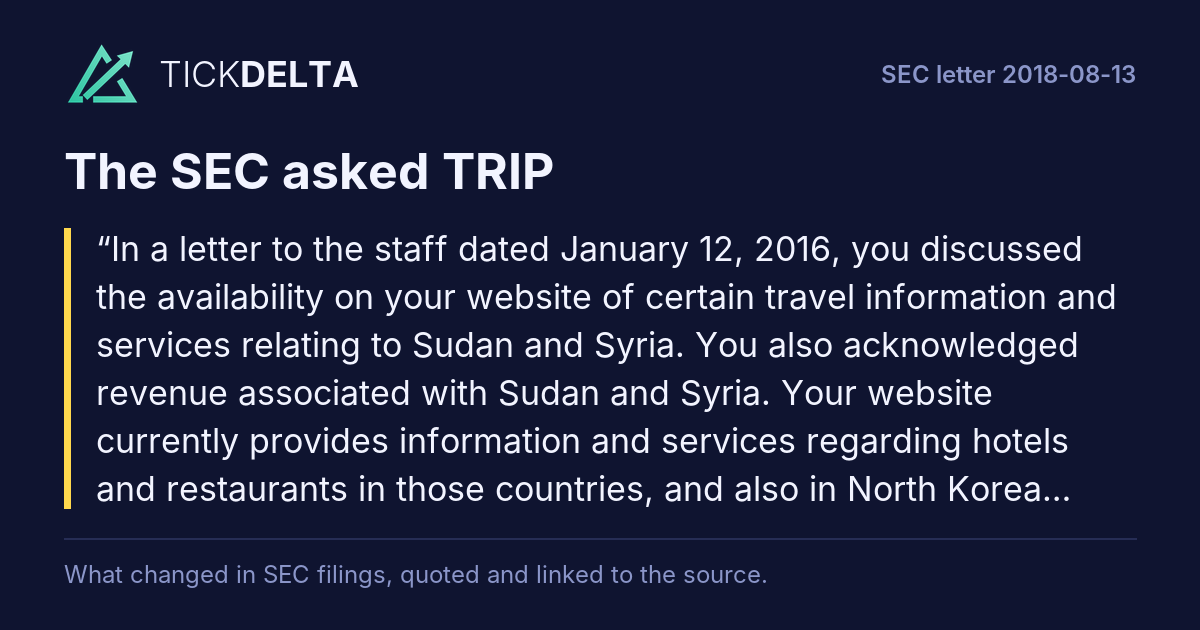
In a letter to the staff dated January 12, 2016, you discussed the availability on your website of certain travel information and services relating to Sudan and Syria. You also acknowledged revenue associated with Sudan and Syria. Your website currently provides information and services regarding hotels and restaurants in those countries, and also in North Korea.
Rest of the question

North Korea, Sudan and Syria are designated by the Department of State as state sponsors of terrorism, and are subject to U.S. economic sanctions and/or export controls. Please describe to us the nature and extent of any past, current, and anticipated contacts with North Korea, and any such contacts with Sudan and Syria since your 2016 letter, including contacts with their governments, whether through subsidiaries, affiliates, partners, customers or other direct or indirect arrangements. Please also discuss the materiality of those contacts, in quantitative terms and in terms of qualitative factors that a reasonable investor would deem important in making an investment decision. Tell us the approximate dollar amounts of revenues, assets and liabilities associated with those countries for the last three fiscal years and the subsequent interim period. Address for us the potential impact of the investor sentiment evidenced by divestment and similar initiatives that have been directed toward companies that have operations associated with U.S.-designated state sponsors of terrorism.

TRIP answered
“Company”) hereby advises the staff (the “Staff”) of the Securities and Exchange Commission (the “Commission”) that the Company has received the Staff’s letter dated August 13, 2018 (the

“Comment Letter”), regarding the Commission’s review of the Company’s Annual Report on Form 10-K for the fiscal year ended December 31, 2017. The Company respectfully requests an extension until September 14, 2018 to respond to the Comment Letter. The Company is committed to responding to the Comment Letter promptly and intends to provide a response to the Staff no later than September 14, 2018.
Read in the reply

Also in this review: company letter, Sep 14, 2018, closing letter, 2018-09-28

Form 10-K

2015-12-21 to 2016-01-19 · 2 questions · 1 letter from the SEC, 1 from the company
Review closed 2016-01-19
RevenueRussia and Ukraine
General
SEC asked (1)
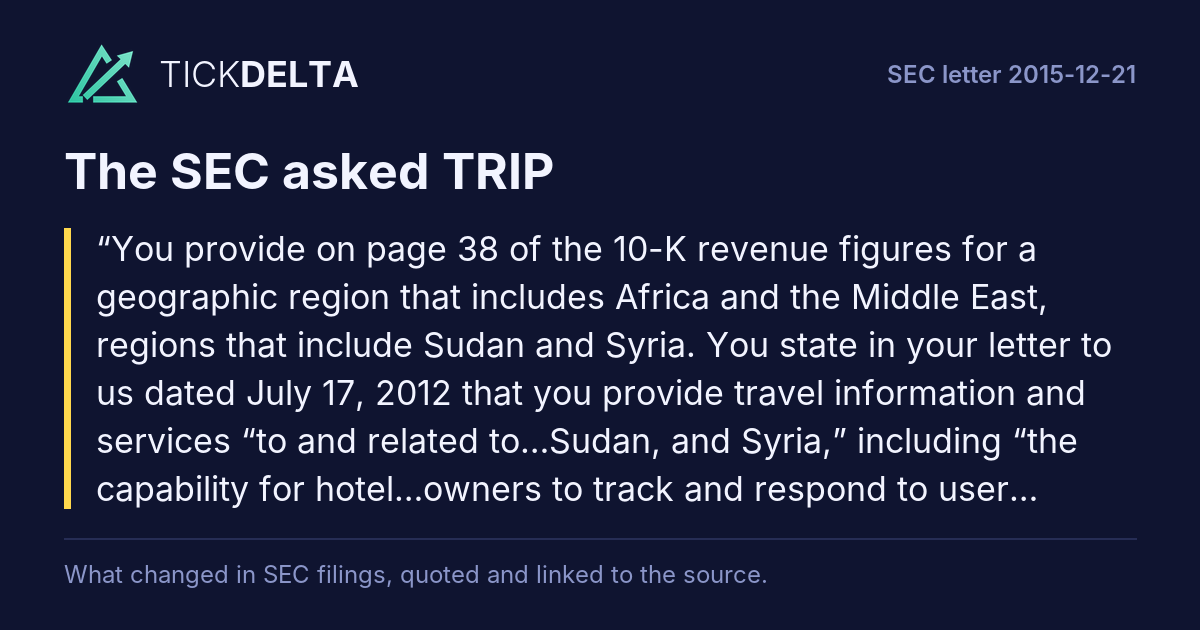
You provide on page 38 of the 10-K revenue figures for a geographic region that includes Africa and the Middle East, regions that include Sudan and Syria. You state in your letter to us dated July 17, 2012 that you provide travel information and services “to and related to…Sudan, and Syria,” including “the capability for hotel…owners to track and respond to user reviews and comments.” Your website provides
Rest of the question

“management photos” for hotels in Sudan and Syria. Sudan and Syria are designated by the Department of State as state sponsors of terrorism, and are subject to U.S. economic sanctions and export controls. Please describe to us the nature and extent of any past, current, and anticipated contacts with Sudan and Syria since the referenced letter, whether through subsidiaries, affiliates, partners, customers, joint ventures or other direct or indirect arrangements. You should describe any services, products, information or technology you have provided to Sudan or Syria, directly or indirectly, and any agreements, commercial arrangements, or other contacts you have had with the governments of those countries or entities they control.

TRIP answered
The Company operates a content-rich information website (located at tripadvisor.com and related country-specific domains) that serves as a travel

U.S. Securities and

Exchange Commission

Page research resource or ‘travel community’ for its visitors. The Company’s website aggregates user-generated reviews, photos, and other content about destinations, accommodations, restaurants and attractions and activities that visitors to the Company’s website can search, view and contribute to as part of their TripAdvisor experience.
Rest of the answer

These activities by visitors to our site (including reading and writing reviews or posting photos) do not generate revenues for the Company. Rather, the website is supported by an advertising business model, allowing users to freely access this information. Historically, the Company has derived substantially all of its revenue from the sale of advertising, primarily through click-based advertising, and to a lesser extent, display-based advertising.

As previously described in the Company’s letter to the Staff dated June 17, 2012, the Company, through its websites, does provide certain travel information and services to or relating to Sudan and Syria. These include hosting user-generated reviews pertaining to hotels, restaurants and attractions in these countries, hosting community forums in which users can share their travel experiences, providing displayand subscription-based advertising products, providing the capability for hotel and restaurant owners to respond to user reviews and comments, and linking to third-party travel-service providers where users may book flights and arrange in-country lodging, including to/in Sudan and Syria. We note that the Company’s website does not itself enable users to book flights to/from these countries. The Company believes that its provision of information and services in respect of these two countries is covered by exemptions to the applicable sanctions, as administered by the Office of

Foreign Assets Control, or OFAC. These include exemptions (a) covering First Amendment-protected free speech and authorizing the importation and exportation to/from each of these countries of “information and informational materials,”1 and (b) broadly authorizing the “arrangement or facilitation of travel” “to or from any country,” as well as all transactions “ordinarily incident to travel to or from any country.”2

Recently, the Company has also begun to generate transaction and other revenue by, directly and indirectly, making hotel room nights available for booking on the Company’s transaction-based sites, making short-term vacation rentals available through our vacation rentals business, selling destination activities through the Company’s Viator subsidiary and providing online restaurant reservations. However, the Company’s website prevents users from booking hotels or arranging

31 C.F.R. § 538.212(c) (Sudan: exempting importation and exportation of information and informational materials); § 542.206(b) (same for Syria).

31 C.F.R. § 538.212(d) (Sudan: “The prohibitions contained in this part do not apply to transactions ordinarily incident to travel to or from any country, including exportation or importation of accompanied baggage for personal use, maintenance within any country including payment of living expenses and acquisition of goods or services for personal use, and arrangement or facilitation of such travel including nonscheduled air, sea, or land voyages.”); § 542.206(c) (same for Syria).

vacation rentals, destination activities or restaurant reservations in either Sudan or

Syria. As a result, based on a review of its records and to our knowledge, the Company confirms that it has not generated any transaction and other revenue from hotels, rentals, destination activities or restaurants based in Sudan or Syria during the fiscal years 2012, 2013, 2014 and 2015.

The Company, which closely monitors the sanctions against Sudan, Syria, and other countries to ensure regulatory compliance and to provide travel advisory warnings when appropriate, anticipates that it will continue to rely upon these exemptions so long as they are available under U.S. law.

The Company does not have any business operations, subsidiaries, affiliated entities or employees in Sudan or Syria. TripAdvisor has never had any form of agreement, arrangement, or other form of contact with the governments of Sudan or Syria, or, to its knowledge, entities those governments control.

Read in the reply
General
SEC asked (2)
Please discuss the materiality of any contacts with Sudan and Syria you describe in response to the comment above, and whether those contacts constitute a material investment risk for your security holders. You should address materiality in quantitative terms, including the approximate dollar amounts of any associated revenues, assets, and liabilities for the last three fiscal years and the subsequent interim
Rest of the question

period. Also, address materiality in terms of qualitative factors that a reasonable investor would deem important in making an investment decision, including the potential impact of corporate activities upon a company's reputation and share value. As you know, various state and municipal governments, universities, and other investors have proposed or adopted divestment or similar initiatives regarding investment in companies that do business with U.S.-designated state sponsors of terrorism. You should address the potential impact of the investor sentiment evidenced by such actions directed toward companies that have operations associated with Sudan and Syria.

TRIP answered
The Company does not believe that the limited contacts with respect to Sudan and Syria described in response to the foregoing comment are material in quantitative or qualitative terms, nor does the Company believe that such limited contacts present a material investment risk to its stockholders.

On a quantitative basis, during full fiscal years 2012, 2013, 2014 and 2015, the Company’s revenues, assets and liabilities associated in any way with Sudan and Syria were immaterial.
Rest of the answer

During those periods, there were no assets, including accounts receivable, or liabilities associated with Sudan and Syria. The Company’s largest sources of revenues, generally, and also with respect to these two countries, are the advertising revenues generated when a user of the TripAdvisor website clicks through to a third-party site to consult hotel availability or book a flight, which, as explained in response to Comment No. 1 above, is lawful under the existing sanctions laws. We note that even in the aggregate, the Company’s revenues associated in any respect with these two countries are de minimis. Below is a breakdown of the estimated total advertising revenues associated with Sudan and Syria for fiscal years 2012, 2013, 2014 and 2015 as compared to total consolidated revenue for the same periods. Note that with respect to “Revenue Associated with Sudan and Syria” below we have estimated revenue that could potentially be attributed to these sites based on a number of factors which are variable and not static; as a result the amounts are not exact.

2012

2013

2014

2015

Revenue Associated with Sudan and Syria

$

6,537

2,758

3,659

5,534

Total Revenues (in millions)

763

945

1,246

1,183

Percentage

.00001

%

Furthermore, the Company does not have any present intention to expand its business activities in any of these countries and, therefore, does not expect its contacts with these countries to have any future material impact to its business, financial condition or results of operations.

On a qualitative basis, the Company does not believe that a reasonable person would consider its limited business related to Sudan and Syria to have a material impact on making an investment decision regarding the Company’s securities. To its knowledge, the Company has not received any investor inquiries about its limited contacts with respect to these countries. Further, given the limited nature of the Company’s indirect contacts, the Company does not believe that it would be impacted by the divestment and similar initiatives mentioned in the Staff’s comment or that its limited contacts will materially impact the

Company’s reputation or share value.

* * *

In connection with the responses in this letter, the Company acknowledges that:

• the Company is responsible for the adequacy and accuracy of the disclosure in the filings;

Staff comments or changes to disclosure in response to Staff comments do not foreclose the Commission from taking any action with respect to the filings; and the Company may not assert Staff comments as a defense in any proceeding initiated by the Commission or any person under the federal securities laws of the United States.

If you have any further questions or comments concerning this response, or if you require additional information, please contact the undersigned at (781) 800-8785.

Read in the reply

Also in this review: request for more time, Jan 8, 2016, closing letter, 2016-01-19

Form 10-K for the Fiscal Year Ended December 31, 2013

2014-04-08 to 2014-12-09 · 10 questions · 3 letters from the SEC, 4 from the company
Review closed 2014-12-09
RevenueExecutive payResults discussion (MD&A)
Management’s Discussion and Analysis of Financial Condition and Results of Operations · Revenue, page 45
SEC asked (1)
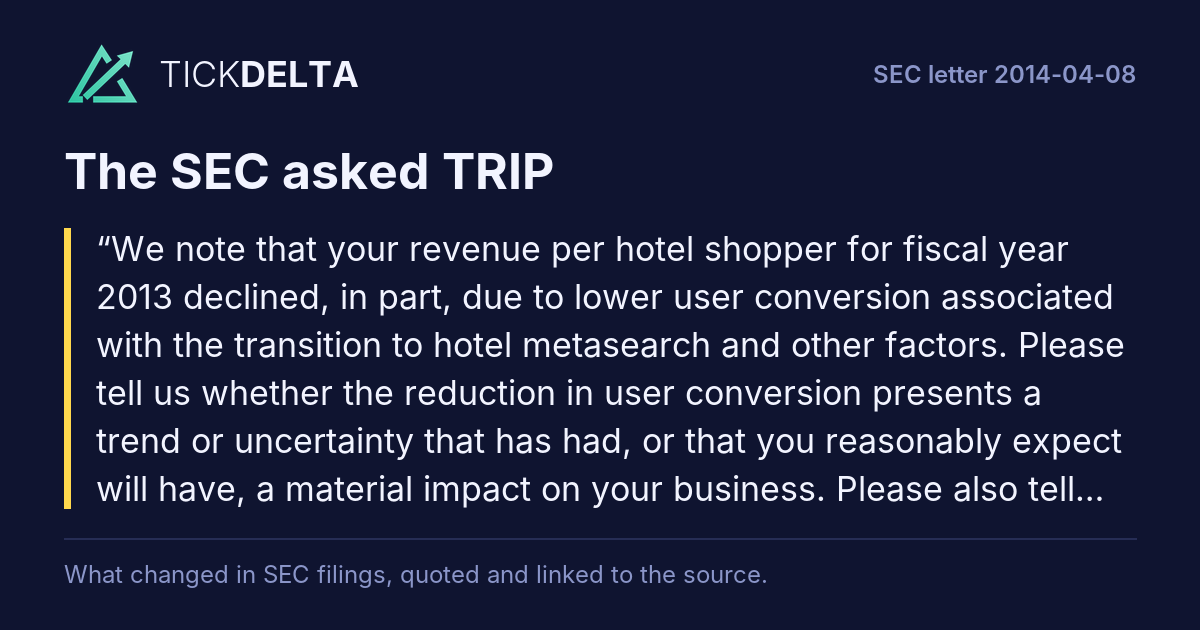
We note that your revenue per hotel shopper for fiscal year 2013 declined, in part, due to lower user conversion associated with the transition to hotel metasearch and other factors. Please tell us whether the reduction in user conversion presents a trend or uncertainty that has had, or that you reasonably expect will have, a material impact on your business.
Rest of the question

Please also tell us what consideration you have given to disclosing qualitative and quantitative information regarding the user conversion rate and its change from period to period. Refer to Item 303(a)(3)(ii) of Regulation S-K and Section III.A of SEC Release 33-8350.

TRIP answered
This letter is being furnished on behalf of TripAdvisor, Inc. (the “Company”) in response to comments contained in the letter dated April 8, 2014 (the “Letter”) from Stephen Krikorian of the Staff (the “Staff”) of the U.S. Securities and Exchange Commission (the “Commission”) to Julie M.B. Bradley, Chief Financial Officer of the Company, with respect to the Company’s Annual Report on Form 10-K for the Fiscal Year Ended December 31, 2013 (File No. 001-35362) that was filed with the Commission on February 11, 2014 (the “2013 Form 10-K”). The responses set forth below have been organized in the same manner in which the Commission’s comments were organized.
Rest of the letter

The responses provided herein are based upon information provided to Goodwin Procter LLP by the Company. Copies of this letter are being sent under separate cover to Laura Veator and Barbara C. Jacobs of the Commission. The Company has acknowledged to us that it is responsible for the accuracy and adequacy of the disclosures made in the Form 10-K and it has authorized this firm to respond to the Letter as follows: Discussion and Analysis of Financial Condition and Results of Operations We note that your revenue per hotel shopper for fiscal year 2013 declined, in part, due to lower user conversion associated with the transition to hotel metasearch and other factors. Please tell us whether the reduction in user conversion presents a trend or uncertainty that has had, or that you reasonably expect will have, a material impact on your business. Please also tell us what consideration you have given to disclosing qualitative and quantitative information regarding the user conversion rate and its change from period to period. Refer to Item 303(a)(3)(ii) of Regulation S-K and Section III.A of SEC Release 33-8350. United States Securities and Exchange Commission In the Quarterly Report on Form 10-Q for the three months ended September 30, 2013 and the 2013 Form 10-K, we identified the decline in revenue per hotel shopper as a material trend based on our reasonable expectation that this trend would continue to have a material impact on our business. As described in the 2013 Form 10-K, the reason for the decline in revenue per hotel shopper was the result of several factors, including (i) our recent transition to hotel metasearch, (ii) the growth in hotel shoppers on smartphones, which have a lower monetization rate than desktops and tablets, and (iii) the growth in emerging international markets, which are currently monetizing at lower levels than our mature markets. Our transition to hotel metasearch, which was introduced to improve the user experience, has caused a significant and persistent shift to new levels of user conversion, which is a measure of how many hotel shoppers ultimately click on a link that generates revenue for us. However, we do not believe there is a reasonable likelihood of the recurrence of such a shift in future periods. Therefore, we determined that a quantification of user conversion, and the comparison of a user conversion rate in a period in which hotel metasearch was utilized to a user conversion rate in a historic period that preceded the transition to hotel metasearch, would not provide meaningful information to an investor. In addition, we described in our Management’s Discussion and Analysis of Financial Condition and Results of Operations, user conversion is merely one component of revenue per hotel shopper, which is one driver of our click-based revenue stream, and there are other factors impacting revenue generally and clickbased revenue in particular. These factors and their influence over revenue continue to evolve as we implement new strategies and develop new revenue generating activities. As a result, we believe that disclosing detailed qualitative and quantitative information regarding the user conversion rate and its change from period to period, would place too much emphasis on this one component of one source of revenue and could potentially be misleading given the lack of a direct correlation between user conversion rates and revenue per hotel shopper. Furthermore, we believe that following the completion of the metasearch transition period, the user conversion rates with hotel metasearch will stabilize and cease to have as meaningful an impact on revenue per hotel shopper. For example, in the first quarter of 2014, despite a decline in user conversion during that period in comparison to the first quarter of 2013, we are seeing an increase in revenue per hotel shopper due to the inherent improvements in cost-per-click pricing, or CPC pricing, associated with the online travel agency, (“OTA”), bidding process that underlies the hotel metasearch business model. If we determine that this is not the case, and that trends in user conversion are material to an investor’s understanding of long-term trends in revenue per hotel shopper, we will reconsider our disclosure. Currently, we continue to focus our efforts, and our disclosure, on strategies that will increase revenue per hotel shopper, including, but not limited to: improved strategies to further monetize on our mobile platform as our number of mobile visitors continues to grow, and the increased maturity of our OTA bidding process in emerging international markets. We note from your disclosure on page 16 that CPC pricing for click-based advertising is based, in part, on competition between advertisers. Your disclosure on page 47 also explains how the change in CPC pricing paid by Expedia during fiscal years 2011 to 2013 had an impact on revenue during these years. Please tell us how the CPC pricing paid by other advertisers, including Priceline, has changed, if at all, over the past three years and whether any price change has had a material impact on your revenues during that time. See Item 303(a)(3)(iii) of Regulation S-K. As a result of the spin-off from Expedia in December 2011, we had expected Expedia to lower its CPC pricing by 10-15% beginning in the fourth quarter of 2011, as noted in each of our Annual Reports on Form 10-K for the periods ended December 31, 2011 and December 31, 2012, and therefore continued to provide more detailed disclosure related to pricing for Expedia in our 2013 Form 10-K. However, we respectfully inform the Staff that in fiscal years 2011 and 2012, CPC pricing paid by advertisers other than Expedia did not fluctuate materially and did not have a material impact on our revenues. Furthermore, while there was an average increase in CPC pricing in fiscal year 2013 that contributed to our revenues, this increase was generally consistent across all of our advertisers. The key driver of this increase was related to the implementation of hotel metasearch which we completed in June 2013. Our metasearch capabilities allowed us to deliver higher quality clicks to our customers, including Expedia and Priceline; as a result, our customers are willing to bid and pay higher prices for this traffic. Our customers, including OTAs, that participate in the bidding process, determine the CPC pricing paid. The amount they are willing to bid for any particular property can be be affected by a variety of factors, such as customer bid optimization and initiatives to expand their reach or achieve other strategic outcomes. As a result, any material pricing trends are difficult to predict. Further, our form of advertising agreement, which we have entered into with Priceline and our other OTA customers and recently entered into with Expedia, does not contain terms related to pricing; as stated above, the prices paid by our customers are determined in the bidding process. As a result, we are not currently contemplating any additional disclosure, but are continually evaluating our disclosure and intend to provide additional information to the extent trends are known and determined to be material to an investor’s understanding of our business. You state that for the fiscal year 2013, your two most significant advertising customers, Expedia and Priceline (and their subsidiaries), each accounted for more than 10% of your total revenue and combined accounted for 47% of total revenue. Of this percentage, Expedia comprised 23% while Priceline comprised 24%. Prior fiscal years show similar concentration with these customers. Please advise of the consideration given to filing your advertising agreements with these entities or incorporating by reference these agreements. In this regard, we note that a master advertising agreement (CPC) with Expedia was filed in an 8-K filed in December 2011 and amended in March 2012; while this 8-K and amendment were incorporated by reference into your fiscal year 2012 10-K, they were not incorporated into your fiscal year 2013 10-K. Further, we believe that the material terms of your advertising agreements with Expedia and Priceline should be set forth in future filings. The Master Advertising Agreement (CPC) with Expedia filed in the Current Report on Form 8-K in December 2011 and amended March 2012, has been terminated and is no longer in effect. Instead, we have entered into our standard form of advertising agreement with Expedia, which is the same form of advertising agreement we have entered into with Priceline and our other OTA customers. As described above, our advertising agreements do not contain pricing terms, as pricing is determined pursuant to the OTA bidding process, but do contain terms related to payment mechanics, advertising criteria and other general provisions. This form of agreement was filed as Exhibit 10.21 to our 2013 Form 10-K, and in the future, as per the Staff’s comment, the Company plans to include a summary description of the terms of this agreement in its annual reports on Form 10-K. If you require additional information, please telephone the undersigned at (617) 570-1021.

One letter for all the questions, without numbered answers. Read the reply
In its next report

First report after the company's reply of May 6, 2014: 10-Q filed Jul 28, 2014 ↗, against the 10-Q filed Oct 23, 2013 ↗.

Tickdelta does not hold the text of both reports, so they are not compared here.

Management’s Discussion and Analysis of Financial Condition and Results of Operations · Revenue, page 45
SEC asked (2)
We note from your disclosure on page 16 that CPC pricing for click-based advertising is based, in part, on competition between advertisers. Your disclosure on page 47 also explains how the change in CPC pricing paid by Expedia during fiscal years 2011 to 2013 had an impact on revenue during these years.
Rest of the question

Please tell us how the CPC pricing paid by other advertisers, including Priceline, has changed, if at all, over the past three years and whether any price change has had a material impact on your revenues during that time. See Item 303(a)(3)(iii) of Regulation S-K.

TRIP answered

See the reply above.

In its next report

First report after the company's reply of May 6, 2014: 10-Q filed Jul 28, 2014 ↗, against the 10-Q filed Oct 23, 2013 ↗.

Tickdelta does not hold the text of both reports, so they are not compared here.

Exhibits; Financial Statement Schedules, page 115
SEC asked (3)
You state that for the fiscal year 2013, your two most significant advertising customers, Expedia and Priceline (and their subsidiaries), each accounted for more than 10% of your total revenue and combined accounted for 47% of total revenue. Of this percentage, Expedia comprised 23% while Priceline comprised 24%. Prior fiscal years show similar concentration with these customers.
Rest of the question

Please advise of the consideration given to filing your advertising agreements with these entities or incorporating by reference these agreements. In this regard, we note that a master advertising agreement (CPC) with Expedia was filed in an 8-K filed in December 2011 and amended in March 2012; while this 8-K and amendment were incorporated by reference into your fiscal year 2012 10-K, they were not incorporated into your fiscal year 2013 10-K. Further, we believe that the material terms of your advertising agreements with Expedia and Priceline should be set forth in future filings.

TRIP answered

See the reply above.

In its next report

First report after the company's reply of May 6, 2014: 10-Q filed Jul 28, 2014 ↗, against the 10-Q filed Oct 23, 2013 ↗.

Tickdelta does not hold the text of both reports, so they are not compared here.

Operations · Revenue, page 45
SEC asked (1)
We note our prior comment 3 and your related response. Please confirm that the Master Advertising Agreement entered into with each of Expedia and Priceline is the only agreement governing your relationships with those customers.
Rest of the question

Further, please ensure that future disclosures describe not only the material terms of this form agreement, but also how this agreement functions with respect to your relationships with Expedia and Priceline, to the extent that these relationships remain material. This discussion should specifically identify any material differences in your agreements with these material customers from the form agreement, and note the termination dates of the agreements entered into with such customers.

TRIP answered
The Company respectfully advises the Staff that the TripAdvisor Media Group Master Advertising Insertion Form is the primary arrangement that the Company has entered into with respect to Expedia and the only arrangement entered into with Priceline and accounted for approximately 99.89% and 100%, respectively, of the total revenue received from each party during the last fiscal year. The Company has also entered into a Master Content Licensing Agreement with Expedia

(the “Content Agreement”), and is not party to any other contractual arrangements with Priceline.
Rest of the answer

The Content Agreement relates to the licensing of TripAdvisor ratings, reviews and information for hotels, restaurants and attractions on the Expedia website and accounts for less than 1% of the Company’s revenue.

Item 601 of Regulation S-K provides that “[i]f the contract is such as ordinarily accompanies the kind of business conducted by the registrant and its subsidiaries, it will be deemed to have been made in the ordinary course of business and need not be filed.”

Because the Company views the Content Agreement as being in the ordinary course of its business, it would have to fall into one of the categories set forth in Item 601(b)(10)(ii) of Regulation S-K in order to be required to be filed. The

Company respectfully submits that this agreement does not fall into any of the categories described in Item 601(b)(10)(ii)(A), (C) or (D). Furthermore, the Company’s business is not substantially dependent on this agreement, so it is not required to be filed under Item 601(b)(10)(ii)(B).

In addition, the

Company confirms to the Staff that in future Form 10-K filings, the Company intends to provide an additional description of the terms of the Master Advertising Insertion Form, which was filed as Exhibit 10.21 to the Form 10-K, including all of the additional disclosures requested by the Staff in its comment. The Company also notes that the Company has reviewed the executed customer agreements and confirmed that currently there are no material differences between the executed versions and the

“form of” the agreement, which is consistent with Instruction 1 to Item 601(a) of Regulation S-K. In the event that the Company enters into a Master Advertising Insertion Form with a material customer that contains material differences from the form, the Company will file that agreement and identify the material differences in its disclosures.

Read in the reply
Operations · Revenue, page 45
SEC asked (2)
We note from your responses that your form advertising agreement does not contain pricing terms, but that rather “pricing is determined pursuant to the OTA bidding process.” Please enhance your disclosure in future filings to describe the mechanics of this bidding process.
Rest of the question

Please tell us in your response, with a view towards expanding future disclosures, how terms related to pricing and payment mechanics with your customers are memorialized.

TRIP answered
In response to the Staff’s comment, the Company intends to enhance its disclosure in future Form 10-K filings to describe the mechanics of the bidding process. Our hotel provider customers, including online travel agencies (“OTAs”), large hotel chains and hoteliers with a Business Listings account, are able to use our proprietary system to submit Cost-Per-Click

(“CPC”) bids to have their rates and availability listed on our site.
Rest of the answer

When the customer submits a CPC bid they agree to pay the amount of that bid each time a user subsequently clicks on the URL link to the customer’s website.

Bids are submitted periodically – sometimes as often as daily or weekly – on a property-by-property basis and the size of the bid relative to other bids received determines the customer’s placement in all meta placements on our site with one or more offer shown, including hotel comparison search results and the property detail page, in each case on both mobile and desktop platforms. The system is automated and the size of the customer’s bid is the only factor impacting the customer’s placement on that page, except that individual customers may be sorted lower in the event that they have not provided price information or if they cease to have availability for the property. Our customers are able to set spending limits or caps in the event that the number of clicks received in a particular period exceeds the amount that customer wishes to spend, at which point the customer’s link will be removed from the search results. Clicks are recorded by the Company and subsequently invoiced to the customer monthly. These and other terms related to pricing and payment mechanics are set forth in the Company’s Master Advertising Insertion Order, which was filed as Exhibit 10.21 to the Form 10-K.

Item 11. Executive Compensation (Incorporated by Reference from Definitive Proxy Statement Filed April 30, 2014)

Read in the reply
Item 11. Executive Compensation (Incorporated by Reference from Definitive Proxy Statement · Compensation Discussion and Analysis, page 21
SEC asked (3)
Item 402(a)(3) of Regulation S-K requires that the company disclose executive compensation for its principal executive officer, principal financial officer and “three most highly compensated executive officers other than the principal executive officer and the principal financial officer who were serving at the end of the last completed fiscal year.” Please advise why the company provides executive compensation
Rest of the question

disclosure for only three named executive officers.

TRIP answered
Based on the standards for determining “executive officers” set forth in Exchange Act Rule 3b-7, the Company has determined that, as of December 31, 2013, Mr. Stephen Kaufer, its principal executive officer, Ms. Julie M.B. Bradley, its principal financial officer, and Mr. Seth J. Kalvert, its principal legal officer, were the only “executive officers” of the Company, and, therefore, has provided executive compensation disclosure for three named executive officers, rather than five, in its 2014 Proxy Statement.

Under Exchange Act Rule 3b-7, an “executive officer” means a company’s “president,
Rest of the answer

any vice president of the registrant in charge of a principal business unit, division or function (such as sales, administration or finance), any other officer who performs a policy making function, or any other person who performs similar policy making functions for the registrant.” Mr. Kaufer is in direct control of all aspects of the Company’s business operations in his role as the President and Chief

Executive Officer, except for certain specialized areas such as finance and legal functions. The other employees in the Company’s principal business units, divisions or functions, except finance and legal functions, do not have the authority to formulate policy or make major decisions on behalf of the Company; these other employees are tasked with implementing the policies and decisions made by Mr. Kaufer. Ms. Bradley, as the Company’s SVP,

Chief Financial Officer, Chief Accounting Officer and Treasurer, is in charge of the Company’s finance function and is the Company’s principal financial officer and principal accounting officer. Mr. Kalvert, as the Company’s SVP, General Counsel and Secretary, is in charge of the Company’s legal function. Consistent with this management structure, the Company’s Board of Directors has determined that, as of

December 31, 2013, the only “executive officers” of the Company, as defined in Exchange Act Rule 3b-7, are Mr. Kaufer, Ms. Bradley and Mr. Kalvert.

The Company evaluates, on an annual basis, the roles and responsibilities of its various officers and key employees in connection with the preparation of its periodic reports. In the event the Company determines that any additional persons meet the standards of an “executive officer,” particularly as the Company grows through new product introductions and through acquisitions, the Company will provide appropriate disclosures, including the disclosure required under Item 402 of Regulation S-K, in all of its future filings with the Commission.

Read in the reply
In its next report

First report after the company's reply of Jul 24, 2014: 10-Q filed Jul 28, 2014 ↗, against the 10-Q filed Oct 23, 2013 ↗.

Tickdelta does not hold the text of both reports, so they are not compared here.

Item 11. Executive Compensation (Incorporated by Reference from Definitive Proxy Statement · Compensation Discussion and Analysis, page 21
SEC asked (4)
Your discussion of each element of compensation, including base salary, annual cash bonus awards, and equity awards, does not indicate how you determined the awards for your named executive officers on an individualized basis.
Rest of the question

For example, you mention certain of the factors management takes into consideration in determining whether to recommend a cash bonus or equity awards, but do not discuss on an individualized basis, how these factors affected the determination in awarding a cash bonus and equity award for each named executive officer. Tell us in your response letter, and with a view towards expanded disclosure in future filings, the elements of company or individual performance, both quantitative and qualitative, as well as any specific contributions the Section 16 Committee considered in its evaluation, and if applicable, how they were weighted and factored into specific compensation decisions for each executive officer, discussed on an individualized basis.

TRIP answered
Please see below for the manner in which the Company’s compensation committee (the “Committee”) determined the specified amount of each element of compensation, including base salary, annual cash bonus awards, and equity awards, for our named executive officers on an individualized basis. As previously disclosed in our proxy statement filed with the SEC on April 30, 2014 (the “Proxy Statement”), during fiscal year 2014, the Committee engaged Compensia, Inc.
Rest of the answer

to assist in an evaluation of the Company’s peer group, to provide competitive compensation market data for certain executive officers positions using peer group data and to advise on matters related to our long-term incentive program structure.

Stephen

Kaufer: The Committee made no changes to Mr. Kaufer’s base salary of $500,000 in 2013 because it wanted to keep Mr. Kaufer’s fixed compensation at a relatively low percentage of his total compensation.

Mr. Kaufer’s variable compensation for fiscal year 2013 was established based on the Company’s financial performance and growth and other non-financial performance metrics, including significant increases in hotel shoppers, unique monthly visitors and other key metrics, the transition to metasearch functionality undertaken by the Company during 2013, and the acquisition of six companies during fiscal 2013. Based on the achievement of these performance goals, acknowledgement by the Committee that the transition to metasearch functionality did not happen as quickly and seamlessly as planned, consideration by the Committee of the factors listed in the Proxy Statement, and the Committee’s review of the third party compensation survey prepared by Compensia, the Committee determined that a cash bonus payment of $450,000 (or 90% of target) was appropriate. In addition, the Committee concluded that it was important for the Company to provide Mr. Kaufer with sufficient incentive to remain with the Company for the long term. After consultation with its compensation consultant and a thorough analysis of peer group CEO compensation data, the Committee concluded that the best retention tool was a sizable option grant with an extended vesting period and targeted the value of such option grant at approximately the median level of peer group long-term equity incentive compensation. Accordingly, in August 2013, the Committee approved a grant to

Mr. Kaufer of an option to purchase 1,100,000 shares of common stock. This option vests in equal installments on the fourth and fifth anniversary of the date of grant so Mr. Kaufer will not be able to benefit from this grant unless he remains with the Company during that period. Additionally, in consideration of the option grant, Mr. Kaufer agreed to certain restrictive covenants which benefit the Company.

Julie M.B. Bradley: The Committee targeted Ms. Bradley’s total compensation at approximately the median level of peer group compensation. Accordingly, the Committee raised Ms. Bradley’s 2013 base salary from $302,500 to $365,000. Ms. Bradley’s variable compensation for fiscal year 2013 was established based on her individual performance achievements, including the implementation of several corporate initiatives, improvements in the Company’s finance and accounting function, her management of several key human resources initiatives including the successful recruiting and onboarding of approximately 700 full-time hires, the integration of six acquisitions, and execution of the lease for the Company’s new corporate headquarters. Based on these individual performance achievements, the Committee’s assessment of these achievements, consideration by the Committee of the factors listed in the Proxy Statement, consideration of the third party compensation survey prepared by Compensia and consideration of the recommendation of Mr. Kaufer, the Committee approved a cash bonus payment of $216,810 (or 90% of target), and the grant of an option to purchase 83,101 shares of common stock to Ms. Bradley, subject to the vesting terms and other conditions set forth in the Proxy Statement.

Seth J. Kalvert: The Committee also targeted Mr. Kalvert’s total compensation at approximately the median level of peer group compensation. Accordingly, the Committee raised Mr. Kalvert’s 2013 base salary from $330,000 to $350,000 to reflect that foregoing consideration and also so that the base salary was more commensurate with Mr. Kalvert’s increased responsibilities with the growth in the legal department of the Company. Mr. Kalvert’s variable compensation for fiscal year 2013 was established based on his management of various government affairs, litigation and compliance initiatives, the negotiation and completion of numerous acquisitions, corporate leases, and key commercial and partnership agreements, and the coordination of critical governance matters during the period. Based on these individual performance achievements, the Committee’s assessment of these achievements, consideration by the Committee of the factors listed in the Proxy Statement, consideration of the third party compensation survey prepared by Compensia and consideration of the recommendation of Mr. Kaufer, the Committee approved a cash bonus payment of $166,250 (or 95% of target), and the grant of an option to purchase 50,473 shares of common stock to Mr. Kalvert, subject to the vesting terms and other conditions set forth in the Proxy Statement.

Although each of the listed elements described above was important to the Committee’s determinations for each named executive officer, the Committee did not assign a specific weight to any element and did not measure individual performance against an objective standard in the evaluation of an executive officer’s base salary, and none of the compensation increases or adjustments could be described as formulaic. Rather, as the disclosure indicates, the Committee uses its subjective judgment and draws on the recommendations of the Company’s President and Chief Executive

Officer.

The Company will, in future filings, provide expanded disclosure relative to how it arrived at and why it paid each particular level of compensation to its named executive officers.

Read in the reply
In its next report

First report after the company's reply of Jul 24, 2014: 10-Q filed Jul 28, 2014 ↗, against the 10-Q filed Oct 23, 2013 ↗.

Tickdelta does not hold the text of both reports, so they are not compared here.

Annual Cash Bonuses, page 23
SEC asked (5)
You state that annual cash bonuses to your named executive officers are subject to achievement of performance goals related to either stock price performance or revenue, but that management also takes into consideration a number of factors in recommending bonuses, “including, but not limited to,” the factors enumerated on page 24. Tell us what other factors are considered in recommending annual bonuses.
Rest of the question

Further, although you have identified certain performance objectives used to determine achievement of a business unit performance, your disclosure should address performance objectives on an individualized basis. Tell us what impact non-achievement of these individual or business unit performance goals would impact availability of the bonus awards.

TRIP answered
The Company respectfully directs the Staff’s attention to the Company’s response to Comment #4, which provides additional information on an individualized basis as requested. The Company also agrees that in future filings it will disclose the potential impact of non-achievement of performance goals on the availability of the cash bonus awards.
Read in the reply
In its next report

First report after the company's reply of Jul 24, 2014: 10-Q filed Jul 28, 2014 ↗, against the 10-Q filed Oct 23, 2013 ↗.

Tickdelta does not hold the text of both reports, so they are not compared here.

Equity Awards, page 25
SEC asked (6)
Please tell us what factors in addition to those listed at the bottom of page 25 were considered by the Compensation Committee and management in establishing the equity grant pool and recommending individual equity awards.
TRIP answered
The Company respectfully directs the Staff’s attention to the Company’s response to Comment #4, which provides additional information on an individualized basis as requested. In determining the size of the equity incentive pool for 2013, the Committee took into account various factors, including the anticipated hiring and retention needs of the Company, the number of shares that remain available in the Company’s stock plan, the need to manage the burn rate, peer group data and the impact of equity grants on the Company’s financial statements.

If you require additional information, please
Rest of the answer

telephone the undersigned at (617) 570-1021.

Read in the reply
In its next report

First report after the company's reply of Jul 24, 2014: 10-Q filed Jul 28, 2014 ↗, against the 10-Q filed Oct 23, 2013 ↗.

Tickdelta does not hold the text of both reports, so they are not compared here.

Definitive Proxy Statement on Schedule 14A · Compensation Discussion and Analysis, page 21
SEC asked
We acknowledge your response to prior comment 1, however, the information that was evaluated in determining whether any other employee was an executive officer as defined in Rule 3b-7 of the Exchange Act appears to take too broad a view of that definition.
Rest of the question

In that regard, we note that the rule does not require that a vice president or other officer “in charge of a principal business unit, division or function” have a policy making function or be able to independently act without approval from another executive officer, such as your Chief Executive or Chief Financial Officer. That is, a vice president or other officer or employee in charge of a principal business unit or function would be considered an executive officer under the rule by virtue of that role and irrespective of such person’s ability to set policy or engage in certain of the functions described in your response. It appears, based on your disclosures about your business operations and the list of management on your investor relations website, that there are other employees in charge of principal business units or functions that could be executive officers as defined in the rule. In your response, please identify the two most highly compensated officers, other than Messrs. Kaufer and Kalvert and Ms. Bradley, who were serving as officers as of December 31, 2013, provide us with position descriptions and/or employment agreements for those employees, and provide us with further analysis regarding whether each person so identified is an executive officer within the meaning of Rule 3b-7 of the Exchange Act.

TRIP answered
TripAdvisor, Inc. (the “Company”) hereby advises the staff (the “Staff”) of the Securities and Exchange

Commission (the “Commission”) that the Company has received the Staff’s letter dated September 19, 2014 (the “Comment Letter”), regarding the Commission’s review of the Company’s Annual Report on

Form 10-K for the fiscal year ended December 31, 2013 and the Definitive Proxy Statement on Schedule 14A for the 2014 Annual Meeting.
Rest of the answer

The Company respectfully requests an extension until November 19, 2014 to respond to the Comment

Letter in order to provide sufficient time for the Company to prepare the response and obtain the necessary Compensation Committee approvals. The Company also acknowledges the delay in filing this request for extension. Based on a call with the

Staff following its receipt of the Comment Letter, the Company began work on its response without making a formal request for extension. The Company is committed to responding to the Comment Letter promptly and intends to provide a response to the

Staff no later than November 19, 2014. Should you have any questions regarding the request made herein, please do not hesitate to contact me at (617) 570-1021. Thank you very much for your cooperation in this matter.

Read in the reply
In its next report

First report after the company's reply of Oct 31, 2014: 10-Q filed Nov 4, 2014 ↗, against the 10-Q filed Oct 23, 2013 ↗.

Tickdelta does not hold the text of both reports, so they are not compared here.

Also in this review: request for more time, Apr 16, 2014, request for more time, Jul 1, 2014, company letter, Sep 11, 2014, closing letter, 2014-12-09

Form 10-K for the Fiscal Year Ended December 31, 2012

2013-05-28 to 2013-06-20 · 1 question · 1 letter from the SEC, 1 from the company
Review closed 2013-06-20
RevenueResults discussion (MD&A)
Operations · Key Drivers of Click-Based Advertising Revenue, page 37
SEC asked
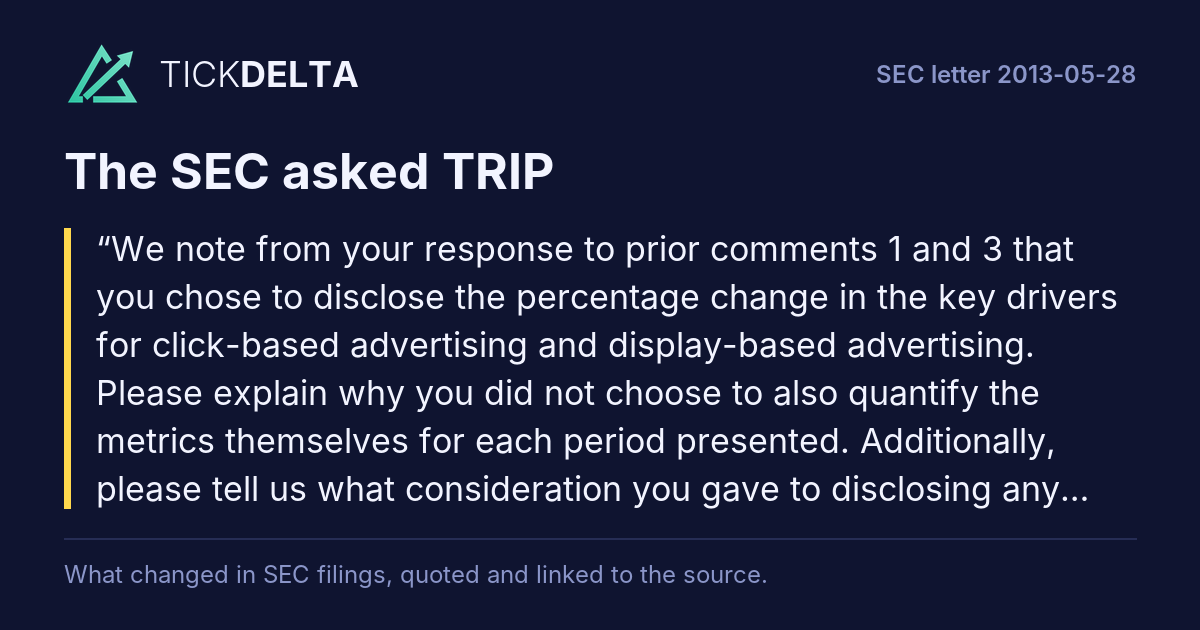
We note from your response to prior comments 1 and 3 that you chose to disclose the percentage change in the key drivers for click-based advertising and display-based advertising. Please explain why you did not choose to also quantify the metrics themselves for each period presented.
Rest of the question

Additionally, please tell us what consideration you gave to disclosing any possible limitations associated with calculating these metrics (e.g., the presence of fictitious or duplicate users), as applicable. In this regard, it appears that your response to prior comments 1 and 3 and related proposed disclosure in Exhibit A to your response letter did not address this portion of our prior comments.

TRIP answered
The Company respectfully advises the Staff that the year-over-year percentage changes of certain key drivers for click-based advertising and display-based advertising, which were included in the Company’s Response Letter, are metrics that the Company’s management uses internally to evaluate its business performance. Year-over-year percentage changes have a strong correlation to revenue trends and are also more useful as compared to gross amounts, which often fluctuate quarter to quarter given the seasonality trends in the Company’s business.
Rest of the answer

In light of the foregoing, it is the Company’s view that the disclosure of the percentage changes, rather than gross amounts, provides investors with useful and understandable information as to the material trends in the Company’s business consistent with SEC Release No. 33-8350, as well as access to the same set of tools that management uses to analyze the Company’s results. This view has been validated by informal feedback received from investors and analysts, who have indicated that the growth rates are helpful non-financial metrics to correlate between click-based advertising revenue growth and year-over-year hotel shopper growth, as well as between display-based advertising revenue growth and the growth in number of impressions and pricing. In addition to being a useful presentation for investors, the Company also believes that this level of disclosure is consistent with other companies in its industry.

Additionally, the Company respectfully advises the Staff that, given the importance of these metrics to the Company’s management in their evaluation of the Company’s performance and stewardship of its business, the Company has implemented ongoing and rigorous processes designed to eliminate from its internal metrics duplicative daily users or traffic generated by search engine crawlers or other non-human users. These processes have been executed consistently for the periods presented in the Company’s public filings.

Moreover, the Company believes that such processes represent an approach that is well within industry norms. As a result, the Company does not believe that the metrics it uses internally and discloses in its public filings are materially impacted by such factors. Therefore, the Company has concluded that the disclosure of any possible limitations with calculating such metrics would be unnecessary and potentially misleading. However, the Company acknowledges and understands that any material changes in the processes it uses to eliminate duplicate or non-human users may impact calculations of the growth rates of its key metrics in a way that could be misleading to investors. The Company submits to the Staff that if any such changes were to occur in the future, the Company will disclose the nature and expected impact of such change to its investors in order to facilitate accurate and useful comparisons of the periods presented.

* * *

If you require any additional information, please telephone Michael Minahan of Goodwin Procter LLP at

(617) 570-1021.

Read in the reply
In its next report

First report after the company's reply of Jun 10, 2013: 10-Q filed Jul 24, 2013 ↗, against the 10-Q filed May 9, 2013 ↗.

Tickdelta does not hold the text of both reports, so they are not compared here.

Also in this review: closing letter, 2013-06-20

Letters without questions

Other letters

UPLOAD and CORRESP
5 other letters: notices that a filing will not be reviewed, requests to declare a registration effective, and the like
  • May 23, 2013 · TRIP: letter to the SEC · TripAdvisor, Inc. · Form 10-K for the Fiscal Year Ended December 31, 2012 · Filed...
  • May 13, 2013 · TRIP: letter to the SEC · TripAdvisor, Inc. · Form 10-K for the Fiscal Year Ended December 31, 2012 · Filed...
  • Jul 20, 2012 · SEC: review completed · TripAdvisor, Inc. · Form 10-K for the Fiscal Year Ended December 31, 2011 · Filed...
  • Jul 17, 2012 · TRIP: letter to the SEC · TripAdvisor, Inc. · Form 10-K for the Fiscal Year Ended December 31, 2011 · Filed...
  • Jun 26, 2012 · TRIP: asks for more time to answer · TripAdvisor, Inc. · Form 10-K for Fiscal Year Ended December 31, 2011 · Filed March...

From the SEC's correspondence on EDGAR: staff letters (form UPLOAD) and company letters (form CORRESP), 29 letters filed since 2012-06-26. Questions and answers are matched by their numbers; topics come from words in each question. The reports are compared word for word (same form, before the first SEC letter against the first report after the company's reply). No AI.

Sources

The SEC's correspondence on EDGAR: staff letters (form UPLOAD) and company letters (form CORRESP), matched question by question. No AI.

Also

Filings: the letters in the filing list.

Work with it

Excel workbook · CSV. Google Sheet that stays up to date: paste =IMPORTDATA("https://tickdelta.com/company/TRIP/export.csv") into a cell.

Next in Owners and insiders:Insider trades
Esc

Type a ticker such as AAPL, a name, an investor such as Buffett, or a topic such as tariffs. ↑ ↓ to move, Enter to open.