Form 10-K for the Fiscal Year Ended December 31, 2021
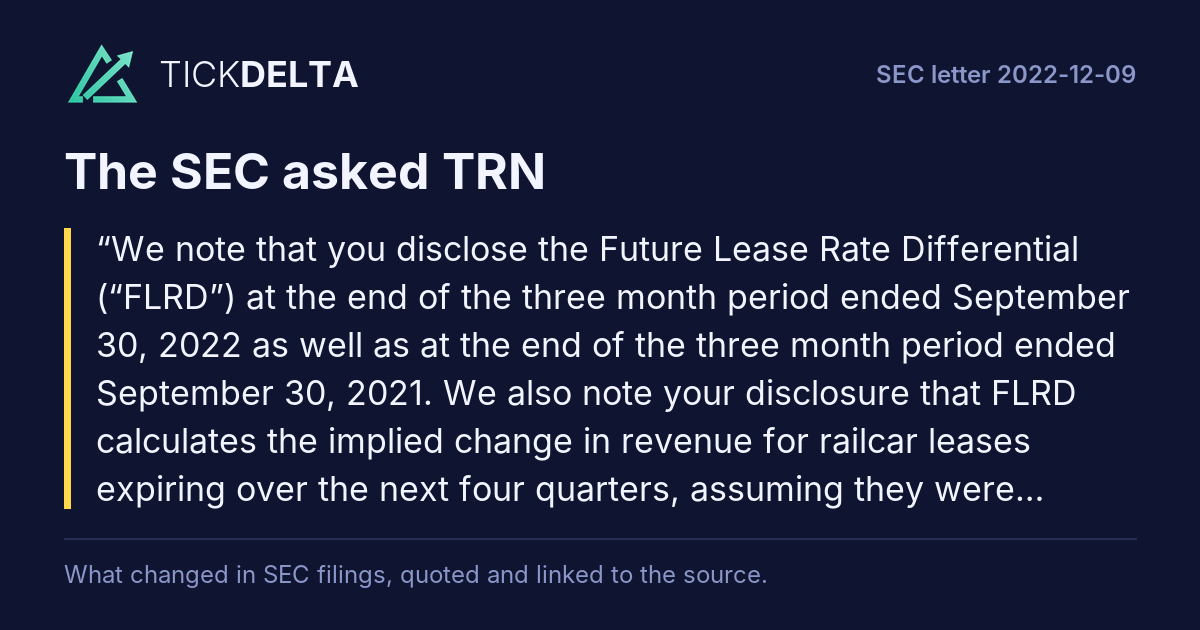
We note that you disclose the Future Lease Rate Differential (“FLRD”) at the end of the three month period ended September 30, 2022 as well as at the end of the three month period ended September 30, 2021. We also note your disclosure that FLRD calculates the implied change in revenue for railcar leases expiring over the next four quarters, assuming they were renewed at the most recent quarterly transacted leaseRest of the question
rates for each railcar type. Please explain to us and consider revising future filings to disclose the reasons why the metric is useful to investors, how management uses the metric, and if there are estimates or assumptions underlying the metric or its calculation, include disclosure of such items if it’s necessary for the metric not to be misleading. For reference, see guidance in SEC Release No. 33-10751 Commission Guidance on Management’s Discussion and Analysis of Financial Condition and Results of Operations.
The FLRD is an analysis of the revenue expected to be generated from actual lease contracts that will be renewing during the applicable periods. We believe the FLRD provides a Company-specific metric that helps investors understand our anticipated near-term changes in lease rates, which frames our communications with the investment community and helpsRead in the reply
14421 N. DALLAS PARKWAY, #1100 DALLAS, TX 75207 214.631.4420 investors and management understand the longer term impact of current market factors on future leasing revenue.Rest of the answer
Other than adjustments for leasing categories for which there is no current activity, the calculation of the FLRD does not rely on management estimates or judgmentally determined assumptions. Instead of using subjective management inputs, the FLRD calculates the implied change in revenue for railcar leases known to be expiring over the next four quarters, assuming these expiring leases were renewed at the most recent quarterly transacted lease rates for each railcar type. The Company believes this assumption is reasonable given the high utilization rate of the Company-owned lease fleet and lease renewal success rate (97.9% and 82.0%, respectively, as of September 30, 2022).
In future filings, earnings releases, and investor presentation materials, the Company will provide the following explanation of FLRD when it is used:
“The Future Lease Rate Differential (FLRD) calculates the implied change in revenue for railcar leases expiring over the next four quarters. The FLRD assumes that these expiring leases will be renewed at the most recent quarterly transacted lease rates for each railcar type. We believe the FLRD is useful to both management and investors as it provides insight into the near-term trend in lease rates as well as the longer term impact of renewing rates on future revenue. The FLRD is calculated as follows:
(New Lease Rates — Expiring Lease Rates) x Expiring Railcar Leases /
(Expiring Lease Rates x Expiring Railcar Leases)”
First report after the company's reply of Dec 20, 2022: 10-K filed Feb 21, 2023 ↗, against the 10-K filed Feb 17, 2022 ↗.
Tickdelta does not hold the text of both reports, so they are not compared here.
In your determination of “Adjusted Net Cash Provided by Operating Activities”, you adjust for proceeds from lease portfolio sales, which is presented in investing activities. Please tell us how you determined that this adjustment does not result in a non-GAAP measure based on individually tailored accounting principles.Rest of the question
Refer to the guidance in Question 100.04 of the Compliance and Disclosure Interpretations on Non-GAAP Financial Measures.
Although not reported within operating revenues in our Consolidated Statements of Operations, lease portfolio sales are significant to the Company’s business and are a relevant source of cash flow. To avoid the potential misconception that the Company considers proceeds from lease portfolio sales to be part of Net Cash Provided by Operating Activities, the Company proposes to simplify the description of Adjusted Free Cash Flow calculation in future filings by eliminating subtotals with potentially misleading labels.Read in the replyRest of the answer
As an example of the proposed revised representation of this measure, please find attached, in Appendix I, the relevant revised excerpt from the 2021 Form 10-K.
First report after the company's reply of Dec 20, 2022: 10-K filed Feb 21, 2023 ↗, against the 10-K filed Feb 17, 2022 ↗.
Tickdelta does not hold the text of both reports, so they are not compared here.
Your calculation of “Free Cash Flow” differs from the typical calculation of this measure (i.e., cash flows from operations less capital expenditures). In order to avoid potential confusion, in future filings, earnings releases, and investor presentations, please revise the
The Company agrees with this recommendation and will revise the title and definition of this non-GAAP measure accordingly. Specifically, in future filings the Company will (i) change the label for the total row to “Adjusted Free Cash Flow After Investments and Dividends” and (ii) revise the title of the non-GAAP measure to “Adjusted Free Cash Flow” wherever this calculation appears in our disclosures and investor communications. As an example, the excerpt in Appendix I reflects these changes.Read in the reply
First report after the company's reply of Dec 20, 2022: 10-K filed Feb 21, 2023 ↗, against the 10-K filed Feb 17, 2022 ↗.
Tickdelta does not hold the text of both reports, so they are not compared here.
Also in this review: closing letter, 2023-01-11