TROWT. Rowe Price
T. Rowe Price Group, Inc. (T. Rowe Price Group, T. Rowe Price, the firm, we, us, or our) is a financial services holding company that provides global investment advisory services through its subsidiaries to investors worldwide. 10-K, Item 1
- Employees
- 7,773
- Headquarters
- Baltimore, MD
- Next results
- around Feb 3, 2027
6 paragraphs in Risk Factors of the 10-K filed Feb 13, 2026 with nothing like them in the 10-K filed Feb 14, 2025. Quoted exactly. Paragraphs that were only edited are under 10-K change.
Compared with the Risk Factors in the latest 10-K of the other 75 Financials companies: a paragraph with at least half its words the same at another company is called similar, and the companies are listed under it. A paragraph most of them have is marked boilerplate. No line means no other company has one like it. This counts text; it does not say how serious a risk is.
•Government Shutdown. The U.S. federal government periodically experiences funding gaps that result in partial or complete shutdowns of government operations. A prolonged shutdown could adversely impact the U.S. economy, financial markets, and our business directly and indirectly. During a shutdown, many federal agencies, such as the SEC, suspend or delay regulatory approvals. A delay in the approval of new products
which we intend to offer could materially impact our performance and the timing with which we begin to attract investors. Additionally, a shutdown could have broader negative effects on consumer and business confidence, the financial markets, and the overall economy. Uncertainty regarding the duration or frequency of government shutdowns may contribute to market volatility and increased redemptions from our products.
Read in the 10-K ↗
services could also interfere with our ability to comply with financial reporting and controls and other regulatory requirements, exposing us to regulatory action and liability to our clients, potentially resulting in financial losses that may not be sufficiently mitigated by insurance coverage.
Read in the 10-K ↗
In addition to our use of AI technologies, we are exposed to risks arising from the use of AI technologies by bad actors to commit fraud and misappropriate funds and to facilitate cyberattacks. Generative AI, if used to perpetrate fraud or launch cyberattacks, could result in losses, liquidity outflows, or other adverse effects at a particular financial institution or exchange. If our use of AI becomes controversial, we may experience brand or reputational harm, competitive harm, or legal liability.
Read in the 10-K ↗
In addition, the U.S. administration and other foreign governments have pursued deregulation measures that may create regulatory uncertainty for our business, and potentially create divergent regulatory frameworks, as other state and local governments may take action to fill the vacuum. Any changes in the regulatory framework applicable to our business, may impose additional costs, require the attention of our senior management, result in limitations on the manner in which business is conducted, or may ultimately have an adverse impact on the competitiveness of our business.
Read in the 10-K ↗
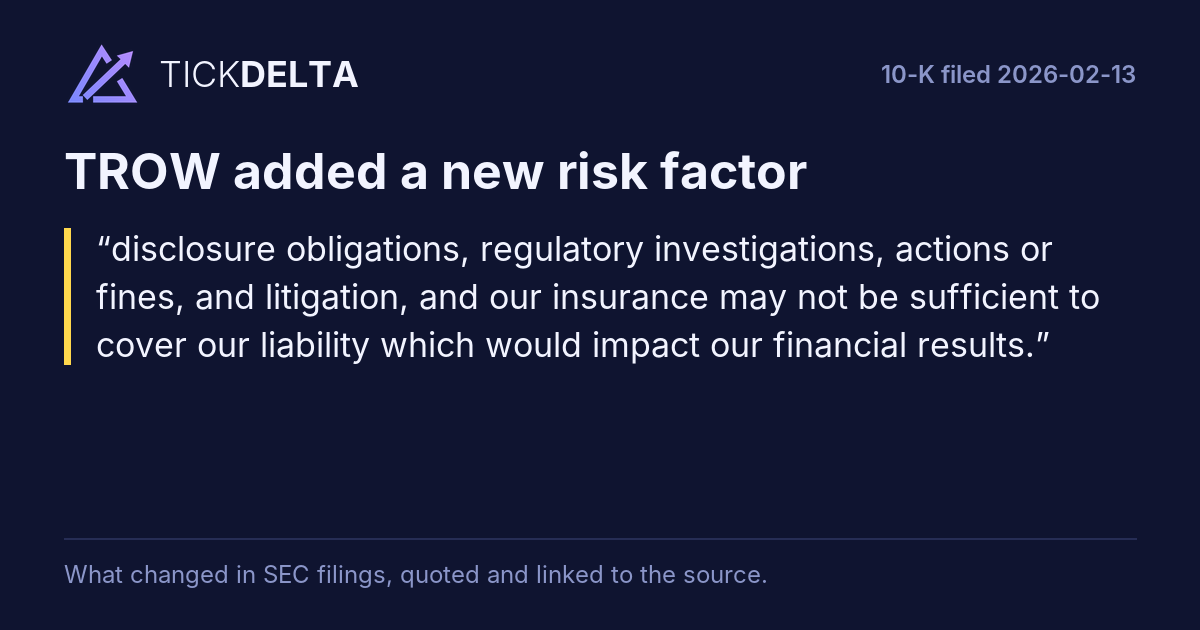
disclosure obligations, regulatory investigations, actions or fines, and litigation, and our insurance may not be sufficient to cover our liability which would impact our financial results.
Read in the 10-K ↗
New in the latest 10-Q
11 paragraphs in the 10-Q filed Oct 29, 2026 with nothing like them in the 10-Q filed Jul 31, 2026 (at least half the words must differ; new numbers alone do not count). Quoted exactly, grouped by the item heading above them. This is text that changed, not a judgement of how serious it is.
Financial statements and notes
We evaluate our collateralized loan obligations (CLOs) issuer under the consolidation guidance of ASC 810, Consolidation, and have determined that the CLO Issuer are variable interest entities. We consolidate those CLO Issuers for which we are the primary beneficiary and report them with our other consolidated investment products.
Read in the 10-Q ↗
Bank loan investments, which comprise almost all of the consolidated CLO Issuers' portfolio collateral, are senior secured corporate loans from a variety of industries. Bank loan investments mature at various dates between 2027 and 2033, pay interest at the applicable reference rate plus a spread of up to 6.00 %, and typically range in S&P credit rating categories from BBB down to unrated. Debt and other liabilities include notes issued by the consolidated CLO Issuer. These notes are issued in various tranches with different risk profiles and mature in 2039. The interest rates are generally variable rates based on the applicable reference rate plus a pre-defined spread, which varies from 1.23 % for the more senior tranches to 7.61 % for more subordinated tranches. The third-party note holders are not affiliated with the firm and have no recourse to our credit. At September 30, 2026, the notes' unpaid principal balance exceeds the fair value of the senior secured bank loans and bonds by approximately $ 6.4 million, and none of the collateral assets are in default.
Read in the 10-Q ↗
Currency translation adjustments Nine months ended 9/30/2026 Nine months ended 9/30/2025 (in millions) Equity method investments Consolidated investment products - variable interest entities Total currency translation adjustments Equity method investments Consolidated investment products - variable interest entities Total currency translation adjustments Balances at beginning of period $ (57.4) $ 6.9 $ (50.5) $ (49.5) $ (2.2) $ (51.7) Other comprehensive income (loss) before reclassifications (10.1) 0.1 (10.0) (3.7) 14.0 10.3 Reclassification adjustments recognized in non-operating income — (4.5) (4.5) — (3.1) (3.1) Other comprehensive income (loss) before income taxes (10.1) (4.4) (14.5) (3.7) 10.9 7.2 Net deferred tax benefits (income taxes) 1.3 1.2 2.5 0.6 (2.6) (2.0) Other comprehensive income (loss) (8.8) (3.2) (12.0) (3.1) 8.3 5.2 Balances at end of period $ (66.2) $ 3.7 $ (62.5) $ (52.6) $ 6.1 $ (46.5)
Read in the 10-Q ↗
In August 2026, we entered into an agreement to acquire F/m Investments, LLC for about $ 75 million plus up to $ 50 million in contingent consideration that may be due as part of an earnout payment. The transaction is expected to close in the first quarter of 2027, subject to required regulatory approvals and other customary closing conditions, and is expected to be funded with existing cash balances. The acquisition is expected to expand our fixed income ETF and SMA capabilities. We expect to account for the transaction as a business combination upon closing.
Read in the 10-Q ↗
Global equity markets generated mixed returns during the third quarter of 2026 as investors balanced resilient corporate earnings against renewed escalation in the U.S.-Iran conflict, uneven labor market data, and persistent inflation pressures. Higher energy prices and a tighter monetary policy backdrop contributed to divergent performance across regions, market capitalizations, investment styles, and sectors.
Read in the 10-Q ↗
International equity markets were mixed during the third quarter as developed European markets posted gains in July and August before declining in September, while developed Asian markets increased. Japanese equities were supported by semiconductor and other artificial intelligence-related shares, as well as a weaker yen following the Bank of Japan’s July policy meeting where it held its policy rate at 1.00%. Emerging market equities were roughly flat, as strength in semiconductor-related companies in South Korea and Taiwan was offset by pressure on energy-importing markets and weakness in China related to soft domestic demand and property-sector data.
Read in the 10-Q ↗
Global fixed income markets generated negative returns during the third quarter of 2026 as government bond yields moved higher and several major central banks shifted toward tighter monetary policy. Persistent inflation pressures, elevated energy costs, geopolitical uncertainty, and concerns about government debt supply weighed on bond prices across developed and emerging markets.
Read in the 10-Q ↗
The Federal Reserve maintained the federal funds target range at 3.50% to 3.75% in July, with three policymakers dissenting in favor of an immediate increase. In September, the Federal Reserve unanimously raised the target range to 3.75% to 4.00%, its first increase in more than three years. Updated projections indicated that most policymakers expected another increase before year-end.
Read in the 10-Q ↗
U.S. fixed income markets recorded negative returns as Treasury yields increased across the curve, with the Federal Reserve’s September rate increase, stronger economic data, and firm inflation readings leading investors to price a higher policy-rate path. Within the investment-grade bond universe, mortgage-backed securities declined the most, followed by corporate bonds and U.S. Treasuries, while non-agency commercial mortgage-backed securities and asset-backed securities also decreased.
Read in the 10-Q ↗
International and emerging markets also declined during the quarter. Developed market sovereign yields rose as tighter monetary policy and higher energy costs sustained inflation concerns, while weakness in several major currencies against the U.S. dollar reduced U.S. dollar-based returns. Emerging market hard currency debt underperformed local currency debt as rising U.S. Treasury yields pressured dollar-denominated sovereign bonds, while the U.S. dollar strengthened in September, weighing on currencies in several oil-importing economies.
Read in the 10-Q ↗
In August 2026, we entered into an agreement to acquire F/m Investments, LLC for about $75 million plus up to $50 million in contingent consideration that may be due as part of an earnout payment. The transaction is expected to close in the first quarter of 2027, subject to receipt of required regulatory approvals and satisfaction of other customary closing conditions, and is expected to be funded with existing cash balances.
Read in the 10-Q ↗
The 10-Q's risk factors against the 10-K
Item 1A of the 10-Q filed Oct 29, 2026 against Item 1A of the 10-K filed Feb 13, 2026.
A 10-Q repeats only the risks that changed, so a 10-K paragraph that is missing from it is not counted as removed.
Added is a paragraph with nothing like it in the 10-K, Reworded a sentence that is in both with several words changed,
Quiet changes a sentence in both where one to four words changed and one is a hedge or a modal
(cut words struck through, new words highlighted and underlined).
Text on the page, not a score; each links to the filing at sec.gov.
What the 10-Q itself says about its risk factors:
Read in the 10-Q ↗
There have been no material changes in the information provided in Item 1A of our Form 10-K Annual Report for 2025.
1 paragraph in the 10-Q's Item 1A, and none of them adds, rewords or quietly edits a paragraph of the 10-K's.
Work on TROW in a spreadsheet:
Excel workbook (a sheet per section, ten years by column, charts, links to the filings) ·
CSV.
For a Google Sheet that stays up to date, paste =IMPORTDATA("https://tickdelta.com/company/TROW/export.csv") into a cell.