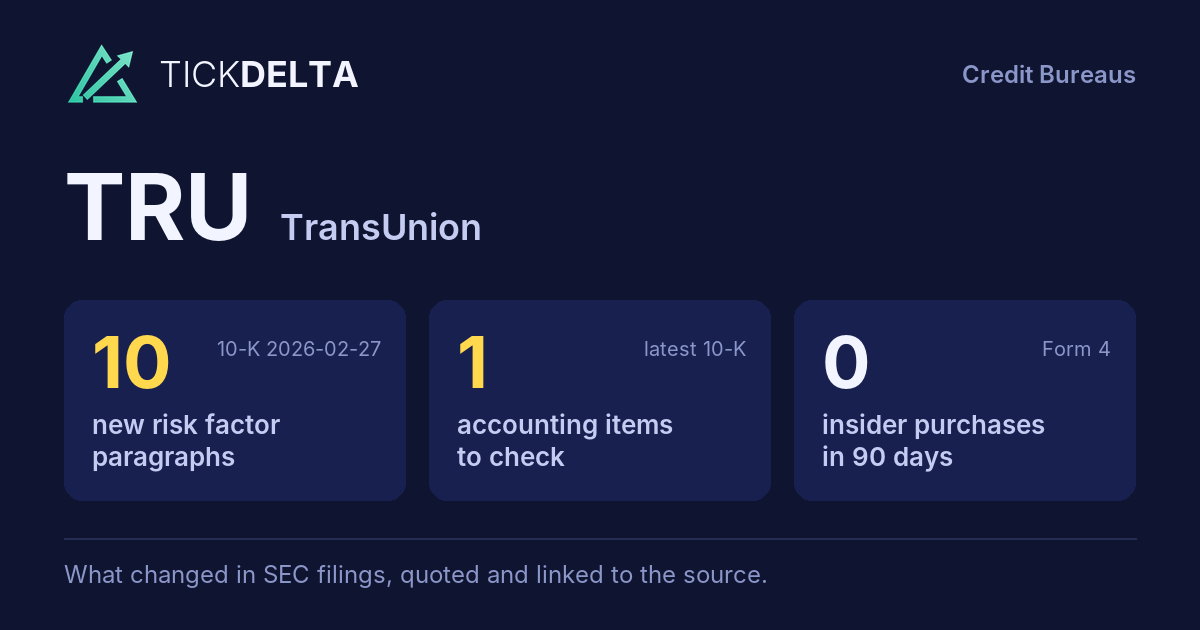
AddedRisk Factors
Natural disasters, pandemics, terrorist acts, war, actions by governments, and other geopolitical activities could disrupt our operations.
Read it in 10-K Feb 27, 2026 at sec.govopen_in_new
AddedRisk Factors
We operate in numerous U.S. and international locations, and we have offices in a number of major cities across the globe. The occurrence of, or concerns related to, a major weather event, earthquake, hurricane, flood, drought, volcanic activity, disease or pandemic, or other natural disaster could significantly disrupt our operations. In addition, acts of civil unrest, failure of critical infrastructure, terrorism, war and armed conflict (including the ongoing conflicts in the Middle East, India, Ukraine and Russia), and abrupt political change, as well as responses by various governments and the international community to such acts, can have a negative effect on our business. Such events could impede delivery of our products and services to our clients, disrupt or shut down the internet or other critical client-facing and business processes, impede the travel of our personnel and clients, dislocate our critical internal functions and personnel, and in general harm our ability to conduct normal business operations, any of which can negatively impact our financial condition and operating results. Such events could also impact the business of our clients, which could materially adversely affect our business.
Read it in 10-K Feb 27, 2026 at sec.govopen_in_new
RemovedRisk Factors
•We may be unable to adequately anticipate, prevent or mitigate damage resulting from increasingly sophisticated methods of illegal or fraudulent activities committed against us, which could harm our business, financial condition and results of operations and could significantly harm our reputation.
Read it in 10-K Feb 13, 2025 at sec.govopen_in_new
RemovedRisk Factors
•Our efforts to execute any element of our business strategy, including our transformation plan to optimize our operating model and invest in our technology, could experience difficulties, delays, or unexpected costs and may not achieve anticipated benefits and savings.
Read it in 10-K Feb 13, 2025 at sec.govopen_in_new
RemovedRisk Factors
•Pandemics, epidemics, disease outbreaks and other public health crises, such as the COVID-19 pandemic, have disrupted our business and operations, and future public health crises could materially adversely impact our business, financial condition, liquidity and results of operations.
Read it in 10-K Feb 13, 2025 at sec.govopen_in_new
RemovedRisk Factors
As a global consumer credit reporting agency and provider of risk and information solutions, we collect, store and transmit a large amount of sensitive and confidential consumer information on over one billion consumers, including financial
Read it in 10-K Feb 13, 2025 at sec.govopen_in_new
RemovedRisk Factors
We may be unable to adequately anticipate, prevent or mitigate damage resulting from increasingly sophisticated methods of illegal or fraudulent activities committed against us, which could harm our business, financial condition and results of operations and could significantly harm our reputation.
Read it in 10-K Feb 13, 2025 at sec.govopen_in_new
RemovedRisk Factors
The defensive measures that we take to manage threats, especially cyber-related threats, to our business may not adequately anticipate, prevent or mitigate harm we may suffer from such threats. Criminals use evolving and increasingly sophisticated methods of perpetrating illegal and fraudulent activities. For example, in September 2020, TransUnion experienced a series of Distributed Denial of Service (“DDoS”) attacks. While these attacks did not result in any unauthorized access to data or systems, there was disruption to TransUnion’s normal operations including degraded customer response time, intermittent timeouts and degraded internal information technology services utilized by TransUnion associates. TransUnion deploys a number of defensive measures to mitigate DDoS attacks, but persistent attackers can challenge these protections.
Read it in 10-K Feb 13, 2025 at sec.govopen_in_new
RemovedRisk Factors
Our services and products depend extensively upon continued access to and receipt of data from external sources, including data received from customers, strategic partners and various government and public records repositories. In some cases, we
Read it in 10-K Feb 13, 2025 at sec.govopen_in_new
RemovedRisk Factors
Entities violated the 2017 Consent Order and engaged in deceptive acts and practices in marketing the TransUnion Credit Monitoring product, among other allegations. The CFPB further alleges that Mr. Danaher violated the 2017 Consent Order and that we and Trans Union LLC provided substantial assistance to TransUnion Interactive, Inc. in violating the 2017 Consent Order and the law. On February 5, 2025, the Court issued a stay in the proceedings at the CFPB’s request. As of December 31, 2024, we have an accrued liability of $56.0 million in connection with this matter and there is a reasonable possibility that a loss in excess of the amount accrued may be incurred, and such an outcome could have a material adverse effect on our results of operations and financial condition.
Read it in 10-K Feb 13, 2025 at sec.govopen_in_new
RemovedRisk Factors
Additionally, in March 2022, we received a NORA letter from the CFPB, alleging that our Tenant and Employment screening business, TransUnion Rental Screening Solutions, Inc. and Trans Union LLC violated the FCRA by failing to (i) follow reasonable procedures to assure maximum possible accuracy of information in consumer reports and (ii) disclose to consumers the sources of such information. On July 27, 2022, the CFPB’s Enforcement Division advised us that it had obtained authority to pursue an enforcement action jointly with the FTC. On October 5, 2023, we reached a settlement in the form of a Consent Order with the CFPB and the FTC regarding this matter, pursuant to which we agreed to pay $11.0 million in redress and $4.0 million in civil money penalties, which has been paid in full, and agreed to implement certain business process changes.
Read it in 10-K Feb 13, 2025 at sec.govopen_in_new
RemovedRisk Factors
In August 2022, the TU Entities received a NORA letter from the CFPB, informing us that the CFPB’s Enforcement Division was considering whether to recommend that the CFPB take legal action against us following an investigation relating to potential violations of law related to the placement and lifting of security freezes resulting from certain system issues. We have corrected associated system issues and have processes in place to monitor and address issues going forward. On April 14, 2023, the CFPB’s Enforcement Division advised us that it had obtained authority to pursue an enforcement action. On October 10, 2023, we reached a settlement in the form of a Consent Order with the CFPB regarding this matter, pursuant to which we agreed to pay $3.0 million in redress and $5.0 million in civil penalties, which settlement has been paid in full.
Read it in 10-K Feb 13, 2025 at sec.govopen_in_new
RemovedRisk Factors
acquisitions or take other actions that we believe to be in our or their best interests. Our inability to take such actions could have a material impact on our revenues or earnings.
Read it in 10-K Feb 13, 2025 at sec.govopen_in_new
RemovedRisk Factors
unfavorable. If these unfavorable macroeconomic conditions persist longer than we currently expect, or are worse than we currently expect, our estimates of revenue growth rates and EBITDA margins would decline, which could lead to an impairment of goodwill.
Read it in 10-K Feb 13, 2025 at sec.govopen_in_new
RewordedRisk Factors
(collectively, the “TU Entities”) and the former President of our Consumer Interactive business, John Danaher, seeking restitution, civil money penalties, and injunctive relief, among other remedies, and alleging that the TU Entities violated the 2017 Consent Order and engaged in deceptive acts and practices in marketing the TransUnion Credit Monitoring product, among other allegations.
Read it in 10-K Feb 27, 2026 at sec.govopen_in_new
RewordedRisk Factors
While we have engaged and may engaged in the future in voluntary initiatives and reporting on environmental and social matters, However, such initiatives and reporting may be costly and may not have the desired effect.
Read it in 10-K Feb 27, 2026 at sec.govopen_in_new
RewordedRisk Factors
The credit agreement governing Trans Union LLC’s senior secured credit facility restricts our ability to dispose of assets and use the proceeds from those dispositions and may also restrict our ability to raise debt or equity capital to be used to repay other indebtedness when it becomes due.
Read it in 10-K Feb 27, 2026 at sec.govopen_in_new
RewordedRisk Factors
Various meteorological phenomena and extreme weather events (including, but not limited to, storms, flooding, drought, wildfire, and extreme temperatures) may directly or indirectly disrupt our operations (including the productivity of our employees) or those of our suppliers or infrastructure on which we rely, require us to incur additional operating or capital expenditures or otherwise adversely impact our business, financial condition, or results of operations.
Read it in 10-K Feb 27, 2026 at sec.govopen_in_new
RewordedRisk Factors
Unauthorized disclosure, loss or corruption of our data or inability of our customers to access our systems could materially disrupt our operations, subject us to substantial regulatory and legal proceedings (including class actions) and potential liability, liability (such as penalties, fines and required changes to business practices), result in a material loss of business and/or significantly harm our reputation. reputation and competitiveness.
Read it in 10-K Feb 27, 2026 at sec.govopen_in_new
RewordedRisk Factors
We further cannot provide assurance that the CFPB will not ultimately commence a lawsuit against us in this matter, nor are we able to predict the likely outcome of this matter, which could have a material adverse effect on our results of operations and financial condition. matter.
Read it in 10-K Feb 27, 2026 at sec.govopen_in_new
RewordedRisk Factors
For example, the California Privacy Protection Agency is currently finalizing finalized regulations under the California Consumer Privacy Act Act, which will become effective over the course of 2026 through 2027, regarding the use of automated decision-making.
Read it in 10-K Feb 27, 2026 at sec.govopen_in_new
RewordedRisk Factors
While we execute security due diligence in these transactions, it is possible that neither the acquired company nor TransUnion may can identify every issue in a timely manner, which could cause impact or cyber concerns create material risk to us during the integration effort.
Read it in 10-K Feb 27, 2026 at sec.govopen_in_new
RewordedRisk Factors
Given We were previously engaged in active discussions with the CFPB regarding this matter, but given recent changes in CFPB leadership, our engagement with the agency on this matter has paused.
Read it in 10-K Feb 27, 2026 at sec.govopen_in_new
RewordedRisk Factors
In the United States, legislation related to AI Technologies has been introduced at the federal level and is advancing 46 states have passed at the state level. least one law relating to AI Technologies.
Read it in 10-K Feb 27, 2026 at sec.govopen_in_new
RewordedRisk Factors
Additionally, given some of our equity interests in various companies, we may be limited in our ability to require or influence such companies to make acquisitions or take other actions that we believe to be in our or their best interests.
Read it in 10-K Feb 27, 2026 at sec.govopen_in_new
RewordedRisk Factors
We conduct operations in over 30 countries and, in the fiscal year ended December 31, 2024, 2025, approximately 22.8% 22% of our reported revenue was derived from by our international operations, operations based on where it was earned, which subjects us to various risks inherent in global operations.
Read it in 10-K Feb 27, 2026 at sec.govopen_in_new
Quiet changesRisk Factors
Other states have also passed AI-focused legislation, such as Colorado’s Artificial Intelligence Act, which will require requires developers and deployers of “high-risk” AI systems to implement certain safeguards against algorithmic discrimination, and Utah’s Artificial Intelligence Policy Act, which establishes disclosure requirements and accountability measures for the use of generative AI in certain consumer interactions.
Read it in 10-K Feb 27, 2026 at sec.govopen_in_new
AddedMD&A
Following three interest rate cuts in 2024 totaling 100 basis points, the U.S. Federal Reserve (the “Fed”) paused further rate cuts in the first half of 2025, in response to uncertainty around the new U.S. administration’s economic and trade policies and their potential impact on inflation, employment, and consumer spending. Continued growth in consumer spending and real wages through the first half of 2025 supported this interest rate pause, but by the third quarter, a weakening employment situation, in particular a material slowing of hiring by businesses, as well as continued easing of inflation, led the Fed to resume rate cuts with a 25 basis point drop in September 2025 followed by two additional rate cuts totaling 50 basis points in the fourth quarter. Further rate cuts could spur renewed consumer confidence to borrow as well as increased demand for rate-sensitive lending products, in particular mortgage loans.
Read it in 10-K Feb 27, 2026 at sec.govopen_in_new
AddedMD&A
Macro-economic conditions in the U.K. and Canada continue to show signs of improvement, driven by falling inflation and moderate growth in other economic indicators. Regulatory actions in India have slowed credit expansion while GDP growth remained robust in the first three quarters of 2025 but slowed in the fourth quarter as a result of high U.S. tariffs. Foreign central banks have also begun to lower rates, which we expect will increase demand for rate-sensitive lending products.
Read it in 10-K Feb 27, 2026 at sec.govopen_in_new
AddedMD&A
In April 2025, the U.S. announced a minimum 10% import duty on all trading partners and higher rates on several large trading partners, with exemptions for certain industries and products. These announcements led to increased market volatility and uncertainty. If policies that significantly increase tariff rates are maintained, there is potential for the U.S. and global economic growth to slow, with increased probability for recession and increased inflation across many of the markets where we operate. With trade negotiations and legal challenges ongoing, the final timing and amount of tariff rates remains uncertain and therefore the impact is difficult to forecast, though it is likely that the final outcome of trade negotiations with many U.S. trading partners will result in higher tariff rates. Despite the early implementation of higher tariffs having a lower-than-expected impact on U.S. inflation rates in 2025, market uncertainty is putting pressure on the global macroeconomic environment. The uncertainty of tariff policy, price increases and stock market volatility has dampened, and may continue to suppress, consumer sentiment.
Read it in 10-K Feb 27, 2026 at sec.govopen_in_new
AddedMD&A
On July 4, 2025, the One Big Beautiful Bill Act (the “OBBBA”) was enacted in the U.S. The OBBBA includes potentially significant provisions, such as the permanent extension of certain expiring provisions of the Tax Cuts and Jobs Act, modifications to the international tax framework and the restoration of favorable tax treatment for certain business provisions including 100% bonus depreciation, domestic research cost expensing, and the business interest expense limitation. The OBBBA has multiple effective dates, with certain provisions effective in 2025 and others implemented periodically through 2027. The impacts of the OBBBA are reflected in our results for the year ended December 31, 2025 resulting in an increase in our provision for income taxes due to foreign inclusions and a decrease in our income taxes paid in 2025.
Read it in 10-K Feb 27, 2026 at sec.govopen_in_new
AddedMD&A
As of December 31, 2025, we have accrued liabilities remaining for the payment of employee separation costs of $10.7 million in connection with our operating model optimization program. We expect payment of these liabilities to occur in 2026.
Read it in 10-K Feb 27, 2026 at sec.govopen_in_new
AddedMD&A
On April 1, 2025, we gained control of Monevo by acquiring the remaining 70% of its outstanding equity, of which we previously owned 30%. We accounted for the transaction as a step acquisition in accordance with ASC Topic 805, Business Combinations. Accordingly, we remeasured our initial 30% investment, including the call option, at a fair value of $60.8 million, resulting in a non-taxable gain of $12.3 million recorded within other income and (expense), net in the Consolidated Statements of Operations. Monevo’s results of operations subsequent to the acquisition date, which are not material, are reflected in both the U.S. Markets and International segments for the year ended December 31, 2025, and affect the comparability of results to the prior year. See Part II, Item 8, “Financial Statements and Supplementary Data – Notes to Consolidated Financial Statements, Note 2, “Business Acquisition,” for further information about this transaction.
Read it in 10-K Feb 27, 2026 at sec.govopen_in_new
AddedMD&A
Repurchased shares are retired, resulting in a reduction to common stock at par with the remainder to additional paid-in capital. Once repurchased, the shares are returned to the status of authorized but unissued shares of the Company and reduce the weighted average number of shares of common stock outstanding for purposes of calculating basic and diluted earnings per share. During the year ended December 31, 2025, the Company repurchased approximately 3,577,000 shares of common stock, respectively, for a total of $302.0 million, including commissions and excise taxes, under the 2025 Repurchase Plan. The average price paid per share for the year ended December 31, 2025 was $84.45. As of December 31, 2025, $700.1 million remains available for repurchases under the 2025 Repurchase Plan.
Read it in 10-K Feb 27, 2026 at sec.govopen_in_new
AddedMD&A
During the second quarter of 2025, we entered into a third-party financing arrangement to purchase certain long-lived assets that will be repaid over 5 years.
Read it in 10-K Feb 27, 2026 at sec.govopen_in_new
AddedMD&A
Approximately 75.5% and 71.6% of our debt is hedged with interest rate swaps as of December 31, 2025 and 2024, respectively.
Read it in 10-K Feb 27, 2026 at sec.govopen_in_new
AddedMD&A
Our effective tax rates were 26.9%, 24.6% and (30.8)% for 2025, 2024 and 2023 respectively. The effective tax rate was higher in 2025 compared to 2024 due primarily to the full year impact of a legal entity restructuring executed during the fourth quarter of 2024 to support the expansion of our global footprint and align with emerging global minimum tax requirements under the Organization for Economic Cooperation and Development (“OECD”) Pillar Two framework, which increased our taxes in certain foreign jurisdictions. The effective tax rate was higher in 2024 compared to 2023 due primarily to the impact of non-deductible goodwill impairments causing a loss for income before taxes in 2023.
Read it in 10-K Feb 27, 2026 at sec.govopen_in_new
AddedMD&A
The OECD introduced the Pillar Two framework establishing a global minimum tax rate of 15% which has been adopted by numerous jurisdictions in 2024 and 2025. In January 2026, the OECD introduced the “side-by-side” framework, expected to apply for fiscal years beginning on or after January 1, 2026, which is designed to reduce certain foreign top-up tax rules for eligible U.S.-parented groups. We will continue to monitor developments and evaluate any potential impacts on our results.
Read it in 10-K Feb 27, 2026 at sec.govopen_in_new
AddedMD&A
primarily to price and volume increases in our Auto line of business, and volume increases and new wins in our Consumer Lending and Card & Banking lines of business.
Read it in 10-K Feb 27, 2026 at sec.govopen_in_new
RemovedMD&A
During 2024, the U.S. economy and labor market remained resilient, with solid GDP growth, rising but still low unemployment, growing real wages and the easing of inflation. The U.S. Federal Reserve maintained higher interest rates into September, which had the effect of slowing aggregate demand, resulting in slower jobs growth and a mild increase in unemployment levels. Higher interest rates have also slowed demand for consumer loans and auto loans, and have had a more pronounced impact on the housing sector, where higher borrowing rates impact both home affordability, driving down purchase activity, and demand for mortgage loan refinancing. The slowdown in demand and job growth, along with lower inflation, prompted the U.S. Federal Reserve to begin lowering interest rates at the end of the third quarter and into the fourth quarter of 2024, with three consecutive rate cuts totaling 100 basis points. These rate cuts could spur renewed consumer confidence to borrow as well as increased demand for rate-sensitive lending products, in particular mortgage loans to the extent that mortgage rates decline in tandem with a lower federal funds rate. However, mortgage rates are not directly tied to the federal funds rate but instead are tied to the 10-year Treasury rates, which rose roughly 100 basis points as of the end of 2024 after hitting a one-year low in September 2024 due to renewed market concerns over inflation. As a result, 30-year mortgage rates remained elevated at year-end, which continues to suppress activity in the housing sector. During 2024, the U.K. also began to show some initial signs of improvement driven by falling inflation and moderate growth in other economic indicators, though macroeconomic challenges impacting credit markets remain in this region. Foreign central banks, including in Canada and Europe, have also begun to lower rates, which we expect will increase demand for rate-sensitive lending products. These dynamics impact the comparability of our results of operations, including our revenue and expense, between the periods presented below.
Read it in 10-K Feb 13, 2025 at sec.govopen_in_new
RemovedMD&A
goods and services, and consequently lower demand for credit, which could have a material adverse impact on various aspects of our business in the future.
Read it in 10-K Feb 13, 2025 at sec.govopen_in_new
RemovedMD&A
In October 2023, we agreed to settle two matters with federal regulators for a total of $23.0 million. On October 5, 2023, we reached a settlement in the form of a Consent Order with the CFPB and the FTC pursuant to which we agreed to pay $11.0 million in redress and $4.0 million in civil money penalties in connection with alleged violations under the FCRA related to our tenant and employment screening business. On October 10, 2023, we reached a settlement with the CFPB in the form of a Consent Order pursuant to which we agreed to pay $3.0 million in redress and $5.0 million in civil money penalties in connection with alleged violations of law in connection with the placement and lifting of security freezes resulting from certain system issues. Both of these settlements were paid in 2023.
Read it in 10-K Feb 13, 2025 at sec.govopen_in_new
RemovedMD&A
On April 8, 2022, we acquired 100% of the equity of the entities that comprised Verisk Financial Services (“VF”). We retained the core businesses of Argus and, as discussed further below, divested the remaining non-core businesses on December 30, 2022. Argus provides financial institutions, payments providers, and retailers worldwide with competitive studies, predictive analytics, models, and advisory services. The results of operations of Argus are included in the U.S. Markets segment in our Consolidated Statements of Operations since the date of the acquisition. We classified the results of operations of the non-core businesses as discontinued operations, net of tax, in the Consolidated Statements of Operations since the acquisition in April 2022. Upon the sale of the non-core businesses in December 2022, we received total proceeds of $173.9 million, consisting of $103.6 million in cash, and a note receivable with a face value of $72.0 million and a fair value of $70.3 million on the date of sale, and recognized a $7.5 million gain which is included in discontinued operations, net of tax. We finalized the sale price of the non-core businesses in the third quarter of 2023 and recorded a $0.5 million reduction of the gain on sale included in discontinued operations, net of tax. See Part II, Item 8, “Financial Statements and Supplementary Data – Notes to Consolidated Financial Statements,” Note 2, “Business Acquisitions” and Note 3 “Discontinued Operations,” for additional information.
Read it in 10-K Feb 13, 2025 at sec.govopen_in_new
RemovedMD&A
•a decrease of approximately $5.0 million from the impact of foreign currencies on our international operations.
Read it in 10-K Feb 13, 2025 at sec.govopen_in_new
RemovedMD&A
•a decrease of approximately $6.0 million from the impact of foreign currencies on our international operations.
Read it in 10-K Feb 13, 2025 at sec.govopen_in_new
RemovedMD&A
For 2023, these expenses include approximately $71.9 million related to employee separation and $3.4 million related to facility exits.
Read it in 10-K Feb 13, 2025 at sec.govopen_in_new
RemovedMD&A
For 2023, interest income increased $16.1 million, compared with 2022. The increase was due primarily to interest earned on notes receivable, including the note receivable issued in connection with our sale of the non-core VF businesses as discussed above, and an increase in interest on our investments due to the increase in interest rates.
Read it in 10-K Feb 13, 2025 at sec.govopen_in_new
RemovedMD&A
For 2024, we reported a 24.6% effective tax rate, which is higher than the 21.0% U.S. federal corporate statutory rate due primarily to nondeductible expenses primarily in connection with executive compensation limitations, foreign withholding taxes, and uncertain tax positions, partially offset by benefits from the research and development credit and the foreign rate differential. In addition, certain deferred tax assets related to expiring foreign tax credits were written off with an offsetting reduction of the valuation allowance.
Read it in 10-K Feb 13, 2025 at sec.govopen_in_new
RemovedMD&A
We continue to evaluate the impact of the OECD efforts to implement a global minimum 15% effective tax rate on certain multinational enterprises, commonly known as Pillar Two. Various changes in international tax laws and regulations based on the Pillar Two proposals and other OECD initiatives have been enacted, some of which impacted us in 2024 or will impact us in 2025 and beyond, resulting in a higher effective tax rate as we realized less benefits from the foreign rate differential and higher withholding taxes.
Read it in 10-K Feb 13, 2025 at sec.govopen_in_new
RemovedMD&A
For 2023, we reported a (30.8)% effective tax rate, which is lower than the 21.0% U.S. federal corporate statutory rate due primarily to the impact of non-deductible goodwill impairment partially offset by benefits on the remeasurement of deferred taxes due to changes in state apportionment rates.
Read it in 10-K Feb 13, 2025 at sec.govopen_in_new
RemovedMD&A
For 2022, we reported a 31.0% effective tax rate, which is higher than the 21.0% U.S. federal corporate statutory rate due primarily to increases in valuation allowances on foreign tax credit carryforwards, nondeductible expenses in connection with certain legal and regulatory matters and executive compensation limitations, and other rate-impacting items, partially offset by benefits from the research and development credit and excess tax benefits on stock-based compensation.
Read it in 10-K Feb 13, 2025 at sec.govopen_in_new
RewordedMD&A
The decrease in interest expense for 2024 2025 was due primarily to lower average interest rates resulting from refinancing transactions in 2024 and rate cuts in 2025 and 2024 and a decrease in the outstanding principal balance due to the higher debt prepayments and refinancing transactions made in 2023 and 2024, partially offset by an increase in the average periodic variable interest rate on the unhedged portion replacement of our debt. hedges.
Read it in 10-K Feb 27, 2026 at sec.govopen_in_new
RewordedMD&A
For 2024, 2025, the increase in cash provided by operating activities was due primarily due to improved operating performance and performance, lower net interest expense, partially offset by employee separation payments expense and a penalty paid for the early termination of a facility lease, both of which were lease in connection with our operating model optimization program. 2024, partially offset by higher income tax payments and higher bonus payouts in 2025.
Read it in 10-K Feb 27, 2026 at sec.govopen_in_new
RewordedMD&A
The increase was Local currency revenue increased, compared with 2024, due primarily to new business wins and higher local currency revenue from strong, broad-based growth across all aspects of the business, including online, batch, consumer and commercial volumes, partially offset by a decrease of 1.6% 4.0% from the impact of foreign currencies.
Read it in 10-K Feb 27, 2026 at sec.govopen_in_new
RewordedMD&A
Federal Reserve and several international central banks have begun lowering interest rates in In response to significant reductions reduction in inflation levels from peak levels in 2022 and 2023, the Fed and several international central banks began lowering interest rates in 2024 and 2025, and have indicated that further interest rate reductions in the future are likely. possible.
Read it in 10-K Feb 27, 2026 at sec.govopen_in_new
RewordedMD&A
We have no obligation to repurchase additional shares, and the timing, actual number and value of the shares that are repurchased, if any, will be are at the discretion of management and will depend on a number of factors, including market conditions, the cost of repurchasing shares, the availability of alternative investment opportunities, liquidity, and other factors deemed appropriate. management.
Read it in 10-K Feb 27, 2026 at sec.govopen_in_new
RewordedMD&A
Stock-based compensation $ 145.6 $ 121.2 $ 100.6 $ 81.1 Goodwill impairment1 — — 414.0 — Mergers and acquisitions, divestitures and business optimization2 30.0 26.5 34.6 50.7 Accelerated technology investment3 84.5 84.2 70.6 54.0 Operating model optimization program4 32.3 94.8 77.6 — Net other5 (52.3) 21.8 15.2 46.1 Total adjustments to EBITDA $ 240.1 $ 348.7 $ 712.5 $ 231.9 Consolidated Adjusted EBITDA 1,645.9 1,506.3 1,343.7 1,344.9 Adjusted EBITDA for Pre-Acquisition Period6 0.9 — — 6.4 Leverage Ratio Adjusted EBITDA $ 1,646.8 $ 1,506.3 $ 1,343.7 $ 1,351.3 Total debt $ 5,103.8 $ 5,147.2 $ 5,340.4 $ 5,670.1 Less:
Read it in 10-K Feb 27, 2026 at sec.govopen_in_new
RewordedMD&A
For 2024, 2025, Emerging Verticals revenue increased $47.3 $103.4 million, or 4.0%, 8.5%, compared with 2023, 2024, due primarily to increases in the Insurance and the Technology, Retail and E-Commerce most other verticals from volume increases across online and batch services, new business wins and an increase in volumes. pricing increases.
Read it in 10-K Feb 27, 2026 at sec.govopen_in_new
RewordedMD&A
The increase was Local currency revenue increased, compared with 2024, primarily due primarily to higher local currency revenue from broad-based growth batch services across several of our markets, regions, new business wins and volume increases partially offset by a decrease of 1.4% from the impact of foreign currencies.
Read it in 10-K Feb 27, 2026 at sec.govopen_in_new
RewordedMD&A
Years Ended December 31, 2025 2024 2023 2022 Gain (loss) Loss from post-acquisition adjustments from previous acquisitions $ — $ (7.2) $ (4.3) $ 3.4 Fair value and impairment adjustments (16.8) (8.4) (1.6) (4.0) Transition services agreement income — — 4.8 10.7 Currency remeasurement gains (losses), losses, net (0.4) (2.1) (4.8) (6.3) Miscellaneous non-operating income and (expense) 0.6 1.9 2.9 0.9 Total other income (expense), net $ (16.6) $ (15.7) $ (3.0) $ 4.7
Read it in 10-K Feb 27, 2026 at sec.govopen_in_new
RewordedMD&A
Consolidated Adjusted EBITDA Margin increased was flat in 2024 2025 due primarily due to an increase decreases in high adjusted EBITDA margin revenue and in our segments as discussed above, partially offset by the realization of cost savings from the transformation plan.
Read it in 10-K Feb 27, 2026 at sec.govopen_in_new
RewordedMD&A
Amortization of certain intangible assets 1.48 1.45 1.51 1.59 Stock-based compensation 0.74 0.62 0.52 0.42 Goodwill impairment1 — — 2.13 — Mergers and acquisitions, divestitures and business optimization2 0.15 0.13 0.18 0.26 Accelerated technology investment3 0.43 0.43 0.36 0.28 Operating model optimization program4 0.16 0.48 0.40 — Net other5 (0.28) 0.10 0.07 0.23 Total adjustments before income tax items $ 2.68 $ 3.22 $ 5.16 $ 2.78 Total adjustments for income taxes6 (0.70) (0.76) (0.74) (0.45) Impact of additional dilutive shares7 — — 0.02 — Adjusted Diluted Earnings per Share $ 4.30 $ 3.91 $ 3.37 $ 3.62
Read it in 10-K Feb 27, 2026 at sec.govopen_in_new
RewordedMD&A
Meanwhile, rates that remain elevated relative to historic levels may result in depressed consumer spending on non-essential goods and services, and consequently lower demand for credit, which could have a material adverse impact on various aspects of our business in the future.
Read it in 10-K Feb 27, 2026 at sec.govopen_in_new