tickdelta
Sign in

Tickdelta is free for now. Sign up and get Pro free

← Screener

TSLATesla, Inc.

Consumer discretionary · Automakers · Nasdaq
Compare with peers → Embed
The 10-K against last year's

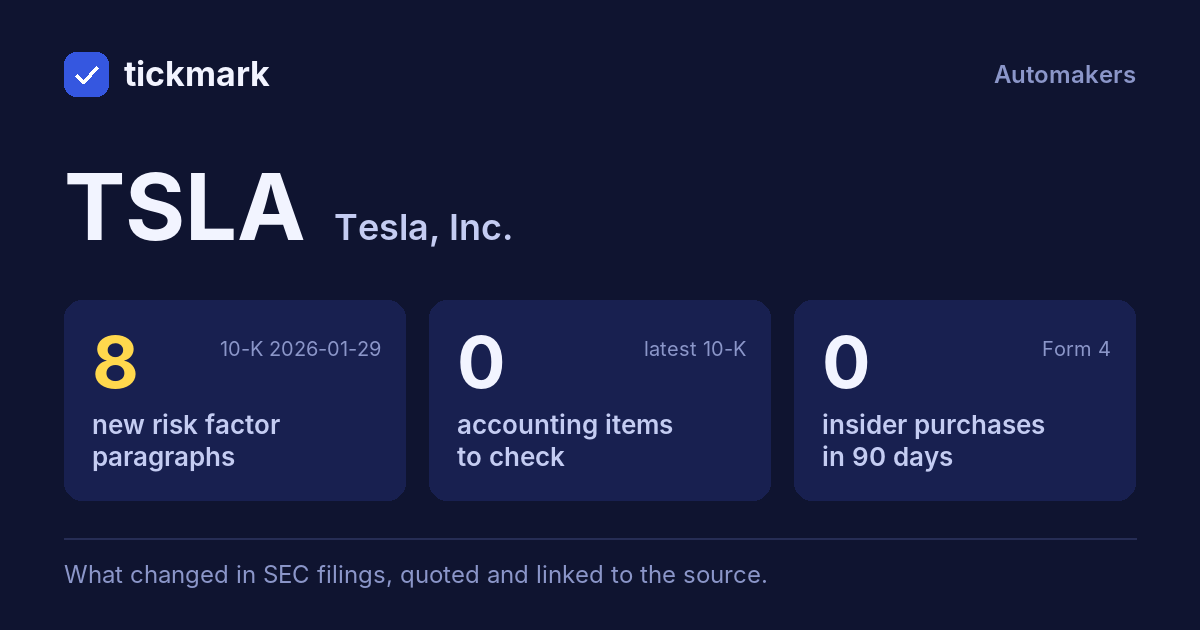
143 changes: 19 added, 16 removed, 106 reworded, 2 quiet changes

10-K Jan 29, 2026 vs Jan 30, 2025
Risk FactorsRedline ↓
15.6%
of the text changed · 12,485 words now
29.0%
of the text changed · 7,618 words now
Legal ProceedingsRedline ↓
39.9%
of the text changed · 2,536 words now
Accounting PoliciesRedline ↓
17.2%
of the text changed · 9,951 words now

10-K 0001628280-26-003952 (2026-01-29) vs 10-K 0001628280-25-003063 (2025-01-30)

The redline

The paragraph that changed most in each section

Marked against last year's 10-K: cut words struck through, new words highlighted and underlined.

Legal Proceedings 236 words changed in this paragraph; it is 74% similar to last year's version.
We are also subject to various lawsuits that seek monetary and other injunctive relief. These lawsuits include proposed class actions and other consumer claims that allege, among other things, purported defects and misrepresentations related to our products and services. For example, on September 14, 2022, a proposed class action was filed against Tesla, Inc. and related entities in the U.S. District Court for the Northern District of California, alleging various claims about the Company’s driver assistance technology systems under state and federal law. This case was later consolidated with several other proposed class actions, and a Consolidated Amended Complaint was filed on October 28, 2022, which seeks damages and other relief on behalf of all persons who purchased or leased from Tesla between January 1, 2016, to the present. On October 5, 2022, a proposed class action complaint was filed in the U.S. District Court for the Eastern District of New York asserting similar state and federal law claims against the same defendants. On September 30, 2023, the Court dismissed this action with leave to amend the complaint. On November 20, 2023, the plaintiff moved to amend the complaint, which Tesla opposed. On August 8, 2024, the Court denied the plaintiff’s motion for leave to file an amended complaint and entered judgment for Tesla. On September 5, 2024, the plaintiff filed a notice of appeal to United States Court of Appeals for the Second Circuit, and the parties are briefing the matter. On March 22, 2023, the plaintiffs in the Northern District of California consolidated action filed a motion for a preliminary injunction to order Tesla to (1) cease using the term “Full Self-Driving Capability” (FSD Capability), (2) cease the sale and activation of FSD Capability and deactivate FSD Capability on Tesla vehicles, and (3) provide certain notices to consumers about proposed court-findings about the accuracy of the use of the terms Autopilot and FSD Capability. Tesla opposed the motion. On September 30, 2023, the Court denied the request for a preliminary injunction, compelled four of five plaintiffs to arbitration, and dismissed the claims of the fifth plaintiff with leave to amend the complaint. On October 31, 2023, the remaining plaintiff in the Northern District of California action filed an amended complaint, which Tesla moved to dismiss, and on May 15, 2024, the Court granted in part and denied in part Tesla’s motion. On May 6, 2025, the plaintiff filed a motion for class certification, which Tesla opposed, and on August 18, 2025, the Court certified a limited class comprised of California consumers who are not subject to an arbitration agreement. On September 1, 2025, Tesla filed a petition in the United States Court of Appeals for the Ninth Circuit for permission to appeal the class certification order, and on December 18, 2025, the Ninth Circuit granted Tesla’s petition. On January 5, 2026, the district court stayed the case pending resolution of the proceedings before the Ninth Circuit. Tesla’s opening brief in the Ninth Circuit is due on March 12, 2026. On October 2, 2023, a similar proposed class action was filed in San Diego County Superior Court in California. Tesla subsequently removed the San Diego County case to federal court and on January 8, 2024, the federal court granted Tesla’s motion to transfer the case to the U.S. District Court for the Northern District of California. Tesla moved to compel arbitration, which the plaintiff did not oppose, and on June 27, 2024, the Court stayed the case pending arbitration.

Source: Item 3, via Note 13 – Commitments and Contingencies, 10-K 0001628280-26-003952 vs Item 3, via Note 14 – Commitments and Contingencies, 10-K 0001628280-25-003063

Risk Factors 236 words changed in this paragraph; it is 61% similar to last year's version.
We are subject to legal and regulatory requirements, political uncertainty and social, environmental and economic conditions in numerous jurisdictions, including markets in which we generate significant sales, over which we sales. We have little control and over these matters which are inherently unpredictable. Our operations in such jurisdictions, particularly as a company based in the U.S., with additional manufacturing operations in China and Europe, create risks relating to conforming our products to regulatory and safety requirements and charging and other electric infrastructures; organizing local operating entities; establishing, staffing and managing foreign business locations; attracting local customers; navigating U.S. and foreign government taxes, regulations and permit requirements; enforceability of our contractual rights; trade restrictions, customs regulations, tariffs and price or exchange controls; and preferences in foreign nations for domestically manufactured products. For example, we monitor tax legislation changes on a global basis, including changes arising as a result of the Organization for Economic Cooperation and Development’s multi-jurisdictional plan of action to address base erosion and profit shifting. Such Further, the United States has recently announced changes to U.S. trade policy, including increasing tariffs on imports, in many cases significantly, and potentially renegotiating or terminating existing trade agreements. The exact scope of any such tariffs that will ultimately be implemented is not known at this time, and the impacts on our business and costs of our products is uncertain. Retaliatory tariffs imposed by other countries on U.S. exports, further increases in U.S. tariffs, and the uncertainties surrounding domestic and foreign tariffs have impacted the pricing for our products, which could adversely impact demand. We cannot predict whether, and to what extent, there may be changes to international trade agreements, such as those with China, or whether, or to what extent, quotas, duties, additional tariffs, export controls or other restrictions will be changed or imposed by the United States or by other countries. Historically, U.S. special tariff actions have increased our costs for vehicles manufactured in the United States and increased costs for those same vehicles when exported from the United States. Further, as it pertains to electric vehicles and lithium-ion batteries for our energy storage products, while the Company has continuously aimed for a strong domestic supply chain, certain parts and components are difficult or impossible to source within the United States. A change on any of these conditions may increase our costs, impact our ability to sell our products and require significant management attention, and may harm our business business, prospects, financial condition and operating results if we are unable to manage them effectively.

Source: Item 1A, 10-K 0001628280-26-003952 vs Item 1A, 10-K 0001628280-25-003063

MD&A 166 words changed in this paragraph; it is 37% similar to last year's version.
We use the fair value method of accounting for our restricted stock awards (“RSAs”), stock options and restricted stock units (“RSUs”) granted to employees and for our employee stock purchase plan (the “ESPP”) (“the ESPP”) to measure the cost of employee services received in exchange for the stock-based awards. The fair value Stock-based compensation expense for equity awards is a non-cash expense and is recorded in Cost of stock option awards with only service and/or performance conditions is estimated on revenues, Research and development expense and Selling, general and administrative expense in the grant or offering date using the Black-Scholes option-pricing model. The Black-Scholes option-pricing model requires inputs such as the risk-free interest rate, expected term and expected volatility. These inputs are subjective and generally require significant judgment. The fair value consolidated statements of RSUs is measured on the grant date operations based on the closing fair market value function of our common stock. The resulting cost is recognized over the period during which an employee is required to provide service in exchange for the awards, usually the vesting period, which is generally four years for stock options and RSUs and six months for the ESPP. Stock-based compensation expense is recognized on a straight-line basis, net of actual forfeitures in the period. employee.

Source: Item 7, 10-K 0001628280-26-003952 vs Item 7, 10-K 0001628280-25-003063

Accounting Policies 141 words changed in this paragraph; it is 30% similar to last year's version.
In December 2023, 2025, the Financial Accounting Standards Board (“FASB”) FASB issued Accounting Standards Update (“ASU”) ASU No. 2023-09, Improvements to Income Tax Disclosures 2025-11, Interim Reporting (Topic 740). 270): Narrow-Scope Improvements. The ASU requires disaggregated information clarifies interim disclosure requirements and the applicability of Topic 270. The objective of the amendments is to provide further clarity about a reporting entity’s effective tax rate reconciliation as well as additional information on income taxes paid. the current interim disclosure requirements. The ASU is effective on a prospective basis for interim reporting periods within annual reporting periods beginning after December 15, 2024. 2027. Adoption of this ASU can be applied either a prospective or a retrospective approach. Early adoption is also permitted for annual financial statements that permitted. We are currently evaluating the provisions of this ASU and do not expect this ASU to have not yet been issued or made available for issuance. This ASU will likely result in the required additional disclosures being included in a material impact on our consolidated financial statements, once adopted. statements.

Source: Item 8, Note 2 – Summary of Significant Accounting Policies, 10-K 0001628280-26-003952 vs Item 8, Note 2 – Summary of Significant Accounting Policies, 10-K 0001628280-25-003063
Every change, by type

Sentences and paragraphs added, removed or reworded

Sentences and paragraphs of TSLA's Risk Factors and MD&A, 10-K 2026-01-29 against 10-K 2025-01-30. Each links to the text at sec.gov.

AddedRisk Factors
Upon launching our Robotaxi service in June 2025, we also entered into the autonomous ride-hailing service market, and have plans to mass produce Cybercab, a purpose-built Robotaxi product. As we seek to expand the scope and geographical footprint of this business, our success will be dependent upon various factors, including the acceptance and adoption by consumers of autonomous driving solutions, and Robotaxi as a preferable option, amid growing competition. If the uptake rate for autonomous driving solutions does not develop as we expect, our business, prospects, financial condition and operating results may be harmed.

Read it in 10-K 2026-01-29 at sec.gov ↗

AddedRisk Factors
Growth of our business is also dependent upon our ability to develop and commercialize Bots, including Optimus, which is in a nascent industry that has yet to develop commercially.

Read it in 10-K 2026-01-29 at sec.gov ↗

AddedRisk Factors
We currently are developing Bots, including Optimus, and intend for these products, as well as accompanying services, to be an important part of our business going forward. While this development requires significant cash investments and management resources, there is no guarantee this business will be successful. We have yet to commercialize Bots and cannot predict how demand for Bots will develop, either from commercial or consumer applications. We also face significant competition from other companies that are designing, developing and building robotics applications. Our success will depend on various factors, including our ability to successfully apply our artificial neural network training experience to autonomous robots, to either source or custom develop the necessary technology and components, and the product’s cost-effectiveness, utility and competitive positioning relative to market alternatives. If our Bots program fails to develop as we expect, or progresses more slowly than expected, our business, prospects, financial condition and operating results may be harmed.

Read it in 10-K 2026-01-29 at sec.gov ↗

AddedRisk Factors
If our products contain design or manufacturing defects, whether relating to our software or hardware, that cause them not to perform as designed or intended or that require repair, or certain features of our vehicles such as new driver

Read it in 10-K 2026-01-29 at sec.gov ↗

AddedRisk Factors
network security and systems may occur despite defensive measures, and may result in fines, penalties and damages and harm our brand, prospects and operating results.

Read it in 10-K 2026-01-29 at sec.gov ↗

AddedRisk Factors
There is a risk that the technologies and initiatives associated with the 2025 CEO Performance Award, including the product goals, are misaligned with current or future consumer demand, resulting in our failure to invest in or pursue another opportunity that generates significant financial returns or leads to greater shareholder value.

Read it in 10-K 2026-01-29 at sec.gov ↗

AddedRisk Factors
If the 2025 CEO Performance Award inadvertently directs our focus and resources toward specific technologies that are misaligned with market preferences, or such preferences evolve unfavorably, or customer demand for these innovations does not materialize as anticipated, we may miss opportunities better aligned with other needs. In particular, the product goals may not be indicative of the types of products or services that would, in the long run, generate financial returns necessary to justify the significant market capitalization goals of the 2025 CEO Performance Award. The product goals were designed to incentivize Elon Musk to devote time and energy to development of these products and services, as these products and services are directionally consistent with Mr. Musk’s vision for the future of our company. Our investments in these technologies and initiatives, including those underlying the product goals, frequently involve long development timelines and substantial capital, and there is no assurance that these investments will deliver the expected business, financial or reputational benefits. As a result, misalignment of consumer demand and the technologies and initiatives associated with the 2025 CEO Performance Award, including the product goals, may impair our ability to realize returns on such investments and could lead to strategic misalignment, underperformance or write-downs of related assets, all of which could have a negative impact on our financial performance and stock price.

Read it in 10-K 2026-01-29 at sec.gov ↗

Show the other 11
AddedMD&A
We are focused on bringing artificial intelligence into the real world, through products and services like FSD (Supervised) and Robotaxi, as well as working to develop and commercialize AI robots (including Optimus). We intend to leverage our current operations, in which we design, develop, manufacture, sell and lease high-performance fully electric vehicles and energy generation and storage systems that increasingly deliver AI-related and enhanced software and services to our customers, to achieve that objective.

Read it in 10-K 2026-01-29 at sec.gov ↗

AddedMD&A
As a result of rapidly evolving trade and fiscal policy, uncertainty in the automotive and energy markets continues, posing risks to our global supply chain and cost structure which could have a meaningfully adverse impact on demand for our products and our profitability. The current tariff regime will have a relatively larger impact on our energy generation and storage business compared to our automotive business. While we prepare for near-term challenges to our business under current policies, we are focused on long-term growth opportunities as we continue to make prudent investments.

Read it in 10-K 2026-01-29 at sec.gov ↗

AddedMD&A
Changes in government and economic policies, incentives or tariffs may also impact our production, cost structure and the competitive landscape. For instance, while the final scope and application of recently announced changes in trade policy remain uncertain at this time, higher tariffs on imports and subsequent retaliatory tariffs could adversely impact consumer spending and demand for durable goods and related services. Furthermore, certain provisions of the OBBBA, including the removal of tax credits for electric vehicles, may also impact consumer demand for electric vehicles in general. We will continue to adjust accordingly to such developments, and we believe our ongoing cost reduction efforts, including through production innovation, process improvements and logistics optimization, and focus on operating leverage, vertical integration and supply chain localization will continue to benefit us in relation to our competitors. Our new products and our advances in autonomy and robotics, position us for future growth.

Read it in 10-K 2026-01-29 at sec.gov ↗

AddedMD&A
Any fees or financial subsidies that are paid or payable by us to a customer’s lender when we arrange the financing are recognized upfront as an offset against automotive sales revenue. As our contract costs related to automotive sales are typically fulfilled within one year, the costs to obtain a contract are expensed as incurred. Amounts billed to customers related to shipping and handling are classified as automotive sales revenue, and we have elected to recognize the cost for freight and shipping when control over vehicles, parts or accessories have transferred to the customer as an expense in cost of automotive sales revenue. Our policy is to exclude taxes collected from a customer from the transaction price of automotive contracts.

Read it in 10-K 2026-01-29 at sec.gov ↗

AddedMD&A
We offer resale value guarantees to our commercial banking partners in connection with certain vehicle leasing programs. Under these programs, we originate the lease with our end customer and immediately transfer the lease and the underlying vehicle to our commercial banking partner, with the transaction being accounted for as a sale under ASC 606. We receive upfront payment for the vehicle, do not bear casualty and credit risks during the lease term, and we provide a guarantee capped to a limit if they are unable to sell the vehicle at or above the vehicle’s contractual or determined residual value at the end of the lease term. We estimate a guarantee liability in accordance with ASC 460, Guarantees and record it within other liabilities on our consolidated balance sheets. On a quarterly basis, we assess the estimated market value of vehicles sold under these programs to determine whether there have been changes to the amount of expected resale value guarantee liabilities. As we accumulate more data related to the resale values of our vehicles or as market conditions change, there may be material changes to their estimated values.

Read it in 10-K 2026-01-29 at sec.gov ↗

AddedMD&A
We use the fair value method of accounting for our restricted stock awards (“RSAs”), stock options and restricted stock units (“RSUs”) granted to employees and for our employee stock purchase plan (“the ESPP”) to measure the cost of employee services received in exchange for the stock-based awards. Stock-based compensation expense for equity awards is a non-cash expense and is recorded in Cost of revenues, Research and development expense and Selling, general and administrative expense in the consolidated statements of operations based on the function of the employee.

Read it in 10-K 2026-01-29 at sec.gov ↗

AddedMD&A
The fair value of restricted stock granted to our CEO with service and/or performance conditions is measured on the grant date based on the closing fair market value of our common stock, adjusted to take into account the illiquidity discount due to any applicable required holding period, less any purchase price or offset amount. The illiquidity discount is determined using a valuation model that requires inputs such as expected share price volatility and the employee’s expected tax rate. The inputs used in the valuation models, which are subjective and generally require significant judgment, are unique to each award based on the best available information at the valuation date.

Read it in 10-K 2026-01-29 at sec.gov ↗

AddedMD&A
Stock-based compensation expense for equity awards with performance conditions is recognized over the requisite service period when the vesting of the award becomes probable. Stock-based compensation expense is recognized on a straight-line basis for equity awards with only a service condition and on a graded vesting basis for equity awards with a performance condition, net of actual forfeitures in the period.

Read it in 10-K 2026-01-29 at sec.gov ↗

AddedMD&A
The fair value and derived service period of performance-based awards granted to our CEO with market, service and performance conditions are estimated on the grant date using a Monte Carlo simulation model. A Monte Carlo simulation model requires inputs such as the risk-free interest rate, expected award term, expected share dilution and expected share price volatility. For awards with a holding requirement that is in effect post-vesting, the fair value is adjusted to take into account an illiquidity discount, which is determined using a valuation model that requires inputs such as expected share price volatility and the employee’s expected tax rate. These inputs, which are subjective and generally require significant judgment, are unique to each award based on the best available information at the valuation date.

Read it in 10-K 2026-01-29 at sec.gov ↗

AddedMD&A
For such awards, stock-based compensation expense is recognized on a straight-line basis over the expected performance achievement period of individual performance milestones when the achievement of each individual performance milestone becomes probable. If applicable, stock-based compensation expense for such awards is recognized over the longer of (i) the expected service period, (ii) the expected achievement period for the operational milestone (performance condition) and (iii) the expected achievement period for the related market capitalization milestone determined on the grant date, with recognition beginning at the point in time that the relevant operational milestone is considered probable of achievement. If such operational milestone becomes probable any time after the grant date or the expected achievement period changes, we will recognize a cumulative expense adjustment from the grant date to that point in time. Stock-based compensation expense will continue to be recognized over the expected achievement period for the operational milestone (if applicable) regardless of whether the market capitalization milestone is achieved earlier than its expected achievement period or achieved at all, as long as the service condition continues to be satisfied. If an operational milestone is subsequently determined to be improbable of achievement, stock-based compensation expense previously recognized would be reversed in the period the condition is deemed improbable.

Read it in 10-K 2026-01-29 at sec.gov ↗

AddedMD&A
As discussed in Part II, Item 9B, Other Information—xAI Investment of this Annual Report on Form 10-K, the Company entered into an agreement in January 2026 to make a minority equity investment.

Read it in 10-K 2026-01-29 at sec.gov ↗

Next Related parties →