Form 10-K
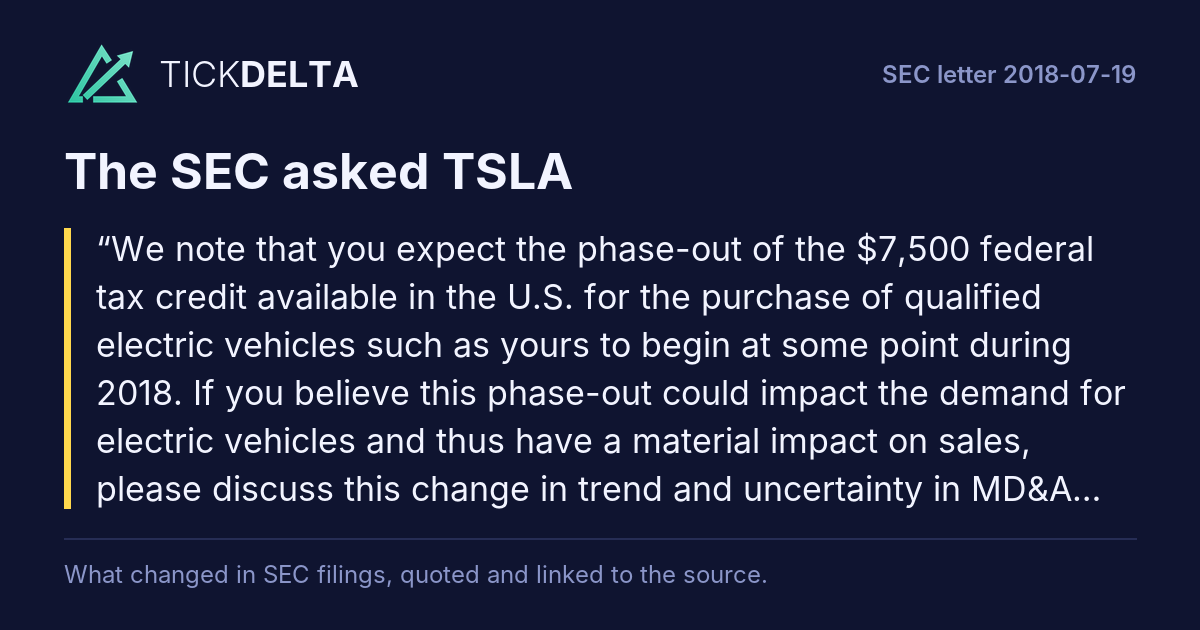
We note that you expect the phase-out of the $7,500 federal tax credit available in the U.S. for the purchase of qualified electric vehicles such as yours to begin at some point during 2018. If you believe this phase-out could impact the demand for electric vehicles and thus have a material impact on sales, please discuss this change in trend and uncertainty in MD&A in accordance with Item 303(a)(3)(ii) ofRest of the question
Regulation S-K.
We respectfully advise the Staff that we have not expected, and currently do not expect, any impact of the scheduled phase-out of the federal tax credit over the course of 2019 on our vehicle demand or sales to be material. Nevertheless, in response to the Staff’s comment, we have included in “Management’s Discussion and Analysis of Financial Condition and Results of Operation—Management Opportunities, Challenges and Risks” in our Quarterly Report on Form 10-Q for the fiscal quarter ended June 30, 2018 (the “Q2 Form 10-Q”) the following discussion of the expected temporary impact on vehicleRead in the reply ↗Rest of the answer
sales:
“In July 2018, we delivered our 200,000th vehicle in the U.S. Under current regulations, the full $7,500 federal tax credit for the purchase of a qualified electric vehicle will continue to be available only for any of our new vehicles delivered by the end of 2018 in the U.S., and then will be reduced to $3,750 for each vehicle delivered by the end of the second quarter of 2019, then to $1,875 for each vehicle delivered by the end of 2019, then to $0 for each vehicle delivered thereafter. In the near term, we believe this phase-out will pull forward customer orders, before normalizing. In the long run, we do not expect a meaningful impact to our sales in the U.S., as we believe that our vehicles offer a compelling proposition at their full price.”
3500 Deer Creek Road, Palo Alto, California 94304
Moreover, in future filings, if we believe that the phase-out of the federal tax credit could negatively impact the demand for our electric vehicles and have a material impact on our sales in a manner that is different than such discussion, we will provide appropriate additional disclosure at that time.
First report after the company's reply of 2018-08-16: 10-Q filed 2018-11-02 ↗.
No earlier 10-Q before the SEC's letter is in Tickdelta, so there is nothing to compare with.
We note that you plan to ramp up production of the Model 3 to produce 5,000 units per week. Please disclose an estimate of the amount of capital necessary to accomplish this goal. See Item 303(a)(1) of Regulation S-K.
We respectfully advise the Staff that we have disclosed under “Management’s Discussion and Analysis of Financial Condition and Results of Operation—Liquidity and Capital Resources” in the Form 10-K as well as in our Quarterly Report on Form 10-Q for the fiscal quarter ended March 31, 2018 (the “Q1 Form 10-Q”) and the Q2 Form 10-Q our expectations for total capital expenditures in 2018, taking into account the capital costs incurred and to be incurred to produce Model 3 at a rate of 5,000 vehicles per week, which we achieved in the last week of June 2018.Read in the reply ↗Rest of the answer
Moreover, as of the end of each period covered by these reports, we had already incurred most of the capital costs to achieve such rate of production, and such capital costs were included in the capital expenditures for the applicable periods included in our consolidated financial statements and notes thereto.
Additionally, we have also disclosed in the same section of the Q2 Form 10-Q that we expect that a planned further expansion of Model 3 manufacturing capacity to rates of 6,000 vehicles per week by late August 2018, and eventually to 10,000 vehicles per week by sometime in 2019, will require limited additional capital expenditures. In future filings, to the best of our ability, we will continue to disclose information about the future capital needs of our business.
First report after the company's reply of 2018-08-16: 10-Q filed 2018-11-02 ↗.
No earlier 10-Q before the SEC's letter is in Tickdelta, so there is nothing to compare with.
Please include a discussion of material planned capital expenditures, as well as the timing of such expenditures, associated with the expansion of Gigafactory 1, ramping production at Gigafactory 2, and tooling and manufacturing capital required to introduce new vehicles, energy storage products, and solar products. See Item 303(a)(2) of Regulation S-K and SEC Release No. 33-6835.
We respectfully advise the Staff that as disclosed under “Management’s Discussion and Analysis of Financial Condition and Results of Operation—Liquidity and Capital Resources” in the Form 10-K, Q1 Form 10-Q and Q2 Form 10-Q, our expectations of our capital expenditures for 2018 at the times of filing such reports were: (i) slightly higher than 2017 (which, as disclosed in the Consolidated Statement of Cash Flows in the Form 10-K, was approximately $3.41 billion), (ii) slightly below $3 billion, and (iii) slightly below $2.5 billion, respectively.Read in the reply ↗Rest of the answer
Such disclosures reflect the best of our ability to project future material capital expenditures, which is generally limited to the near term at this still-early stage in our life cycle when we have just begun high-volume manufacturing. It is challenging to predict the magnitude and timing of capital expenditures beyond the current fiscal year, or at best, the next four fiscal quarters, because we are still focused on significantly ramping the production rate of our Model 3 vehicle, and the extent of our current operations is still such that the timing and capital-efficiency of our future initiatives will largely depend on the progress of our ongoing Model 3 vehicle production ramp. Furthermore, as such future initiatives are expected to grow the scale of our business by multiples and at a rate that we have not previously experienced, predictions are even more difficult to make at this time.
However, in response to the Staff’s comment, we have included the following disclosure in the Q2 Form 10-Q under “Management’s Discussion and Analysis of Financial Condition and Results of Operation—Liquidity and Capital Resources” to discuss our expectations for capital expenditures beyond 2018 to the best of our current ability:
“For the twelve-month period ending June 30, 2019, we expect total capital expenditures to be approximately $2.5 billion. As we continue to expand our existing manufacturing capacity, introduce new products, expand our retail stores, services centers, mobile repair services and Supercharging network, we are utilizing our increasing experience and learnings from past and current product ramps to do so at a level of capital efficiency per dollar of spend that we expect to be significantly greater than historical levels. Moreover, we expect that cash generated from our core operations will generally be sufficient for such future capital expenditures, although we may choose to seek alternative financing sources with respect to certain projects outside of the ordinary course of business. For example, we expect that much of our investment in our Gigafactory 3 to be constructed in Shanghai, China will be funded through indebtedness arranged through local financial institutions.”
In future filings, to the best of our ability, we will continue to disclose information about future material planned capital expenditures as well as the timing of such expenditures.
First report after the company's reply of 2018-08-16: 10-Q filed 2018-11-02 ↗.
No earlier 10-Q before the SEC's letter is in Tickdelta, so there is nothing to compare with.
We note that some of the $2.04 billion of unused committed amounts as of December 31, 2017 and the $1.96 billion of unused committed amounts as of March 31, 2018 under your credit facilities and financing funds are subject to satisfying specific conditions prior to draw-down. Please describe the specific conditions that must be satisfied before the funds can be used.Rest of the question
In addition, disclose any restrictions on the use of available funds. See Item 303(a)(1) of Regulation S-K.
We respectfully advise the Staff that with respect to our disclosure obligations pursuant to Item 303(a)(1) of Regulation S-K, there have not been, as of the filing of the Form 10-K, the Q1 Form 10-Q or the Q2 Form 10-Q, any known demands, commitments, events or uncertainties with respect to these facilities or funds that were or are likely to result in our liquidity thereunder increasing or decreasing in a material way.Read in the reply ↗Rest of the answer
However, in response to the Staff’s comment, we have included the following disclosure in the Q2 Form 10-Q under “Management’s Discussion and Analysis of Financial Condition and Results of Operation—Liquidity and Capital Resources”:
“In addition, we had $1.31 billion of unused committed amounts under our credit facilities and financing funds, some of which are subject to satisfying specified conditions prior to draw-down (such as pledging to our lenders sufficient amounts of qualified receivables, inventories, leased vehicles and our interests in those leases, solar energy systems and the associated customer contracts, our interests in financing funds or various other assets; and contributing or selling qualified solar energy systems and the associated customer contracts or qualified leased vehicles and our interests in those leases into the financing funds). Upon the draw-down of any unused committed amounts, there are no restrictions on the use of such funds for general corporate purposes.”
As appropriate, we will make similar disclosures regarding any material conditions that must be satisfied before any committed funds under our credit facilities or financing funds may be used, or any material restrictions on their use, in future filings.
First report after the company's reply of 2018-08-16: 10-Q filed 2018-11-02 ↗.
No earlier 10-Q before the SEC's letter is in Tickdelta, so there is nothing to compare with.
We note that you will need significant capital to continue research and development projects, establish sales, delivery and service centers, and continue to significantly increase the number of Supercharger stations and connectors. Please provide an estimate of the amount of capital necessary to accomplish these goals as well as the timing of such costs. See Item 303(a)(2) of Regulation S-K.
We respectfully refer the Staff to our response to the Staff’s comment number 3 above, including the additional disclosure we included under “Management’s Discussion and Analysis of Financial Condition and Results of Operation—Liquidity and Capital Resources” in the Q2 Form 10-Q. Our future capital spend on research and development projects, sales, delivery and service centers, Supercharger stations and connectors will also depend in large part on the progress of our ongoing Model 3 ramp, and therefore making predictions as to timing and magnitude in any particular period other than the nearRead in the reply ↗Rest of the answer
term is difficult at this time.
First report after the company's reply of 2018-08-16: 10-Q filed 2018-11-02 ↗.
No earlier 10-Q before the SEC's letter is in Tickdelta, so there is nothing to compare with.
We note that the amounts reported in the table of contractual obligations for long-term debt and capital lease obligations due in 2018 do not agree to the corresponding amounts reported on the balance sheet as current portion of long-term debt and capital leases.Rest of the question
Please reconcile the difference and to the extent deemed necessary, provide footnotes to the table to describe any pertinent data necessary for an understanding of the timing and amount of the specified contractual obligations. See Item 303(a)(5) of Regulation S-K.
to the Staff’s comment, the Company will append a footnote to all future reports that include a table of contractual obligations to describe the reconciling items noted above. Read in the reply ↗
First report after the company's reply of 2018-08-16: 10-Q filed 2018-11-02 ↗.
No earlier 10-Q before the SEC's letter is in Tickdelta, so there is nothing to compare with.
We note in your response to the staff dated May 24, 2017 that future interest payments pertaining to long-term debt are included in the amounts disclosed in your contractual obligations table and that you would modify the the line caption as "Long-term debt, including scheduled interest" to clarify this point in future filings; however, we are unable to locate this revised presentation. Please revise.
We respectfully advise the Staff that this line caption was an unintentional omission, but the scheduled interest was in fact included in the long-term debt amounts. In future filings that include a table of contractual obligations, we will modify the line caption in accordance with your comment. Read in the reply ↗
First report after the company's reply of 2018-08-16: 10-Q filed 2018-11-02 ↗.
No earlier 10-Q before the SEC's letter is in Tickdelta, so there is nothing to compare with.
We note reference to the report of other auditors with respect to the December 31, 2016 balance sheet. Please provide the separate audit report being referenced in accordance with Article 2-05 of Regulation S-X.
We respectfully advise the Staff that the separate audit report with respect to the December 31, 2016 balance sheet was filed as Exhibit 99.1, titled “Certain Excerpts from Annual Report on Form 10-K of SolarCity,” to the Form 10-K, incorporated by reference to Exhibit 99.1 to our Annual Report on Form 10-K for the fiscal year ended December 31, 2016. Read in the reply ↗
First report after the company's reply of 2018-08-16: 10-Q filed 2018-11-02 ↗.
No earlier 10-Q before the SEC's letter is in Tickdelta, so there is nothing to compare with.
We note in your response to the staff dated May 24, 2017 that expanded disclosure would be provided on recalls if related costs are material to your financial statements. We note recalls occurred during 2017 and reports of an additional recall in 2018. Please tell us your consideration of including an accounting policy for recall costs.
We respectfully advise the Staff that all vehicle recalls to date have only resulted in immaterial costs to us. In response to the Staff’s comment, we have clarified that accrued warranty costs include estimated costs of recalls in our disclosure of our warranty accounting policy under the heading “Summary of Significant Accounting Policies—Warranties” in Note 2 to our consolidated financial statements included in the Q2 Form 10-Q. Read in the reply ↗
First report after the company's reply of 2018-08-16: 10-Q filed 2018-11-02 ↗.
No earlier 10-Q before the SEC's letter is in Tickdelta, so there is nothing to compare with.
We note your response to prior comment 2 that further expansion of Model 3 manufacturing capacity to rates of 6,000 vehicles per week by late August 2018, and eventually to 10,000 vehicles per week by sometime in 2019, will require limited additional capital expenditures.Rest of the question
However, we also note the risk factor disclosure on page 51 that Model 3 has "required significant investment and will require additional resources in connection with its ongoing ramp". If the risk factor disclosure is true, please provide a discussion of the related additional future expenditures in accordance with Item 303(a)(1) and (2) of Regulation S-K. Please advise or revise accordingly.
We respectfully advise the Staff that the referenced language and other similar language in our risk factors (e.g., “our Model 3 production plan has generally required significant investments of cash and management resources, and we expect to deploy additional resources as we further progress our ramp [emphasis added]” on page 47 of the Q2 Form 10-Q) refers to significant past investments, but does not
3500 Deer Creek Road, Palo Alto, California 94304 on its face, nor is it intended to, project the magnitude of our future expenditures.Read in the reply ↗Rest of the answer
Rather, we have included this language in our risk factors precisely because we are still in the middle of a key product ramp that will require some amount of additional spend to complete, but since it will be impossible to know the precise amount until we have completed the ramp, there is a potential risk that it could be greater than our expectations.
On the other hand, we have continued to discuss such expectations for future spend in other items of our periodic reports on a quarterly basis. We disclosed the following in “Management’s Discussion and Analysis of Financial Condition and Results of Operation—Management Opportunities, Challenges and Risks” in our Quarterly Report on Form 10-Q for the fiscal quarter ended September 30, 2018 (the “Q3 Form 10-Q”):
“We are continuing to work to increase Model 3 production to approximately 10,000 units per week in the most optimal manner from both a timing and capital expenditures perspective. At the Fremont Factory, we expect to continue to increase our Model 3 production rate to approximately 7,000 units per week with only limited additional capital expenditures, and we believe we can increase that rate to beyond 7,000 units per week with incremental capital expenditures. In China, which is the largest market for electric vehicles in the world, our Model S and Model X sales have been, and will likely continue to be, negatively impacted by recently-increased tariffs imposed by the Chinese government on U.S.-manufactured vehicles. We are seeking to alleviate the impact of such tariffs for Model 3 by developing plans to start producing approximately 3,000 Model 3 vehicles per week in Shanghai, China in the initial phase of our Gigafactory 3, which will have progressively increased levels of localization through local sourcing and manufacturing. However, the timeframe for that is subject to a number of uncertainties, including regulatory approval, supply chain constraints, and the pace of bringing the factory online.”
Moreover, in consideration of our updated manufacturing plans, including with respect to China, we updated our disclosure in the Q3 Form 10-Q to disclose our estimated capital expenditures for the current and next two fiscal years in “Management’s Discussion and Analysis of Financial Condition and Results of Operation—Liquidity and Capital Resources,” as follows:
“We currently expect total 2018 capital expenditures to be slightly below $2.5 billion, including the acquisition of land use rights in Shanghai, China to build Gigafactory 3 and for its initial design and construction expenses.”
“Considering the pipeline of new products planned at this point, and consistent with our current strategy of using a partner to manufacture cells, as well as considering all other infrastructure growth and expansion of Gigafactories 1, 2 and 3, we currently estimate that capital expenditures will be between $2.5 to $3.0 billion annually for the next two fiscal years.”
In future filings, to the best of our ability and in accordance with our then-current expectations, we will continue to update our disclosures about the future capital needs of our business.
First report after the company's reply of 2018-11-14: 10-K filed 2019-02-19 ↗.
No earlier 10-K before the SEC's letter is in Tickdelta, so there is nothing to compare with.
We note your response to prior comment 4 that some of the unused committed funds are subject to certain satisfying conditions such as pledging to the lenders sufficient amounts of qualified receivables, inventories, leased vehicles, etc.Rest of the question
Please confirm that in future filings, if you are at risk of not satisfying these conditions, additional disclosure will be provided describing a known event or uncertainty that will result in or that is reasonably likely to affect your liquidity in a material way pursuant to Item 303(a)(1) of Regulation S-K. Additionally, we note the additional disclosure on page 43 that upon draw-down of any unused committed amounts, there are no restrictions on the use of such funds for general corporate purposes. However, we also note per the Form 8-K filed on August 23, 2017 that the Warehouse Agreements were established to support the Tesla Finance direct vehicle leasing program, therefore, it appears the unused committed funds cannot be used for general corporate purposes. Please advise.
We respectfully advise the Staff that our characterization of the Warehouse Agreements as “supporting” our direct vehicle leasing program is in reference to the fact that our direct vehicle leases and related vehicles (and only such assets) are eligible to be included in the borrowing base for these facilities. Once we have allocated the assets to the facilities, we may draw an amount of funds based on such assets, which allows us to receive a greater amount of cash upfront for our directly leased vehicles.Read in the reply ↗Rest of the answer
After funds are drawn, however, the Warehouse Agreements (which have been filed with the Commission) do not restrict the manner in which they may be used by us, including for general corporate purposes. Nevertheless, in future filings, if there is a known event or uncertainty that will result in or that is reasonably likely to affect our liquidity in a material way pursuant to Item 303(a)(1) of Regulation S-K, we will provide additional disclosures.
First report after the company's reply of 2018-11-14: 10-K filed 2019-02-19 ↗.
No earlier 10-K before the SEC's letter is in Tickdelta, so there is nothing to compare with.
We note your response to prior comments 3 and 5. We continue to believe that a discussion of liquidity on a long term basis is required by Item 303 of Regulation S-K [see Instruction 5 to paragraph 303(a)] and SEC Release No. 33-6835.Rest of the question
Therefore, please provide a discussion describing material planned capital expenditures affecting your initiatives and continued growth, their dependence on the progress of your ongoing Model 3 vehicle production ramp, and your current estimate of the required amounts resulting from expansion of Gigafactory 1, ramping production at Gigafactory 2, tooling and manufacturing capital required to introduce new vehicles and solar products, research and development projects, new delivery and service centers, and new Supercharger stations, for future periods beyond 2018. Similarly, if you decide not to incur such expenditures and therefore known uncertainty exists regarding continuation of your disclosed growth trends, and the adverse effect from the discontinuation of the growth trend is reasonably likely to be material, please revise your discussion in accordance with Item 303(a)(2) of Regulation S-K and SEC Release No. 33-6835.
We respectfully advise the Staff that we remain committed to disclosing our future capital expenditures to the extent we are able to estimate them. At this point of the Model 3 ramp and product roadmap, we are able to project our capital expenditures for a longer period of time than we were able to previously, and as noted above, have included in “Management’s Discussion and Analysis of Financial Condition and Results of Operation—Liquidity and Capital Resources” in the Q3 Form 10-Q the following:
“Considering the pipeline of new products planned at this point, and consistent with ourRead in the reply ↗Rest of the answer
current strategy of using a partner to manufacture cells, as well as considering all other infrastructure growth and expansion of Gigafactories 1, 2 and 3, we currently estimate that capital expenditures will be between $2.5 to $3.0 billion annually for the next two fiscal years.”
In future filings, to the best of our ability and in accordance with our then-current expectations, we will continue to update our disclosures about the future capital needs of our business.
First report after the company's reply of 2018-11-14: 10-K filed 2019-02-19 ↗.
No earlier 10-K before the SEC's letter is in Tickdelta, so there is nothing to compare with.
We note your response to prior comment 6 that you included amounts voluntarily repaid within 12 months following December 31, 2017 within the contractual obligations table. Per Item 303(a)(5) of Regulation S-K, amounts are to be aggregated by time period in which payments are due, not according to the timing of planned payments.Rest of the question
Therefore, it does not appear appropriate to categorize the $1.1 billion of voluntary early repayments under the Credit Agreement [notes (e) and (3)] under the 2018 column unless they are due in 2018, but instead they should be explained in a footnote to the table. Similarly, with regard to the voluntary early repayments under the Warehouse Agreements [notes (f) and (4)], we note that you included the excess principal amount repaid during 2018 prior to the filing of the Form 10-K in the 2018 column. It appears that you should narratively describe these excess repayments, along with their sources, in a footnote to the table as well. Please revise future presentations accordingly.
to the Staff’s comment, we confirm that in any future report that includes a table of contractual obligations, in addition to including in the table the information required by Regulation S-K Item 303(a)(5), we will use one or more explanatory footnotes to the extent we believe that additional information not required by Item 303(a)(5) would be useful to understand our contractual commitments. Read in the reply ↗
First report after the company's reply of 2018-11-14: 10-K filed 2019-02-19 ↗.
No earlier 10-K before the SEC's letter is in Tickdelta, so there is nothing to compare with.
Also in this review: closing letter, 2019-02-22