Screener / SEC EDGAR /CIK 0001638826 /10-K filed Mar 25, 2026, compared with Apr 2, 2025 /Numbers from the XBRL of the 10-Ks
Nasdaq Technology · Software

ServiceTitan, Inc. TTAN

Compare with peers Embed
The 10-K against last year's

167 changes: 15 added, 33 removed, 110 reworded, 9 quiet changes

10-K Mar 25, 2026 vs Apr 2, 2025

10-K 0001638826-26-000028 (Mar 25, 2026) vs 10-K 0000950170-25-048834 (Apr 2, 2025)

Every paragraph, and how much of it changed

One bar per paragraph, in the order of the 10-K. Height and colour show the share of its words not in the closest paragraph a year earlier; the tallest bars are new paragraphs.

Risk Factors

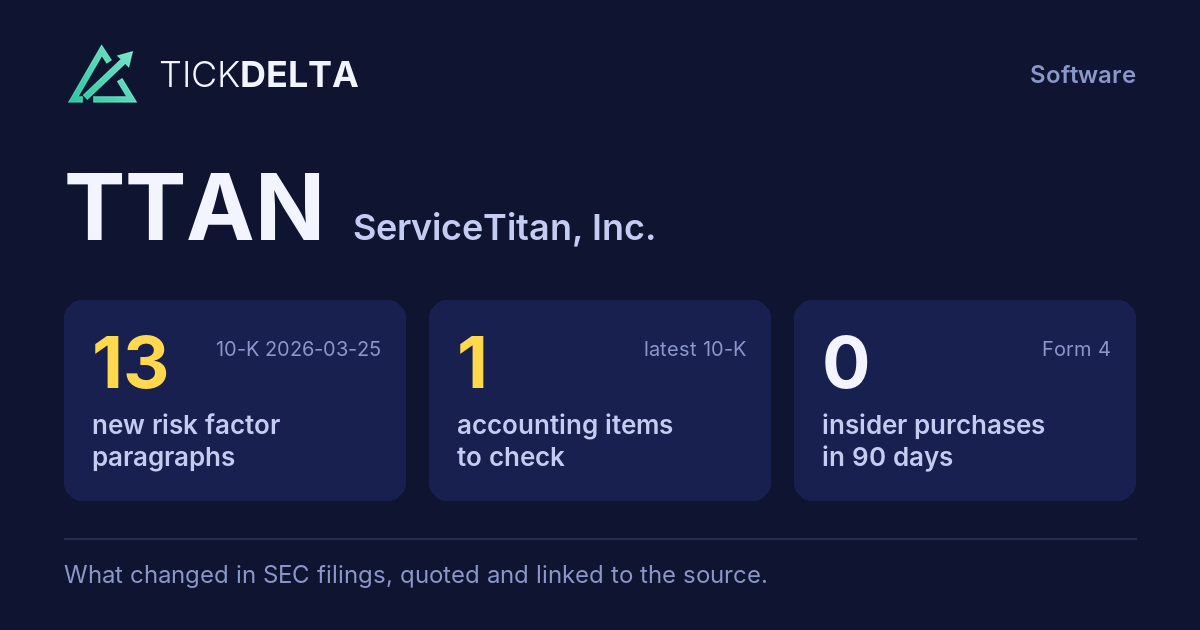
324 paragraphs · 13 new · 106 reworded · 18 gone · 10-K Mar 25, 2026 against Apr 2, 2025
New paragraph Reworded (5% of its words or more) Same or nearly
Paragraph 104 · 49% changed Every version of it
Moreover, as the regulatory framework for AI (and machine learning technology) evolves, is rapidly evolving, and it is possible that new laws and regulations will be adopted in the United States and in non-U.S. jurisdictions, or that existing laws and regulations may be amended or interpreted in ways that would affect the operation of our business, including the way in which we use AI and machine learning technology. The scope and direction of orders, policies, rules and regulations related to AI and machine learning at the federal level in the United States in the near future is uncertain. Meanwhile, various U.S. states have enacted laws that regulate In January 2025, President Trump issued an Executive Order that, among other things, requires certain agencies to develop and submit to the use of AI, including seventeen laws enacted in California in 2024 that provide consumers with certain protections around companies’ use of AI, such as by requiring companies President action plans to disclose certain uses of GenAI, Colorado’s Artificial Intelligence Act, which will require developers “sustain and deployers of “high-risk” enhance America’s global AI systems dominance,” and to implement certain safeguards against algorithmic discrimination, and Utah’s Artificial Intelligence Policy Act, which establishes disclosure requirements and accountability measures for the use of GenAI in certain consumer interactions. Our ability specifically review all rulemaking taken pursuant to provide AI-driven insights and products may also be constrained by current or future regulatory requirements in the United States or in non-U.S. jurisdictions that could restrict or impose burdensome and costly requirements on our ability to leverage data in innovative ways. Further, the cost to comply with such laws or regulations could be significant and could increase our operating expenses, which could adversely affect our business, financial condition and results of operations. rescinded executive orders issued under prior
Paragraph 46 · 47% changed Every version of it
If investments do not accurately anticipate customer demand, if we fail to attract and integrate realize the benefits of these investments by not achieving market acceptance, or our new personnel products or retain and motivate our current personnel, platform enhancements suffer from performance or quality issues or are delayed, our business, financial condition and results of operations could be adversely affected.
Paragraph 105 · 47% changed Every version of it
Moreover, as administrations and, if possible, rescind any such rulemaking to the regulatory framework for AI (and machine learning technology) evolves, extent it is possible that inconsistent with, or presents a barrier to, the Trump Administration’s new laws and regulations will be adopted executive order. Thus, the Trump Administration may continue to rescind other existing federal orders and/or administrative policies relating to AI technologies or may implement new executive orders and/or other rulemaking relating to AI technologies in the United States and in non-U.S. jurisdictions, or that existing laws and regulations may be interpreted in ways that would affect the operation of our business, including the way in which we use AI and machine learning technology. The scope and direction of orders, policies, rules and regulations related to AI and machine learning future. Any such changes at the federal level in the United States in the near future is uncertain. could require us to expend significant resources to modify our platform, products, services, or operations to ensure compliance or remain competitive. Meanwhile, various U.S. states have enacted laws that regulate the use of AI, including seventeen several laws enacted in California in 2024 and 2025 that provide consumers with certain protections around companies’ use of AI, such as by requiring companies to disclose certain uses of GenAI, Colorado’s Artificial Intelligence Act, which will require developers and deployers of “high-risk” AI systems to implement certain safeguards against algorithmic discrimination, and Utah’s Artificial Intelligence Policy Act, which establishes disclosure requirements and accountability measures for the use of GenAI in certain consumer interactions. Our ability The California Privacy Protection Agency also recently finalized regulations under the California Consumer Privacy Act, as amended by the California Privacy Rights Act of 2018 (collectively, the “CCPA”), regarding the use of automated decision-making and providing disclosures to provide AI-driven insights consumers regarding such use. Implementation standards and products enforcement practice are likely to remain uncertain for the foreseeable future, and we cannot determine the impact future laws, regulations, standards, or perception of their requirements may also be constrained by current or future regulatory requirements have on our platform and our business. In addition, on May 21, 2024, the European Union approved the EU Artificial Intelligence Act (the “EU AI Act”), which establishes a comprehensive, risk-based governance framework for AI in the United States or EU market. Although we are not currently subject to the EU AI Act, we may become subject to it in non-U.S. jurisdictions that could restrict or impose burdensome the future, which may affect our use of AI technologies and costly requirements on our ability to leverage data in innovative ways. Further, the cost to comply with such laws provide, improve or regulations could be significant commercialize our platform, and could increase our operating expenses, which could adversely affect our business, operations and financial condition and results of operations. condition.
Paragraph 106 · 45% changed Every version of it
Moreover, as the regulatory framework for AI (and machine learning technology) evolves, it It is possible that further new laws and regulations will be adopted in the United States and in other non-U.S. jurisdictions, or that existing laws and regulations regulations, including competition, antitrust, data privacy and consumer protection laws, may be interpreted or enforced in ways that would affect the operation of limit our ability to use AI technologies for our business, including or require us to change the way in which we use AI technologies. We may not always be able to anticipate how to respond to these new or updated laws or regulations, and machine learning technology. The scope and direction of orders, policies, rules and regulations related to AI and machine learning at the federal level in the United States in the near future is uncertain. Meanwhile, various U.S. states have enacted laws that regulate the use of AI, including seventeen laws enacted in California in 2024 that provide consumers with certain protections around companies’ use of AI, such as by requiring companies to disclose certain uses of GenAI, Colorado’s Artificial Intelligence Act, which will require developers and deployers of “high-risk” AI systems to implement certain safeguards against algorithmic discrimination, and Utah’s Artificial Intelligence Policy Act, which establishes disclosure requirements and accountability measures for the use of GenAI in certain consumer interactions. Our our ability to provide AI-driven insights and products may also be constrained by current or future regulatory requirements in the United States or in non-U.S. jurisdictions that jurisdictions, which could restrict or impose burdensome and costly requirements on our ability to leverage data in innovative ways. ways and negatively affect the performance of our products, services, and business and the way in which we use AI technologies. Further, the cost to comply with such laws or regulations regulations, or decisions or guidance interpreting existing laws, including the redesign of our platform to achieve compliance, could be significant and could increase our operating expenses, which could adversely affect our business, financial condition and results of operations. In addition, if we fail or are perceived to fail to comply with these laws and regulations, we may face lawsuits (including class actions), investigations, enforcement actions, negative reputational impacts, and other penalties that materially impact our business.
Paragraph 80 · 45% changed Every version of it
If we fail risks may be further increased if our disaster recovery plans prove to manage be inadequate, and could generally adversely affect our growth effectively, our brand and brand, reputation, business, financial condition and results of operations could be adversely affected. operations.
Paragraph 293 · 44% changed Every version of it
The trading price of our Class A common stock could decline as a result of sales of a large number of shares of our Class A common stock in the market after public market, particularly sales by our IPO, directors, officers, and principal stockholders, and the perception that these sales could occur may also depress the trading price of our Class A common stock. As of January 31, 2025, 2026, we had 76,644,240 81,956,537 shares of our Class A common stock, 13,404,097 12,644,614 shares of our Class B common stock and no shares of our Class C common stock outstanding. The While shares held by directors, executive officers, and other affiliates are subject to volume limitations under Rule 144 under the Securities Act, we are unable to predict the timing of or the effect that such sales may have on the prevailing trading price of our Class A common stock that we sold in our IPO were able to be resold immediately. The remaining shares of our capital stock will become available for sale under the terms of market standoff provisions in agreements with us, and lock-up agreements entered into between the holders of those shares and the underwriters of our IPO. stock.
Paragraph 292 · 42% changed Every version of it
A Sales of a substantial portion number of the outstanding shares of our Class A common stock (including shares of our Class A common stock issuable upon conversion of our Class B common stock) are currently restricted from immediate resale but may be sold on the Exchange in the near future. The large number of shares eligible for public sale or subject to rights requiring us to register them for public sale could depress the trading price of our Class A common stock.
Paragraph 246 · 40% changed Every version of it
The preparation of financial statements in conformity with GAAP requires management to make estimates and assumptions that affect the amounts reported in our financial statements and accompanying notes. We base our estimates on historical experience and on various other assumptions that we believe to be reasonable under the circumstances, as described in the section titled “Management’s Discussion and Analysis of Financial Condition and Results of Operations.” The results of these estimates form the basis for making judgments about the recognition and measurement of certain assets and liabilities and revenue and expenses that is not readily apparent from other sources. Our accounting policies that involve judgment and use of estimates include revenue recognition, fair value of stock-based compensation, fair value of the common stock underlying our stock-based awards and fair value of assets

MD&A

98 paragraphs · 2 new · 44 reworded · 15 gone · 10-K Mar 25, 2026 against Apr 2, 2025
New paragraph Reworded (5% of its words or more) Same or nearly
Paragraph 49 · 49% changed
Sales and marketing expense increased by $33.4 million, or 15%, for fiscal 2025, compared to fiscal 2024. The increase in sales and marketing expense was primarily driven by an increase decrease of $25.6 $4.6 million in personnel-related costs related to an increase in headcount, including an increase of $4.2 million in commissions and an increase of $3.5 million in stock-based compensation. We also recorded a $6.0 million increase in impairment losses on operating lease assets and related property and equipment for a portion of our headquarters space office spaces that we ceased to use during use.
Paragraph 79 · 48% changed
Fiscal 2026 2025 2024 (in thousands) Net cash provided by (used in) operating activities $ 110,131 $ 37,053 Capitalized internal-use software (19,877) (17,799) Purchase of property and equipment (4,704) (3,800) Deposits for property and equipment (477) - Non-GAAP free cash flow $ (39,702) activities Net cash used in investing activities (22,783) (40,347) Net cash provided by financing 279,713 24,269 activities Net increase (decrease) in cash, cash equivalents, and 85,073 $ 293,983 $ (55,780) restricted cash 15,454
Paragraph 14 · 44% changed
Increase GTV By Entering New Trades and Markets. ServiceTitan began by serving a single trade—plumbing—and focusing on residential homes, and we now serve many trades that serve all sites: homes, businesses and even new construction. As we have penetrated new trades over time, we have significantly expanded our potential customer reach, unlocking new markets to drive future customer growth. We plan to continue to innovate and expand into new trade verticals through our playbook of harnessing common features of the trades industry, while also identifying and building features specific to each new trade vertical. It takes significant time and research and development to identify new trade verticals to enter and build out functionalities on top of our common products, as well as investment in sales and marketing resources, to ensure we can successfully go to market with an end-to-end offering in such new verticals.
Paragraph 48 · 41% changed
Research and development expense increased by $59.5 $39.5 million, or 29%, 15%, for fiscal 2025, 2026, compared to fiscal 2024. 2025. The increase in research and development expense was primarily driven by an increase of $48.0 $35.7 million in personnel-related costs related to costs, which included an increase in headcount, including headcount and an increase of $12.8 $6.7 million in stock-based compensation. The There was also an increase in stock-based compensation included $8.7 of $4.9 million in expense recorded for performance awards where vesting was triggered due employee benefit expenses primarily related to our IPO. Additionally, health insurance and an increase of $4.4 million in infrastructure and server costs and software subscription fees related to our ongoing product development efforts increased $4.3 million related to our ongoing product development efforts. We also recorded a $5.8 million increase in impairment losses on operating lease assets and related property and equipment for a portion of our headquarters space that we ceased to use. costs. These increases were partially offset by a decrease of $1.0 million in third-party development resources as we leveraged more internal development resources in fiscal 2025.
Paragraph 43 · 40% changed
Platform cost of revenue increased by $33.2 $10.6 million, or 20%, 5%, for fiscal 2025, 2026, compared to fiscal 2024. 2025. This increase was primarily due to a $13.7 $16.4 million increase in the costs related to the provisioning of our platform services products and $10.4 products. This increase was partially offset by a $6.0 million increase decrease in personnel-related costs, primarily due to an increase the shift in headcount. In addition, amortization of capitalized internally developed software increased by $4.8 million and we also recorded a $4.7 million increase in impairment losses on operating lease assets and related property and equipment for the portion roles of our headquarters that we ceased customer success function to use. These increases were partially offset by a decrease sales and marketing activities at the beginning of $0.8 million of restructuring costs related to our reductions in workforce. Platform gross margin increased to 73% for fiscal 2025, compared to 71% for fiscal 2024, primarily due to improved efficiencies in delivering our platform at scale. 2026.
Paragraph 98 · 38% changed
Accounting for acquisitions represents a critical accounting policy. For information regarding our acquisition accounting policy, see Note 2 to our audited consolidated financial statements included elsewhere in this Annual Report. Determining the fair value of assets acquired and liabilities assumed requires management to make judgments and estimates, including the selection of valuation methodologies, assumptions used in future revenue, cost and cash flow forecasts and selection of comparable companies. We engage the assistance of valuation specialists in concluding on fair value measurements in connection with determining fair values of assets acquired and liabilities assumed in a business combination. While we use our best estimates and judgments, estimates are inherently uncertain and subject to refinement. The valuation of intangible assets, primarily customer relationships and developed technology, includes estimates that are critical accounting estimates. These critical estimates are primarily those relating to forecasted growth rates, customer retention rates and obsolescence rates of acquired technology. We base these estimates using information available regarding historical trends and future industry conditions and macroeconomic events, and judgments regarding the replacement and obsolescence of acquired technologies, among other factors.
Paragraph 97 · 37% changed
Accounting for acquisitions represents a critical accounting policy. For information regarding our acquisition accounting policy, see Note 2 to our audited consolidated financial statements included elsewhere in this Annual Report. Determining the fair value of assets acquired and liabilities assumed requires management to make judgments and estimates, including the selection of valuation methodologies, assumptions used in future revenue, cost and cash flow forecasts and selection of comparable companies. We engage the assistance of valuation specialists in concluding on fair value measurements in connection with determining fair values of assets acquired and liabilities assumed in a business combination. combinations. While we use our best estimates and judgments, estimates are inherently uncertain and subject to refinement. The valuation of intangible assets, primarily customer relationships and developed technology, includes estimates that are critical accounting estimates. These critical estimates are primarily those relating to forecasted growth rates, customer retention rates and obsolescence rates of acquired technology. We base these estimates using information available regarding historical trends and future industry conditions and macroeconomic events, and judgments regarding the replacement and obsolescence of acquired technologies, among other factors.
Paragraph 44 · 32% changed
Professional services and other cost of revenue decreased by $0.2 increased $5.7 million, or 1%, 8%, for fiscal 2025, 2026, compared to fiscal 2024. 2025. Personnel-related costs increased by $7.7 million primarily due to an increase in headcount. This decrease was primarily driven by the disposal of certain marketing solutions in the fourth quarter of fiscal 2024, which contributed $4.7 million in revenue for fiscal 2024. The decrease increase was partially offset by increased revenue from a higher volume decrease of professional services performed $2.3 million in fiscal 2025. third-party service fees.

A paragraph is matched with the one last year that shares the most of its words; under half in common makes it new. The paragraphs shown are the 8 reworded the most in each section.

The paragraph that changed most in each section

The redline

Marked against last year's 10-K: cut words struck through, new words highlighted.

Risk Factors339 words changed in this paragraph; it is 62% similar to last year's version.
Our customers and end customers may use our platform to make telephone calls and send short message services (“SMS”), text messages to our customers. In particular, the TCPA imposes significant restrictions on the use of telephone calls and text messages to residential and mobile telephone numbers as a means of communication when prior consent of the person being contacted has not been obtained. In addition, our customers may be required to comply with registration requirements to use SMS text messages, such as A2P 10DLC registration. Our customers’ use of our platform for marketing activities must comply with the above-mentioned laws and other requirements. Despite our ongoing and substantial efforts to limit such use, certain customers or end customers may use our platform to transmit unauthorized, offensive or illegal messages, calls, spam, phishing scams and website links to harmful applications, reproduce and distribute copyrighted material or the trademarks of others without permission, launder money, traffic drugs, fraudulently sell goods or services, use credit or debit cards in an unauthorized manner, record conversations without proper notice or consent, and report inaccurate or fraudulent data or information. While these actions are in violation of our policies, our efforts to defeat spamming attacks, illegal robocalls and other fraudulent activity will not prevent all such attacks and activity. Additionally, if the measures we have taken are too restrictive and inadvertently screen proper transactions, this could diminish our customer experience. Violations of the TCPA may be enforced by the FCC or by individuals through litigation, including through costly class actions, of which numerous suits under federal and state laws have been filed in recent years against companies who conduct telemarketing and/or SMS texting programs, resulting in multi-million dollar settlements to the plaintiffs. In addition to costly and time-consuming litigation, statutory penalties for TCPA violations range from $500 to $1,500 per violation, which has been interpreted to mean per phone call and/or text message sent and therefore the fines and settlement amounts can be very significant. Due to the evolving interpretation of the TCPA’s restrictions, and the highly litigated nature of the TCPA, our and our customers’ business and results of operations may be adversely affected by regulators, including the FCC, or the courts interpreting the TCPA restrictions differently than we do, by actual or perceived violations of the TCPA, as well as by lawsuits or other claims against us and our customers relating to violations of the TCPA. The outcome of such proceedings may not be favorable, and one or more unfavorable outcomes could have a material adverse impact on our financial condition. Additionally, any changes to the TCPA, its interpretation, or enforcement of it by the government or private parties that further restrict the way we or our customers’ contact and communicate with potential customers or generate leads could harm our business, financial condition and results of operations. Additionally, we also send marketing messages via email and are subject to the CAN-SPAM, which establishes specific requirements for commercial email messages and outlines penalties for the transmission of commercial email messages that are intended to deceive the recipient as to source or content, and obligates, among other things, the sender of commercial emails to provide recipients with the ability to opt out of receiving future commercial emails from the sender. As laws and regulations, including FTC and FCC enforcement thereof, rapidly evolve to govern the use of these communications and marketing platforms, the failure by us or our customers, or our employees or third parties acting at our direction, to abide by applicable laws and regulations could adversely impact our business, reputation and brand, financial condition and results of operations or subject us to fines or other penalties.

Source: Item 1A, 10-K 0001638826-26-000028 vs Item 1A, 10-K 0000950170-25-048834

Accounting Policies160 words changed in this paragraph; it is 36% similar to last year's version.
In December 2023, the FASB issued ASU 2023-09, Income Taxes (Topic 740): Improvements to Income Tax Disclosure, requiring enhanced income tax disclosures. This ASU Disclosures, which requires public entities, on an annual basis, to provide disclosure of specific categories and disaggregation of information in the rate reconciliation table. This ASU also requires reconciliation, as well as disclosure of disaggregated information related to income taxes paid, income or loss from continuing operations before income tax expense or benefit paid disaggregated between domestic and foreign, and income tax expense or benefit from continuing operations disaggregated between federal, state, and foreign. The requirements of this by jurisdiction. ASU are 2023-09 is effective for annual periods fiscal years beginning after December 15, 2024, with the Company’s fiscal 2026. Early early adoption is permitted and the amendments should be applied on a prospective basis. Retrospective application is permitted. The Company is currently evaluating adopted ASU 2023-09 for the impact of year ended January 31, 2026, and applied the new guidance on disclosure requirements prospectively to the current annual period. Prior period disclosures have not been adjusted to reflect the new disclosure within its requirements. See Note 14 Income Taxes in the accompanying notes to the consolidated financial statements. statements for further details.

Source: Item 8, Note 2 – Summary of Significant Accounting Policies, 10-K 0001638826-26-000028 vs Item 8, Note 2 – Summary of Significant Accounting Policies, 10-K 0000950170-25-048834

MD&A159 words changed in this paragraph; it is 51% similar to last year's version.
General and administrative expense increased by $78.5 $35.0 million, or 58%, 16%, for fiscal 2025, 2026, compared to fiscal 2024. 2025. The increase in general and administrative expense was primarily driven by an increase of $57.4 $31.7 million in personnel-related costs related to costs, which included an increase in headcount, including headcount and an increase of $44.8 $24.5 million in stock-based compensation. The increase in In fiscal 2026, stock-based compensation also included $52.2 million in expense recorded for performance awards where vesting was triggered due to our IPO, of which $15.0 includes $53.6 million related to performance-based RSUs granted to our Co-Founders, which Co-Founders in October 2024. Additionally, there was an increase of $7.1 million in third-party consulting costs related to legal, consulting and audit services, an increase of $5.6 million in our allowance for credit losses as we further integrated acquired businesses, and an increase of $2.5 million in employee benefit expenses primarily related to health insurance. These increases were partially offset by a $6.2 decrease of $13.2 million expense in fiscal 2024 related to the 2024 Tender Offer. We also recorded a $15.5 million increase in impairment losses on operating lease assets and related property and equipment for a portion of our headquarters space office spaces that we ceased to use. Additionally, consulting and professional fees increased $2.7 million primarily related to preparation activities for our IPO in fiscal 2025 and acquisition related expenses increased $1.6 million related to our acquisition of Convex Labs Inc. (“Convex”) in fiscal 2025.

Source: Item 7, 10-K 0001638826-26-000028 vs Item 7, 10-K 0000950170-25-048834

Legal Proceedings68 words changed in this paragraph; it is 74% similar to last year's version.
In the ordinary course of business, the Company may provide indemnifications of varying scope and terms to customers, vendors, lessors, investors, directors, officers, employees and other parties with respect to certain matters, including, but not limited to, losses arising out of the Company’s breach of such agreements, products or services to be provided by the Company, or from intellectual property infringement claims made by third parties. These indemnifications may survive termination of the underlying agreement and the maximum potential amount of future payments the Company could be required to make under these indemnification provisions may not be subject to maximum loss clauses. The maximum potential amount of future payments the Company could be required to make under these indemnification provisions is indeterminable. The Company is not subject to any material indemnification claims that are probable or reasonably possible, and has not made any cash payments under its indemnification agreements that had a material effect on the financial position, results of operations or cash flows of the Company.

Source: Item 3, via Note 8 – Commitments and Contingencies, 10-K 0001638826-26-000028 vs Item 3, via Note 8 – Commitments and Contingencies, 10-K 0000950170-25-048834

Sentences and paragraphs added, removed or reworded

Every change, by type

Sentences and paragraphs of TTAN's Risk Factors and MD&A, 10-K Mar 25, 2026 against 10-K Apr 2, 2025. Each links to the text at sec.gov.

Quiet changes are sentences kept from last year with one to four words changed, at least one of them a hedge, a modal or a qualifier (may, could, will, not, significant, material…). A year or date rolling forward is not counted.

The full word list

adverse, adversely, all, although, anticipate, anticipates, any, approximately, believe, believes, can, cannot, certain, could, expect, expects, generally, however, if, intend, intends, largely, likely, many, material, materially, may, might, most, must, never, no, not, possible, primarily, probable, should, significant, significantly, some, substantial, substantially, unlikely, will, would

AddedRisk Factors
The following summarizes factors that could have a material adverse effect on the Company’s business, reputation, results of operations, financial condition and stock price. The Company may not be able to accurately predict, control or mitigate these risks. Statements in this section are based on the Company’s beliefs and opinions regarding matters that could materially adversely affect the Company in the future and are not representations as to whether such matters have or have not occurred previously. The risks and uncertainties described below are not exhaustive and should not be considered a complete statement of all potential risks or uncertainties that the Company faces or may face in the future.
Read it in 10-K Mar 25, 2026 at sec.gov
AddedRisk Factors
Additionally, our competitors may make substantial investments in AI, machine learning and GenAI capabilities that may allow them to replicate key aspects of our platform more quickly and cost-effectively than previously possible. While we have made, and expect to continue to make, significant investments to integrate AI, including GenAI, into our platform, AI technologies are rapidly evolving and there can be no guarantee that our platform will remain competitive as new AI technologies are developed, adopted, and integrated into software solutions. We may also face greater competition from non-specialist solutions relying on generic LLMs, GenAI and general-purpose agents to address a broad range of business needs. As we attempt to sell our platform to new and existing customers, we must convince them that our solutions are superior to other solutions available to their organizations, including generic LLMs, software created using natural language prompts and GenAI (referred to as vibe coding) and other emerging technologies.
Read it in 10-K Mar 25, 2026 at sec.gov
AddedRisk Factors
We rely on our own, and our third-party service providers’, platforms, computer systems, hardware, software, technology infrastructure and online sites and networks for both internal and external operations that are critical to our
Read it in 10-K Mar 25, 2026 at sec.gov
AddedRisk Factors
The software underlying our platform is highly complex and may contain undetected errors or vulnerabilities, some of which may only be discovered after the code has been released. Our practice is to effect frequent releases of
Read it in 10-K Mar 25, 2026 at sec.gov
AddedRisk Factors
higher interest rates and could require us to comply with more onerous covenants, which could further restrict our business operations. In addition, we cannot assure you that we will be able to refinance any future indebtedness on commercially reasonable terms, or at all.
Read it in 10-K Mar 25, 2026 at sec.gov
Show the other 63
AddedRisk Factors
As of January 31, 2026, we are no longer an EGC. Moreover, we are a large accelerated filer. As a large accelerated filer, we are subject to certain disclosure and compliance requirements that apply to other public companies but that did not previously apply to us due to our status as an EGC. These requirements include, but are not limited to:
Read it in 10-K Mar 25, 2026 at sec.gov
AddedRisk Factors
•the requirement that our independent registered public accounting firm attest to the effectiveness of our internal control over financial reporting under Section 404(b) of the Sarbanes-Oxley Act;
Read it in 10-K Mar 25, 2026 at sec.gov
AddedRisk Factors
•compliance with any requirement that may be adopted by the Public Company Accounting Oversight Board regarding mandatory audit firm rotation or a supplement to the auditor’s report providing additional information about the audit and the financial statements; and
Read it in 10-K Mar 25, 2026 at sec.gov
RemovedRisk Factors
We also may record phone calls or other conversations on behalf of our customers for coaching or other quality assurance purposes, and our customers may also record phone calls that are placed through our platform. The actual or perceived improper calling of customer phones or recording of customer calls or other conversations may subject
Read it in 10-K Apr 2, 2025 at sec.gov
RemovedRisk Factors
We were a private company from our inception through our IPO, and, as such, we have not had the internal control over financial reporting requirements of a publicly traded company. As a result of becoming a public company, we are now required to furnish a report by management on the effectiveness of our internal control over financial reporting beginning with our Annual Report on Form 10-K for fiscal 2026. This assessment will need to include disclosure of any material weaknesses identified in our internal control over financial reporting.
Read it in 10-K Apr 2, 2025 at sec.gov
RemovedRisk Factors
We have previously identified material weaknesses in our internal control over financial reporting, which consisted of the following: (i) lack of an effective control environment including insufficient resources with an appropriate level of controls knowledge and expertise commensurate with our financial reporting requirements, (ii) ineffective controls over our financial close and financial reporting, including controls over cash flow statements, balance sheet reconciliations and journal entries including maintaining appropriate segregation of duties, (iii) ineffective controls related to the identification of, and accounting for, certain non-routine, complex or unusual events or transactions and the adoption of new accounting standards, and (iv) ineffective information technology general controls in the areas of user access, program change-management, program development and computer operations controls over certain information technology systems relevant to our financial statements. After these material weaknesses were identified, we implemented a remediation plan that included the following:
Read it in 10-K Apr 2, 2025 at sec.gov
RemovedRisk Factors
•We hired additional qualified accounting and IT personnel to bolster our technical reporting, operational accounting, tax and IT compliance capabilities. We implemented controls to formalize roles and review responsibilities to align with our team’s skills and experience and implemented formal controls over segregation of duties. We evaluated our resource needs and will continue to evaluate and hire additional resources as needed to support our growth.
Read it in 10-K Apr 2, 2025 at sec.gov
RemovedRisk Factors
•We designed and implemented procedures and controls to identify and account for complex accounting transactions and other technical accounting and financial reporting matters including accounting memoranda addressing these matters.
Read it in 10-K Apr 2, 2025 at sec.gov
RemovedRisk Factors
•We also engaged and will continue to engage external consultants with appropriate expertise for more complex technical accounting issues, specifically related to acquisitions and new accounting standards, which supplements our internal resources and allows us to scale our accounting processes to match growth and changes in our business and operations.
Read it in 10-K Apr 2, 2025 at sec.gov
RemovedRisk Factors
•We implemented an enterprise resource planning (“ERP”), system and other applications to support our business processes. We designed and implemented controls to, among other things, optimize automation to enhance our financial statement close process, reduce the number of manual journal entries, enforce segregation of duties and facilitate the proper review of journal entries.
Read it in 10-K Apr 2, 2025 at sec.gov
RemovedRisk Factors
•We formalized accounting processes, policies and procedures supporting our financial close process, including creating standard balance sheet reconciliation templates, and formalized procedures over the review of financial statements.
Read it in 10-K Apr 2, 2025 at sec.gov
RemovedRisk Factors
•We enhanced IT governance processes, including implementing a streamlined process to govern access and change management processes across key corporate applications, implementing more robust IT policies and procedures over access and change management and computer operations, automating components of our change management and logical access processes, and enhanced IT controls.
Read it in 10-K Apr 2, 2025 at sec.gov
RemovedRisk Factors
•sales of shares of our Class A common stock by us or our stockholders, as well as the anticipation of the expiration of, or releases from, market standoff agreements or lock-up agreements;
Read it in 10-K Apr 2, 2025 at sec.gov
RemovedRisk Factors
Our executive officers, directors and the holders of a substantial majority of our capital stock and securities convertible into or exchangeable for our capital stock have entered into lock-up agreements with the underwriters of our IPO under which they agreed, subject to specific exceptions, not to dispose of or hedge any of our capital stock for 180 days following the date of our IPO. We refer to this period as the restricted period. Our executive officers, directors and the holders of substantially all of our capital stock and securities convertible into or exchangeable for our capital stock are subject to market standoff agreements with us under which they agreed that, subject to certain exceptions, during the restricted period, they will not directly or indirectly dispose any of our capital stock. When the restricted period expires with respect to all or a portion of our shares, our security holders will be able to sell their shares in the public market.
Read it in 10-K Apr 2, 2025 at sec.gov
RewordedRisk Factors
Our amended and restated bylaws provide that, unless we consent in writing to the selection of an alternative forum, to the fullest extent permitted by law, the sole and exclusive forum for (i) any derivative action or proceeding brought on our behalf, (ii) any action asserting a claim of breach of a fiduciary duty owed by any of our directors, officers or other employees to us or our stockholders, (iii) any action arising pursuant to any provision of the DGCL, our amended and restated certificate of incorporation or our amended and restated bylaws or (iv) any other action asserting a claim that is governed by the internal affairs doctrine shall be the Court of Chancery of the State of Delaware (or, if the Court of Chancery does not have jurisdiction, the federal district court for the District of Delaware), in all cases subject to the court having jurisdiction over indispensable parties named as defendants.
Read it in 10-K Mar 25, 2026 at sec.gov
RewordedRisk Factors
In addition, negative Negative global and regional economic conditions, including conditions resulting from changes in gross domestic product growth, financial and credit market fluctuations, inflation, rising interest rates, and bank failures, international trade relations, geopolitical instability and uncertainty, such as the war in Ukraine and resulting heightened risk of cyberattacks, intellectual property theft, and a reduction in information technology spending regardless of macroeconomic conditions could have adverse impacts on our business, results of operations and financial condition, including longer sales cycles, lower prices for our subscriptions, higher default rates among our channel partners, reduced sales and slower or declining growth.
Read it in 10-K Mar 25, 2026 at sec.gov
RewordedRisk Factors
Moreover, as the regulatory framework for AI (and machine learning technology) evolves, it It is possible that further new laws and regulations will be adopted in the United States and in other non-U.S. jurisdictions, or that existing laws and regulations regulations, including competition, antitrust, data privacy and consumer protection laws, may be interpreted or enforced in ways that would affect the operation of limit our ability to use AI technologies for our business, including or require us to change the way in which we use AI and machine learning technology. technologies.
Read it in 10-K Mar 25, 2026 at sec.gov
RewordedRisk Factors
Our We may not always be able to anticipate how to respond to these new or updated laws or regulations, and our ability to provide AI-driven insights and products may also be constrained by current or future regulatory requirements in the United States or in non-U.S. jurisdictions that jurisdictions, which could restrict or impose burdensome and costly requirements on our ability to leverage data in innovative ways. ways and negatively affect the performance of our products, services, and business and the way in which we use AI technologies.
Read it in 10-K Mar 25, 2026 at sec.gov
RewordedRisk Factors
In addition, we have filed a registration statement statements on Form S-8 under the Securities Act to register shares reserved for future issuance under our equity compensation plans and, subject to the satisfaction of applicable exercise periods and the expiration or waiver of the lock-up agreements referred to above, periods, the shares issued upon exercise of outstanding stock options will be available for immediate resale in the United States in the open market. public market, subject in some cases to the volume and other restrictions of Rule 144.
Read it in 10-K Mar 25, 2026 at sec.gov
RewordedRisk Factors
Upon the completion of the IPO, stockholders owning an aggregate of up to approximately 80.5 million shares Certain holders of our Class A common stock (including shares of our Class A common stock issuable upon conversion of our Class B common stock and/or the exercise or settlement, as applicable, of outstanding equity awards) were are entitled, under the IRA, provisions of our amended and restated investors’ rights agreement, dated as of July 27, 2023, to require us to register shares owned by them for public sale in the United States.
Read it in 10-K Mar 25, 2026 at sec.gov
RewordedRisk Factors
A Sales of a substantial portion number of the outstanding shares of our Class A common stock (including shares of our Class A common stock issuable upon conversion of our Class B common stock) are currently restricted from immediate resale but may be sold on could depress the Exchange in the near future. trading price of our Class A common stock.
Read it in 10-K Mar 25, 2026 at sec.gov
RewordedRisk Factors
It is possible, however, that However, we could face sales tax or other tax or VAT audits and that our liability for these taxes could exceed our estimates as in which tax authorities in the United States or and other jurisdictions could still successfully assert that we are obligated to collect additional tax amounts from our paying customers and remit those taxes amounts to those authorities.
Read it in 10-K Mar 25, 2026 at sec.gov
RewordedRisk Factors
While we remediated these material weaknesses, such remediation does Our internal control over financial reporting may not guarantee that our remediated controls will continue to be effective or that and we will not may experience other material weaknesses in the future, which could affect the reliability of our financial statements and have other adverse consequences.
Read it in 10-K Mar 25, 2026 at sec.gov
RewordedRisk Factors
We conducted a formal study through January 31, 2025 2026 that concluded that although there had been prior ownership changes, there were no actual limitations on the use changes and that our utilization of our NOLs. pre-change tax attribute carryforwards will be subject to annual limitations.
Read it in 10-K Mar 25, 2026 at sec.gov
RewordedRisk Factors
For example, California’s Consumer Privacy Act of 2018, as amended by the California Privacy Rights Act of 2020 (collectively, the “CCPA”), CCPA introduced new rights for California residents and obligations for covered businesses collecting, using, disclosing and processing personal information. Personal Information, including obligations to:
Read it in 10-K Mar 25, 2026 at sec.gov
RewordedRisk Factors
Compliance with these rules and regulations will has and is expected to continue to increase our legal and financial compliance costs, and increase demand on our systems, particularly after since we are no longer an “emerging growth company. Emerging Growth Company (“EGC”) and are now a large accelerated filer.
Read it in 10-K Mar 25, 2026 at sec.gov
Quiet changesRisk Factors
Accordingly, if any element of our engagement of team members through PEOs, or of our relationship with independent contractors, fails is found not to comply with laws or regulations, our business, financial condition and results of operations could be materially and adversely affected.
Read it in 10-K Mar 25, 2026 at sec.gov
Quiet changesRisk Factors
A However, a majority of our customers are small- and medium-sized businesses (“SMBs”), and we expect they will continue to comprise a large portion of our customer base for the foreseeable future.
Read it in 10-K Mar 25, 2026 at sec.gov
Quiet changesRisk Factors
We may be unable to generate sufficient cash flow to satisfy our significant future debt service obligations, which could have an adverse effect on our business, financial condition, results of operations and cash flows.
Read it in 10-K Mar 25, 2026 at sec.gov
Quiet changesRisk Factors
For example, covenants contained in our Amended Credit Agreement will limit our ability to pay dividends, to create, incur or assume indebtedness or liens, to consummate certain strategic transactions, to engage in transactions with affiliates and to make certain investments.
Read it in 10-K Mar 25, 2026 at sec.gov
Quiet changesRisk Factors
As a result of disclosure of information in this Annual Report and in filings required of a public company, our business, financial condition and results of operations will become are more visible, which may result in threatened or actual litigation, including by competitors.
Read it in 10-K Mar 25, 2026 at sec.gov
Quiet changesRisk Factors
These new public company obligations and constituents will require significant attention from our senior management and could divert their attention away from the day-to-day management of our business, which may harm our business, financial condition and results of operations.
Read it in 10-K Mar 25, 2026 at sec.gov
Quiet changesRisk Factors
These shares will be are available to be used in the future for various uses including to further strategic initiatives, such as financings or acquisitions, or issue future equity awards to our service providers.
Read it in 10-K Mar 25, 2026 at sec.gov
AddedMD&A
In January 2023, we entered into a secured credit agreement (the “Original Credit Agreement”) with Wells Fargo Bank N.A., as administrative agent and collateral agent, and certain lenders. In September 2024, we amended the Original Credit Agreement (the “First Amendment”) to, among other things, convert our existing term loan to a new term loan balance and a revolving credit facility. On January 30, 2026, we entered into a second amendment (the “Second Amendment”) to the Original Credit Agreement (as amended by the First Amendment and the Second Amendment, the “Amended Credit Agreement”) that increased the total borrowing capacity of the revolving credit facility made available under the Amended Credit Agreement from $140.0 million to $250.0 million and extended the term of the Amended Credit Agreement through January 30, 2031.
Read it in 10-K Mar 25, 2026 at sec.gov
AddedMD&A
In addition, the Second Amendment (i) modified pricing and unused commitment fees payable under the Amended Credit Agreement to be based on total net leverage rather than recurring revenue, (ii) replaced the recurring revenue and liquidity financial covenants in the Original Credit Agreement with a total net leverage financial covenant, and (iii) modified certain negative covenants, including liens, indebtedness, investments, dispositions, restricted payments and restricted debt payments, to provide us with more flexibility thereunder. Prior to entering into the Second Amendment we voluntarily repaid, in full, the approximately $107.0 million term loan that was outstanding under the Original Credit Agreement. As of January 31, 2026, no loans were outstanding under the Amended Credit Agreement.
Read it in 10-K Mar 25, 2026 at sec.gov
RemovedMD&A
In December 2024, we completed our initial public offering (the “IPO”), in which we issued and sold an aggregate of 10,120,000 shares of our Class A common stock at a public offering price of $71.00 per share. We received aggregate proceeds of $674.1 million, net of underwriting costs and offering expenses. Immediately prior to the closing of the IPO, all 42,465,855 shares of our then-outstanding shares of redeemable convertible preferred stock automatically converted into 44,257,289 Class A common shares at their respective as-adjusted conversion ratios.
Read it in 10-K Apr 2, 2025 at sec.gov
RemovedMD&A
Upon the effectiveness of the registration statement on Form S-1 relating to the IPO (the “IPO Registration Statement”), the performance vesting condition of certain stock options and restricted stock units (“RSUs”) was met, and we recognized $59.1 million of stock-based compensation expense for the portion of the service period completed by service providers from the grant date through the effectiveness of the IPO Registration Statement.
Read it in 10-K Apr 2, 2025 at sec.gov
RemovedMD&A
In addition, we expect our sales marketing expense to increase in absolute dollars and as a percentage of revenue resulting from a portion of our customer success personnel shifting roles to sales and marketing activities at the beginning fiscal 2026 as we shift the customer success function to focus on both customer retention and also customer expansion.
Read it in 10-K Apr 2, 2025 at sec.gov
RemovedMD&A
In January 2023, we entered into a secured credit agreement with Wells Fargo Bank N.A., as administrative agent and collateral agent, and certain lenders. In September 2024, we entered into an amendment to the secured credit agreement, effective October 1, 2024 (as amended, the “Credit Agreement”) that converted our existing term loan balance of $177.3 million and $70.0 million revolver facility to a term loan of $107.3 million (as amended, the “Term Loan”) and a revolver facility of $140.0 million, of which $70.0 million was initially drawn (as amended, the “Revolver Facility”). In January 2025 we repaid all amounts outstanding under the Revolver Facility. The Credit Agreement contains the standard and customary covenants for agreements of this type, including various reporting, affirmative and negative covenants. Among other things, these covenants set forth minimum revenue thresholds, require the maintenance of minimum liquidity and establish certain limits to our and our subsidiaries’ ability to create or incur liens on assets, make acquisitions of or investments in businesses, engage in any material line of business substantially different from our current lines of business, incur additional indebtedness or contingent obligations, sell or dispose of assets, pay dividends and make loans or advances to employees.
Read it in 10-K Apr 2, 2025 at sec.gov
RemovedMD&A
The Term Loan and Revolver Facility will mature in January 2028 and bear interest at a floating rate at our option of either (i) a term Secured Overnight Financing Rate (“SOFR”), based rate for a specified interest period plus an applicable margin, which is initially 2.5% per annum and ranges from 2.25% to 3.00% per annum based on a ratio of outstanding debt to annual recurring revenue, or (ii) a base rate plus an applicable margin, which is initially 1.5% per annum and ranges from 1.25% to 2.0% per annum based on the ratio of total outstanding debt to annual recurring revenue. On the first day of each calendar quarter, we have been required to repay an aggregate principal amount equal to 0.25% of the aggregate original principal amount of the Term Loan, which repayment amount became fixed at approximately $0.3 million beginning January 1, 2025. The Revolver Facility will incur a 0.25% annual fee for undrawn amounts.
Read it in 10-K Apr 2, 2025 at sec.gov
RemovedMD&A
As of January 31, 2025, we had total debt of $105.1 million, consisting of the outstanding principal balance of the Term Loan of $107.0 million, net of unamortized debt issuance costs of $1.9 million. There was no balance drawn under the Revolver Facility.
Read it in 10-K Apr 2, 2025 at sec.gov
RemovedMD&A
An accounting policy is deemed critical if it is both important to the portrayal of our financial condition and results and requires us to make difficult, subjective, or complex judgments, often as a result of the need to make estimates about the effects of matters that are inherently uncertain. An accounting estimate is deemed critical where the nature of the estimate is material due to the levels of subjectivity and judgment necessary to account for highly uncertain matters or the susceptibility of such matters to change, and the impact of the estimate on our financial condition or operating performance is material.
Read it in 10-K Apr 2, 2025 at sec.gov
RemovedMD&A
Prior to our Class A common stock trading on the Nasdaq Global Select Market, we were required to estimate the fair value of the common stock underlying our stock awards. Significant judgment was required in determining the fair value of our common stock. Such fair values of our common stock underlying our stock-based awards were determined by our board of directors with input from management and independent third-party valuations prepared in accordance with the American Institute of Certified Public Accountants Accounting and Valuation Guide: Valuation of Privately-Held-Company Equity Securities Issued as Compensation. We believe that our board of directors has the relevant experience and expertise to determine the fair value of our common stock. As described below, the exercise price of our stock-based options was determined by our board of directors based in part on the most recent contemporaneous third-party valuation as of the grant date. Given the absence of a public trading market of our common stock, our board of directors exercised reasonable judgment and considered numerous objective and subjective factors to determine the best estimate of the fair value of our common stock including:
Read it in 10-K Apr 2, 2025 at sec.gov
RemovedMD&A
In valuing our common stock, we determined the equity value using a hybrid approach where two scenarios were examined: (1) the IPO scenario and (2) the stay private scenario. The per share equity values derived from these scenarios were then probability weighted to estimate the per share value of our common stock.
Read it in 10-K Apr 2, 2025 at sec.gov
RewordedMD&A
The primary drivers of the changes in our operating assets and liabilities related to an increase in deferred contract costs of $15.8 million and contract assets of $6.6 $22.4 million, an increase in accounts receivable of $17.7 $20.8 million due to the increase in revenue, a decrease in accounts payable and other accrued expenses of $9.0 million due to the payment of deferred offering costs related to our IPO, and a decrease of operating lease liabilities of $9.4 $12.0 million, and an increase in contract assets of $11.9 million.
Read it in 10-K Mar 25, 2026 at sec.gov
RewordedMD&A
For a discussion of our consolidated statement of operations data for the fiscal 2024 2025 compared to fiscal 2023, 2024, refer to the section titled “Management’s Discussion and Analysis of Financial Condition and Results of Operations” in our Prospectus Annual Report on Form 10-K for the fiscal year ended January 31, 2025 filed with the SEC pursuant to Rule 424(b)(4) under the Securities Act of 1933, as amended, on December 11, 2024. April 2, 2025, which is incorporated by reference herein.
Read it in 10-K Mar 25, 2026 at sec.gov
RewordedMD&A
Other expense, income (expense), net, decreased increased by $1.3 million, or 16%, $18.9 million for fiscal 2025, 2026, compared to fiscal 2024, 2025, primarily due to an increase of $1.7 $10.5 million in interest income related to our higher cash balance and a decrease of $0.9 $8.3 million in interest expense due to the restructuring of our debt and repayment of our Revolver Facility that occurred in fiscal 2025.
Read it in 10-K Mar 25, 2026 at sec.gov
RewordedMD&A
For further information of the below critical The significant accounting policies and estimates and methods used in the preparation of our other significant accounting policies, see consolidated financial statements are discussed in Note 2 to our audited consolidated financial statements included elsewhere in Item 8 of this Annual Report. Report on Form 10-K.
Read it in 10-K Mar 25, 2026 at sec.gov
RewordedMD&A
This consisted of cash outflows of $17.8 $19.9 million for the investments in capitalized internal-use software, $3.8 million for the purchase of property and equipment, and $1.2 $19.8 million of cash paid, net of cash acquired, for the acquisition of Convex. Conduit, $4.7 million for the purchase of property and equipment, and $0.5 million in deposits for property and equipment.
Read it in 10-K Mar 25, 2026 at sec.gov
RewordedMD&A
We maintain a full valuation allowance for our U.S. federal and state deferred tax assets, including net operating loss carryforwards, that are unable to be offset by our U.S. federal and state deferred tax liabilities, as we have concluded that it is not more likely than not that the U.S. deferred tax assets will be realized.
Read it in 10-K Mar 25, 2026 at sec.gov
RewordedMD&A
Fiscal 2026 2025 2024 GAAP operating margin (30 (30 (17.6 (29.8 Stock-based compensation expense and 19 17 15.9 19.5 related employer payroll taxes Stock-based compensation expense - 2 — 5.6 1.9 Co-Founders performance based RSUs Amortization of acquired intangible assets 6 8 4.7 5.9 Restructuring charges — 1 0.3 Acquisition-related items — — 0.1 0.3 Loss on operating lease assets 5 1 1.1 5.1 Non-GAAP operating margin * 3 (3 9.8 3.3
Read it in 10-K Mar 25, 2026 at sec.gov
RewordedMD&A
In addition, free cash flow does not reflect mandatory debt service and other non-discretionary expenditures that are required to be made under contractual commitments and does not represent the total increase or decrease in our cash balance for any given period.
Read it in 10-K Mar 25, 2026 at sec.gov
RewordedMD&A
Fiscal 2026 2025 2024 (in thousands) Net cash provided by (used in) operating activities $ 110,131 $ 37,053 $ (39,702) activities Net cash used in investing activities (44,839) (22,783) (40,347) Net cash provided by (used in) financing activities (78,786) 279,713 24,269 activities Net increase (decrease) in cash, cash equivalents, and restricted cash $ (13,494) $ 293,983 $ (55,780) restricted cash
Read it in 10-K Mar 25, 2026 at sec.gov
RewordedMD&A
We also recorded These increases were partially offset by a $6.0 decrease of $4.6 million increase in impairment losses on operating lease assets and related property and equipment for a portion of our headquarters space office spaces that we ceased to use during use.
Read it in 10-K Mar 25, 2026 at sec.gov
RewordedMD&A
Fiscal 2026 2025 2024 (in thousands) GAAP net loss $ (159,853) $ (239,094) $ (195,145) Stock-based compensation expense and 152,361 150,461 105,032 related employer payroll taxes Stock-based compensation expense - 53,618 14,980 — Co-Founders performance based RSUs Amortization of acquired intangible assets 45,179 45,925 48,817 Restructuring charges — 2,496 8,182 Acquisition-related items 1,155 2,183 (1,092) Loss on operating lease assets 10,950 39,149 4,857 Income tax effects related to the above (1,715) 439 1,915 adjustments (1) Non-GAAP net income (loss) $ 101,695 $ 16,539 $ (27,434)
Read it in 10-K Mar 25, 2026 at sec.gov
RewordedMD&A
Our audited management’s discussion and analysis of financial condition and results of operations is based on our consolidated financial statements and the related notes thereto included elsewhere in this Annual Report thereto, which are prepared in accordance with GAAP.
Read it in 10-K Mar 25, 2026 at sec.gov

Sources

The two latest 10-Ks on EDGAR, section by section. Each change links to the text at sec.gov.

Also

New risk factors: paragraphs with nothing like them last year, quoted in full.

Work with it

Excel workbook · CSV. Google Sheet that stays up to date: paste =IMPORTDATA("https://tickdelta.com/company/TTAN/export.csv") into a cell.

Next:Related parties
Esc

Type a ticker such as AAPL, a name, an investor such as Buffett, or a topic such as tariffs. ↑ ↓ to move, Enter to open.