Screener / SEC EDGAR /CIK 0000737758 /10-K filed Dec 17, 2025, compared with Dec 18, 2024 /Numbers from the XBRL of the 10-Ks
NYSE Industrials · Lawn & Garden Tractors & Home Lawn & Gardens Equip

Toro Co TTC

Compare with peers Embed
SEC comment letters, last 20 years

2 reviews of TTC's filings by SEC staff

UPLOAD and CORRESP
Reviews 2 latest letter Aug 15, 2022
Questions asked 9 each answered in the company's own letter
No closing letter 0 reviews without a letter saying the staff completed it

When the SEC's staff reviews a filing, it writes to the company with numbered questions, and the company answers each one in a letter. SEC publishes the exchange once the review is over, at least 20 business days later. A question is not an accusation; most reviews end with the company adding detail to its next filing.

How the reviews went

Every review on EDGAR, from the first staff letter to the letter that closes it

  1. 1. Staff letters 3 UPLOAD
  2. 2. Questions in them 9 numbered comments
  3. 3. Company replies 3 CORRESP
  4. 4. Reviews closed 2 of 2 closing letter

Half the closed reviews took 71 days or less from the first letter to the closing letter.

Form 10-K for the fiscal year ended October 31, 2021

2022-08-15 to 2022-08-29 · 2 questions · 1 letter from the SEC, 1 from the company
Review closed 2022-08-29
Non-GAAP measures
Exhibit 99.1 · Outlook, page 2
SEC asked (1)
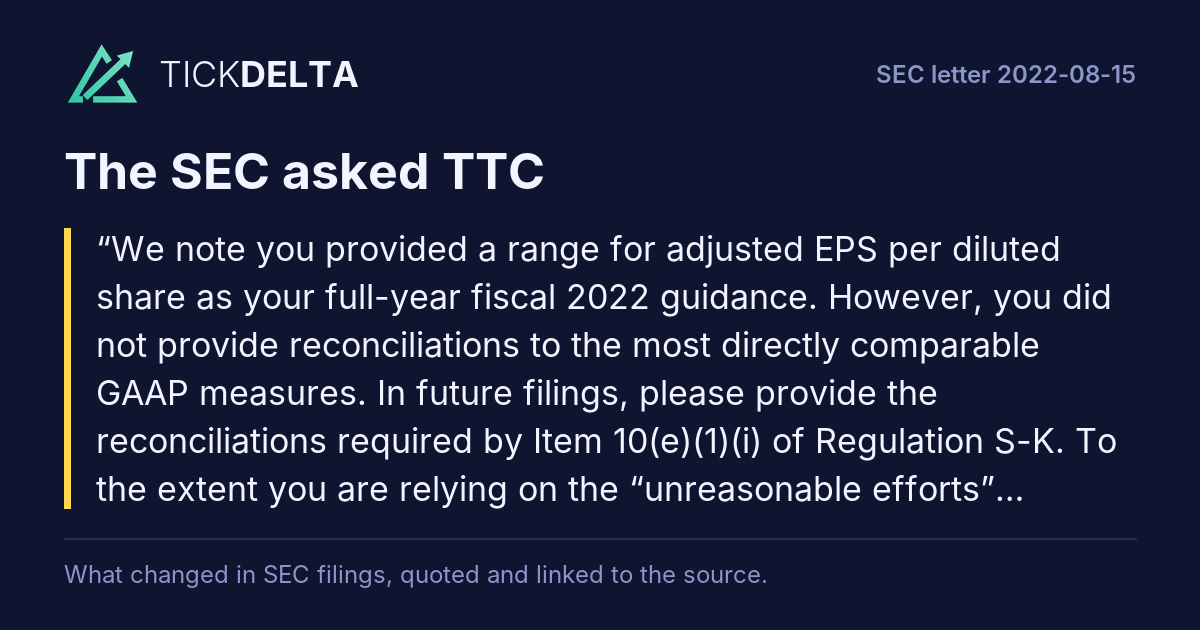
We note you provided a range for adjusted EPS per diluted share as your full-year fiscal 2022 guidance. However, you did not provide reconciliations to the most directly comparable GAAP measures. In future filings, please provide the reconciliations required by Item 10(e)(1)(i) of Regulation S-K.
Rest of the question

To the extent you are relying on the “unreasonable efforts” exception in Item 10(e)(1)(i)(B), please revise future filings to disclose this fact and identify any information that is unavailable and its probable significance. Reference is made to Question 102.10 of the Division’s Compliance and Disclosure Interpretations for Non-GAAP Financial Measures.

TTC answered
The company respectfully acknowledges the Staff's comment and advises the Staff that, in future filings, the company will provide the reconciliations required by Item 10(e)(1)(i) of Regulation S-K, or to the extent the company is relying on the “unreasonable efforts” exception in Item 10(e)(1)(i)(B), the company will disclose this fact and identify any information that is unavailable and its probable significance.

With respect to the projected range for adjusted EPS per diluted share set forth in the company’s financial guidance for the fiscal year ending October 31, 2022 in the company’s
Rest of the answer

earnings release included in its Current

Report on Form 8-K as filed with the Commission on June 2, 2022, the company advises the Staff that the company is relying on the “unreasonable efforts” exception in Item 10(e)(1)(i)(B) of Regulation S-K as indicated in the following passage within the “Use of Non-GAAP Financial Information” section of the company’s release:

The Toro Company cannot provide quantitative reconciliations of forward-looking non-GAAP financial measures provided herein or in its related earnings call without unreasonable effort because the combined effect and timing of recognition of potential charges or gains is inherently uncertain and difficult to predict. In addition, since any adjustments could have a substantial effect on U.S. GAAP measures of financial performance, such quantitative reconciliations would imply a degree of precision and certainty that could be confusing to investors. From a qualitative perspective, it is anticipated that the differences between the forward-looking non-GAAP financial measures and the most directly comparable GAAP financial measure will consist of items similar to those described in the financial tables later in this release, including, for example and without limitation, certain non-cash, large, and/or unpredictable charges and benefits; acquisitions and dispositions; legal judgments, settlements, or other matters; and tax positions.

In response to the Staff’s comment, the company intends in future filings, as applicable, to add certain additional disclosures to clarify the fact that the company is relying on the “unreasonable efforts” exception in

Item 10(e)(1)(i)(B) of Regulation S-K and to identify more specifically any information that is unavailable and its probable significance. The company anticipates that these additional disclosures will include the following:

•

Add the following language to the clarifying note currently at the end of the Operating Results section of the company’s earnings release to read (added language in bold):

“*Non-GAAP financial measure. Please refer to the “Use of Non-GAAP Financial Information” for details regarding these measures, as well as the tables provided for a reconciliation of historical non-GAAP financial measures to the most comparable GAAP measures.”

Revise the disclosure in the “Use of Non-GAAP Financial Information” section of the company’s earnings release to read:

“The Toro Company does not provide a quantitative reconciliation of the company’s projected range for adjusted diluted EPS for fiscal 202X to diluted EPS, which is the most directly comparable GAAP measure, in reliance on the unreasonable efforts exception provided under Item 10(e)(1)(i)(B) of Regulation S-K. The company’s adjusted diluted EPS guidance for fiscal 202X excludes certain items that are inherently uncertain and difficult to predict, including certain non-cash, large and/or unpredictable charges and benefits; acquisitions and dispositions; legal judgments, settlements, or other matters; and tax positions. Due to the uncertainty of the amount or timing of these future excluded items, management does not forecast them for internal use and therefore cannot create a quantitative adjusted diluted EPS for fiscal 202X to diluted EPS reconciliation without unreasonable efforts. A quantitative reconciliation of adjusted diluted EPS for fiscal 202X to diluted EPS would imply a degree of precision and certainty as to these future items that does not exist and could be confusing to investors. From a qualitative perspective, it is anticipated that the differences between adjusted diluted EPS for fiscal 202X to diluted EPS will consist of items similar to those described in the financial tables later in this release, including, for example and without limitation, certain non-cash, large, and/or unpredictable charges and benefits; acquisitions and dispositions; legal judgments, settlements, or other matters; and tax positions. The timing and amount of any of these excluded items could significantly impact the company’s diluted EPS for a particular period.”

Read in the reply
In its next report

First report after the company's reply of Aug 25, 2022: 10-Q filed Sep 1, 2022 ↗, against the 10-Q filed Jun 2, 2022 ↗.

Tickdelta does not hold the text of both reports, so they are not compared here.

Exhibit 99.1 · Outlook, page 2
SEC asked (2)
We note that in sections of the earning release your non-GAAP measures have different labels. For example, adjusted diluted EPS in the first section of the earnings release is labeled adjusted EPS per diluted share in the highlights sections and non-GAAP net earnings per diluted share in the reconciliation of this non-GAAP measure to the most directly comparable GAAP measure.
Rest of the question

Please clarify and/or in future filings, please revise to label your non-GAAP measure consistently.

TTC answered
The Company respectfully acknowledges the Staff's comment and confirms that the terms “adjusted diluted EPS” and “adjusted EPS per diluted share” as used in the highlights section of the company’s earnings release included in its Current Report on Form 8-K as filed with the Commission on June 2, 2022 and the term “non-GAAP net earnings per diluted share” as used in the reconciliation table in the same earnings release are the same non-GAAP measure despite the company’s use of different labels.
Rest of the answer

In response to the Staff’s comment, we intend to consistently refer to this non-GAAP measure as “adjusted diluted EPS” in future filings, as applicable, and also intend to use a consistent label for other non-GAAP measures in future filings, as applicable.

After you have had an opportunity to review the above responses to your comments, please contact me at 952-887-8076 to discuss any further questions or comments you might have.

cc:

Read in the reply

Also in this review: closing letter, 2022-08-29

Form 10-K for the Fiscal Year Ended October 31, 2016

2017-02-01 to 2017-04-13 · 7 questions · 2 letters from the SEC, 2 from the company
Review closed 2017-04-13
SegmentsRevenueLiquidity and cashDebt
Item 8. Financial Statements · Consolidated Statements of Cash Flows, page 46
SEC asked (1)
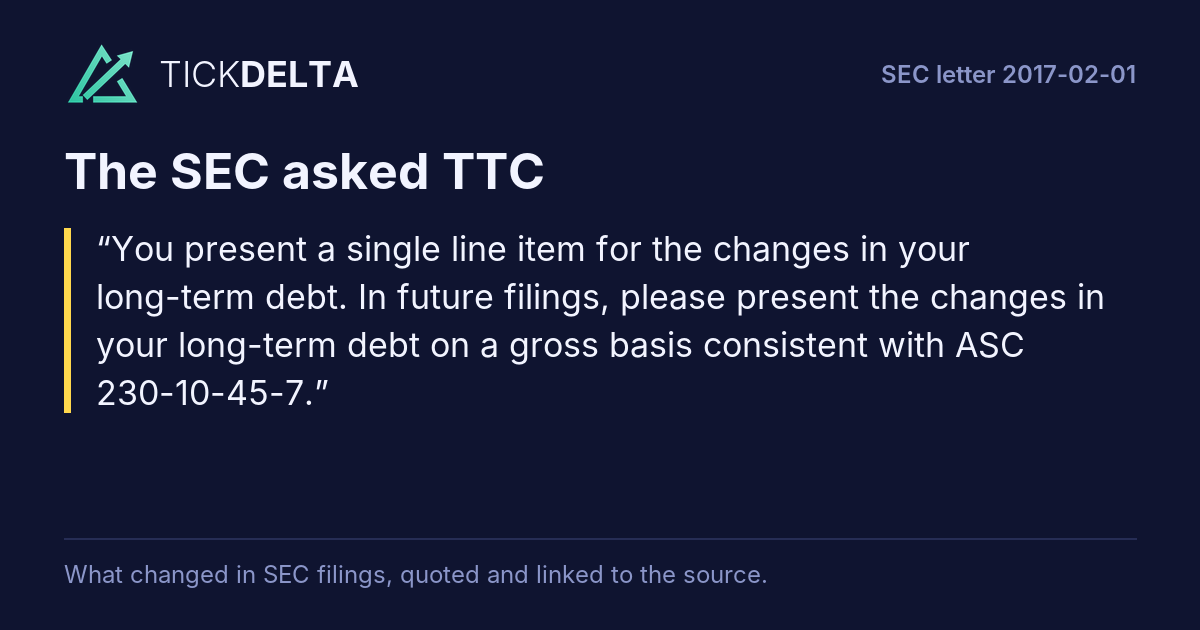
You present a single line item for the changes in your long-term debt. In future filings, please present the changes in your long-term debt on a gross basis consistent with ASC 230-10-45-7.
TTC answered
The Company acknowledges the Staff's comment and as requested in future filings, as applicable, we intend to expand our presentation of the changes in long-term debt in our Consolidated Statements of Cash Flows on a gross basis consistent with ASC 230-10-45-7.
Read in the reply
In its next report

First report after the company's reply of Mar 1, 2017: 10-Q filed Mar 8, 2017 ↗, against the 10-Q filed Aug 31, 2016 ↗.

Tickdelta does not hold the text of both reports, so they are not compared here.

Note 1. Summary of Significant Accounting Policies and Related Data · Sales Promotions and Incentives, page 51
SEC asked (2)
You disclose that the expense of each program is classified as a reduction from gross sales or as a component of selling, general, and administrative expense. In future filings please briefly explain the nature of each significant program and state where you classify the related expense. Refer to ASC 605-50-45-2.
TTC answered
The Company acknowledges the Staff's comment and as requested in future filings, as applicable, we intend to briefly explain the nature of each significant sales promotion and incentive program and state whether the related expense for the program is classified as a reduction from gross sales or as a component of selling, general and administrative expense.
Rest of the answer

Supplementally, we provide the Staff the following information regarding each of the sales promotion and incentive programs that we use.

Referring to ASC 605-50-45-2, cash consideration (including a sales incentive) given by a vendor to a customer is presumed to be a reduction of the selling prices of the vendor’s products or services and, therefore, shall be characterized as a reduction of revenue when recognized in the vendor’s income statement. That presumption is overcome and the consideration should be characterized as a cost incurred if, and to the extent that, both of the following conditions are met:

a.

The vendor receives, or will receive, an identifiable benefit (goods or services) in exchange for the consideration. In order to meet this condition, the identified benefit must be sufficiently separable from the recipient’s purchase of the vendor’s products such that the vendor could have entered into an exchange transaction with a party other than a purchaser of its products or services in order to receive that benefit.

b.

The vendor can reasonably estimate the fair value of the benefit identified under the preceding condition. If the amount of consideration paid by the vendor exceeds the estimated fair value of the benefit received, that excess amount shall be characterized as a reduction of revenue when recognized in the vendor’s income statement.

We supplementally advise the Staff that in the normal course of promoting and selling our products, we utilize several types of sales promotion and incentive programs. The following is a summary of each significant sales promotion and incentive program in which the related expense is classified as a reduction from gross sales pursuant to ASC-605-50-45-2:

•

Off-Invoice Discounts: Our costs for off-invoice discounts represent a reduction in the selling price of our products given at the time of sale.

Rebate Programs: Our rebate programs are generally based on claims submitted from either our direct customers or end-users of our products, depending upon the program. The amount of the rebate varies based on the specific program and is either a dollar amount or a percentage of the purchase price and can also be based on actual retail price as compared to our selling price.

Volume Discounts: Our costs for volume discount programs are based on our customers’ purchases and orders which are tracked on an annual basis. Volume discounts earned by customers are based on specific volume ranges at predetermined percentages of purchases.

Financing Programs: Our costs for financing programs, namely floor planning and retail financing, represent financing costs associated with programs under which we pay a portion of the interest cost to finance distributor and dealer inventories through third party financing arrangements for a specific period of time. Retail financing is similar to floor planning with the difference being that retail financing programs are offered to end-user customers under which we pay a portion of interest costs on behalf of end-users for financing purchases of our equipment.

Commissions Paid to Home Center Customers: We pay commissions to home center customers as an off-invoice discount. These commissions do not represent any selling effort by the home center customer but rather is a discount from the selling price of the product.

The following is a summary of each significant sales promotion and incentive program in which the related expense is classified as a component of selling, general, and administrative expense pursuant to ASC-605-50-45-2:

Commissions Paid to Distributors and Dealers: For certain products, we use a distribution network of dealers and distributors that purchase and take possession of products for sale to the end customer. In addition, we have dealers and distributors that act as sales agents for us on certain products using a direct-selling type model. Under this direct-selling type model, our network of distributors and dealers facilitates a sale directly to the dealer or end customer on our behalf. Commissions to distributors and dealers in these instances represent commission payments to sales agents that are also our customers. Commissions paid to distributors and dealers are within the conditions of ASC 605-50-45-2, and are classified as selling, general and administrative expense as 1) there is an identifiable benefit to us because we realize additional sales since the distributor is acting as our sales force and that benefit could be, and in some cases is, provided by another third party who is not a customer, and 2) the benefit is representative of fair value with commission rates that are reasonable and consistent with expectations for a commission cost as well as with actual commission rates provided when the sales agents are not customers of the company.

Cooperative Advertising: Cooperative advertising programs are based on advertising costs incurred by distributors and dealers for promoting our products. We support a portion of those advertising costs in which claims are submitted by the distributor or dealer along with evidence of the advertising material procured/produced and evidence of the cost incurred in the form of third party invoices or receipts. Cooperative advertising is within the conditions of ASC 605-50-45-2, and are classified as selling, general and administrative expense as 1) there is an identifiable benefit to us as we realize advertising cost savings and benefit from additional sales as the distributors and dealers are acting as part of our sales force, and 2) the benefit is representative of fair value as it is consistent with expectations for advertising costs that would be incurred by the company in the normal course of business.

Read in the reply
In its next report

First report after the company's reply of Mar 1, 2017: 10-Q filed Mar 8, 2017 ↗, against the 10-Q filed Aug 31, 2016 ↗.

Tickdelta does not hold the text of both reports, so they are not compared here.

Note 12. Segment Data, page 60
SEC asked (3)
We note that you aggregate your nine operating segments into three reportable segments. Please compare and contrast your operating segments relative to their economic characteristics and to each of the areas listed in ASC 280-10-50-11a to 11e. Regarding any differences among your operating segments, tell us why you determined that disaggregation was not warranted.
TTC answered
The Company acknowledges the Staff's comment and supplementally provides the following information regarding our segments.

Based on the guidance of ASC 280-10-50-1 we have organized our company into the following nine operating segments: Residential, Landscape Contractor, Sitework Systems, Exmark, Commercial, Boss, Irrigation, Micro-Irrigation, and Distribution.

In defining aggregation criteria, ASC 280-10-50-11 states,

Operating segments often exhibit similar long-term financial performance if they have similar economic characteristics.
Rest of the answer

For example, similar long-term average gross margins for two operating segments would be expected if their economic characteristics were similar. Two or more operating segments may be aggregated into a single operating segment if aggregation is consistent with the objective and basic principles of this Subtopic, if the segments have similar economic characteristics, and if the segments are similar in each of the following areas:

The nature of products and services

The nature of the production processes c.

The type or class of customer for their products or services d.

The methods used to distribute their products or provide their services e.

If applicable, the nature of the regulatory environment, for example, banking, insurance, or public utilities.

We have applied the aggregation criteria set forth in ASC 280-10-50-11 to form the following reportable segments: Residential Segment, Professional Segment, and Distribution Segment.

Residential Reportable Segment

Our Residential reportable segment is also our Residential operating segment and is not aggregated with other operating segments. Our Residential operating segment primarily sells zero-turn radius riding mowers and walk power mowers. Snow thrower products are also offered which include single-stage and two-stage snow thrower models as well as a range of electric snow thrower models. The Residential operating segment sells home solutions products as well, which include electric, gas, and cordless grass trimmers, electric and cordless hedge trimmers, and electric, gas, and cordless blower-vacuums. These products are designed, marketed and sold to homeowners for home use. Our Residential operating segment products are sold directly to home centers, dealers, hardware retailers, mass retailers, and online.

Distribution Reportable Segment

Our Distribution operating segment mainly consists of our company-owned distributorship. The net sales and total assets of our company-owned distributorship that comprises the Distribution operating segment does not meet the quantitative thresholds, defined in paragraph ASC 280-10-50-12, for separate reporting as an operating segment. Given the immateriality of the Distribution operating segment, we combined it with our corporate activities and elimination of intersegment revenues and expenses and it is shown as “Other” in periodic reports filed with the SEC due to the insignificance of the Distribution segment.

Professional Reportable Segment

Our Professional reportable segment is comprised of our Landscape Contractor, Sitework Systems, Exmark, Commercial, Boss, Irrigation, and Micro-Irrigation operating segments that have been aggregated based on the criteria of ASC 280-10-50-11a to 11e, along with similar trends in economic characteristics.

Nature of Products and Services

The products sold in each of our operating segments in the Professional reportable segment are similar in nature in that they are heavy-duty professional landscape maintenance and enhancement products, all of which are innovative, integrated solutions that create, maintain, enhance, and conserve a variety of landscapes. The products offered by each of these operating segments are professional grade and are utilized by professionals in their field for landscape management.

Landscape Contractor: Our Landscape Contractor operating segment products include professional grade zero-turn radius riding and stand-on mowers, heavy-duty walk power mowers, as well as other heavy-duty professional products. These products have a long life cycle at high hours of use and are built to handle the professional grade work of landscape contractor professionals.

Sitework Systems: Our Sitework Systems operating segment products are designed to improve efficiency in creation and renovation of various types of landscapes. These products include compact utility loaders, directional drills, trenchers, stump grinders, and turf renovation products. These products are designed for, and are used by, professionals in the rental and specialty construction/commercial landscape market.

Exmark: Our Exmark operating segment products are sold under the Exmark brand and include commercial grade zero-turn radius riding mowers with professional enhancements, aerators, rotary brooms, spreaders, seeders, as well as other professional turf management products. These products have a long life cycle and are built for professional grade tasks.

Boss: Our Boss operating segment products include heavy-duty snowplows, as well as salt and sand spreaders. These heavy-duty products are used in a professional capacity for the snow and ice management market to help professionals maintain landscapes during the winter season.

Commercial: Our Commercial operating segment includes product offerings for golf, sports fields and grounds landscapes and are targeted to heavy users that require consistent professional results. These products include mowers, utility vehicles, aerators, turf sprayers, top dressers, debris management products, as well as other various heavy-duty products. These products are built with long life cycles to offer consistent reliability in order for professionals to maintain commercial landscapes.

Irrigation: Our Irrigation operating segment product offerings are targeted towards commercial landscapes and include golf courses and sports fields, as well as other properties that need reliable, professional results. Our Irrigation products include rotors, sprinkler bodies and nozzles, controllers, valves, drip tubing, and soil sensors. Our Irrigation operating segment also includes lighting product offerings that are targeted to properties that need professional lighting solutions. The products in our Irrigation operating segment provide reliable dependability for professionals in order to maintain consistent landscapes.

Micro-Irrigation: Our Micro-Irrigation operating segment includes products like drip tape, irrigation tubing, and soil sensors that are designed to apply water precisely. These products are used in a professional capacity for the agriculture market and other various professional landscape applications.

Nature of the Production Processes

We have strategically identified specific core manufacturing competencies for vertical integration, such as injection molding, extrusion, welding, stamping, fabrication, laser cutting, painting, machining, and aluminum die casting, and have chosen outside vendors to provide other services. We design component parts in cooperation with our vendors, contract with them for the development of tooling, and then enter into agreements with these vendors to purchase component parts manufactured using the tooling. In addition, our vendors regularly test new technologies to be applied in the design and production of component parts. Manufacturing operations include robotic and computer-automated equipment intended to speed production, reduce costs, and improve the quality, fit, and finish of our products. Operations are also designed to be flexible enough to accommodate product design changes that are necessary to respond to market conditions and changing customer requirements.

Rule 83 Confidential Treatment Request by The Toro Company; Request #1

Our products manufactured in the Professional segment are manufactured using similar techniques. [***.]

Type or Class of Customer for Products or Services

The end-customers that purchase our Professional segment products are similar in that they are professional users engaged in landscape management and require reliable solutions for creating and maintaining landscapes. In addition, as our Professional operating segment products are complementary for our end-customer, we market and sell products together to the same customer. For example, we market and sell to customers in the golf and sports field industries a range of Professional reportable segment products (mowers, sprinklers, compact utility loaders, utility vehicles, aerators, controllers, and lighting). This is also evident in other industries as we market and sell a range of our products in the Professional reportable segment to construction/commercial landscape companies (mowers, heavy-duty snowplows, sprinklers, utility vehicles, compact utility loaders, drip tape, controllers, and valves). Additionally, as our Professional reportable segment products are complementary, professional users who purchase our heavy-duty Boss operating segment snowplows also purchase spring and summer season products from our other Professional operating segments. For example, if we have a snow season with strong sales of our heavy-duty snowplows and ice management products sold through our Boss operating segment, our other Professional operating segments that have the same customer, such as our Landscape Contractor, Sitework Systems, and Exmark operating segments, also benefit with positive sales growth as those same professional customers generally use the increase in funds from the snow season to invest in capital equipment sold through our other Professional operating segments for the spring and summer seasons.

Methods Used to Distribute Products or Provide Services

Each operating segment in the Professional reportable segment markets its products through a distribution channel that consists of distributors and dealers. Professional segment products are sold through our distribution channel for resale to professional end-users that include: landscape contractors, golf courses, sports fields, municipalities, schools/universities, growers, and construction/commercial landscape companies. As our Professional operating segment products are complementary of each other, our professional distribution channel partners include as part of their product offerings products from across our Professional operating segments for resale to end-users. Our distribution channel is expected to be experts with respect to the Professional reportable segment products that they sell, and many are educated through our “Toro University” and other education programs provided by us. Because our Professional reportable segment products require a greater level of service and expertise than our Residential reportable segment products, our distribution channel provides a high level of service to professional end-users, and we partner with our distribution channel in regards to training, education, and service of our Professional segment products.

Economic Characteristics

ASC 280-10-55-7A notes that based on guidance from ASC 280-10-50-11, operating segments are considered to be similar if they can be expected to have essentially the same future prospects. The similarity of the economic characteristics should be evaluated based on future prospects and not exclusively on the current indicators.

In determining whether our operating segments have similar economic characteristics, we considered the primary economic trend factors that our Chief Operating Decision Maker (“CODM”) uses in allocating resources to each segment and for evaluating the performance of each segment, which are historical and projected trends in revenue, revenue growth, gross margin, and operating margin. We also performed an analysis of long-term revenue and average gross margin trends for the operating segments in our Professional reportable segment to evaluate economic similarities and long-term performance, utilizing both historical and projected data.

The Staff’s Comment No. 4 requested historical and projected revenues, gross margin, operating margin, and measure of segment profitability. We utilized this data for the initial basis of our analysis, while not limiting the scope solely to current financial indicators.

Revenue and Revenue Growth Trends

Rule 83 Confidential Treatment Request by The Toro Company; Request #2

Our company provides landscape management solutions which cover professional landscapes during all seasons. As we offer an extensive range of complementary products to professionals which are grouped and sold from multiple Professional operating segments, the revenue and revenue growth of our operating segments in our Professional reportable segment economically trend together as a whole. Or, put another way, our Professional operating segments share customers; therefore, as we expand market share, either organically or through acquisition, we expect short-term variances, but we also expect convergence on a long-term basis as our Professional operating segments experience the same trends. [***.] Further, we expect that the revenues of each operating segment in the Professional reportable segment will continue to trend together on a go-forward basis as such expectation is consistent with our historical experience.

Gross Margin and Operating Margin Trends

Rule 83 Confidential Treatment Request by The Toro Company; Request #3

As mentioned above, our Professional operating segments economically trend together. While we have differences in the margin percentages of our Professional operating segments, the gross margins and operating margins for each of the Professional operating segments experience the same trends. The differences in our margin percentages reflect how Toro has grown as a company. The products produced by the Commercial and Irrigation operating segments are seen as market leaders, driven by our long-standing commitment to innovation and the ability to satisfy our professional customers’ needs in landscape management. This long history of innovation in our Commercial and Irrigation operating segment products, enhanced by listening to the needs of our professional customers, spreads into new innovation in our other Professional operating segments. [***.] The ability to innovate and satisfy the needs of our customers drives convergence of gross margins and operating margins over time.

Rule 83 Confidential Treatment Request by The Toro Company; Request #4

Professional businesses are competitive, and generally we do not benefit from having a first-mover advantage. [***.]

We believe that the aggregation of our operating segments in the Professional reportable segment is consistent with the objective and basic principles of ASC 280 as our Professional operating segments economically trend together, as demonstrated by historical and projected trends in revenue, revenue growth, gross margins, and operating margins.

Summary

The products sold in each of our Professional operating segments (Landscape Contractor, Sitework Systems, Exmark, Commercial, Boss, Irrigation, and Micro-Irrigation) are all similar in that they are professional landscape management products that are manufactured using a similar production process. All of the products for these operating segments are distributed and sold to professional users that are in need of integrated solutions that create, maintain, and enhance functional professional landscapes. All of the landscape management products offered by each of these operating segments are professional grade, long lasting, and are used by professionals in their field.

Rule 83 Confidential Treatment Request by The Toro Company; Request #5

[***.] The products are sold to homeowners through home centers, dealers, hardware retailers, mass retailers, and online. Economic trends of the Residential operating segment are different from the economic trends of the Professional operating segments due to higher competition in the Residential operating segment markets.

We have also considered whether reporting segment information differently would add significantly to an investor’s understanding of our company. We concluded that reporting segment information differently would not significantly add to an investor’s understanding of our company as our aggregated Professional operating segments trend together through similar economic characteristics, and these aggregated Professional operating segments share customers, in which, as we expand market share, either organically or through acquisition, we expect to converge on a long-term basis. Additionally, based on a segment disclosure comparison of other professional landscape companies, many disclose a reportable segment comprised of the aggregation of multiple landscape management product offerings. Therefore, comparisons with our peers at a reportable segment disclosure level are appropriate from an investor’s perspective.

In conclusion, through review and analysis of the economic characteristics of our Professional operating segments and each of the criteria listed in ASC 280-10-50-11a to 11e, we believe that the considerations surrounding the nature of our products, production process, type of customer, and distribution method, are important factors as to how we view the similarity of our Professional operating segments. Those considerations, together with the economic trend characteristics that we expect given the similarity of the Professional operating segments, support the aggregation of these operating segments into our Professional reportable segment to realize three total reportable segments: Residential, Professional, and Distribution.
Read in the reply
In its next report

First report after the company's reply of Mar 1, 2017: 10-Q filed Mar 8, 2017 ↗, against the 10-Q filed Aug 31, 2016 ↗.

Tickdelta does not hold the text of both reports, so they are not compared here.

Note 12. Segment Data, page 60
SEC asked (4)
Please provide us with your historical and your projected revenues, gross margin, operating margin, and measure of segment profitability.
TTC answered
The Company acknowledges the Staff's comment and supplementally provides the historical (Fiscal 2014-2016) and projected (“PJ”) (Fiscal 2017-2018) net sales, gross margin, operating margin and profit before taxes for our nine operating segments: Residential, Landscape Contractor, Sitework Systems, Exmark, Commercial, Boss, Irrigation, Micro-Irrigation, and Distribution.

Rule 83 Confidential Treatment Request by The Toro Company; Request #6

Net Sales (USD in 000's)

Operating Segment

Fiscal 2014

Fiscal 2015

Fiscal 2016

(PJ) Fiscal 2017

(PJ) Fiscal 2018
Read in the reply
In its next report

First report after the company's reply of Mar 1, 2017: 10-Q filed Mar 8, 2017 ↗, against the 10-Q filed Aug 31, 2016 ↗.

Tickdelta does not hold the text of both reports, so they are not compared here.

Note 12. Segment Data, page 60
SEC asked (5)
Tell us why the company is organized in the manner that it is.
TTC answered
Structurally, we are a matrix organization based on product lines. Based on the guidance of ASC 280-10-50-9, our operating segments are organized by the types of products and services sold.

We have organized our company into the following operating segments for the purpose of making operating decisions and assessing performance: Residential, Landscape Contractor, Sitework Systems, Exmark, Commercial, Boss, Irrigation, Micro-Irrigation, and Distribution. From our analysis discussed in the Staff’s Comment No.
Rest of the answer

3, we have applied the aggregation criteria set forth in ASC 280-10-50-11 to form the following reportable segments: Residential Segment, Professional Segment, and Distribution Segment. These reportable segments share the same economic trend factors that our CODM uses in allocating resources to each segment and for evaluating the performance of each segment.

Our financial reporting structure reflects the structure of our segments. Our CODM reviews financial information and assesses business performance at a consolidated, reportable segment, and operating segment level on a monthly, quarterly and annual basis. Reporting to the CODM are Group Vice Presidents (“VP”) that manage our business at a group level and regularly review results of operations. Group VPs meet individually with the CODM to assess performance of segments and receive the monthly financial reporting package that is provided to the CODM. Reporting up through the Group VPs are VPs and General Managers (“GM”). These VPs and GMs regularly review the results of operations for the operating segments they are responsible for. While the CODM has responsibility for determining the allocation of resources, including performance targets and budgets for our reportable segments and operating segments, the Group VPs, VPs, and GMs help determine how to use those allocated resources. This management structure helps us align and react to trends within our segments.

The company notes for the Staff that we have been in a period of CEO transition. During the course of this transition, Richard M. Olson was elected President and Chief Operating Officer, which was effective September

1, 2015 and President and CEO, which was effective November 1, 2016. Our internal management structure has temporarily changed during this transition period as a result of the departure of a Group VP and two VPs.

Read in the reply
In its next report

First report after the company's reply of Mar 1, 2017: 10-Q filed Mar 8, 2017 ↗, against the 10-Q filed Aug 31, 2016 ↗.

Tickdelta does not hold the text of both reports, so they are not compared here.

Note 12. Segment Data, page 60
SEC asked (6)
You group net sales of similar products and services into two categories: equipment and irrigation and lighting. ASC 280-10-50-40 requires you to disclose revenues from external customers for each product and service or each group of similar products and services unless it is impracticable to do so. Please describe for us the similarities and differences between the products you have determined to present as a group.
TTC answered
The Company acknowledges the Staff's comment and notes that in our review of ASC 280-10-50-40 we concluded that it was impracticable to disclose net sales from external customers for each product and service. As noted in the Staff’s Comment No. 2, certain sales promotion and incentive programs are classified as a reduction from gross sales which impacts our net sales. [***.]

We then reviewed each group of similar products and services across our three reportable segments noted in the Staff’s Comment No. 3.
Rest of the answer

Due to the same sales promotion and incentive program allocation constraints as noted above, we found that the lowest level of net sales detail for our Residential reportable segment was equipment, as the entire Residential operating segment sells equipment.

Rule 83 Confidential Treatment Request by The Toro Company; Request #8

Building off of the conclusion that equipment would be a product category, we analyzed our Professional reportable segment for similar equipment products. As noted in the Staff’s Comment No. 3, our Professional reportable segment includes products that are similar in nature as they are heavy-duty professional landscape maintenance and enhancement products. [***.] Not basing our analysis on the nature of product and only recognizing similar basic Residential and Professional equipment, we identified that our Landscape Contractor, Sitework Systems, Commercial, Exmark, and Boss operating segments met this standard. Remaining within our Professional reportable segment was our Irrigation and Micro-Irrigation operating segments which did not meet the same conditions used to analyze equipment.

Noting the objective of ASC 280-10-50-40, we concluded to report net sales based on categories of Equipment and Irrigation, as a lower level of reporting would be impracticable and would not add significantly to an investor’s understanding of our company.

* * * * *

After you have had an opportunity to review the above responses to your comments, please contact me at 952-887-8076 to discuss any further questions or comments you might have.

Read in the reply
In its next report

First report after the company's reply of Mar 1, 2017: 10-Q filed Mar 8, 2017 ↗, against the 10-Q filed Aug 31, 2016 ↗.

Tickdelta does not hold the text of both reports, so they are not compared here.

SEC asked
We note your responses to comments 3 and 4. With respect to the Commercial, Irrigation, and Micro-Irrigation operating segments, please explain to us why you believe that each of these operating segments has economic characteristics similar to the other operating segments in the Professional reportable segment, and why they meet the requirements to be aggregated in accordance with ASC 280-10-50-11.
TTC answered
The Company acknowledges the Staff's comment and for purposes of this response we refer to our Landscape Contractor, Sitework Systems, Exmark and Boss operating segments collectively as our “other Professional operating segments.”

Economic Characteristics

As discussed in our response letter to the Staff dated March 1, 2017, ASC 280-10-55-7A through 55-7C notes that based on guidance from ASC 280-10-50-11, operating segments are considered to be similar if they can be expected to have essentially the same future prospects.
Rest of the answer

The similarity of the economic characteristics should be evaluated based on future prospects and not exclusively on the current indicators. In determining whether our operating segments have similar economic characteristics, we considered the primary economic trend factors that our Chief Operating Decision Maker uses in allocating resources to each segment and for evaluating the performance of each segment, which are historical and projected trends in revenue, revenue growth, gross margin, and operating margin.

Quantitative Economic Characteristics

We have supplementally provided quantitative analyses for gross margin and operating margin trends for our Commercial, Irrigation, Micro-Irrigation and other Professional operating segments below. We believe that analyzing these profitability trends is a more indicative way to demonstrate the economic characteristics and trends of our operating segments as opposed to analyzing revenue trends. This quantitative analysis demonstrates economic trend patterns and convergence trends of the operating segments aggregated within the Professional reportable segment over time.

As discussed in our response letter to the Staff dated March 1, 2017, our Professional operating segments economically trend together. Although our Professional operating segments can have current indicators that impact each landscape market, such as global economic impacts or various weather patterns, the operating segments ultimately trend together as a whole. All of the Professional operating segments sell professional-grade products to professional end-users; and therefore, if current indicators impact one Professional landscape market, it has been our experience that such indicators also will impact other Professional landscape markets. The graphs below provide evidence of these economic trends in our Professional operating segments.

Gross Margin and Operating Margin Trend Analyses

Rule 83 Confidential Treatment Request by The Toro Company; Request #1

[***].

Rule 83 Confidential Treatment Request by The Toro Company; Request #2

The graphs above provide our Professional segment gross margins and operating margins, as well as linear regression trends, from fiscal 2007 through projected (PJ) fiscal 2018. In the data reflected in the graphs above, we would like to note an economic indicator that occurred from fiscal 2007 through fiscal 2009, the U.S. housing market crash. The resulting economic recession affected both the gross margins and operating margins of our Commercial, Irrigation, and other Professional operating segments in the same way. As indicated in the graphs above, the margin percentages decreased from fiscal 2007 through the middle of fiscal 2009, with landscape markets slowly recovering through the latter half of fiscal 2009. These margin decreases and subsequent recoveries are not only occurring at the same time, but are also fluctuating at a similar percentage point rate. After the impact of the U.S. housing market crash, it is also evident in the graphs above that margin rates for our Commercial, Irrigation, and other Professional operating segments continued to trend together, [***]

Rule 83 Confidential Treatment Request by The Toro Company; Request #3

While we have differences in the gross margin percentages of our Professional operating segments, with our [***].

Rule 83 Confidential Treatment Request by The Toro Company; Request #4

We also have differences in the operating margin percentages of our Professional operating segments, with our [***]. However, similar to gross margin trends, the operating margins of our Commercial, Irrigation, and other Professional operating segments are trending together.

Rule 83 Confidential Treatment Request by The Toro Company; Request #5

As discussed in our response letter to the Staff dated March 1, 2017, [***].

Micro-Irrigation

Rule 83 Confidential Treatment Request by The Toro Company; Request #6

The Micro-Irrigation operating segment is a very small part of our Professional reportable segment. In the graphs below, we have presented gross margins and operating margins for our Professional reportable segment as well as our Professional reportable segment excluding the Micro-Irrigation operating segment. As you can see, the Micro-Irrigation operating segment does not have a material impact on the performance measures of our Professional reportable segment and is not material to how an investor understands our business. Although our Micro-Irrigation operating segment is immaterial to the Professional reportable segment as a whole, we believe that it should be included in the Professional reportable segment as it economically trends together with our Professional operating segments when one-time items that do not reflect future prospects are removed. In addition to economic trends, our Micro-Irrigation products meet the aggregation criteria listed in ASC 280-10-50-11 as they are professional products used in creating and maintaining landscapes, are products manufactured using a production process similar to the operating segments in our Professional reportable segment, and are sold through a distribution channel to professional end-user customers consistent with the sales process used by our Professional operating segments.

Rule 83 Confidential Treatment Request by The Toro Company; Request #7

Qualitative Economic Characteristics

As discussed in our response letter to the Staff dated March 1, 2017, the products sold in each of our Professional operating segments are similar in nature as the products are (i) professional landscape management products that are manufactured using a similar production process; (ii) distributed and sold to professional users that are in need of integrated solutions that create, maintain, and enhance functional professional landscapes; and (iii) are professional grade, long lasting, and are used by professionals in their field. Below we have included additional analysis, as well as reiterating the analysis made in our response letter to the Staff dated March 1, 2017, for the criteria listed in ASC 280-10-50-11a to 11e.

Nature of Products and Services

The products sold in each of our operating segments in the Professional reportable segment are similar in nature in that they are heavy-duty professional landscape maintenance and enhancement products, all of which are innovative, integrated solutions that create, maintain, enhance, and conserve a variety of landscapes. The products offered by each of these operating segments are professional grade and are utilized by professionals in their field for landscape management.

Nature of the Production Processes

Our products manufactured in the Professional segment are manufactured using similar techniques as we are primarily an assembler for our Professional segment products.

Type or Class of Customer for Products or Services

Rule 83 Confidential Treatment Request by The Toro Company; Request #8

The end-user customers that purchase our Professional segment products are professional users engaged in landscape management and require reliable solutions for creating and maintaining landscapes. Our Professional operating segment products are complementary for our professional end-user customers, which is evident as we market and sell products from the different Professional operating segments together to the same customer. In addition to the examples provided in our response letter to the Staff dated March 1, 2017, a common example of this is how we market and sell to a golf course superintendent (professional end-user). [***]. By providing multiple innovative solutions to a golf course superintendent, as described above, we are able to provide a comprehensive impact on the needs of maintaining and enhancing their landscape.

Methods Used to Distribute Products or Provide Services

Each operating segment in the Professional reportable segment markets its products through a distribution channel that consists of distributors and dealers. Professional segment products are sold through our distribution channel for resale to professional end-users. As our Professional operating segment products are complementary of each other, our professional distribution channel partners include as part of their product offerings products from across our Professional operating segments for resale to end-users.

Summary

As evidenced by our gross margin and operating margin trend analyses above, our Commercial, Irrigation, Micro-Irrigation, and other Professional operating segments trend together as a whole. Not only do the margins of these operating segments economically trend together, but the margins of our other Professional operating segments and Micro-Irrigation operating segment are quantitatively converging with the margins of our Commercial and Irrigation operating segments in a consistent manner over time. We believe that all of our Professional operating segments are similar as they share the same future prospects.

As evidenced in our qualitative discussion above, our Commercial, Irrigation, Micro-Irrigation, and other Professional operating segment products are similar in nature as they are professional landscape management products used to create, maintain, enhance, and conserve landscapes. These are products that are primarily assembled as part of their production process. Our Commercial, Irrigation, Micro-Irrigation, and other Professional operating segment products are marketed, sold, and distributed to professional end-users that are in need of integrated landscape management solutions. All of the landscape management products offered by each of these operating segments are professional grade, long lasting, and are used by professionals in their field.

How our Professional reportable segment is structured is how we view our business, how we manage the results of our business, and how our investors understand our business. Our Professional operating segments have similar economic characteristics and trend together with respect to such economic characteristics; we expect that they share the same future prospects; the nature of their products are similar; their products are manufactured using a similar production process; their products are marketed and sold to the same type of professional landscape management end-user; and their products are sold using a distribution channel which resells the products to professional landscape management end-users.

In conclusion, through our quantitative and qualitative analyses above, as well as our discussion in our response letter to the Staff dated March 1, 2017, we believe that through review and analysis of the economic characteristics of our Professional operating segments and each of the criteria listed in ASC 280-10-50-11a to 11e, the aggregation of these operating segments into our Professional reportable segment is supported.

* * * * *

After you have had an opportunity to review the above responses to your comments, please contact me at 952-887-8076 to discuss any further questions or comments you might have.

Read in the reply

Also in this review: closing letter, 2017-04-13

From the SEC's correspondence on EDGAR: staff letters (form UPLOAD) and company letters (form CORRESP), 8 letters filed since 2017-02-01. Questions and answers are matched by their numbers; topics come from words in each question. The reports are compared word for word (same form, before the first SEC letter against the first report after the company's reply). No AI.

Sources

The SEC's correspondence on EDGAR: staff letters (form UPLOAD) and company letters (form CORRESP), matched question by question. No AI.

Also

Filings: the letters in the filing list.

Work with it

Excel workbook · CSV. Google Sheet that stays up to date: paste =IMPORTDATA("https://tickdelta.com/company/TTC/export.csv") into a cell.

Next in Owners and insiders:Insider trades
Esc

Type a ticker such as AAPL, a name, an investor such as Buffett, or a topic such as tariffs. ↑ ↓ to move, Enter to open.