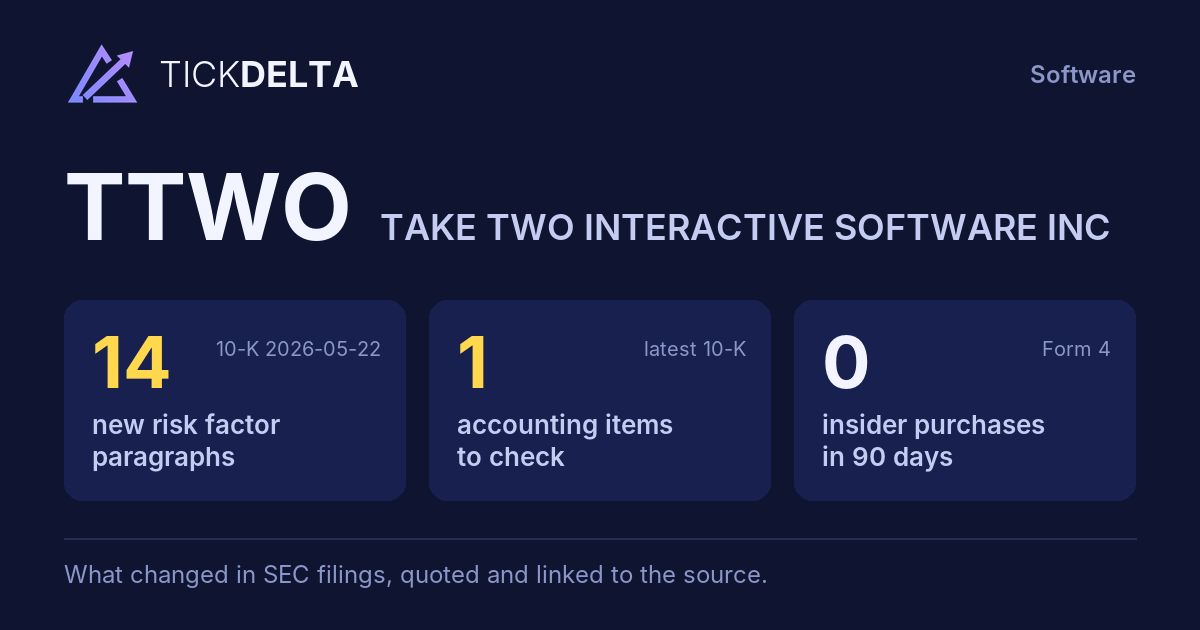
Sentences and paragraphs of TTWO's Risk Factors and MD&A, 10-K May 22, 2026 against 10-K May 20, 2025.
Each links to the text at sec.gov.
AddedRisk Factors
•Our ability to use net operating losses and tax credit carryforwards may be limited by an ownership change
Read it in 10-K May 22, 2026 at sec.gov ↗
AddedRisk Factors
The AI regulatory landscape is evolving, and we may be required to dedicate additional operational and financial resources to ensure compliance with new legal requirements. For instance, the European Union ("E.U.") Artificial Intelligence Act entered into force in August 2024, with some provisions becoming enforceable between February 2025 and August 2027, subject to a likely delay of the Act's high-risk enforcement until December 2027. In the U.S., some states have enacted general purpose AI laws, while others have enacted use-case specific AI laws; other states may enact similar laws in the future, which will add complexity to our compliance efforts. This uncertainty may require additional investments in oversight and the development of protections and safeguards to ensure compliance, including to the extent any personal information is processed by such technologies.
Read it in 10-K May 22, 2026 at sec.gov ↗
AddedRisk Factors
However, even with safeguards and oversight in place, the development and deployment of AI technologies may nevertheless pose risks. For example, our employees, contractors, vendors, or other partners may use AI tools in ways that are inconsistent with our policies or expectations, including by entering confidential, proprietary, personal, or regulated information into third-party AI services, and some AI providers may have limited operating histories or governance processes, any of which could compromise our information, expose us to legal or regulatory claims, or harm our reputation. Additionally, the data sets used to train the underlying models may be flawed, the AI tools may function in an unexpected manner, or generate biased, incorrect, or inappropriate content, which could negatively impact the performance or perception of our products and brand, incur regulatory scrutiny, or impose legal liability. Further, intellectual property ownership surrounding AI technologies has not been fully addressed by U.S. courts or other federal or state laws or regulations, and the use or adoption of third-party AI technologies into our products and services may result in exposure to claims of copyright infringement, other intellectual property misappropriation, or uncertainty regarding copyright ownership of AI-generated assets.
Read it in 10-K May 22, 2026 at sec.gov ↗
AddedRisk Factors
While the impact of AI on our industry is still emerging and uncertain, to the extent our competitors successfully implement AI technologies into their products or services more effectively or efficiently than we do, are able to imitate or compete more easily with our products, or if we fail to anticipate and respond to changing industry standards or consumer demand, or experience delays in integrating these technologies into our operations, we may face significant risks to our competitive position, financial performance, and long-term growth prospects.
Read it in 10-K May 22, 2026 at sec.gov ↗
AddedRisk Factors
Our vendors, service providers, business partners, and software supply chain may also experience disruptions, be subject to attacks, or have compromised security, which may result in future security incidents and breaches, and otherwise adversely impact our ability to provide our products and services.
Read it in 10-K May 22, 2026 at sec.gov ↗
AddedRisk Factors
Our continued success will depend to a significant extent on our senior management team and our relationship with ZMC Advisors, L.P. ("ZMC"). Our Executive Chairman/Chief Executive Officer and President are partners of ZMC. We are
Read it in 10-K May 22, 2026 at sec.gov ↗
AddedRisk Factors
Certain of our products are based on or incorporate intellectual property owned by others. For example, certain of our 2K products include rights licensed from major sports leagues and players' associations. Similarly, some of our other titles are
Read it in 10-K May 22, 2026 at sec.gov ↗
AddedRisk Factors
monitoring program and pay a fine of $20 million. Also, we may be subject to civil claims and regulatory actions alleging our games, including social casino games, violate certain state laws concerning unfair or deceptive acts or practices in conduct of any trade or commerce or certain state gambling laws.
Read it in 10-K May 22, 2026 at sec.gov ↗
Show the other 10
AddedRisk Factors
or when. Any such new or amended privacy laws may add complexity to our compliance efforts and require us to expend additional financial or other resources as a result.
Read it in 10-K May 22, 2026 at sec.gov ↗
AddedRisk Factors
common stock, which, under certain circumstances, could reduce the market price of our common stock and the value of any outstanding notes.
Read it in 10-K May 22, 2026 at sec.gov ↗
AddedRisk Factors
On July 4, 2025, the One Big Beautiful Bill Act ("OBBB") was signed into law. OBBB includes significant provisions, including but not limited to (1) permanent extension of certain expiring provisions of the Tax Cuts and Jobs Act of 2017 ("TCJA"), (2) modifications to the international provisions relating to Base Erosion Anti Abuse Act ("BEAT"), Global Intangible Low-Tax Income ("GILTI") and Foreign Derived Deduction Eligible Income ("FDDEI"), (3) permanent reinstatement deduction for domestic research expenditures and 100% bonus depreciation for certain qualified property, and (4) modifications to tax credits. The legislation has multiple effective dates, with certain provisions effective in the fiscal year ended March 31, 2026 and others implemented in future periods. We have estimated the accounting for income tax effects of the OBBB, which reduced our estimated U.S. cash tax liability. It did not, however, impact our U.S. deferred tax assets or liabilities since we continue to maintain a full valuation allowance against U.S. net deferred tax assets. We are continuing to evaluate the impact of OBBB on the Company. It is possible that these changes could have an adverse impact on our effective tax rate, tax payments, financial condition, or results of operations. The new tax law is complex and additional interpretive guidance may be issued that could affect the interpretations and assumptions we have made, as well as actions we may take as a result of OBBB.
Read it in 10-K May 22, 2026 at sec.gov ↗
AddedRisk Factors
not yet enacted Pillar Two legislation, it is possible that Pillar Two could have an adverse impact effective tax rate, tax payments, and financial condition in future periods.
Read it in 10-K May 22, 2026 at sec.gov ↗
AddedMD&A
achieve the desired return on our investments in product development. Accordingly, our strategy for these platforms is to focus our development efforts on a select number of the highest quality titles.
Read it in 10-K May 22, 2026 at sec.gov ↗
AddedMD&A
Fiscal Year Ended March 31, 2026 2025 Increase/(decrease) Increase/(decrease) % Net Bookings $ 6,721.0 5,648.0 $1,073.0 19.0%
Read it in 10-K May 22, 2026 at sec.gov ↗
AddedMD&A
amortization of intangible assets primarily due to higher impairments in the prior year and (ii) lower product costs as a percentage of net revenue, partially offset by higher amortization of capitalized software and development costs primarily due to the timing of releases.
Read it in 10-K May 22, 2026 at sec.gov ↗
AddedMD&A
The accounting for tax incentives and credits may increase or decrease our effective tax rate due to changes in tax legislation and elections we may make.
Read it in 10-K May 22, 2026 at sec.gov ↗
AddedMD&A
On July 4, 2025, the One Big Beautiful Bill Act ("OBBB") was signed into law. OBBB includes significant provisions, including but not limited to (1) permanent extension of certain expiring provisions of the Tax Cuts and Jobs Act of 2017 ("TCJA"), (2) modifications to the international provisions relating to Base Erosion Anti Abuse Act ("BEAT"), Global Intangible Low-Tax Income ("GILTI") and Foreign Derived Deduction Eligible Income ("FDDEI"), (3) permanent reinstatement deduction for domestic research expenditures and 100% bonus depreciation for certain qualified property, and (4) modifications to tax credits. The legislation has multiple effective dates, with certain provisions effective in the fiscal year ended March 31, 2026 and others implemented in future periods. We have estimated the accounting for income tax effects of
Read it in 10-K May 22, 2026 at sec.gov ↗
AddedMD&A
the OBBB, which reduced our estimated U.S. cash tax liability. It did not, however, impact our U.S. deferred tax assets or liabilities since we continue to maintain a full valuation allowance against U.S. net deferred tax assets. We are continuing to evaluate the impact of OBBB on the Company. It is possible that these changes could have an adverse impact on our effective tax rate, tax payments, financial condition, or results of operations. The new tax law is complex and additional interpretive guidance may be issued that could affect the interpretations and assumptions we have made, as well as actions we may take as a result of OBBB.
Read it in 10-K May 22, 2026 at sec.gov ↗