Form 10-K for the Year Ended March 31, 2019
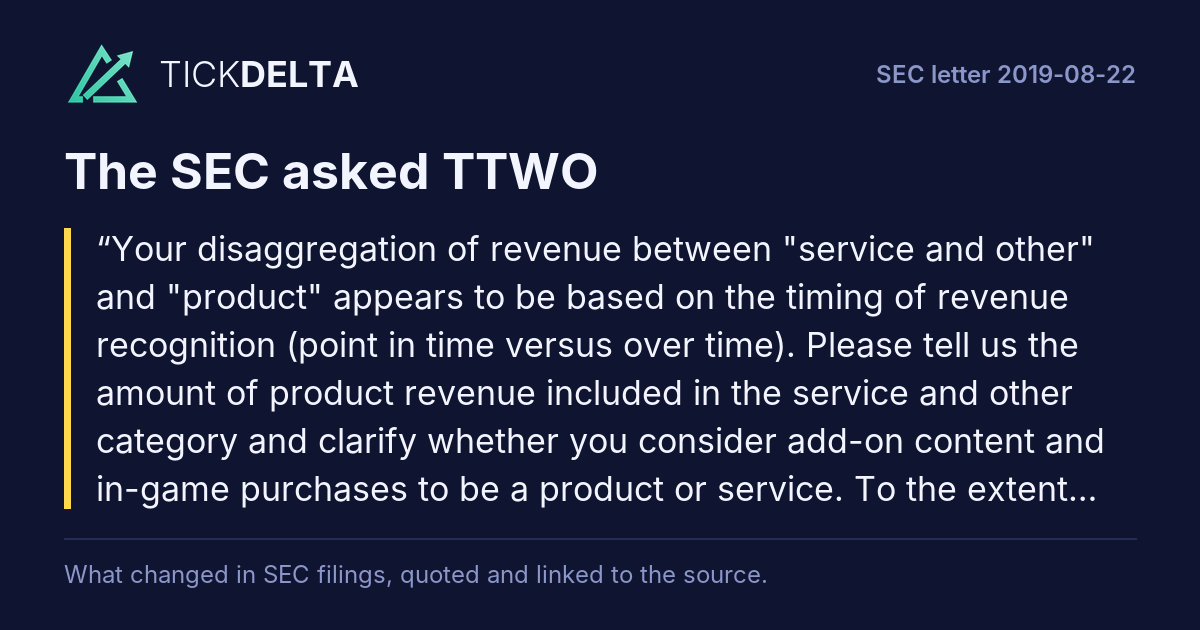
Your disaggregation of revenue between "service and other" and "product" appears to be based on the timing of revenue recognition (point in time versus over time). Please tell us the amount of product revenue included in the service and other category and clarify whether you consider add-on content and in-game purchases to be a product or service.Rest of the question
To the extent the remaining service revenue is greater than 10% of total revenue, separately present revenue and the related cost of revenues from product and services on the face of your consolidated statement of operations. Refer to Rule 5-03(b)(1) and (2) of Regulation S-X.
In evaluating the presentation of our statement of operations and applying the guidance in Rule 5-03(b)(1) and (2) of Regulation S-X, we have primarily focused on the presentation that we believe is most useful to investors. As a result, we have historically presented revenue generated from our software product sales, including sales of software products whose online gameplay is dependent on our game related services (i.e., online gameplay functionality that is dependent upon online support services and/or free content updates), as well as sales of virtual currency, downloadable add-onRead in the reply ↗Rest of the answer
content, and in-game purchases under one caption: “Net revenue.” We note that the regulation was issued many years ago and did not contemplate sales of intangible products such as software. There has been limited guidance provided on how to apply Rule 5-03 as it relates to intangible product sales, resulting in diversity in practice.
We believe that this presentation is most useful to our investors, because they view our primary business as developing and publishing high-quality interactive entertainment experiences across a range of genres, regardless of how those experiences are delivered or subsequently supported by us. We believe that investors view us not as a products and services company but rather as a publisher/developer.
We acknowledge that many of our software product offerings (and those of our competitors) are supported by online support services, and there is diversity in practice in presenting revenue and cost of revenue for the non-service and service components of software products. In our view, we believe that the new disaggregated revenue disclosures required by ASC 606 provide the most relevant information with respect to the underlying sales of our products. We do not believe that breaking out product and service information on the face of our consolidated statement of operations would provide useful information to our investors, as we do not believe that the implied margins associated with the different revenue components would be meaningful. For our internal purposes, we view margins based on the product sale in its entirety and not based on the timing of when a performance obligation is satisfied or how a product is distributed (physical retail versus digital). In addition, our mix of revenue by product type or distribution method, the impact of deferring revenues, and the timing of recognizing such revenues for certain of our software products may not align with how cost recognition would be presented in cost of sales.
To address the fact that we do have software product offerings with significant service components, in accordance with ASC 606-10-50-1, we have provided footnote disclosure about the nature of our revenue and timing of our revenue recognition. This includes providing disaggregated revenue category disclosures primarily focused on the timing of revenue recognition (“product” and “service and other”), the nature of our software offerings underlying our revenue recognition (“full game and other” and “recurrent consumer spending”), how these software offerings are distributed (“physical retail and other” and “digital online”), and the types of platforms they are played on (“console” and “PC and other”).
With respect to the Staff’s question on the amount of product revenue included in the “service and other” category, for fiscal 2019, we had approximately $1.15 billion of product revenue that relied on our game related services included in this disaggregated revenue category. This included revenue allocated to our game related services of our full game software product sales as well as supplemental sales of virtual currency and in-game purchases. The remaining balance in the “service and other” category is comprised of other revenue that represents less than 10% of our total net revenue in fiscal 2019; therefore, we did not deem it necessary to present separately any additional “subcaptions” on the face of our consolidated statement of operations.
We will continue to monitor the composition of our revenue to assess whether additional “subcaptions” described in Rule 5-03(b)(1) and (2) of Regulation S-X should be presented on the face of our consolidated statement of operations.
First report after the company's reply of 2019-10-04: 10-Q filed 2019-11-08 ↗, against the 10-Q filed 2019-08-06 ↗.
Tickdelta does not hold the text of both reports, so they are not compared here.
We note that international revenues comprised approximately 46% of total net revenues. To the extent that revenue from any one country is material, please separately disclose the revenue related to such country. Refer to ASC 280-10-50-41.
We respectfully note that there is no country outside of the United States (“U.S.”) from which we derive a material amount of net revenue. For fiscal 2019, 2018, and 2017, the country from which we derived the largest amount of net revenue outside the U.S. was [***]. Net revenue for [***] was [***], [***], and [***] of total net revenue, respectively, for each of those years.Read in the reply ↗Rest of the answer
We regularly monitor this as part of our quarterly reporting process to assess whether additional disclosure would be required in accordance with ASC 280-10-50-41, and, should there be a change in magnitude or composition, we would make the appropriate disclosure for that reporting period.
First report after the company's reply of 2019-10-04: 10-Q filed 2019-11-08 ↗, against the 10-Q filed 2019-08-06 ↗.
Tickdelta does not hold the text of both reports, so they are not compared here.
We note that you recognize revenue for full game products that are dependent on your game related service over an estimated service period as substantially all game play requires online access to your game related services.Rest of the question
Please provide us with a detailed analysis of the factors considered in determining that the software and gaming services are not both distinct and separable for certain of your games and tell us to which specific games this accounting applies. Clarify whether such games can be played offline and if so, how that factored into your analysis. Tell us the amount of revenue recognized from such games for fiscal 2018 and to date in fiscal 2019. Refer to ASC 606-10-25-19 through 25-21.
Our revenue recognition policy generally differentiates among three types of full game software products we currently publish: software products with offline gameplay and insignificant online gameplay, software products with online gameplay and insignificant offline gameplay, and software products that have both significant offline and online gameplay.
As described in Note 1—Basis of Presentation and Significant Accounting Policies in our fiscal 2019 Form 10-K, “[c]ertain of our full game software products are delivered primarily as an online gaming experience with substantially all gameplayRead in the reply ↗Rest of the answer
requiring online access to our game related services.” These software products have been designed to be played primarily as an online gaming experience, in which a user must have access to our game related services in order to play. The offline gameplay available in these software products is generally less than ten hours, which we believe is immaterial in the context of the overall game. [***] and [***], which were released in [***] and [***], respectively, are examples of these types of software products. Overall, revenue from our software products delivered primarily as an online gaming experience with insignificant offline gameplay represented [***] of total revenue in fiscal 2019 and [***] in fiscal 2018.
For the online gaming experience to function as designed, online gameplay and functionality depend on access to our game related services. Game related services are not sold separately or apart by us or any other vendor; a user cannot benefit from online gameplay without access to our dedicated game servers and game related services. The nature of these services can and does change, users are required to use the latest version of the software product, and users do not have the ability to opt-out. We also determine the duration for which game related services are provided (i.e., as disclosed in our end user license agreements, all online functionality terminates when we cease to operate our game servers).
We evaluated the guidance of ASC 606-10-25-19 through 25-21 and ASC 606-10-55-56(b) and concluded that we have a single performance obligation to provide an online gaming experience. Our conclusion is supported by ASC 606-10-55-56(b), which states that a “license that the customer can benefit from only in conjunction with a related service (such as an online service provided by the entity that enables, by granting a license, the customer to access content)” is not distinct. While the game’s code and related assets reside on the user’s game console, the user can only benefit from that online gameplay in conjunction with our online services. Further, we considered the factors listed in ASC 606-10-25-21(a) and (c) in determining whether the game’s online gameplay and online services are separately identifiable, noting that, in the context of the game design, the online software is highly dependent on, and interrelated with, the game related services and therefore would not be distinct. We therefore concluded that the software license and game related services should be combined into a single performance obligation and revenue would be recognized over an estimated service period.
First report after the company's reply of 2019-10-04: 10-Q filed 2019-11-08 ↗, against the 10-Q filed 2019-08-06 ↗.
Tickdelta does not hold the text of both reports, so they are not compared here.
You state on 71 that upon the adoption of ASC 606, the "majority" of the sales price for certain of your games was allocated to the offline software and recognized upon transfer of control to your customers. Please describe for us each of the performance obligations included in your products with online functionality.Rest of the question
Explain further the specific methods, inputs, estimates and assumptions used in determining the standalone selling price for each performance obligation and tell us the percentage of the transaction price allocated to each.
Performance Obligations
Certain of our software products have both significant offline and online gameplay functionality. Software products with identified significant offline and online gameplay functionality include Grand Theft Auto V (including Grand Theft Auto Online), Red Dead Redemption 2 (including Red Dead Online), and titles in our NBA 2K franchise.Read in the reply ↗Rest of the answer
In accordance with ASC 606, we assess the promised goods and services offered for our software products to determine the separate performance obligations on a product-by-product basis, noting the following performance obligations:
· A license to our intellectual property that delivers a significant offline gameplay experience, sometimes referred to as the “Story Mode.” We determined this to be a distinct performance obligation under the guidance in ASC 625-10-25-19, as a user can benefit from offline functionality on its own and it is not dependent on our online services.
· Game related services (online functionality that is dependent on online support services and/or free content updates). For software products such as Grand Theft Auto V, Red Dead Redemption 2, and our NBA 2K series, a significant separate and distinct online gameplay experience from the Story Mode/offline functionality of these games is promised as part of the overall software product. The online functionality is dependent on our dedicated game servers and game related services for the online gaming experience to function as designed, similar to our online games with insignificant offline gameplay as more fully discussed in our response to comment 3, above. Therefore, we determined that the online game functionality is an identified performance obligation with revenue recognized over an estimated service period. In addition, for Grand Theft Auto V and Red Dead Redemption 2, free content updates are provided on a “when and if available” basis and only update the online gameplay functionality of these games (i.e., Grand Theft Auto Online and Red Dead Online). These free content updates happen throughout each game’s life. Examples of recent free content updates to these games include Diamond Casino and Resort for Grand Theft Auto Online and Frontier Pursuits for Red Dead Online. Because the free content updates for these software products only affect their online gameplay functionality, we consider the free content updates to be part of our game related services. For our NBA 2K series we provide roster updates continuously, which are considered part of our game related services.
For all of our software products, we also provide routine bug fixes and customer service, which we have deemed to be immaterial in the context of our software products and therefore do not consider them to be separate performance obligations under the guidance of ASC 606.
Estimated Standalone Selling Price
Due to the unique features of each software product and because we do not sell the identified performance obligations separately, for our software products with two performance obligations (Story Mode/offline functionality and game related services), we do not have observable standalone selling prices for each performance obligation. Therefore, to determine the standalone selling price for each performance obligation, we employ an expected cost-plus margin methodology at the time of each product release. Cost inputs utilized in our methodology generally consist of (a) our product development costs for the separate offline functionality (Story Mode) and online gameplay functionality, (b) post-release development costs for planned free content updates, (c) licensing costs (i.e., costs to license IP, music, or image rights in the software product), (d) game related service personnel and server costs, (e) physical disk inventory cost, (f) shipping/distribution costs, and (g) marketing costs.
Of the cost inputs noted above, product development and post-release development costs are the most significant amounts and primarily include direct development personnel expenses (payroll costs and stock-based compensation), third-party development/production expenses, and allocations of overhead. For most of our software products, the development of the offline (Story Mode) content represents the primary focus of the software product and therefore is the most significant input to the overall software product cost.
The most significant estimate in the determination of the standalone selling price primarily relates to the costs of the planned free future content updates that we expect to provide to users to update the online gameplay as part of our game related services. The estimates are based on internal cost forecasts around future development plans for the online functionality, which are dependent on the continuing success of the software product and consumer preferences.
To date, the margins applicable to the offline and online functionality have been the same since the primary driver of both the offline and online modes is similar game content from which we would expect to derive a similar margin. We did not observe market evidence that offline only or online only games would inherently have higher or lower margins when compared to each other as they have similar selling prices, rely on similar development techniques, have similar customers, and have similar distribution methods. Therefore, we concluded that uniform expected margins were reasonable.
To evaluate the results of our estimated standalone selling price for each identified performance obligation, we corroborate our cost-plus margin methodology to the extent available and applicable to market data, past pricing for games with similar content or functionality, other data points such as player usage patterns (offline versus online minutes played by users), and competitor-disclosed pricing information. If applicable, we also perform look-back analyses of actual costs to estimated costs for previous iterations of software products to inform our estimates.
We then allocate the overall software product transaction price to each performance obligation using the relative standalone selling price method. Amounts allocated to the offline functionality (Story Mode) performance obligation are recognized when control of the software product is transferred to the customer and amounts allocated to the online game related services performance obligation is recognized over an estimated service period, which is the period of time that faithfully depicts the satisfaction of our performance obligation.
Allocation percentages
As a result of applying our estimated standalone pricing methodology, the following relative percentages were allocated to the identified performance obligations of our software products that have both significant offline and online gameplay functionality:
[***] of the transaction consideration was allocated to offline (Story Mode) and [***] to game related services.
[***] of the transaction consideration was allocated to offline (Story Mode) and [***] to game related services
We note that for [***]. This is driven by [***]. We continue to update our cost-plus margin methodology to reflect additional investments or other new information related to our software products after their initial release. [***]. Therefore, such cost investments were factored into our estimated standalone selling price analysis of the performance obligations at the time of adopting ASC 606 for all open contracts and each reporting period since adoption for new game sales.
First report after the company's reply of 2019-10-04: 10-Q filed 2019-11-08 ↗, against the 10-Q filed 2019-08-06 ↗.
Tickdelta does not hold the text of both reports, so they are not compared here.
Specifically with regards to the performance obligation related to online functionality, please help us understand the different roles and responsibilities that you and your platform partners have with respect to technology, host configurations, maintenance and services.Rest of the question
Tell us whether you use your own or third-party servers to host the multiplayer or online game play and describe the interaction of your online functionality with Sony and Microsoft's platforms. Compare and contrast the different service obligations that you and your platform partners have with respect to the players who purchase your games and how such obligations factored into your determination of the standalone selling price and the transaction price allocation for your game related services.
For our console-based software products with significant online functionality—Grand Theft Auto V (including Grand Theft Auto Online), Red Dead Redemption 2 (including Red Dead Online), and titles in our NBA 2K franchise—we are responsible for fulfilling all obligations with respect to online functionality and features. The game data necessary for the proper functioning of the online game experience is managed by us.Read in the reply ↗Rest of the answer
We and not Sony and/or Microsoft are primarily responsible for performing our game related services for our games with significant online functionality, with Sony/Microsoft’s role being relatively limited to initially authenticating a user for online gameplay through their subscription service, which we deem insignificant and not related to actual gameplay or the functionality of our products. Sony/Microsoft have no access to our gameplay data or ability to affect the online gameplay.
After a user purchases the game and loads the game, whether digitally or from a physical disk, onto their console, the game’s code reside primarily on the user’s console. From then, the offline functionality (Story Mode) of the game can be played without further involvement from us or any other party; however, the online functionality cannot be utilized without our game related services provided through our dedicated game servers, as discussed in our responses to comments 3 and 4, above. Our servers receive and process each user’s input, and users must connect to our dedicated game servers to interact during online gameplay. The online features of our software products generally include:
· Account authentication — ensuring the user is in good standing with us and has not been banned from allowing access to the online gameplay.
· Broadcast controller packets — facilitating and processing user movements occurring in real-time from one console to another (e.g., if, in NBA 2K, player 1 dribbles a basketball to the left or right, our servers relay that information to player 2 supporting the synchronized movement between the players without a time lag).
· Progress saving - storing, saving, and maintaining users’ game progress allowing them to pick up where they last left off in the online gameplay, including character attributes such as strength, stamina and other special abilities (shooting, driving, flying, etc.) obtained through gameplay, missions completed, inventory, etc.
· Leaderboard tracking — storing, saving, and maintaining various leaderboard statistics that allow individual users to track their performance against other users.
· Matchmaking — evaluating user skill levels and connecting users with similar game skillsets to play against one another.
· Management of in-game virtual currency and virtual goods — tracking virtual currency balances and related usages. Our servers authenticate and unlock virtual goods that have been transferred to an individual user for gameplay.
To access and play our console-based software products online functionality, users first must have access to Sony’s PlayStation Plus, in the case of PlayStation 4, or Microsoft’s Xbox Live Gold services, in the case of Xbox One, which requires a paid subscription directly with Sony/Microsoft.
If Sony/Microsoft determines the user is not authorized to access their servers, the user will not be able to access our software products’ online functionality.
If Sony/Microsoft authenticates a user, the user is then directed to our dedicated game servers, which connect users and facilitate online gameplay for our software products with significant online gameplay functionality as discussed above. We would not be able to fulfill our promise to transfer a functioning online game experience absent access to our game related services. Online gameplay can only be fully delivered to a user when our online intellectual property is on a user’s console and operates in combination with our dedicated game servers. As discussed in our responses to comments 3 and 4, above, all of the game related services occurring in an integrated manner on our dedicated game servers are highly interdependent and interrelated. If our servers are down, users cannot utilize the online gameplay functionality of our software products.
We use both owned and third-party servers to support our software products’ online gameplay functionality. We use internally owned and third-party servers for different aspects of the above noted online services on a title-by-title basis. We treat both internally owned and third-party servers the same when assessing our performance obligations and determining our estimated standalone selling prices.
When determining estimated standalone selling prices for our software products with significant online functionality, we do not factor in Sony/Microsoft’s performance obligations, as they would not have an impact on how we price our software products.
First report after the company's reply of 2019-10-04: 10-Q filed 2019-11-08 ↗, against the 10-Q filed 2019-08-06 ↗.
Tickdelta does not hold the text of both reports, so they are not compared here.
Please describe further for us the nature of your in-game content. Tell us what product and/or services are transferred to the game-player upon sale of such goods and how that impacts the timing of revenue recognition. Clarify whether the type of game in which the in-game purchase is made (e.g. games with offline functionality vs. online only games) impacts the accounting for such transaction.Rest of the question
Also, please cite the specific guidance you relied upon in accounting for such sales.
In-game content that users can acquire in connection with our software products typically consists of virtual goods that can be purchased either via virtual currency or direct monetary transaction in a separate transaction from the original software product sale.
Virtual good transactions can be initiated in our console-based software products that have online gameplay or in our mobile games through a separate purchase of virtual currency. When a purchase of virtual currency is made, we transfer the virtual purchasing power to a user’s virtual currency account.Read in the reply ↗Rest of the answer
Each user’s virtual currency account is maintained on our servers, whether purchased or earned through gameplay. The user can then utilize virtual currency to purchase a virtual good within a specific game. When a user converts virtual currency to a virtual good, the virtual good is unlocked and transferred to the user’s account, enabling the user to begin benefiting from the good during gameplay. All virtual currency purchases and the related transfer of a virtual good, regardless of what software product they are associated with, require access to our game related services.
Additionally, virtual goods are available within our free-to-play mobile software products through direct monetary transactions, which are referred to as in-game purchases and which are consistent with virtual currency transactions.
Revenue from such in-game content transactions is deferred and recognized ratably over an estimated service period, which is the time period in which an average user plays our software products (“user life”). As the user will typically continue to benefit from the virtual good over the period of time during which they play the related software product, we have aligned our revenue recognition policy to account for these transactions as a performance obligation satisfied over time as per ASC 606-10-25-27:
An entity transfers control of a good or service over time and, therefore, satisfies a performance obligation and recognizes revenue over time, if one of the following criteria is met:
a. The customer simultaneously receives and consumes the benefits provided by the entity’s performance as the entity performs (see paragraphs 606-10-55-5 through 55-6).
In addition to virtual goods discussed above, we also sell downloadable add-on content, which consists of optional items purchased by users that include separate game content to supplement the previously purchased software product and generally provides additional gameplay elements, such as missions, characters, abilities, and environments. Use of such add-on content typically provides incremental hours of gameplay. Revenue from the sale of separate add-on content is evaluated for revenue recognition on the same basis as our full game software products. Historically, however, add-on content has typically been available for our software products that primarily have a significant offline gaming experience and insignificant online gameplay, and, thus, the related revenue has been recognized at the time of purchase as per ASC 606-10-25-23:
An entity shall recognize revenue when (or as) the entity satisfies a performance obligation by transferring a promised good or service (that is, an asset) to a customer. An asset is transferred when (or as) the customer obtains control of that asset.
First report after the company's reply of 2019-10-04: 10-Q filed 2019-11-08 ↗, against the 10-Q filed 2019-08-06 ↗.
Tickdelta does not hold the text of both reports, so they are not compared here.
We note your measure of adjusted cash flow includes an adjustment for changes in restricted cash. Considering the presentation of restricted cash within the statement of cash flows was amended with the adoption of ASC 2016-08, tell us how you determined that such adjustment does not result in a non-GAAP measure based on individually tailored accounting principles and why you believe this measure is useful toRest of the question
investors. Refer to the guidance in Question 100.04 of the Non-GAAP C&DIs and Rule 100(b) of Regulation G.
We use Adjusted Operating Cash Flow, a non-GAAP measure of financial performance, which is defined as U.S. GAAP net cash from operating activities, adjusted for changes in restricted cash. As disclosed in our earnings releases, we believe it is important to consider Adjusted Operating Cash Flow, in addition to net cash from operating activities, as it provides more transparency into our current business trends without regard to the timing of payments from restricted cash, which is primarily related to a dedicated account limited to the payment of certain internal royalty obligations, asRead in the reply ↗Rest of the answer
further described below. Internally, management uses Adjusted Operating Cash Flow in assessing our operating results and in projecting future results. Accordingly, we believe that our presentation of Adjusted Operating Cash Flow provides investors with an opportunity to see the Company as viewed by management, to assess our performance with the same metrics that management utilizes internally and to be able to compare such information with prior periods. We have presented this non-GAAP financial measure on a consistent basis since the quarter ended September 30, 2018.
As described in Note 1—Basis of Presentation and Significant Accounting Policies of our fiscal 2019 Form 10-K, “[o]ur restricted cash balance is primarily related to a dedicated account limited to the payment of certain internal royalty obligations.” The withdrawal from these accounts do not occur at regular intervals, and, therefore, the inclusion of restricted cash in our beginning and ending balances for calculating operating cash flows can result in less outflows when the restricted cash balance is increasing and more outflows when a withdrawal is made. Management does not believe these changes reflect our operations for a particular period because the withdrawals are not directly caused by our performance or use of cash.
In Management’s view, the supplementary presentation of Adjusted Operating Cash Flow informs investors about this particular driver of operating cash flows in an efficient and understandable manner, providing investors with useful information and additional insight into the cash generated and used by the Company during the period to support operations.
Question 100.04 of the Non-GAAP CD&Is addresses using non-GAAP items that are “individually tailored to recognition and measurement methods for financial statement line items” other than the GAAP measure itself. We considered the following questions in evaluating whether the adjustment for changes in restricted cash is an individually tailored accounting principle as described in Question 100.4 of the Non-GAAP C&DIs:
· Does the adjustment shift the measure from an accrual basis of accounting to a cash or modified basis of accounting?
We do not believe this consideration is applicable for a cash flow measure.
· Does the adjustment include transactions that are also reportable in another company’s financial statements?
We do not believe this consideration is applicable as we are adjusting for changes in our own restricted cash.
· Does the adjustment render the measure inconsistent with the underlying economics or ignore certain aspects of the economics?
We believe the adjustment shows, on a supplementary basis, cash flows that remove the impact of the timing of payments from our restricted cash, which is primarily related to a dedicated account limited to the payment of certain internal royalty obligations.
· Does the adjustment reflect parts, but not all, of an accounting concept?
We are adjusting for all changes in restricted cash, which represent the entire accounting concept.
We do not believe the adjustment for changes in restricted cash meets the criteria in any of the above questions. As such, the adjustment for changes in restricted cash should not be considered an individually tailored recognition and measurement method.
Rule 100(b) of Regulation G requires a registrant not to make a non-GAAP financial measure public that “contains an untrue statement of a material fact or omits to state a material fact necessary in order to make the presentation of the non-GAAP financial measure, in light of the circumstances under which it is presented, not misleading.” As discussed in the preceding paragraphs, we do not believe the adjustment for changes in restricted cash is an untrue statement of a material fact or an omission that results in a misleading presentation.
In addition, the Company acknowledges that:
· the Company is responsible for the adequacy and accuracy of the disclosure in the filing;
· Staff comments or changes to disclosure in response to Staff comments do not foreclose the Commission from taking any action with respect to the filing; and
· the Company may not assert Staff comments as a defense in any proceeding initiated by the Commission or any person under the federal securities laws of the United States.
First report after the company's reply of 2019-10-04: 10-Q filed 2019-11-08 ↗, against the 10-Q filed 2019-08-06 ↗.
Tickdelta does not hold the text of both reports, so they are not compared here.
We note your responses to prior comments 4 and 5. We continue to evaluate your responses and may have further comments.
We respectfully acknowledge the Staff’s continued evaluation of our responses to prior comments 4 and 5. Read in the reply ↗
First report after the company's reply of 2019-11-27: 10-Q filed 2020-02-07 ↗, against the 10-Q filed 2019-08-06 ↗.
Tickdelta does not hold the text of both reports, so they are not compared here.
We note from your response to prior comment 6 that revenue from the sale of in-game content transactions is recognized ratably over an estimated service period, which is the time period in which an average user plays your software products (“user life”). Please clarify whether you recognize revenue from the sale of such goods over the user life remaining subsequent to the time in which the good was purchased.Rest of the question
Alternatively, if the service period for the virtual goods extends beyond the user life, please explain why and tell us the specific guidance you considered.
We have determined that individual sales of our full game software products and in-game content are separate contracts that contain separate units of accounting as each transaction is distinct. For purposes of recognizing revenue for our performance obligations satisfied over time, we must make an estimate of the service period.
We evaluated ASC 606-10-25-31 and 25-32 in determining how to measure progress for the recognition of revenue for performance obligations satisfied over time.Read in the reply ↗Rest of the answer
We believe that the estimated service period that most faithfully depicts the timing of satisfying our game-related service performance obligation for each unique sale transaction (full game or in-game content) is the period of time that an average user plays our software products (“user life”). Our estimated user lives, which currently range between 9 and 15 months as determined on a title-by-title basis, are primarily based on the weighted average number of days between players’ first and last days played online utilizing the total population of users for a title (which ranges between 13 million and over 100 million unique users for our titles with significant online gameplay functionality). We consider that this methodology enables us to capture the most reasonable and relevant estimated service period to ascribe to each distinct transaction as it encapsulates all user behavior in the aggregate (e.g., some users will play for longer periods, some users will play for shorter periods, each user has a different in-game content purchasing pattern). When a new game is launched and therefore no history of online player data is available, we consider other factors to determine the user life, such as the estimated service period of other games actively being sold with similar characteristics. We also consider known online trends and, to the extent publicly available, the service periods of our competitors’ software products that are similar to ours. Determining the estimated service period is subjective and requires management judgment. We continually monitor our user life determinations over the life of a game to assess whether they need to be updated.
In applying ASC 606 to our transactions, we have concluded that each sale (full game or in-game content) is a separate contract with the customer as separate sales generally contain distinct performance obligations at the relevant standalone selling price. Therefore, we do not modify the original contract when we provide additional in-game content to a specific user. As we sell distinct content to our customers, we need to determine an estimated service period for each distinct service component that is required to be recognized over-time (i.e., distinct performance obligations related to online play for our full game sales and in-game content).
ASC 606-10-25-32 requires us to apply a single method to measure progress for each performance obligation satisfied over time and apply the method consistently to each performance obligation. We believe that our policy of determining and assigning an estimated service period based on our average user life, as more fully described above, for each distinct service component that is required to be recognized over-time (i.e., distinct performance obligations related to online play for our full game sales and in-game content), complies with these provisions in ASC 606 and most appropriately depicts the satisfaction of our performance obligations.
Therefore, our policy of utilizing one estimated service period for each distinct performance obligation may result in the service period for an in-game content sale extending beyond the original service period for the full game sale. However, we believe our policy complies with ASC 606 and appropriately reflects the satisfaction of our performance obligations for each distinct in-game content transaction as our service period encapsulates an average of all user lives. We do not believe that ASC 606 requires us to link performance obligations for in-game content sold in new contracts to performance obligations sold in previous contracts for the purpose of estimating a service period. In addition, applying such a policy would result in assigning a different service period for each in-game content sale (based on when the in-game content is sold in relation to the sale of the full game), which would not result in a consistent measure of progress for each distinct performance obligation sold in new contracts.
First report after the company's reply of 2019-11-27: 10-Q filed 2020-02-07 ↗, against the 10-Q filed 2019-08-06 ↗.
Tickdelta does not hold the text of both reports, so they are not compared here.
We note your response to prior comment 7. Please consider changing the title of your non-GAAP measure of adjusted operating cash flow to a more descriptive title such as "adjusted unrestricted operating cash flow."
Beginning with the earnings release furnished with our Form 8-K on November 7, 2019, we have changed the title of our non-GAAP measure to Adjusted Unrestricted Operating Cash Flow.
In addition, the Company acknowledges that:
· the Company is responsible for the adequacy and accuracy of the disclosure in the filing;
· Staff comments or changes to disclosure in response to Staff comments do not foreclose the Commission from taking any action with respect to the filing; and
· the Company may not assert Staff comments as a defense in any proceeding initiated by the Commission or any personRead in the reply ↗Rest of the answer
under the federal securities laws of the United States.
First report after the company's reply of 2019-11-27: 10-Q filed 2020-02-07 ↗, against the 10-Q filed 2019-08-06 ↗.
Tickdelta does not hold the text of both reports, so they are not compared here.
Also in this review: request for more time, 2019-08-27, request for more time, 2019-09-13, request for more time, 2019-11-04, closing letter, 2019-12-20