tickdelta
Sign in

Tickdelta is free for now. Sign up and get Pro free

← Screener

Technology · Software · NYSE

TWLOTwilio

Compare with peers → Embed
The 10-K against last year's

224 changes: 37 added, 60 removed, 126 reworded, 1 quiet changes

10-K Feb 24, 2026 vs Feb 26, 2025
Risk FactorsRedline ↓
32.0%
of the text changed · 23,008 words now
32.3%
of the text changed · 6,055 words now
Legal ProceedingsRedline ↓
0.8%
of the text changed · 723 words now
Accounting PoliciesRedline ↓
12.5%
of the text changed · 6,075 words now

10-K 0001447669-26-000021 (Feb 24, 2026) vs 10-K 0001447669-25-000035 (Feb 26, 2025)

The redline

The paragraph that changed most in each section

Marked against last year's 10-K: cut words struck through, new words highlighted and underlined.

Risk Factors 243 words changed in this paragraph; it is 51% similar to last year's version.
For example, we outsource a substantial majority of our cloud infrastructure to Amazon Web Services (“AWS”), which hosts our products and platform. Our customers need to be able to reliably access our platform, without material interruption or degradation of performance. AWS runs its own platform that we access, and we are, therefore, vulnerable to service interruptions at AWS. We have experienced, and expect that we may experience interruptions, delays and outages in service and availability in the future due to a variety of factors, including infrastructure changes, human or software errors, website hosting disruptions and capacity constraints. Capacity constraints could be caused by a number of potential causes, including technical failures, natural disasters, public health epidemics or pandemics, fraud or security attacks. In addition, if our security, or that of AWS, is compromised, if our products, platform or customer data become unavailable, or if our users are unable to use our products within a reasonable amount of time or at all, any one of which may be due to circumstances beyond our control, then our business, results of operations and financial condition could be adversely affected. In some instances, we may encounter difficulties or otherwise not be able to identify the cause or causes of these performance problems within a period of time acceptable to our customers. It may become increasingly difficult to maintain and improve our platform performance and to troubleshoot performance issues, especially during peak usage times, as our products become more complex and the usage of our products increases. To the extent that we do not effectively address capacity constraints, either through AWS or alternative providers of cloud infrastructure, or through other factors that may result in interruptions, delays and outages in service and availability of our products and/or services, our business, results of operations and financial condition may be adversely affected. In addition, if Amazon.com, Inc. (“Amazon”) requires that we comply with unfavorable terms in order to continue our use of AWS or if Amazon implements any changes in its service levels for AWS, the changes may adversely affect our ability to meet our customers’ requirements, result in negative publicity which could harm our reputation and brand and may adversely affect the usage of our platform.

Source: Item 1A, 10-K 0001447669-26-000021 vs Item 1A, 10-K 0001447669-25-000035

Accounting Policies 175 words changed in this paragraph; it is 31% similar to last year's version.
In November 2023, September 2025, the Financial Accounting Standards Board (“FASB”) FASB issued Accounting Standards Update No. (“ASU”) 2023-07, “Segment Reporting (Topic 280): ASU 2025-06, “Intangibles-Goodwill and Other-Internal-Use Software (Subtopic 350-40): Targeted Improvements to Reportable Segment Disclosures,” the Accounting for Internal-Use Software,” which is intended to improve reportable segment disclosures. The modernizes the accounting for internal-use software by replacing the previous stage-based model and aligning the capitalization process with current development practices, especially agile and iterative methods. ASU expands segment disclosures by requiring disclosure of significant segment expenses that are regularly provided to the Chief Operating Decision Maker (“CODM”) and included within each reported measure of segment profit or loss. It also requires disclosure of the amount and description of the composition of other segment items and interim disclosures of a reportable segment's profit or loss and assets. ASU 2023-07 2025-06 is effective for fiscal years annual reporting periods beginning after December 15, 2023, 2027, and interim periods within fiscal years beginning after December 15, 2024, with retrospective application required. may be applied prospectively, retrospectively, or using a modified transition approach. Early adoption is permitted. The Company adopted is in process of evaluating the impact of the adoption of this ASU 2023-07 in the fourth quarter of 2024. The adoption required certain additional disclosure that the Company made in Note 8 to these on its consolidated financial statements.

Source: Item 8, Note 2 – Summary of Significant Accounting Policies, 10-K 0001447669-26-000021 vs Item 8, Note 2 – Summary of Significant Accounting Policies, 10-K 0001447669-25-000035

MD&A 160 words changed in this paragraph; it is 34% similar to last year's version.
In 2024, we introduced a company-wide annual cash bonus program to reduce our use of equity compensation. The bonus payout amount for each eligible participant is determined based on the Company and the individual full year performance metrics. In the year ended December 31, 2024, we recorded $134.1 million of expense related to this program. The program provided for a 25% mid-year bonus cash payment in its initial year only, which resulted in a $24.3 million cash payment in July 2024. As of December 31, 2024, the 2025, we had an accrued bonus liability was $109.8 of $136.2 million related to our company-wide bonus program recorded in the accrued expenses and other current liabilities in our consolidated balance sheet included elsewhere in this Annual Report on Form 10-K. The bonus payout will be determined for each eligible recipient based on Company and individual performance metrics and paid in March 2026, which we expect to impact our cash flows in the first quarter of 2025. The introduction of this bonus program and reduction of our use of equity compensation impacted our expenses commencing in 2024. We expect that the reduction of our use of equity compensation will reduce our operating expenses in future periods. 2026.

Source: Item 7, 10-K 0001447669-26-000021 vs Item 7, 10-K 0001447669-25-000035

Legal Proceedings 6 words changed in this paragraph; it is 97% similar to last year's version.
Additionally, the Company has contractual commitments with its cloud infrastructure providers, network service providers and other vendors that are noncancellable and expire within one to four five years. In the year ended December 31, 2024, 2025, the Company entered into several such agreements with terms of up to four five years for a total purchase commitment of $182.5 $149.1 million. Future minimum payments under these noncancellable purchase commitments are summarized in the table below. Unrecognized tax benefits are not included in these amounts because any amounts expected to be settled in cash are not significant:As of December 31, 2024 2025 Year Ending December 31, (In thousands) 2025 2026 $ 405,331 2026 245,946 288,615 2027 3,831 31,861 2028 220 13,152 2029 9,166 2030 6,447 Total payments $ 655,328 349,241

Source: Item 3, via Note 18 – Commitments and Contingencies, 10-K 0001447669-26-000021 vs Item 3, via Note 17 – Commitments and Contingencies, 10-K 0001447669-25-000035
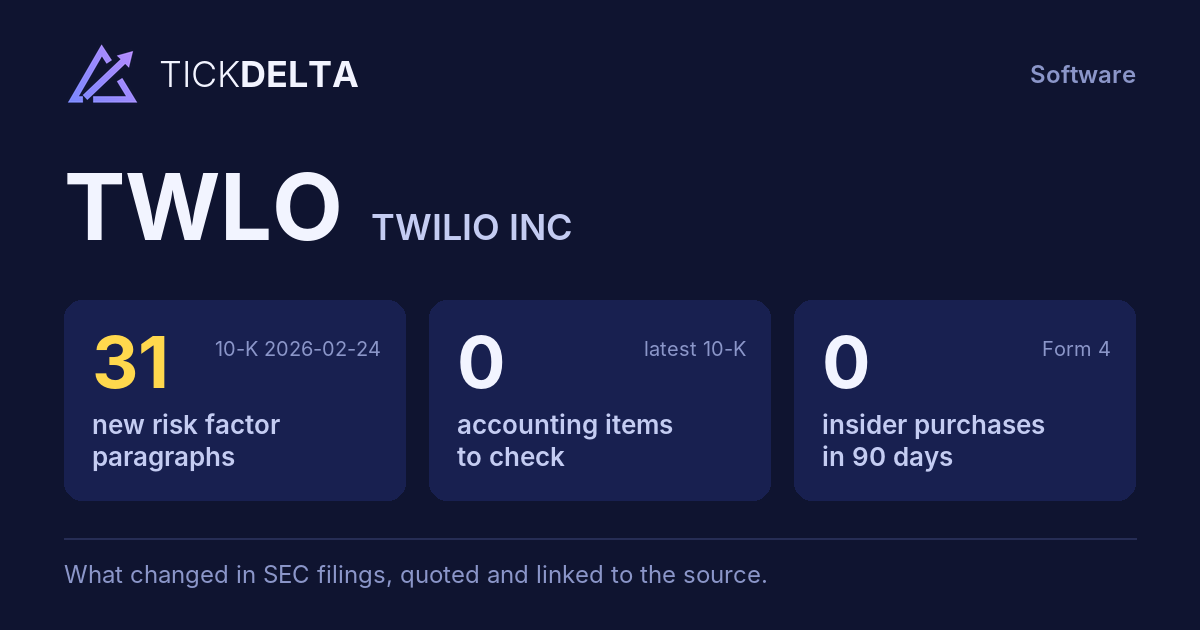
Every change, by type

Sentences and paragraphs added, removed or reworded

Sentences and paragraphs of TWLO's Risk Factors and MD&A, 10-K Feb 24, 2026 against 10-K Feb 26, 2025. Each links to the text at sec.gov.

AddedRisk Factors
Macroeconomic and political conditions and uncertainties have in the past adversely affected, and may in the future adversely affect, our business, results of operations and financial condition, and could exacerbate many of the other risks described in this “Risk Factors” section.

Read it in 10-K Feb 24, 2026 at sec.gov ↗

AddedRisk Factors
Reliance on these providers poses risks to the quality of our services, primarily by limiting our control, operating flexibility, and ability to timely identify and respond to necessary service changes, and by subjecting us to service interruptions or outages. Reliance on such providers in the past has caused, and may in the future cause, errors, service outages, security incidents, or poor-quality communications on our products, and we could encounter difficulty identifying the source of the problem. This has in the past, and may in the future, cause harm to our brand, result in lost revenue, and cause us to lose existing and prospective customers.

Read it in 10-K Feb 24, 2026 at sec.gov ↗

AddedRisk Factors
We also face risks related to losing access to these services. Many of these providers do not have long-term committed contracts with us and may interrupt services or terminate their agreements with us without notice. We may not be able to replace these services on a cost-effective basis, or at all, and even if we can, replacing providers may be time-consuming, costly and result in delays.

Read it in 10-K Feb 24, 2026 at sec.gov ↗

AddedRisk Factors
We depend upon our IT systems to conduct virtually all of our business operations, ranging from our internal operations and research and development activities to our marketing and sales efforts and communications with our customers, vendors and other business partners. Moreover, our platform stores, transmits, and otherwise processes our, our customers’ and our partners’ proprietary, confidential, and sensitive data. We also rely on various third-party service providers – including network service providers, internet service providers, telecommunications carriers, and providers of cloud infrastructure and cloud communications – for business operations, to operate our platform and to deliver our products, as well as third-party technology and intellectual property.

Read it in 10-K Feb 24, 2026 at sec.gov ↗

AddedRisk Factors
We have been targeted by threat actors seeking unauthorized access to our systems or data, or that of our customers or third-party service providers, or to disrupt our operations or ability to provide our services. Our third-party service providers have also been targeted. Our platform and our underlying infrastructure, the information we store and process, and those of our third-party service providers, are subject to evolving threats and have in the past and may in the future be subject to breaches, compromises, disruptions, or other incidents, including as a result of the following:

Read it in 10-K Feb 24, 2026 at sec.gov ↗

AddedRisk Factors
•fraud, social-engineering attacks (such as phishing) and other third-party attempts to induce our employees, customers or partners to disclose sensitive information to gain access to our customers’ data or systems, or our data or our systems;

Read it in 10-K Feb 24, 2026 at sec.gov ↗

Show the other 10
AddedRisk Factors
•efforts by hackers or sophisticated groups, such as criminal organizations, state-sponsored organizations or nation-states, to launch coordinated cyberattacks on internally built infrastructure or on third-party cloud-computing platform providers, including malicious code, ransomware, destructive malware, supply chain attacks and distributed denial-of-service attacks;

Read it in 10-K Feb 24, 2026 at sec.gov ↗

AddedRisk Factors
•third-party attempts to abuse our marketing, advertising, messaging or products and functionalities to impersonate persons or organizations and disseminate information that is false, misleading or malicious;

Read it in 10-K Feb 24, 2026 at sec.gov ↗

AddedRisk Factors
•attacks on, malfunctions or unavailability of, or other vulnerabilities in, the underlying networks and services that power the internet or that our products otherwise depend on, many of which are not under our control or the control of our customers or partners;

Read it in 10-K Feb 24, 2026 at sec.gov ↗

AddedRisk Factors
•employee fraud, misconduct or error, including resulting from efforts to bribe, extort, infiltrate or otherwise compromise our or our service providers’ workforce.

Read it in 10-K Feb 24, 2026 at sec.gov ↗

AddedMD&A
We envision a world in which every digital interaction is amazing. By combining our leading communications capabilities with rich contextual data and AI, we provide the infrastructure for businesses of all sizes to revolutionize how they engage with their customers by delivering seamless, trusted, and personalized customer experiences at scale.

Read it in 10-K Feb 24, 2026 at sec.gov ↗

AddedMD&A
Operating Decision Maker (“CODM”), to reflect this realignment and the change in how management currently views and operates the business. These changes required us to re-evaluate our operating segment structure and resulted in the conclusion that starting with the third quarter of 2025 and as of December 31, 2025, we had one operating and reportable segment, which comprised all of the consolidated Company.

Read it in 10-K Feb 24, 2026 at sec.gov ↗

AddedMD&A
In June 2025, a major U.S. mobile carrier increased network service provider fees for A2P messages delivered to its subscribers. Other major U.S. carriers have since followed suit, with fee increases effective in January and April 2026. We pass these fees through to our customers at cost. As a result, we recognize an equal amount of revenue and cost of revenue related to these fees. The increased fees do not impact our gross profit, but they will create a modest headwind to our gross margins going forward. Such fees may increase further over time.

Read it in 10-K Feb 24, 2026 at sec.gov ↗

AddedMD&A
Given our recent history of generating net income in the U.S., we believe that there is a reasonable possibility that within the next twelve months sufficient positive evidence may become available to allow us to determine that a significant portion of the valuation allowance recorded against our U.S. deferred tax assets should be released. The reversal would result in a significant income tax benefit for the period when we release the valuation allowance in the U.S. However, the exact timing and amount of the valuation allowance release are subject to change based on our actual operating results.

Read it in 10-K Feb 24, 2026 at sec.gov ↗

AddedMD&A
Our results of operations have in the past been, and could in the future be, impacted by adverse macroeconomic conditions. We are continuing to monitor actual and potential effects of recent macroeconomic and political conditions and uncertainty on our business. For additional details, see Part I, Item 1A, “Risk Factors” in this Annual Report on Form 10-K.

Read it in 10-K Feb 24, 2026 at sec.gov ↗

Next Related parties →