Paragraph 69 · 42% changed
Every version of it
Screener
/
SEC EDGAR
/CIK 0001289460
/10-K filed Feb 27, 2026, compared with Feb 28, 2025
/Numbers from the XBRL of the 10-Ks
Nasdaq
Consumer discretionary · Restaurants
Texas Roadhouse, Inc. TXRH
The 10-K against last year's
144 changes: 17 added, 34 removed, 91 reworded, 2 quiet changes
10-K Feb 27, 2026 vs Feb 28, 2025
Risk Factors
21.8%
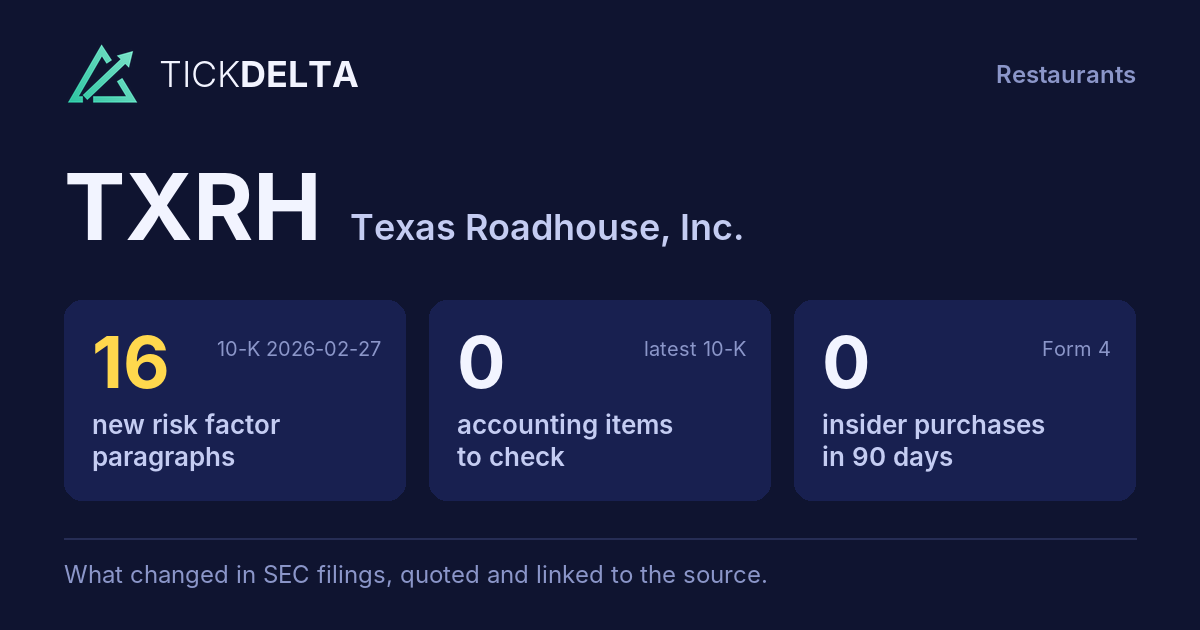
of the text changed · 10,196 words now · 16 new paragraphs, 29 gone
MD&A
15.4%
of the text changed · 6,792 words now · 1 new paragraphs, 5 gone
10-K 0001104659-26-021292 (Feb 27, 2026) vs 10-K 0001558370-25-001904 (Feb 28, 2025) Not compared: Legal Proceedings, Accounting Policies.
Every paragraph, and how much of it changed
One bar per paragraph, in the order of the 10-K. Height and colour show the share of its words not in the closest paragraph a year earlier; the tallest bars are new paragraphs.
Risk Factors
134 paragraphs · 16 new · 49 reworded · 29 gone · 10-K Feb 27, 2026 against Feb 28, 2025
New paragraph
Reworded (5% of its words or more)
Same or nearly
Paragraph 62 · 41% changed
Every version of it
In addition to having to comply with these licensing requirements, various federal and state labor laws govern our relationship with our employees and affect operating costs. These For example, federal and state wage and hour laws include and regulations govern such matters as minimum wage and tipped wage requirements, overtime pay, overtime, meal and rest breaks, proper exempt classifications, classification, child labor, pay for all hours worked (including overtime), and proper handling of tips. A significant number of our hourly restaurant personnel receive tips as part of their compensation and are paid at or above a minimum wage after giving effect to applicable tips. Other federal and state labor laws and regulations govern such matters as health benefits, unemployment taxes, workers’ compensation, work authorization and eligibility requirements, equal employment opportunities, anti-discrimination working conditions and harassment requirements, and working conditions. A number of factors could adversely affect our operating results, including:
Paragraph 21 · 36% changed
Every version of it
Paragraph 56 · 35% changed
Every version of it
Our success depends, in part, upon the popularity of our food products. Continued social concerns or shifts Shifts in consumer preferences away from or social concerns regarding our restaurants restaurants, food sourcing, or food offerings, particularly beef, beef offerings could harm our business. Consumer preferences regarding food sourcing in response to environmental reduce demand. Medical conditions or welfare concerns could also harm our business. Additionally, current and new medical treatments that restrict consumption of certain foods may cause consumers to avoid or consume less of our products. products and current and new medical treatments such as GLP-1 agonists may shift consumer preferences.
Paragraph 28 · 35% changed
Every version of it
Paragraph 27 · 34% changed
Every version of it
The development of additional restaurant concepts, including Bubba’s 33 and Jaggers, created internally or acquired as a part of our other strategic initiatives initiatives, may not be as successful as our experience in the development of the Texas Roadhouse concept. These concepts may have lower brand awareness and less operating experience than most Texas Roadhouse restaurants. In addition, they may have a higher initial investment cost and/or a lower per person average check amount. As a result, the development and/or acquisition of additional restaurant Pursuing new concepts may not contribute to our average unit volume growth and/or profitability in an incremental way. We can provide no assurance that these units will be accepted in the markets targeted for expansion and/or that we or our franchisees will be able to achieve our targeted returns when opening new locations. In the future, we may determine not to move forward with any further expansion and/or acquisition of additional restaurant concepts. These decisions could limit or delay our overall long-term growth. Additionally, expansion and/or acquisition of additional restaurant concepts might divert our management’s capital and management attention from other business concerns or initiatives and could have an adverse impact on our core Texas Roadhouse business. operations.
Paragraph 99 · 34% changed
Every version of it
Paragraph 37 · 33% changed
Every version of it
The entrance into and operations in international markets may not be as successful as our experience in the development of our concepts domestically or any success we have had with our concepts in other international markets. In addition, operating Operating in international markets may require significant resources and management attention and will subject us to economic, political, and regulatory risks that are different from and incremental to those in the United States. In addition to the risks that we face in the United States, our international operations involve risks that could adversely affect our business, including: including the need to adapt our concepts for specific cultural, language, and consumer preferences; new and different sources of competition; the ability to identify appropriate business partners; difficulties and costs associated with staffing and managing foreign operations; difficulties in adapting and sourcing product specifications for international restaurant locations; fluctuations in currency exchange rates, which could impact royalties, revenue, and expenses of our international operations, and expose us to foreign currency exchange rate risk; and political or social unrest, economic instability, and the destabilization of a region, including the effects of actual or threatened terrorist attacks.
Paragraph 69 · 42% changed
Every version of it
10-K Feb 28, 2025The federal Americans with Disabilities Act prohibits discrimination on the basis of disability in public accommodations and employment. Although our restaurants and other places of accommodation are designed to be accessible to the disabled, we could be required to make unexpected modifications to provide service to, or make reasonable accommodations, for disabled persons.
10-K Feb 27, 2026
As places of public accommodation, our restaurants are required to comply with the applicable requirements of the Americans with Disabilities Act ("ADA") and related state accessibility statutes. Under the ADA and related state laws, we must provide equal access to our goods and services to disabled guests, which means complying with the applicable ADA Standards for Accessible Design when constructing or undertaking remodeling of our restaurants. Although our restaurants are designed to be accessible to disabled guests, we could be required to make unexpected modifications to provide service or equal access to, or make reasonable accommodations for, disabled guests.
Paragraph 62 · 41% changed
Every version of it
10-K Feb 28, 2025
In addition to having to comply with these licensing requirements, various federal and state labor laws govern our relationship with our employees and affect operating costs. These laws include minimum and tipped wage requirements, overtime pay, meal and rest breaks, exempt classifications, health benefits, unemployment taxes, workers’ compensation, work authorization and eligibility requirements, equal employment opportunities, anti-discrimination and harassment requirements, and working conditions. A number of factors could adversely affect our operating results, including:
10-K Feb 27, 2026
In addition to having to comply with these licensing requirements, various federal and state labor laws govern our relationship with our employees and affect operating costs. For example, federal and state wage and hour laws and regulations govern such matters as minimum wage and overtime, meal and rest breaks, proper exempt classification, child labor, pay for all hours worked (including overtime), and proper handling of tips. A significant number of our hourly restaurant personnel receive tips as part of their compensation and are paid at or above a minimum wage after giving effect to applicable tips. Other federal and state labor laws and regulations govern such matters as health benefits, unemployment taxes, workers’ compensation, work authorization and eligibility requirements, working conditions and
Paragraph 21 · 36% changed
Every version of it
10-K Feb 28, 2025Our average unit volume and comparable restaurant sales may not increase at rates achieved in the past, which may affect our sales growth and will continue to be a critical factor affecting our profitability. Our business is also subject to seasonal fluctuations. Historically, sales in most of our restaurants have been higher during the winter months of each year. Holidays, changes in weather, severe weather, and similar conditions may impact sales volumes seasonally in some operating regions. Accordingly, results for one quarter are not necessarily indicative of results to be expected for any other quarter or for any year and comparable restaurant sales for any particular future period may decrease. In the future, operating results may fall below the expectations of securities analysts and investors. In that event, the price of our common stock could decrease.
10-K Feb 27, 2026
Given the impact of these various factors, our average unit volume and comparable restaurant sales may not increase at the rates seen in prior periods, which could constrain sales growth and impact profitability. Our business is also subject to seasonal fluctuations, as historically, sales in most of our restaurants have seen higher levels during the first half of the year. Variables such as holidays, changes in weather, severe weather events, and similar conditions may drive sales higher or lower in certain operating regions at different times. Therefore, the results of one fiscal quarter should not be viewed as indicative of forthcoming quarters or the year as a whole, and comparable restaurant sales in any future period may decline. Should our operating results fall below the expectations of securities analysts and investors in the future, it could result in a decrease in the market price of our common stock.
Paragraph 56 · 35% changed
Every version of it
10-K Feb 28, 2025
Our success depends, in part, upon the popularity of our food products. Continued social concerns or shifts in consumer preferences away from our restaurants or food offerings, particularly beef, could harm our business. Consumer preferences regarding food sourcing in response to environmental or welfare concerns could also harm our business. Additionally, current and new medical treatments may cause consumers to avoid or consume less of our products.
10-K Feb 27, 2026
Our success depends, in part, upon the popularity of our food products. Shifts in consumer preferences or social concerns regarding our restaurants, food sourcing, or beef offerings could reduce demand. Medical conditions or treatments that restrict consumption of certain foods may cause consumers to avoid or consume less of our products and current and new medical treatments such as GLP-1 agonists may shift consumer preferences.
Paragraph 28 · 35% changed
Every version of it
10-K Feb 28, 2025The development of additional restaurant concepts, including Bubba’s 33 and Jaggers, created internally or acquired as a part of our other strategic initiatives may not be as successful as our experience in the development of the Texas Roadhouse concept. These concepts may have lower brand awareness and less operating experience than most Texas Roadhouse restaurants. In addition, they may have a higher initial investment cost and/or a lower per person average check amount. As a result, the development and/or acquisition of additional restaurant concepts may not contribute to our average unit volume growth and/or profitability in an incremental way. We can provide no assurance that these units will be accepted in the markets targeted for expansion and/or that we or our franchisees will be able to achieve our targeted returns when opening new locations. In the future, we may determine not to move forward with any further expansion and/or acquisition of additional restaurant concepts. These decisions could limit or delay our overall long-term growth. Additionally, expansion and/or acquisition of additional restaurant concepts might divert our management’s attention from other business concerns or initiatives and could have an adverse impact on our core Texas Roadhouse business.
10-K Feb 27, 2026
These concepts may take longer to ramp up, operate at lower margins, or fail to achieve acceptable returns. As a result, developing or acquiring additional concepts may not contribute to average unit volume growth or profitability and could negatively affect our results. We can provide no assurance that these units will be accepted in the markets targeted for expansion and/or that we or our franchisees will be able to achieve our targeted returns when opening new locations. In the future, we may determine not to move forward with any further expansion and/or acquisition of additional restaurant concepts. These decisions could limit or delay our overall long-term growth.
Paragraph 27 · 34% changed
Every version of it
10-K Feb 28, 2025
The development of additional restaurant concepts, including Bubba’s 33 and Jaggers, created internally or acquired as a part of our other strategic initiatives may not be as successful as our experience in the development of the Texas Roadhouse concept. These concepts may have lower brand awareness and less operating experience than most Texas Roadhouse restaurants. In addition, they may have a higher initial investment cost and/or a lower per person average check amount. As a result, the development and/or acquisition of additional restaurant concepts may not contribute to our average unit volume growth and/or profitability in an incremental way. We can provide no assurance that these units will be accepted in the markets targeted for expansion and/or that we or our franchisees will be able to achieve our targeted returns when opening new locations. In the future, we may determine not to move forward with any further expansion and/or acquisition of additional restaurant concepts. These decisions could limit or delay our overall long-term growth. Additionally, expansion and/or acquisition of additional restaurant concepts might divert our management’s attention from other business concerns or initiatives and could have an adverse impact on our core Texas Roadhouse business.
10-K Feb 27, 2026
The development of additional restaurant concepts, including Bubba’s 33 and Jaggers, created internally or acquired as a part of our other strategic initiatives, may not be as successful as our experience in the development of the Texas Roadhouse concept. These concepts may have lower brand awareness and less operating experience than most Texas Roadhouse restaurants. In addition, they may have a higher initial investment cost and/or a lower per person average check amount. Pursuing new concepts may divert capital and management attention from our core operations.
Paragraph 99 · 34% changed
Every version of it
10-K Feb 28, 2025We rely heavily on information systems in all aspects of our operations, including point-of-sale systems, digital apps, financial systems, marketing programs, e-commerce, and various other processes and transactions. This reliance has significantly increased in recent years as we have had to depend to a greater extent on systems such as online ordering, contactless payments, and online waitlists as our guests are increasingly using our website and digital applications to place and pay for their orders. Our point-of-sale processing in our restaurants includes collection of cash, credit cards, debit cards, gift cards, and other processes and procedures. Our ability to efficiently and effectively manage our business depends significantly on the reliability, security, and capacity of these systems. As our business needs continue to evolve, these systems will require upgrading and maintenance over time, consequently requiring significant future commitments of resources and capital. As we become increasingly reliant on digital ordering and payment as a sales channel, our business could be negatively impacted if we are unable to successfully implement, execute, or maintain our consumer-facing digital initiatives. Additionally, the increased use of remote work has increased the susceptibility of our infrastructure to disruption.
10-K Feb 27, 2026
our business depends significantly on the reliability, security, and capacity of these systems. As our business needs continue to evolve, these systems will require upgrading and maintenance over time, consequently requiring significant future commitments of resources and capital. As we become increasingly reliant on digital ordering and payment as a sales channel, our business could be negatively impacted if we are unable to successfully implement, execute, or maintain our consumer-facing digital initiatives. In addition, we rely on third-party cloud, hosting, content delivery, and telecommunications providers, and disruptions, outages, or degradations at these providers could impair our digital ordering and point-of-sale systems. The increased use of remote work has also increased the susceptibility of our infrastructure to disruption.
Paragraph 37 · 33% changed
Every version of it
10-K Feb 28, 2025
The entrance into international markets may not be as successful as our experience in the development of our concepts domestically or any success we have had with our concepts in other international markets. In addition, operating in international markets may require significant resources and management attention and will subject us to economic, political, and regulatory risks that are different from and incremental to those in the United States. In addition to the risks that we face in the United States, our international operations involve risks that could adversely affect our business, including:
10-K Feb 27, 2026
The entrance into and operations in international markets may not be as successful as our experience in the development of our concepts domestically or any success we have had with our concepts in other international markets. Operating in international markets may require significant resources and management attention and will subject us to economic, political, and regulatory risks that are different from and incremental to those in the United States. In addition to the risks that we face in the United States, our international operations involve risks that could adversely affect our business, including the need to adapt our concepts for specific cultural, language, and consumer preferences; new and different sources of competition; the ability to identify appropriate business partners; difficulties and costs associated with staffing and managing foreign operations; difficulties in adapting and sourcing product specifications for international restaurant locations; fluctuations in currency exchange rates, which could impact royalties, revenue, and expenses of our international operations, and expose us to foreign currency exchange rate risk; and political or social unrest, economic instability, and the destabilization of a region, including the effects of actual or threatened terrorist attacks.
MD&A
105 paragraphs · 1 new · 56 reworded · 5 gone · 10-K Feb 27, 2026 against Feb 28, 2025
New paragraph
Reworded (5% of its words or more)
Same or nearly
Paragraph 86 · 47% changed
Paragraph 55 · 40% changed
Paragraph 72 · 37% changed
In our Texas Roadhouse reportable segment, restaurant margin dollars increased $193.8 decreased $13.4 million or 28.9% 1.5% in 2024. 2025. The increase decrease was primarily due to higher sales food and improved labor productivity beverage costs driven by commodity inflation and lapping the benefit of the additional week in the prior year, partially offset by wage and other labor inflation as well as higher general liability insurance expense. sales.
Paragraph 99 · 34% changed
Paragraph 68 · 33% changed
Paragraph 73 · 32% changed
In our Bubba’s 33 reportable segment, restaurant margin dollars increased $12.5 $2.8 million or 36.8% 6.0% in 2024. 2025. The increase was primarily due to higher sales and improved labor productivity partially offset by wage higher food and other labor inflation. beverage costs driven by commodity inflation, an increase in general liability insurance expense, and lapping the benefit of the additional week in the prior year.
Paragraph 77 · 29% changed
Net cash used in investing activities was $482.8 million in 2025 compared to $336.9 million in 2024 compared to $367.2 million in 2023. 2024. The decrease increase was primarily due to the acquisition of franchise stores in 2023 partially offset by 2025 and an increase in capital expenditures. The increase in capital expenditures is due to an increase in 2024. restaurant relocations, restaurant refurbishments and expansions, and the purchase of our Support Center for approximately $22.8 million. These increases were partially offset by a decrease in the timing of new company restaurant spend.
Paragraph 98 · 29% changed
Under our policies, trailing 12-month cash flow results under a predetermined amount at the individual restaurant level signals a potential impairment. In our evaluation of restaurants that do not meet the cash flow threshold, we estimate future undiscounted cash flows from operating the restaurant over the remaining useful life of the primary asset, which is the building or the operating lease right-of-use asset. In the estimation of future cash flows, we consider the period of time the restaurant has been open, the trend of operations over such period, and future periods and expectations for future sales growth. We limit assumptions about important factors such as trend of future operations and sales growth to those that are supportable based upon our plans for the restaurant and actual results at comparable restaurants. Both qualitative and quantitative information are considered when evaluating for potential impairments. As we assess the
Paragraph 86 · 47% changed
10-K Feb 28, 2025We maintain a revolving credit facility (the "credit facility") with a syndicate of commercial lenders led by JPMorgan Chase Bank, N.A. and PNC Bank, N.A. The credit facility is an unsecured, revolving credit agreement and has a borrowing capacity of up to $300.0 million with the option to increase by an additional $200.0 million subject to certain limitations, including approval by the syndicate of lenders. The credit facility has a maturity date of May 1, 2026.
10-K Feb 27, 2026
On April 24, 2025, we entered into an agreement for a revolving credit facility with a syndicate of commercial lenders led by JPMorgan Chase Bank, N.A. and PNC Bank, N.A. This credit facility superseded and replaced our previous credit facility.
Paragraph 55 · 40% changed
10-K Feb 28, 2025Franchise royalties and fees increased by $4.4 million or 16.1% compared to 2023. The increases were due to comparable franchise restaurant sales growth and new store openings partially offset by $1.5 million related to the reclassification of certain items that were reported in general and administrative expenses in our consolidated statement of income in 2023. Franchise comparable restaurant sales increased 6.4% in 2024.
10-K Feb 27, 2026
Royalties and franchise fees decreased $0.6 million or 2.0% in 2025 compared to 2024. The decrease in 2025 was due to decreased royalties related to the franchise stores that were acquired, partially offset by increased royalties related to our royalty-based retail products that rolled out in 2024.
Paragraph 72 · 37% changed
10-K Feb 28, 2025
In our Texas Roadhouse reportable segment, restaurant margin dollars increased $193.8 million or 28.9% in 2024. The increase was primarily due to higher sales and improved labor productivity partially offset by wage and other labor inflation as well as higher general liability insurance expense.
10-K Feb 27, 2026
In our Texas Roadhouse reportable segment, restaurant margin dollars decreased $13.4 million or 1.5% in 2025. The decrease was primarily due to higher food and beverage costs driven by commodity inflation and lapping the benefit of the additional week in the prior year, partially offset by higher sales.
Paragraph 99 · 34% changed
10-K Feb 28, 2025period of time the restaurant has been open, the trend of operations over such period, and future periods and expectations for future sales growth. We limit assumptions about important factors such as trend of future operations and sales growth to those that are supportable based upon our plans for the restaurant and actual results at comparable restaurants. Both qualitative and quantitative information are considered when evaluating for potential impairments. As we assess the ongoing expected cash flows and carrying amounts of our long-lived assets, these factors could cause us to realize a material impairment charge. Based on our reviews performed on the cash flows of our restaurants, the carrying amount associated with restaurants deemed at risk for impairment is not material to our consolidated financial statements.
10-K Feb 27, 2026
ongoing expected cash flows and carrying amounts of our long-lived assets, these factors could cause us to realize a material impairment charge. Based on our reviews performed on the cash flows of our restaurants, the carrying amount associated with restaurants deemed at risk for impairment is not material to our consolidated financial statements.
Paragraph 68 · 33% changed
10-K Feb 28, 2025Our effective tax rate increased to 15.3% in 2024 compared to 12.5% in 2023. The increase was driven by a decrease in the impact of the FICA tip tax credit, due to increased profitability. In 2025, we expect an effective tax rate of 15% to 16% based on forecasted operating results.
10-K Feb 27, 2026
In 2026, we expect an effective tax rate of 14% to 15% based on forecasted operating results.
Paragraph 73 · 32% changed
10-K Feb 28, 2025
In our Bubba’s 33 reportable segment, restaurant margin dollars increased $12.5 million or 36.8% in 2024. The increase was primarily due to higher sales and improved labor productivity partially offset by wage and other labor inflation.
10-K Feb 27, 2026
In our Bubba’s 33 reportable segment, restaurant margin dollars increased $2.8 million or 6.0% in 2025. The increase was primarily due to higher sales partially offset by higher food and beverage costs driven by commodity inflation, an increase in general liability insurance expense, and lapping the benefit of the additional week in the prior year.
Paragraph 77 · 29% changed
10-K Feb 28, 2025
Net cash used in investing activities was $336.9 million in 2024 compared to $367.2 million in 2023. The decrease was primarily due to the acquisition of franchise stores in 2023 partially offset by an increase in capital expenditures in 2024.
10-K Feb 27, 2026
Net cash used in investing activities was $482.8 million in 2025 compared to $336.9 million in 2024. The increase was primarily due to the acquisition of franchise stores in 2025 and an increase in capital expenditures. The increase in capital expenditures is due to an increase in restaurant relocations, restaurant refurbishments and expansions, and the purchase of our Support Center for approximately $22.8 million. These increases were partially offset by a decrease in the timing of new company restaurant spend.
Paragraph 98 · 29% changed
10-K Feb 28, 2025
Under our policies, trailing 12-month cash flow results under a predetermined amount at the individual restaurant level signals a potential impairment. In our evaluation of restaurants that do not meet the cash flow threshold, we estimate future undiscounted cash flows from operating the restaurant over the remaining useful life of the primary asset, which is the building or the operating lease right-of-use asset. In the estimation of future cash flows, we consider the
10-K Feb 27, 2026
Under our policies, trailing 12-month cash flow results under a predetermined amount at the individual restaurant level signals a potential impairment. In our evaluation of restaurants that do not meet the cash flow threshold, we estimate future undiscounted cash flows from operating the restaurant over the remaining useful life of the primary asset, which is the building or the operating lease right-of-use asset. In the estimation of future cash flows, we consider the period of time the restaurant has been open, the trend of operations over such period, and future periods and expectations for future sales growth. We limit assumptions about important factors such as trend of future operations and sales growth to those that are supportable based upon our plans for the restaurant and actual results at comparable restaurants. Both qualitative and quantitative information are considered when evaluating for potential impairments. As we assess the
A paragraph is matched with the one last year that shares the most of its words; under half in common makes it new. The paragraphs shown are the 8 reworded the most in each section.
The paragraph that changed most in each section
The redline
Marked against last year's 10-K: cut words struck through, new words highlighted.
Risk Factors227 words changed in this paragraph; it is 31% similar to last year's version.
Our profitability depends in part on our ability to anticipate and react to changes in food and supply costs and/or the availability of products necessary to operate our business, including increased costs arising from federal and/or state mandated requirements. Any An increase in food prices or loss of supply, particularly proteins, could adversely affect our operating results. In addition, 2025, we experienced higher than normal commodity inflation, specifically relating to beef, impacting our restaurant margin and we are susceptible anticipating these higher inflationary conditions to increases in food costs as a result of factors beyond our control, such as food supply constrictions, inflationary cycles, weather conditions, food safety concerns, global pandemics, product recalls, global market and trade conditions, and government regulations including the imposition of tariffs. We cannot predict whether we will be able to anticipate and react to changing food costs and/or loss of supply by adjusting our purchasing practices, menu prices, or menu offerings, and a failure to do so could adversely affect our operating results. Extreme and/or long term increases in commodity prices could adversely affect our future results, especially if we are unable, primarily due to competitive reasons, to increase menu prices. Additionally, if there is a time lag between the increasing commodity prices and our ability to increase menu prices or if we believe the commodity price increase to be short in duration and we choose not to pass on the cost increases, our short-term results could be negatively affected. Also, if we adjust pricing there is no assurance that we will realize the full benefit of any adjustment due to changes in our guests’ menu item selections and guest traffic. continue into 2026.
Source: Item 1A, 10-K 0001104659-26-021292 vs Item 1A, 10-K 0001558370-25-001904
MD&A87 words changed in this paragraph; it is 60% similar to last year's version.
Total revenue increased $741.7 $504.7 million or 16.0% 9.4% to $5.9 billion in 2025 compared to $5.4 billion in 2024 compared to $4.6 billion in 2023 primarily due to an increase in store weeks and comparable restaurant sales partially offset by lapping the benefit of the additional week which added $114.7 million in revenue in 2024. Store weeks and an increase in store weeks. Comparable comparable restaurant sales increased 5.0% and store weeks increased 8.5% and 7.5%, 4.9%, respectively, at company restaurants in 2025 compared to 2024. The increase in store weeks was due to new store openings and the acquisition of franchise restaurants. The increase in comparable restaurant sales was due to an increase in guest traffic along with an increase in per person average check. The increase in store weeks was due to new store openings and the benefit of the additional week in 2024. The additional week added $114.7 million in revenue and a 2% benefit to store week growth.
Source: Item 7, 10-K 0001104659-26-021292 vs Item 7, 10-K 0001558370-25-001904
Sentences and paragraphs added, removed or reworded
Every change, by type
Sentences and paragraphs of TXRH's Risk Factors and MD&A, 10-K Feb 27, 2026 against 10-K Feb 28, 2025. Each links to the text at sec.gov.
Quiet changes are sentences kept from last year with one to four words changed, at least one of them a hedge, a modal or a qualifier (may, could, will, not, significant, material…). A year or date rolling forward is not counted.
The full word list
adverse, adversely, all, although, anticipate, anticipates, any, approximately, believe, believes, can, cannot, certain, could, expect, expects, generally, however, if, intend, intends, largely, likely, many, material, materially, may, might, most, must, never, no, not, possible, primarily, probable, should, significant, significantly, some, substantial, substantially, unlikely, will, would
AddedRisk Factors
changes in federal, state, and/or local tax laws, including the impact of tariffs;
Read it in 10-K Feb 27, 2026 at sec.gov
AddedRisk Factors
Our profitability depends in part on changes in food and supply costs and/or the availability of products necessary to operate our business, including increased costs arising from federal and/or state mandated requirements. An increase in food prices or loss of supply, particularly proteins, could adversely affect our operating results. In 2025, we experienced higher than normal commodity inflation, specifically relating to beef, impacting our restaurant margin and we are anticipating these higher inflationary conditions to continue into 2026.
Read it in 10-K Feb 27, 2026 at sec.gov
AddedRisk Factors
You should not rely on past changes in our average unit volume or comparable restaurant sales as an indication of our future results of operations, as these metrics may fluctuate significantly over time. A wide range of factors, both within and beyond our control, have historically influenced, and will likely continue to influence, average unit volume and comparable restaurant sales. These factors include, among others, the level of consumer awareness and perception of our restaurant concepts with respect to quality, price, value, and service; the effectiveness of our business strategy; our ability to sustain higher levels of to-go sales and differentiate our concepts within off-premise channels; and the impact of competition both from other restaurants (including fast-casual and quick-service establishments) and alternative food service providers, such as delivery services, meal kits, and grocery stores. Additional factors that can affect our performance include our ability to implement menu price increases without negatively impacting guest traffic or average check size; general economic conditions, adverse weather patterns and natural disasters; seasonal consumer trends; the introduction of new menu items and changes in pricing; a loss of parking or access rights resulting from government action or private transactions; and negative publicity related to food safety, health concerns, service quality, or the integrity of our suppliers’ food processing.
Read it in 10-K Feb 27, 2026 at sec.gov
AddedRisk Factors
If we fail to protect the reputation of our brands, our guest traffic, sales, and overall financial performance could be materially adversely affected.
Read it in 10-K Feb 27, 2026 at sec.gov
AddedRisk Factors
The strength of our Company depends heavily on the value and reputation of our brands. Our ability to attract and retain guests, employees, and franchise partners; maintain pricing power; and grow domestically and internationally is directly tied to brand perception. Negative publicity or events, whether or not accurate, could significantly damage our reputation and the value of our brands, reduce demand, and impair our operating results.
Read it in 10-K Feb 27, 2026 at sec.gov
AddedRisk Factors
Reputational harm could arise from a wide range of factors, including concerns about food quality or safety; food-borne illness claims; tampering or contamination incidents; poor health inspection results; supply chain or processing issues involving us or our vendors; facility conditions; guest complaints; alcohol related incidents; litigation; security breaches or technology failures; employee and/or labor relations concerns, including, but not limited to, allegations of harassment, discrimination, retaliation, or other misconduct; alleged violations of laws, regulations, or industry standards; and politically motivated accusations or other negative publicity. The actions of third parties, including our suppliers, franchisees, and our licensees in retail initiatives, also presents reputational risk outside of our direct control. Moreover, the rapid and broad dissemination of information through social media and other digital channels can amplify adverse events, sometimes without regard to accuracy or context, making it more difficult to mitigate or remediate negative impressions quickly or effectively.
Read it in 10-K Feb 27, 2026 at sec.gov
AddedRisk Factors
Any deterioration in our reputation could reduce guest traffic, adversely affect sales, limit our ability to grow new units or enter new markets, pressure margins through increased promotional activity or other remedial measures, increase costs related to quality assurance and compliance, diminish employee engagement and retention, and expose us to greater regulatory, legal, and operational risks. Collectively or individually, these impacts could materially adversely affect our business, financial condition, results of operations, and cash flows.
Read it in 10-K Feb 27, 2026 at sec.gov
AddedRisk Factors
Any acquisition or future development that we pursue, including the on-going development of new concepts or retail initiatives utilizing our intellectual property, whether or not successfully completed, may involve risks, including material adverse effects on our operating results, particularly in the fiscal quarters immediately following the acquisition or development as the restaurants are integrated into our operations; risks associated with entering into new domestic markets or conducting operations where we have no or limited prior experience; risks associated with successfully integrating new employees, processes, and systems while also maintaining our culture and brand standards; risks inherent in accurately assessing the value, future growth potential, strengths, weaknesses, contingent and other liabilities and potential profitability of acquisition candidates, and our ability to achieve projected economic and operating synergies, without impacting our underlying business; and the diversion of management’s attention from other business concerns.
Read it in 10-K Feb 27, 2026 at sec.gov
Show the other 48
AddedRisk Factors
We are also subject to governmental regulations throughout the world which includes complying with local laws, regulations, and customs in foreign jurisdictions; regulatory requirements or tariffs on goods needed to construct and/or operate our restaurants; compliance with U.S. laws such as the Foreign Corrupt Practices Act, and similar laws in foreign jurisdictions; differences in the registration and/or enforceability of intellectual property and contract rights; adverse tax consequences, profit repatriation, and other restrictions on the transfer of funds; and different and more stringent user protection, data protection, privacy, and other laws. Our failure to manage any of these risks successfully could harm our existing or future international operations and our overall business and results of our operations.
Read it in 10-K Feb 27, 2026 at sec.gov
AddedRisk Factors
Our brand value also depends on protection of trade secrets (including recipes, supplier relationships, and operational know-how), copyrights (including app, website, and marketing content), domain names, software, and, where applicable, rights of publicity. Protecting these assets can be difficult, particularly in jurisdictions with limited enforcement. Use of open-source software, third-party content, and artificial intelligence ("AI") in our technology and marketing may impose license obligations or usage restrictions and may increase the risk of third-party IP claims or content moderation obligations. Our inability to register or protect our marks and other proprietary rights in foreign jurisdictions could adversely affect our competitive position in international markets.
Read it in 10-K Feb 27, 2026 at sec.gov
AddedRisk Factors
safety standards, equal employment opportunities, anti-discrimination and harassment, and other similar legal requirements. A number of factors could adversely affect our operating results, including:
Read it in 10-K Feb 27, 2026 at sec.gov
AddedRisk Factors
In addition, some individuals, shareholder activists, government officials, and regulators have expressed opposing views and actions with respect to ESG matters which includes the proposal or enactment of "Anti-ESG" policies and initiatives. Strong opinions continue to be publicly expressed both for and against diversity and inclusion and ESG initiatives and positions taken by many corporations, including our Company, are tracked, monitored, and subject to heightened scrutiny from consumers, investors, advocacy groups, and public figures, potentially leading to consumer boycotts, negative publicity campaigns, litigation, and reputational harm. Negative reputational incidents or perceptions
Read it in 10-K Feb 27, 2026 at sec.gov
RemovedRisk Factors
RemovedRisk Factors
RemovedRisk Factors
RemovedRisk Factors
RemovedRisk Factors
RemovedRisk Factors
RemovedRisk Factors
RemovedRisk Factors
RemovedRisk Factors
RemovedRisk Factors
RemovedRisk Factors
RemovedRisk Factors
RewordedRisk Factors
RewordedRisk Factors
In addition, as we implement new technology platforms and AI programs to improve productivity and overall guest experience, productivity, there can be no guarantees that these platforms will operate as reliably or be as operationally impactful as intended. intended and such platforms may increase our operational, privacy, cybersecurity, and intellectual property risks, including errors, bias, data leakage, and claims related to training data and generated outputs, and may increase expenses.
Read it in 10-K Feb 27, 2026 at sec.gov
RewordedRisk Factors
RewordedRisk Factors
RewordedRisk Factors
RewordedRisk Factors
As a result, the development and/or acquisition of developing or acquiring additional restaurant concepts may not contribute to our average unit volume growth and/or or profitability in an incremental way. and could negatively affect our results.
Read it in 10-K Feb 27, 2026 at sec.gov
RewordedRisk Factors
As a result, we are particularly susceptible to adverse trends and economic conditions in those states, including any state mandated state-mandated changes in minimum and tipped wage rates and other laws and regulations that have a direct or indirect impact on our operations as well as economic pressures that may result in lower sales and profits at our restaurants.
Read it in 10-K Feb 27, 2026 at sec.gov
RewordedRisk Factors
RewordedRisk Factors
Entities across all industries are facing increased attention related to ESG environmental, social, and/or governance ("ESG") matters including packaging and waste, waste; animal health and welfare, welfare; human rights, rights; reproductive rights, rights; diversity and inclusion efforts, efforts; climate change, change; greenhouse gases, gases; and land, energy, and water use.
Read it in 10-K Feb 27, 2026 at sec.gov
RewordedRisk Factors
Although our restaurants and other places of accommodation are designed to be accessible to the disabled, disabled guests, we could be required to make unexpected modifications to provide service or equal access to, or make reasonable accommodations, for accommodations for, disabled persons. guests.
Read it in 10-K Feb 27, 2026 at sec.gov
RewordedRisk Factors
These include antitrust and tax requirements, anti-boycott regulations, import/export/customs, import/export controls and customs requirements, the potential imposition of tariffs and or other trade barriers or restrictions, other international trade regulations, the USA Patriot Act, and the Foreign Corrupt Practices Act.
Read it in 10-K Feb 27, 2026 at sec.gov
RewordedRisk Factors
New, modified, and existing privacy privacy, data protection, and data protection AI laws and regulations at the local, state, federal, and international levels may result in significant costs and compliance challenges and adversely affect our business and financial condition.
Read it in 10-K Feb 27, 2026 at sec.gov
Quiet changesRisk Factors
In addition, failure to adequately monitor and proactively respond to employee dissatisfaction could lead to poor guest satisfaction, higher turnover, litigation, and possible unionization efforts, which could negatively impact our results of operations.
Read it in 10-K Feb 27, 2026 at sec.gov
AddedMD&A
In 2026, we expect store week growth of 5% to 6% across all concepts, including the impact of franchise acquisitions.
Read it in 10-K Feb 27, 2026 at sec.gov
RemovedMD&A
RemovedMD&A
RemovedMD&A
RemovedMD&A
RemovedMD&A
RewordedMD&A
Net income increased $128.7 decreased $28.0 million or 42.2% 6.5% to $405.6 million in 2025 compared to $433.6 million in 2024 compared to $304.9 million in 2023 primarily due to higher lower restaurant margin dollars, as described below, partially offset by and higher depreciation and amortization expenses and higher general and administrative expenses. partially offset by lower income tax expense.
Read it in 10-K Feb 27, 2026 at sec.gov
RewordedMD&A
The decrease increase was primarily driven by wage and other labor inflation of 3.7% in 2025, partially offset by the benefit of a higher guest check and labor productivity partially offset by wage and other labor inflation of 4.6% in 2024. productivity.
Read it in 10-K Feb 27, 2026 at sec.gov
RewordedMD&A
The decrease was driven by lower incentive compensation expense, the increase in average unit volume volume, and lower general liability insurance expense of $2.7 million, partially offset by higher incentive compensation expense credit card fees and higher general liability insurance expense. utilities expenses.
Read it in 10-K Feb 27, 2026 at sec.gov
RewordedMD&A
The decrease was driven by the increase in average unit volume, lower incentive compensation expense, and lower restricted stock expense was primarily due to shifting lapping the impact of the shift in the timing of our restricted stock grants from quarterly to annually.
Read it in 10-K Feb 27, 2026 at sec.gov
RewordedMD&A
The increase decrease was primarily due to an increase a decrease in net income, income and an unfavorable change in working capital partially offset by an increase in depreciation and amortization expense, and a favorable change in working capital. expense.
Read it in 10-K Feb 27, 2026 at sec.gov
RewordedMD&A
RewordedMD&A
Diluted earnings per share increased 42.5% decreased 5.8% to $6.10 from $6.47 from $4.54 in the prior year primarily 2024 due to the increase decrease in net income. income partially offset by the impact of share repurchases.
Read it in 10-K Feb 27, 2026 at sec.gov
RewordedMD&A
As of December 31, 2024 30, 2025 and December 26, 2023, 31, 2024, we were are contingently liable for $7.8 million for five lease guarantees and $9.4 million and $10.4 million, respectively, for seven lease guarantees. guarantees, respectively.
Read it in 10-K Feb 27, 2026 at sec.gov
RewordedMD&A
Restaurant margin is used by our chief operating decision maker CODM to evaluate restaurant-level operating efficiency and performance. performance, assist in the evaluation of operating trends over time, and in making capital allocation decisions.
Read it in 10-K Feb 27, 2026 at sec.gov
RewordedMD&A
In 2024, 2025, we had store week growth of approximately 7.5% 5.0% across all concepts, including a benefit from franchise acquisitions in 2025, offset by lapping the impact of 2% from the additional week. week in 2024.
Read it in 10-K Feb 27, 2026 at sec.gov
RewordedMD&A
The increase decrease in restaurant margin, as a percentage of restaurant and other sales, was primarily driven due to commodity inflation of 6.1% and wage and other labor inflation of 3.7% partially offset by higher sales.
Read it in 10-K Feb 27, 2026 at sec.gov
RewordedMD&A
Quiet changesMD&A
We intend to satisfy our capital requirements over the next 12 months with cash on hand, net cash provided by operating activities, and if as needed, funds available under our revolving credit facility.
Read it in 10-K Feb 27, 2026 at sec.gov
Sources
The two latest 10-Ks on EDGAR, section by section. Each change links to the text at sec.gov.
Also
New risk factors: paragraphs with nothing like them last year, quoted in full.
Work with it
Excel workbook · CSV. Google Sheet that stays up to date: paste =IMPORTDATA("https://tickdelta.com/company/TXRH/export.csv") into a cell.