Form 10-K
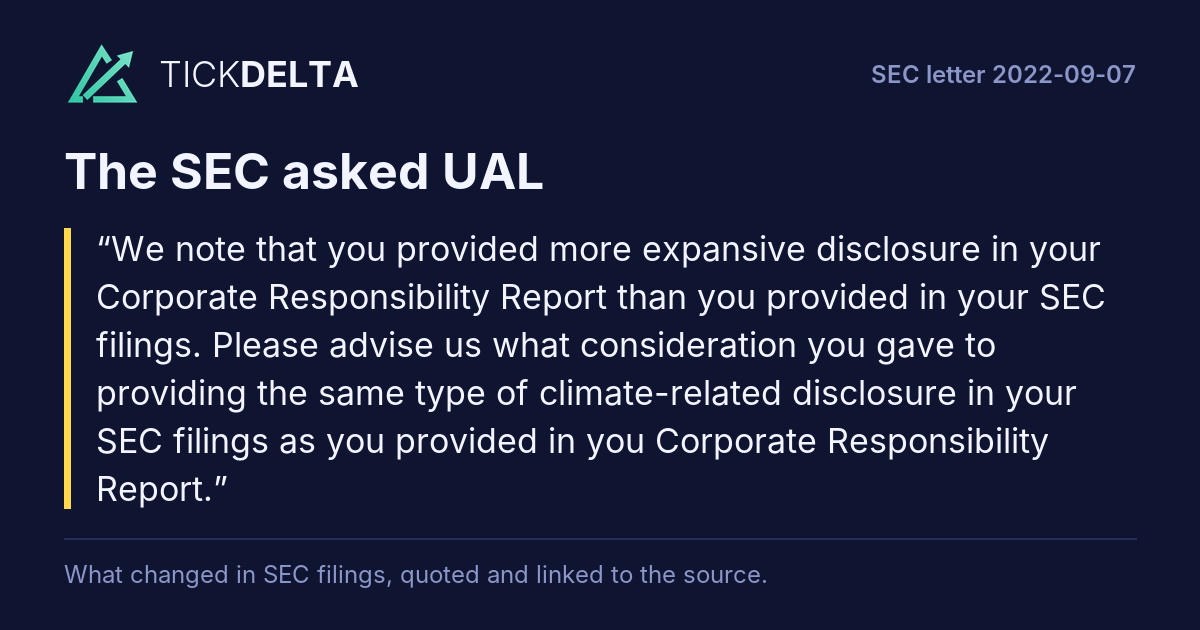
We note that you provided more expansive disclosure in your Corporate Responsibility Report than you provided in your SEC filings. Please advise us what consideration you gave to providing the same type of climate-related disclosure in your SEC filings as you provided in you Corporate Responsibility Report.
United respectfully advises the Staff that United’s CRR addresses sustainability reporting practices, speaks to a wide range of stakeholder interests and provides disclosures beyond those considered material for investors in the context of disclosures required in an Annual Report on Form 10-K pursuant to Applicable Disclosure Requirements.Read in the reply ↗Rest of the answer
Our CRR provides a single, convenient location for our stakeholders—including employees, customers, partners, investors, the communities in which we fly and policymakers—to review extensive ESG-related information that is of interest to them but not required in our SEC filings.
United’s Disclosure Council and other appropriate United subject matter experts are involved in the preparation and review of United’s filings with the SEC in a process designed to confirm United’s compliance with Applicable Disclosure Requirements and United’s disclosure of information that is material to investors in the context of SEC periodic reports. United’s Disclosure Council meets on a quarterly basis to review United’s prior and proposed new disclosures and discuss any changes that may be appropriate as a result of potentially material events, trends and risks identified in a process designed to ensure all material events, trends and risks, either quantitatively or qualitatively, to United’s business, financial condition, liquidity and results of operations are appropriately disclosed in its SEC filings. In determining the materiality of information to be included in its disclosures, United refers to the standard of materiality set forth in Basic Inc. v. Levinson, 485 U.S. 224 (1988). During United’s review process pursuant to its disclosure controls and procedures in connection with preparing its 2021 Form 10-K, United determined that it would include certain key climate-related qualitative and quantitative data in the 2021 Form 10-K regardless of the data’s quantitative materiality when compared to United’s consolidated financial statements or qualitative materiality under Applicable Disclosure Requirements, including United’s 2019 and 2020 Scope 1 (direct), Scope 2 (indirect) and Scope 3 (other indirect) GHG emissions and carbon intensity emission rates, as well as information regarding United’s climate goals, how United intends to meet its goals and how United is incorporating its approach to climate change into its corporate strategy.
Also during United’s review process in connection with preparing its 2021 Form 10-K, United considered whether it was required under Applicable Disclosure Requirements to provide any of the extensive climate-related details that it included in the then-current CRR. Except for the disclosures that United made in the 2021 Form 10-K, United did not identify any additional matters discussed in the then-current CRR that were required under Applicable Disclosure Requirements or that were otherwise material information necessary in order to make the required statements in the 2021 Form 10-K, in light of the circumstances under which they were made, not misleading. In connection with the preparation of the 2021 Form 10-K, United also considered the additional details ultimately provided in the current version of the CRR that was issued after United filed the 2021 Form 10-K and concluded that they also were not required under Applicable Disclosure Requirements and were not otherwise material information necessary in order to make the required statements in the 2021 Form 10-K, in light of the circumstances under which they were made, not misleading.
First report after the company's reply of 2022-10-07: 10-Q filed 2022-10-19 ↗, against the 10-Q filed 2022-07-21 ↗.
Tickdelta does not hold the text of both reports, so they are not compared here.
Disclosure is provided in your Form 10-K regarding the company’s pledge “to become 100% green by eliminating its greenhouse gas (‘GHG’) emissions by 2050 without relying on the use of traditional carbon offsets, the only airline globally to make this commitment.” Please describe your basis for identifying yourself as the only airline to make this type of commitment along with other statements such as describingRest of the question
yourself as “the largest airline to invest in zero-emission engines for regional aircraft.” In addition, clarify your definition of the term “100% green.”
Regarding United’s statement in the 2021 Form 10-K that it is the only airline to commit to becoming 100% green by eliminating its GHG emissions by 2050 without relying on the use of traditional carbon offsets, United reviewed public documents from major global airlines1 and as of the 2021 Form 10-K filing, it was not aware of any public commitment by another airline to achieve net zero GHG emissions without using traditional carbon offsets.
Regarding United’s statement in the 2021 Form 10-K that it is the largest airline to invest in zero-emission engines for regional aircraft, UnitedRead in the reply ↗Rest of the answer
determined that, as of the 2021 Form 10-K filing, it was the largest airline on an available seat-mile basis to invest in zero-emission engines for regional aircraft based on publicly announced commitments and investments as well as United’s equity stake in hydrogen-electric engine developer, ZeroAvia, Inc. In other words, as of the 2021 Form 10-K filing, United was not aware of any airlines that had invested in manufacturers of zero-emission engines for regional aircraft based on publicly announced commitments and investments that were bigger than United on an available seat-mile basis.
Lastly, regarding the term “100% green” in the 2021 Form 10-K, the term is referring to United’s pledge described in the rest of that sentence—i.e., United’s pledge to “eliminat[e] its greenhouse gas (‘GHG’) emissions by 2050 without relying on the use of traditional carbon offsets . . . .”
First report after the company's reply of 2022-10-07: 10-Q filed 2022-10-19 ↗, against the 10-Q filed 2022-07-21 ↗.
Tickdelta does not hold the text of both reports, so they are not compared here.
Please revise to disclose the material effects of transition risks related to climate change that may affect your business, financial condition, and results of operations, such as market trends that may alter business opportunities, credit risks, or technological changes.
United respectfully notes that it has disclosed in the Risk Factors section of the 2021 Form 10-K the material effects that climate change-related transition risks may have on United and it believes that those disclosures provided sufficient specificity for investors because the disclosures address each of the four risk categories of climate change transition risks (“Policy and Legal,” “Technology,” “Market,” and “Reputation”) identified in the TCFD framework that may potentially impact United’s business, financial condition, liquidity or results of operations.Read in the reply ↗Rest of the answer
Specifically, United described the potential for increased costs and reputational harm due to increased stakeholder attention with respect to climate change in the transition to a lower-carbon economy under the heading “We are subject to many forms of environmental regulation and liability and risks associated with climate change and may incur substantial costs as a result. In addition, failure to achieve or demonstrate progress towards our climate goals may expose us to liability and reputational harm.” For example, the disclosure noted the following:
1 For example, airlines such as American Airlines Group Inc., Delta Air Lines, Inc., Southwest Airlines Co., JetBlue Airways Corporation, Alaska Air Group, Inc., Deutsche Lufthansa Aktiengesellschaft, Air France-KLM SA and International Consolidated Airlines Group, S.A. have all disclosed that their “net zero” targets include voluntary carbon offsets.
•“Compliance with existing and future environmental laws and regulations can require significant expenditures and operational changes and violations can lead to significant fines and penalties and reputational harm.”
•“[United] has incurred, and expects to continue to incur, costs to achieve its goal of net zero carbon emissions and to comply with environmental sustainability legislation and regulation and non-binding standards and accords. Such activity may require the Company to modify its supply chain practices, make capital investments to modify certain aspects of its operations or increase its operating costs (including fuel costs). The precise nature of future binding or non-binding legislation, regulation, standards and accords, which is an increased focus of global, national and regional regulators, is difficult to predict and the financial impact to the Company would likely be significant if future legal standards do not align with the Company’s plans to achieve its climate goals or if proposed U.S. legislation to accelerate the production of [sustainable aviation fuel] development fails to be enacted into law.”
•“There can be no assurance . . . that any future investments that we make in furtherance of achieving our climate goals will produce the expected results or meet increasing stakeholder environmental, social and governance expectations.”
•“[W]e could incur significant costs to improve the climate resiliency of our infrastructure and supply chain and otherwise prepare for, respond to, and mitigate the effects of climate change.”
•“If we are unable to meet or properly report on our progress toward achieving our climate change goals and commitments, we could face adverse publicity and reactions from other investors, activist groups, or other stakeholders, which could result in reputational harm or other adverse effects to the Company.”
United confirms that it will continue to disclose in future SEC filings with specificity the effects of the known risks posed by the transition to a lower-carbon economy if material.
United also believes that strategic opportunities exist for it as a result of climate change and that the sustainability-related solutions being pursued to advance its goal to become 100% green by achieving net zero GHG emissions by 2050 without relying on the use of traditional carbon offsets will help mitigate several of these potential risks posed by the transition to a lower-carbon economy. United disclosed in the “Business” section of the 2021 Form 10-K that it “believes that its investment in these [sustainability-related] solutions are sound, particularly given that the Company’s climate goals and overall climate strategy are increasingly important factors in its relationships with its employees and customers.” As United plans to continue to make sustainability-driven investments, it intends to disclose any such material opportunities in its future SEC filings.
First report after the company's reply of 2022-10-07: 10-Q filed 2022-10-19 ↗, against the 10-Q filed 2022-07-21 ↗.
Tickdelta does not hold the text of both reports, so they are not compared here.
Disclose any material litigation risks related to climate change and explain the potential impact to the company.
United respectfully advises the Staff that, as part of the review process pursuant to its disclosure controls and procedures in connection with preparing the 2021 Form 10-K as described in response to Comment #1, United monitors and assesses litigation risks on a regular basis. One aspect of this review process is that United’s litigation team meets quarterly with members of United’s financial reporting team to provide updates on, and assess the materiality of, pending litigation and regulatory matters, including potential exposures relating to such matters, by reference to ApplicableRead in the reply ↗Rest of the answer
Disclosure Requirements, the accounting standards applicable to loss contingencies under ASC Topic 450, Contingencies, and qualitative factors. In addition, United utilizes an enterprise risk management process to regularly identify and evaluate risks to its general operations, including a monitoring process to identify, assess and track known and potential loss contingencies. United’s management, after considering a number of factors (including, but not limited to, the information currently available, the views of legal counsel, the nature of contingencies to which United is subject and prior experience), did not identify as of the time of filing the 2021 Form 10-K any pending legal proceedings or contingencies related to climate change that required disclosure under Item 103 of Regulation S-K or under U.S. generally accepted accounting principles, such as ASC Topic 450, Contingencies. However, the ultimate resolutions of United’s legal proceedings and other contingencies are inherently unpredictable and subject to significant uncertainties as disclosed in the 2021 Form 10-K.
United’s Disclosure Council and other appropriate United subject matter experts also review United’s risk factor disclosures to identify potentially material risks for disclosure. As also noted in our response to Comment #3, United respectfully advises the Staff that United disclosed in the Risk Factors section of the 2021 Form 10-K that compliance with climate-related laws and regulations can increase its exposure to government-instituted fines and penalties. United confirms that in future SEC filings, when material and where appropriate, it will include additional disclosures about litigation risks related to climate change and the potential impact to United.
First report after the company's reply of 2022-10-07: 10-Q filed 2022-10-19 ↗, against the 10-Q filed 2022-07-21 ↗.
Tickdelta does not hold the text of both reports, so they are not compared here.
We note your disclosures on pages 8 and 28 regarding your capital expenditures for climate-related projects. Please tell us about and quantify capital expenditures for climaterelated projects for each of the years covered by your Form 10-K and any amounts budgeted for future periods.
While United has incurred, and expects to continue to incur, capital expenditures to achieve its goal of net zero carbon emissions, as a result of transition risks related to climate change and to comply with environmental sustainability legislation and regulation and non-binding standards and accords, except for what United has disclosed in its SEC filings, as of the 2021 Form 10-K filing, the related capital expenditures, individually and in the aggregate, were not material to its business, financial condition, liquidity or results of operations.Read in the reply ↗Rest of the answer
In fact, the related capital expenditures were not, and are expected not to be, solely for purposes of achieving United’s climate-related goals, mitigating United’s climate change transition risks or complying with environmental regulation and accords. For example, the newer more fuel-efficient aircraft orders discussed in the “Environmental, Social and Governance Approach and Highlights—Climate Strategy” section of the 2021 Form 10-K were made for replacement of older aircraft and for growth opportunities. Moreover, for initiatives that are inseparable from the costs of capitalized projects incorporating sustainable design, the incremental costs of sustainable elements were not identifiable when comparing the overall costs to more carbon-intensive alternatives. It is also important to note that many of United’s climate-related initiatives have not required, and are not expected to require, any capital expenditures. For example, in June 2021 United launched a new corporate venture capital subsidiary, United Airlines Ventures, Ltd. (“UAV”), to focus United’s efforts in forming commercial arrangements with, as well as investing in, early-stage climate technology companies that have the potential to scale and support United’s climate targets or are generally supportive of advancing sustainability within the broader economy. Disclosures relating to those investments were included in Note 9 in the 2021 Form 10-K, but the UAV investments did not involve capital expenditures. Similarly, when
United purchases sustainable aviation fuel (“SAF”) under its SAF supply contracts, United typically does not need to make capital expenditures to account for the price premium of the SAF that it purchases compared to conventional jet fuel.
United will include in its future SEC filings relevant disclosure concerning the impact of capital expenditures for climate-related projects if material.
First report after the company's reply of 2022-10-07: 10-Q filed 2022-10-19 ↗, against the 10-Q filed 2022-07-21 ↗.
Tickdelta does not hold the text of both reports, so they are not compared here.
To the extent material, discuss the indirect consequences of climate-related regulation or business trends, such as the following: • decreased demand for services that produce significant greenhouse gas emissions or are related to carbon-based energy sources; • increased demand for goods that result in lower emissions than competing products; • increased competition to develop innovative new products that result inRest of the question
lower emissions; • increased demand for generation and transmission of energy from alternative energy sources; and • any anticipated reputational risks resulting from operations or products that produce material greenhouse gas emissions.
Set forth below is United’s response to each of the individual items referenced in the Staff’s Comment #6:
◦decreased demand for services that produce significant greenhouse gas emissions or are related to carbon-based energy sources;
United believes that customer demand is currently dependent on a number of factors unrelated to its GHG emissions, including routes, fares, schedules (both timing and frequency), services, products, customer service and frequent flyer programs.
Although United does not have any evidence of this potential trend occurring now, United believes it is possibleRead in the reply ↗Rest of the answer
that, in the future, segments of the public may choose airline travel based on airlines’ GHG emissions, which is why United disclosed in the 2021 Form 10-K that it is resolute in attaining its mid-term and long-term climate goals. In addition, United disclosed in the 2021 Form 10-K that its primary effort with respect to one of its key pathways to achieving its climate goals is reducing its fossil jet fuel consumption by working with strategic partners to employ and commercialize the use of SAF, which is aligned with the sustainability commitments of United’s corporate customers to mitigate their travel emissions in accordance with their respective climate goals. However, United did not believe as of the 2021 Form 10-K filing that this potential trend was a risk that was material to United. In fact, United believes that it will likely benefit if this trend ultimately materializes.
United respectfully advises the Staff that it disclosed in the 2021 Form 10-K that United is committed to finding solutions—both individually as a company and together with partners in both the private and public sectors—to build the future of sustainable flight. To that end, United provided detailed disclosure on three of its key pathways to achieving its climate goals that are relevant to the need to innovate its operations to lower its GHG emissions: (i) innovating for potentially transformative carbon reduction technology, (ii) removing United’s atmospheric carbon impacts and (iii) collaborating with employees, customers, airports, suppliers, cross-industry partners and policymakers to facilitate faster action and the commercialization of technology solutions concerning climate change. United did not believe, as of the 2021 Form 10-K filing, that competition regarding the need to innovate its operations to lower its GHG emissions was a material risk to United.
United respectfully advises the Staff that it provided detailed disclosure in the 2021 Form 10-K on one of its key pathways to achieving its climate goals that is particularly relevant to demand for generation and transmission of energy from alternative energy sources—reducing United’s environmental footprint. United disclosed that its primary effort with respect to this key pathway is reducing its fossil jet fuel consumption—the largest contributor to its environmental footprint—by working with strategic partners to employ and commercialize the use of SAF. United also disclosed in the Risk Factors section of the 2021 Form 10-K that “the financial impact to the Company would likely be significant . . . if proposed U.S. legislation to accelerate the production of SAF development fails to be enacted into law.”
◦any anticipated reputational risks resulting from operations or products that produce material greenhouse gas emissions.
As noted in the response to Comment #3, United respectfully advises the Staff that it disclosed in the 2021 Form 10-K the potential for reputational harm due to increased stakeholder attention with respect to climate change in the transition to a lower-carbon economy in the Risk Factors section under the heading “We are subject to many forms of environmental regulation and liability and risks associated with climate change and may incur substantial costs as a result. In addition, failure to achieve or demonstrate progress towards our climate goals may expose us to liability and reputational harm.”
United will continue to monitor the material indirect consequences of climate-related regulation or business trends—including with respect to strategic opportunities—and if they are considered reasonably likely to have a material effect on its business, financial condition, liquidity or results of operations, United will disclose such consequences in future SEC filings as appropriate.
First report after the company's reply of 2022-10-07: 10-Q filed 2022-10-19 ↗, against the 10-Q filed 2022-07-21 ↗.
Tickdelta does not hold the text of both reports, so they are not compared here.
We note page 28 of your Form 10-K describes substantial costs and operational disruptions as a result of severe weather events caused by climate change. If material, please discuss the physical effects of climate change on your operations and results in greater detail.Rest of the question
This disclosure may include: • quantification of material weather-related damages to your property or operations; • potential for indirect weather-related impacts that have affected or may affect your major suppliers; and • any weather-related impacts on the cost or availability of insurance. Your response should include quantitative information for each of the periods covered by your Form 10-K and explain whether changes are expected in future periods, as applicable.
should include quantitative information for each of the periods covered by your Form 10-K and explain whether changes are expected in future periods, as applicable.
Response: Neither weather-related damages to United’s property and operations (or those of its suppliers to the extent such damages impacted United) nor impacts of the physical effects of climate change to the cost or availability of insurance were material to United during the years covered by the 2021 Form 10-K.
United assesses and manages climate-related risks through its integrated, company-wide risk management process.Read in the reply ↗Rest of the answer
United’s business continuity and operation management functions also monitor weather in real time to identify how United may be impacted by weather-related events.
United conducts preparedness planning and implements measures designed to maintain business continuity and mitigate the financial impacts of physical climate-related risks. Accordingly, United believes that it is well-positioned to quickly assess the impact of identified events and implement business continuity plans. Additionally, United’s ongoing risk management processes are designed to identify and mitigate longer-term risks posed by climate change. Various departments at United constantly evaluate and respond to weather-related events, focus on improving aircraft performance and work with local airport authorities to ensure that adequate airport runway capacity and operating capabilities are in place.
From time to time, United has experienced isolated weather-related damages to some of its property and operations; however, the impact of such damages has not been material when compared to United’s consolidated financial statements or qualitatively material to investors and has been covered by insurance. For example, the historic winter storm that took place across Texas in early 2021 caused the electric grid operator to lose control and resulted in significant—but immaterial—increases in United’s electric utility bills of approximately $9 million (which is less than 0.5% of United’s losses before taxes in 2021). In addition, the storm did not cause any property damage.
United also did not believe as of the 2021 Form 10-K filing that severe weather events or other physical effects of climate change were reasonably likely to have a material impact on United’s business, financial condition, liquidity or results of operations. Accordingly, these items are not disclosed in the “Management’s Discussion and Analysis of Financial Condition and Results of Operations” section of the 2021 Form 10-K. However, United respectfully notes that, while the referenced disclosure in the Staff’s Comment #7 indicates that United “is likely to incur substantial costs and operational disruptions as a result of increases in the frequency, severity or duration of severe weather events caused by climate change[,]” the disclosure in the 2021 Form 10-K also indicated that United “is not able to predict accurately the materiality of any potential losses or costs associated with the effects of climate change.” Thus, as the disclosure in the 2021 Form 10-K expressly noted, it is possible that United’s predictions in that regard are incorrect and that future related impacts may in fact be material. United confirms that it will disclose the impact of any weather-related events if material or reasonably likely to become material in future SEC filings.
In addition, as of the 2021 Form 10-K filing, United did not believe there had been any weather-related impacts due to climate change that had materially impacted the cost of its insurance. The cost of United’s insurance premiums is tied to several factors, including the availability and demand for insurance in the overall insurance market, program limits, deductibles, the insured’s risk profile as well as weather and other insured losses. United also acknowledged in its disclosure in the Risk Factors section of the 2021 Form 10-K that it is not “fully insured against all potential hazards and risks incident to our business.” However, United’s aggregate insurance costs are immaterial as a percentage of United’s operating expenses when comparing such costs to United’s consolidated financial statements for the relevant period. Furthermore, United is not aware of any specific weather-related impact on its availability of insurance that is material to United’s business, financial condition, liquidity or results of operations.
First report after the company's reply of 2022-10-07: 10-Q filed 2022-10-19 ↗, against the 10-Q filed 2022-07-21 ↗.
Tickdelta does not hold the text of both reports, so they are not compared here.
We note your disclosure on page 28 regarding compliance costs related to climate change. Please quantify any compliance costs for each of the periods covered by your Form 10-K as well as any expected future costs.
United respectfully notes that, while the referenced disclosure in the Staff’s Comment #8 indicated that “[c]ompliance with existing and future environmental laws and regulations can require significant expenditures and operational changes and violations can lead to significant fines and penalties and reputational harm . . . .”, compliance costs related to climate change were not material to United during the years covered by the 2021 Form 10-K and, as of the filing of the 2021 Form 10-K, United did not believe that it was reasonably likely that they will be material in the future.Read in the reply ↗Rest of the answer
As such, these items are not disclosed in the “Management’s Discussion and Analysis of Financial Condition and Results of Operations” section of the 2021 Form 10-K.
At the time that United filed the 2021 Form 10-K, based on what it believed to be reasonable assumptions (including monitoring, reporting and verification costs for climate compliance schemes such as the Carbon Offsetting and Reduction Scheme for International Aviation or the European Union Emissions Trading Scheme), United anticipated that costs to comply with environmental sustainability legislation and regulation would be under approximately $100,000 per year, which United believes is not quantitively material when compared to United’s consolidated financial statements or qualitatively material to investors. These costs are related to current and near-term obligations under climate-related regulatory requirements. United confirms that it will disclose the impact of any climate-related compliance costs if material in future SEC filings.
First report after the company's reply of 2022-10-07: 10-Q filed 2022-10-19 ↗, against the 10-Q filed 2022-07-21 ↗.
Tickdelta does not hold the text of both reports, so they are not compared here.
We note your disclosure on page 9 regarding carbon offsets purchased in 2019 and 2020. Please quantify for us the amounts expended to purchase these offsets. We remind you that the company and its management are responsible for the accuracy and adequacy of their disclosures, notwithstanding any review, comments, action or absence of action by the staff.
For the years ended December 31, 2019 and 2020, United purchased offsets as part of a discrete promotional campaign originally offered in late 2019 through the beginning of 2020. The total spend on offsets in connection with this campaign was less than $500,000. Read in the reply ↗
First report after the company's reply of 2022-10-07: 10-Q filed 2022-10-19 ↗, against the 10-Q filed 2022-07-21 ↗.
Tickdelta does not hold the text of both reports, so they are not compared here.
We note your response to prior comment 3 and reissue it in part. Please expand your disclosure to discuss risks related to climate change market trends that may alter business opportunities in greater detail, including, for example, changes in customer demand related to greenhouse gas emissions.
In the Response Letter, United provided that “[a]lthough United does not have any evidence of this potential trend occurring now, United believes it is possible that, in the future, segments of the public may choose airline travel based on airlines’ GHG emissions, which is why United disclosed in the 2021 Form 10-K that it is resolute in attaining its mid-term and long-term climate goals.” However, United respectfully advises the Staff of its note in the Response Letter that United did not believe as of the 2021 Form 10-K filing that this potential trend represented a material risk.Read in the reply ↗Rest of the answer
United reiterates that it does not expect that the potential trend (should it materialize) would be reasonably likely to have a material impact on its business, financial condition, liquidity or results of operations in the foreseeable future. In fact, as United
233 South Wacker Drive, 13th Floor–WHQLA, Chicago, IL 60606 previewed in the 2021 Form 10-K, even though United’s “absolute GHG emissions will rise in the immediate future as the impact of the COVID-19 pandemic on the Company’s operations lessens and the Company implements its United Next strategy and expects to return to growth with the anticipated increase in travel demand[,]” United’s operating revenue in both the second and third quarters of 2022 far exceeded its operating revenue in the respective quarters in 2019 despite any greenhouse gas (“GHG”) emissions increase. Similarly, United confirmed in its press release announcing its financial results for the third quarter of 2022, a copy of which is furnished pursuant to Item 2.02 as Exhibit 99.1 to a Current Report on Form 8-K dated October 18, 2022, that it expected its adjusted operating margin1 for the fourth quarter of 2022 to be above its adjusted operating margin for the same quarter of 2019.2
In addition, United disclosed in the Risk Factors section of the 2021 Form 10-K the potential impact of climate change market trends on United, including the following:
•“If we are unable to meet or properly report on our progress toward achieving our climate change goals and commitments, we could face adverse publicity and reactions from other investors, activist groups, or other stakeholders, which could result in reputational harm or other adverse effects to the Company.”
•“[W]e could incur significant costs to improve the climate resiliency of our infrastructure and supply chain and otherwise prepare for, respond to, and mitigate the effects of climate change. We are not able to predict accurately the materiality of any potential losses or costs associated with the effects of climate change.”
United confirms that it will continue to evaluate current and anticipated material risks related to climate change market trends that may alter its business opportunities as the trends and risks evolve and disclose—and provide appropriate updates to—the material trends and risks in its future SEC filings as appropriate in accordance with Commission rules and regulations then in effect.
First report after the company's reply of 2022-11-14: 10-K filed 2023-02-16 ↗, against the 10-K filed 2022-02-18 ↗.
Tickdelta does not hold the text of both reports, so they are not compared here.
We note your response to prior comment 6. Please expand your disclosure to address reputational risks that may result from your current operations that produce material greenhouse gas emissions.
To date, United has not observed any significant negative impact to its reputation or brand as a result of its GHG emissions that exposed United to material adverse consequences to its business, financial condition, liquidity and results of operations. United confirms that investors and other stakeholders expressing interest in climate change matters have generally been supportive of United’s goals and pathways.Read in the reply ↗Rest of the answer
Furthermore, United has not observed a
1 Adjusted operating margin is a financial measure that is not calculated in accordance with accounting principles generally accepted in the United States of America (“GAAP”) and is calculated as operating margin, excluding operating special charges (credits), the nature of which were not determinable at the time. As a result, the company did not provide a target for or a reconciliation to operating margin, the most directly comparable GAAP measure, because United was unable to predict certain items contained in the GAAP measure without unreasonable efforts.
2 Guidance provided in connection with United’s press release announcing its financial results for the third quarter of 2022 speaks only as of its date.
233 South Wacker Drive, 13th Floor–WHQLA, Chicago, IL 60606 2 decrease in its bookings because of its GHG emissions. Rather, as noted in the response to Comment #1, United’s financial results have been strong since the first quarter of 2022. In its future SEC filings, United will include relevant disclosures in the “Management’s Discussion and Analysis of Financial Condition and Results of Operations” section if it believes that reputational risks that may result from its current operations that produce material GHG emissions represent a material event or uncertainty that is reasonably likely to affect its future results or financial condition.
United also respectfully advises the Staff that it provided detailed disclosure in the Risk Factors section of the 2021 Form 10-K on the reputational risks that may potentially result from United’s future as well as its current operations in connection with United’s production of GHG emissions, including the following:
•“Compliance with existing and future environmental laws and regulations can require significant expenditures and operational changes and violations can lead to significant fines and penalties and reputational harm.”
•“If we are unable to meet or properly report on our progress toward achieving our climate change goals and commitments, we could face adverse publicity and reactions from other investors, activist groups, or other stakeholders, which could result in reputational harm or other adverse effects to the Company.”
United confirms that it will continue to evaluate current and anticipated material reputational risks that may result from its operations as a result of its GHG emissions as the risks evolve and disclose—and provide appropriate updates to—the material reputational impacts, trends, uncertainties and risks in its future SEC filings as appropriate in accordance with Commission rules and regulations then in effect.
First report after the company's reply of 2022-11-14: 10-K filed 2023-02-16 ↗, against the 10-K filed 2022-02-18 ↗.
Tickdelta does not hold the text of both reports, so they are not compared here.
We note your response to prior comment 7 states that weather-related damages to your property and operations were not material during the years covered by your Form 10-K and that you note by way of example the costs related to the 2021 winter storm that took place across Texas. Please quantify all weather-related damages to your property and operations for each of the periods covered by your Form 10-K.Rest of the question
We also note that at the time of the filing of your Form 10-K you did not believe there had been any weather-related impacts due to climate change that had materially impacted the cost of insurance. Please quantify your insurance costs for each of the periods covered by your Form 10-K and explain whether changes to your insurance costs are expected in future periods. In addition, tell us how you considered including disclosure regarding the potential impact to you from weather-related disruptions to your suppliers.
United’s corporate insurance office tracks damage and loss events affecting United’s property and operations. The weather-related damages to United’s properties and operations, net of insurance reimbursements, that were reported to United’s corporate insurance office were de minimis (i.e., less than $4 million in the aggregate) in each of the fiscal years ended December
233 South Wacker Drive, 13th Floor–WHQLA, Chicago, IL 60606 3
31, 2019 and 2020 and were, in the aggregate, less than $26 million in the fiscal year ended December 31, 2021.
United’s total insurance expense for its propertyRead in the reply ↗Rest of the answer
and operations was in the aggregate approximately $52 million, $38 million and $44 million in the fiscal years ended December 31, 2019, 2020 and 2021, respectively. United currently does not expect material changes in insurance costs in future periods due to weather-related events.
In the Response Letter, United described the review process involved in the preparation and review of its filings with the SEC in its response to Comment #1, which is the review process that United preformed with respect to its consideration of potential disclosure regarding the impact to United of weather-related disruptions to its suppliers. During the review process, United did not identify any risk or uncertainty related to weather-related disruptions to its suppliers that would reasonably be expected to have a material adverse effect on its business, financial condition, liquidity or results of operations. As a result, United did not explicitly disclose weather-related disruptions as among the material risks pertaining to its suppliers’ performance that could impact United’s business because United considers it to be more reasonably likely that some other factors set forth in the Risk Factors section of the 2021 Form 10-K would be the cause of its suppliers’ potential failure to perform their obligations. United respectfully advises the Staff of the following disclosure in the Risk Factors section relating to its suppliers and other partners, which was prepared based on the review process described above:
•“A number of factors may impact the Company’s regional network, including weather-related effects, seasonality, equipment or software failures and cybersecurity attacks and any significant declines in demand for air travel services, including as a result of the COVID-19 pandemic.”
•“The airline industry is heavily dependent on business models that concentrate operations in major airports in the United States and throughout the world. An extended interruption or disruption at one of our hubs or other airports where we have a significant presence resulting from ATC delays, weather conditions, natural disasters, growth constraints, relations with third-party service providers, failure of computer systems, disruptions to government agencies or personnel (including as a result of government shutdowns), disruptions at airport facilities or other key facilities used by us to manage our operations, labor relations, power supplies, fuel supplies, terrorist activities, international hostilities or otherwise could result in the cancellation or delay of a significant portion of our flights and, as a result, could have a material impact on our business, operating results and financial condition.”
•“[I]f the Company is unable to acquire additional aircraft at acceptable prices from Boeing or Airbus, or if Boeing or Airbus fails to make timely deliveries of aircraft (whether as a result of any failure or delay in obtaining regulatory approval or certification for new model aircraft . . . or manufacturing delays or otherwise) or to provide adequate support for its products, including with respect to the aircraft subject to firm orders under our United Next plan, the Company’s operations could be materially and adversely affected.”
233 South Wacker Drive, 13th Floor–WHQLA, Chicago, IL 60606 4
•“The failure of any of the Company’s third-party service providers to perform their service obligations adequately, or other interruptions of services, may reduce the Company’s revenues and increase its expenses, prevent the Company from operating its flights and providing other services to its customers or result in adverse publicity or harm to our brand.”
United will continue to evaluate the potential risks and impacts of weather-related disruptions on its suppliers and partners as the risks and impacts evolve and disclose—and provide appropriate updates to—the material impacts, trends, uncertainties, and risks in its future SEC filings as appropriate in accordance with Commission rules and regulations then in effect.
First report after the company's reply of 2022-11-14: 10-K filed 2023-02-16 ↗, against the 10-K filed 2022-02-18 ↗.
Tickdelta does not hold the text of both reports, so they are not compared here.
We note your response to prior comment 8 and reissue it in part. Please quantify any compliance costs related to climate change for each of the periods covered by your Form 10-K.
United estimates that its aggregate costs incurred specifically to comply with environmental sustainability legislation and regulation and non-binding standards and accords related to climate change were approximately $16,000, $37,000 and $29,000 in the fiscal years ended December 31, 2019, 2020 and 2021, respectively. Read in the reply ↗
First report after the company's reply of 2022-11-14: 10-K filed 2023-02-16 ↗, against the 10-K filed 2022-02-18 ↗.
Tickdelta does not hold the text of both reports, so they are not compared here.
Also in this review: request for more time, 2022-09-09, closing letter, 2022-11-22