Form 10-K
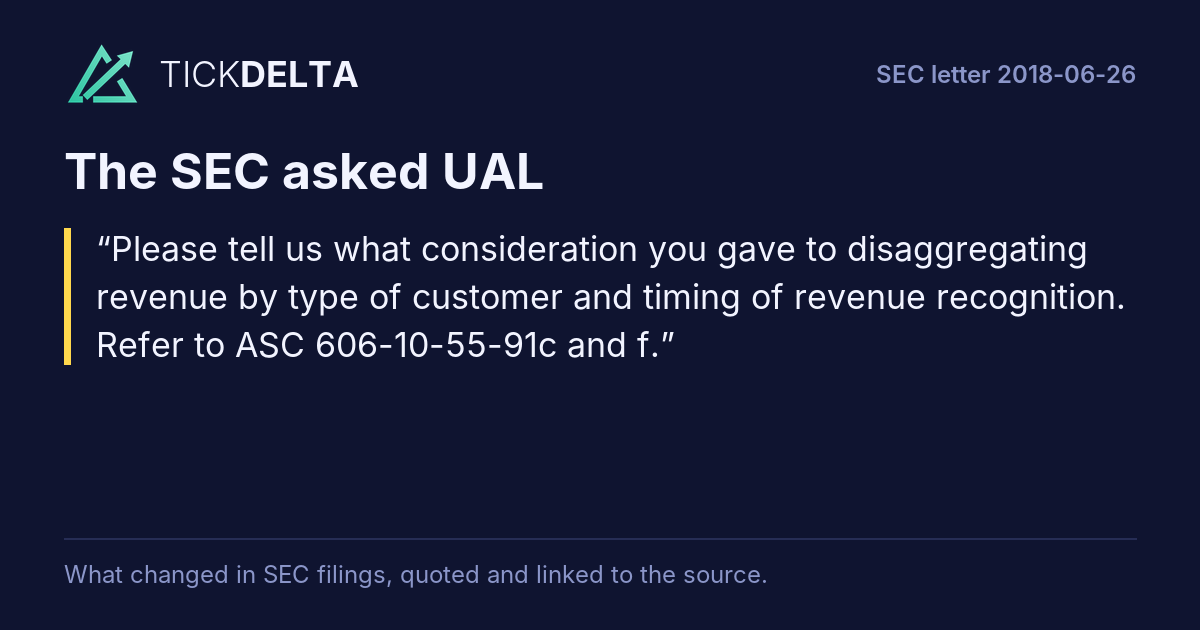
Please tell us what consideration you gave to disaggregating revenue by type of customer and timing of revenue recognition. Refer to ASC 606-10-55-91c and f.
The Company evaluated the revenue disaggregation categories outlined in ASC 606-10-55-91c and f:
a.
Type of Customer (ASC 606-10-55-91c) - Beyond geographic regions, the Company does not have significant other customer types that are uniquely impacted differently by economic factors. The Company considered disaggregating revenue from sales to corporate customers and government customers but concluded that there are not different economic factors that affect the nature, amount, timing and uncertainty of revenues and cash flows for these types of customers, based on the following:
i.
ThereRead in the reply ↗Rest of the answer
is no difference in the method of satisfying the performance obligation amongst traveling passengers.
ii.
Government and corporate customers generally have contracts with multiple airlines thus providing their employees with the freedom to choose travel carriers. Sales to corporate and government customers would still exist even if there were no contracts as these customers would mainly use the airline based on their individual preferences.
iii.
The Company does not segregate revenue by corporate or government travel in its reports to its chief operating decision maker or within other disclosures presented outside of the financial statements.
b.
Market Segmentation (ASC 606-10-55-91c) - The Company offers varying fare levels depending on the seats and configuration of aircraft. As such fares might be sold as United Polaris, United First, United Business, United Economy or United Basic Economy. These fare levels and offerings may change from year to year depending on the Company’s strategy. The Company concluded that fare classes are not uniquely impacted differently by economic factors that would impact the nature, timing, and the uncertainty of revenue recognition and cash flows. The Company concluded that disaggregation for market segmentation is not appropriate as the Company manages its flights to maximize total revenue earned per flight rather than a particular fare class. As such, there are not different economic factors that impact these fare types in the Company’s financial statements as if they were independent offerings. Also, the Company does not segregate revenue by market segmentation in its reports to its chief operating decision maker or within other disclosures presented outside of the financial statements.
c.
Timing of Transfer of Goods or Services (ASC 606-10-55-91f) - The Company did consider disaggregating revenue based on the timing of services provided. The Company determined that materially all of its passenger ticket revenue is recognized at a point in time. Ticket revenue is recognized when the passenger flies. Miles redeemed are recognized when the frequent flyer loyalty program ("MileagePlus") member redeems them and completes the flight, consistent with passenger ticket revenue, or takes delivery of non-travel goods or services. Revenue from miles redemption is reported separately in the Company’s financial statement footnotes. Please see the response to Comment #2 and Comment #3 below for additional information related to the advertising and marketing performance obligations under the co-brand agreement, for which the revenue is recognized over the term of the agreement, as disclosed.
First report after the company's reply of 2018-06-29: 10-Q filed 2018-07-18 ↗, against the 10-Q filed 2018-04-18 ↗.
Tickdelta does not hold the text of both reports, so they are not compared here.
Please tell us whether advertising under the co-brand agreement is performed over the term of the agreement and whether there is an expected pattern of recognition.
In accordance with ASC 606-10-55-65 as interpreted by the AICPA Revenue Recognition Guide, Chapter 10 - Airlines (paragraph 10.6.61), the performance obligation(s) related to the brand elements, other marketing services, and ancillary services is (are) satisfied over time. Advertising is provided to the financial institution over the term of the co-brand agreement. As such, the Company utilizes credit card usage, when the MileagePlus members use their co-branded credit cards to make purchases, and recognize revenue in accordance with the sales or usage based exception in ASC 606-10-55-65. Read in the reply ↗
First report after the company's reply of 2018-06-29: 10-Q filed 2018-07-18 ↗, against the 10-Q filed 2018-04-18 ↗.
Tickdelta does not hold the text of both reports, so they are not compared here.
You disclose that revenue for the marketing performance obligation under the co-brand agreement is recorded to other operating revenue over the term of the co-brand agreement based on customer's use of the Mileage-Plus credit card.Rest of the question
Please tell us why recognition is based on the customer's use of the credit card and how this impacts or is expected to impact the pattern of recognition for the marketing performance obligation over the term of the agreement.
The Company determined that the predominant element in the co-brand agreement is intellectual property related to the Company’s brand and customer list (collectively referred to as the marketing performance obligation) in accordance with ASC 606-10-55-65A. In accordance with ASC 606-10-55-65, as interpreted by the AICPA Revenue Recognition Guide, Chapter 10 - Airlines (paragraphs 10.6.63 through 10.6.66), the marketing performance obligation is provided to the financial institution continuously over the term of the agreement, and royalties are generated each time the MileagePlus member usesRead in the reply ↗Rest of the answer
the co-branded credit card and therefore when the Company issues the miles to the customer. As such, the Company recognizes revenue based on the sales and usage based exception in ASC 606-10-55-65 when the MileagePlus member uses the credit card as it is the time a) the subsequent sale or usage occurs and b) the performance obligation has been partially satisfied as the Company’s obligation is satisfied continuously over the term of the agreement.
First report after the company's reply of 2018-06-29: 10-Q filed 2018-07-18 ↗, against the 10-Q filed 2018-04-18 ↗.
Tickdelta does not hold the text of both reports, so they are not compared here.
Please tell us how you account for breakage, if any, on miles sold under the co-brand agreement.
For the portion of our outstanding mileage credits that we estimate will not be redeemed, we recognize the associated value proportionally as the remaining mileage credits are redeemed in accordance with ASC 606-10-55-48. Read in the reply ↗
First report after the company's reply of 2018-06-29: 10-Q filed 2018-07-18 ↗, against the 10-Q filed 2018-04-18 ↗.
Tickdelta does not hold the text of both reports, so they are not compared here.
Please tell us who you determined the customer to be for each of the performance obligations under the co-brand agreement.
Consistent with the AICPA Revenue Recognition Guide, Chapter 10 - Airlines (paragraph 10.6.45 and 10.6.46), customers for the performance obligations under the co-brand agreement include the Company, Chase Bank USA, NA, and the Company's MileagePlus members. The financial institution is the direct customer of the Company for the sale of marketing-related elements (including marketing and advertising) and the credit card holder (MileagePlus member) is the end customer of the airline for earning the miles awarded under the Company's MileagePlus program. Read in the reply ↗
First report after the company's reply of 2018-06-29: 10-Q filed 2018-07-18 ↗, against the 10-Q filed 2018-04-18 ↗.
Tickdelta does not hold the text of both reports, so they are not compared here.
We note your response to our prior comment 2. Please revise your disclosure consistent with your response to state the timing and pattern of recognition. MD&A
We respectfully acknowledge the Staff's comment and included revised disclosure in the Form 10-Q for the quarterly period ended June 30, 2018 of UAL and United, filed with the SEC on July 18, 2018. Read in the reply ↗
First report after the company's reply of 2018-07-23: 10-Q filed 2018-10-17 ↗, against the 10-Q filed 2018-04-18 ↗.
Tickdelta does not hold the text of both reports, so they are not compared here.
We note your disclosure that other operating revenue increased $55 million primarily due to an approximately $50 million one-time payment of MileagePlus related revenue. Please tell us the nature of this one-time payment and why its receipt resulted in recognition of revenue during the quarter.
The Company received $[***] million in the first quarter of 2018 related to a [***] provision of the co-brand agreement. Similar to other consideration received under the co-brand agreement, the Company allocated the $[***] million payment across the performance obligations identified in the co-brand agreement, including MileagePlus miles awarded, marketing, advertising and other travel-related benefits. A total of $50 million was allocated to marketing, advertising and certain other travel-related benefits.Read in the reply ↗Rest of the answer
The remaining $[***] million was allocated to MileagePlus miles awarded and was deferred. The deferred portion of the payment will be recognized at the time of the related travel.
First report after the company's reply of 2018-07-23: 10-Q filed 2018-10-17 ↗, against the 10-Q filed 2018-04-18 ↗.
Tickdelta does not hold the text of both reports, so they are not compared here.
We note from your response letter dated July 23, 2018 that you received a one-time payment related to a provision of your co-brand agreement, and that you allocated this type of revenue across your performance obligations. You then describe how you defer this revenue allocated to MileagePlus award miles, but recognize up front revenue allocated to the other three performance obligation categories.Rest of the question
Please revise this disclosure to include a policy disclosure related to this type of payment.
We respectfully acknowledge the Staff's comment and will revise our disclosure in future filings, beginning with the Form 10-Q for the quarterly period ended September 30, 2018 of UAL and United, to include the following: "We account for all the payments received (including monthly and one-time payments) under the co-brand agreement by allocating them to the separately identifiable performance obligations." Additionally, we will revise our disclosure in the future to clarify when the marketing performance obligation is recognized as revenue as follows: "United’s marketing performanceRead in the reply ↗Rest of the answer
obligation is to provide Chase access to its customer list and the use of its brand. Marketing revenue is recorded in other operating revenue as miles are delivered to Chase."
First report after the company's reply of 2018-09-05: 10-Q filed 2018-10-17 ↗, against the 10-Q filed 2018-04-18 ↗.
Tickdelta does not hold the text of both reports, so they are not compared here.
On page 17 of this Form 10-Q, you indicate that under ASC 606, you identified four separately identifiable performance obligation categories in your co-brand agreement with Chase Bank, and determined revenue recognition patterns based on satisfaction of those performance obligations.Rest of the question
We note that travel-related revenue, such as revenue from MileagePlus miles awarded, bag fees, and seat upgrades is deferred and recognized in passenger revenue at the time of travel. In contrast, advertising, lounge pass revenue, and marketing revenue is recorded in other operating revenue based on various factors, such as when the lounge pass is used, or customer use pattern of the credit card over the term of the co-brand agreement. Your response to comment 2 in your letter dated July 23, 2018 indicates the $50 million relates to a cash payment received under a provision of the cobrand agreement and, similar to other consideration received under the co-brand agreement, you allocated the payment across the performance obligations identified in the co-brand agreement based on fixed percentages. The amounts related to MileagePlus miles awarded were deferred, while the $50 million allocated to marketing, advertising, and certain other travel related benefits was recognized on receipt. This recognition pattern appears to be consistent with the policy set forth in your Form 10-K, prior to adoption of ASC 606. Please tell us why you believe your recognition pattern in the first quarter complies with your recognition policy for such revenue under ASC 606.
The Company received a one-time payment under the co-brand agreement in the first quarter of 2018. The portion of that payment that related to the marketing, advertising and certain travel related benefits performance obligations was approximately $50 million. As described in the Revenue footnote on page 17 of the Form 10-Q, and in accordance with ASC 606, we allocate proceeds from the co-brand agreement to each performance obligation, and, in the case of the marketing performance obligation, we recognize revenue based on the use of the credit card (which we will clarify in future filings isRead in the reply ↗Rest of the answer
when miles are delivered to Chase which had occurred by the time this cash payment was received). The performance obligation for the advertising and other travel related benefits were also complete as of the date of the receipt of this payment. This recognition is the same as the accounting used prior to the adoption of ASC 606.
First report after the company's reply of 2018-09-05: 10-Q filed 2018-10-17 ↗, against the 10-Q filed 2018-04-18 ↗.
Tickdelta does not hold the text of both reports, so they are not compared here.
Also in this review: closing letter, 2018-09-06